wheel CHEVROLET CLASSIC 2005 Workshop Manual
[x] Cancel search | Manufacturer: CHEVROLET, Model Year: 2005, Model line: CLASSIC, Model: CHEVROLET CLASSIC 2005Pages: 320, PDF Size: 4.86 MB
Page 254 of 320
The compact spare tire is for temporary use only.
Replace the compact spare tire with a full-size tire as
soon as you can. SeeCompact Spare Tire on
page 5-70.
Compact Spare Tire
Although the compact spare tire was fully inflated when
the vehicle was new, it can lose air after a time.
Check the inflation pressure regularly. It should be
60 psi (420 kPa).
After installing the compact spare on the vehicle, stop
as soon as possible and make sure the spare tire
is correctly inflated. The compact spare is made to
perform well at speeds up to 65 mph (105 km/h)
for distances up to 3,000 miles (5 000 km), so you can
finish your trip and have the full-size tire repaired or
replaced at your convenience. Of course, it is best
to replace the spare with a full-size tire as soon as
possible. The spare tire will last longer and be in good
shape in case it is needed again.Notice:When the compact spare is installed, do
not take your vehicle through an automatic car wash
with guide rails. The compact spare can get
caught on the rails. That can damage the tire and
wheel, and maybe other parts of your vehicle.
Do not use the compact spare on other vehicles.
And do not mix the compact spare tire or wheel with
other wheels or tires. They will not fit. Keep the
spare tire and its wheel together.
Notice:Tire chains will not t your compact spare.
Using them can damage your vehicle and can
damage the chains too. Do not use tire chains on
your compact spare.
5-70
Page 259 of 320
Exterior painted surfaces are subject to aging, weather,
and chemical fallout that can take their toll over a
period of years. To help keep the paint finish looking
new, keep the vehicle in a garage or covered whenever
possible.
Windshield and Wiper Blades
If the windshield is not clear after using the windshield
washer, or if the wiper blade chatters when running,
wax, sap, or other material may be on the blade
or windshield.
Clean the outside of the windshield with a glass
cleaning liquid or powder and water solution. The
windshield is clean if beads do not form when it is rinsed
with water.
Grime from the windshield will stick to the wiper blades
and affect their performance. Clean the blade by
wiping vigorously with a cloth soaked in full-strength
windshield washer solvent. Then rinse the blade
with water.
Check the wiper blades and clean them as necessary;
replace blades that look worn.
Aluminum Wheels
Notice:If you use strong soaps, chemicals,
abrasive polishes, cleaners, brushes, or cleaners
that contain acid on aluminum or chrome-plated
wheels, you could damage the surface of the
wheel(s). The repairs would not be covered by your
warranty. Use only GM-approved cleaners on
aluminum or chrome-plated wheels.
Keep the wheels clean using a soft clean cloth with mild
soap and water. Rinse with clean water. After rinsing
thoroughly, dry with a soft clean towel. A wax may then
be applied.
Notice:Using chrome polish on aluminum wheels
could damage the wheels. The repairs would not
be covered by your warranty. Use chrome polish on
chrome wheels only.
The surface of these wheels is similar to the painted
surface of the vehicle. Do not use strong soaps,
chemicals, abrasive polishes, abrasive cleaners,
cleaners with acid, or abrasive cleaning brushes on
them because the surface could be damaged. Do not
use chrome polish on aluminum wheels.
5-75
Page 260 of 320
Notice:If you drive your vehicle through an
automatic car wash that has silicone carbide tire
cleaning brushes, you could damage the aluminum
or chrome-plated wheels. The repairs would not
be covered by your warranty. Never drive a vehicle
equipped with aluminum or chrome-plated wheels
through an automatic car wash that uses silicone
carbide tire cleaning brushes.
Do not take the vehicle through an automatic car wash
that has silicone carbide tire cleaning brushes. These
brushes can also damage the surface of these wheels.
Tires
To clean the tires, use a stiff brush with tire cleaner.
Notice:Using petroleum-based tire dressing
products on your vehicle may damage the paint
nish and/or tires. When applying a tire dressing,
always wipe off any overspray from all painted
surfaces on your vehicle.
Sheet Metal Damage
If the vehicle is damaged and requires sheet metal
repair or replacement, make sure the body repair shop
applies anti-corrosion material to parts repaired or
replaced to restore corrosion protection.
Original manufacturer replacement parts will provide the
corrosion protection while maintaining the warranty.
Finish Damage
Any stone chips, fractures or deep scratches in the
finish should be repaired right away. Bare metal
will corrode quickly and may develop into major repair
expense.
Minor chips and scratches can be repaired with touch-up
materials available from your GM dealer. Larger areas
of finish damage can be corrected in your GM
dealer’s body and paint shop.
Underbody Maintenance
Chemicals used for ice and snow removal and dust
control can collect on the underbody. If these are not
removed, corrosion and rust can develop on the
underbody parts such as fuel lines, frame, floor pan,
and exhaust system even though they have corrosion
protection.
At least every spring, flush these materials from the
underbody with plain water. Clean any areas where mud
and debris can collect. Dirt packed in close areas of
the frame should be loosened before being flushed.
Your dealer or an underbody car washing system can
do this for you.
5-76
Page 261 of 320

Chemical Paint Spotting
Some weather and atmospheric conditions can create a
chemical fallout. Airborne pollutants can fall upon and
attack painted surfaces on the vehicle. This damage can
take two forms: blotchy, ring-shaped discolorations,
and small, irregular dark spots etched into the
paint surface.
Although no defect in the paint job causes this, GM will
repair, at no charge to the owner, the surfaces of
new vehicles damaged by this fallout condition within
12 months or 12,000 miles (20 000 km) of purchase,
whichever occurs first.
Vehicle Care/Appearance Materials
Description Usage
Polishing Cloth
Wax-TreatedInterior and exterior
polishing cloth.
Tar and Road Oil
RemoverRemoves tar, road oil
and asphalt.
Chrome Cleaner
and PolishUse on chrome or
stainless steel.
White Sidewall Tire
CleanerRemoves soil and black
marks from whitewalls.
Vinyl Cleaner Cleans vinyl.
Glass CleanerRemoves dirt, grime,
smoke and fingerprints.
Description Usage
Chrome and Wire Wheel
CleanerRemoves dirt and grime
from chrome wheels and
wire wheel covers.
Finish EnhancerRemoves dust,
fingerprints, and surface
contaminants. Spray on
wipe off.
Swirl Remover PolishRemoves swirl marks, fine
scratches and other light
surface contamination.
Cleaner WaxRemoves light scratches
and protects finish.
Foaming Tire Shine
Low GlossCleans, shines and
protects in one easy step,
no wiping necessary.
Wash Wax ConcentrateMedium foaming
shampoo. Cleans and
lightly waxes.
Biodegradable and
phosphate free.
Spot LifterQuickly and easily
removes spots and stains
from carpets, vinyl and
cloth upholstery.
Odor EliminatorOdorless spray odor
eliminator used on fabrics,
vinyl, leather and carpet.
5-77
Page 269 of 320
Capacities and Specications
The following approximate capacities are given in English and metric conversions. SeePart D: Recommended Fluids
and Lubricants on page 6-22for more information.
ApplicationCapacities
English Metric
Air Conditioning Refrigerant R134a 1.4 lbs 0.6 kg
Automatic Transaxle Complete Overhaul 9.5 qt 9.0 L
Cooling System 8.6 qt 8.2 L
Engine Oil with Filter 5.0 qt 4.7 L
Fuel Tank 14.1 gal 53.4 L
Wheel Nut Torque 100 ft lb 140Y
All capacities are approximate. When adding, be sure to fill to the appropriate level, as recommended in this
manual.
Engine Specications
Engine VIN Code Transaxle Spark Plug Gap
2.2L L4 ECOTEC
®™ F Automatic 0.042 inch (1.06 mm)
5-85
Page 291 of 320
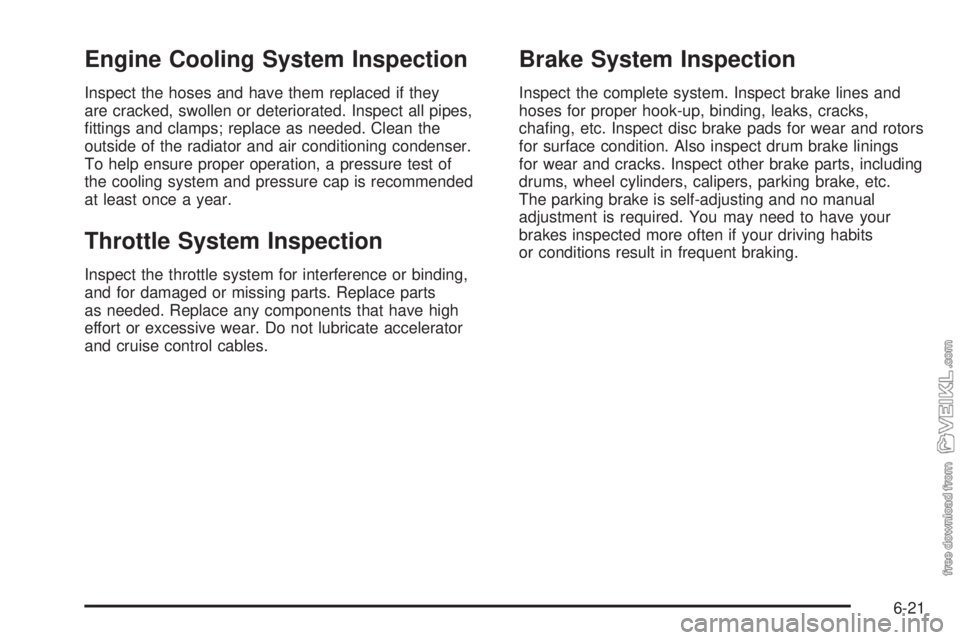
Engine Cooling System Inspection
Inspect the hoses and have them replaced if they
are cracked, swollen or deteriorated. Inspect all pipes,
fittings and clamps; replace as needed. Clean the
outside of the radiator and air conditioning condenser.
To help ensure proper operation, a pressure test of
the cooling system and pressure cap is recommended
at least once a year.
Throttle System Inspection
Inspect the throttle system for interference or binding,
and for damaged or missing parts. Replace parts
as needed. Replace any components that have high
effort or excessive wear. Do not lubricate accelerator
and cruise control cables.
Brake System Inspection
Inspect the complete system. Inspect brake lines and
hoses for proper hook-up, binding, leaks, cracks,
chafing, etc. Inspect disc brake pads for wear and rotors
for surface condition. Also inspect drum brake linings
for wear and cracks. Inspect other brake parts, including
drums, wheel cylinders, calipers, parking brake, etc.
The parking brake is self-adjusting and no manual
adjustment is required. You may need to have your
brakes inspected more often if your driving habits
or conditions result in frequent braking.
6-21
Page 301 of 320
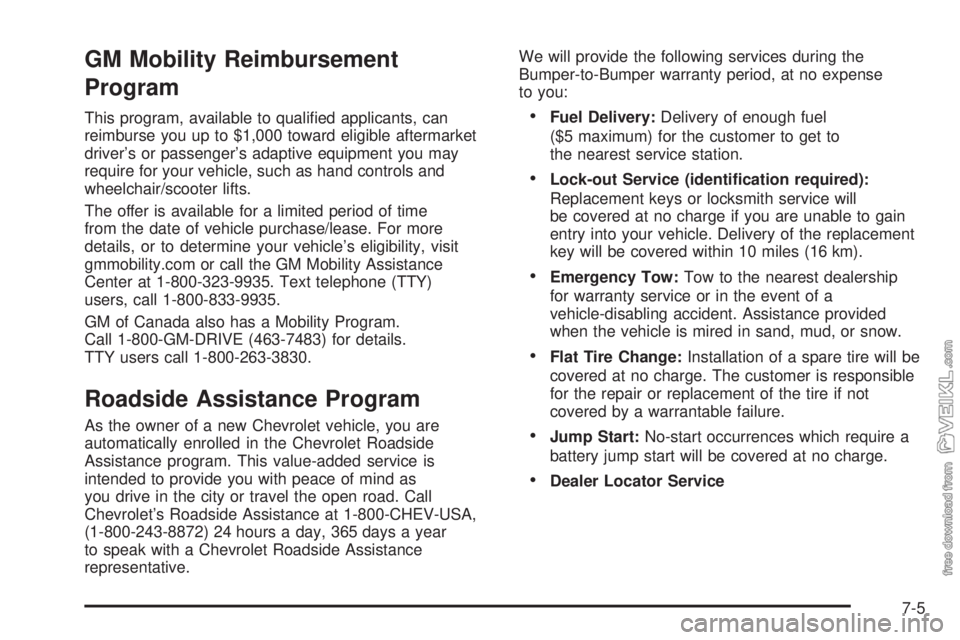
GM Mobility Reimbursement
Program
This program, available to qualified applicants, can
reimburse you up to $1,000 toward eligible aftermarket
driver’s or passenger’s adaptive equipment you may
require for your vehicle, such as hand controls and
wheelchair/scooter lifts.
The offer is available for a limited period of time
from the date of vehicle purchase/lease. For more
details, or to determine your vehicle’s eligibility, visit
gmmobility.com or call the GM Mobility Assistance
Center at 1-800-323-9935. Text telephone (TTY)
users, call 1-800-833-9935.
GM of Canada also has a Mobility Program.
Call 1-800-GM-DRIVE (463-7483) for details.
TTY users call 1-800-263-3830.
Roadside Assistance Program
As the owner of a new Chevrolet vehicle, you are
automatically enrolled in the Chevrolet Roadside
Assistance program. This value-added service is
intended to provide you with peace of mind as
you drive in the city or travel the open road. Call
Chevrolet’s Roadside Assistance at 1-800-CHEV-USA,
(1-800-243-8872) 24 hours a day, 365 days a year
to speak with a Chevrolet Roadside Assistance
representative.We will provide the following services during the
Bumper-to-Bumper warranty period, at no expense
to you:
•Fuel Delivery:Delivery of enough fuel
($5 maximum) for the customer to get to
the nearest service station.
•Lock-out Service (identication required):
Replacement keys or locksmith service will
be covered at no charge if you are unable to gain
entry into your vehicle. Delivery of the replacement
key will be covered within 10 miles (16 km).
•Emergency Tow:Tow to the nearest dealership
for warranty service or in the event of a
vehicle-disabling accident. Assistance provided
when the vehicle is mired in sand, mud, or snow.
•Flat Tire Change:Installation of a spare tire will be
covered at no charge. The customer is responsible
for the repair or replacement of the tire if not
covered by a warrantable failure.
•Jump Start:No-start occurrences which require a
battery jump start will be covered at no charge.
•Dealer Locator Service
7-5
Page 305 of 320
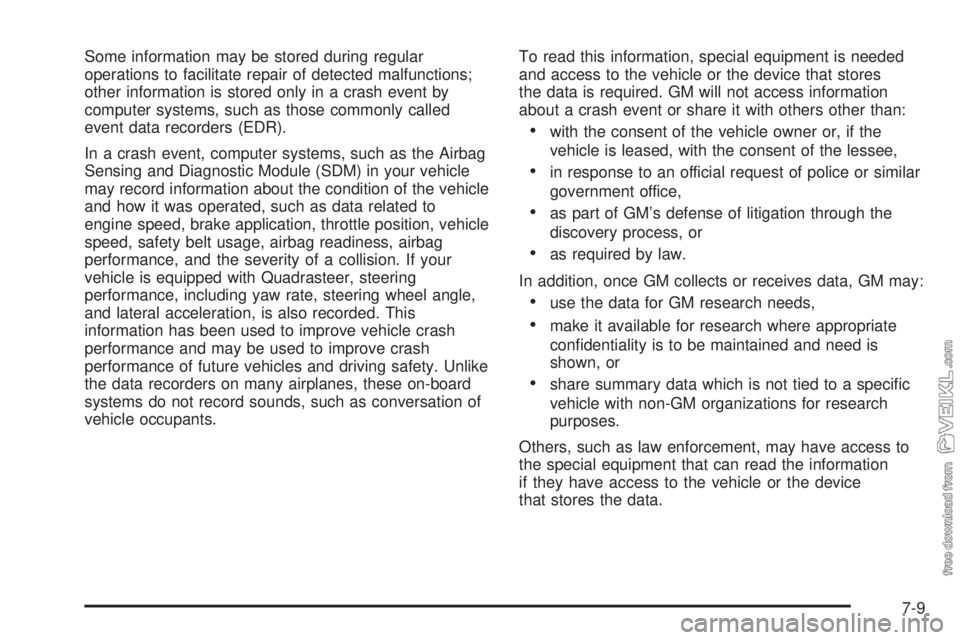
Some information may be stored during regular
operations to facilitate repair of detected malfunctions;
other information is stored only in a crash event by
computer systems, such as those commonly called
event data recorders (EDR).
In a crash event, computer systems, such as the Airbag
Sensing and Diagnostic Module (SDM) in your vehicle
may record information about the condition of the vehicle
and how it was operated, such as data related to
engine speed, brake application, throttle position, vehicle
speed, safety belt usage, airbag readiness, airbag
performance, and the severity of a collision. If your
vehicle is equipped with Quadrasteer, steering
performance, including yaw rate, steering wheel angle,
and lateral acceleration, is also recorded. This
information has been used to improve vehicle crash
performance and may be used to improve crash
performance of future vehicles and driving safety. Unlike
the data recorders on many airplanes, these on-board
systems do not record sounds, such as conversation of
vehicle occupants.To read this information, special equipment is needed
and access to the vehicle or the device that stores
the data is required. GM will not access information
about a crash event or share it with others other than:
•with the consent of the vehicle owner or, if the
vehicle is leased, with the consent of the lessee,
•in response to an official request of police or similar
government office,
•as part of GM’s defense of litigation through the
discovery process, or
•as required by law.
In addition, once GM collects or receives data, GM may:
•use the data for GM research needs,
•make it available for research where appropriate
confidentiality is to be maintained and need is
shown, or
•share summary data which is not tied to a specific
vehicle with non-GM organizations for research
purposes.
Others, such as law enforcement, may have access to
the special equipment that can read the information
if they have access to the vehicle or the device
that stores the data.
7-9
Page 309 of 320
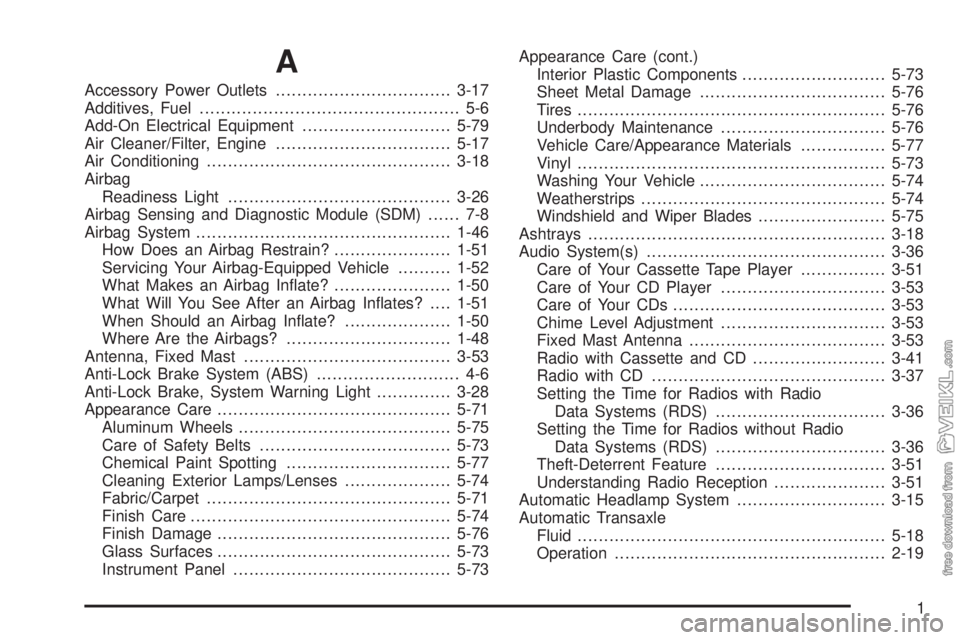
A
Accessory Power Outlets.................................3-17
Additives, Fuel................................................. 5-6
Add-On Electrical Equipment............................5-79
Air Cleaner/Filter, Engine.................................5-17
Air Conditioning..............................................3-18
Airbag
Readiness Light..........................................3-26
Airbag Sensing and Diagnostic Module (SDM)...... 7-8
Airbag System................................................1-46
How Does an Airbag Restrain?......................1-51
Servicing Your Airbag-Equipped Vehicle..........1-52
What Makes an Airbag Inflate?......................1-50
What Will You See After an Airbag Inflates?....1-51
When Should an Airbag Inflate?....................1-50
Where Are the Airbags?...............................1-48
Antenna, Fixed Mast.......................................3-53
Anti-Lock Brake System (ABS)........................... 4-6
Anti-Lock Brake, System Warning Light..............3-28
Appearance Care............................................5-71
Aluminum Wheels........................................5-75
Care of Safety Belts....................................5-73
Chemical Paint Spotting...............................5-77
Cleaning Exterior Lamps/Lenses....................5-74
Fabric/Carpet..............................................5-71
Finish Care.................................................5-74
Finish Damage............................................5-76
Glass Surfaces............................................5-73
Instrument Panel.........................................5-73Appearance Care (cont.)
Interior Plastic Components...........................5-73
Sheet Metal Damage...................................5-76
Tires..........................................................5-76
Underbody Maintenance...............................5-76
Vehicle Care/Appearance Materials................5-77
Vinyl..........................................................5-73
Washing Your Vehicle...................................5-74
Weatherstrips..............................................5-74
Windshield and Wiper Blades........................5-75
Ashtrays........................................................3-18
Audio System(s).............................................3-36
Care of Your Cassette Tape Player................3-51
Care of Your CD Player...............................3-53
Care of Your CDs........................................3-53
Chime Level Adjustment...............................3-53
Fixed Mast Antenna.....................................3-53
Radio with Cassette and CD.........................3-41
Radio with CD............................................3-37
Setting the Time for Radios with Radio
Data Systems (RDS)................................3-36
Setting the Time for Radios without Radio
Data Systems (RDS)................................3-36
Theft-Deterrent Feature................................3-51
Understanding Radio Reception.....................3-51
Automatic Headlamp System............................3-15
Automatic Transaxle
Fluid..........................................................5-18
Operation...................................................2-19
1
Page 311 of 320
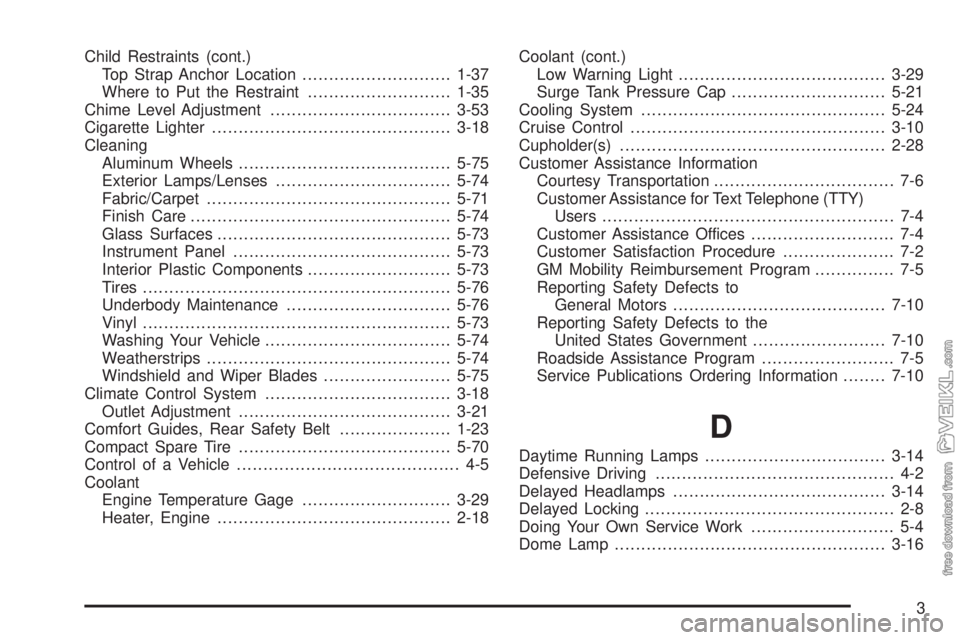
Child Restraints (cont.)
Top Strap Anchor Location............................1-37
Where to Put the Restraint...........................1-35
Chime Level Adjustment..................................3-53
Cigarette Lighter.............................................3-18
Cleaning
Aluminum Wheels........................................5-75
Exterior Lamps/Lenses.................................5-74
Fabric/Carpet..............................................5-71
Finish Care.................................................5-74
Glass Surfaces............................................5-73
Instrument Panel.........................................5-73
Interior Plastic Components...........................5-73
Tires..........................................................5-76
Underbody Maintenance...............................5-76
Vinyl..........................................................5-73
Washing Your Vehicle...................................5-74
Weatherstrips..............................................5-74
Windshield and Wiper Blades........................5-75
Climate Control System...................................3-18
Outlet Adjustment........................................3-21
Comfort Guides, Rear Safety Belt.....................1-23
Compact Spare Tire........................................5-70
Control of a Vehicle.......................................... 4-5
Coolant
Engine Temperature Gage............................3-29
Heater, Engine............................................2-18Coolant (cont.)
Low Warning Light.......................................3-29
Surge Tank Pressure Cap.............................5-21
Cooling System..............................................5-24
Cruise Control................................................3-10
Cupholder(s)..................................................2-28
Customer Assistance Information
Courtesy Transportation.................................. 7-6
Customer Assistance for Text Telephone (TTY)
Users....................................................... 7-4
Customer Assistance Offices........................... 7-4
Customer Satisfaction Procedure..................... 7-2
GM Mobility Reimbursement Program............... 7-5
Reporting Safety Defects to
General Motors........................................7-10
Reporting Safety Defects to the
United States Government.........................7-10
Roadside Assistance Program......................... 7-5
Service Publications Ordering Information........7-10
D
Daytime Running Lamps..................................3-14
Defensive Driving............................................. 4-2
Delayed Headlamps........................................3-14
Delayed Locking............................................... 2-8
Doing Your Own Service Work........................... 5-4
Dome Lamp...................................................3-16
3