child lock CHEVROLET CLASSIC 2005 Owners Manual
[x] Cancel search | Manufacturer: CHEVROLET, Model Year: 2005, Model line: CLASSIC, Model: CHEVROLET CLASSIC 2005Pages: 320, PDF Size: 4.86 MB
Page 1 of 320
Seats and Restraint Systems........................... 1-1
Front Seats
............................................... 1-2
Safety Belts
.............................................. 1-6
Child Restraints
.......................................1-26
Airbag System
.........................................1-46
Restraint System Check
............................1-52
Features and Controls..................................... 2-1
Keys
........................................................ 2-2
Doors and Locks
....................................... 2-7
Windows
.................................................2-13
Theft-Deterrent Systems
............................2-15
Starting and Operating Your Vehicle
...........2-15
Mirrors
....................................................2-27
Storage Areas
.........................................2-28
Instrument Panel............................................. 3-1
Instrument Panel Overview
.......................... 3-4
Climate Controls
......................................3-18
Warning Lights, Gages, and Indicators
........3-22
Audio System(s)
.......................................3-36
Driving Your Vehicle....................................... 4-1
Your Driving, the Road, and Your Vehicle
..... 4-2
Towing
...................................................4-32Service and Appearance Care.......................... 5-1
Service
..................................................... 5-3
Fuel
......................................................... 5-5
Checking Things Under the Hood
...............5-10
Bulb Replacement
....................................5-40
Windshield Wiper Blade Replacement
.........5-46
Tires
......................................................5-47
Appearance Care
.....................................5-71
Vehicle Identification
.................................5-78
Electrical System
......................................5-79
Capacities and Specifications
.....................5-85
Normal Maintenance Replacement Parts
......5-86
Maintenance Schedule..................................... 6-1
Maintenance Schedule
................................ 6-2
Customer Assistance and Information.............. 7-1
Customer Assistance and Information
........... 7-2
Reporting Safety Defects
...........................7-10
Index................................................................ 1
2005 Chevrolet Classic Owner ManualM
Page 17 of 320
Q:If I am a good driver, and I never drive far from
home, why should I wear safety belts?
A:You may be an excellent driver, but if you are in an
accident — even one that is not your fault — you
and your passengers can be hurt. Being a good
driver does not protect you from things beyond your
control, such as bad drivers.
Most accidents occur within 25 miles (40 km)
of home. And the greatest number of serious
injuries and deaths occur at speeds of less
than 40 mph (65 km/h).
Safety belts are for everyone.
How to Wear Safety Belts Properly
This part is only for people of adult size.
Be aware that there are special things to know about
safety belts and children. And there are different
rules for smaller children and babies. If a child will be
riding in your vehicle, seeOlder Children on page 1-26
orInfants and Young Children on page 1-28. Follow
those rules for everyone’s protection.
First, you will want to know which restraint systems your
vehicle has.
We will start with the driver position.
Driver Position
Lap-Shoulder Belt
The driver has a lap-shoulder belt. Here is how to wear
it properly.
1. Close and lock the door.
2. Adjust the seat so you can sit up straight. To see
how, see “Seats” in the Index.
1-11
Page 25 of 320
Right Front Passenger Position
To learn how to wear the right front passenger’s safety
belt properly, seeDriver Position on page 1-11.
The right front passenger’s safety belt works the same
way as the driver’s safety belt — except for one
thing. If you ever pull the shoulder portion of the belt out
all the way, you will engage the child restraint locking
feature. If this happens, just let the belt go back all
the way and start again.
Rear Seat Passengers
It is very important for rear seat passengers to buckle
up! Accident statistics show that unbelted people in
the rear seat are hurt more often in crashes than those
who are wearing safety belts.
Rear passengers who are not safety belted can be
thrown out of the vehicle in a crash. And they can strike
others in the vehicle who are wearing safety belts.
Rear Seat Outside Passenger Positions
Lap-Shoulder Belt
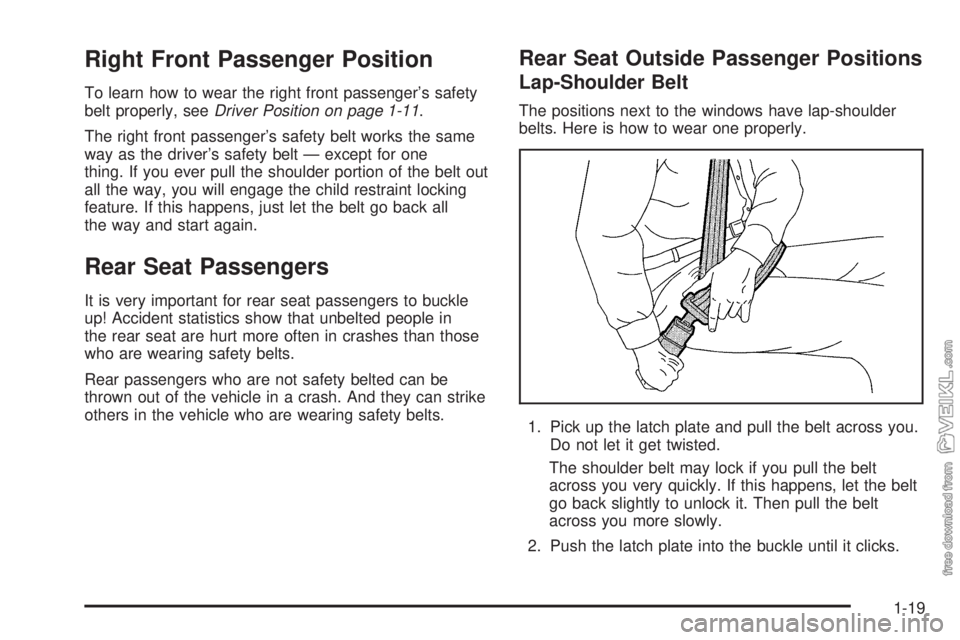
The positions next to the windows have lap-shoulder
belts. Here is how to wear one properly.
1. Pick up the latch plate and pull the belt across you.
Do not let it get twisted.
The shoulder belt may lock if you pull the belt
across you very quickly. If this happens, let the belt
go back slightly to unlock it. Then pull the belt
across you more slowly.
2. Push the latch plate into the buckle until it clicks.
1-19
Page 67 of 320
Doors and Locks
Door Locks
{CAUTION:
Unlocked doors can be dangerous.
Passengers — especially children — can
easily open the doors and fall out of a
moving vehicle. When a door is locked, the
handle will not open it. You increase the
chance of being thrown out of the vehicle
in a crash if the doors are not locked. So,
wear safety belts properly and lock the
doors whenever you drive.
Young children who get into unlocked
vehicles may be unable to get out. A child
can be overcome by extreme heat and can
suffer permanent injuries or even death
from heat stroke. Always lock your vehicle
whenever you leave it.
Outsiders can easily enter through an
unlocked door when you slow down or
stop your vehicle. Locking your doors can
help prevent this from happening.There are several ways to lock and unlock your vehicle.
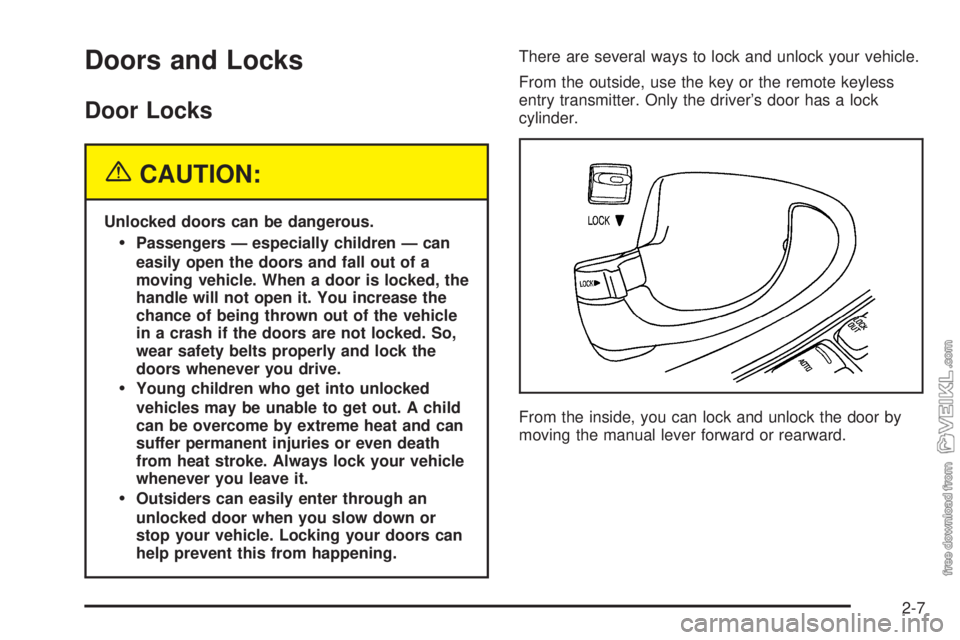
From the outside, use the key or the remote keyless
entry transmitter. Only the driver’s door has a lock
cylinder.
From the inside, you can lock and unlock the door by
moving the manual lever forward or rearward.
2-7
Page 70 of 320
Rear Door Security Locks
Your vehicle has rear door security locks that help
prevent passengers from opening the rear doors of
your vehicle from the inside.
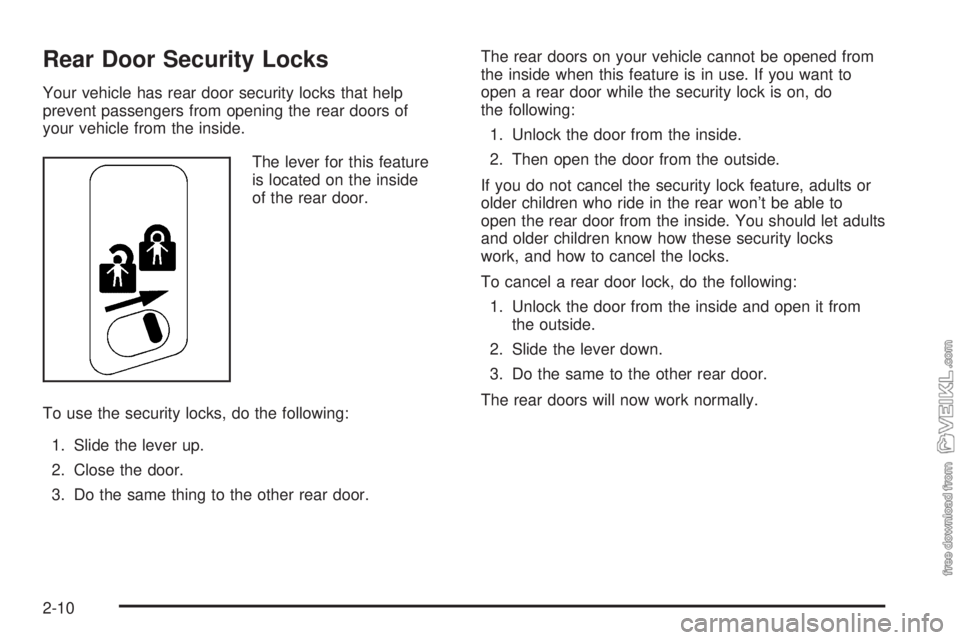
The lever for this feature
is located on the inside
of the rear door.
To use the security locks, do the following:
1. Slide the lever up.
2. Close the door.
3. Do the same thing to the other rear door.The rear doors on your vehicle cannot be opened from
the inside when this feature is in use. If you want to
open a rear door while the security lock is on, do
the following:
1. Unlock the door from the inside.
2. Then open the door from the outside.
If you do not cancel the security lock feature, adults or
older children who ride in the rear won’t be able to
open the rear door from the inside. You should let adults
and older children know how these security locks
work, and how to cancel the locks.
To cancel a rear door lock, do the following:
1. Unlock the door from the inside and open it from
the outside.
2. Slide the lever down.
3. Do the same to the other rear door.
The rear doors will now work normally.
2-10
Page 151 of 320
If you need to reduce your speed as you approach a
curve, do it before you enter the curve, while your front
wheels are straight ahead.
Try to adjust your speed so you can “drive” through the
curve. Maintain a reasonable, steady speed. Wait to
accelerate until you are out of the curve, and then
accelerate gently into the straightaway.
Steering in Emergencies
There are times when steering can be more effective
than braking. For example, you come over a hill and find
a truck stopped in your lane, or a car suddenly pulls
out from nowhere, or a child darts out from between
parked cars and stops right in front of you. You
can avoid these problems by braking — if you can stop
in time. But sometimes you cannot; there is not room.
That is the time for evasive action — steering around
the problem.
Your vehicle can perform very well in emergencies like
these. First apply your brakes — but, unless you
have anti-lock, not enough to lock your wheels.
SeeBraking on page 4-5. It is better to remove as
much speed as you can from a possible collision. Then
steer around the problem, to the left or right depending
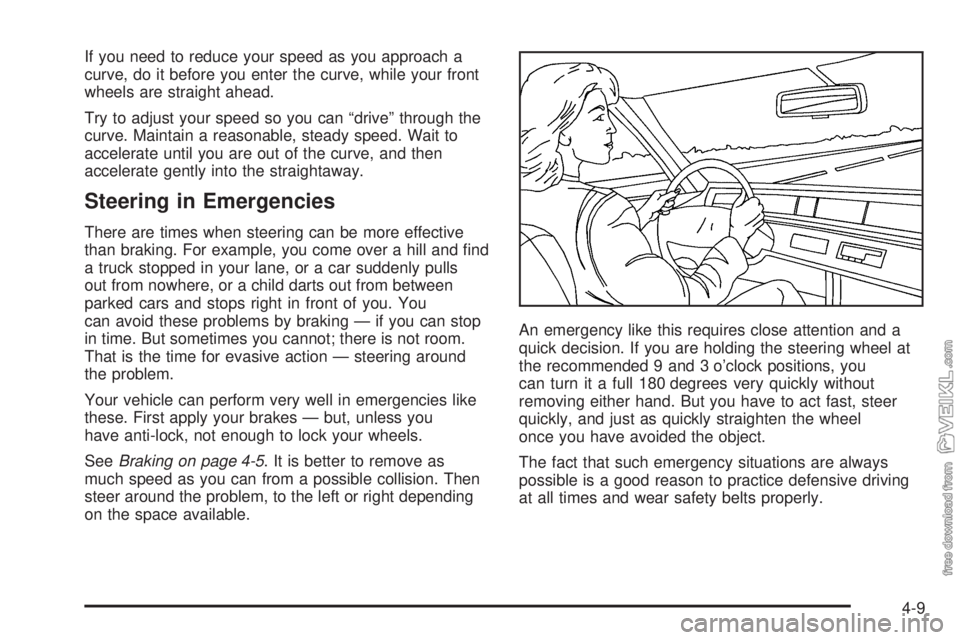
on the space available.An emergency like this requires close attention and a
quick decision. If you are holding the steering wheel at
the recommended 9 and 3 o’clock positions, you
can turn it a full 180 degrees very quickly without
removing either hand. But you have to act fast, steer
quickly, and just as quickly straighten the wheel
once you have avoided the object.
The fact that such emergency situations are always
possible is a good reason to practice defensive driving
at all times and wear safety belts properly.
4-9
Page 191 of 320
Filling the Tank
{CAUTION:
Fuel vapor burns violently and a fuel re can
cause bad injuries. To help avoid injuries to
you and others, read and follow all the
instructions on the pump island. Turn off
your engine when you are refueling. Do not
smoke if you are near fuel or refueling your
vehicle. Keep sparks, ames, and smoking
materials away from fuel. Do not leave the
fuel pump unattended when refueling your
vehicle — this is against the law in some
places. Keep children away from the fuel
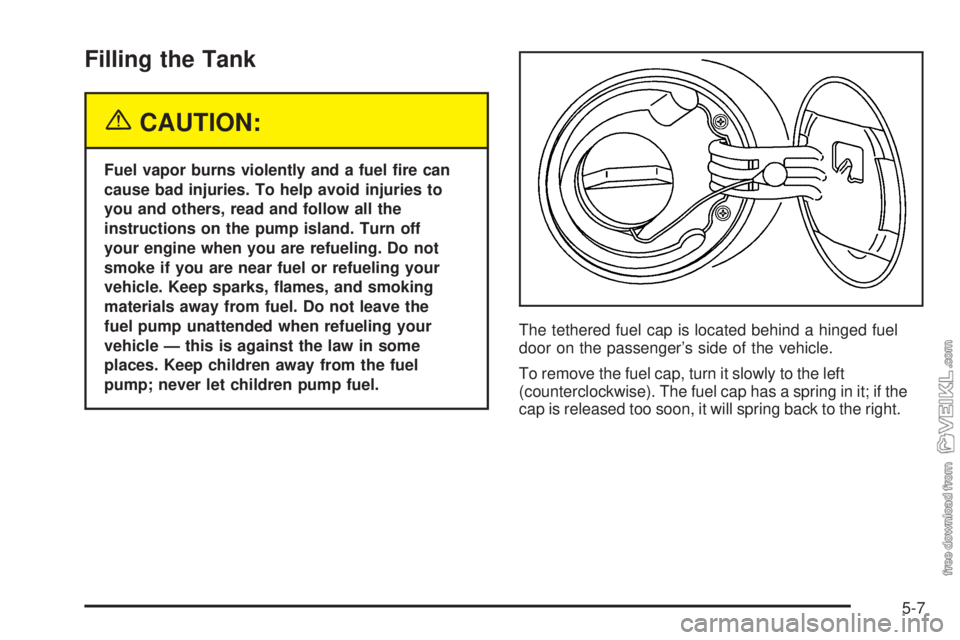
pump; never let children pump fuel.The tethered fuel cap is located behind a hinged fuel
door on the passenger’s side of the vehicle.
To remove the fuel cap, turn it slowly to the left
(counterclockwise). The fuel cap has a spring in it; if the
cap is released too soon, it will spring back to the right.
5-7
Page 310 of 320
B
Battery..........................................................5-34
Run-Down Protection...................................3-16
Before Leaving on a Long Trip.........................4-19
Brake
Anti-Lock Brake System (ABS)........................ 4-6
Emergencies................................................ 4-7
Parking......................................................2-22
System Inspection.......................................6-21
System Warning Light..................................3-27
Brakes..........................................................5-31
Braking........................................................... 4-5
Braking in Emergencies..................................... 4-7
Break-In, New Vehicle.....................................2-15
Bulb Replacement...........................................5-40
Center High-Mounted Stoplamp (CHMSL)........5-42
Front Turn Signal Lamps..............................5-42
Halogen Bulbs............................................5-40
Headlamps.................................................5-40
Replacement Bulbs......................................5-45
Taillamps, Turn Signal, Stoplamps and
Back-up Lamps........................................5-43
Buying New Tires...........................................5-56
C
California Fuel.................................................. 5-5
Capacities and Specifications............................5-85
Carbon Monoxide...................2-11, 2-25, 4-22, 4-35Care of
Safety Belts................................................5-73
Your Cassette Tape Player............................3-51
Your CD Player...........................................3-53
Your CDs ...................................................3-53
Center Console Storage Area...........................2-28
Center High-Mounted Stoplamp (CHMSL)...........5-42
Center Rear Passenger Position,
Safety Belts................................................1-22
Chains, Tire...................................................5-59
Charging System Light....................................3-27
Check
Engine Light...............................................3-30
Checking Things Under the Hood......................5-10
Chemical Paint Spotting...................................5-77
Child Restraints
Child Restraint Systems...............................1-32
Infants and Young Children...........................1-28
Lower Anchorages and Top Tethers for
Children (LATCH System)..........................1-38
Older Children.............................................1-26
Securing a Child Restraint Designed for
the LATCH System...................................1-40
Securing a Child Restraint in a Center
Rear Seat Position...................................1-42
Securing a Child Restraint in a Rear
Outside Seat Position...............................1-40
Securing a Child Restraint in the Right
Front Seat Position...................................1-44
Top Strap...................................................1-36
2
Page 311 of 320
Child Restraints (cont.)
Top Strap Anchor Location............................1-37
Where to Put the Restraint...........................1-35
Chime Level Adjustment..................................3-53
Cigarette Lighter.............................................3-18
Cleaning
Aluminum Wheels........................................5-75
Exterior Lamps/Lenses.................................5-74
Fabric/Carpet..............................................5-71
Finish Care.................................................5-74
Glass Surfaces............................................5-73
Instrument Panel.........................................5-73
Interior Plastic Components...........................5-73
Tires..........................................................5-76
Underbody Maintenance...............................5-76
Vinyl..........................................................5-73
Washing Your Vehicle...................................5-74
Weatherstrips..............................................5-74
Windshield and Wiper Blades........................5-75
Climate Control System...................................3-18
Outlet Adjustment........................................3-21
Comfort Guides, Rear Safety Belt.....................1-23
Compact Spare Tire........................................5-70
Control of a Vehicle.......................................... 4-5
Coolant
Engine Temperature Gage............................3-29
Heater, Engine............................................2-18Coolant (cont.)
Low Warning Light.......................................3-29
Surge Tank Pressure Cap.............................5-21
Cooling System..............................................5-24
Cruise Control................................................3-10
Cupholder(s)..................................................2-28
Customer Assistance Information
Courtesy Transportation.................................. 7-6
Customer Assistance for Text Telephone (TTY)
Users....................................................... 7-4
Customer Assistance Offices........................... 7-4
Customer Satisfaction Procedure..................... 7-2
GM Mobility Reimbursement Program............... 7-5
Reporting Safety Defects to
General Motors........................................7-10
Reporting Safety Defects to the
United States Government.........................7-10
Roadside Assistance Program......................... 7-5
Service Publications Ordering Information........7-10
D
Daytime Running Lamps..................................3-14
Defensive Driving............................................. 4-2
Delayed Headlamps........................................3-14
Delayed Locking............................................... 2-8
Doing Your Own Service Work........................... 5-4
Dome Lamp...................................................3-16
3
Page 314 of 320
Horn............................................................... 3-6
How to Use This Manual...................................... ii
How to Wear Safety Belts Properly...................1-11
I
Ignition Positions.............................................2-16
Infants and Young Children, Restraints...............1-28
Inflation -- Tire Pressure..................................5-53
Inspection
Brake System.............................................6-21
Engine Cooling System................................6-21
Exhaust System..........................................6-20
Fuel System...............................................6-20
Part C - Periodic Maintenance.......................6-20
Steering, Suspension and Front Drive
Axle Boot and Seal..................................6-20
Throttle System...........................................6-21
Instrument Panel
Overview..................................................... 3-4
Instrument Panel (I/P)
Brightness..................................................3-16
Cluster.......................................................3-23
J
Jump Starting.................................................5-34
K
Keyless Entry System....................................... 2-3
Keys............................................................... 2-2
L
Labelling, Tire Sidewall....................................5-48
Lamps
Battery Run-Down Protection.........................3-16
Dome........................................................3-16
Trunk.........................................................3-16
LATCH System
Child Restraints...........................................1-38
Securing a Child Restraint Designed for
the LATCH System...................................1-40
Light
Airbag Readiness........................................3-26
Anti-Lock Brake System Warning...................3-28
Brake System Warning.................................3-27
6