cruise control CHEVROLET CLASSIC 2005 Owners Manual
[x] Cancel search | Manufacturer: CHEVROLET, Model Year: 2005, Model line: CLASSIC, Model: CHEVROLET CLASSIC 2005Pages: 320, PDF Size: 4.86 MB
Page 89 of 320
Instrument Panel Overview...............................3-4
Hazard Warning Flashers................................3-6
Other Warning Devices...................................3-6
Horn.............................................................3-6
Tilt Wheel.....................................................3-6
Turn Signal/Multifunction Lever.........................3-7
Turn and Lane-Change Signals........................3-8
Headlamp High/Low-Beam Changer..................3-8
Flash-to-Pass.................................................3-8
Windshield Washer.........................................3-9
Windshield Wiper Lever...................................3-9
Cruise Control..............................................3-10
Headlamps..................................................3-13
Headlamps on Reminder................................3-14
Headlamps Off in PARK (P)...........................3-14
Delayed Headlamps......................................3-14
Daytime Running Lamps (DRL).......................3-14
Automatic Headlamp System..........................3-15
Instrument Panel Brightness...........................3-16
Dome Lamp.................................................3-16
Entry/Exit Lighting.........................................3-16
Trunk Lamp.................................................3-16
Battery Run-Down Protection..........................3-16
Accessory Power Outlets...............................3-17
Ashtrays and Cigarette Lighter........................3-18Climate Controls............................................3-18
Climate Control System.................................3-18
Outlet Adjustment.........................................3-21
Warning Lights, Gages, and Indicators............3-22
Instrument Panel Cluster................................3-23
Speedometer and Odometer...........................3-24
Trip Odometer..............................................3-24
Tachometer.................................................3-25
Safety Belt Reminder Light.............................3-25
Airbag Readiness Light..................................3-26
Charging System Light..................................3-27
Brake System Warning Light..........................3-27
Anti-Lock Brake System Warning Light.............3-28
Engine Coolant Temperature Gage..................3-29
Low Coolant Warning Light............................3-29
Malfunction Indicator Lamp.............................3-30
Oil Pressure Light.........................................3-32
Passlock
®Warning Light................................3-33
Highbeam On Light.......................................3-34
Low Washer Fluid Warning Light.....................3-34
Door Ajar Light.............................................3-34
Service Vehicle Soon Light............................3-34
Fuel Gage...................................................3-35
Section 3 Instrument Panel
3-1
Page 93 of 320
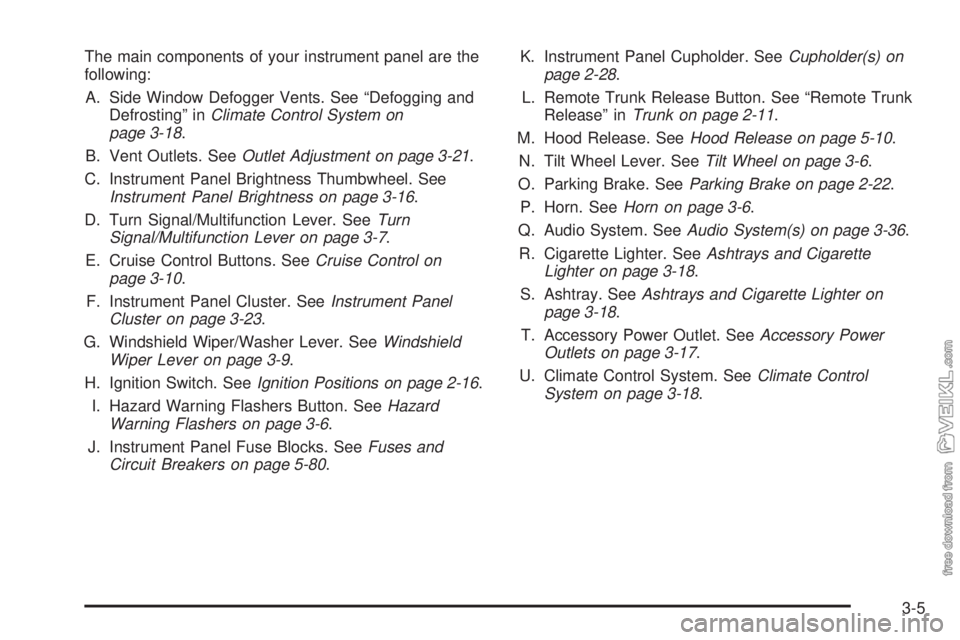
The main components of your instrument panel are the
following:
A. Side Window Defogger Vents. See “Defogging and
Defrosting” inClimate Control System on
page 3-18.
B. Vent Outlets. SeeOutlet Adjustment on page 3-21.
C. Instrument Panel Brightness Thumbwheel. See
Instrument Panel Brightness on page 3-16.
D. Turn Signal/Multifunction Lever. SeeTurn
Signal/Multifunction Lever on page 3-7.
E. Cruise Control Buttons. SeeCruise Control on
page 3-10.
F. Instrument Panel Cluster. SeeInstrument Panel
Cluster on page 3-23.
G. Windshield Wiper/Washer Lever. SeeWindshield
Wiper Lever on page 3-9.
H. Ignition Switch. SeeIgnition Positions on page 2-16.
I. Hazard Warning Flashers Button. SeeHazard
Warning Flashers on page 3-6.
J. Instrument Panel Fuse Blocks. SeeFuses and
Circuit Breakers on page 5-80.K. Instrument Panel Cupholder. SeeCupholder(s) on
page 2-28.
L. Remote Trunk Release Button. See “Remote Trunk
Release” inTrunk on page 2-11.
M. Hood Release. SeeHood Release on page 5-10.
N. Tilt Wheel Lever. SeeTilt Wheel on page 3-6.
O. Parking Brake. SeeParking Brake on page 2-22.
P. Horn. SeeHorn on page 3-6.
Q. Audio System. SeeAudio System(s) on page 3-36.
R. Cigarette Lighter. SeeAshtrays and Cigarette
Lighter on page 3-18.
S. Ashtray. SeeAshtrays and Cigarette Lighter on
page 3-18.
T. Accessory Power Outlet. SeeAccessory Power
Outlets on page 3-17.
U. Climate Control System. SeeClimate Control
System on page 3-18.
3-5
Page 98 of 320
HI (High Speed):Move the lever up to the second
setting past INT, for wiping at high speed.
MIST:Move the lever all the way down to MIST for a
single wiping cycle. Hold it there until the windshield
wipers start; then let go. The windshield wipers will
stop after one wipe. If you want more wipes, hold the
band on mist longer.
Remember that damaged wiper blades may prevent
you from seeing well enough to drive safely. To avoid
damage, be sure to clear ice and snow from the
wiper blades before using them.
If they are frozen to the windshield, carefully loosen or
thaw them. If your blades do become damaged, get
new blades or blade inserts.
Heavy snow or ice can overload your wiper motor.
A circuit breaker will stop the motor until it cools.
Clear away snow or ice to prevent an overload.Cruise Control
With cruise control, you can maintain a speed of about
25 mph (40 km/h) or more without keeping your foot
on the accelerator. This can really help on long
trips. Cruise control does not work at speeds below
25 mph (40 km/h).
{CAUTION:
Cruise control can be dangerous where you
cannot drive safely at a steady speed. So, do
not use your cruise control on winding roads
or in heavy traffic.
Cruise control can be dangerous on slippery
roads. On such roads, fast changes in tire
traction can cause needless wheel spinning,
and you could lose control. Do not use cruise
control on slippery roads.
3-10
Page 99 of 320
Setting Cruise Control
{CAUTION:
If you leave your cruise control on when you
are not using cruise, you might hit a button
and go into cruise when you do not want to.
You could be startled and even lose control.
Keep the cruise control switch off until you
want to use cruise control.
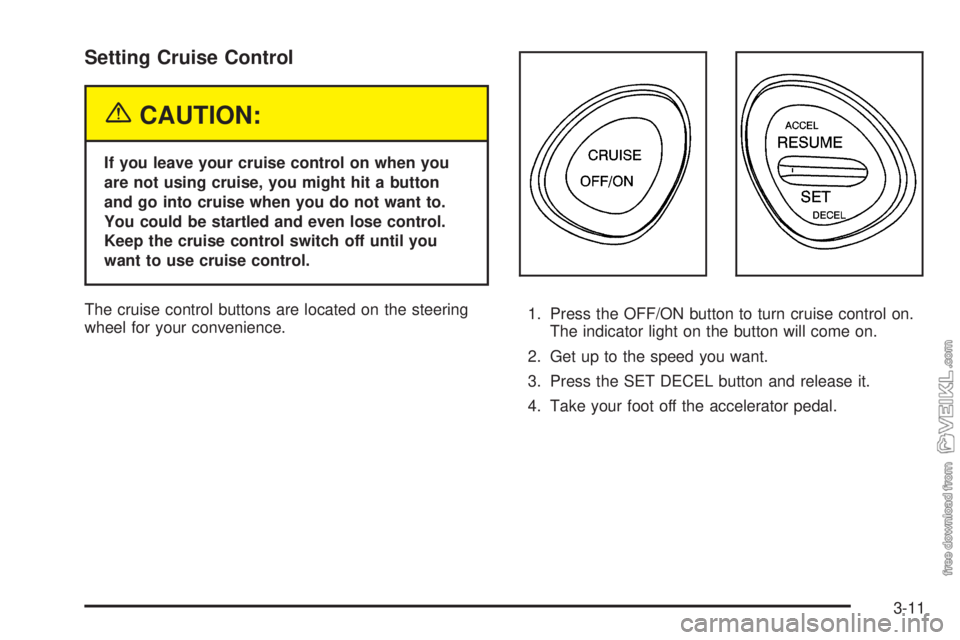
The cruise control buttons are located on the steering
wheel for your convenience.1. Press the OFF/ON button to turn cruise control on.
The indicator light on the button will come on.
2. Get up to the speed you want.
3. Press the SET DECEL button and release it.
4. Take your foot off the accelerator pedal.
3-11
Page 100 of 320
Resuming a Set Speed
Suppose you set your cruise control at a desired
speed and then you apply the brake. This shuts off the
cruise control. But you do not need to reset it. Once
you are going about 25 mph (40 km/h) or more, you
can press the cruise control ACCEL RESUME button
briefly. You will go right back up to your chosen
speed and stay there.
If you press the ACCEL RESUME button briefly, the
vehicle will keep going faster until you release the switch
or apply the brake. So unless you want to go faster,
do not hold down the ACCEL RESUME button.
Increasing Speed While Using Cruise
Control
There are two ways to go to a higher speed.
•Use the accelerator pedal to get to the higher
speed. Press the SET DECEL button, then release
the button and the accelerator pedal. You will
now cruise at the higher speed.
•Press the ACCEL RESUME button. Hold it there until
you get up to the speed you want, and then release
the button. To increase your speed in very small
amounts, press the ACCEL RESUME button briefly
and then release it. Each time you do this, your
vehicle will go about 1 mph (1.6 km/h) faster.The accelerate feature will only work after you turn on
the cruise control by pressing the SET DECEL button.
Reducing Speed While Using Cruise
Control
There are two ways to reduce your speed while using
cruise control:
•Press the SET DECEL button until you reach the
lower speed you want, then release it.
•To slow down in very small amounts, press the
SET DECEL button briefly. Each time you do
this, you will go about 1 mph (1.6 km/h) slower.
Passing Another Vehicle While Using
Cruise Control
Use the accelerator pedal to increase your speed.
When you take your foot off the pedal, your vehicle will
slow down to the cruise control speed you set earlier.
3-12
Page 101 of 320
Using Cruise Control on Hills
How well your cruise control will work on hills depends
upon your speed, load and the steepness of the
hills. When going up steep hills, you may have to
step on the accelerator pedal to maintain your speed.
When going downhill, you may have to brake or shift to
a lower gear to keep your speed down. Applying the
brake takes you out of cruise control. Many drivers find
this to be too much trouble and do not use cruise
control on steep hills.
Ending Cruise Control
There are two ways to turn off the cruise control:
•Step lightly on the brake pedal;
•Press the OFF/ON button.
Erasing Speed Memory
When you turn off the cruise control or the ignition,
your cruise control set speed memory is erased.
Headlamps
The lever on the left side of the steering column
operates the exterior lamps.
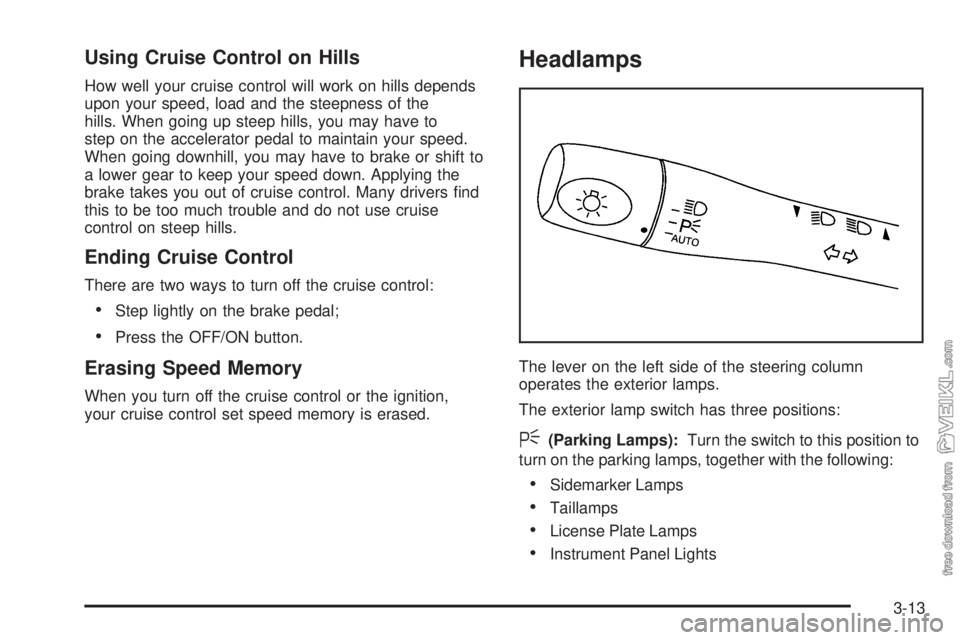
The exterior lamp switch has three positions:
<(Parking Lamps):Turn the switch to this position to
turn on the parking lamps, together with the following:
•Sidemarker Lamps
•Taillamps
•License Plate Lamps
•Instrument Panel Lights
3-13
Page 266 of 320
Passenger’s Side
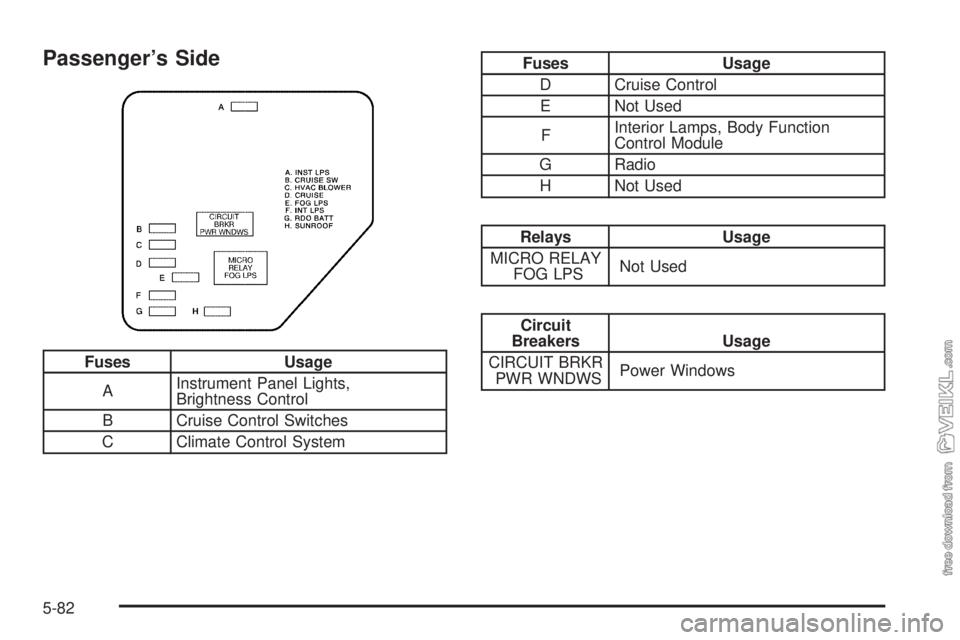
Fuses Usage
AInstrument Panel Lights,
Brightness Control
B Cruise Control Switches
C Climate Control System
Fuses Usage
D Cruise Control
E Not Used
FInterior Lamps, Body Function
Control Module
G Radio
H Not Used
Relays Usage
MICRO RELAY
FOG LPSNot Used
Circuit
Breakers Usage
CIRCUIT BRKR
PWR WNDWSPower Windows
5-82
Page 291 of 320
Engine Cooling System Inspection
Inspect the hoses and have them replaced if they
are cracked, swollen or deteriorated. Inspect all pipes,
fittings and clamps; replace as needed. Clean the
outside of the radiator and air conditioning condenser.
To help ensure proper operation, a pressure test of
the cooling system and pressure cap is recommended
at least once a year.
Throttle System Inspection
Inspect the throttle system for interference or binding,
and for damaged or missing parts. Replace parts
as needed. Replace any components that have high
effort or excessive wear. Do not lubricate accelerator
and cruise control cables.
Brake System Inspection
Inspect the complete system. Inspect brake lines and
hoses for proper hook-up, binding, leaks, cracks,
chafing, etc. Inspect disc brake pads for wear and rotors
for surface condition. Also inspect drum brake linings
for wear and cracks. Inspect other brake parts, including
drums, wheel cylinders, calipers, parking brake, etc.
The parking brake is self-adjusting and no manual
adjustment is required. You may need to have your
brakes inspected more often if your driving habits
or conditions result in frequent braking.
6-21
Page 311 of 320
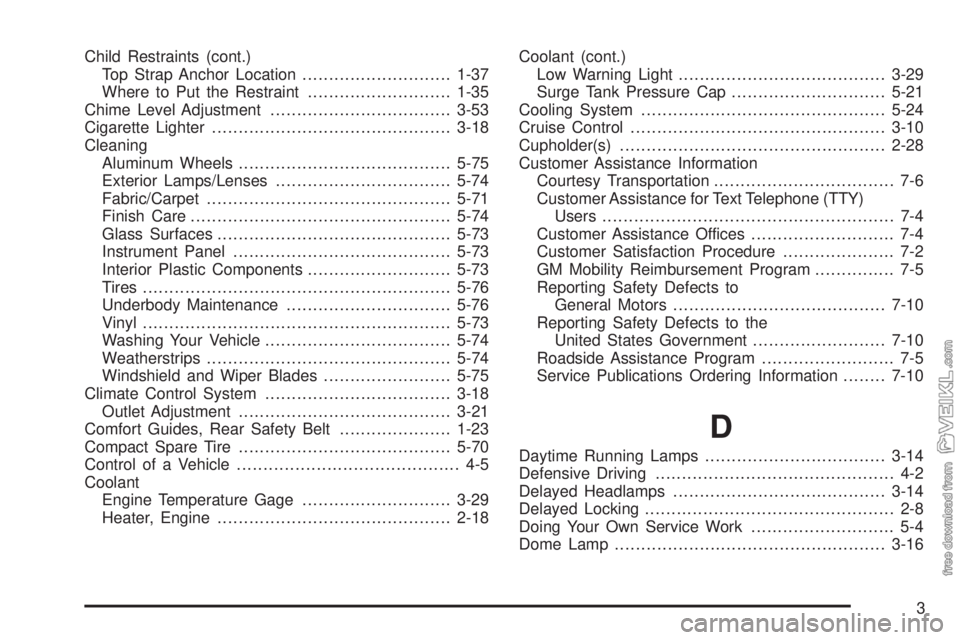
Child Restraints (cont.)
Top Strap Anchor Location............................1-37
Where to Put the Restraint...........................1-35
Chime Level Adjustment..................................3-53
Cigarette Lighter.............................................3-18
Cleaning
Aluminum Wheels........................................5-75
Exterior Lamps/Lenses.................................5-74
Fabric/Carpet..............................................5-71
Finish Care.................................................5-74
Glass Surfaces............................................5-73
Instrument Panel.........................................5-73
Interior Plastic Components...........................5-73
Tires..........................................................5-76
Underbody Maintenance...............................5-76
Vinyl..........................................................5-73
Washing Your Vehicle...................................5-74
Weatherstrips..............................................5-74
Windshield and Wiper Blades........................5-75
Climate Control System...................................3-18
Outlet Adjustment........................................3-21
Comfort Guides, Rear Safety Belt.....................1-23
Compact Spare Tire........................................5-70
Control of a Vehicle.......................................... 4-5
Coolant
Engine Temperature Gage............................3-29
Heater, Engine............................................2-18Coolant (cont.)
Low Warning Light.......................................3-29
Surge Tank Pressure Cap.............................5-21
Cooling System..............................................5-24
Cruise Control................................................3-10
Cupholder(s)..................................................2-28
Customer Assistance Information
Courtesy Transportation.................................. 7-6
Customer Assistance for Text Telephone (TTY)
Users....................................................... 7-4
Customer Assistance Offices........................... 7-4
Customer Satisfaction Procedure..................... 7-2
GM Mobility Reimbursement Program............... 7-5
Reporting Safety Defects to
General Motors........................................7-10
Reporting Safety Defects to the
United States Government.........................7-10
Roadside Assistance Program......................... 7-5
Service Publications Ordering Information........7-10
D
Daytime Running Lamps..................................3-14
Defensive Driving............................................. 4-2
Delayed Headlamps........................................3-14
Delayed Locking............................................... 2-8
Doing Your Own Service Work........................... 5-4
Dome Lamp...................................................3-16
3