lock CHEVROLET COBALT 2007 1.G Owners Manual
[x] Cancel search | Manufacturer: CHEVROLET, Model Year: 2007, Model line: COBALT, Model: CHEVROLET COBALT 2007 1.GPages: 450, PDF Size: 2.48 MB
Page 291 of 450
A. Engine Air Cleaner/Filter. SeeEngine
Air Cleaner/Filter on page 300.
B. Engine Oil Fill Cap. See “When to Add
Engine Oil” underEngine Oil on page 293.
C. Engine Oil Dipstick (Out of View).
See “Checking Engine Oil” under
Engine Oil on page 293.
D. Brake Master Cylinder Reservoir. See “Brake
Fluid” underBrakes on page 318andHydraulic
Clutch on page 302.
E. Engine Compartment Fuse Block. SeeEngine
Compartment Fuse Block on page 386.F. Remote Positive (+) Terminal. SeeJump
Starting on page 322.
G. Remote Negative (−) Terminal. SeeJump
Starting on page 322.
H. Engine Coolant Surge Tank. SeeCooling
System on page 311.
I. Windshield Washer Fluid Reservoir.
See “Adding Washer Fluid” underWindshield
Washer Fluid on page 317.
291
Page 293 of 450
A. Windshield Washer Fluid Reservoir. See
“Adding Washer Fluid” underWindshield
Washer Fluid on page 317.
B. Engine Oil Dipstick. See “Checking Engine Oil”
underEngine Oil on page 293.
C. Engine Oil Fill Cap. See “When to Add Engine
Oil” underEngine Oil on page 293.
D. Intercooler System Pressure Cap. SeeEngine
Coolant on page 302.
E. Brake Master Cylinder Reservoir. See “Brake
Fluid” underBrakes on page 318andHydraulic
Clutch on page 302.
F. Engine Compartment Fuse Block. SeeEngine
Compartment Fuse Block on page 386.
G. Remote Positive (+) Terminal. SeeJump
Starting on page 322.
H. Remote Negative (−) Terminal. SeeJump
Starting on page 322.
I. Engine Coolant Surge Tank. SeeCooling
System on page 311.
J. Engine Air Cleaner/Filter. SeeEngine
Air Cleaner/Filter on page 300.Engine Oil
Checking Engine Oil
It is a good idea to check the engine oil every time
you get fuel. In order to get an accurate reading,
the oil must be warm and the vehicle must be
on level ground.
The engine oil dipstick handle is a yellow loop.
SeeEngine Compartment Overview on page 290
for the location of the engine oil dipstick.
1. Turn off the engine and give the oil several
minutes to drain back into the oil pan. If you
do not do this, the oil dipstick might not
show the actual level.
2. Pull out the dipstick and clean it with a paper
towel or cloth, then push it back in all the
way. Remove it again, keeping the tip down,
and check the level.
293
Page 299 of 450
After changing the engine oil, the system must be
reset as follows:
1. Turn the ignition to RUN, with the engine off.
2. Press the information and reset buttons
on the DIC at the same time to enter the
personalization menu. SeeDIC Vehicle
Personalization on page 186.
3. Press the information button to scroll through
the available personalization menu modes
until the DIC display shows OIL-LIFE RESET.
4. Press and hold the reset button until the DIC
display shows ACKNOWLEDGED. This will
tell you the system has been reset.
5. Turn the key to LOCK.
If the CHANGE OIL SOON message comes back
on when you start your vehicle, the engine oil
life system has not reset. Repeat the reset
procedure.What to Do with Used Oil
Used engine oil contains certain elements that may
be unhealthy for your skin and could even cause
cancer. Do not let used oil stay on your skin for
very long. Clean your skin and nails with soap and
water, or a good hand cleaner. Wash or properly
dispose of clothing or rags containing used engine
oil. See the manufacturer’s warnings about the use
and disposal of oil products.
Used oil can be a threat to the environment. If you
change your own oil, be sure to drain all the oil from
the lter before disposal. Never dispose of oil by
putting it in the trash, pouring it on the ground, into
sewers, or into streams or bodies of water. Instead,
recycle it by taking it to a place that collects used
oil. If you have a problem properly disposing of
your used oil, ask your dealer, a service station,
or a local recycling center for help.
299
Page 308 of 450
{CAUTION:
You can be burned if you spill coolant
on hot engine parts. Coolant contains
ethylene glycol, and it will burn if the
engine parts are hot enough. Do not spill
coolant on a hot engine.
1. You can remove the ll neck pressure cap
when the intercooler system, including the
upper intercooler hose, is no longer hot.
Turn the pressure cap slowly counterclockwise
about one-quarter of a turn. If you hear a
hiss, wait for that to stop. This will allow any
remaining pressure to be vented.
2. Then keep turning the pressure cap slowly,
and remove it.3. Add the proper DEX-COOL
®coolant mixture
to the ll neck, until there is coolant visible in
the horizontal tube section of the ll neck.
4. With the ll neck pressure cap off, start the
engine and let it run for at least 30 seconds.
Watch out for the engine cooling fan. Turn the
engine off. By this time, the coolant level inside
the ll neck may be lower. If the level drops so
that coolant is no longer visible in the horizontal
tube section of the ll neck, add more of the
DEX-COOL
®coolant mixture to the ll neck
until the level is again visible in the horizontal
tube section.
5. Replace the intercooler system pressure cap.
Be sure the pressure cap is hand-tight and
fully seated.
If the coolant is not at the proper level when
the system cools down again, see your dealer.
308
Page 315 of 450
{CAUTION:
You can be burned if you spill coolant
on hot engine parts. Coolant contains
ethylene glycol and it will burn if the
engine parts are hot enough. Do not
spill coolant on a hot engine.
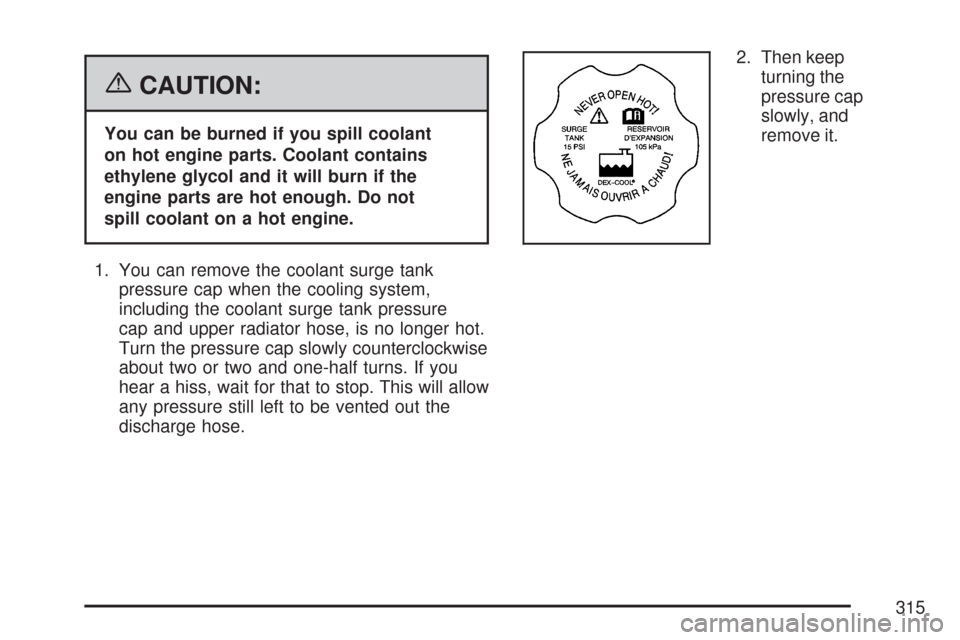
1. You can remove the coolant surge tank
pressure cap when the cooling system,
including the coolant surge tank pressure
cap and upper radiator hose, is no longer hot.
Turn the pressure cap slowly counterclockwise
about two or two and one-half turns. If you
hear a hiss, wait for that to stop. This will allow
any pressure still left to be vented out the
discharge hose.2. Then keep
turning the
pressure cap
slowly, and
remove it.
315
Page 324 of 450
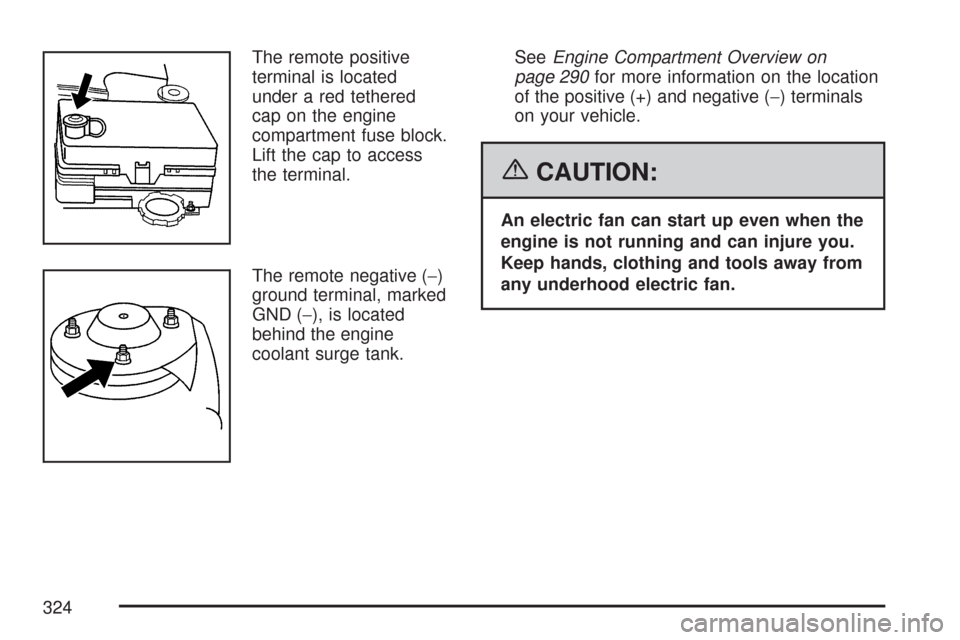
The remote positive
terminal is located
under a red tethered
cap on the engine
compartment fuse block.
Lift the cap to access
the terminal.
The remote negative (−)
ground terminal, marked
GND (−), is located
behind the engine
coolant surge tank.SeeEngine Compartment Overview on
page 290for more information on the location
of the positive (+) and negative (−) terminals
on your vehicle.
{CAUTION:
An electric fan can start up even when the
engine is not running and can injure you.
Keep hands, clothing and tools away from
any underhood electric fan.
324
Page 330 of 450
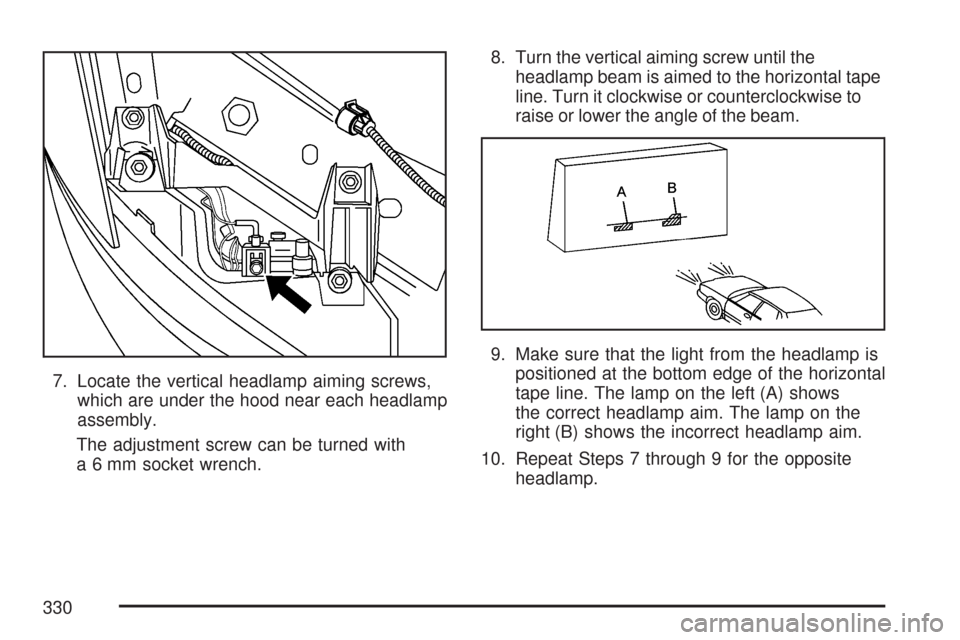
7. Locate the vertical headlamp aiming screws,
which are under the hood near each headlamp
assembly.
The adjustment screw can be turned with
a 6 mm socket wrench.8. Turn the vertical aiming screw until the
headlamp beam is aimed to the horizontal tape
line. Turn it clockwise or counterclockwise to
raise or lower the angle of the beam.
9. Make sure that the light from the headlamp is
positioned at the bottom edge of the horizontal
tape line. The lamp on the left (A) shows
the correct headlamp aim. The lamp on the
right (B) shows the incorrect headlamp aim.
10. Repeat Steps 7 through 9 for the opposite
headlamp.
330
Page 332 of 450
To replace one of these bulbs:
1. Open the hood. SeeHood Release on
page 289for more information.
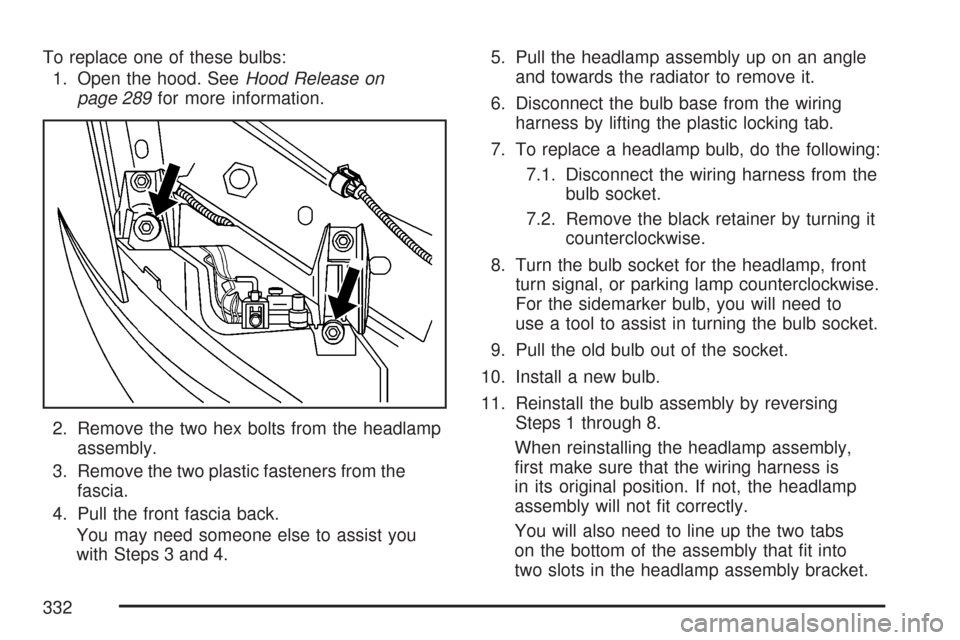
2. Remove the two hex bolts from the headlamp
assembly.
3. Remove the two plastic fasteners from the
fascia.
4. Pull the front fascia back.
You may need someone else to assist you
with Steps 3 and 4.5. Pull the headlamp assembly up on an angle
and towards the radiator to remove it.
6. Disconnect the bulb base from the wiring
harness by lifting the plastic locking tab.
7. To replace a headlamp bulb, do the following:
7.1. Disconnect the wiring harness from the
bulb socket.
7.2. Remove the black retainer by turning it
counterclockwise.
8. Turn the bulb socket for the headlamp, front
turn signal, or parking lamp counterclockwise.
For the sidemarker bulb, you will need to
use a tool to assist in turning the bulb socket.
9. Pull the old bulb out of the socket.
10. Install a new bulb.
11. Reinstall the bulb assembly by reversing
Steps 1 through 8.
When reinstalling the headlamp assembly,
rst make sure that the wiring harness is
in its original position. If not, the headlamp
assembly will not t correctly.
You will also need to line up the two tabs
on the bottom of the assembly that t into
two slots in the headlamp assembly bracket.
332
Page 334 of 450
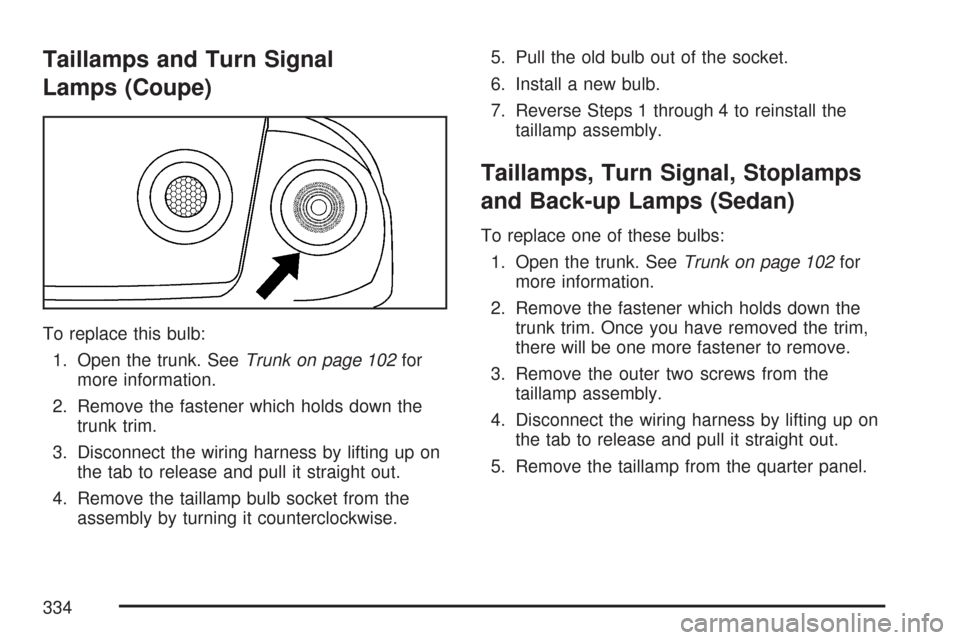
Taillamps and Turn Signal
Lamps (Coupe)
To replace this bulb:
1. Open the trunk. SeeTrunk on page 102for
more information.
2. Remove the fastener which holds down the
trunk trim.
3. Disconnect the wiring harness by lifting up on
the tab to release and pull it straight out.
4. Remove the taillamp bulb socket from the
assembly by turning it counterclockwise.5. Pull the old bulb out of the socket.
6. Install a new bulb.
7. Reverse Steps 1 through 4 to reinstall the
taillamp assembly.
Taillamps, Turn Signal, Stoplamps
and Back-up Lamps (Sedan)
To replace one of these bulbs:
1. Open the trunk. SeeTrunk on page 102for
more information.
2. Remove the fastener which holds down the
trunk trim. Once you have removed the trim,
there will be one more fastener to remove.
3. Remove the outer two screws from the
taillamp assembly.
4. Disconnect the wiring harness by lifting up on
the tab to release and pull it straight out.
5. Remove the taillamp from the quarter panel.
334
Page 335 of 450
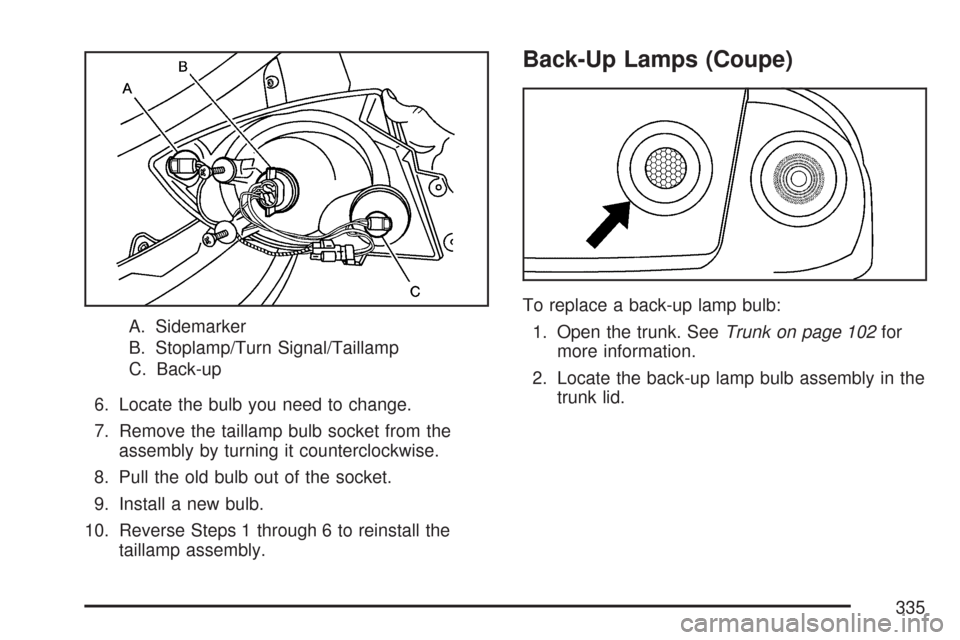
A. Sidemarker
B. Stoplamp/Turn Signal/Taillamp
C. Back-up
6. Locate the bulb you need to change.
7. Remove the taillamp bulb socket from the
assembly by turning it counterclockwise.
8. Pull the old bulb out of the socket.
9. Install a new bulb.
10. Reverse Steps 1 through 6 to reinstall the
taillamp assembly.
Back-Up Lamps (Coupe)
To replace a back-up lamp bulb:
1. Open the trunk. SeeTrunk on page 102for
more information.
2. Locate the back-up lamp bulb assembly in the
trunk lid.
335