battery CHEVROLET COBALT 2007 1.G User Guide
[x] Cancel search | Manufacturer: CHEVROLET, Model Year: 2007, Model line: COBALT, Model: CHEVROLET COBALT 2007 1.GPages: 450, PDF Size: 2.48 MB
Page 156 of 450
The battery can be discharged at idle if the
electrical loads are very high. This is true for all
vehicles. This is because the generator (alternator)
may not be spinning fast enough at idle to
produce all the power that is needed for very
high electrical loads.
A high electrical load occurs when several of the
following loads are on: headlamps, high beams,
fog lamps, rear window defogger, climate
control fan at high speed, heated seats, engine
cooling fans, trailer loads, and loads plugged into
accessory power outlets.
EPM works to prevent excessive discharge of the
battery. It does this by balancing the generator’s
output and the vehicle’s electrical needs. It can
increase engine idle speed to generate more
power, whenever needed. It can temporarily
reduce the power demands of some accessories.
Normally, these actions occur in steps or levels,
without being noticeable. In rare cases at the
highest levels of corrective action, this action
may be noticeable to the driver.Battery Run-Down Protection
Your vehicle has a battery saver feature designed
to protect the vehicle’s battery.
When any interior lamp is left on and the ignition
is turned off, the battery rundown protection
system automatically turns the lamp off after
20 minutes. This prevents draining of the battery.
Accessory Power Outlet(s)
Accessory power outlets can be used to connect
electrical equipment such as a cellular phone
or CB radio.
The accessory power outlet is located in the
center console, rearward of the shift lever.
To use the outlet, remove the cover. When not in
use, always cover the outlet with the protective cap.
Notice:Leaving electrical equipment on for
extended periods will drain the battery. Always
turn off electrical equipment when not in
use and do not plug in equipment that exceeds
the maximum amperage rating of 20 amperes.
156
Page 170 of 450
If, after several seconds, all status indicator lights
remain on, or if there are no lights at all, there
may be a problem with the lights or the passenger
sensing system. See your dealer for service.
{CAUTION:
If the off indicator and the airbag
readiness light ever come on together,
it means that something may be wrong
with the airbag system. If this ever
happens, have the vehicle serviced
promptly, because an adult-size person
sitting in the right front passenger seat
may not have the protection of the frontal
airbag. SeeAirbag Readiness Light on
page 167.
Charging System Light
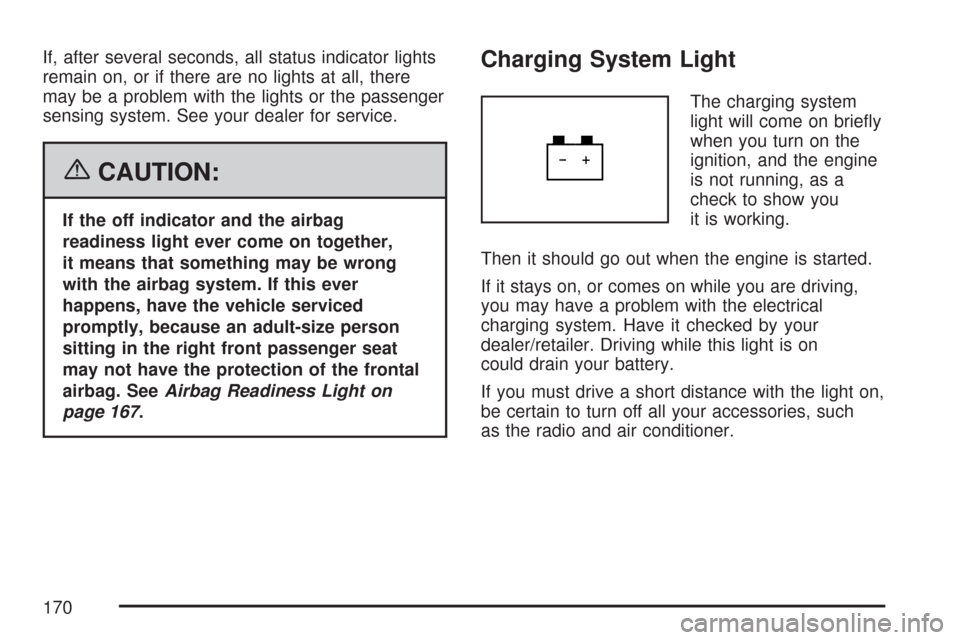
The charging system
light will come on briey
when you turn on the
ignition, and the engine
is not running, as a
check to show you
it is working.
Then it should go out when the engine is started.
If it stays on, or comes on while you are driving,
you may have a problem with the electrical
charging system. Have it checked by your
dealer/retailer. Driving while this light is on
could drain your battery.
If you must drive a short distance with the light on,
be certain to turn off all your accessories, such
as the radio and air conditioner.
170
Page 177 of 450
Have you recently changed brands of fuel?
If so, be sure to fuel your vehicle with quality fuel.
SeeGasoline Octane on page 283. Poor fuel
quality will cause your engine not to run as
efficiently as designed. You may notice this
as stalling after start-up, stalling when you put
the vehicle into gear, misring, hesitation on
acceleration, or stumbling on acceleration.
(These conditions may go away once the engine
is warmed up.) This will be detected by the
system and cause the light to turn on.
If you experience one or more of these conditions,
change the fuel brand you use. It will require at
least one full tank of the proper fuel to turn the
light off.
If none of the above steps have made the light
turn off, your dealer can check the vehicle.
Your dealer has the proper test equipment and
diagnostic tools to x any mechanical or electrical
problems that may have developed.Emissions Inspection and
Maintenance Programs
Some state/provincial and local governments have
or may begin programs to inspect the emission
control equipment on your vehicle. Failure to pass
this inspection could prevent you from getting a
vehicle registration.
Here are some things you need to know to help
your vehicle pass an inspection:
Your vehicle will not pass this inspection if the
check engine light is on or not working properly.
Your vehicle will not pass this inspection if the
OBD (on-board diagnostic) system determines that
critical emission control systems have not been
completely diagnosed by the system. The vehicle
would be considered not ready for inspection.
This can happen if you have recently replaced
your battery or if your battery has run down. The
diagnostic system is designed to evaluate critical
emission control systems during normal driving.
This may take several days of routine driving. If you
have done this and your vehicle still does not pass
the inspection for lack of OBD system readiness,
your dealer can prepare the vehicle for inspection.
177
Page 185 of 450
COOLING MODE ON
This message may display on some vehicles.
Under severe conditions, hot ambient
temperatures, steep grades, and towing, your
vehicle may experience more transaxle shifting.
This is temporary and normal under these
conditions. This does not require engine or
transaxle service.
CRUISE ENGAGED
This message displays when the cruise control
system is active. SeeCruise Control on page 149
for more information.
DOOR AJAR
This message displays if one or more of the
vehicle’s doors are not closed properly. When this
message displays, make sure that the door(s)
are closed completely.
ENGINE DISABLED
This message displays if the starting of the engine
is disabled. Have your vehicle serviced by your
dealer immediately.
ENG (Engine) PWR (Power) REDUCED
This message displays to inform you that the
vehicle has reduced engine power to avoid
damaging the engine. Reduced engine power
can affect the vehicle’s ability to accelerate.
If this message is on, but there is no reduction
in performance, proceed to your destination.
The performance may be reduced the next time
the vehicle is driven. The vehicle may be driven
at a reduced speed while this message is on, but
acceleration and speed may be reduced. Anytime
this message stays on, the vehicle should be taken
to your dealer for service as soon as possible.
ICE POSSIBLE
This message displays when the outside air
temperature is cold enough to create icy road
conditions. Adjust your driving accordingly.
KEY FOB BATT (Battery) LOW
This message displays if the Remote Keyless
Entry (RKE) transmitter battery is low. Replace
the battery in the transmitter. See “Battery
Replacement” underRemote Keyless Entry (RKE)
System Operation on page 92.
185
Page 187 of 450
To change feature settings, use the following
procedure:
Entering Personalization Menu
1. Turn the ignition on while the vehicle is
stopped.
To avoid excessive drain on the battery,
it is recommended that the headlamps are
turned off.
2. Press and hold the information and reset
buttons at the same time for one second, then
release to enter the personalization menu.
If the vehicle speed is greater than
2 mph (3 km/h), only the UNITS menu
will be accessible.
3. Press the information button to scroll through
the available personalization menu modes.
Press the reset button to scroll through
the available settings for each mode.
If you do not make a selection within
ten seconds, the display will go back to
the previous information displayed.
Personalization Menu Modes
OIL LIFE RESET
When this feature is displayed, you can reset
the engine oil life system. To reset the system,
seeEngine Oil Life System on page 298.
See “OIL LIFE” underDIC Operation and
Displays on page 181for more information.
UNITS
This feature allows you to select the units of
measurement in which the DIC will display the
vehicle information. When UNITS appears on the
display, press and hold the reset button for at
least one second to scroll through the available
settings:
ENGLISH (default in United States):All
information will be displayed in English units.
METRIC (default in Canada):All information will
be displayed in metric units.
Choose one of the available settings and press
the information button to select it and move on to
the next feature.
187
Page 257 of 450
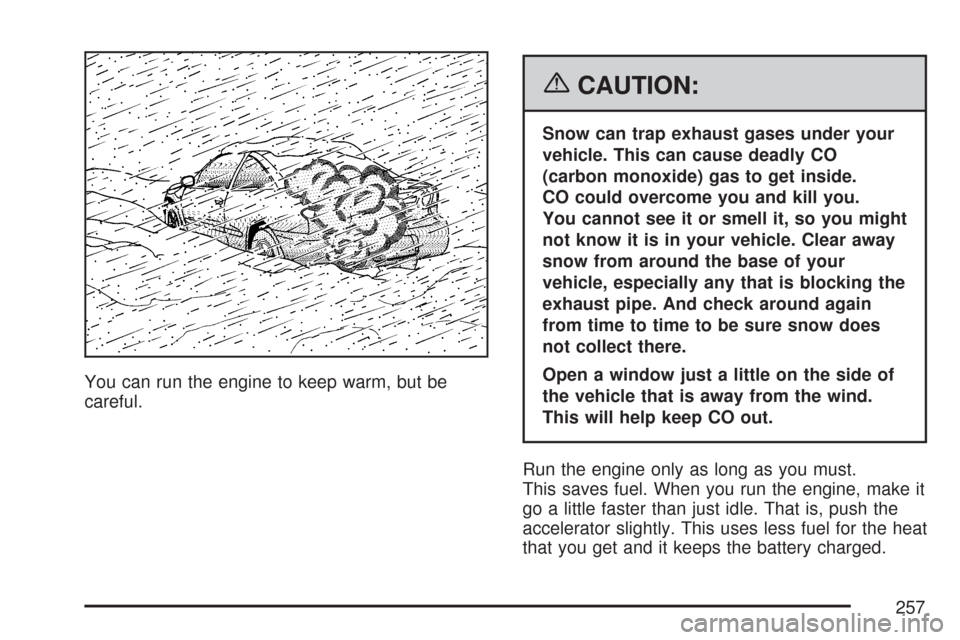
You can run the engine to keep warm, but be
careful.
{CAUTION:
Snow can trap exhaust gases under your
vehicle. This can cause deadly CO
(carbon monoxide) gas to get inside.
CO could overcome you and kill you.
You cannot see it or smell it, so you might
not know it is in your vehicle. Clear away
snow from around the base of your
vehicle, especially any that is blocking the
exhaust pipe. And check around again
from time to time to be sure snow does
not collect there.
Open a window just a little on the side of
the vehicle that is away from the wind.
This will help keep CO out.
Run the engine only as long as you must.
This saves fuel. When you run the engine, make it
go a little faster than just idle. That is, push the
accelerator slightly. This uses less fuel for the heat
that you get and it keeps the battery charged.
257
Page 258 of 450
You will need a well-charged battery to restart the
vehicle, and possibly for signaling later on with
the headlamps. Let the heater run for a while.
Then, shut the engine off and close the window
almost all the way to preserve the heat. Start the
engine again and repeat this only when you
feel really uncomfortable from the cold. But do it
as little as possible. Preserve the fuel as long
as you can. To help keep warm, you can get out
of the vehicle and do some fairly vigorous
exercises every half hour or so until help comes.
If Your Vehicle is Stuck in Sand,
Mud, Ice, or Snow
In order to free your vehicle when it is stuck,
you will need to spin the wheels, but you do not
want to spin your wheels too fast. The method
known as rocking can help you get out when you
are stuck, but you must use caution.
{CAUTION:
If you let your vehicle’s tires spin at high
speed, they can explode, and you or others
could be injured. And, the transaxle or
other parts of the vehicle can overheat.
That could cause an engine compartment
re or other damage. When you are stuck,
spin the wheels as little as possible. Do not
spin the wheels above 35 mph (55 km/h) as
shown on the speedometer.
Notice:Spinning the wheels can destroy parts
of your vehicle as well as the tires. If you spin
the wheels too fast while shifting the transaxle
back and forth, you can destroy the transaxle.
SeeRocking Your Vehicle to Get It Out on
page 259.
For information about using tire chains on your
vehicle, seeTire Chains on page 357.
258
Page 266 of 450
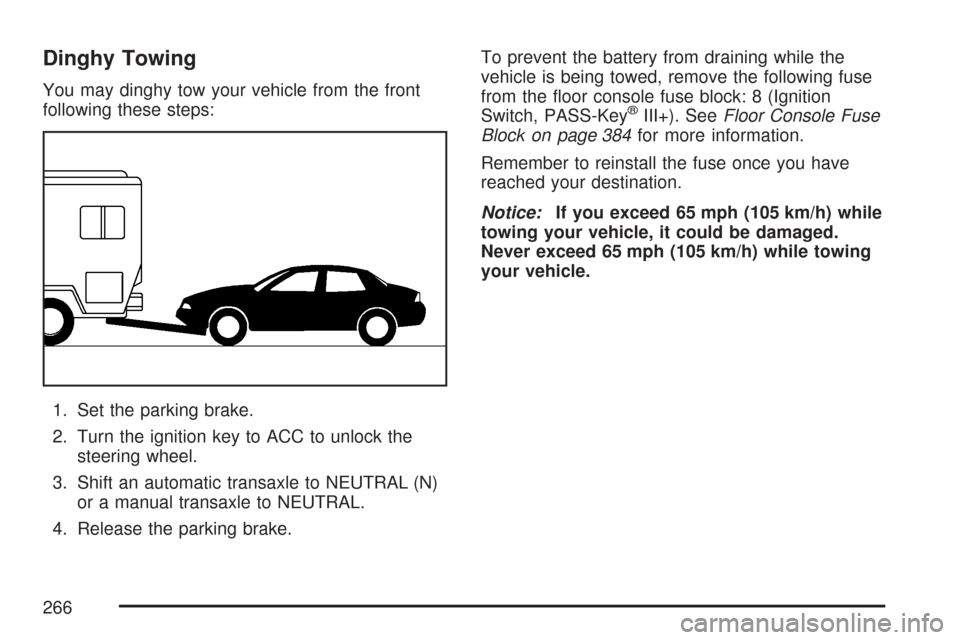
Dinghy Towing
You may dinghy tow your vehicle from the front
following these steps:
1. Set the parking brake.
2. Turn the ignition key to ACC to unlock the
steering wheel.
3. Shift an automatic transaxle to NEUTRAL (N)
or a manual transaxle to NEUTRAL.
4. Release the parking brake.To prevent the battery from draining while the
vehicle is being towed, remove the following fuse
from the oor console fuse block: 8 (Ignition
Switch, PASS-Key
®III+). SeeFloor Console Fuse
Block on page 384for more information.
Remember to reinstall the fuse once you have
reached your destination.
Notice:If you exceed 65 mph (105 km/h) while
towing your vehicle, it could be damaged.
Never exceed 65 mph (105 km/h) while towing
your vehicle.
266
Page 277 of 450
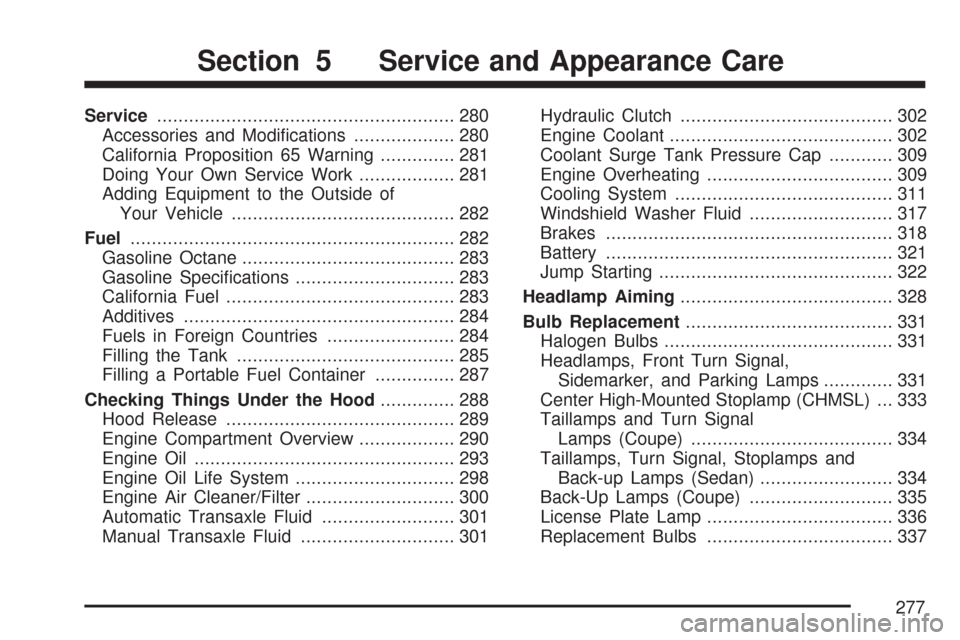
Service........................................................ 280
Accessories and Modications................... 280
California Proposition 65 Warning.............. 281
Doing Your Own Service Work.................. 281
Adding Equipment to the Outside of
Your Vehicle.......................................... 282
Fuel............................................................. 282
Gasoline Octane........................................ 283
Gasoline Specications.............................. 283
California Fuel........................................... 283
Additives................................................... 284
Fuels in Foreign Countries........................ 284
Filling the Tank......................................... 285
Filling a Portable Fuel Container............... 287
Checking Things Under the Hood.............. 288
Hood Release........................................... 289
Engine Compartment Overview.................. 290
Engine Oil................................................. 293
Engine Oil Life System.............................. 298
Engine Air Cleaner/Filter............................ 300
Automatic Transaxle Fluid......................... 301
Manual Transaxle Fluid............................. 301Hydraulic Clutch........................................ 302
Engine Coolant.......................................... 302
Coolant Surge Tank Pressure Cap............ 309
Engine Overheating................................... 309
Cooling System......................................... 311
Windshield Washer Fluid........................... 317
Brakes...................................................... 318
Battery...................................................... 321
Jump Starting............................................ 322
Headlamp Aiming........................................ 328
Bulb Replacement....................................... 331
Halogen Bulbs........................................... 331
Headlamps, Front Turn Signal,
Sidemarker, and Parking Lamps............. 331
Center High-Mounted Stoplamp (CHMSL) ... 333
Taillamps and Turn Signal
Lamps (Coupe)...................................... 334
Taillamps, Turn Signal, Stoplamps and
Back-up Lamps (Sedan)......................... 334
Back-Up Lamps (Coupe)........................... 335
License Plate Lamp................................... 336
Replacement Bulbs................................... 337
Section 5 Service and Appearance Care
277
Page 321 of 450
Brake Adjustment
Every time you make a moderate brake stop, the
disc brakes adjust for wear. If you rarely make
a moderate or heavier stop, then the brakes might
not adjust correctly. If you drive in that way,
then — very carefully — make a few moderate
brake stops about every 1,000 miles (1 600 km),
so the brakes will adjust properly.
If your vehicle has rear drum brakes and the
brake pedal goes down farther than normal,
the rear drum brakes might need adjustment.
Adjust them by backing up and rmly applying
the brakes a few times.
Replacing Brake System Parts
The braking system on a vehicle is complex.
Its many parts have to be of top quality and work
well together if the vehicle is to have really good
braking. Your vehicle was designed and tested with
top-quality brake parts. When you replace parts of
the braking system — for example, when the brake
linings wear down and you need new ones put
in — be sure you get new approved replacement
parts. If you do not, the brakes might not workproperly. For example, if someone puts in
brake linings that are wrong for your vehicle, the
balance between the front and rear brakes can
change — for the worse. The braking performance
you have come to expect can change in many other
ways if someone puts in the wrong replacement
brake parts.
Battery
Your vehicle has a maintenance free battery.
When it is time for a new battery, get one that has
the replacement number shown on the original
battery’s label. We recommend an ACDelco
®
replacement battery.
Your vehicle’s battery is located in the trunk. You
do not need to access the battery to jump start
your vehicle. SeeJump Starting on page 322.
Warning:Battery posts, terminals, and related
accessories contain lead and lead compounds,
chemicals known to the State of California
to cause cancer and reproductive harm.
Wash hands after handling.
321