ignition CHEVROLET COBALT 2007 1.G Repair Manual
[x] Cancel search | Manufacturer: CHEVROLET, Model Year: 2007, Model line: COBALT, Model: CHEVROLET COBALT 2007 1.GPages: 450, PDF Size: 2.48 MB
Page 266 of 450
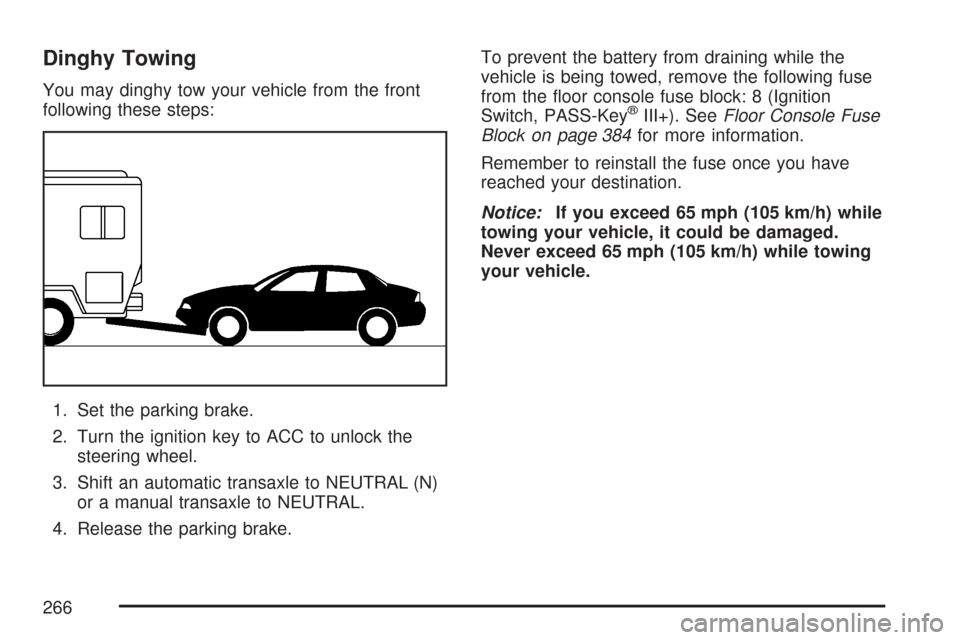
Dinghy Towing
You may dinghy tow your vehicle from the front
following these steps:
1. Set the parking brake.
2. Turn the ignition key to ACC to unlock the
steering wheel.
3. Shift an automatic transaxle to NEUTRAL (N)
or a manual transaxle to NEUTRAL.
4. Release the parking brake.To prevent the battery from draining while the
vehicle is being towed, remove the following fuse
from the oor console fuse block: 8 (Ignition
Switch, PASS-Key
®III+). SeeFloor Console Fuse
Block on page 384for more information.
Remember to reinstall the fuse once you have
reached your destination.
Notice:If you exceed 65 mph (105 km/h) while
towing your vehicle, it could be damaged.
Never exceed 65 mph (105 km/h) while towing
your vehicle.
266
Page 299 of 450
After changing the engine oil, the system must be
reset as follows:
1. Turn the ignition to RUN, with the engine off.
2. Press the information and reset buttons
on the DIC at the same time to enter the
personalization menu. SeeDIC Vehicle
Personalization on page 186.
3. Press the information button to scroll through
the available personalization menu modes
until the DIC display shows OIL-LIFE RESET.
4. Press and hold the reset button until the DIC
display shows ACKNOWLEDGED. This will
tell you the system has been reset.
5. Turn the key to LOCK.
If the CHANGE OIL SOON message comes back
on when you start your vehicle, the engine oil
life system has not reset. Repeat the reset
procedure.What to Do with Used Oil
Used engine oil contains certain elements that may
be unhealthy for your skin and could even cause
cancer. Do not let used oil stay on your skin for
very long. Clean your skin and nails with soap and
water, or a good hand cleaner. Wash or properly
dispose of clothing or rags containing used engine
oil. See the manufacturer’s warnings about the use
and disposal of oil products.
Used oil can be a threat to the environment. If you
change your own oil, be sure to drain all the oil from
the lter before disposal. Never dispose of oil by
putting it in the trash, pouring it on the ground, into
sewers, or into streams or bodies of water. Instead,
recycle it by taking it to a place that collects used
oil. If you have a problem properly disposing of
your used oil, ask your dealer, a service station,
or a local recycling center for help.
299
Page 323 of 450
Trying to start your vehicle by pushing or
pulling it will not work, and it could damage
your vehicle.
1. Check the other vehicle. It must have a
12-volt battery with a negative ground system.
Notice:If the other vehicle’s system is not
a 12-volt system with a negative ground, both
vehicles can be damaged. Only use vehicles
with 12-volt systems with negative grounds to
jump start your vehicle.
2. Get the vehicles close enough so the jumper
cables can reach, but be sure the vehicles are
not touching each other. If they are, it could
cause a ground connection you do not want.
You would not be able to start your vehicle, and
the bad grounding could damage the electrical
systems.
To avoid the possibility of the vehicles rolling,
set the parking brake rmly on both vehicles
involved in the jump start procedure. Put
an automatic transaxle in PARK (P) or
a manual transaxle in NEUTRAL before
setting the parking brake.Notice:If you leave your radio or other
accessories on during the jump starting
procedure, they could be damaged. The repairs
would not be covered by your warranty. Always
turn off your radio and other accessories when
jump starting your vehicle.
3. Turn off the ignition on both vehicles. Unplug
unnecessary accessories plugged into the
cigarette lighter or the accessory power outlet.
Turn off the radio and all lamps that are not
needed. This will avoid sparks and help save
both batteries. And it could save the radio!
4. Open the hood on the other vehicle and
locate the positive (+) and negative (−)
terminal locations on that vehicle.
You will not see the battery of your vehicle
under the hood. It is located in the trunk.
You will not need to access your battery for
jump starting. Your vehicle has a remote
positive (+) and a remote negative (−) jump
starting terminal.
323
Page 385 of 450
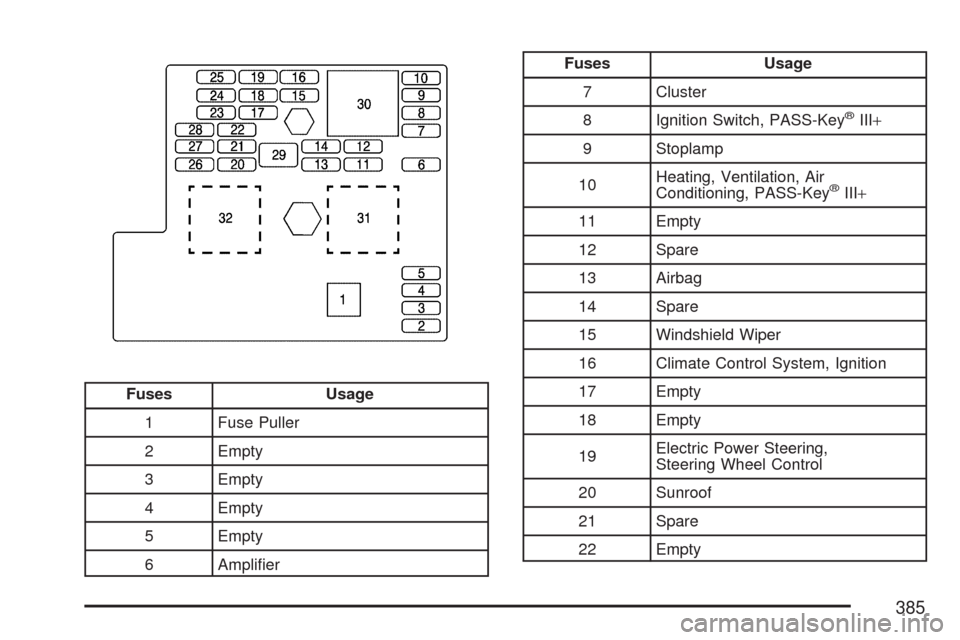
Fuses Usage
1 Fuse Puller
2 Empty
3 Empty
4 Empty
5 Empty
6 Amplier
Fuses Usage
7 Cluster
8 Ignition Switch, PASS-Key
®III+
9 Stoplamp
10Heating, Ventilation, Air
Conditioning, PASS-Key
®III+
11 Empty
12 Spare
13 Airbag
14 Spare
15 Windshield Wiper
16 Climate Control System, Ignition
17 Empty
18 Empty
19Electric Power Steering,
Steering Wheel Control
20 Sunroof
21 Spare
22 Empty
385
Page 388 of 450
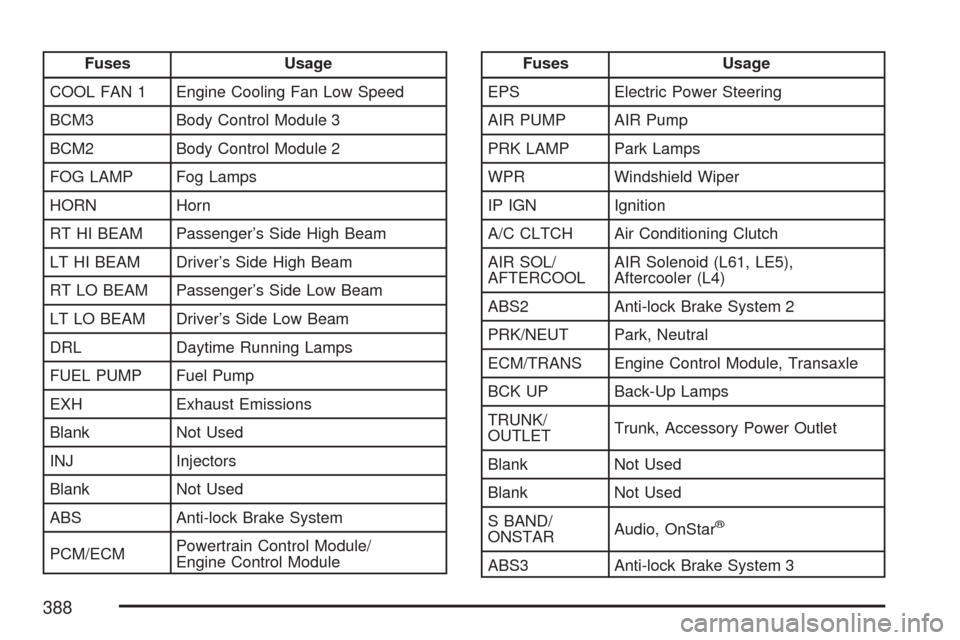
Fuses Usage
COOL FAN 1 Engine Cooling Fan Low Speed
BCM3 Body Control Module 3
BCM2 Body Control Module 2
FOG LAMP Fog Lamps
HORN Horn
RT HI BEAM Passenger’s Side High Beam
LT HI BEAM Driver’s Side High Beam
RT LO BEAM Passenger’s Side Low Beam
LT LO BEAM Driver’s Side Low Beam
DRL Daytime Running Lamps
FUEL PUMP Fuel Pump
EXH Exhaust Emissions
Blank Not Used
INJ Injectors
Blank Not Used
ABS Anti-lock Brake System
PCM/ECMPowertrain Control Module/
Engine Control ModuleFuses Usage
EPS Electric Power Steering
AIR PUMP AIR Pump
PRK LAMP Park Lamps
WPR Windshield Wiper
IP IGN Ignition
A/C CLTCH Air Conditioning Clutch
AIR SOL/
AFTERCOOLAIR Solenoid (L61, LE5),
Aftercooler (L4)
ABS2 Anti-lock Brake System 2
PRK/NEUT Park, Neutral
ECM/TRANS Engine Control Module, Transaxle
BCK UP Back-Up Lamps
TRUNK/
OUTLETTrunk, Accessory Power Outlet
Blank Not Used
Blank Not Used
S BAND/
ONSTARAudio, OnStar
®
ABS3 Anti-lock Brake System 3
388
Page 404 of 450
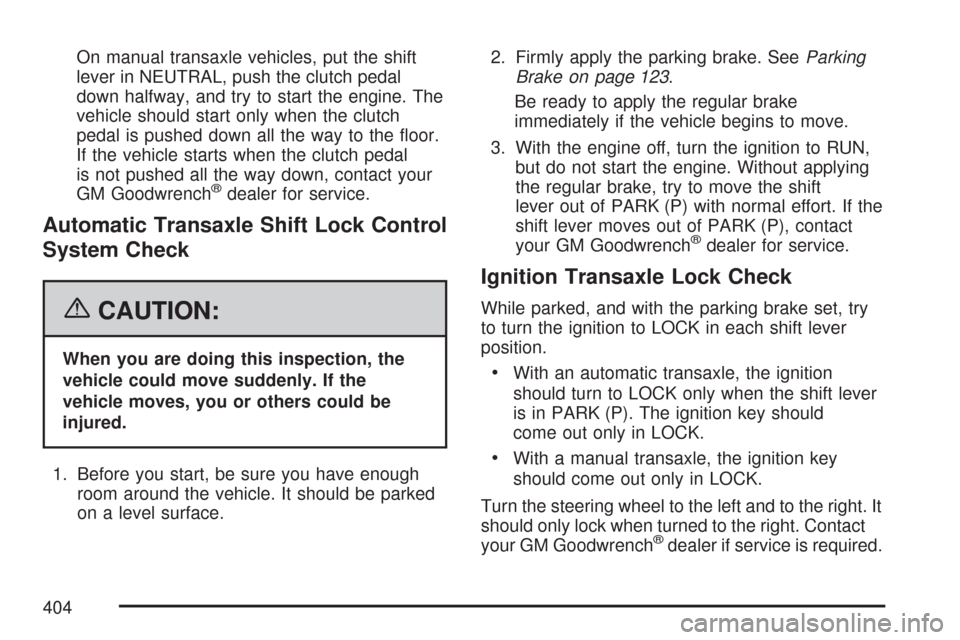
On manual transaxle vehicles, put the shift
lever in NEUTRAL, push the clutch pedal
down halfway, and try to start the engine. The
vehicle should start only when the clutch
pedal is pushed down all the way to the oor.
If the vehicle starts when the clutch pedal
is not pushed all the way down, contact your
GM Goodwrench
®dealer for service.
Automatic Transaxle Shift Lock Control
System Check
{CAUTION:
When you are doing this inspection, the
vehicle could move suddenly. If the
vehicle moves, you or others could be
injured.
1. Before you start, be sure you have enough
room around the vehicle. It should be parked
on a level surface.2. Firmly apply the parking brake. SeeParking
Brake on page 123.
Be ready to apply the regular brake
immediately if the vehicle begins to move.
3. With the engine off, turn the ignition to RUN,
but do not start the engine. Without applying
the regular brake, try to move the shift
lever out of PARK (P) with normal effort. If the
shift lever moves out of PARK (P), contact
your GM Goodwrench
®dealer for service.
Ignition Transaxle Lock Check
While parked, and with the parking brake set, try
to turn the ignition to LOCK in each shift lever
position.
With an automatic transaxle, the ignition
should turn to LOCK only when the shift lever
is in PARK (P). The ignition key should
come out only in LOCK.
With a manual transaxle, the ignition key
should come out only in LOCK.
Turn the steering wheel to the left and to the right. It
should only lock when turned to the right. Contact
your GM Goodwrench
®dealer if service is required.
404
Page 434 of 450
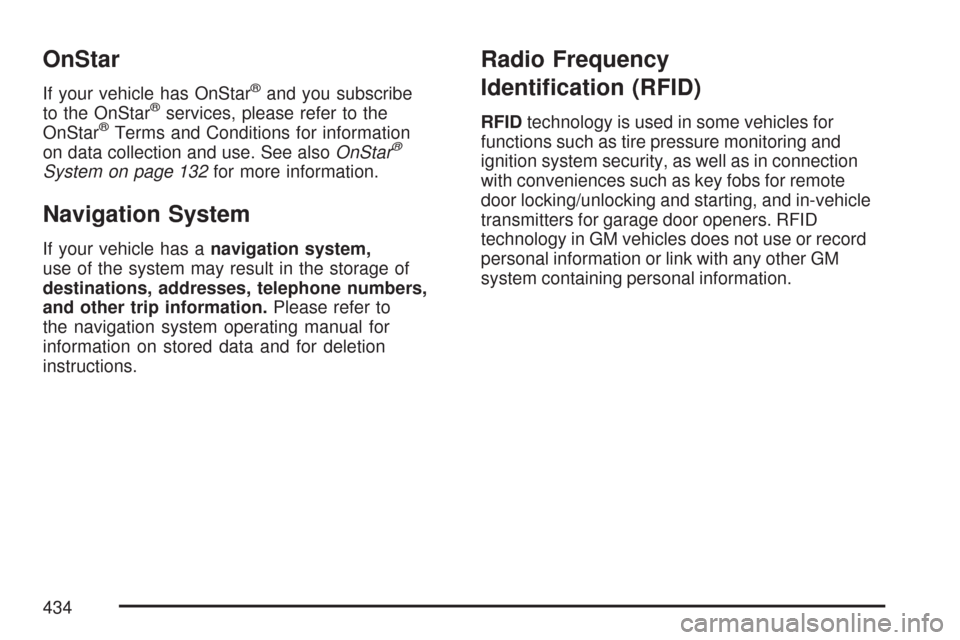
OnStar
If your vehicle has OnStar®and you subscribe
to the OnStar®services, please refer to the
OnStar®Terms and Conditions for information
on data collection and use. See alsoOnStar®
System on page 132for more information.
Navigation System
If your vehicle has anavigation system,
use of the system may result in the storage of
destinations, addresses, telephone numbers,
and other trip information.Please refer to
the navigation system operating manual for
information on stored data and for deletion
instructions.
Radio Frequency
Identication (RFID)
RFIDtechnology is used in some vehicles for
functions such as tire pressure monitoring and
ignition system security, as well as in connection
with conveniences such as key fobs for remote
door locking/unlocking and starting, and in-vehicle
transmitters for garage door openers. RFID
technology in GM vehicles does not use or record
personal information or link with any other GM
system containing personal information.
434
Page 441 of 450
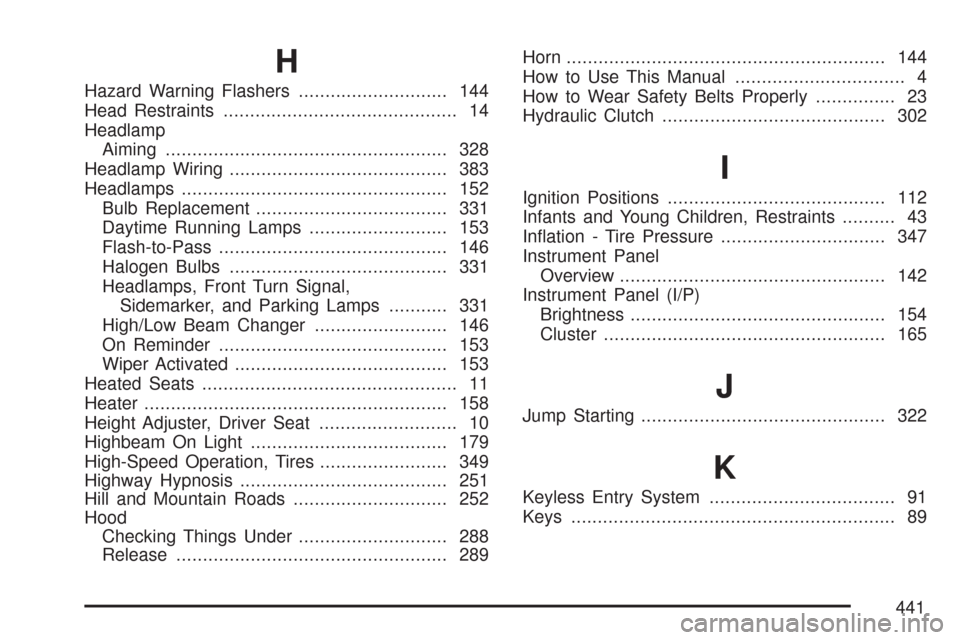
H
Hazard Warning Flashers............................ 144
Head Restraints............................................ 14
Headlamp
Aiming..................................................... 328
Headlamp Wiring......................................... 383
Headlamps.................................................. 152
Bulb Replacement.................................... 331
Daytime Running Lamps.......................... 153
Flash-to-Pass........................................... 146
Halogen Bulbs......................................... 331
Headlamps, Front Turn Signal,
Sidemarker, and Parking Lamps........... 331
High/Low Beam Changer......................... 146
On Reminder........................................... 153
Wiper Activated........................................ 153
Heated Seats................................................ 11
Heater......................................................... 158
Height Adjuster, Driver Seat.......................... 10
Highbeam On Light..................................... 179
High-Speed Operation, Tires........................ 349
Highway Hypnosis....................................... 251
Hill and Mountain Roads............................. 252
Hood
Checking Things Under............................ 288
Release................................................... 289Horn............................................................ 144
How to Use This Manual................................ 4
How to Wear Safety Belts Properly............... 23
Hydraulic Clutch.......................................... 302
I
Ignition Positions......................................... 112
Infants and Young Children, Restraints.......... 43
Ination - Tire Pressure............................... 347
Instrument Panel
Overview.................................................. 142
Instrument Panel (I/P)
Brightness................................................ 154
Cluster..................................................... 165
J
Jump Starting.............................................. 322
K
Keyless Entry System................................... 91
Keys............................................................. 89
441