cig CHEVROLET COBALT 2009 1.G Owners Manual
[x] Cancel search | Manufacturer: CHEVROLET, Model Year: 2009, Model line: COBALT, Model: CHEVROLET COBALT 2009 1.GPages: 402, PDF Size: 2.15 MB
Page 119 of 402

Instrument Panel Overview...............................3-4
Hazard Warning Flashers................................3-6
Other Warning Devices...................................3-6
Horn.............................................................3-6
Tilt Wheel.....................................................3-6
Turn Signal/Multifunction Lever.........................3-7
Turn and Lane-Change Signals........................3-7
Headlamp High/Low-Beam Changer..................3-8
Flash-to-Pass.................................................3-8
Windshield Wipers..........................................3-8
Windshield Washer.........................................3-9
Cruise Control..............................................3-10
Headlamps..................................................3-12
Wiper Activated Headlamps............................3-13
Headlamps on Reminder................................3-13
Daytime Running Lamps (DRL).......................3-13
Fog Lamps..................................................3-14
Instrument Panel Brightness...........................3-14
Dome Lamp.................................................3-15Entry/Exit Lighting.........................................3-15
Mirror Reading Lamps...................................3-15
Electric Power Management...........................3-15
Battery Run-Down Protection..........................3-16
Accessory Power Outlet(s).............................3-16
Ashtray(s) and Cigarette Lighter......................3-17
Climate Controls............................................3-18
Climate Control System.................................3-18
Outlet Adjustment.........................................3-21
Passenger Compartment Air Filter...................3-21
Warning Lights, Gages, and Indicators............3-23
Instrument Panel Cluster................................3-24
Speedometer and Odometer...........................3-25
Tachometer.................................................3-25
Safety Belt Reminders...................................3-26
Airbag Readiness Light..................................3-27
Passenger Airbag Status Indicator...................3-28
Charging System Light..................................3-30
Up-Shift Light...............................................3-30
Section 3 Instrument Panel
3-1
Page 123 of 402
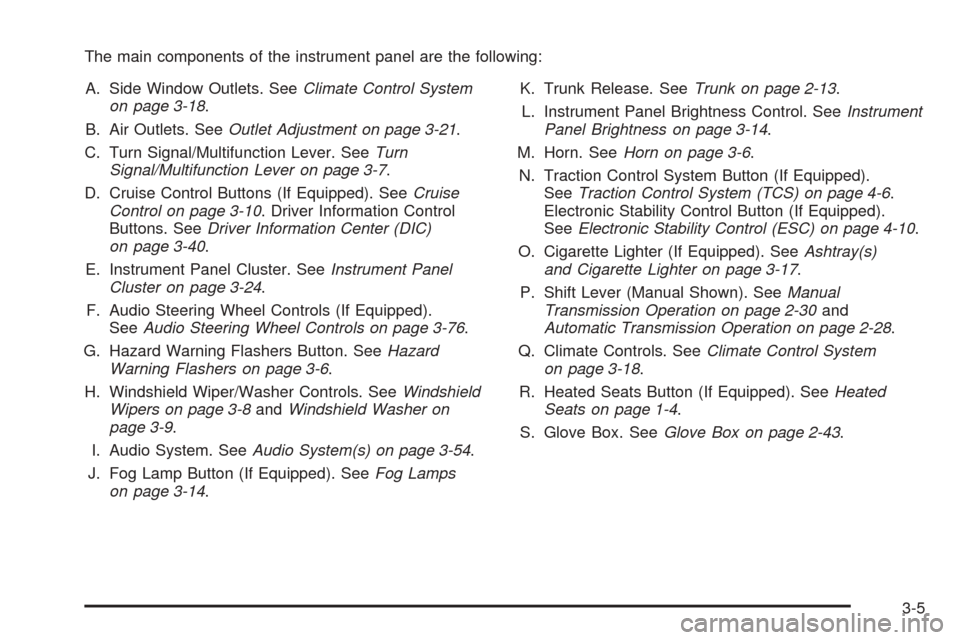
The main components of the instrument panel are the following:
A. Side Window Outlets. SeeClimate Control System
on page 3-18.
B. Air Outlets. SeeOutlet Adjustment on page 3-21.
C. Turn Signal/Multifunction Lever. SeeTurn
Signal/Multifunction Lever on page 3-7.
D. Cruise Control Buttons (If Equipped). SeeCruise
Control on page 3-10. Driver Information Control
Buttons. SeeDriver Information Center (DIC)
on page 3-40.
E. Instrument Panel Cluster. SeeInstrument Panel
Cluster on page 3-24.
F. Audio Steering Wheel Controls (If Equipped).
SeeAudio Steering Wheel Controls on page 3-76.
G. Hazard Warning Flashers Button. SeeHazard
Warning Flashers on page 3-6.
H. Windshield Wiper/Washer Controls. SeeWindshield
Wipers on page 3-8andWindshield Washer on
page 3-9.
I. Audio System. SeeAudio System(s) on page 3-54.
J. Fog Lamp Button (If Equipped). SeeFog Lamps
on page 3-14.K. Trunk Release. SeeTrunk on page 2-13.
L. Instrument Panel Brightness Control. SeeInstrument
Panel Brightness on page 3-14.
M. Horn. SeeHorn on page 3-6.
N. Traction Control System Button (If Equipped).
SeeTraction Control System (TCS) on page 4-6.
Electronic Stability Control Button (If Equipped).
SeeElectronic Stability Control (ESC) on page 4-10.
O. Cigarette Lighter (If Equipped). SeeAshtray(s)
and Cigarette Lighter on page 3-17.
P. Shift Lever (Manual Shown). SeeManual
Transmission Operation on page 2-30and
Automatic Transmission Operation on page 2-28.
Q. Climate Controls. SeeClimate Control System
on page 3-18.
R. Heated Seats Button (If Equipped). SeeHeated
Seats on page 1-4.
S. Glove Box. SeeGlove Box on page 2-43.
3-5
Page 135 of 402
Certain electrical accessories may not be compatible
with the accessory power outlet and could result
in blown vehicle or adapter fuses. If you experience a
problem, see your dealer/retailer for additional
information on the accessory power outlet.
Notice:Adding any electrical equipment to your
vehicle may damage it or keep other components
from working as they should. The repairs would not
be covered by your warranty. Do not use equipment
exceeding maximum amperage rating of 20 amperes.
Check with your dealer/retailer before adding
electrical equipment.
When adding electrical equipment, be sure to
follow the installation instructions included with the
equipment.
Notice:Improper use of the power outlet can cause
damage not covered by your warranty. Do not
hang any type of accessory or accessory bracket
from the plug because the power outlets are
designed for accessory power plugs only.Ashtray(s) and Cigarette Lighter
Your vehicle may have an ashtray and cigarette lighter.
To use the lighter, located on the instrument panel
below the climate controls, push it in all the way and let
go. When it is ready, it will pop back out by itself.
Notice:Holding a cigarette lighter in while it is
heating will not allow the lighter to back away from
the heating element when it is hot. Damage from
overheating may occur to the lighter or heating
element, or a fuse could be blown. Do not hold a
cigarette lighter in while it is heating. Do not
use equipment exceeding maximum amperage rating
of 15 amperes.
To clean the center console ashtray, remove the entire
ashtray and empty it.
Notice:If you put papers, pins, or other ammable
items in the ashtray, hot cigarettes or other
smoking materials could ignite them and possibly
damage your vehicle. Never put ammable items in
the ashtray.
3-17
Page 273 of 402
{CAUTION:
Batteries can hurt you. They can be dangerous
because:
They contain acid that can burn you.
They contain gas that can explode or ignite.
They contain enough electricity to burn you.
If you do not follow these steps exactly, some
or all of these things can hurt you.
Notice:Ignoring these steps could result in costly
damage to your vehicle that would not be covered
by your warranty.
Trying to start your vehicle by pushing or pulling it
will not work, and it could damage your vehicle.
1. Check the other vehicle. It must have a 12-volt
battery with a negative ground system.
Notice:If the other vehicle’s system is not a 12-volt
system with a negative ground, both vehicles can
be damaged. Only use vehicles with 12-volt systems
with negative grounds to jump start your vehicle.2. Get the vehicles close enough so the jumper
cables can reach, but be sure the vehicles are
not touching each other. If they are, it could
cause a ground connection you do not want.
You would not be able to start your vehicle, and
the bad grounding could damage the electrical
systems.
To avoid the possibility of the vehicles rolling, set the
parking brake rmly on both vehicles involved in the
jump start procedure. Put an automatic transmission
in PARK (P) or a manual transmission in NEUTRAL
before setting the parking brake.
Notice:If you leave your radio or other accessories
on during the jump starting procedure, they could
be damaged. The repairs would not be covered
by your warranty. Always turn off your radio and
other accessories when jump starting your vehicle.
3. Turn off the ignition on both vehicles. Unplug
unnecessary accessories plugged into the
cigarette lighter or the accessory power outlet.
Turn off the radio and all lamps that are not
needed. This will avoid sparks and help save
both batteries. And it could save the radio!
5-35
Page 344 of 402
Fuses and Circuit Breakers
The wiring circuits in your vehicle are protected from
short circuits by a combination of fuses, circuit breakers
and fusible thermal links. This greatly reduces the
chance of damage caused by electrical problems.
Look at the silver-colored band inside the fuse. If the
band is broken or melted, replace the fuse. Be sure
you replace a bad fuse with a new one of the identical
size and rating.
If you ever have a problem on the road and do not
have a spare fuse, you can “borrow” one that has
the same amperage. Just pick some feature of your
vehicle that you can get along without — like the
radio or cigarette lighter — and use its fuse if it is the
correct amperage. Replace it as soon as you can.
There are two fuse blocks in your vehicle: the oor
console fuse block and the engine compartment
fuse block.
There is one additional fuse located in the back of
the vehicle near the battery.
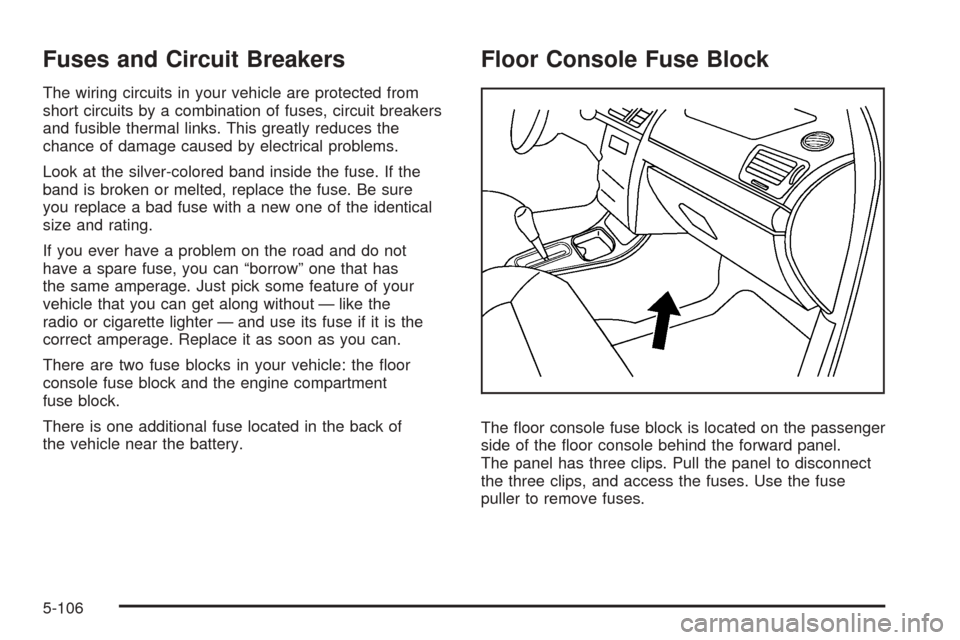
Floor Console Fuse Block
The oor console fuse block is located on the passenger
side of the oor console behind the forward panel.
The panel has three clips. Pull the panel to disconnect
the three clips, and access the fuses. Use the fuse
puller to remove fuses.
5-106
Page 391 of 402
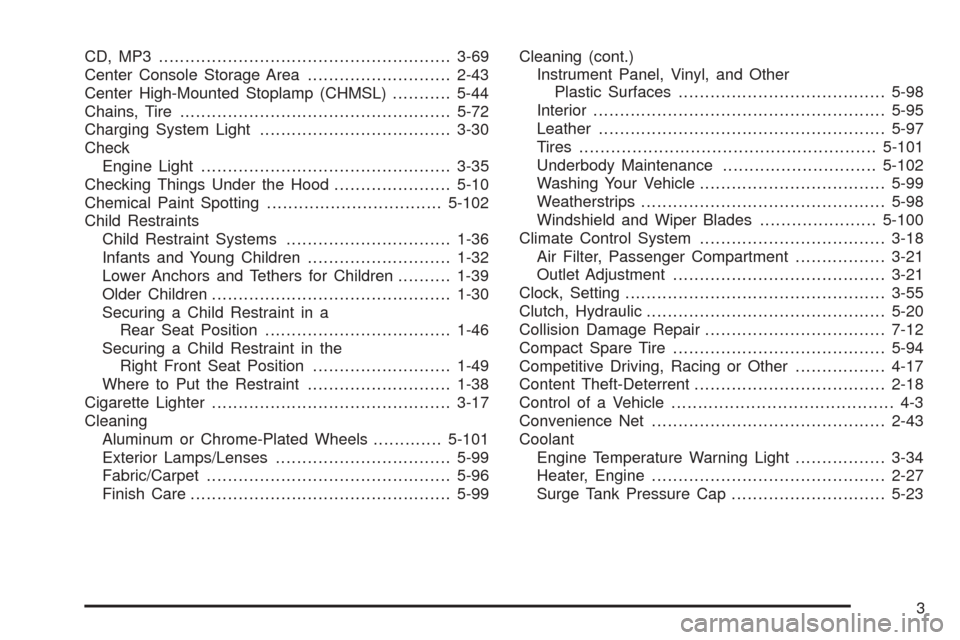
CD, MP3 .......................................................3-69
Center Console Storage Area...........................2-43
Center High-Mounted Stoplamp (CHMSL)...........5-44
Chains, Tire...................................................5-72
Charging System Light....................................3-30
Check
Engine Light...............................................3-35
Checking Things Under the Hood......................5-10
Chemical Paint Spotting.................................5-102
Child Restraints
Child Restraint Systems...............................1-36
Infants and Young Children...........................1-32
Lower Anchors and Tethers for Children..........1-39
Older Children.............................................1-30
Securing a Child Restraint in a
Rear Seat Position...................................1-46
Securing a Child Restraint in the
Right Front Seat Position..........................1-49
Where to Put the Restraint...........................1-38
Cigarette Lighter.............................................3-17
Cleaning
Aluminum or Chrome-Plated Wheels.............5-101
Exterior Lamps/Lenses.................................5-99
Fabric/Carpet..............................................5-96
Finish Care.................................................5-99Cleaning (cont.)
Instrument Panel, Vinyl, and Other
Plastic Surfaces.......................................5-98
Interior.......................................................5-95
Leather......................................................5-97
Tires........................................................5-101
Underbody Maintenance.............................5-102
Washing Your Vehicle...................................5-99
Weatherstrips..............................................5-98
Windshield and Wiper Blades......................5-100
Climate Control System...................................3-18
Air Filter, Passenger Compartment.................3-21
Outlet Adjustment........................................3-21
Clock, Setting.................................................3-55
Clutch, Hydraulic.............................................5-20
Collision Damage Repair..................................7-12
Compact Spare Tire........................................5-94
Competitive Driving, Racing or Other.................4-17
Content Theft-Deterrent....................................2-18
Control of a Vehicle.......................................... 4-3
Convenience Net............................................2-43
Coolant
Engine Temperature Warning Light.................3-34
Heater, Engine............................................2-27
Surge Tank Pressure Cap.............................5-23
3