high CHEVROLET COBALT 2009 1.G Owners Manual
[x] Cancel search | Manufacturer: CHEVROLET, Model Year: 2009, Model line: COBALT, Model: CHEVROLET COBALT 2009 1.GPages: 402, PDF Size: 2.15 MB
Page 8 of 402
Heated Seats
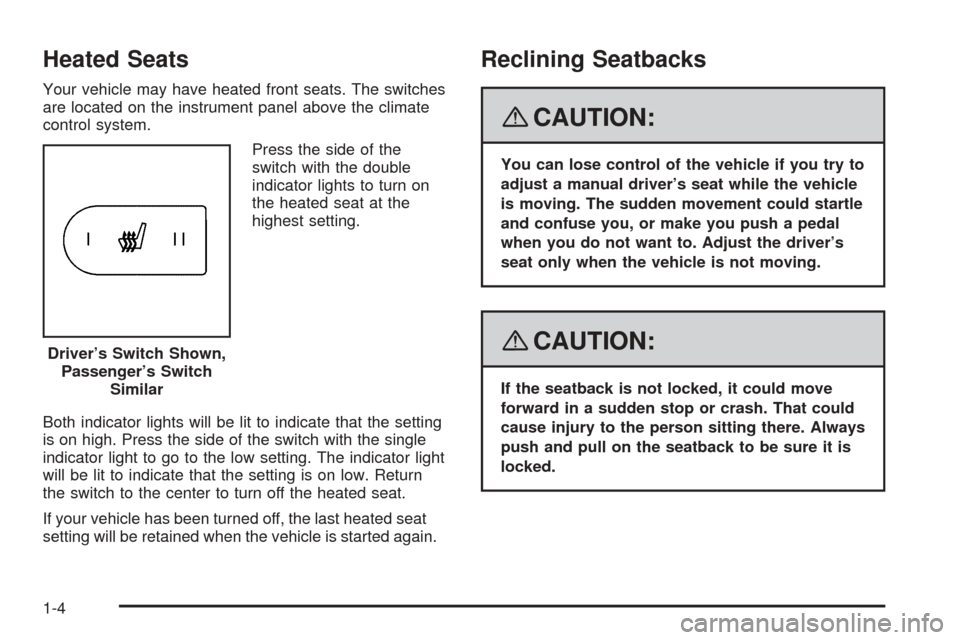
Your vehicle may have heated front seats. The switches
are located on the instrument panel above the climate
control system.
Press the side of the
switch with the double
indicator lights to turn on
the heated seat at the
highest setting.
Both indicator lights will be lit to indicate that the setting
is on high. Press the side of the switch with the single
indicator light to go to the low setting. The indicator light
will be lit to indicate that the setting is on low. Return
the switch to the center to turn off the heated seat.
If your vehicle has been turned off, the last heated seat
setting will be retained when the vehicle is started again.
Reclining Seatbacks
{CAUTION:
You can lose control of the vehicle if you try to
adjust a manual driver’s seat while the vehicle
is moving. The sudden movement could startle
and confuse you, or make you push a pedal
when you do not want to. Adjust the driver’s
seat only when the vehicle is not moving.
{CAUTION:
If the seatback is not locked, it could move
forward in a sudden stop or crash. That could
cause injury to the person sitting there. Always
push and pull on the seatback to be sure it is
locked. Driver’s Switch Shown,
Passenger’s Switch
Similar
1-4
Page 19 of 402
How to Wear Safety Belts Properly
This section is only for people of adult size.
Be aware that there are special things to know about
safety belts and children. And there are different rules
for smaller children and babies. If a child will be riding
in your vehicle, seeOlder Children on page 1-30or
Infants and Young Children on page 1-32. Follow those
rules for everyone’s protection.
It is very important for all occupants to buckle up.
Statistics show that unbelted people are hurt more often
in crashes than those who are wearing safety belts.
Occupants who are not buckled up can be thrown out of
the vehicle in a crash. And they can strike others in
the vehicle who are wearing safety belts.
First, before you or your passenger(s) wear a safety
belt, there is important information you should know.
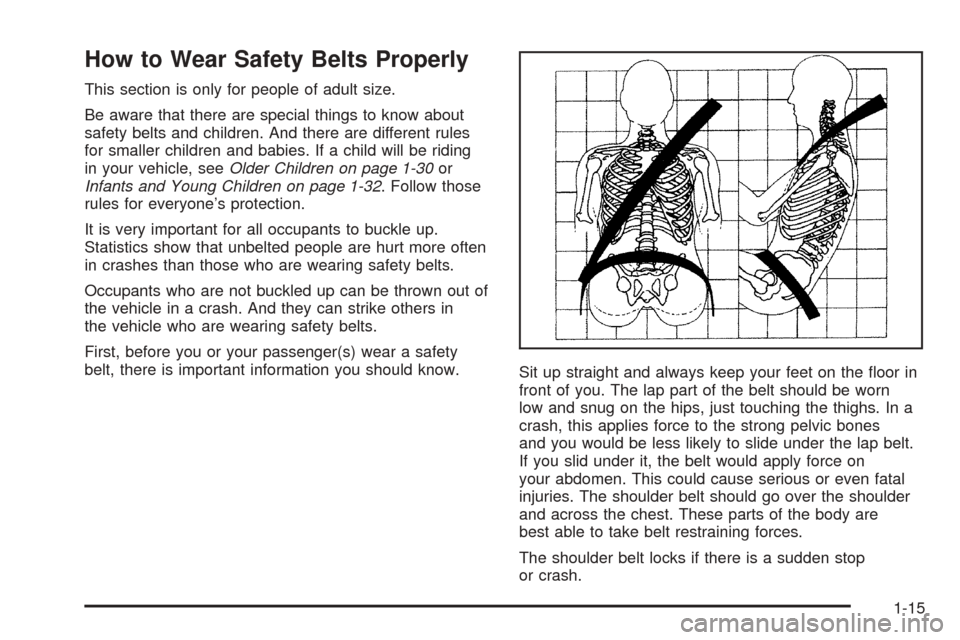
Sit up straight and always keep your feet on the oor in
front of you. The lap part of the belt should be worn
low and snug on the hips, just touching the thighs. In a
crash, this applies force to the strong pelvic bones
and you would be less likely to slide under the lap belt.
If you slid under it, the belt would apply force on
your abdomen. This could cause serious or even fatal
injuries. The shoulder belt should go over the shoulder
and across the chest. These parts of the body are
best able to take belt restraining forces.
The shoulder belt locks if there is a sudden stop
or crash.
1-15
Page 21 of 402
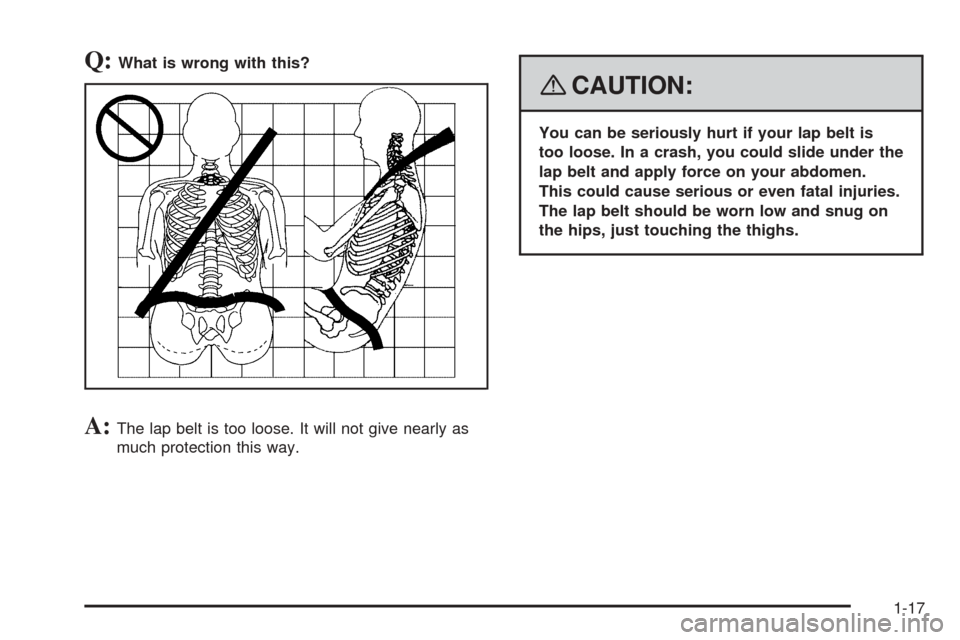
Q:What is wrong with this?
A:The lap belt is too loose. It will not give nearly as
much protection this way.
{CAUTION:
You can be seriously hurt if your lap belt is
too loose. In a crash, you could slide under the
lap belt and apply force on your abdomen.
This could cause serious or even fatal injuries.
The lap belt should be worn low and snug on
the hips, just touching the thighs.
1-17
Page 23 of 402
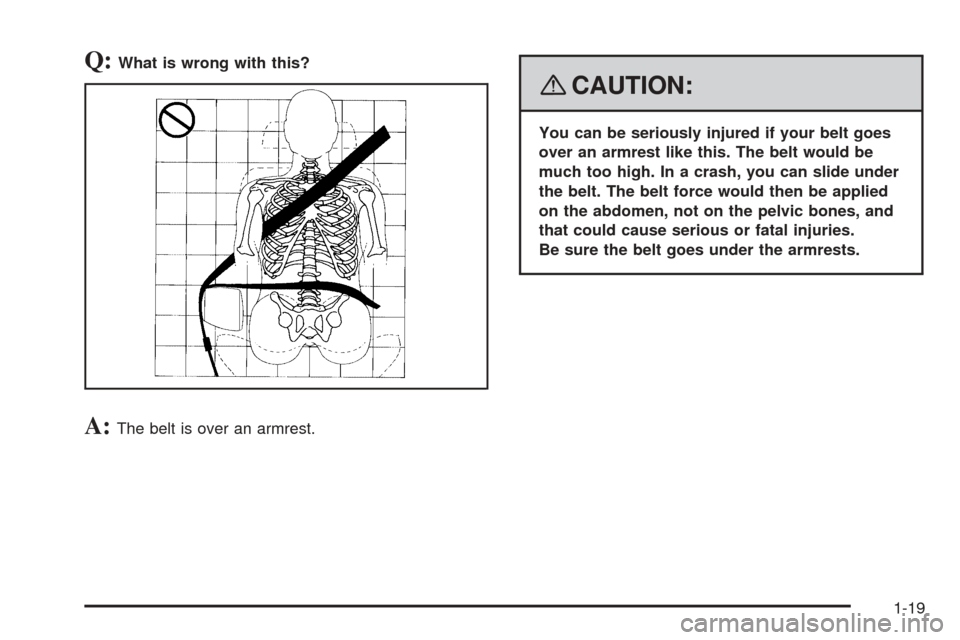
Q:What is wrong with this?
A:The belt is over an armrest.
{CAUTION:
You can be seriously injured if your belt goes
over an armrest like this. The belt would be
much too high. In a crash, you can slide under
the belt. The belt force would then be applied
on the abdomen, not on the pelvic bones, and
that could cause serious or fatal injuries.
Be sure the belt goes under the armrests.
1-19
Page 34 of 402
Child Restraints
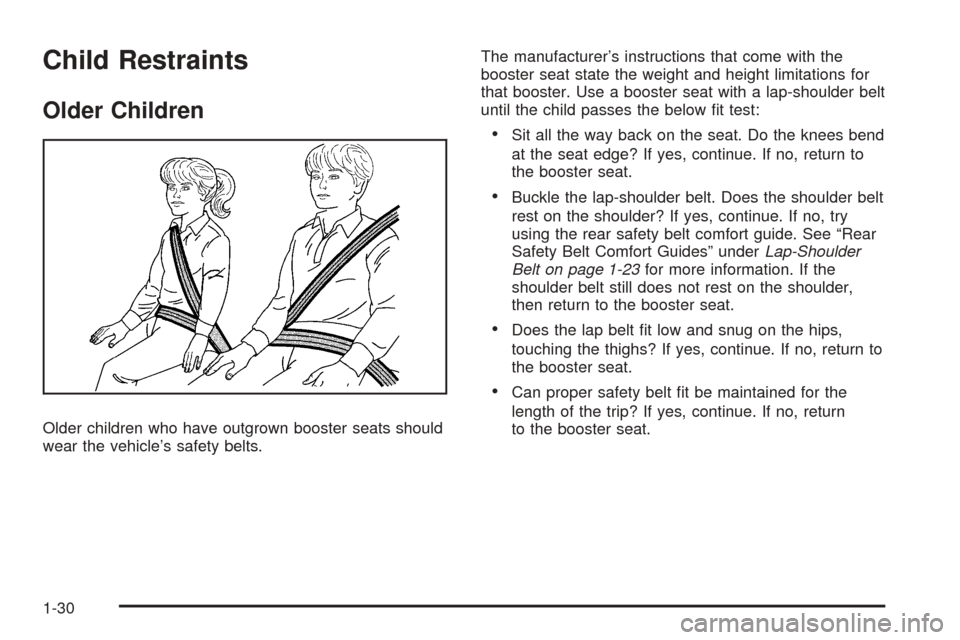
Older Children
Older children who have outgrown booster seats should
wear the vehicle’s safety belts.The manufacturer’s instructions that come with the
booster seat state the weight and height limitations for
that booster. Use a booster seat with a lap-shoulder belt
until the child passes the below t test:
Sit all the way back on the seat. Do the knees bend
at the seat edge? If yes, continue. If no, return to
the booster seat.
Buckle the lap-shoulder belt. Does the shoulder belt
rest on the shoulder? If yes, continue. If no, try
using the rear safety belt comfort guide. See “Rear
Safety Belt Comfort Guides” underLap-Shoulder
Belt on page 1-23for more information. If the
shoulder belt still does not rest on the shoulder,
then return to the booster seat.
Does the lap belt t low and snug on the hips,
touching the thighs? If yes, continue. If no, return to
the booster seat.
Can proper safety belt t be maintained for the
length of the trip? If yes, continue. If no, return
to the booster seat.
1-30
Page 35 of 402
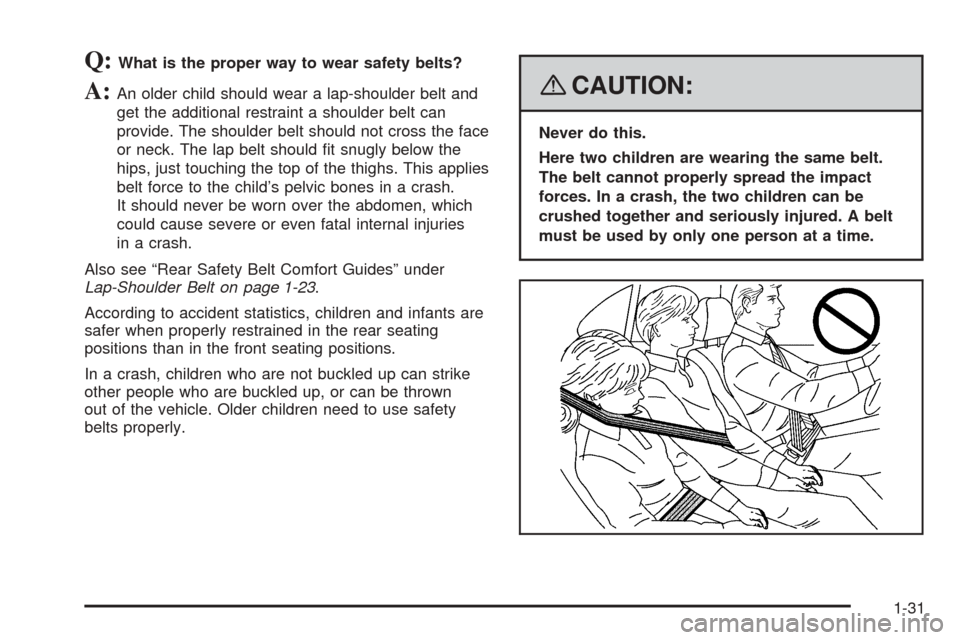
Q:What is the proper way to wear safety belts?
A:An older child should wear a lap-shoulder belt and
get the additional restraint a shoulder belt can
provide. The shoulder belt should not cross the face
or neck. The lap belt should t snugly below the
hips, just touching the top of the thighs. This applies
belt force to the child’s pelvic bones in a crash.
It should never be worn over the abdomen, which
could cause severe or even fatal internal injuries
in a crash.
Also see “Rear Safety Belt Comfort Guides” under
Lap-Shoulder Belt on page 1-23.
According to accident statistics, children and infants are
safer when properly restrained in the rear seating
positions than in the front seating positions.
In a crash, children who are not buckled up can strike
other people who are buckled up, or can be thrown
out of the vehicle. Older children need to use safety
belts properly.{CAUTION:
Never do this.
Here two children are wearing the same belt.
The belt cannot properly spread the impact
forces. In a crash, the two children can be
crushed together and seriously injured. A belt
must be used by only one person at a time.
1-31
Page 78 of 402
Remote Keyless Entry (RKE)
System
If the vehicle has the Remote Keyless Entry (RKE)
system, it operates on a radio frequency subject
to Federal Communications Commission (FCC)
Rules and with Industry Canada.
This device complies with Part 15 of the FCC Rules.
Operation is subject to the following two conditions:
1. This device may not cause interference.
2. This device must accept any interference received,
including interference that may cause undesired
operation of the device.
This device complies with RSS-210 of Industry Canada.
Operation is subject to the following two conditions:
1. This device may not cause interference.
2. This device must accept any interference received,
including interference that may cause undesired
operation of the device.
Changes or modications to this system by other than
an authorized service facility could void authorization
to use this equipment.At times you may notice a decrease in range. This is
normal for any RKE system. If the transmitter does
not work or if you have to stand closer to your vehicle
for the transmitter to work, try this:Check the distance. You may be too far from your
vehicle. You may need to stand closer during
rainy or snowy weather.
Check the location. Other vehicles or objects may
be blocking the signal. Take a few steps to the
left or right, hold the transmitter higher, and
try again.
Check to determine if battery replacement is
necessary. See “Battery Replacement” later
in this section.
If you are still having trouble, see your dealer/retailer
or a qualied technician for service.
2-4
Page 80 of 402
If enabled through the DIC, and it is dark enough outside,
the vehicle’s high-beam headlamps, parking lamps,
and back-up lamps will turn on each time
Kon the
transmitter is pressed. These exterior lamps will stay
on for 20 seconds, or until a door is opened. See
“EXT (Exterior) LIGHTS” underDIC Vehicle
Personalization on page 3-48
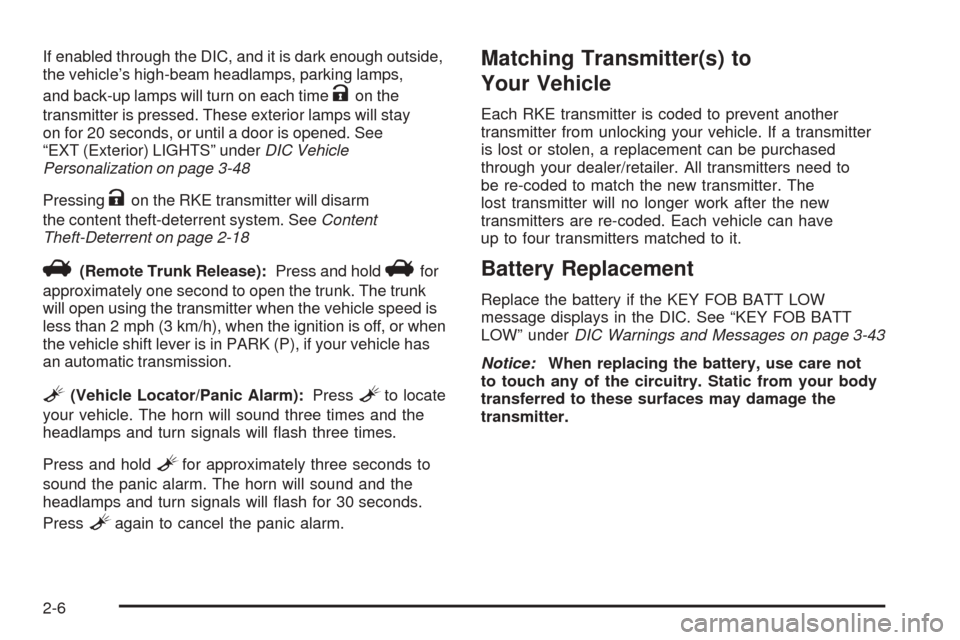
Pressing
Kon the RKE transmitter will disarm
the content theft-deterrent system. SeeContent
Theft-Deterrent on page 2-18
V(Remote Trunk Release):Press and holdVfor
approximately one second to open the trunk. The trunk
will open using the transmitter when the vehicle speed is
less than 2 mph (3 km/h), when the ignition is off, or when
the vehicle shift lever is in PARK (P), if your vehicle has
an automatic transmission.
L(Vehicle Locator/Panic Alarm):PressLto locate
your vehicle. The horn will sound three times and the
headlamps and turn signals will ash three times.
Press and hold
Lfor approximately three seconds to
sound the panic alarm. The horn will sound and the
headlamps and turn signals will ash for 30 seconds.
Press
Lagain to cancel the panic alarm.
Matching Transmitter(s) to
Your Vehicle
Each RKE transmitter is coded to prevent another
transmitter from unlocking your vehicle. If a transmitter
is lost or stolen, a replacement can be purchased
through your dealer/retailer. All transmitters need to
be re-coded to match the new transmitter. The
lost transmitter will no longer work after the new
transmitters are re-coded. Each vehicle can have
up to four transmitters matched to it.
Battery Replacement
Replace the battery if the KEY FOB BATT LOW
message displays in the DIC. See “KEY FOB BATT
LOW” underDIC Warnings and Messages on page 3-43
Notice:When replacing the battery, use care not
to touch any of the circuitry. Static from your body
transferred to these surfaces may damage the
transmitter.
2-6
Page 83 of 402
To manually shut off a remote start, do any of the
following. The parking lamps will turn off to indicate
the engine is off.
Aim the RKE transmitter at the vehicle and press
and release the remote start button.
Turn on the hazard warning ashers.
Turn the ignition switch to ON/RUN and then
LOCK/OFF.
Your vehicle’s engine can be started two times,
per ignition cycle, using the transmitter’s remote
start feature.
If the remote start procedure is used again before
the rst 10 minute time frame has ended, the rst
10 minutes will immediately expire and the second
10 minute time frame will start.The remote vehicle start feature will not operate if any
of the follow occur:
The remote start system is disabled through the DIC.
The vehicle’s key is in the ignition.
The vehicle’s hood is open.
The hazard warning ashers are on.
The check engine light is on. SeeMalfunction
Indicator Lamp on page 3-35.
The engine coolant temperature is too high.
The oil pressure is low.
Two remote vehicle starts have already been
provided for that ignition cycle.
Vehicles that have the remote vehicle start feature are
shipped from the factory with the remote start system
enabled. The system may be enabled or disabled
through the DIC. See “REMOTE START” underDIC
Vehicle Personalization on page 3-48for additional
information.
2-9
Page 87 of 402
Lockout Protection
If your vehicle has power door locks, it will have this
feature. If you press the power door lock switch
when the key is in the ignition and any door is open,
all the doors will lock and the driver’s door will unlock.
Be sure to remove the key from the ignition when
locking your vehicle.
The lockout protection can be overridden by pressing
and holding the power door lock in the lock position
for three seconds.
Trunk
To release the trunk lid from the outside, use the key
or the remote keyless entry transmitter, if equipped.
{CAUTION:
It can be dangerous to drive with the trunk lid
open because carbon monoxide (CO) gas can
come into your vehicle. You cannot see or
smell CO. It can cause unconsciousness and
even death. If you must drive with the trunk lid
open or if electrical wiring or other cable
connections must pass through the seal
between the body and the trunk lid:
Make sure all other windows are shut.
Turn the fan on your heating or cooling
system to its highest speed and select
the control setting that will force outside
air into your vehicle. See Climate
Control System.
If you have air outlets on or under the
instrument panel, open them all the way.
SeeEngine Exhaust on page 2-36.
2-13