four wheel drive CHEVROLET COLORADO 2004 1.G Owner's Manual
[x] Cancel search | Manufacturer: CHEVROLET, Model Year: 2004, Model line: COLORADO, Model: CHEVROLET COLORADO 2004 1.GPages: 414, PDF Size: 2.71 MB
Page 256 of 414
Parking on Hills
{CAUTION:
You really should not park your vehicle, with a
trailer attached, on a hill. If something goes
wrong, your rig could start to move. People
can be injured, and both your vehicle and the
trailer can be damaged.
But if you ever have to park your rig on a hill, here’s
how to do it:
1. Apply your regular brakes, but don’t shift into
PARK (P) yet, or into gear for a manual transmission.
When parking uphill, turn your wheels away from the
curb. When parking downhill, turn your wheels into
the curb.2. Have someone place chocks under the
trailer wheels.
3. When the wheel chocks are in place, release the
regular brakes until the chocks absorb the load.
4. Reapply the regular brakes. Then apply your
parking brake, and then shift into PARK (P), or
REVERSE (R) for a manual transmission. See
Parking Brake on page 2-31for more information.
5. If you have a four-wheel-drive vehicle, be sure the
transfer case is in a drive gear and not in
NEUTRAL. SeeFour-Wheel Drive on page 2-27for
more information.
6. Release the regular brakes.
4-68
Page 259 of 414
Service............................................................5-3
Doing Your Own Service Work.........................5-4
Adding Equipment to the Outside of
Your Vehicle..............................................5-4
Fuel................................................................5-5
Gasoline Octane............................................5-5
Gasoline Specications....................................5-5
California Fuel...............................................5-6
Additives.......................................................5-6
Fuels in Foreign Countries...............................5-7
Filling Your Tank............................................5-7
Filling a Portable Fuel Container.....................5-10
Checking Things Under the Hood....................5-10
Hood Release..............................................5-11
Engine Compartment Overview.......................5-12
Engine Oil...................................................5-13
Engine Air Cleaner/Filter................................5-18
Automatic Transmission Fluid.........................5-19
Manual Transmission Fluid.............................5-22
Hydraulic Clutch (Manual Transmission)...........5-24
Engine Coolant.............................................5-25
Radiator Pressure Cap..................................5-28Engine Overheating.......................................5-28
Cooling System............................................5-30
Engine Fan Noise.........................................5-36
Power Steering Fluid.....................................5-36
Windshield Washer Fluid................................5-37
Brakes........................................................5-39
Battery........................................................5-42
Jump Starting...............................................5-43
Rear Axle.......................................................5-48
Four-Wheel Drive............................................5-48
Front Axle......................................................5-49
Bulb Replacement..........................................5-50
Halogen Bulbs..............................................5-50
Headlamps..................................................5-50
Front Turn Signal, Sidemarker and Daytime
Running Lamps.........................................5-52
Center High-Mounted Stoplamp (CHMSL).........5-53
Taillamps, Turn Signal, Stoplamps and
Back-up Lamps.........................................5-53
Replacement Bulbs.......................................5-54
Windshield Wiper Blade Replacement..............5-55
Section 5 Service and Appearance Care
5-1
Page 301 of 414
Jump Starting
If your battery has run down, you may want to use
another vehicle and some jumper cables to start your
vehicle. Be sure to follow the steps below to do it safely.
{CAUTION:
Batteries can hurt you. They can be dangerous
because:
They contain acid that can burn you.
They contain gas that can explode
or ignite.
They contain enough electricity to
burn you.
If you do not follow these steps exactly, some
or all of these things can hurt you.
Notice:Ignoring these steps could result in costly
damage to your vehicle that would not be covered
by your warranty.
Trying to start your vehicle by pushing or pulling it
will not work, and it could damage your vehicle.
1. Check the other vehicle. It must have a
12–volt battery with a negative ground system.Notice:If the other vehicle’s system is not a 12-volt
system with a negative ground, both vehicles can
be damaged. Only use vehicles with 12-volt systems
with negative grounds to jump start your vehicle.
2. Get the vehicles close enough so the jumper cables
can reach, but be sure the vehicles aren’t touching
each other. If they are, it could cause a ground
connection you don’t want. You wouldn’t be able to
start your vehicle, and the bad grounding could
damage the electrical systems.
To avoid the possibility of the vehicles rolling, set
the parking brake rmly on both vehicles involved in
the jump start procedure. Put an automatic
transmission in PARK (P) or a manual transmission
in NEUTRAL before setting the parking brake. If
you have a four-wheel-drive vehicle, be sure
the transfer case is not in NEUTRAL (N).
Notice:If you leave your radio or other accessories
on during the jump starting procedure, they could
be damaged. The repairs would not be covered
by your warranty. Always turn off your radio and
other accessories when jump starting your vehicle.
3. Turn off the ignition on both vehicles. Unplug
unnecessary accessories plugged into the cigarette
lighter or in the accessory power outlets. Turn off
the radio and all lamps that aren’t needed. This will
avoid sparks and help save both batteries. And it
could save your radio!
5-43
Page 306 of 414
Rear Axle
When to Check and Change Lubricant
It is not necessary to regularly check rear axle uid
unless you suspect there is a leak or you hear an
unusual noise. A uid loss could indicate a problem.
Have it inspected and repaired.
How to Check Lubricant
To get an accurate reading, the vehicle should be on a
level surface.
If the level is below the bottom of the ller plug hole,
you will need to add some lubricant. Add enough
lubricant to raise the level to the bottom of the ller
plug hole.
What to Use
SeeRecommended Fluids and Lubricants on page 6-12
to determine which kind of lubricant to use.
Four-Wheel Drive
Lubricant checks in this section also apply to these
vehicles. However, there are two additional systems that
need lubrication.
Transfer Case
When to Check Lubricant
Refer to the Maintenance Schedule to determine how
often to check the lubricant. SeeAdditional Required
Services on page 6-6.
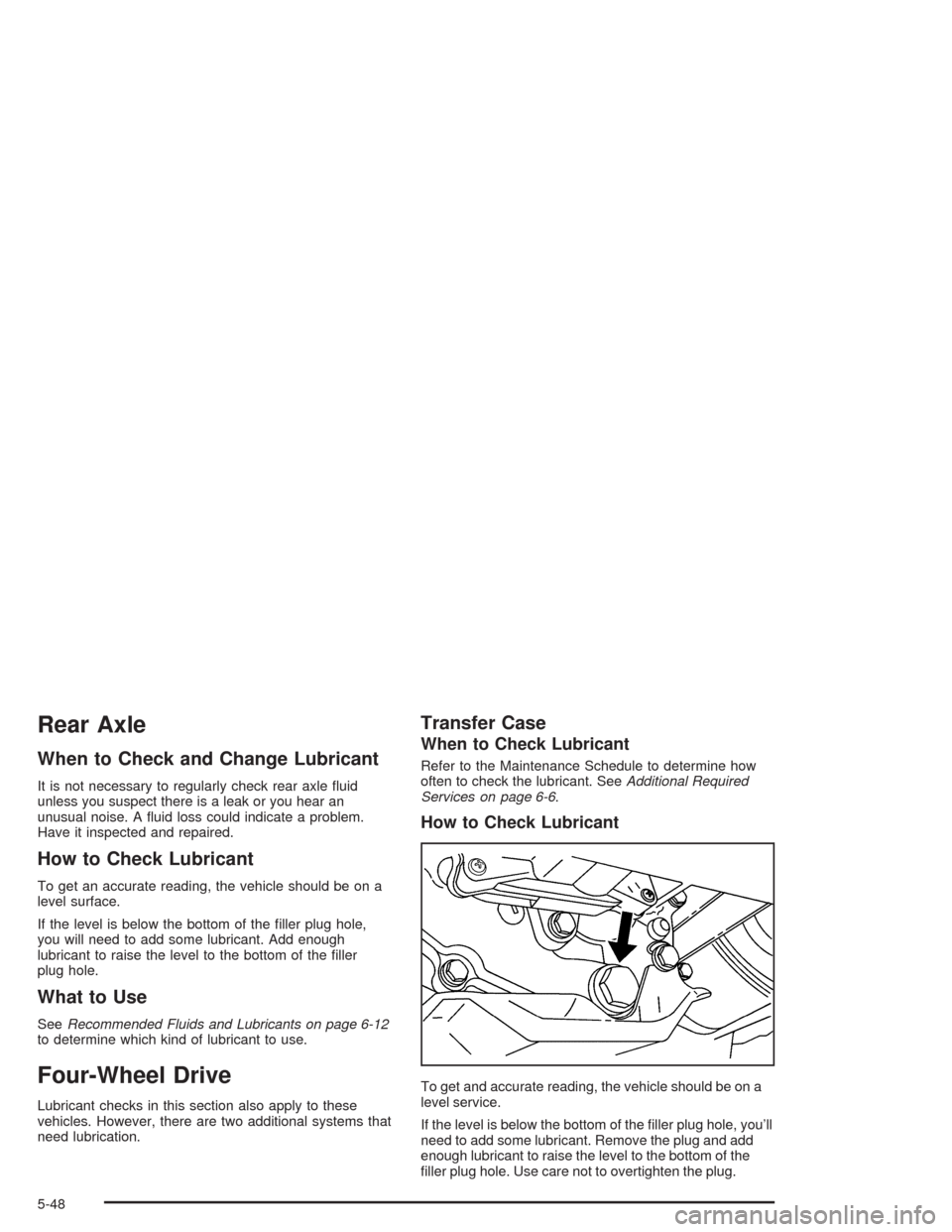
How to Check Lubricant
To get and accurate reading, the vehicle should be on a
level service.
If the level is below the bottom of the ller plug hole, you’ll
need to add some lubricant. Remove the plug and add
enough lubricant to raise the level to the bottom of the
ller plug hole. Use care not to overtighten the plug.
5-48
Page 351 of 414
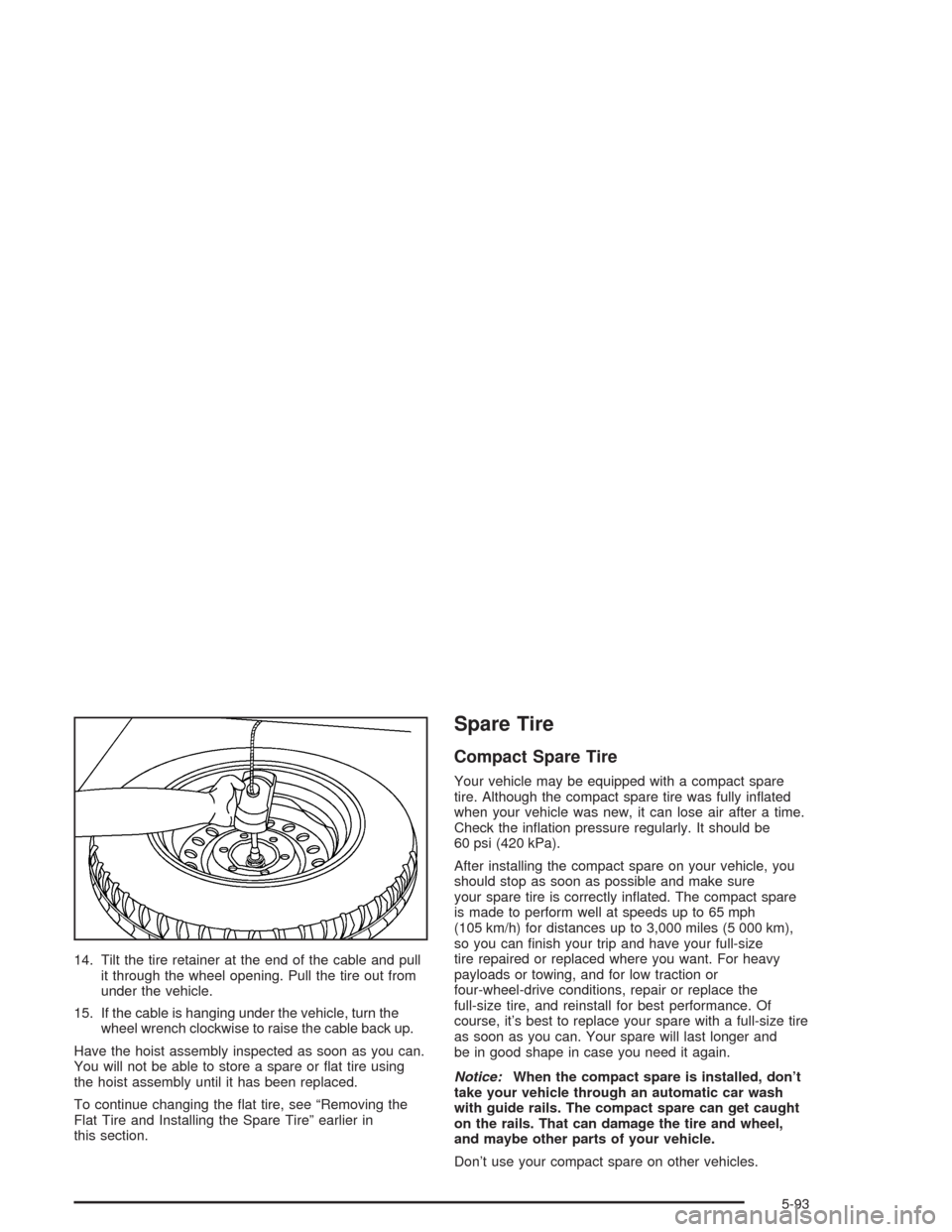
14. Tilt the tire retainer at the end of the cable and pull
it through the wheel opening. Pull the tire out from
under the vehicle.
15. If the cable is hanging under the vehicle, turn the
wheel wrench clockwise to raise the cable back up.
Have the hoist assembly inspected as soon as you can.
You will not be able to store a spare or at tire using
the hoist assembly until it has been replaced.
To continue changing the at tire, see “Removing the
Flat Tire and Installing the Spare Tire” earlier in
this section.
Spare Tire
Compact Spare Tire
Your vehicle may be equipped with a compact spare
tire. Although the compact spare tire was fully inated
when your vehicle was new, it can lose air after a time.
Check the ination pressure regularly. It should be
60 psi (420 kPa).
After installing the compact spare on your vehicle, you
should stop as soon as possible and make sure
your spare tire is correctly inated. The compact spare
is made to perform well at speeds up to 65 mph
(105 km/h) for distances up to 3,000 miles (5 000 km),
so you can nish your trip and have your full-size
tire repaired or replaced where you want. For heavy
payloads or towing, and for low traction or
four-wheel-drive conditions, repair or replace the
full-size tire, and reinstall for best performance. Of
course, it’s best to replace your spare with a full-size tire
as soon as you can. Your spare will last longer and
be in good shape in case you need it again.
Notice:When the compact spare is installed, don’t
take your vehicle through an automatic car wash
with guide rails. The compact spare can get caught
on the rails. That can damage the tire and wheel,
and maybe other parts of your vehicle.
Don’t use your compact spare on other vehicles.
5-93
Page 363 of 414
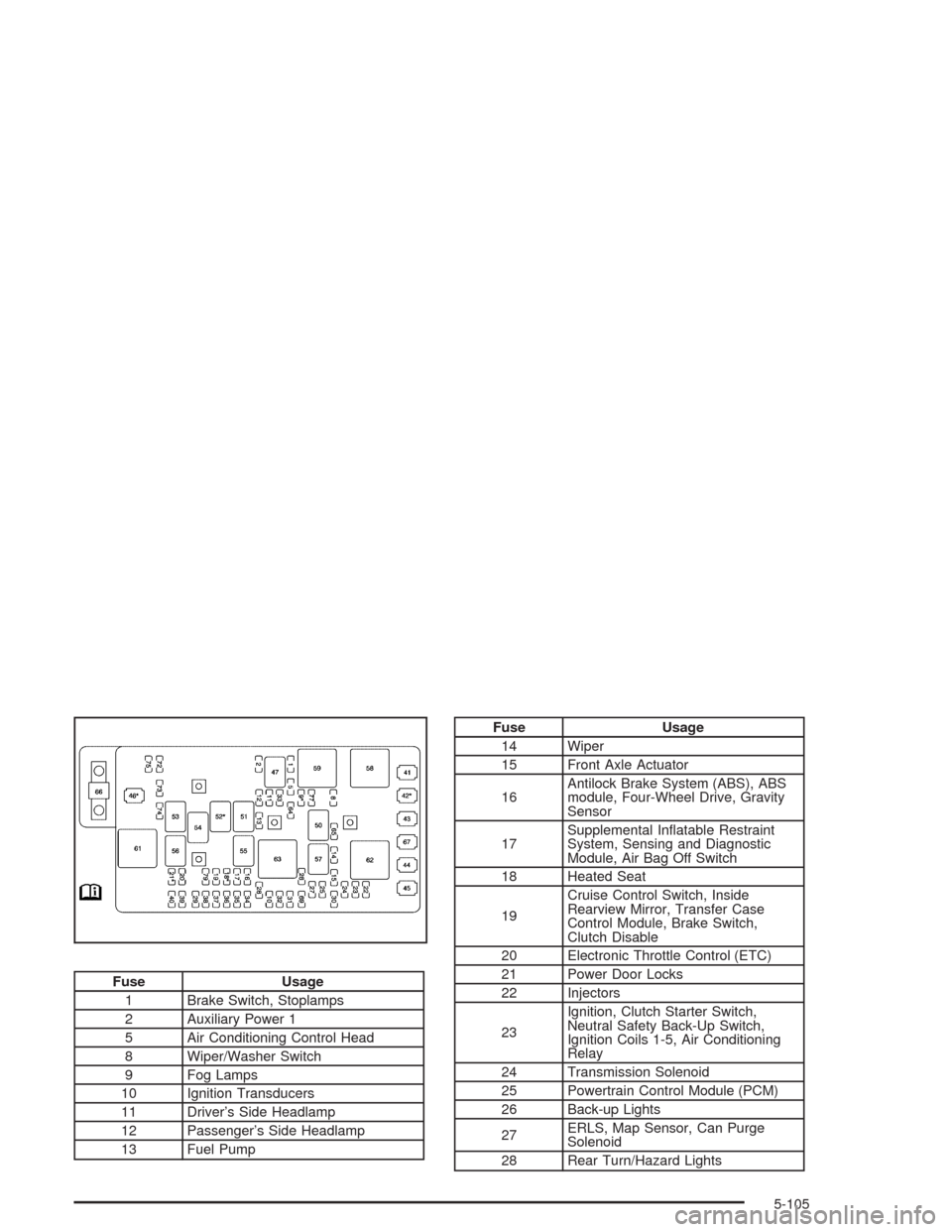
Fuse Usage
1 Brake Switch, Stoplamps
2 Auxiliary Power 1
5 Air Conditioning Control Head
8 Wiper/Washer Switch
9 Fog Lamps
10 Ignition Transducers
11 Driver’s Side Headlamp
12 Passenger’s Side Headlamp
13 Fuel Pump
Fuse Usage
14 Wiper
15 Front Axle Actuator
16Antilock Brake System (ABS), ABS
module, Four-Wheel Drive, Gravity
Sensor
17Supplemental Inatable Restraint
System, Sensing and Diagnostic
Module, Air Bag Off Switch
18 Heated Seat
19Cruise Control Switch, Inside
Rearview Mirror, Transfer Case
Control Module, Brake Switch,
Clutch Disable
20 Electronic Throttle Control (ETC)
21 Power Door Locks
22 Injectors
23Ignition, Clutch Starter Switch,
Neutral Safety Back-Up Switch,
Ignition Coils 1-5, Air Conditioning
Relay
24 Transmission Solenoid
25 Powertrain Control Module (PCM)
26 Back-up Lights
27ERLS, Map Sensor, Can Purge
Solenoid
28 Rear Turn/Hazard Lights
5-105
Page 369 of 414
Using Your Maintenance Schedule
We at General Motors want to help you keep your vehicle
in good working condition. But we do not know exactly
how you will drive it. You may drive very short distances
only a few times a week. Or you may drive long distances
all the time in very hot, dusty weather. You may use your
vehicle in making deliveries. Or you may drive it to work,
to do errands or in many other ways.
Because of all the different ways people use their
vehicles, maintenance needs vary. You may need more
frequent checks and replacements. So please read
the following and note how you drive. If you have any
questions on how to keep your vehicle in good condition,
see your GM Goodwrench dealer.
This schedule is for vehicles that:
carry passengers and cargo within recommended
limits. You will nd these limits on the tire and
loading information label. SeeLoading Your Vehicle
on page 4-50.
are driven on reasonable road surfaces within legal
driving limits.
are driven off-road in the recommended manner.
SeeOff-Road Driving with Your Four-Wheel-Drive
Vehicle on page 4-14.
use the recommended fuel. SeeGasoline Octane
on page 5-5.The services inScheduled Maintenance on page 6-4
should be performed when indicated. SeeAdditional
Required Services on page 6-6andMaintenance
Footnotes on page 6-7for further information.
{CAUTION:
Performing maintenance work on a vehicle can
be dangerous. In trying to do some jobs, you
can be seriously injured. Do your own
maintenance work only if you have the
required know-how and the proper tools and
equipment for the job. If you have any doubt,
see your GM Goodwrench dealer to have a
qualied technician do the work.
Some maintenance services can be complex. So,
unless you are technically qualied and have the
necessary equipment, you should have your GM
Goodwrench dealer do these jobs.
6-3
Page 404 of 414
F
Fan Knob......................................................3-12
Filter
Engine Air Cleaner......................................5-18
Finding a Program Type (PTY) Station.......3-42, 3-51
Finding a Station............................3-37, 3-40, 3-48
Finish Care....................................................5-98
Finish Damage.............................................5-100
Five-Speed....................................................2-25
Fixed Mast Antenna........................................3-59
Flat Tire........................................................5-73
Flat Tire, Changing.........................................5-74
FLUID...........................................................3-34
Fluid
Automatic Transmission................................5-19
Manual Transmission....................................5-22
Power Steering...........................................5-36
Windshield Washer......................................5-37
FM ...............................................................3-59
Fog Lamps...................................................... 3-9
Following Distance..........................................4-66
Four-Wheel Drive....................................2-27, 5-48
Front Armrest Storage Area..............................2-44
Front Axle......................................................5-49
Fuel............................................................... 5-5
Additives...................................................... 5-6
California Fuel.............................................. 5-6Fuel (cont.)
Filling a Portable Fuel Container....................5-10
Filling Your Tank........................................... 5-7
Fuels in Foreign Countries.............................. 5-7
Gage.........................................................3-29
Gasoline Octane........................................... 5-5
Gasoline Specications.................................. 5-5
FUEL CAP.....................................................3-34
Fuses
Fuses and Circuit Breakers.........................5-104
Windshield Wiper.......................................5-103
G
Gage
Engine Coolant Temperature.........................3-24
Fuel..........................................................3-29
Speedometer..............................................3-17
Tachometer.................................................3-18
Gasoline
Octane........................................................ 5-5
Specications............................................... 5-5
Getting Familiar with Off-Road Driving................4-16
Glove Box.....................................................2-44
GM Mobility Program for Persons with
Disabilities.................................................... 7-6
GM Oil Life System™......................................3-30
6
Page 411 of 414
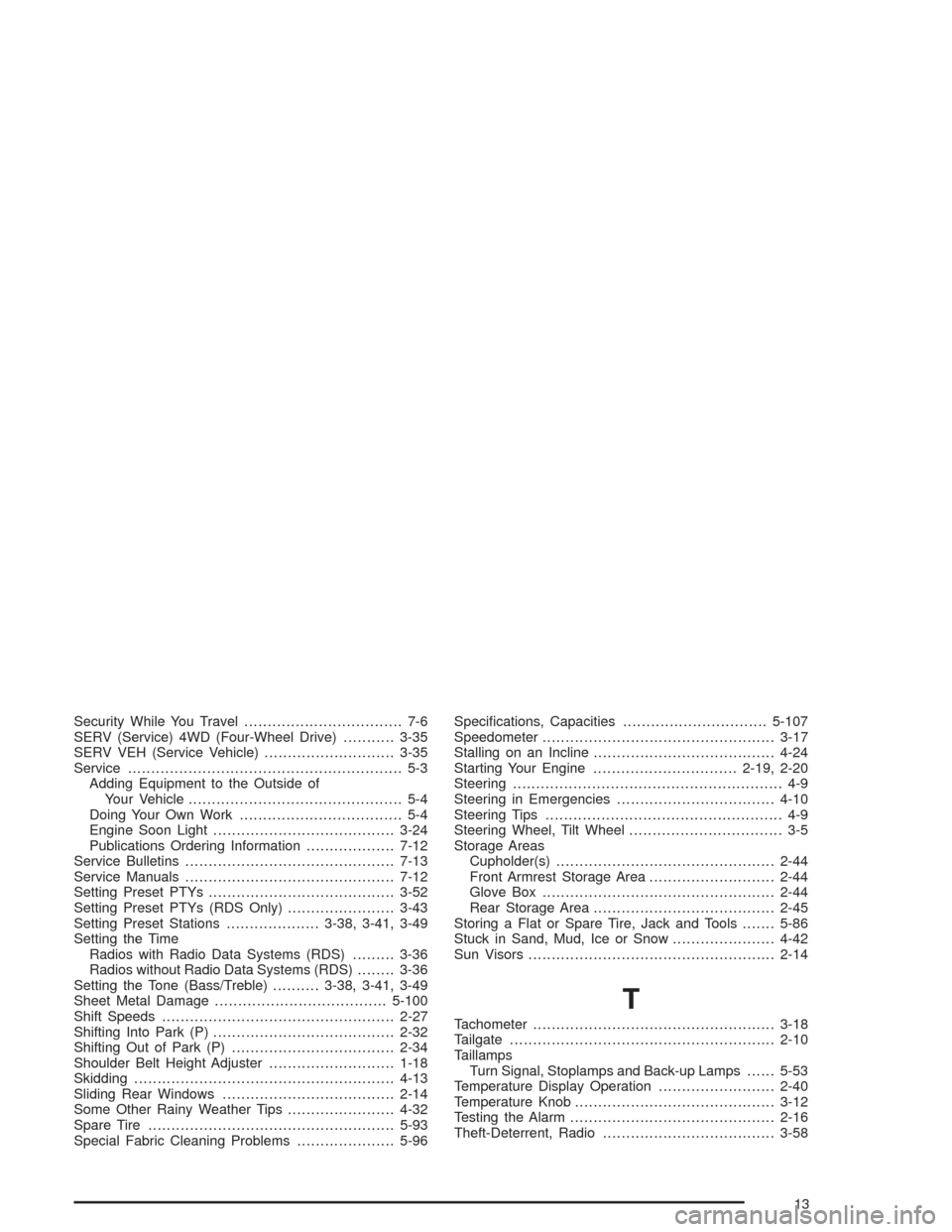
Security While You Travel.................................. 7-6
SERV (Service) 4WD (Four-Wheel Drive)...........3-35
SERV VEH (Service Vehicle)............................3-35
Service........................................................... 5-3
Adding Equipment to the Outside of
Your Vehicle.............................................. 5-4
Doing Your Own Work................................... 5-4
Engine Soon Light.......................................3-24
Publications Ordering Information...................7-12
Service Bulletins.............................................7-13
Service Manuals.............................................7-12
Setting Preset PTYs........................................3-52
Setting Preset PTYs (RDS Only).......................3-43
Setting Preset Stations....................3-38, 3-41, 3-49
Setting the Time
Radios with Radio Data Systems (RDS).........3-36
Radios without Radio Data Systems (RDS)........3-36
Setting the Tone (Bass/Treble)..........3-38, 3-41, 3-49
Sheet Metal Damage.....................................5-100
Shift Speeds..................................................2-27
Shifting Into Park (P).......................................2-32
Shifting Out of Park (P)...................................2-34
Shoulder Belt Height Adjuster...........................1-18
Skidding........................................................4-13
Sliding Rear Windows.....................................2-14
Some Other Rainy Weather Tips.......................4-32
Spare Tire.....................................................5-93
Special Fabric Cleaning Problems.....................5-96Specications, Capacities...............................5-107
Speedometer..................................................3-17
Stalling on an Incline.......................................4-24
Starting Your Engine...............................2-19, 2-20
Steering.......................................................... 4-9
Steering in Emergencies..................................4-10
Steering Tips................................................... 4-9
Steering Wheel, Tilt Wheel................................. 3-5
Storage Areas
Cupholder(s)...............................................2-44
Front Armrest Storage Area...........................2-44
Glove Box..................................................2-44
Rear Storage Area.......................................2-45
Storing a Flat or Spare Tire, Jack and Tools.......5-86
Stuck in Sand, Mud, Ice or Snow......................4-42
Sun Visors.....................................................2-14
T
Tachometer....................................................3-18
Tailgate.........................................................2-10
Taillamps
Turn Signal, Stoplamps and Back-up Lamps......5-53
Temperature Display Operation.........................2-40
Temperature Knob...........................................3-12
Testing the Alarm............................................2-16
Theft-Deterrent, Radio.....................................3-58
13