lock CHEVROLET COLORADO 2005 1.G Owners Manual
[x] Cancel search | Manufacturer: CHEVROLET, Model Year: 2005, Model line: COLORADO, Model: CHEVROLET COLORADO 2005 1.GPages: 414, PDF Size: 2.57 MB
Page 1 of 414
Seats and Restraint Systems........................... 1-1
Front Seats
............................................... 1-3
Rear Seats
............................................... 1-8
Safety Belts
.............................................1-11
Child Restraints
.......................................1-32
Airbag System
.........................................1-62
Restraint System Check
............................1-75
Features and Controls..................................... 2-1
Keys
........................................................ 2-2
Doors and Locks
....................................... 2-7
Windows
.................................................2-12
Theft-Deterrent Systems
............................2-14
Starting and Operating Your Vehicle
...........2-16
Mirrors
....................................................2-35
OnStar
®System
......................................2-39
Storage Areas
.........................................2-41
Instrument Panel............................................. 3-1
Instrument Panel Overview
.......................... 3-4
Climate Controls
......................................3-19
Warning Lights, Gages, and Indicators
........3-22
Driver Information Center (DIC)
..................3-36
Audio System(s)
.......................................3-42Driving Your Vehicle....................................... 4-1
Your Driving, the Road, and Your Vehicle
..... 4-2
Towing
...................................................4-48
Service and Appearance Care.......................... 5-1
Service
..................................................... 5-3
Fuel
......................................................... 5-5
Checking Things Under the Hood
...............5-10
Rear Axle
...............................................5-44
Four-Wheel Drive
.....................................5-44
Front Axle
...............................................5-45
Bulb Replacement
....................................5-46
Windshield Wiper Blade Replacement
.........5-50
Tires
......................................................5-52
Appearance Care
.....................................5-88
Vehicle Identication
.................................5-97
Electrical System
......................................5-98
Capacities and Specications
...................5-103
Maintenance Schedule..................................... 6-1
Maintenance Schedule
................................ 6-2
Customer Assistance and Information.............. 7-1
Customer Assistance and Information
........... 7-2
Reporting Safety Defects
...........................7-10
Index................................................................ 1
2005 Chevrolet Colorado Owner ManualM
Page 9 of 414
Front Seats
Manual Seats
{CAUTION:
You can lose control of the vehicle if you try to
adjust a manual driver’s seat while the vehicle
is moving. The sudden movement could startle
and confuse you, or make you push a pedal
when you do not want to. Adjust the driver’s
seat only when the vehicle is not moving.
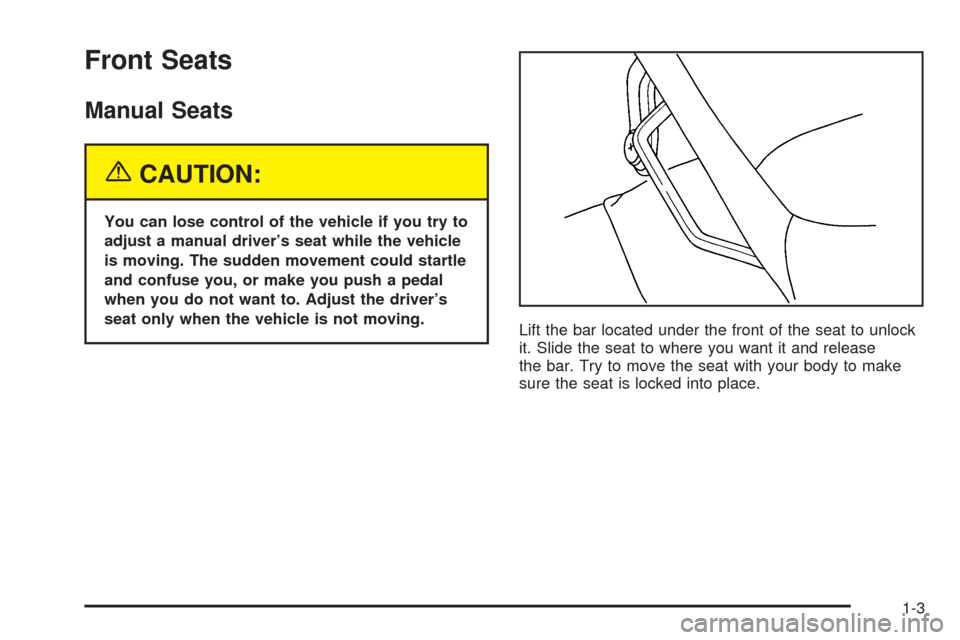
Lift the bar located under the front of the seat to unlock
it. Slide the seat to where you want it and release
the bar. Try to move the seat with your body to make
sure the seat is locked into place.
1-3
Page 10 of 414
Power Seats
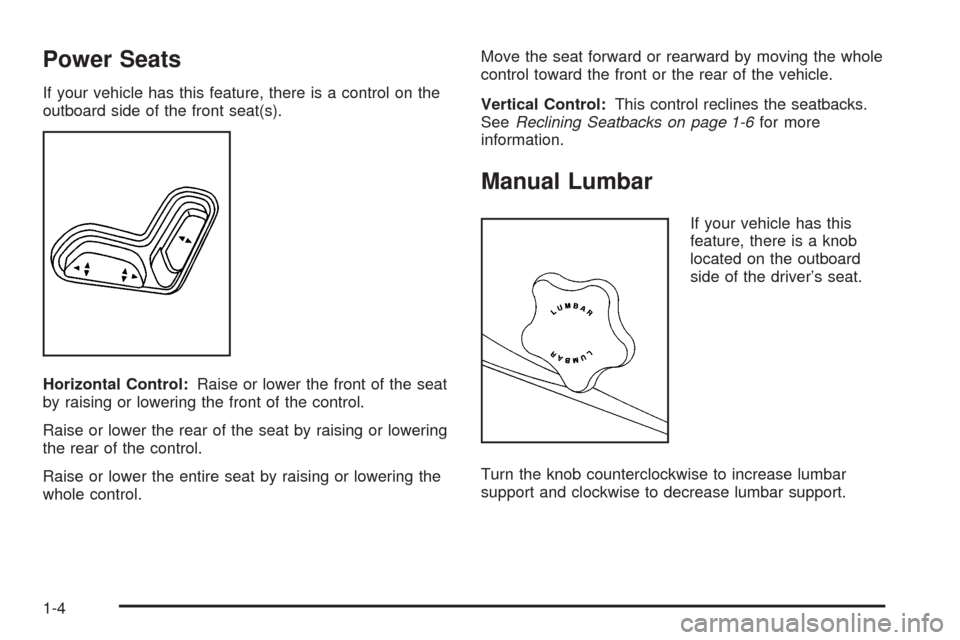
If your vehicle has this feature, there is a control on the
outboard side of the front seat(s).
Horizontal Control:Raise or lower the front of the seat
by raising or lowering the front of the control.
Raise or lower the rear of the seat by raising or lowering
the rear of the control.
Raise or lower the entire seat by raising or lowering the
whole control.Move the seat forward or rearward by moving the whole
control toward the front or the rear of the vehicle.
Vertical Control:This control reclines the seatbacks.
SeeReclining Seatbacks on page 1-6for more
information.
Manual Lumbar
If your vehicle has this
feature, there is a knob
located on the outboard
side of the driver’s seat.
Turn the knob counterclockwise to increase lumbar
support and clockwise to decrease lumbar support.
1-4
Page 12 of 414
Reclining Seatbacks
Your vehicle may have reclining seatbacks.
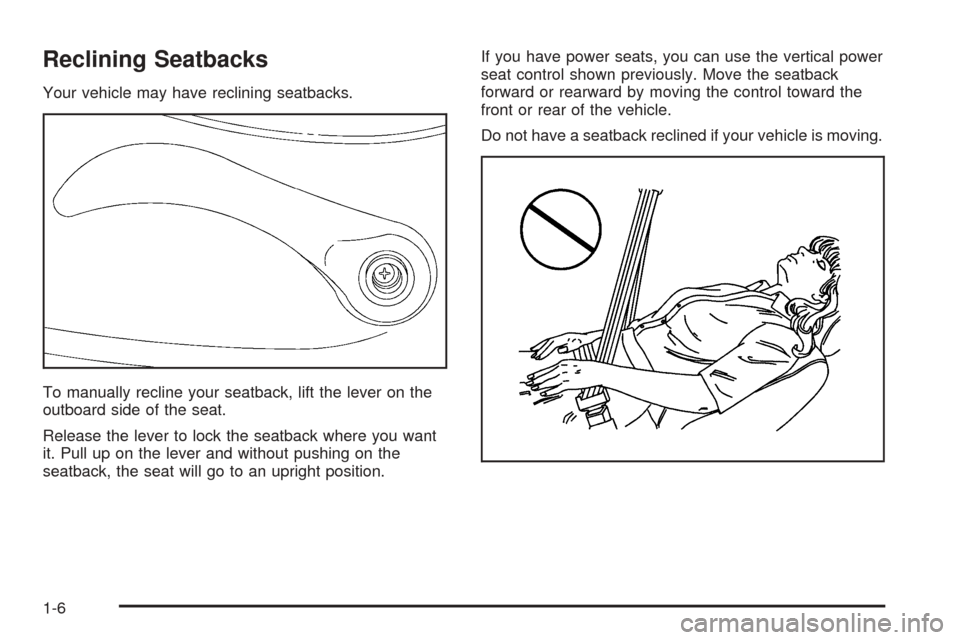
To manually recline your seatback, lift the lever on the
outboard side of the seat.
Release the lever to lock the seatback where you want
it. Pull up on the lever and without pushing on the
seatback, the seat will go to an upright position.If you have power seats, you can use the vertical power
seat control shown previously. Move the seatback
forward or rearward by moving the control toward the
front or rear of the vehicle.
Do not have a seatback reclined if your vehicle is moving.
1-6
Page 14 of 414
Seatback Latches
Your vehicle may be equipped with front seatbacks that
fold forward to let people get into the rear seat or to
access the storage area behind the seat.
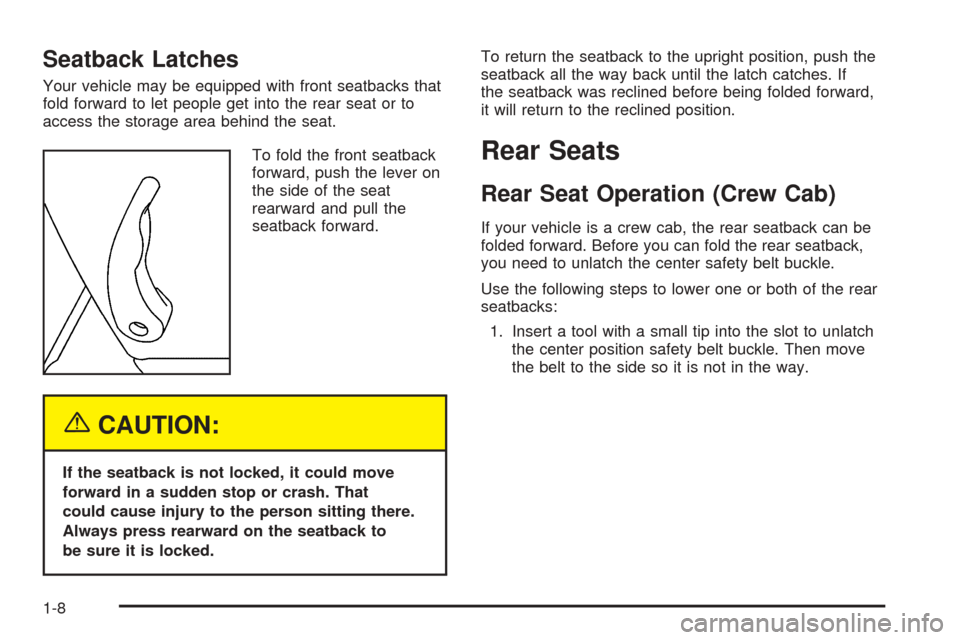
To fold the front seatback
forward, push the lever on
the side of the seat
rearward and pull the
seatback forward.
{CAUTION:
If the seatback is not locked, it could move
forward in a sudden stop or crash. That
could cause injury to the person sitting there.
Always press rearward on the seatback to
be sure it is locked.To return the seatback to the upright position, push the
seatback all the way back until the latch catches. If
the seatback was reclined before being folded forward,
it will return to the reclined position.
Rear Seats
Rear Seat Operation (Crew Cab)
If your vehicle is a crew cab, the rear seatback can be
folded forward. Before you can fold the rear seatback,
you need to unlatch the center safety belt buckle.
Use the following steps to lower one or both of the rear
seatbacks:
1. Insert a tool with a small tip into the slot to unlatch
the center position safety belt buckle. Then move
the belt to the side so it is not in the way.
1-8
Page 15 of 414
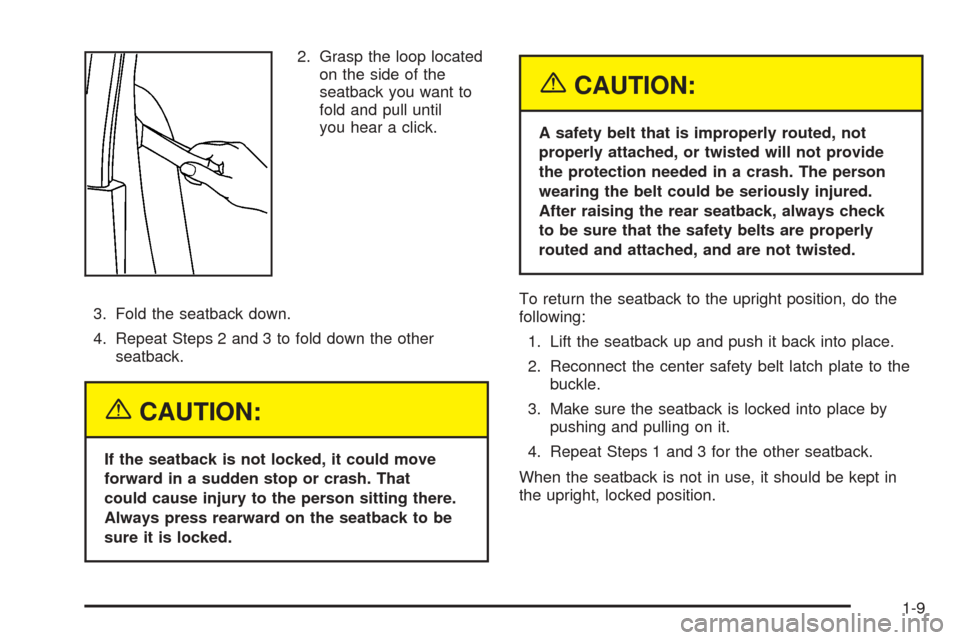
2. Grasp the loop located
on the side of the
seatback you want to
fold and pull until
you hear a click.
3. Fold the seatback down.
4. Repeat Steps 2 and 3 to fold down the other
seatback.
{CAUTION:
If the seatback is not locked, it could move
forward in a sudden stop or crash. That
could cause injury to the person sitting there.
Always press rearward on the seatback to be
sure it is locked.
{CAUTION:
A safety belt that is improperly routed, not
properly attached, or twisted will not provide
the protection needed in a crash. The person
wearing the belt could be seriously injured.
After raising the rear seatback, always check
to be sure that the safety belts are properly
routed and attached, and are not twisted.
To return the seatback to the upright position, do the
following:
1. Lift the seatback up and push it back into place.
2. Reconnect the center safety belt latch plate to the
buckle.
3. Make sure the seatback is locked into place by
pushing and pulling on it.
4. Repeat Steps 1 and 3 for the other seatback.
When the seatback is not in use, it should be kept in
the upright, locked position.
1-9
Page 23 of 414
How to Wear Safety Belts Properly
This part is only for people of adult size.
Be aware that there are special things to know about
safety belts and children. And there are different
rules for smaller children and babies. If a child will be
riding in your vehicle, seeOlder Children on page 1-32
orInfants and Young Children on page 1-35. Follow
those rules for everyone’s protection.
First, you will want to know which restraint systems your
vehicle has.
We will start with the driver position.
Driver Position
Lap-Shoulder Belt
The driver has a lap-shoulder belt. Here is how to
wear it properly.
1. Close and lock the door.
2. Adjust the seat so you can sit up straight.
To see how, see “Seats” in the Index.3. Pick up the latch plate and pull the belt across you.
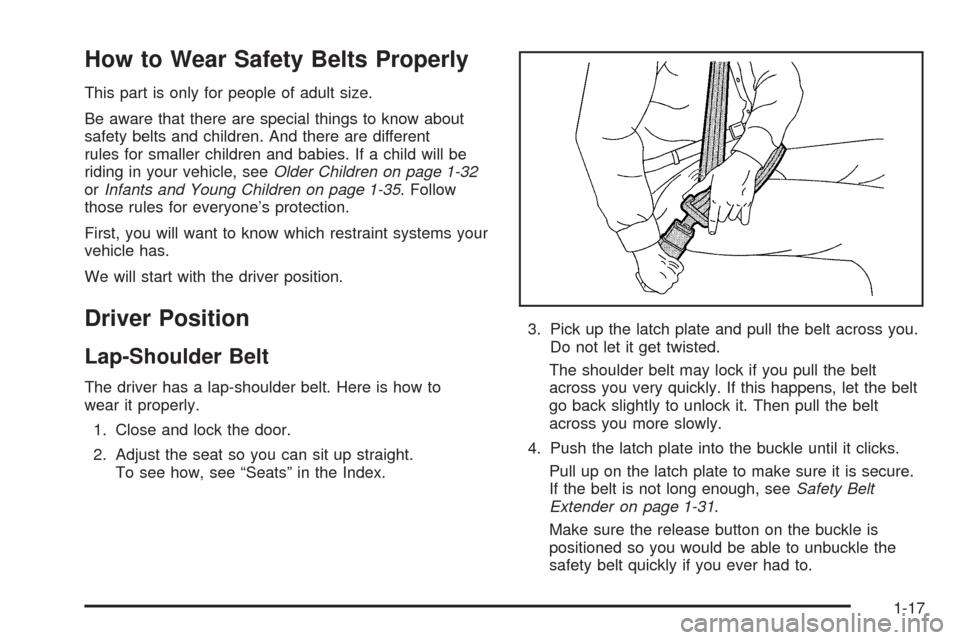
Do not let it get twisted.
The shoulder belt may lock if you pull the belt
across you very quickly. If this happens, let the belt
go back slightly to unlock it. Then pull the belt
across you more slowly.
4. Push the latch plate into the buckle until it clicks.
Pull up on the latch plate to make sure it is secure.
If the belt is not long enough, seeSafety Belt
Extender on page 1-31.
Make sure the release button on the buckle is
positioned so you would be able to unbuckle the
safety belt quickly if you ever had to.
1-17
Page 24 of 414
5. Move the shoulder belt height adjuster to the height
that is right for you. SeeShoulder Belt Height
Adjustment on page 1-23.
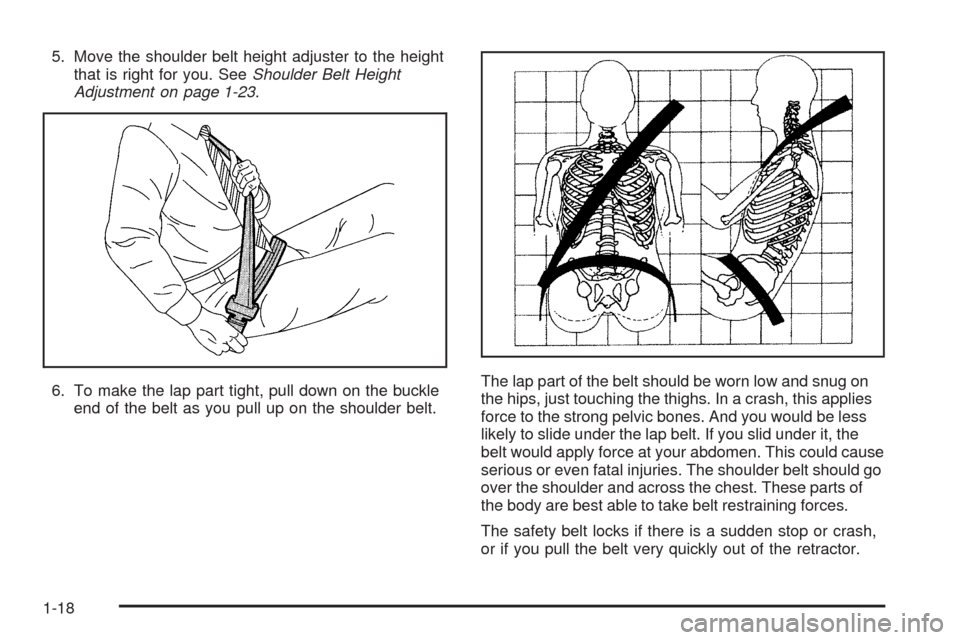
6. To make the lap part tight, pull down on the buckle
end of the belt as you pull up on the shoulder belt.The lap part of the belt should be worn low and snug on
the hips, just touching the thighs. In a crash, this applies
force to the strong pelvic bones. And you would be less
likely to slide under the lap belt. If you slid under it, the
belt would apply force at your abdomen. This could cause
serious or even fatal injuries. The shoulder belt should go
over the shoulder and across the chest. These parts of
the body are best able to take belt restraining forces.
The safety belt locks if there is a sudden stop or crash,
or if you pull the belt very quickly out of the retractor.
1-18
Page 29 of 414
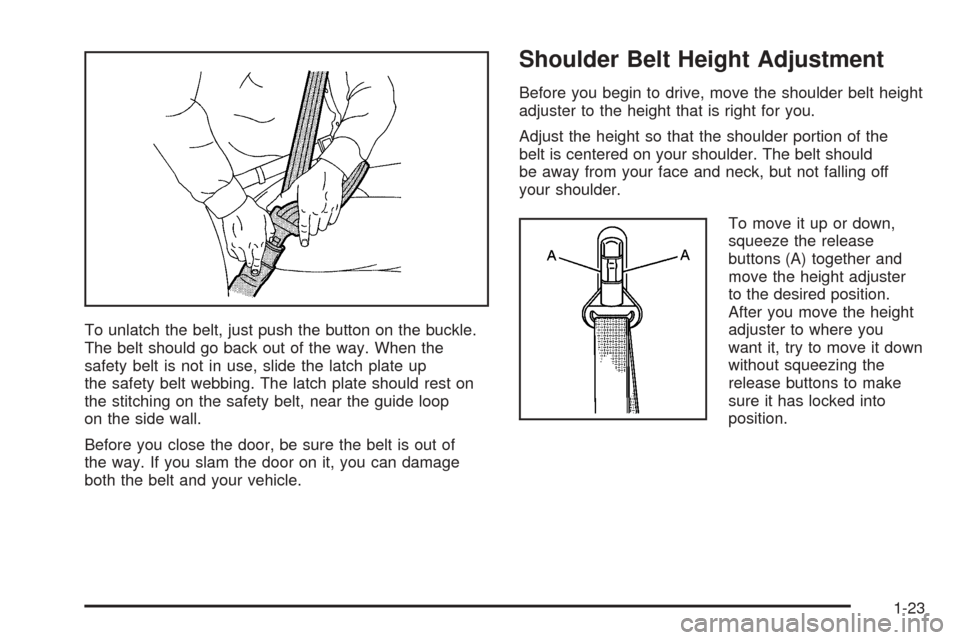
To unlatch the belt, just push the button on the buckle.
The belt should go back out of the way. When the
safety belt is not in use, slide the latch plate up
the safety belt webbing. The latch plate should rest on
the stitching on the safety belt, near the guide loop
on the side wall.
Before you close the door, be sure the belt is out of
the way. If you slam the door on it, you can damage
both the belt and your vehicle.
Shoulder Belt Height Adjustment
Before you begin to drive, move the shoulder belt height
adjuster to the height that is right for you.
Adjust the height so that the shoulder portion of the
belt is centered on your shoulder. The belt should
be away from your face and neck, but not falling off
your shoulder.
To move it up or down,
squeeze the release
buttons (A) together and
move the height adjuster
to the desired position.
After you move the height
adjuster to where you
want it, try to move it down
without squeezing the
release buttons to make
sure it has locked into
position.
1-23
Page 30 of 414
Safety Belt Use During Pregnancy
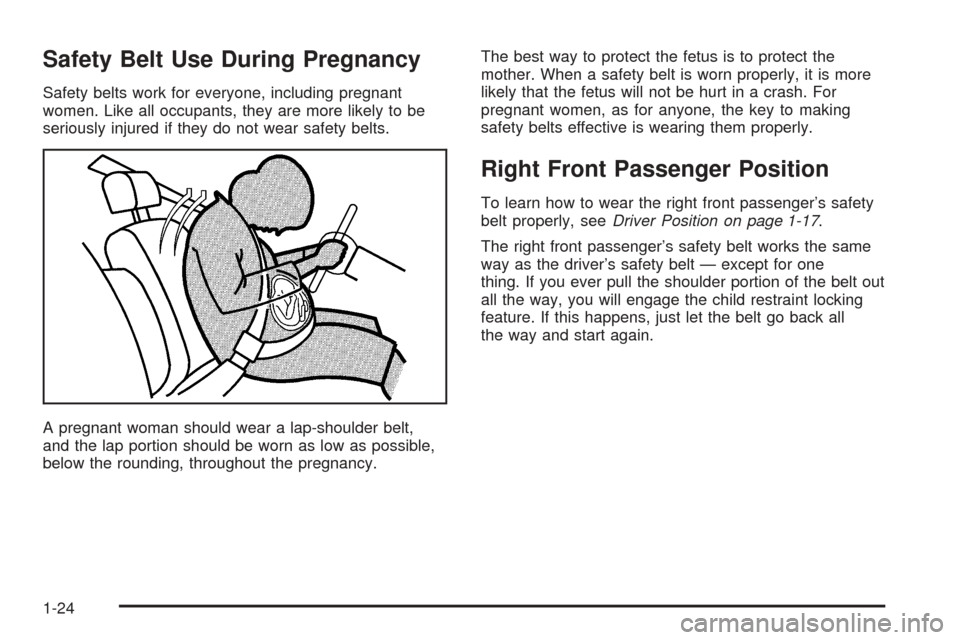
Safety belts work for everyone, including pregnant
women. Like all occupants, they are more likely to be
seriously injured if they do not wear safety belts.
A pregnant woman should wear a lap-shoulder belt,
and the lap portion should be worn as low as possible,
below the rounding, throughout the pregnancy.The best way to protect the fetus is to protect the
mother. When a safety belt is worn properly, it is more
likely that the fetus will not be hurt in a crash. For
pregnant women, as for anyone, the key to making
safety belts effective is wearing them properly.
Right Front Passenger Position
To learn how to wear the right front passenger’s safety
belt properly, seeDriver Position on page 1-17.
The right front passenger’s safety belt works the same
way as the driver’s safety belt — except for one
thing. If you ever pull the shoulder portion of the belt out
all the way, you will engage the child restraint locking
feature. If this happens, just let the belt go back all
the way and start again.
1-24