light CHEVROLET COLORADO 2006 1.G User Guide
[x] Cancel search | Manufacturer: CHEVROLET, Model Year: 2006, Model line: COLORADO, Model: CHEVROLET COLORADO 2006 1.GPages: 434, PDF Size: 2.57 MB
Page 87 of 434
Restraint System Check
Checking the Restraint Systems
Now and then, make sure the safety belt reminder
light and all your belts, buckles, latch plates, retractors
and anchorages are working properly. Look for any
other loose or damaged safety belt system parts.
If you see anything that might keep a safety belt
system from doing its job, have it repaired. See
Care of Safety Belts on page 5-92for more information.
Torn or frayed safety belts may not protect you in
a crash. They can rip apart under impact forces.
If a belt is torn or frayed, get a new one right away.Also look for any opened or broken airbag covers, and
have them repaired or replaced. The airbag system
does not need regular maintenance.
Notice:If you damage the covering for the driver’s
or the right front passenger’s airbag, or the side
impact airbag covering (if equipped) on the ceiling
near the side windows, the airbag may not work
properly. You may have to replace the airbag
module in the steering wheel, both the airbag
module and the instrument panel for the right front
passenger’s airbag, or side impact airbag module
and ceiling covering for roof-mounted side impact
airbags (if equipped.) Do not open or break the
airbag coverings.
1-81
Page 88 of 434
Replacing Restraint System Parts
After a Crash
{CAUTION:
A crash can damage the restraint systems
in your vehicle. A damaged restraint system
may not properly protect the person using it,
resulting in serious injury or even death in
a crash. To help make sure your restraint
systems are working properly after a crash,
have them inspected and any necessary
replacements made as soon as possible.
If you have had a crash, do you need new belts or
LATCH system parts?
After a very minor collision, nothing may be necessary.
But if the belts were stretched, as they would be if worn
during a more severe crash, then you need new parts.
If the LATCH system was being used during a more
severe crash, you may need new LATCH system parts.If belts are cut or damaged, replace them. Collision
damage also may mean you will need to have LATCH
system, safety belt or seat parts repaired or replaced.
New parts and repairs may be necessary even if the belt
or LATCH system was not being used at the time of
the collision.
If an airbag inates, you will need to replace airbag
system parts. See the part on the airbag system earlier
in this section.
If the frontal airbags inate, you will also need to
replace the driver’s and right front passenger’s safety
belt retractor assembly. Be sure to do so. Then the new
retractor assembly will be there to help protect you in
a collision.
After a crash you may need to replace the driver and
front passenger’s safety belt retractor assemblies, even
if the frontal airbags have not deployed. The driver
and front passenger’s safety belt retractor assemblies
contain the safety belt pretensioners. Have your
safety belt pretensioners checked if your vehicle has
been in a collision, or if your airbag readiness light stays
on after you start your vehicle or while you are driving.
SeeAirbag Readiness Light on page 3-26.
1-82
Page 98 of 434

Tailgate
You can open the tailgate by pulling up on the outside
handle while pulling the tailgate down.
When you put the tailgate back up, be sure it latches
securely.
You can lock the tailgate using your ignition key.
Turn the key counterclockwise to lock the tailgate.
Turn the key clockwise to unlock the tailgate.
Removing the Tailgate
Follow these steps if you want to remove the tailgate:
1. With the tailgate fully open, lift up slightly on
the entire tailgate assembly.
Remove the retaining
cables from both sides
of the tailgate by pulling
the clips away from the bolt
heads while pushing the
cable bracket forward.
When the larger part of
the hole on the bracket is
over the bolt, slide the
bracket off of the bolt.
2. With the tailgate partially down, lift up on the
passenger’s side and pull the tailgate toward
you, then move the tailgate to the right to release
the driver’s side. You can then remove the
entire tailgate assembly.
2-10
Page 99 of 434
Reverse the procedure to reinstall the tailgate.
Make sure it is secure.
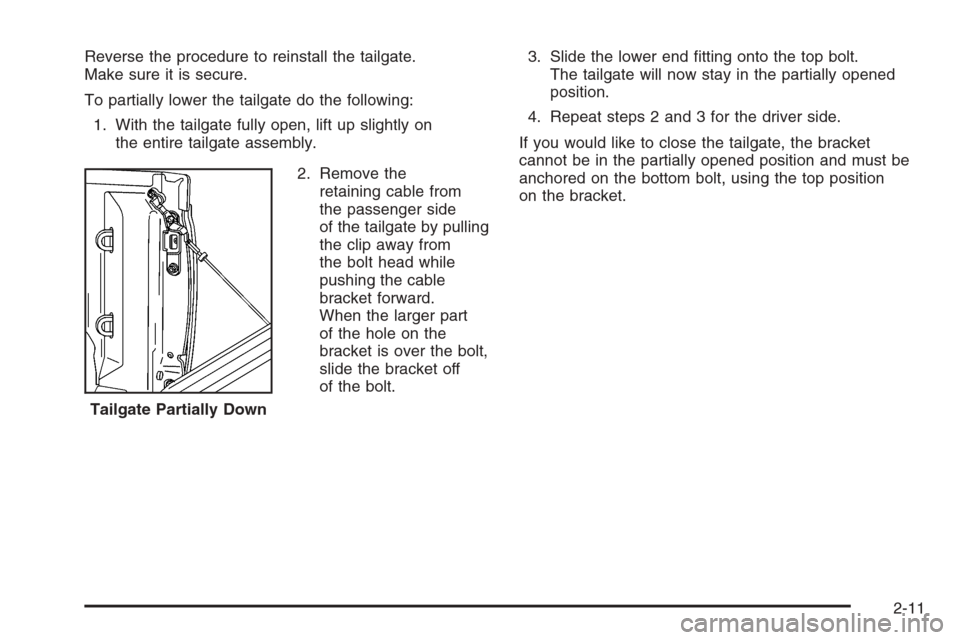
To partially lower the tailgate do the following:
1. With the tailgate fully open, lift up slightly on
the entire tailgate assembly.
2. Remove the
retaining cable from
the passenger side
of the tailgate by pulling
the clip away from
the bolt head while
pushing the cable
bracket forward.
When the larger part
of the hole on the
bracket is over the bolt,
slide the bracket off
of the bolt.3. Slide the lower end tting onto the top bolt.
The tailgate will now stay in the partially opened
position.
4. Repeat steps 2 and 3 for the driver side.
If you would like to close the tailgate, the bracket
cannot be in the partially opened position and must be
anchored on the bottom bolt, using the top position
on the bracket.
Tailgate Partially Down
2-11
Page 103 of 434
Theft-Deterrent Systems
Vehicle theft is big business, especially in some cities.
Although your vehicle has a number of theft-deterrent
features, we know that nothing we put on it can make
it impossible to steal.
Content Theft-Deterrent
If your vehicle has the
remote keyless entry
system, the vehicle has
a content theft-deterrent
alarm system.
To activate the content theft-deterrent system,
do the following:
1. Close all the doors.
2. Lock the doors with the remote keyless entry
transmitter. The security light, located on the
instrument panel cluster, will ash.If the lock button on the remote keyless entry transmitter
is pressed, but a door is open, the horn will chirp
six times. Press the lock button again, within
three seconds, and the doors will lock. Close the
open door and the system will be activated.
If a locked door is not opened using the remote keyless
entry transmitter, or by OnStar
®, the pre-alarm will
go off. If the engine is not started or unlock not
pressed within 10 seconds, the front turn signal lamps
will ash for two minutes, and the horn will sound for
two minutes, then will turn off to save the battery power.
Remember, the theft-deterrent system will not activate
if you lock the doors with a key, the manual door lock,
or power door lock switch. The system can only be
activated using the remote keyless entry transmitter,
or by OnStar
®. SeeOnStar®System on page 2-41
for additional information. You should also remember
that you can start your vehicle with the correct ignition
key if the alarm has been set off.
Here is how to avoid setting off the alarm by accident:
If you do not want to activate the theft-deterrent
system, the vehicle should be locked with the
door key after the doors are closed.
Always unlock a door with the remote keyless
entry transmitter. Unlocking a door any other
way will set off the alarm.
2-15
Page 104 of 434
If you set off the alarm by accident, you can turn off
the alarm by pressing unlock on the remote keyless
entry transmitter. The alarm will not stop if you try
to unlock a door any other way.
Testing the Alarm
The alarm can be tested by following these steps:
1. From inside the vehicle, activate the system by
locking the doors with the remote keyless entry
transmitter.
2. Unlock the door with the manual door lock and
open the door. This should set off the alarm.
3. To turn the alarm off, press the unlock button
on the remote keyless entry transmitter or start
the engine.
If the alarm does not sound when it should but the
lights ash, check to see if the horn works. The horn
fuse may be blown. To replace the fuse, seeFuses
and Circuit Breakers on page 5-99.
If the alarm does not sound or the front turn signal
lamps do not ash, see your dealer for service.
Passlock®
Your vehicle has the Passlock®theft-deterrent system.
Passlock
®is a passive theft-deterrent system.
Passlock®enables fuel if the ignition lock cylinder is
turned with a valid key. If an incorrect key is used or
the ignition lock cylinder is tampered with, the fuel
system is disabled and the vehicle will not start.
During normal operation, the security light will turn off
approximately ve seconds after the engine is started.
SeeSecurity Light on page 3-36.
If the engine stalls and the security light ashes, wait
about 10 minutes until the light stops ashing before
trying to restart the engine. Remember to release
the key from START as soon as the engine starts.
If the engine does not start after three tries, the vehicle
needs service.
If the engine is running and the security light comes
on, you will be able to restart the engine if you turn the
engine off. However, your Passlock
®system is not
working properly and must be serviced by your dealer.
Your vehicle is not protected by Passlock
®at
this time. See your dealer for service.
In an emergency, call the Roadside Assistance Center.
SeeRoadside Assistance Program on page 7-6.
2-16
Page 106 of 434
If you have an automatic transmission, the ignition
switch cannot be turned to LOCK unless the shift lever
is in PARK (P).
Notice:Using a tool to force the key from the
ignition switch could cause damage or break the
key. Use the correct key and turn the key only
with your hand. Make sure the key is all the way in.
If it is, turn the steering wheel left and right while
you turn the key hard. If none of this works,
then your vehicle needs service.
ACC (ACCESSORY) (B):This is the position in
which you can operate your electrical accessories or
items plugged into the accessory power outlets.
On automatic transmission vehicles, this position
unlocks the ignition. On manual transmission vehicles,
it unlocks the ignition and steering wheel. Use this
position if your vehicle must be pushed or towed.
ON (C):This is the position that the switch returns
to after you start your engine and release the switch.
The switch stays in ON when the engine is running.
But even when the engine is not running, you can use
ON to operate your electrical accessories and to display
some instrument panel cluster warning and indicator
lights. The transmission is also unlocked in this position
on automatic transmission vehicles.START (D):This is the position that starts the engine.
When the engine starts, release the key. The ignition
switch will return to ON for normal driving.
When the engine is not running, ACC and ON allow you
to operate your electrical accessories, such as the
radio or items plugged into the accessory power outlets.
A warning tone will sound if you open the driver’s
door when the ignition is in ACC or LOCK and the key
is in the ignition.
Retained Accessory Power (RAP)
Your vehicle has Retained Accessory Power (RAP)
which will allow certain features of your vehicle
to continue working for up to 20 minutes after the
ignition key is turned to LOCK.
Your radio, wipers and power windows will work when
the ignition key is in ON or ACC. Once the key is turned
from ON to LOCK, these features will continue to
work for up to 20 minutes or until a door is opened.
2-18
Page 113 of 434
Up-Shift Light
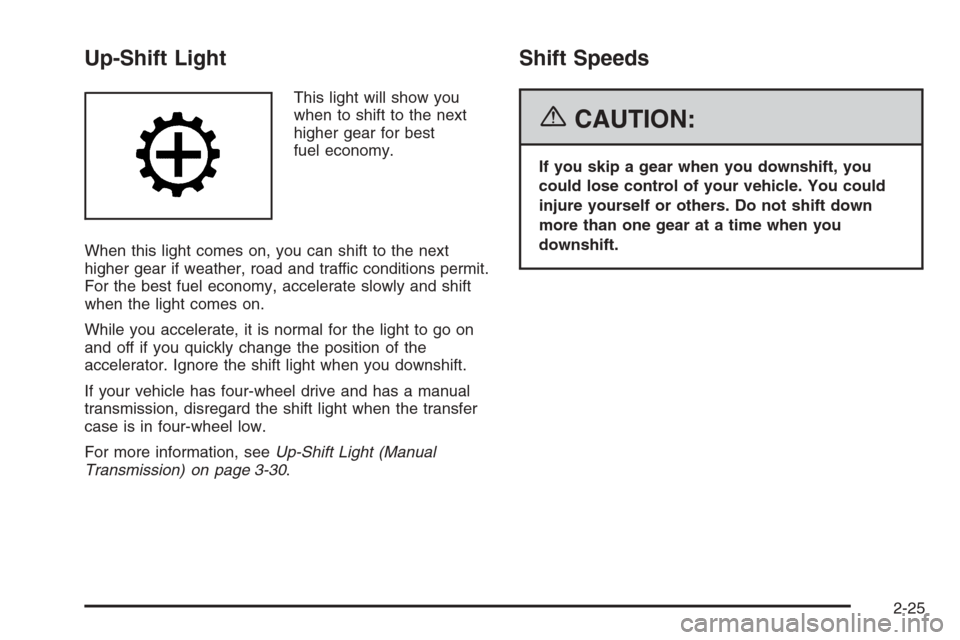
This light will show you
when to shift to the next
higher gear for best
fuel economy.
When this light comes on, you can shift to the next
higher gear if weather, road and traffic conditions permit.
For the best fuel economy, accelerate slowly and shift
when the light comes on.
While you accelerate, it is normal for the light to go on
and off if you quickly change the position of the
accelerator. Ignore the shift light when you downshift.
If your vehicle has four-wheel drive and has a manual
transmission, disregard the shift light when the transfer
case is in four-wheel low.
For more information, seeUp-Shift Light (Manual
Transmission) on page 3-30.
Shift Speeds
{CAUTION:
If you skip a gear when you downshift, you
could lose control of your vehicle. You could
injure yourself or others. Do not shift down
more than one gear at a time when you
downshift.
2-25
Page 115 of 434
{CAUTION:
Shifting the transfer case to NEUTRAL
can cause your vehicle to roll even if the
transmission is in PARK (P), or if you have a
manual transmission, even if you are in gear.
You or someone else could be seriously
injured. Be sure to set the parking brake
before placing the transfer case in NEUTRAL.
SeeParking Brake on page 2-30.
N (NEUTRAL):Shift the vehicle’s transfer case to
NEUTRAL only when towing your vehicle.
4
m(Four-Wheel High):This setting engages your
front axle to help drive your vehicle. Use four-wheel high
when you need extra traction, such as on snowy or
icy roads, or in most off-road situations.
4
n(Four-Wheel Low):This setting also engages your
front axle to give you extra traction. It sends the maximum
power to all four wheels. You might choose four-wheel
low if you were driving off-road in sand, mud, or deep
snow and while climbing or descending steep hills.Indicator lights in the buttons show you which setting you
are in. The indicator lights will come on briey when you
turn on the ignition and one will stay on the selected
setting. If the lights do not come on, you should take your
vehicle in for service. An indicator light will ash while
shifting. It will stay on when the shift is completed.
If for some reason the transfer case does not shift, it will
return to the last chosen setting.
Shifting from Two-Wheel High to
Four-Wheel High
Press and release the Four-Wheel High button. This
can be done at any speed, and the front axle will lock
automatically.
Shifting from Four-Wheel High to
Two-Wheel High
Press and release the Two-Wheel High button. This can
be done at any speed, and the front axle will unlock
automatically.
It is normal to hear and feel your vehicle’s transfer case
shift into Four-Wheel High. If you shift with the vehicle
stopped, the indicator light may still ash slowly. It
may be necessary to shift the transmission momentarily
into REVERSE (R) and DRIVE (D), for an automatic
transmission, or REVERSE (R) and FIRST (1) for
a manual transmission to have the light stop ashing.
2-27
Page 116 of 434
Shifting from Two-Wheel High or
Four-Wheel High to Four-Wheel Low
To shift from Two-Wheel High or Four-Wheel High to
Four-Wheel Low, the vehicle must be stopped or moving
less than 3 mph (5 km/h) with the transmission in
NEUTRAL (N) for an automatic transmission or the
clutch pedal engaged for a manual transmission.
The preferred method for shifting into Four-Wheel
Low is to have your vehicle moving 1 to 2 mph
(1.6 to 3.2 km/h).
Press and release the Four-Wheel Low button.
You must wait for the Four-Wheel Low indicator
light to stop ashing and stay on before shifting the
transmission into gear or releasing the clutch pedal.
If the Four-Wheel Low button is pressed when
your vehicle is in gear and/or moving faster than
3 mph (5 km/h), the four-wheel low indicator light
will ash for 30 seconds and not complete the shift.
Shifting from Four-Wheel Low to
Two-Wheel High or Four-Wheel High
To shift from Four-Wheel Low to Two-Wheel High
or Four-Wheel High, your vehicle must be stopped or
moving less than 3 mph (5 km/h) with the transmission
in NEUTRAL (N) for an automatic transmission or
the clutch pedal engaged for a manual transmission.
The preferred method for shifting out of four-wheel
low is to have your vehicle moving 1 to 2 mph
(1.6 to 3.2 km/h).
Press and release the Four-Wheel High or Two-Wheel
High button. You must wait for the Four-Wheel High
or Two-Wheel High indicator light to stop ashing and
stay on before shifting the transmission into gear or
releasing the clutch pedal.
If the Four-Wheel High or Two-Wheel High button is
pressed when your vehicle is in gear and/or moving
faster than 3 mph (5km/h), the Four-Wheel High or
Two Wheel High indicator light will ash for 30 seconds
but not complete the shift.
2-28