parking brake CHEVROLET COLORADO 2008 1.G Owner's Guide
[x] Cancel search | Manufacturer: CHEVROLET, Model Year: 2008, Model line: COLORADO, Model: CHEVROLET COLORADO 2008 1.GPages: 438, PDF Size: 2.5 MB
Page 289 of 438

Checking the Fluid Level
Prepare your vehicle as follows:
1. Park your vehicle on a level place. Keep the engine
running.
2. With the parking brake applied, place the shift lever
in P (PARK).
3. With your foot on the brake pedal, move the shift
lever through each gear range, pausing for about
three seconds in each range. Then, position
the shift lever in P (PARK).
4. Let the engine run at idle for three minutes or more.
Then, without shutting off the engine, follow these steps:
1. Flip the handle up and then pull out the dipstick and
wipe it with a clean rag or paper towel.
The automatic transmission
dipstick handle with this
symbol on it is located in
the engine compartment on
the passenger’s side of the
vehicle.
SeeEngine Compartment Overview on page 5-12
for more information on location.
2. Push it back in all the way, wait three seconds and
then pull it back out again.3. Check both sides of the dipstick, and read the lower
level. The uid level must be in the COLD area,
below the cross-hatched area, for a cold check or in
the HOT or cross-hatched area for a hot check.
Be sure to keep the dipstick pointed down to get an
accurate reading.
4. If the uid level is in the acceptable range, push the
dipstick back in all the way; then ip the handle
down to lock the dipstick in place.
5-23
Page 310 of 438
Jump Starting
If your vehicle’s battery has run down, you may want to
use another vehicle and some jumper cables to start
your vehicle. Be sure to use the following steps to do it
safely.
{CAUTION:
Batteries can hurt you. They can be dangerous
because:
They contain acid that can burn you.
They contain gas that can explode or
ignite.
They contain enough electricity to
burn you.
If you do not follow these steps exactly, some
or all of these things can hurt you.
Notice:Ignoring these steps could result in costly
damage to your vehicle that would not be covered by
your warranty.
Trying to start your vehicle by pushing or pulling it
will not work, and it could damage your vehicle.
1. Check the other vehicle. It must have a 12-volt
battery with a negative ground system.Notice:If the other vehicle’s system is not a 12-volt
system with a negative ground, both vehicles can be
damaged. Only use vehicles with 12-volt systems
with negative grounds to jump start your vehicle.
2. Get the vehicles close enough so the jumper cables
can reach, but be sure the vehicles are not touching
each other. If they are, it could cause a ground
connection you do not want. You would not be able
to start your vehicle, and the bad grounding
could damage the electrical systems.
To avoid the possibility of the vehicles rolling, set the
parking brake rmly on both vehicles involved in the
jump start procedure. Put an automatic transmission
in PARK (P) or a manual transmission in NEUTRAL
before setting the parking brake. If you have a
four-wheel-drive vehicle, be sure the transfer case is
not in NEUTRAL.
Notice:If you leave your radio or other accessories
on during the jump starting procedure, they could
be damaged. The repairs would not be covered
by your warranty. Always turn off your radio and
other accessories when jump starting your vehicle.
3. Turn off the ignition on both vehicles. Unplug
unnecessary accessories plugged into the cigarette
lighter or the accessory power outlets. Turn off
the radio and all lamps that are not needed. This
will avoid sparks and help save both batteries. And
it could save the radio!
5-44
Page 339 of 438
TPMS Sensor Matching Process
Each TPMS sensor has a unique identication code.
Any time you replace one or more of the TPMS sensors
or rotate your vehicle’s tires, the identication codes
need to be matched to the new tire/wheel position. The
sensors are matched to the tire/wheel positions in
the following order: driver side front tire, passenger side
front tire, passenger side rear tire, and driver side
rear tire using a TPMS diagnostic tool. See your
dealer/retailer for service.
The TPMS sensors can also be matched to each
tire/wheel position by increasing or decreasing the tire’s
air pressure. If increasing the tire’s air pressure, do
not exceed the maximum ination pressure indicated on
the tire’s sidewall. To let air-pressure out of a tire you
can use the pointed end of the valve cap, a pencil-style
air pressure gage, or a key.
You have one minute to match the rst tire/wheel
position, and ve minutes overall, to match all four
tire/wheel positions. If it takes longer than one minute,
to match the rst tire and wheel, or more than
ve minutes to match all four tire and wheel positions,
the matching process stops and you need to start over.The TPMS sensor matching procedure is outlined
below:
1. Set the parking brake.
2. Turn the ignition switch to ON/RUN with the
engine off.
3. Turn the exterior lamp switch from AUTO to OFF
four times within three seconds. A double horn
chirp will sound and the TPMS low tire warning light
starts ashing. The double horn chirp and ashing
TPMS warning light indicates the TPMS matching
process has started. The TPMS warning light should
continue ashing throughout the matching
procedure. The LOW TIRE message displays on
the Driver Information Center (DIC).
4. Start with the driver side front tire.
5. Remove the valve cap from the valve cap stem.
Activate the TPMS sensor by increasing or
decreasing the tire’s air pressure for 10 seconds,
then stop and listen for a single horn chirp.
The single horn chirp should sound within
15 seconds, conrming that the sensor identication
code has been matched to this tire and wheel
position. If you do not hear the conrming single
horn chirp, turn the ignition switch to LOCK and start
over beginning with Step 2.
5-73
Page 350 of 438

Changing a Flat Tire
If a tire goes at, avoid further tire and wheel damage
by driving slowly to a level place. Turn on your
hazard warning ashers. SeeHazard Warning Flashers
on page 3-5for more information.
{CAUTION:
Changing a tire can be dangerous. The vehicle
can slip off the jack and roll over or fall on you
or other people. You and they could be badly
injured or even killed. Find a level place to
change your tire. To help prevent the vehicle
from moving:
1. Set the parking brake rmly.
2. Put the shift lever in PARK (P).
CAUTION: (Continued)
CAUTION: (Continued)
3. If you have a four-wheel-drive vehicle,
be sure the transfer case is in a drive
gear – not in NEUTRAL.
4. Turn off the engine and do not restart
while the vehicle is raised.
5. Do not allow passengers to remain in the
vehicle.
To be even more certain the vehicle will not
move, put blocks at the front and rear of the
tire farthest away from the one being changed.
That would be the tire on the other side, at the
opposite end of the vehicle.
5-84
Page 383 of 438
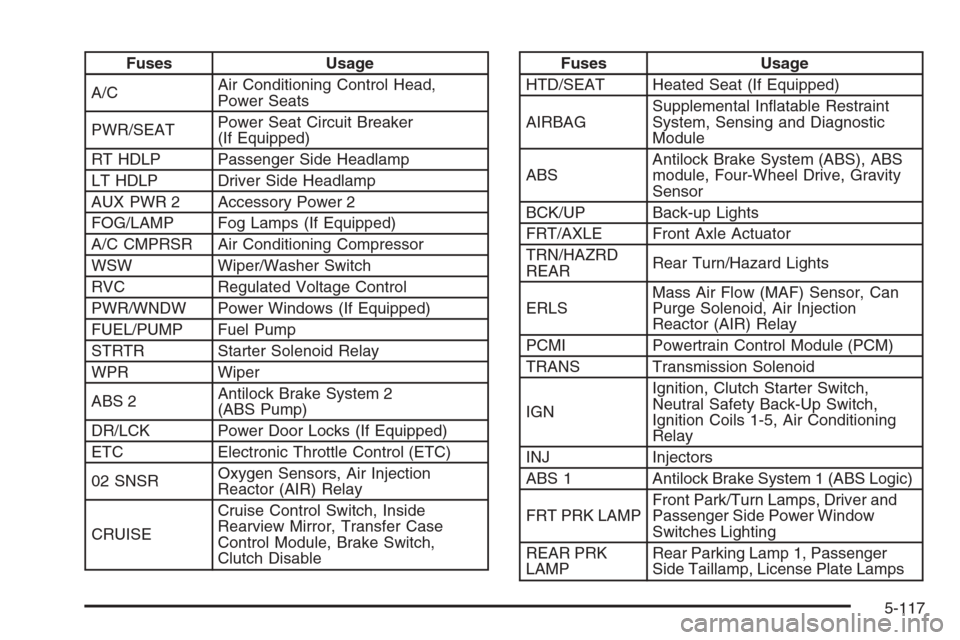
Fuses Usage
A/CAir Conditioning Control Head,
Power Seats
PWR/SEATPower Seat Circuit Breaker
(If Equipped)
RT HDLP Passenger Side Headlamp
LT HDLP Driver Side Headlamp
AUX PWR 2 Accessory Power 2
FOG/LAMP Fog Lamps (If Equipped)
A/C CMPRSR Air Conditioning Compressor
WSW Wiper/Washer Switch
RVC Regulated Voltage Control
PWR/WNDW Power Windows (If Equipped)
FUEL/PUMP Fuel Pump
STRTR Starter Solenoid Relay
WPR Wiper
ABS 2Antilock Brake System 2
(ABS Pump)
DR/LCK Power Door Locks (If Equipped)
ETC Electronic Throttle Control (ETC)
02 SNSROxygen Sensors, Air Injection
Reactor (AIR) Relay
CRUISECruise Control Switch, Inside
Rearview Mirror, Transfer Case
Control Module, Brake Switch,
Clutch DisableFuses Usage
HTD/SEAT Heated Seat (If Equipped)
AIRBAGSupplemental Inatable Restraint
System, Sensing and Diagnostic
Module
ABSAntilock Brake System (ABS), ABS
module, Four-Wheel Drive, Gravity
Sensor
BCK/UP Back-up Lights
FRT/AXLE Front Axle Actuator
TRN/HAZRD
REARRear Turn/Hazard Lights
ERLSMass Air Flow (MAF) Sensor, Can
Purge Solenoid, Air Injection
Reactor (AIR) Relay
PCMI Powertrain Control Module (PCM)
TRANS Transmission Solenoid
IGNIgnition, Clutch Starter Switch,
Neutral Safety Back-Up Switch,
Ignition Coils 1-5, Air Conditioning
Relay
INJ Injectors
ABS 1 Antilock Brake System 1 (ABS Logic)
FRT PRK LAMPFront Park/Turn Lamps, Driver and
Passenger Side Power Window
Switches Lighting
REAR PRK
LAMPRear Parking Lamp 1, Passenger
Side Taillamp, License Plate Lamps
5-117
Page 393 of 438

Maintenance Footnotes
(a)Visually inspect brake lines and hoses for proper
hook-up, binding, leaks, cracks, chafing, etc. Inspect
disc brake pads for wear and rotors for surface
condition. Inspect drum brake linings/shoes for wear or
cracks. Inspect other brake parts, including drums,
wheel cylinders, calipers, parking brake, etc. Check
parking brake adjustment.
(b)Visually inspect front and rear suspension and
steering system for damaged, loose, or missing parts or
signs of wear. Inspect power steering lines and hoses
for proper hook-up, binding, leaks, cracks, chafing,
etc. Visually check constant velocity joints, rubber boots,
and axle seals for leaks.
(c)Visually inspect hoses and have them replaced if they
are cracked, swollen, or deteriorated. Inspect all pipes,
fittings, and clamps; replace with genuine parts as
needed. To help ensure proper operation, a pressure test
of the cooling system and pressure cap and cleaning the
outside of the radiator and air conditioning condenser is
recommended at least once a year.
(d)Inspect wiper blades for wear, cracking, or
contamination. Clean the windshield and wiper blades, if
contaminated. Replace wiper blades that are worn or
damaged. See Windshield Wiper Blade Replacement on
page 5-57 and Windshield and Wiper Blades on
page 5-110 for more information.(e)Make sure the safety belt reminder light and safety
belt assemblies are working properly. Look for any
other loose or damaged safety belt system parts. If you
see anything that might keep a safety belt system
from doing its job, have it repaired. Have any torn or
frayed safety belts replaced. Also see Checking
the Restraint Systems on page 1-76.
(f)Lubricate all key lock cylinders, body door and fuel
door hinges, latches and locks (including glove box and
console doors), hood latch assembly, secondary
latch, pivots, spring anchor, release pawl, and any
moving seat hardware. Lubricate hood safety lever pivot
and prop rod pivot and tailgate latch bolt, handle
assembly pivot points, and hinges. More frequent
lubrication may be required when exposed to a corrosive
environment. Applying silicone grease on weatherstrips
with a clean cloth will make them last longer, seal
better, and not stick or squeak.
(g)A fluid loss in any vehicle system could indicate a
problem. Have the system inspected and repaired
and the fluid level checked. Add fluid if needed.
6-7
Page 396 of 438
At Least Once a Year
Starter Switch Check
{CAUTION:
When you are doing this inspection, the
vehicle could move suddenly. If the vehicle
moves, you or others could be injured.
1. Before you start, be sure you have enough room
around the vehicle.
2. Firmly apply both the parking brake and the regular
brake. SeeParking Brake on page 2-32.
Do not use the accelerator pedal, and be ready to
turn off the engine immediately if it starts.
3. On automatic transmission vehicles, try to start the
engine in each gear. The vehicle should start only in
PARK (P) or NEUTRAL (N). If the vehicle starts in
any other position, contact your dealer/retailer for
service.
On manual transmission vehicles, put the shift lever
in NEUTRAL, push the clutch pedal down halfway,
and try to start the engine. The vehicle should
start only when the clutch pedal is pushed down all
the way to the oor. If the vehicle starts when
the clutch pedal is not pushed all the way down,
contact your dealer/retailer for service.
Automatic Transmission Shift Lock
Control System Check
{CAUTION:
When you are doing this inspection, the
vehicle could move suddenly. If the vehicle
moves, you or others could be injured.
1. Before you start, be sure you have enough room
around the vehicle. It should be parked on a level
surface.
2. Firmly apply the parking brake. SeeParking Brake
on page 2-32.
Be ready to apply the regular brake immediately if
the vehicle begins to move.
3. With the engine off, turn the ignition to ON/RUN, but
do not start the engine. Without applying the regular
brake, try to move the shift lever out of PARK (P) with
normal effort. If the shift lever moves out of
PARK (P), contact your dealer/retailer for service.
6-10
Page 397 of 438
Ignition Transmission Lock Check
While parked, and with the parking brake set, try to turn
the ignition to LOCK/OFF in each shift lever position.
With an automatic transmission, the ignition
should turn to LOCK/OFF only when the shift lever
is in PARK (P). The ignition key should come
out only in LOCK/OFF.
With a manual transmission, the ignition key should
come out only in LOCK/OFF.
Contact your dealer/retailer if service is required.
Parking Brake and Automatic
Transmission Park (P) Mechanism
Check
{CAUTION:
When you are doing this check, your vehicle
could begin to move. You or others could be
injured and property could be damaged. Make
sure there is room in front of your vehicle in
case it begins to roll. Be ready to apply the
regular brake at once should the vehicle begin
to move.Park on a fairly steep hill, with the vehicle facing
downhill. Keeping your foot on the regular brake, set the
parking brake.
To check the parking brake’s holding ability: With
the engine running and transmission in
NEUTRAL (N), slowly remove foot pressure from
the regular brake pedal. Do this until the vehicle is
held by the parking brake only.
To check the PARK (P) mechanism’s holding ability:
With the engine running, shift to PARK (P). Then
release the parking brake followed by the regular
brake.
Contact your dealer/retailer if service is required.
Underbody Flushing Service
At least every spring, use plain water to ush any
corrosive materials from the underbody. Take care to
clean thoroughly any areas where mud and other debris
can collect.
6-11
Page 398 of 438

Recommended Fluids and
Lubricants
Fluids and lubricants identied below by name, part
number, or specication can be obtained from your
dealer/retailer.
Usage Fluid/Lubricant
Engine OilEngine oil which meets
GM Standard GM6094M and
displays the American Petroleum
Institute Certied for Gasoline
Engines starburst symbol. To
determine the proper viscosity for
your vehicle’s engine, seeEngine
Oil on page 5-15.
Engine Coolant50/50 mixture of clean, drinkable
water and use only DEX-COOL
®
Coolant. SeeEngine Coolant on
page 5-27.
Hydraulic Brake
SystemDelco
®Supreme 11 Brake Fluid or
equivalent DOT-3 brake uid.
Windshield
WasherOptikleen
®Washer Solvent.
Parking Brake
Cable GuidesChassis Lubricant
(GM Part No. U.S. 12377985,
in Canada 88901242) or lubricant
meeting requirements of NLGI #2,
Category LB or GC-LB.
Usage Fluid/Lubricant
Power Steering
SystemGM Power Steering Fluid
(GM Part No. U.S. 89021184,
in Canada 89021186).
Automatic
TransmissionDEXRON
®-VI Automatic
Transmission Fluid.
Manual
TransmissionManual Transmission Fluid
(GM Part No. U.S. 89021806,
in Canada 89021807).
Hydraulic
Clutch SystemHydraulic Clutch Fluid
(GM Part No. U.S. 12345347,
in Canada 10953517) or equivalent
DOT-3 brake uid.
Key Lock
CylindersMulti-Purpose Lubricant, Superlube
(GM Part No. U.S. 12346241,
in Canada 10953474).
Chassis
LubricationChassis Lubricant
(GM Part No. U.S. 12377985,
in Canada 88901242) or lubricant
meeting requirements of NLGI #2,
Category LB or GC-LB.
Front and
Rear AxleSAE 75W-90 Synthetic
Axle Lubricant (GM Part
No. U.S. 89021677,
in Canada 89021678) meeting
GM Specication 9986115.
6-12
Page 426 of 438

Audio System (cont.)
Theft-Deterrent Feature................................3-67
XM™ Satellite Radio Antenna System............3-69
Audio System(s).............................................3-47
Automatic Headlamp System............................3-15
Automatic Transmission
Fluid..........................................................5-21
Operation...................................................2-24
B
Battery..........................................................5-43
Electric Power Management..........................3-17
Run-Down Protection...................................3-18
Brake
Emergencies................................................ 4-5
Brakes..........................................................5-39
System Warning Light..................................3-30
Braking........................................................... 4-3
Braking in Emergencies..................................... 4-5
Break-In, New Vehicle.....................................2-19
Bulb Replacement...........................................5-51
Center High-Mounted Stoplamp (CHMSL)........5-54
Front Turn Signal, Parking and Daytime
Running Lamps........................................5-53
Halogen Bulbs............................................5-51
Headlamp Aiming........................................5-51
Headlamps.................................................5-52Bulb Replacement (cont.)
License Plate Lamps....................................5-56
Replacement Bulbs......................................5-56
Taillamps, Turn Signal, Stoplamps and
Back-up Lamps........................................5-54
Buying New Tires...........................................5-76
C
Calibration.............................................2-40, 2-43
California Fuel.................................................. 5-6
California Perchlorate Materials Requirements....... 5-4
California Proposition 65 Warning....................... 5-4
Canadian Owners................................................ ii
Capacities and Specications..........................5-119
Carbon Monoxide...........................2-10, 2-37, 4-28
Care of
Safety Belts..............................................5-108
CD, MP3 .......................................................3-63
Center Console Storage Area...........................2-50
Center High-Mounted Stoplamp (CHMSL)...........5-54
Chains, Tire...................................................5-82
Charging System Light....................................3-29
Check
Engine Light...............................................3-33
Checking Things Under the Hood......................5-10
Chemical Paint Spotting.................................5-112
2