ECU CHEVROLET COLORADO 2012 1.G Workshop Manual
[x] Cancel search | Manufacturer: CHEVROLET, Model Year: 2012, Model line: COLORADO, Model: CHEVROLET COLORADO 2012 1.GPages: 394, PDF Size: 6.38 MB
Page 260 of 394
Black plate (22,1)Chevrolet Colorado Owner Manual - 2012
10-22 Vehicle Care
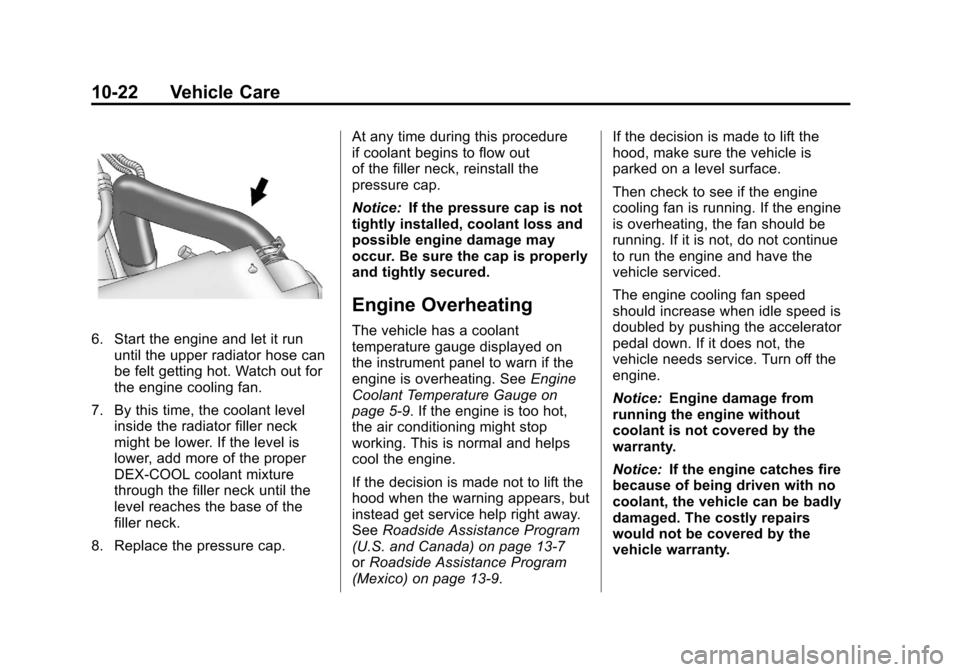
6. Start the engine and let it rununtil the upper radiator hose can
be felt getting hot. Watch out for
the engine cooling fan.
7. By this time, the coolant level inside the radiator filler neck
might be lower. If the level is
lower, add more of the proper
DEX‐COOL coolant mixture
through the filler neck until the
level reaches the base of the
filler neck.
8. Replace the pressure cap. At any time during this procedure
if coolant begins to flow out
of the filler neck, reinstall the
pressure cap.
Notice:
If the pressure cap is not
tightly installed, coolant loss and
possible engine damage may
occur. Be sure the cap is properly
and tightly secured.
Engine Overheating
The vehicle has a coolant
temperature gauge displayed on
the instrument panel to warn if the
engine is overheating. See Engine
Coolant Temperature Gauge on
page 5‑9. If the engine is too hot,
the air conditioning might stop
working. This is normal and helps
cool the engine.
If the decision is made not to lift the
hood when the warning appears, but
instead get service help right away.
See Roadside Assistance Program
(U.S. and Canada) on page 13‑7
or Roadside Assistance Program
(Mexico) on page 13‑9. If the decision is made to lift the
hood, make sure the vehicle is
parked on a level surface.
Then check to see if the engine
cooling fan is running. If the engine
is overheating, the fan should be
running. If it is not, do not continue
to run the engine and have the
vehicle serviced.
The engine cooling fan speed
should increase when idle speed is
doubled by pushing the accelerator
pedal down. If it does not, the
vehicle needs service. Turn off the
engine.
Notice:
Engine damage from
running the engine without
coolant is not covered by the
warranty.
Notice: If the engine catches fire
because of being driven with no
coolant, the vehicle can be badly
damaged. The costly repairs
would not be covered by the
vehicle warranty.
Page 274 of 394
Black plate (36,1)Chevrolet Colorado Owner Manual - 2012
10-36 Vehicle Care
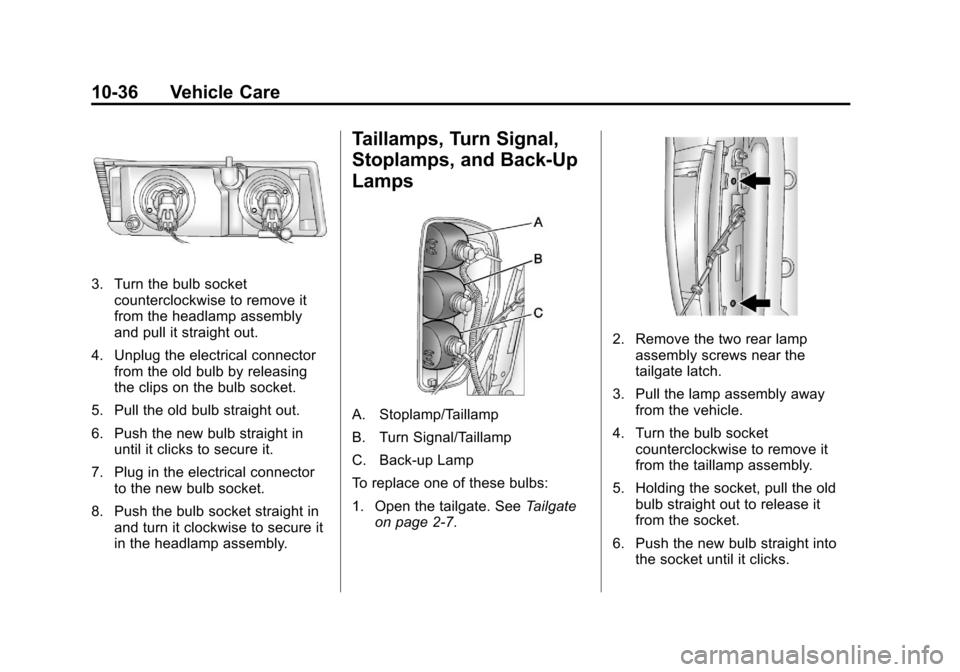
3. Turn the bulb socketcounterclockwise to remove it
from the headlamp assembly
and pull it straight out.
4. Unplug the electrical connector from the old bulb by releasing
the clips on the bulb socket.
5. Pull the old bulb straight out.
6. Push the new bulb straight in until it clicks to secure it.
7. Plug in the electrical connector to the new bulb socket.
8. Push the bulb socket straight in and turn it clockwise to secure it
in the headlamp assembly.
Taillamps, Turn Signal,
Stoplamps, and Back-Up
Lamps
A. Stoplamp/Taillamp
B. Turn Signal/Taillamp
C. Back‐up Lamp
To replace one of these bulbs:
1. Open the tailgate. See Tailgate
on page 2‑7.
2. Remove the two rear lamp assembly screws near the
tailgate latch.
3. Pull the lamp assembly away from the vehicle.
4. Turn the bulb socket counterclockwise to remove it
from the taillamp assembly.
5. Holding the socket, pull the old bulb straight out to release it
from the socket.
6. Push the new bulb straight into the socket until it clicks.
Page 275 of 394
Black plate (37,1)Chevrolet Colorado Owner Manual - 2012
Vehicle Care 10-37
7. Insert the bulb socket into thetaillamp assembly and turn it
clockwise to secure.
8. Reinstall the taillamp assembly and tighten the screws.
Center High-Mounted
Stoplamp (CHMSL)
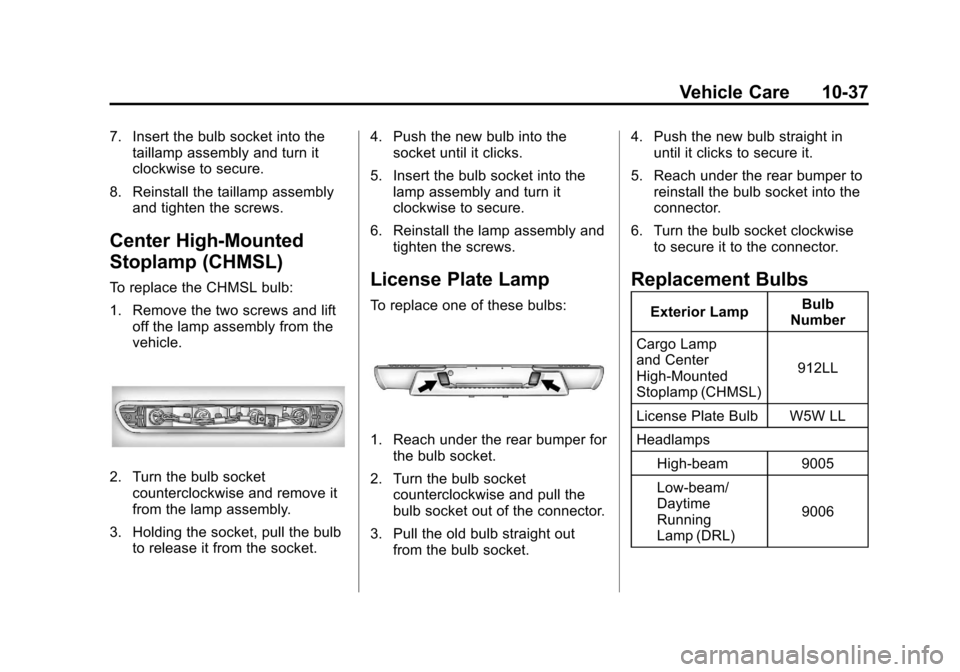
To replace the CHMSL bulb:
1. Remove the two screws and liftoff the lamp assembly from the
vehicle.
2. Turn the bulb socketcounterclockwise and remove it
from the lamp assembly.
3. Holding the socket, pull the bulb to release it from the socket. 4. Push the new bulb into the
socket until it clicks.
5. Insert the bulb socket into the lamp assembly and turn it
clockwise to secure.
6. Reinstall the lamp assembly and tighten the screws.
License Plate Lamp
To replace one of these bulbs:
1. Reach under the rear bumper forthe bulb socket.
2. Turn the bulb socket counterclockwise and pull the
bulb socket out of the connector.
3. Pull the old bulb straight out from the bulb socket. 4. Push the new bulb straight in
until it clicks to secure it.
5. Reach under the rear bumper to reinstall the bulb socket into the
connector.
6. Turn the bulb socket clockwise to secure it to the connector.
Replacement Bulbs
Exterior Lamp Bulb
Number
Cargo Lamp
and Center
High‐Mounted
Stoplamp (CHMSL) 912LL
License Plate Bulb W5W LL
Headlamps High-beam 9005
Low-beam/
Daytime
Running
Lamp (DRL) 9006
Page 305 of 394
Black plate (67,1)Chevrolet Colorado Owner Manual - 2012
Vehicle Care 10-67
Notice:If your vehicle has a tire
size other than P215/70R16,
P235/75R16, P265/70R17, P235/
50R18, or P265/65R18 use tire
chains only where legal and only
when you must. Use chains that
are the proper size for your tires.
Install them on the tires of the
rear axle. Do not use chains on
the tires of the front axle. Tighten
them as tightly as possible with
the ends securely fastened.
Drive slowly and follow the chain
manufacturer's instructions.
If you can hear the chains
contacting your vehicle, stop
and retighten them. If the contact
continues, slow down until it
stops. Driving too fast or
spinning the wheels with chains
on will damage your vehicle.If a Tire Goes Flat
It is unusual for a tire to blowout
while driving, especially if the tires
are maintained properly. If air goes
out of a tire, it is much more likely to
leak out slowly. But if there ever is a
blowout, here are a few tips about
what to expect and what to do:
If a front tire fails, the flat tire
creates a drag that pulls the vehicle
toward that side. Take your foot off
the accelerator pedal and grip the
steering wheel firmly. Steer to
maintain lane position, and then
gently brake to a stop, well off the
road, if possible.
A rear blowout, particularly on a
curve, acts much like a skid and
may require the same correction
as used in a skid. Stop pressing
the accelerator pedal and steer to straighten the vehicle. It may
be very bumpy and noisy. Gently
brake to a stop, well off the road,
if possible.
{WARNING
Driving on a flat tire will cause
permanent damage to the tire.
Re-inflating a tire after it has
been driven on while severely
underinflated or flat may cause
a blowout and a serious crash.
Never attempt to re-inflate a tire
that has been driven on while
severely underinflated or flat.
Have your dealer or an authorized
tire service center repair or
replace the flat tire as soon as
possible.
Page 312 of 394
Black plate (74,1)Chevrolet Colorado Owner Manual - 2012
10-74 Vehicle Care
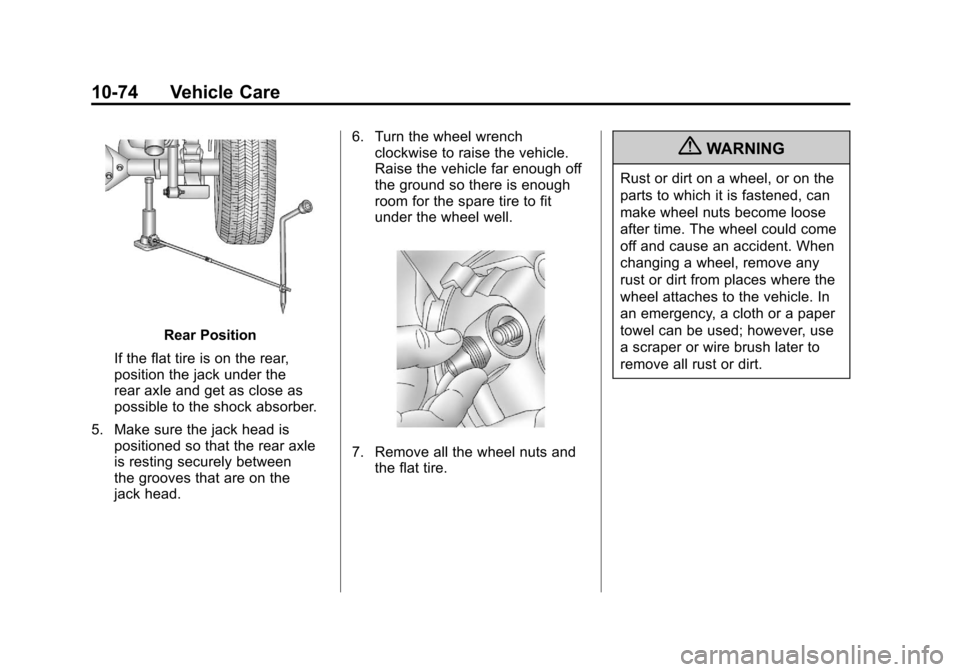
Rear Position
If the flat tire is on the rear,
position the jack under the
rear axle and get as close as
possible to the shock absorber.
5. Make sure the jack head is positioned so that the rear axle
is resting securely between
the grooves that are on the
jack head. 6. Turn the wheel wrench
clockwise to raise the vehicle.
Raise the vehicle far enough off
the ground so there is enough
room for the spare tire to fit
under the wheel well.
7. Remove all the wheel nuts andthe flat tire.
{WARNING
Rust or dirt on a wheel, or on the
parts to which it is fastened, can
make wheel nuts become loose
after time. The wheel could come
off and cause an accident. When
changing a wheel, remove any
rust or dirt from places where the
wheel attaches to the vehicle. In
an emergency, a cloth or a paper
towel can be used; however, use
a scraper or wire brush later to
remove all rust or dirt.
Page 316 of 394
Black plate (78,1)Chevrolet Colorado Owner Manual - 2012
10-78 Vehicle Care
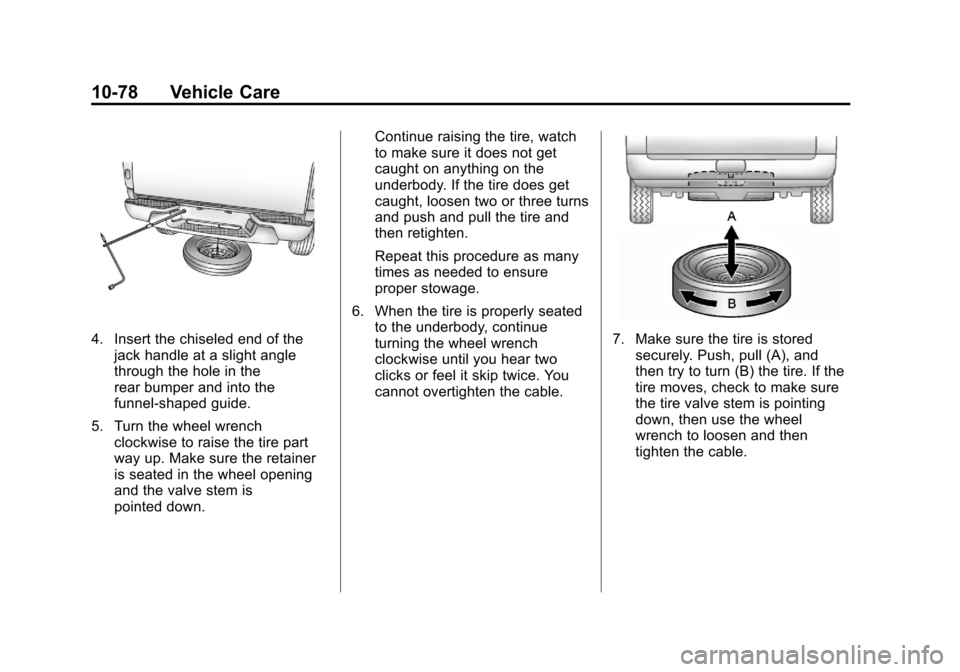
4. Insert the chiseled end of thejack handle at a slight angle
through the hole in the
rear bumper and into the
funnel-shaped guide.
5. Turn the wheel wrench clockwise to raise the tire part
way up. Make sure the retainer
is seated in the wheel opening
and the valve stem is
pointed down. Continue raising the tire, watch
to make sure it does not get
caught on anything on the
underbody. If the tire does get
caught, loosen two or three turns
and push and pull the tire and
then retighten.
Repeat this procedure as many
times as needed to ensure
proper stowage.
6. When the tire is properly seated to the underbody, continue
turning the wheel wrench
clockwise until you hear two
clicks or feel it skip twice. You
cannot overtighten the cable.7. Make sure the tire is storedsecurely. Push, pull (A), and
then try to turn (B) the tire. If the
tire moves, check to make sure
the tire valve stem is pointing
down, then use the wheel
wrench to loosen and then
tighten the cable.
Page 317 of 394
Black plate (79,1)Chevrolet Colorado Owner Manual - 2012
Vehicle Care 10-79
To store the tools:
1. Return the tools to thestorage bag.
2. Attach the storage bag to the floor under the front
passenger seat.
3. Reinstall the wing nut to secure the bag to the vehicle. To store the jack and wheel blocks:
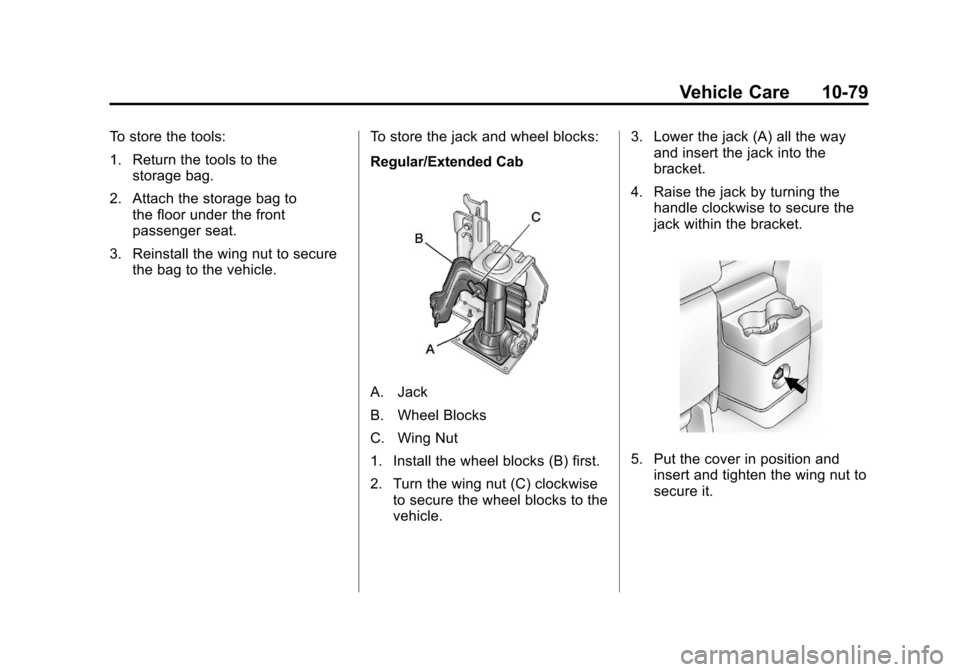
Regular/Extended Cab
A. Jack
B. Wheel Blocks
C. Wing Nut
1. Install the wheel blocks (B) first.
2. Turn the wing nut (C) clockwise
to secure the wheel blocks to the
vehicle. 3. Lower the jack (A) all the way
and insert the jack into the
bracket.
4. Raise the jack by turning the handle clockwise to secure the
jack within the bracket.
5. Put the cover in position andinsert and tighten the wing nut to
secure it.
Page 318 of 394
Black plate (80,1)Chevrolet Colorado Owner Manual - 2012
10-80 Vehicle Care
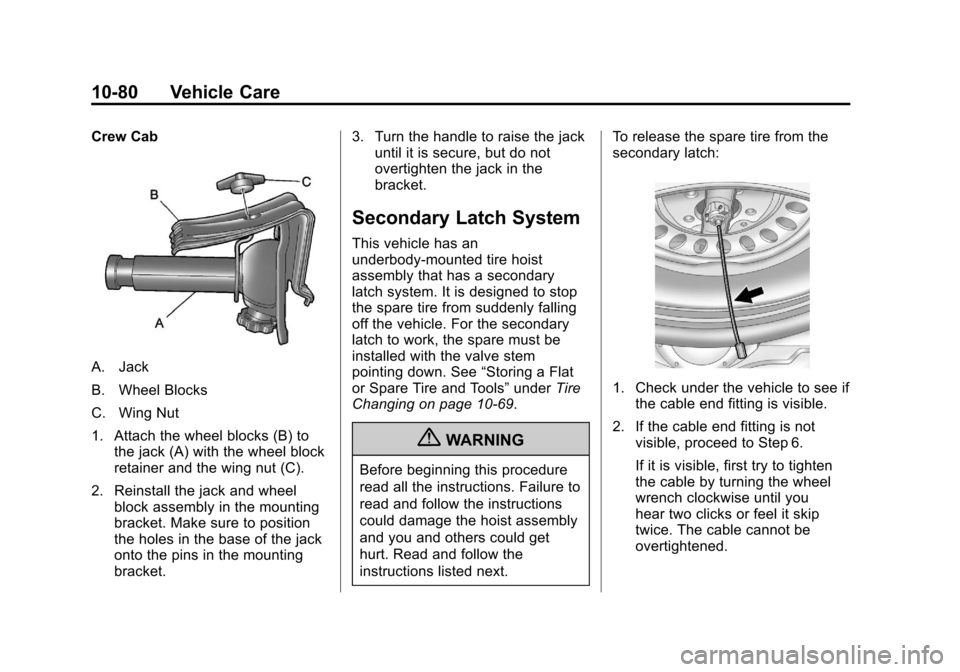
Crew Cab
A. Jack
B. Wheel Blocks
C. Wing Nut
1. Attach the wheel blocks (B) tothe jack (A) with the wheel block
retainer and the wing nut (C).
2. Reinstall the jack and wheel block assembly in the mounting
bracket. Make sure to position
the holes in the base of the jack
onto the pins in the mounting
bracket. 3. Turn the handle to raise the jack
until it is secure, but do not
overtighten the jack in the
bracket.
Secondary Latch System
This vehicle has an
underbody‐mounted tire hoist
assembly that has a secondary
latch system. It is designed to stop
the spare tire from suddenly falling
off the vehicle. For the secondary
latch to work, the spare must be
installed with the valve stem
pointing down. See “Storing a Flat
or Spare Tire and Tools” underTire
Changing on page 10‑69.
{WARNING
Before beginning this procedure
read all the instructions. Failure to
read and follow the instructions
could damage the hoist assembly
and you and others could get
hurt. Read and follow the
instructions listed next. To release the spare tire from the
secondary latch:
1. Check under the vehicle to see if
the cable end fitting is visible.
2. If the cable end fitting is not visible, proceed to Step 6.
If it is visible, first try to tighten
the cable by turning the wheel
wrench clockwise until you
hear two clicks or feel it skip
twice. The cable cannot be
overtightened.
Page 319 of 394
Black plate (81,1)Chevrolet Colorado Owner Manual - 2012
Vehicle Care 10-81
3. Loosen the cable by turning thewheel wrench counterclockwise
three or four turns.
4. Repeat this procedure at least two times. If the spare tire
lowers to the ground, continue
with Step 5 under “Storing a Flat
or Spare Tire and Tools” under
Tire Changing on page 10‑69.
5. Turn the wrench counterclockwise until
approximately 15 cm (6 in) of
cable is exposed.
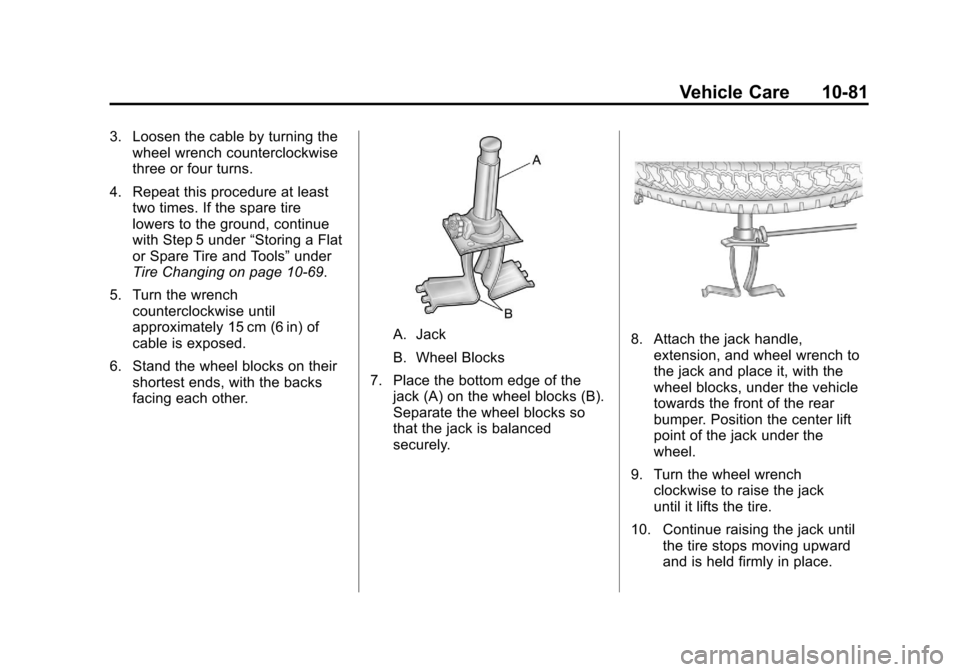
6. Stand the wheel blocks on their shortest ends, with the backs
facing each other.
A. Jack
B. Wheel Blocks
7. Place the bottom edge of the jack (A) on the wheel blocks (B).
Separate the wheel blocks so
that the jack is balanced
securely.8. Attach the jack handle,extension, and wheel wrench to
the jack and place it, with the
wheel blocks, under the vehicle
towards the front of the rear
bumper. Position the center lift
point of the jack under the
wheel.
9. Turn the wheel wrench clockwise to raise the jack
until it lifts the tire.
10. Continue raising the jack until the tire stops moving upward
and is held firmly in place.
Page 328 of 394
Black plate (90,1)Chevrolet Colorado Owner Manual - 2012
10-90 Vehicle Care
Dinghy Towing
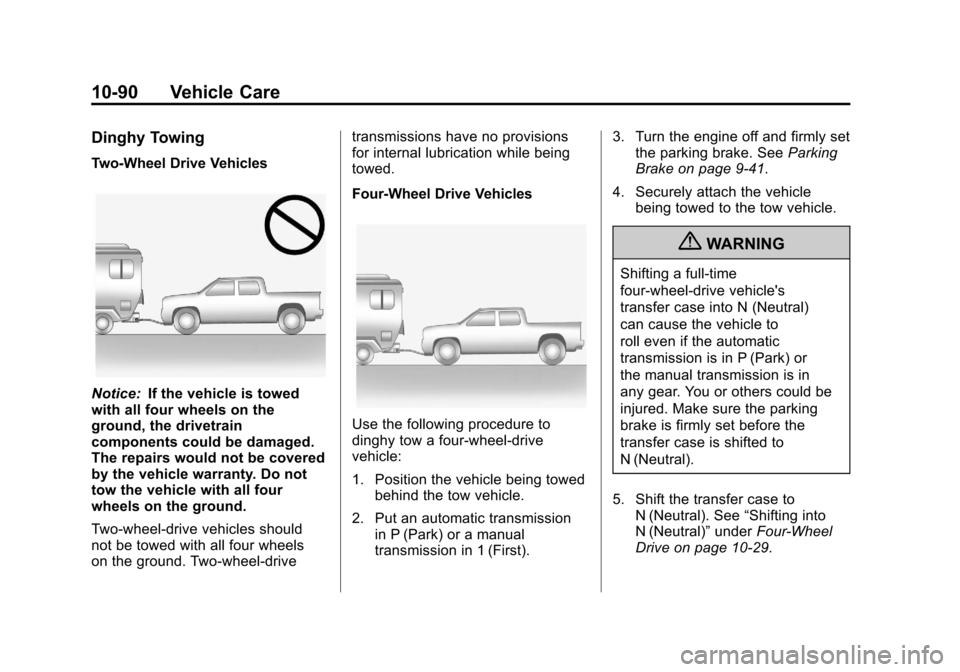
Two-Wheel Drive Vehicles
Notice:If the vehicle is towed
with all four wheels on the
ground, the drivetrain
components could be damaged.
The repairs would not be covered
by the vehicle warranty. Do not
tow the vehicle with all four
wheels on the ground.
Two-wheel-drive vehicles should
not be towed with all four wheels
on the ground. Two-wheel-drive transmissions have no provisions
for internal lubrication while being
towed.
Four-Wheel Drive Vehicles
Use the following procedure to
dinghy tow a four-wheel-drive
vehicle:
1. Position the vehicle being towed
behind the tow vehicle.
2. Put an automatic transmission in P (Park) or a manual
transmission in 1 (First). 3. Turn the engine off and firmly set
the parking brake. See Parking
Brake on page 9‑41.
4. Securely attach the vehicle being towed to the tow vehicle.
{WARNING
Shifting a full‐time
four‐wheel‐drive vehicle's
transfer case into N (Neutral)
can cause the vehicle to
roll even if the automatic
transmission is in P (Park) or
the manual transmission is in
any gear. You or others could be
injured. Make sure the parking
brake is firmly set before the
transfer case is shifted to
N (Neutral).
5. Shift the transfer case to N (Neutral). See “Shifting into
N (Neutral)” underFour-Wheel
Drive on page 10‑29.