cooling CHEVROLET COLORADO 2017 2.G User Guide
[x] Cancel search | Manufacturer: CHEVROLET, Model Year: 2017, Model line: COLORADO, Model: CHEVROLET COLORADO 2017 2.GPages: 419, PDF Size: 7.38 MB
Page 273 of 419
Chevrolet Colorado Owner Manual (GMNA-Localizing-U.S./Canada/Mexico-10122675) - 2017 - crc - 8/22/16
272 Driving and Operating
minutes before turning the engineoff. If the overheat warning comeson, seeEngine Overheating0296.
Parking on Hills
{Warning
Parking the vehicle on a hill with
the trailer attached can be
dangerous. If something goes
wrong, the rig could start to move.
People can be injured, and both
the vehicle and the trailer can be
damaged. When possible, always
park the rig on a flat surface.
If parking the rig on a hill:
1. Press the brake pedal, but donot shift into P (Park) yet. Turnthe wheels into the curb iffacing downhill or into traffic iffacing uphill.
2. Have someone place chocksunder the trailer wheels.
3. When the wheel chocks are inplace, release the regularbrakes until the chocks absorbthe load.
4. Reapply the brake pedal. Thenapply the parking brake andshift into P (Park).
5. Release the brake pedal.
Leaving After Parking on a Hill
1. Apply and hold the brakepedal.
2. Start the engine.
3. Shift into a gear.
4. Release the parking brake.
5. Let up on the brake pedal.
6. Drive slowly until the trailer isclear of the chocks.
7. Stop and have someone pickup and store the chocks.
Maintenance when Trailer
Towing
The vehicle needs service moreoften when pulling a trailer. SeeMaintenance Schedule0366.Things that are especially importantin trailer operation are automatictransmission fluid, engine oil, axlelubricant, belts, cooling system, and
brake system. It is a good idea toinspect these before and duringthe trip.
Check periodically to see that allhitch nuts and bolts are tight.
Trailer Towing
Do not tow a trailer during break-in.SeeNew Vehicle Break-In0232.
{Warning
The driver can lose control when
pulling a trailer if the correct
equipment is not used or the
vehicle is not driven properly. For
example, if the trailer is too heavy
or the trailer brakes are
inadequate for the load, the
vehicle may not stop as expected.
The driver and passengers could
be seriously injured. The vehicle
may also be damaged; the
resulting repairs would not be
covered by the vehicle warranty.
Pull a trailer only if all the steps in
this section have been followed.
(Continued)
Page 280 of 419
Chevrolet Colorado Owner Manual (GMNA-Localizing-U.S./Canada/Mexico-10122675) - 2017 - crc - 8/22/16
Vehicle Care 279
Vehicle Care
General Information
General Information . . . . . . . . . . 280California Proposition65 Warning . . . . . . . . . . . . . . . . . 280California PerchlorateMaterials Requirements . . . . . 280Accessories andModifications . . . . . . . . . . . . . . . . 281
Vehicle Checks
Doing Your OwnService Work . . . . . . . . . . . . . . . 281Hood . . . . . . . . . . . . . . . . . . . . . . . . . 282Engine CompartmentOverview . . . . . . . . . . . . . . . . . . . . 283Engine Oil . . . . . . . . . . . . . . . . . . . . 286Engine Oil Life System . . . . . . . 288Automatic TransmissionFluid . . . . . . . . . . . . . . . . . . . . . . . . 290Manual Transmission Fluid . . . 290Hydraulic Clutch . . . . . . . . . . . . . . 290Engine Air Cleaner/Filter . . . . . . 291Cooling System . . . . . . . . . . . . . . 292Engine Coolant . . . . . . . . . . . . . . . 294Engine Overheating . . . . . . . . . . 296Engine Fan . . . . . . . . . . . . . . . . . . . 297Washer Fluid . . . . . . . . . . . . . . . . . 298Brakes . . . . . . . . . . . . . . . . . . . . . . . 298
Brake Fluid . . . . . . . . . . . . . . . . . . . 299Battery - North America . . . . . . 300Four-Wheel Drive . . . . . . . . . . . . . 301Front Axle . . . . . . . . . . . . . . . . . . . . 302Rear Axle . . . . . . . . . . . . . . . . . . . . 303Starter Switch Check . . . . . . . . . 303Automatic Transmission ShiftLock Control FunctionCheck . . . . . . . . . . . . . . . . . . . . . . . 304Ignition Transmission LockCheck . . . . . . . . . . . . . . . . . . . . . . . 304Park Brake and P (Park)Mechanism Check . . . . . . . . . . 305Wiper Blade Replacement . . . . 305
Headlamp Aiming
Headlamp Aiming . . . . . . . . . . . . 306
Bulb Replacement
Bulb Replacement . . . . . . . . . . . . 306Halogen Bulbs . . . . . . . . . . . . . . . . 306Headlamps, Front Turn Signal,Sidemarker, and ParkingLamps . . . . . . . . . . . . . . . . . . . . . . 307Ta i l l a m p s , T u r n S i g n a l ,Stoplamps, and Back-UpLamps . . . . . . . . . . . . . . . . . . . . . . 307Center High-MountedStoplamp (CHMSL) andCargo Lamp . . . . . . . . . . . . . . . . . 308Replacement Bulbs . . . . . . . . . . . 309
Electrical System
Electrical System Overload . . . 309Fuses . . . . . . . . . . . . . . . . . . . . . . . . 310Engine Compartment FuseBlock . . . . . . . . . . . . . . . . . . . . . . . . 310Instrument Panel FuseBlock . . . . . . . . . . . . . . . . . . . . . . . . 314
Wheels and Tires
Tires . . . . . . . . . . . . . . . . . . . . . . . . . . 316All-Season Tires . . . . . . . . . . . . . . 317Winter Tires . . . . . . . . . . . . . . . . . . 317All-Terrain Tires . . . . . . . . . . . . . . . 318Tire Sidewall Labeling . . . . . . . . 318Tire Designations . . . . . . . . . . . . . 320Tire Terminology andDefinitions . . . . . . . . . . . . . . . . . . 321Tire Pressure . . . . . . . . . . . . . . . . . 323Tire Pressure MonitorSystem . . . . . . . . . . . . . . . . . . . . . . 325Tire Pressure MonitorOperation . . . . . . . . . . . . . . . . . . . 326Tire Inspection . . . . . . . . . . . . . . . . 329Tire Rotation . . . . . . . . . . . . . . . . . 329When It Is Time for NewTires . . . . . . . . . . . . . . . . . . . . . . . . 330Buying New Tires . . . . . . . . . . . . . 331Different Size Tires andWheels . . . . . . . . . . . . . . . . . . . . . . 332Uniform Tire QualityGrading . . . . . . . . . . . . . . . . . . . . . 333
Page 285 of 419

Chevrolet Colorado Owner Manual (GMNA-Localizing-U.S./Canada/Mexico-10122675) - 2017 - crc - 8/22/16
284 Vehicle Care
1. Coolant Surge Tank andPressure Cap. SeeEngineCoolant0294.
2.Engine Air Cleaner/Filter0291.
3. Engine Oil Fill Cap. SeeEngine Oil0286.
4. Engine Cooling Fan (Out ofView). SeeCoolingSystem0292.
5. Engine Oil Dipstick. SeeEngine Oil0286.
6.Engine Compartment FuseBlock0310.
7. Brake/Clutch Fluid Reservoir.SeeBrake Fluid0299orHydraulic Clutch0290(IfEquipped).
8. Windshield Washer FluidReservoir. SeeWasherFluid0298.
9.Battery - North America0300.
Page 287 of 419
Chevrolet Colorado Owner Manual (GMNA-Localizing-U.S./Canada/Mexico-10122675) - 2017 - crc - 8/22/16
286 Vehicle Care
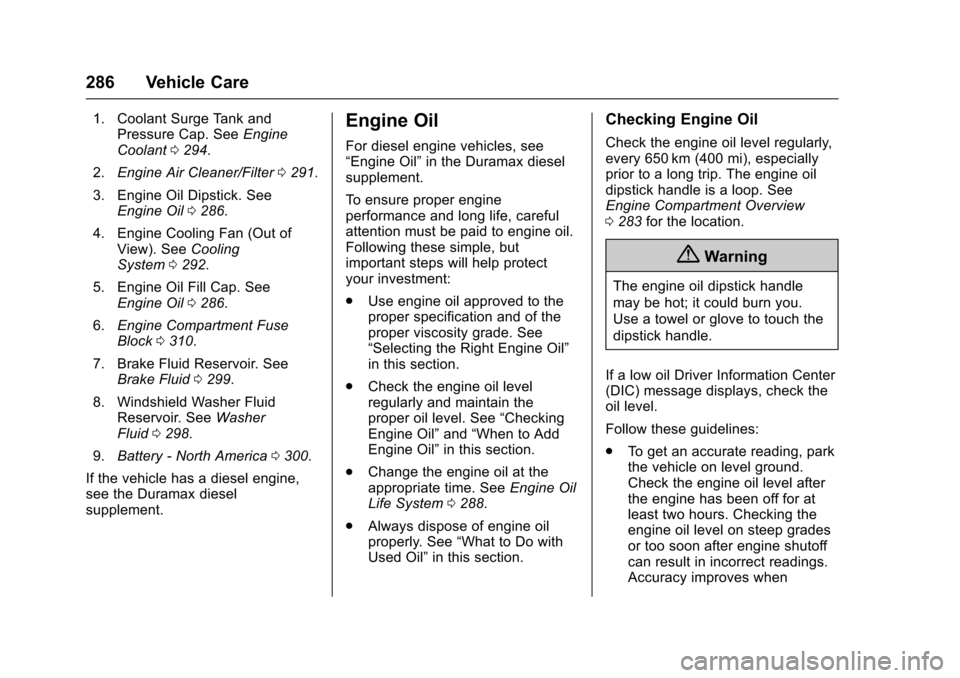
1. Coolant Surge Tank andPressure Cap. SeeEngineCoolant0294.
2.Engine Air Cleaner/Filter0291.
3. Engine Oil Dipstick. SeeEngine Oil0286.
4. Engine Cooling Fan (Out ofView). SeeCoolingSystem0292.
5. Engine Oil Fill Cap. SeeEngine Oil0286.
6.Engine Compartment FuseBlock0310.
7. Brake Fluid Reservoir. SeeBrake Fluid0299.
8. Windshield Washer FluidReservoir. SeeWasherFluid0298.
9.Battery - North America0300.
If the vehicle has a diesel engine,see the Duramax dieselsupplement.
Engine Oil
For diesel engine vehicles, see“Engine Oil”in the Duramax dieselsupplement.
To e n s u r e p r o p e r e n g i n eperformance and long life, carefulattention must be paid to engine oil.Following these simple, butimportant steps will help protectyour investment:
.Use engine oil approved to theproper specification and of theproper viscosity grade. See“Selecting the Right Engine Oil”in this section.
.Check the engine oil levelregularly and maintain theproper oil level. See“CheckingEngine Oil”and“When to AddEngine Oil”in this section.
.Change the engine oil at theappropriate time. SeeEngine OilLife System0288.
.Always dispose of engine oilproperly. See“What to Do withUsed Oil”in this section.
Checking Engine Oil
Check the engine oil level regularly,every 650 km (400 mi), especiallyprior to a long trip. The engine oildipstick handle is a loop. SeeEngine Compartment Overview0283for the location.
{Warning
The engine oil dipstick handle
may be hot; it could burn you.
Use a towel or glove to touch the
dipstick handle.
If a low oil Driver Information Center(DIC) message displays, check theoil level.
Follow these guidelines:
.To g e t a n a c c u r a t e r e a d i n g , p a r kthe vehicle on level ground.Check the engine oil level afterthe engine has been off for atleast two hours. Checking theengine oil level on steep gradesor too soon after engine shutoffcan result in incorrect readings.Accuracy improves when
Page 293 of 419
Chevrolet Colorado Owner Manual (GMNA-Localizing-U.S./Canada/Mexico-10122675) - 2017 - crc - 8/22/16
292 Vehicle Care
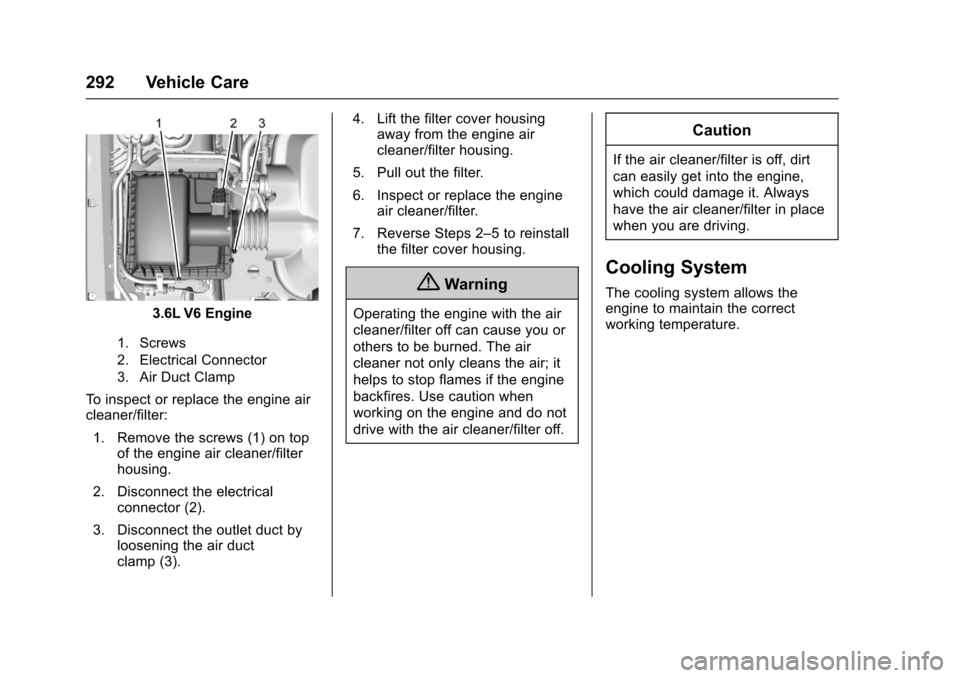
3.6L V6 Engine
1. Screws
2. Electrical Connector
3. Air Duct Clamp
To i n s p e c t o r r e p l a c e t h e e n g i n e a i rcleaner/filter:
1. Remove the screws (1) on topof the engine air cleaner/filterhousing.
2. Disconnect the electricalconnector (2).
3. Disconnect the outlet duct byloosening the air ductclamp (3).
4. Lift the filter cover housingaway from the engine aircleaner/filter housing.
5. Pull out the filter.
6. Inspect or replace the engineair cleaner/filter.
7. Reverse Steps 2–5toreinstallthe filter cover housing.
{Warning
Operating the engine with the air
cleaner/filter off can cause you or
others to be burned. The air
cleaner not only cleans the air; it
helps to stop flames if the engine
backfires. Use caution when
working on the engine and do not
drive with the air cleaner/filter off.
Caution
If the air cleaner/filter is off, dirt
can easily get into the engine,
which could damage it. Always
have the air cleaner/filter in place
when you are driving.
Cooling System
The cooling system allows theengine to maintain the correctworking temperature.
Page 294 of 419
Chevrolet Colorado Owner Manual (GMNA-Localizing-U.S./Canada/Mexico-10122675) - 2017 - crc - 8/22/16
Vehicle Care 293
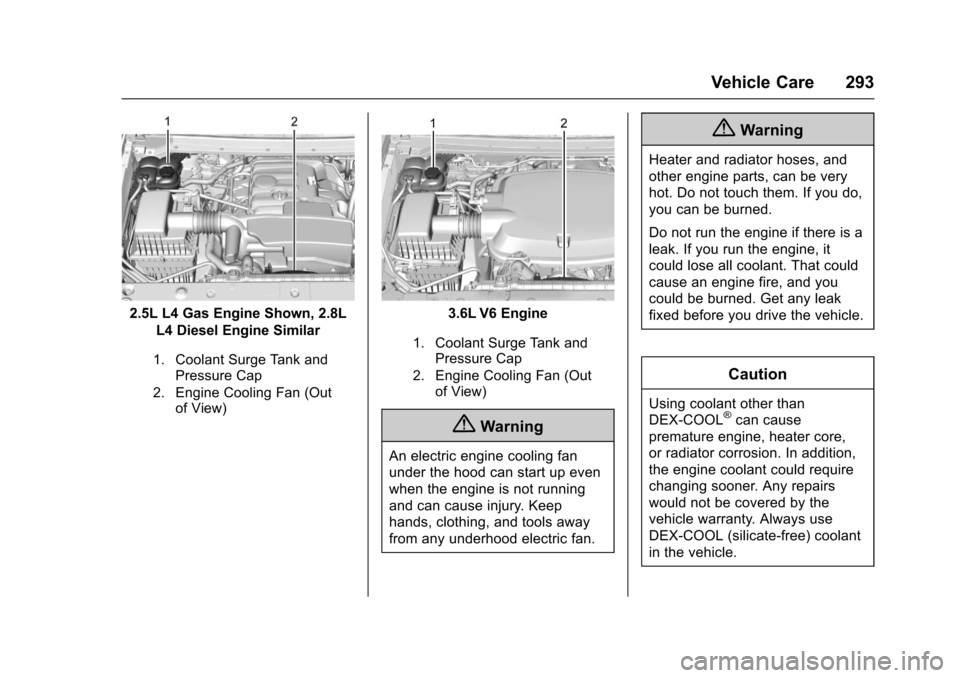
2.5L L4 Gas Engine Shown, 2.8L
L4 Diesel Engine Similar
1. Coolant Surge Tank andPressure Cap
2. Engine Cooling Fan (Outof View)
3.6L V6 Engine
1. Coolant Surge Tank andPressure Cap
2. Engine Cooling Fan (Outof View)
{Warning
An electric engine cooling fan
under the hood can start up even
when the engine is not running
and can cause injury. Keep
hands, clothing, and tools away
from any underhood electric fan.
{Warning
Heater and radiator hoses, and
other engine parts, can be very
hot. Do not touch them. If you do,
you can be burned.
Do not run the engine if there is a
leak. If you run the engine, it
could lose all coolant. That could
cause an engine fire, and you
could be burned. Get any leak
fixed before you drive the vehicle.
Caution
Using coolant other than
DEX-COOL®can cause
premature engine, heater core,
or radiator corrosion. In addition,
the engine coolant could require
changing sooner. Any repairs
would not be covered by the
vehicle warranty. Always use
DEX-COOL (silicate-free) coolant
in the vehicle.
Page 295 of 419
Chevrolet Colorado Owner Manual (GMNA-Localizing-U.S./Canada/Mexico-10122675) - 2017 - crc - 8/22/16
294 Vehicle Care
Engine Coolant
The cooling system in the vehicle isfilled with DEX-COOL®enginecoolant mixture. SeeRecommendedFluids and Lubricants0375andMaintenance Schedule0366.
The following explains the coolingsystem and how to check and addcoolant when it is low. If there is aproblem with engine overheating,seeEngine Overheating0296.
What to Use
{Warning
Adding only plain water or some
other liquid to the cooling system
can be dangerous. Plain water
and other liquids, can boil before
the proper coolant mixture will.
The coolant warning system is set
for the proper coolant mixture.
With plain water or the wrong
mixture, the engine could get too
hot but you would not get the
overheat warning. The engine
(Continued)
Warning (Continued)
could catch fire and you or others
could be burned. Use a 50/
50 mixture of clean, drinkable
water and DEX-COOL coolant.
Use a 50/50 mixture of clean,drinkable water and DEX-COOLcoolant. If using this mixture,nothing else needs to be added.
This mixture:
.Gives freezing protection downto✓37 °C (✓34 °F) outsidetemperature.
.Gives boiling protection up to129 °C (265 °F) enginetemperature.
.Protects against rust andcorrosion.
.Will not damage aluminum parts.
.Helps keep the proper enginetemperature.
Caution
If improper coolant mixture,
inhibitors, or additives are used in
the vehicle cooling system, the
engine could overheat and be
damaged. Too much water in the
mixture can freeze and crack
engine cooling parts. The repairs
would not be covered by the
vehicle warranty. Use only the
proper mixture of engine coolant
for the cooling system. See
Recommended Fluids and
Lubricants0375.
Never dispose of engine coolant byputting it in the trash, or by pouringit on the ground, or into sewers,streams or, bodies of water. Havethe coolant changed by anauthorized service center, familiarwith legal requirements regardingused coolant disposal. This will helpprotect the environment and yourhealth.
Page 296 of 419
Chevrolet Colorado Owner Manual (GMNA-Localizing-U.S./Canada/Mexico-10122675) - 2017 - crc - 8/22/16
Vehicle Care 295
Checking Coolant
The vehicle must be on a levelsurface when checking the coolantlevel.
Check to see if coolant is visible inthe coolant surge tank. If the coolantinside the coolant surge tank isboiling, do not do anything else untilit cools down.
If coolant is visible but the coolantlevel is not at or above the markpointed to, add a 50/50 mixture ofclean, drinkable water andDEX-COOL coolant.
Be sure the cooling system is coolbefore this is done.
If no coolant is visible in the coolantsurge tank, add coolant as follows:
How to Add Coolant to the
Coolant Surge Tank
{Warning
Yo u c a n b e b u r n e d i f y o u s p i l l
coolant on hot engine parts.
Coolant contains ethylene glycol
(Continued)
Warning (Continued)
and it will burn if the engine parts
are hot enough. Do not spill
coolant on a hot engine.
Caution
This vehicle has a specific
coolant fill procedure. Failure to
follow this procedure could cause
the engine to overheat and be
severely damaged.
{Warning
Steam and scalding liquids from a
hot cooling system can blow out
and burn you badly. Never turn
the cap when the cooling system,
including the surge tank pressure
cap, is hot. Wait for the cooling
system and surge tank pressure
cap to cool.
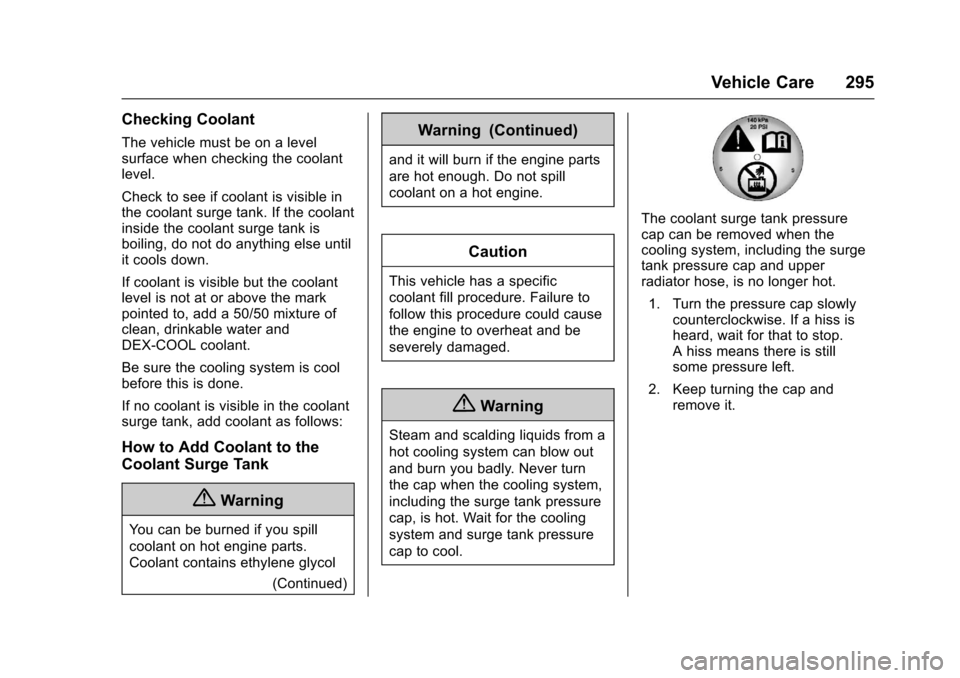
The coolant surge tank pressurecap can be removed when thecooling system, including the surgetank pressure cap and upperradiator hose, is no longer hot.
1. Turn the pressure cap slowlycounterclockwise. If a hiss isheard, wait for that to stop.Ahissmeansthereisstillsome pressure left.
2. Keep turning the cap andremove it.
Page 297 of 419
Chevrolet Colorado Owner Manual (GMNA-Localizing-U.S./Canada/Mexico-10122675) - 2017 - crc - 8/22/16
296 Vehicle Care
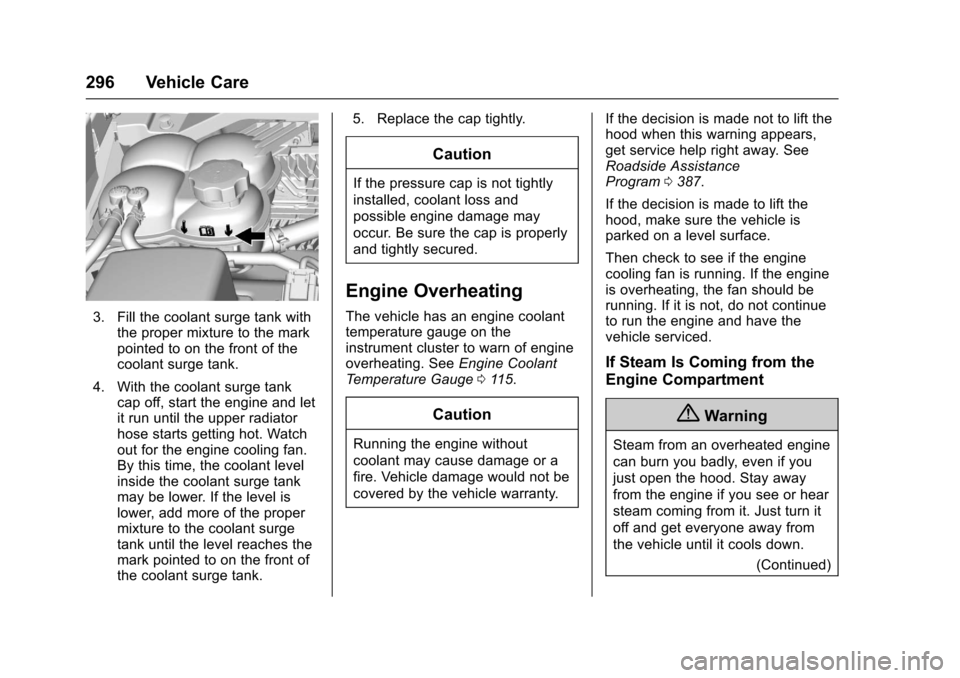
3. Fill the coolant surge tank withthe proper mixture to the markpointed to on the front of thecoolant surge tank.
4. With the coolant surge tankcap off, start the engine and letit run until the upper radiatorhose starts getting hot. Watchout for the engine cooling fan.By this time, the coolant levelinside the coolant surge tankmay be lower. If the level islower, add more of the propermixture to the coolant surgetank until the level reaches themark pointed to on the front ofthe coolant surge tank.
5. Replace the cap tightly.
Caution
If the pressure cap is not tightly
installed, coolant loss and
possible engine damage may
occur. Be sure the cap is properly
and tightly secured.
Engine Overheating
The vehicle has an engine coolanttemperature gauge on theinstrument cluster to warn of engineoverheating. SeeEngine CoolantTe m p e r a t u r e G a u g e011 5.
Caution
Running the engine without
coolant may cause damage or a
fire. Vehicle damage would not be
covered by the vehicle warranty.
If the decision is made not to lift thehood when this warning appears,get service help right away. SeeRoadside AssistanceProgram0387.
If the decision is made to lift thehood, make sure the vehicle isparked on a level surface.
Then check to see if the enginecooling fan is running. If the engineis overheating, the fan should berunning. If it is not, do not continueto run the engine and have thevehicle serviced.
If Steam Is Coming from the
Engine Compartment
{Warning
Steam from an overheated engine
can burn you badly, even if you
just open the hood. Stay away
from the engine if you see or hear
steam coming from it. Just turn it
off and get everyone away from
the vehicle until it cools down.
(Continued)
Page 298 of 419
Chevrolet Colorado Owner Manual (GMNA-Localizing-U.S./Canada/Mexico-10122675) - 2017 - crc - 8/22/16
Vehicle Care 297
Warning (Continued)
Wait until there is no sign of
steam or coolant before you open
the hood.
If you keep driving when the
engine is overheated, the liquids
in it can catch fire. You or others
could be badly burned. Stop the
engine if it overheats, and get out
of the vehicle until the engine
is cool.
If No Steam Is Coming from
the Engine Compartment
If an engine overheat warning isdisplayed but no steam can be seenor heard, the problem may not betoo serious. Sometimes the enginecan get a little too hot when thevehicle:
.Climbs a long hill on a hot day.
.Stops after high-speed driving.
.Idles for long periods in traffic.
If the overheat warning is displayedwith no sign of steam:
1. Turn the air conditioning off.
2. Turn the heater on to thehighest temperature and to thehighest fan speed. Open thewindows as necessary.
3. When it is safe to do so, pull offthe road, shift to P (Park) orN(Neutral),andlettheengine idle.
If the engine coolant temperaturegauge is no longer in the overheatzone, the vehicle can be driven.Continue to drive the vehicle slowlyfor about 10 minutes. Keep a safedistance from the vehicle in front.If the warning does not come backon, continue to drive normally andhave the cooling system checkedfor proper fill and function.
If the warning continues, pull over,stop, and park the vehicleright away.
If there is no sign of steam, idle theengine for three minutes whileparked. If the warning is stilldisplayed, turn off the engine until itcools down.
Engine Fan
If the vehicle has a clutched enginecooling fan, when the clutch isengaged, the fan spins faster toprovide more air to cool the engine.In most everyday driving conditions,the fan is spinning slower and theclutch is not fully engaged. Thisimproves fuel economy and reducesfan noise. Under heavy vehicleloading, trailer towing, and/or highoutside temperatures, the fan speedincreases as the clutch more fullyengages, so an increase in fannoise may be heard. This is normaland should not be mistaken as thetransmission slipping or makingextra shifts. It is merely the coolingsystem functioning properly. The fanwill slow down when additionalcooling is not required and theclutch disengages.
This fan noise may also be heardwhen starting the engine. It will goaway as the fan clutch partiallydisengages.
If the vehicle has electric coolingfan(s), the fans may be heardspinning at low speed during most