airbag CHEVROLET COLORADO 2017 2.G Owners Manual
[x] Cancel search | Manufacturer: CHEVROLET, Model Year: 2017, Model line: COLORADO, Model: CHEVROLET COLORADO 2017 2.GPages: 419, PDF Size: 7.38 MB
Page 4 of 419
Chevrolet Colorado Owner Manual (GMNA-Localizing-U.S./Canada/Mexico-10122675) - 2017 - crc - 8/22/16
Introduction 3
Danger, Warning, and
Caution
Warning messages found on vehiclelabels and in this manual describehazards and what to do to avoid orreduce them.
{Danger
Danger indicates a hazard with a
high level of risk which will result
in serious injury or death.
{Warning
Warning indicates a hazard that
could result in injury or death.
Caution
Caution indicates a hazard that
could result in property or vehicle
damage.
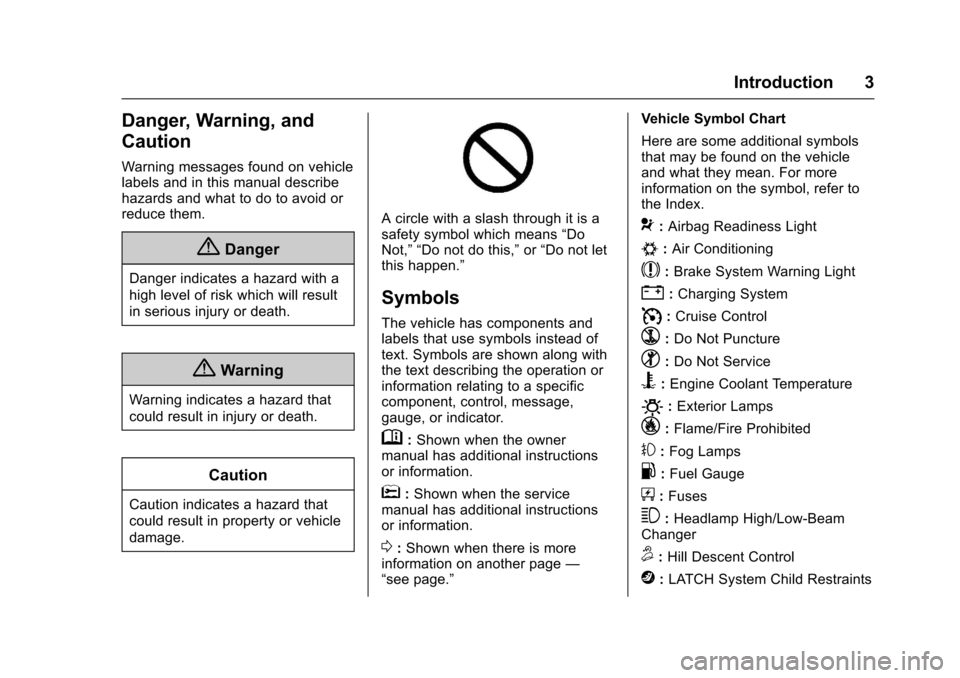
Acirclewithaslashthroughitisasafety symbol which means“DoNot,”“Do not do this,”or“Do not letthis happen.”
Symbols
The vehicle has components andlabels that use symbols instead oftext. Symbols are shown along withthe text describing the operation orinformation relating to a specificcomponent, control, message,gauge, or indicator.
M:Shown when the ownermanual has additional instructionsor information.
*:Shown when the servicemanual has additional instructionsor information.
0:Shown when there is moreinformation on another page—“see page.”
Vehicle Symbol Chart
Here are some additional symbolsthat may be found on the vehicleand what they mean. For moreinformation on the symbol, refer tothe Index.
9:Airbag Readiness Light
#:Air Conditioning
$:Brake System Warning Light
":Charging System
I:Cruise Control
`:Do Not Puncture
^:Do Not Service
B:Engine Coolant Temperature
O:Exterior Lamps
_:Flame/Fire Prohibited
#:Fog Lamps
.:Fuel Gauge
+:Fuses
3:Headlamp High/Low-BeamChanger
5:Hill Descent Control
j:LATCH System Child Restraints
Page 13 of 419
Chevrolet Colorado Owner Manual (GMNA-Localizing-U.S./Canada/Mexico-10122675) - 2017 - crc - 8/22/16
12 In Brief
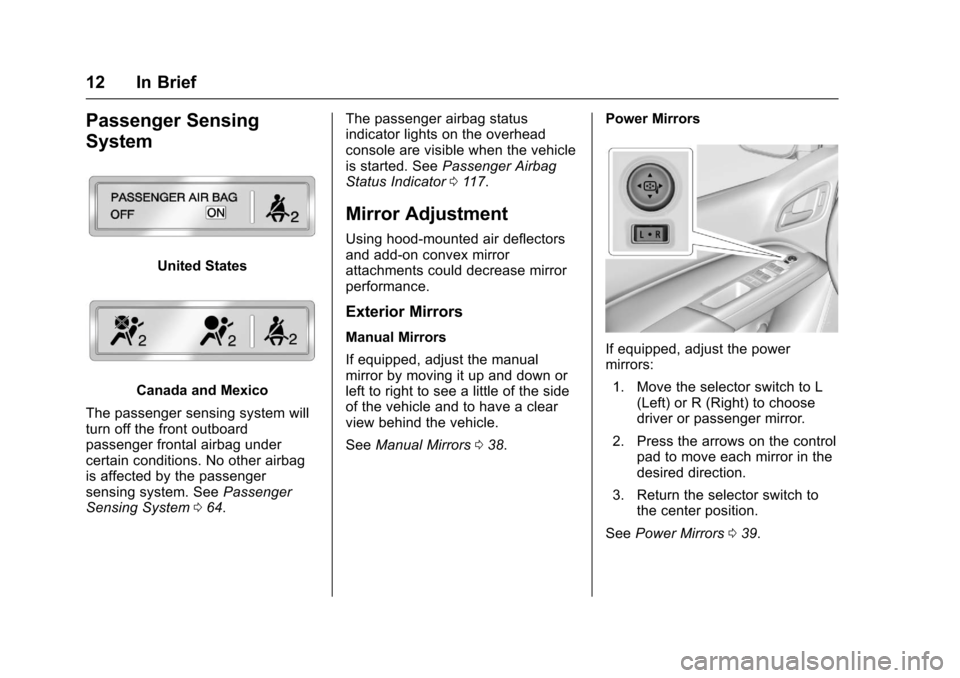
Passenger Sensing
System
United States
Canada and Mexico
The passenger sensing system willturn off the front outboardpassenger frontal airbag undercertain conditions. No other airbagis affected by the passengersensing system. SeePassengerSensing System064.
The passenger airbag statusindicator lights on the overheadconsole are visible when the vehicleis started. SeePassenger AirbagStatus Indicator011 7.
Mirror Adjustment
Using hood-mounted air deflectorsand add-on convex mirrorattachments could decrease mirrorperformance.
Exterior Mirrors
Manual Mirrors
If equipped, adjust the manualmirror by moving it up and down orleft to right to see a little of the sideof the vehicle and to have a clearview behind the vehicle.
SeeManual Mirrors038.
Power Mirrors
If equipped, adjust the powermirrors:
1. Move the selector switch to L(Left) or R (Right) to choosedriver or passenger mirror.
2. Press the arrows on the controlpad to move each mirror in thedesired direction.
3. Return the selector switch tothe center position.
SeePower Mirrors039.
Page 29 of 419
Chevrolet Colorado Owner Manual (GMNA-Localizing-U.S./Canada/Mexico-10122675) - 2017 - crc - 8/22/16
28 Keys, Doors, and Windows
{Warning
If the key is unintentionally
rotated while the vehicle is
running, the ignition could be
moved out of the RUN position.
This could be caused by heavy
items hanging from the key ring,
or by large or long items attached
to the key ring that could be
contacted by the driver or
steering wheel. If the ignition
moves out of the RUN position,
the engine will shut off, braking
and steering power assist may be
(Continued)
Warning (Continued)
impacted, and airbags may not
deploy. To reduce the risk of
unintentional rotation of the
ignition key, do not change the
way the ignition key and Remote
Keyless Entry (RKE) transmitter,
if equipped, are connected to the
provided key rings.
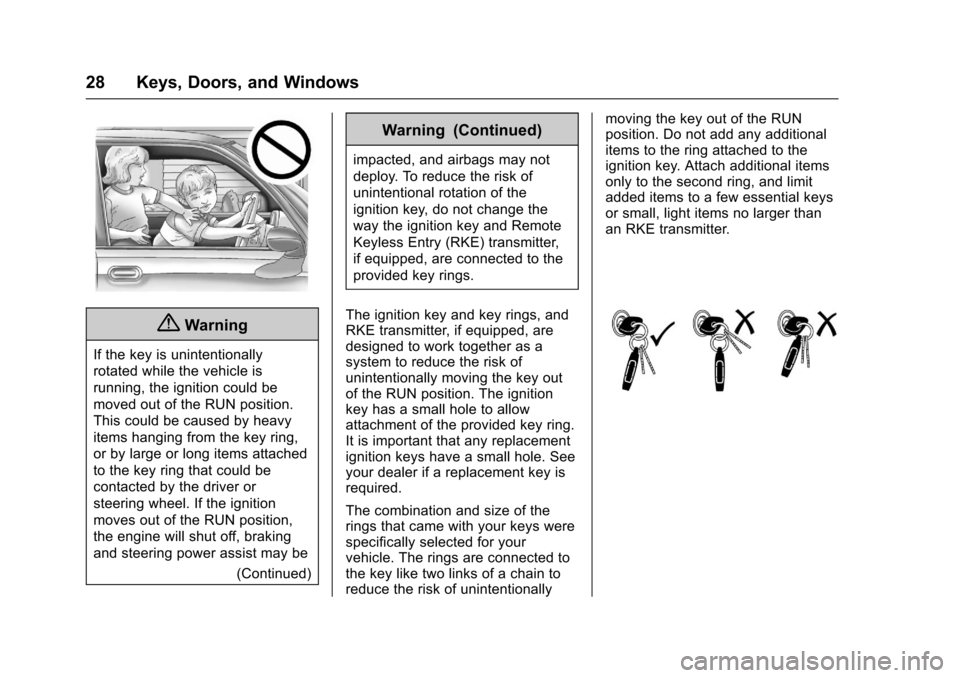
The ignition key and key rings, andRKE transmitter, if equipped, aredesigned to work together as asystem to reduce the risk ofunintentionally moving the key outof the RUN position. The ignitionkey has a small hole to allowattachment of the provided key ring.It is important that any replacementignition keys have a small hole. Seeyour dealer if a replacement key isrequired.
The combination and size of therings that came with your keys werespecifically selected for yourvehicle. The rings are connected tothe key like two links of a chain toreduce the risk of unintentionally
moving the key out of the RUNposition. Do not add any additionalitems to the ring attached to theignition key. Attach additional itemsonly to the second ring, and limitadded items to a few essential keysor small, light items no larger thanan RKE transmitter.
Page 45 of 419
Chevrolet Colorado Owner Manual (GMNA-Localizing-U.S./Canada/Mexico-10122675) - 2017 - crc - 8/22/16
44 Seats and Restraints
Seats and
Restraints
Head Restraints
Head Restraints . . . . . . . . . . . . . . . 45
Front Seats
Seat Adjustment . . . . . . . . . . . . . . . 46Power Seat Adjustment . . . . . . . . 46Lumbar Adjustment . . . . . . . . . . . . 47Reclining Seatbacks . . . . . . . . . . . 47Heated Front Seats . . . . . . . . . . . . 48
Rear Seats
Rear Seats . . . . . . . . . . . . . . . . . . . . 49
Safety Belts
Safety Belts . . . . . . . . . . . . . . . . . . . . 51How to Wear Safety BeltsProperly . . . . . . . . . . . . . . . . . . . . . . 53Lap-Shoulder Belt . . . . . . . . . . . . . 53Safety Belt Use DuringPregnancy . . . . . . . . . . . . . . . . . . . . 56Safety Belt Extender . . . . . . . . . . . 56Safety System Check . . . . . . . . . . 57Safety Belt Care . . . . . . . . . . . . . . . 57Replacing Safety Belt SystemParts after a Crash . . . . . . . . . . . 57
Airbag System
Airbag System . . . . . . . . . . . . . . . . . 58Where Are the Airbags? . . . . . . . 60When Should an AirbagInflate? . . . . . . . . . . . . . . . . . . . . . . . 61What Makes an AirbagInflate? . . . . . . . . . . . . . . . . . . . . . . . 62How Does an AirbagRestrain? . . . . . . . . . . . . . . . . . . . . . 62What Will You See after anAirbag Inflates? . . . . . . . . . . . . . . 62Passenger Sensing System . . . 64Servicing the Airbag-EquippedVehicle . . . . . . . . . . . . . . . . . . . . . . . 68Adding Equipment to theAirbag-Equipped Vehicle . . . . . 68Airbag System Check . . . . . . . . . . 69Replacing Airbag System Partsafter a Crash . . . . . . . . . . . . . . . . . 69
Child Restraints
Older Children . . . . . . . . . . . . . . . . . 70Infants and Young Children . . . . 71Child Restraint Systems . . . . . . . 74Where to Put the Restraint . . . . . 75Lower Anchors and Tethers forChildren (LATCH System) . . . . 77Replacing LATCH System PartsAfter a Crash . . . . . . . . . . . . . . . . . 90
Securing Child Restraints (Withthe Safety Belt in theRear Seat) . . . . . . . . . . . . . . . . . . . 91Securing Child Restraints (Withthe Safety Belt in theFront Seat) . . . . . . . . . . . . . . . . . . . 96
Page 53 of 419
Chevrolet Colorado Owner Manual (GMNA-Localizing-U.S./Canada/Mexico-10122675) - 2017 - crc - 8/22/16
52 Seats and Restraints
Warning (Continued)
passengers to ride in any area of
the vehicle that is not equipped
with seats and safety belts.
Always wear a safety belt, and
check that all passenger(s) are
restrained properly too.
This vehicle has indicators as areminder to buckle the safety belts.SeeSafety Belt Reminders011 6.
This vehicle may have the SafetyBelt Assurance System, which mayprevent the vehicle from shifting outof P (Park). SeeSafety BeltMessages0136.
Why Safety Belts Work
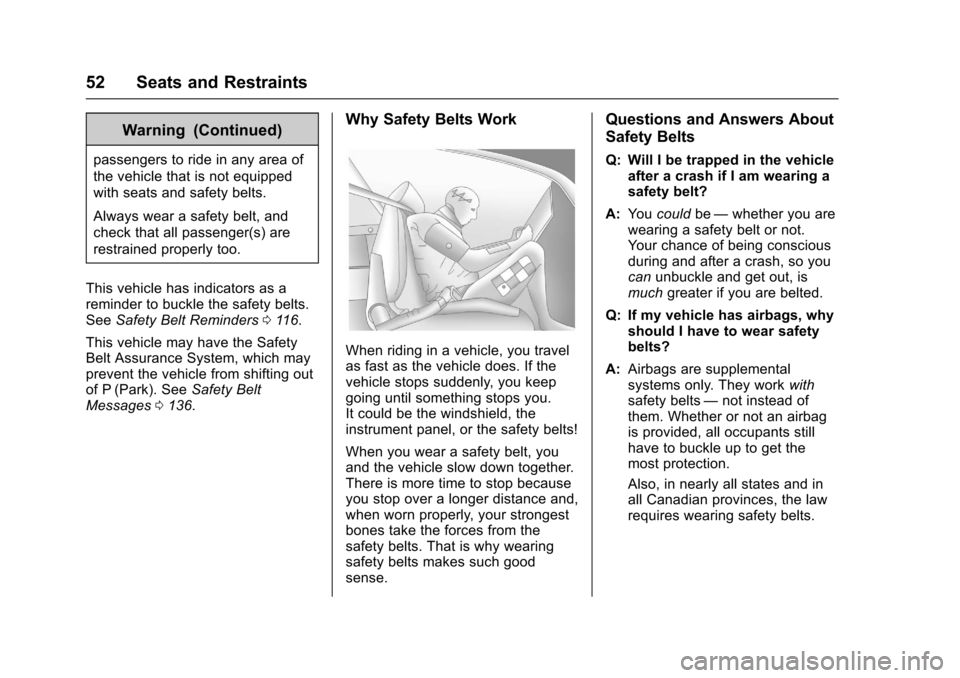
When riding in a vehicle, you travelas fast as the vehicle does. If thevehicle stops suddenly, you keepgoing until something stops you.It could be the windshield, theinstrument panel, or the safety belts!
When you wear a safety belt, youand the vehicle slow down together.There is more time to stop becauseyou stop over a longer distance and,when worn properly, your strongestbones take the forces from thesafety belts. That is why wearingsafety belts makes such goodsense.
Questions and Answers About
Safety Belts
Q: Will I be trapped in the vehicleafter a crash if I am wearing asafety belt?
A:Yo ucouldbe—whether you arewearing a safety belt or not.Yo u r c h a n c e o f b e i n g c o n s c i o u sduring and after a crash, so youcanunbuckle and get out, ismuchgreater if you are belted.
Q: If my vehicle has airbags, whyshould I have to wear safetybelts?
A:Airbags are supplementalsystems only. They workwithsafety belts—not instead ofthem. Whether or not an airbagis provided, all occupants stillhave to buckle up to get themost protection.
Also, in nearly all states and inall Canadian provinces, the lawrequires wearing safety belts.
Page 59 of 419
Chevrolet Colorado Owner Manual (GMNA-Localizing-U.S./Canada/Mexico-10122675) - 2017 - crc - 8/22/16
58 Seats and Restraints
have been stressed or damaged.See your dealer to have the safetybelt assemblies inspected orreplaced.
New parts and repairs may benecessary even if the safety beltsystem was not being used at thetime of the crash.
Have the safety belt pretensionerschecked if the vehicle has been in acrash, or if the airbag readiness lightstays on after you start the vehicleor while you are driving. SeeAirbagReadiness Light011 7.
Airbag System
The vehicle has the followingairbags:
.Afrontalairbagforthedriver.
.Afrontalairbagforthefrontoutboard passenger.
.Aseat-mountedsideimpactairbag for the driver.
.Aseat-mountedsideimpactairbag for the front outboardpassenger.
.Aroof-railairbagforthedriverand the passenger seateddirectly behind the driver.
.Aroof-railairbagforthefrontoutboard passenger and thepassenger seated directlybehind the front outboardpassenger.
All vehicle airbags have the wordAIRBAG on the trim or on a labelnear the deployment opening.
For frontal airbags, the wordAIRBAG is on the center of thesteering wheel for the driver and onthe instrument panel for the frontoutboard passenger.
For seat-mounted side impactairbags, the word AIRBAG is on theside of the seatback closest tothe door.
For roof-rail airbags, the wordAIRBAG is on the ceiling or trim.
Airbags are designed to supplementthe protection provided by safetybelts. Even though today's airbagsare also designed to help reducethe risk of injury from the force of aninflating bag, all airbags must inflatevery quickly to do their job.
Here are the most important thingsto know about the airbag system:
{Warning
Yo u c a n b e s e v e r e l y i n j u r e d o r
killed in a crash if you are not
wearing your safety belt, even
with airbags. Airbags are
(Continued)
Page 60 of 419
Chevrolet Colorado Owner Manual (GMNA-Localizing-U.S./Canada/Mexico-10122675) - 2017 - crc - 8/22/16
Seats and Restraints 59
Warning (Continued)
designed to work with safety
belts, not replace them. Also,
airbags are not designed to inflate
in every crash. In some crashes
safety belts are the only restraint.
SeeWhen Should an Airbag
Inflate?061.
Wearing your safety belt during a
crash helps reduce your chance
of hitting things inside the vehicle
or being ejected from it. Airbags
are“supplemental restraints”to
the safety belts. Everyone in the
vehicle should wear a safety belt
properly, whether or not there is
an airbag for that person.
{Warning
Because airbags inflate with great
force and faster than the blink of
an eye, anyone who is up
against, or very close to any
(Continued)
Warning (Continued)
airbag when it inflates can be
seriously injured or killed. Do not
sit unnecessarily close to any
airbag, as you would be if sitting
on the edge of the seat or leaning
forward. Safety belts help keep
you in position before and during
acrash.Alwayswearasafety
belt, even with airbags. The driver
should sit as far back as possible
while still maintaining control of
the vehicle. The safety belts and
the front outboard passenger
airbags are most effective when
you are sitting well back and
upright in the seat with both feet
on the floor.
Occupants should not lean on or
sleep against the door or side
windows in seating positions with
seat-mounted side impact airbags
and/or roof-rail airbags.
{Warning
Children who are up against,
or very close to, any airbag when
it inflates can be seriously injured
or killed. Always secure children
properly in the vehicle. To read
how, seeOlder Children070or
Infants and Young Children071.
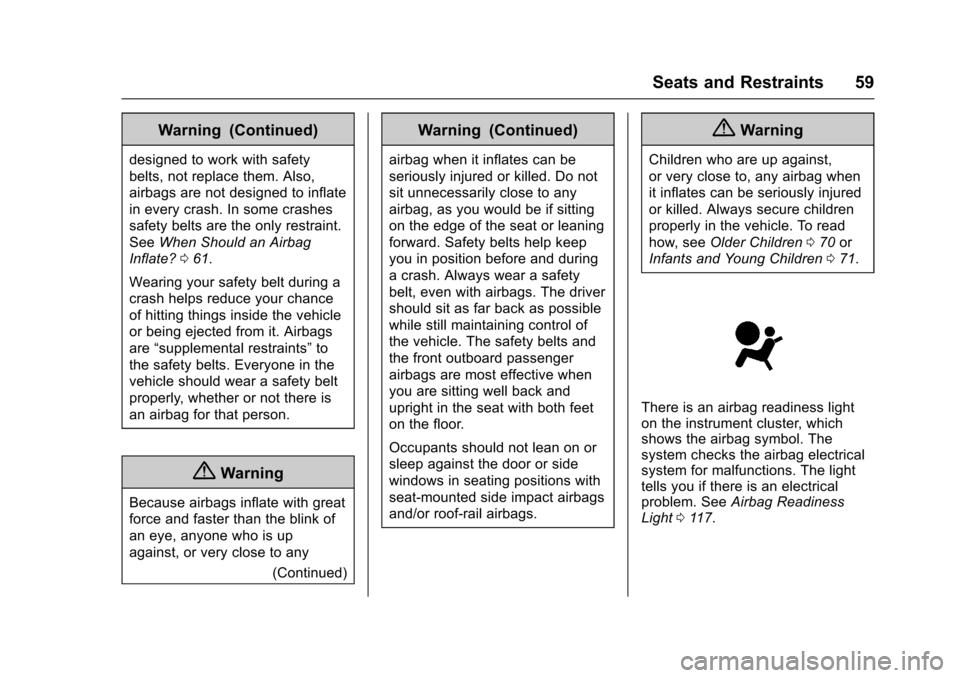
There is an airbag readiness lighton the instrument cluster, whichshows the airbag symbol. Thesystem checks the airbag electricalsystem for malfunctions. The lighttells you if there is an electricalproblem. SeeAirbag ReadinessLight011 7.
Page 61 of 419
Chevrolet Colorado Owner Manual (GMNA-Localizing-U.S./Canada/Mexico-10122675) - 2017 - crc - 8/22/16
60 Seats and Restraints
Where Are the Airbags?
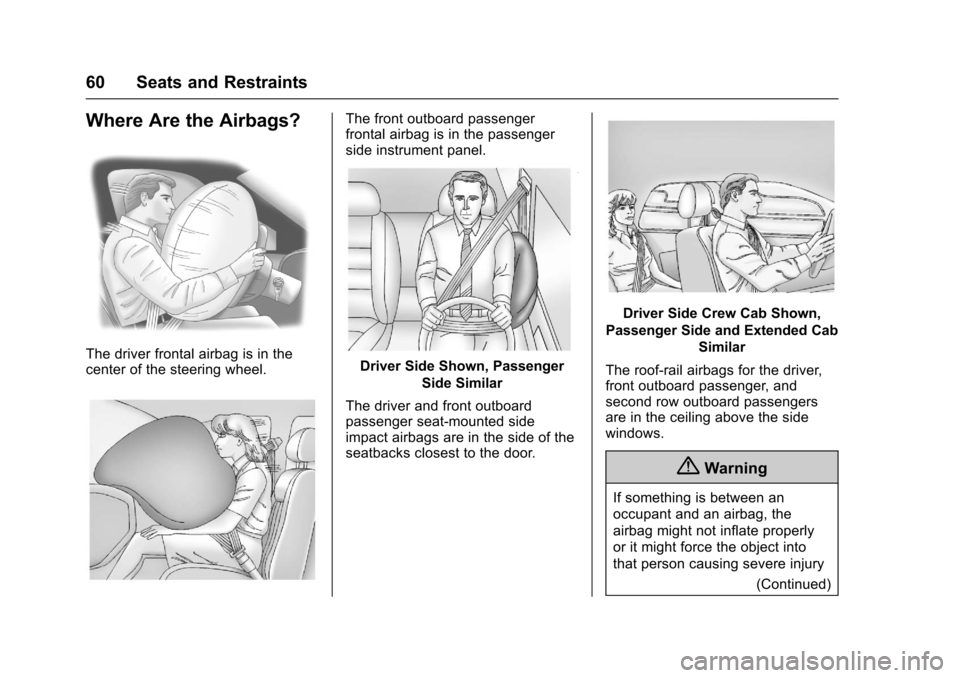
The driver frontal airbag is in thecenter of the steering wheel.
The front outboard passengerfrontal airbag is in the passengerside instrument panel.
Driver Side Shown, Passenger
Side Similar
The driver and front outboardpassenger seat-mounted sideimpact airbags are in the side of theseatbacks closest to the door.
Driver Side Crew Cab Shown,
Passenger Side and Extended Cab
Similar
The roof-rail airbags for the driver,front outboard passenger, andsecond row outboard passengersare in the ceiling above the sidewindows.
{Warning
If something is between an
occupant and an airbag, the
airbag might not inflate properly
or it might force the object into
that person causing severe injury
(Continued)
Page 62 of 419
Chevrolet Colorado Owner Manual (GMNA-Localizing-U.S./Canada/Mexico-10122675) - 2017 - crc - 8/22/16
Seats and Restraints 61
Warning (Continued)
or even death. The path of an
inflating airbag must be kept
clear. Do not put anything
between an occupant and an
airbag, and do not attach or put
anything on the steering wheel
hub or on or near any other
airbag covering.
Do not use seat accessories that
block the inflation path of a
seat-mounted side impact airbag.
Never secure anything to the roof
of a vehicle with roof-rail airbags
by routing a rope or tie⇣down
through any door or window
opening. If you do, the path of an
inflating roof-rail airbag will be
blocked.
When Should an Airbag
Inflate?
This vehicle is equipped withairbags. SeeAirbag System058.Airbags are designed to inflate if theimpact exceeds the specific airbag
system's deployment threshold.Deployment thresholds are used topredict how severe a crash is likelyto be in time for the airbags toinflate and help restrain theoccupants. The vehicle haselectronic sensors that help theairbag system determine theseverity of the impact. Deploymentthresholds can vary with specificvehicle design.
Frontal airbags are designed toinflate in moderate to severe frontalor near frontal crashes to helpreduce the potential for severeinjuries, mainly to the driver's orfront outboard passenger's headand chest.
Whether the frontal airbags will orshould inflate is not based primarilyon how fast the vehicle is traveling.It depends on what is hit, thedirection of the impact, and howquickly the vehicle slows down.
Frontal airbags may inflate atdifferent crash speeds depending onwhether the vehicle hits an objectstraight on or at an angle, and
whether the object is fixed ormoving, rigid or deformable, narrowor wide.
Frontal airbags are not intended toinflate during vehicle rollovers, inrear impacts, or in many sideimpacts.
In addition, the vehicle hasadvanced technology frontalairbags. Advanced technologyfrontal airbags adjust the restraintaccording to crash severity.
Seat-mounted side impact airbagsare designed to inflate in moderateto severe side crashes dependingon the location of the impact.Seat-mounted side impact airbagsare not designed to inflate in frontalimpacts, near frontal impacts,rollovers, or rear impacts.Aseat-mountedsideimpactairbagis designed to inflate on the side ofthe vehicle that is struck.
Roof-rail airbags are designed toinflate in moderate to severe sidecrashes depending on the locationof the impact. In addition, theseroof-rail airbags are designed toinflate during a rollover or in a
Page 63 of 419
Chevrolet Colorado Owner Manual (GMNA-Localizing-U.S./Canada/Mexico-10122675) - 2017 - crc - 8/22/16
62 Seats and Restraints
severe frontal impact. Roof-railairbags are not designed to inflate inrear impacts. Both roof-rail airbagswill inflate when either side of thevehicle is struck, if the sensingsystem predicts that the vehicle isabout to roll over on its side, or in asevere frontal impact.
In any particular crash, no one cansay whether an airbag should haveinflated simply because of thevehicle damage or repair costs.
What Makes an Airbag
Inflate?
In a deployment event, the sensingsystem sends an electrical signaltriggering a release of gas from theinflator. Gas from the inflator fills theairbag causing the bag to break outof the cover. The inflator, the airbag,and related hardware are all part ofthe airbag module.
For airbag locations, seeWhere Arethe Airbags?060.
How Does an Airbag
Restrain?
In moderate to severe frontal ornear frontal collisions, even beltedoccupants can contact the steeringwheel or the instrument panel. Inmoderate to severe side collisions,even belted occupants can contactthe inside of the vehicle.
Airbags supplement the protectionprovided by safety belts bydistributing the force of the impactmore evenly over theoccupant's body.
Rollover capable roof-rail airbagsare designed to help contain thehead and chest of occupants in theoutboard seating positions in thefirst and second rows. The rollovercapable roof-rail airbags aredesigned to help reduce the risk offull or partial ejection in rolloverevents, although no system canprevent all such ejections.
But airbags would not help in manytypes of collisions, primarilybecause the occupant's motion isnot toward those airbags. SeeWhenShould an Airbag Inflate?061.
Airbags should never be regardedas anything more than a supplementto safety belts.
What Will You See after
an Airbag Inflates?
After the frontal airbags andseat-mounted side impact airbagsinflate, they quickly deflate, soquickly that some people may noteven realize an airbag inflated.Roof-rail airbags may still be at leastpartially inflated for some time afterthey inflate. Some components ofthe airbag module may be hot forseveral minutes. For location of theairbags, seeWhere Are theAirbags?060.
The parts of the airbag that comeinto contact with you may be warm,but not too hot to touch. There maybe some smoke and dust comingfrom the vents in the deflatedairbags. Airbag inflation does not