warning CHEVROLET COLORADO 2019 Owner's Manual
[x] Cancel search | Manufacturer: CHEVROLET, Model Year: 2019, Model line: COLORADO, Model: CHEVROLET COLORADO 2019Pages: 387, PDF Size: 5.69 MB
Page 313 of 387
Chevrolet Colorado Owner Manual (GMNA-Localizing-U.S./Canada/Mexico-
12460274) - 2019 - CRC - 10/1/18
312 Vehicle Care
Jump Starting
Jump Starting - North
America
For more information about the
vehicle battery, seeBattery - North
America 0260.
If the battery has run down, try to
use another vehicle and some
jumper cables to start your vehicle.
Be sure to use the following steps to
do it safely.
{Warning
WARNING: Battery posts,
terminals, and related
accessories contain lead and lead
compounds, chemicals known to
the State of California to cause
cancer and birth defects or other
reproductive harm. Batteries also
contain other chemicals known to
the State of California to cause
cancer. WASH HANDS AFTER
(Continued)
Warning (Continued)
HANDLING.For more information
go to www.P65Warnings.ca.gov/
passenger-vehicle.
See California Proposition
65 Warning 0240 and the back
cover.
{Warning
Batteries can hurt you. They can
be dangerous because:
. They contain acid that can
burn you.
. They contain gas that can
explode or ignite.
. They contain enough
electricity to burn you.
If you do not follow these steps
exactly, some or all of these
things can hurt you.
Caution
Ignoring these steps could result
in costly damage to the vehicle
that would not be covered by the
vehicle warranty. Trying to start
the vehicle by pushing or pulling it
will not work, and it could damage
the vehicle.
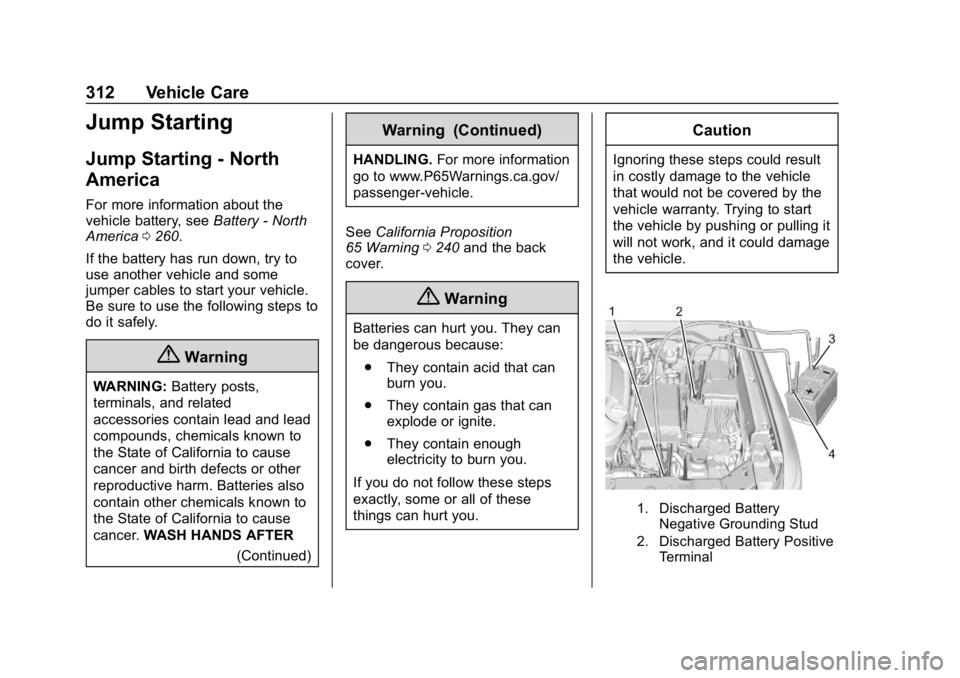
1. Discharged Battery Negative Grounding Stud
2. Discharged Battery Positive Terminal
Page 314 of 387
Chevrolet Colorado Owner Manual (GMNA-Localizing-U.S./Canada/Mexico-
12460274) - 2019 - CRC - 10/1/18
Vehicle Care 313
3. Good Battery NegativeTerminal
4. Good Battery Positive Terminal
The jump start negative grounding
stud (1) for the discharged battery is
to the left of the windshield washer
fluid reservoir.
The jump start positive terminal on
the discharged battery (2) is located
in the engine compartment on the
driver side of the vehicle.
The jump start positive terminal (3)
and negative terminal (4) are on the
battery of the vehicle providing the
jump start.
The positive jump start connection
for the discharged battery is under a
trim cover. Open the cover to
expose the terminal.
1. Check the other vehicle. It must have a 12-volt battery
with a negative ground system.
Caution
If the other vehicle does not have
a 12-volt system with a negative
ground, both vehicles can be
damaged. Only use a vehicle that
has a 12-volt system with a
negative ground for jump starting.
2. Position the two vehicles so that they are not touching.
3. Set the parking brake firmly and put the shift lever in
P (Park) with an automatic
transmission, or N (Neutral)
with a manual transmission.
Caution
If any accessories are left on or
plugged in during the jump
starting procedure, they could be
damaged. The repairs would not
be covered by the vehicle
warranty. Whenever possible, turn
off or unplug all accessories on
either vehicle when jump starting. 4. Turn the ignition off. Turn off all
lights and accessories in both
vehicles, except the hazard
warning flashers if needed.
{Warning
An electric fan can start up even
when the engine is not running
and can injure you. Keep hands,
clothing, and tools away from any
underhood electric fan.
{Warning
Using a match near a battery can
cause battery gas to explode.
People have been hurt doing this,
and some have been blinded.
Use a flashlight if you need more
light.
Battery fluid contains acid that
can burn you. Do not get it on
you. If you accidentally get it in
your eyes or on your skin, flush
the place with water and get
medical help immediately.
Page 315 of 387
Chevrolet Colorado Owner Manual (GMNA-Localizing-U.S./Canada/Mexico-
12460274) - 2019 - CRC - 10/1/18
314 Vehicle Care
{Warning
Fans or other moving engine
parts can injure you badly. Keep
your hands away from moving
parts once the engine is running.
5. Connect one end of the red positive (+) cable to the
positive (+) terminal on the
discharged battery.
6. Connect the other end of the red positive (+) cable to the
positive (+) terminal of the good
battery.
7. Connect one end of the black negative (–) cable to the
negative (–) terminal of the
good battery.
8. Connect the other end of the black negative (–) cable to the
negative (–) grounding stud for
the discharged battery.
9. Start the engine in the vehicle with the good battery and run
the engine at idle speed for at
least four minutes. 10. Try to start the vehicle that had
the dead battery. If it will not
start after a few tries, it
probably needs service.
Caution
If the jumper cables are
connected or removed in the
wrong order, electrical shorting
may occur and damage the
vehicle. The repairs would not be
covered by the vehicle warranty.
Always connect and remove the
jumper cables in the correct order,
making sure that the cables do
not touch each other or other
metal.
Jumper Cable Removal
Reverse the sequence exactly when
removing the jumper cables.
After starting the disabled vehicle
and removing the jumper cables,
allow it to idle for several minutes.
Towing the Vehicle
Caution
Incorrectly towing a disabled
vehicle may cause damage. The
damage would not be covered by
the vehicle warranty. Do not lash
or hook to suspension
components. Use the proper
straps around the tires to secure
the vehicle. Do not drag a locked
wheel/tire while loading the
vehicle. Do not use a sling type
lift to tow the vehicle. This could
damage the vehicle.
GM recommends a flatbed tow truck
to transport a disabled vehicle. Use
ramps to help reduce approach
angles, if necessary. A towed
vehicle should have its drive wheels
off the ground. Contact Roadside
Assistance or a professional towing
service if the disabled vehicle must
be towed.
Page 317 of 387
Chevrolet Colorado Owner Manual (GMNA-Localizing-U.S./Canada/Mexico-
12460274) - 2019 - CRC - 10/1/18
316 Vehicle Care
Dinghy Towing
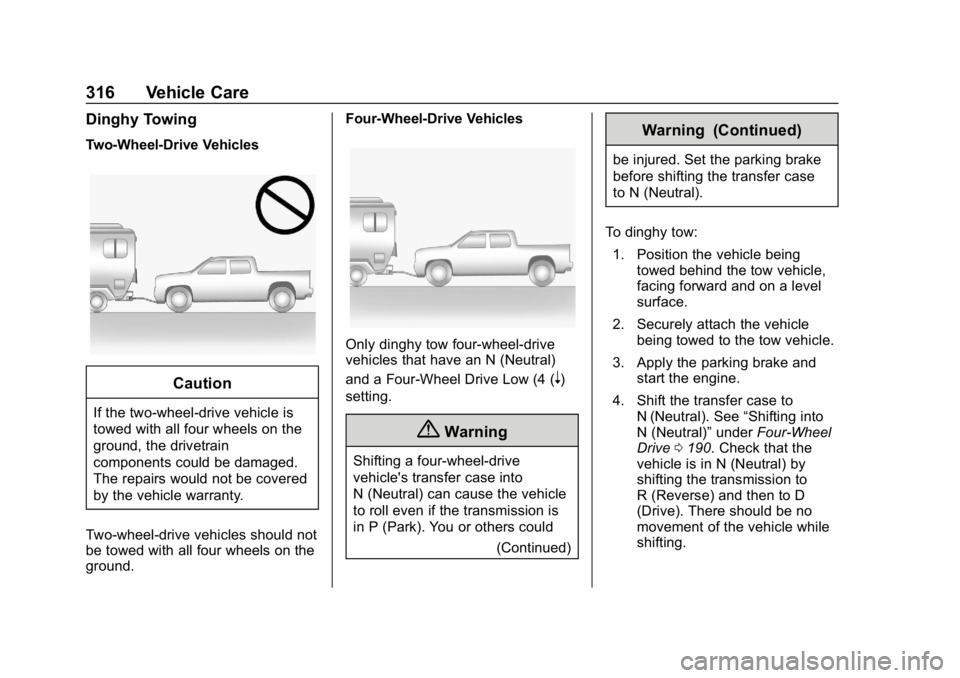
Two-Wheel-Drive Vehicles
Caution
If the two-wheel-drive vehicle is
towed with all four wheels on the
ground, the drivetrain
components could be damaged.
The repairs would not be covered
by the vehicle warranty.
Two-wheel-drive vehicles should not
be towed with all four wheels on the
ground. Four-Wheel-Drive Vehicles
Only dinghy tow four-wheel-drive
vehicles that have an N (Neutral)
and a Four-Wheel Drive Low (4 (
n)
setting.
{Warning
Shifting a four-wheel-drive
vehicle's transfer case into
N (Neutral) can cause the vehicle
to roll even if the transmission is
in P (Park). You or others could
(Continued)
Warning (Continued)
be injured. Set the parking brake
before shifting the transfer case
to N (Neutral).
To dinghy tow: 1. Position the vehicle being towed behind the tow vehicle,
facing forward and on a level
surface.
2. Securely attach the vehicle being towed to the tow vehicle.
3. Apply the parking brake and start the engine.
4. Shift the transfer case to N (Neutral). See “Shifting into
N (Neutral)” underFour-Wheel
Drive 0190. Check that the
vehicle is in N (Neutral) by
shifting the transmission to
R (Reverse) and then to D
(Drive). There should be no
movement of the vehicle while
shifting.
Page 319 of 387
Chevrolet Colorado Owner Manual (GMNA-Localizing-U.S./Canada/Mexico-
12460274) - 2019 - CRC - 10/1/18
318 Vehicle Care
Dolly Towing
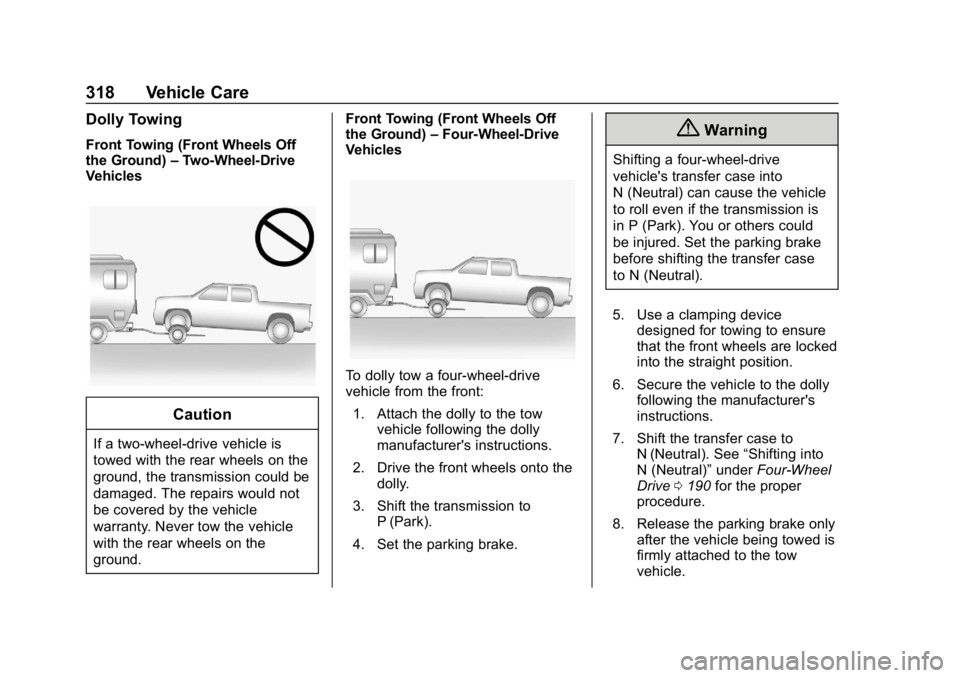
Front Towing (Front Wheels Off
the Ground)–Two-Wheel-Drive
Vehicles
Caution
If a two-wheel-drive vehicle is
towed with the rear wheels on the
ground, the transmission could be
damaged. The repairs would not
be covered by the vehicle
warranty. Never tow the vehicle
with the rear wheels on the
ground. Front Towing (Front Wheels Off
the Ground)
–Four-Wheel-Drive
Vehicles
To dolly tow a four-wheel-drive
vehicle from the front:
1. Attach the dolly to the tow vehicle following the dolly
manufacturer's instructions.
2. Drive the front wheels onto the dolly.
3. Shift the transmission to P (Park).
4. Set the parking brake.
{Warning
Shifting a four-wheel-drive
vehicle's transfer case into
N (Neutral) can cause the vehicle
to roll even if the transmission is
in P (Park). You or others could
be injured. Set the parking brake
before shifting the transfer case
to N (Neutral).
5. Use a clamping device designed for towing to ensure
that the front wheels are locked
into the straight position.
6. Secure the vehicle to the dolly following the manufacturer's
instructions.
7. Shift the transfer case to N (Neutral). See “Shifting into
N (Neutral)” underFour-Wheel
Drive 0190 for the proper
procedure.
8. Release the parking brake only after the vehicle being towed is
firmly attached to the tow
vehicle.
Page 328 of 387
Chevrolet Colorado Owner Manual (GMNA-Localizing-U.S./Canada/Mexico-
12460274) - 2019 - CRC - 10/1/18
Vehicle Care 327
Cargo Cover and
Convenience Net
If equipped, wash with warm water
and mild detergent. Do not use
chlorine bleach. Rinse with cold
water, and then dry completely.
Care of Seat Belts
Keep belts clean and dry.
{Warning
Do not bleach or dye seat belt
webbing. It may severely weaken
the webbing. In a crash, they
might not be able to provide
adequate protection. Clean and
rinse seat belt webbing only with
mild soap and lukewarm water.
Allow the webbing to dry.
Floor Mats
{Warning
If a floor mat is the wrong size or
is not properly installed, it can
interfere with the pedals.
Interference with the pedals can
cause unintended acceleration
and/or increased stopping
distance which can cause a crash
and injury. Make sure the floor
mat does not interfere with the
pedals.
Use the following guidelines for
proper floor mat usage:
. The original equipment floor
mats were designed for your
vehicle. If the floor mats need
replacing, it is recommended
that GM certified floor mats be purchased. Non-GM floor mats
may not fit properly and may
interfere with the pedals. Always
check that the floor mats do not
interfere with the pedals.
. Do not use a floor mat if the
vehicle is not equipped with a
floor mat retainer on the driver
side floor.
. Use the floor mat with the
correct side up. Do not turn
it over.
. Do not place anything on top of
the driver side floor mat.
. Use only a single floor mat on
the driver side.
. Do not place one floor mat on
top of another.
Page 331 of 387
Chevrolet Colorado Owner Manual (GMNA-Localizing-U.S./Canada/Mexico-
12460274) - 2019 - CRC - 10/1/18
330 Service and Maintenance
Caution (Continued)
approved by GM could damage
the vehicle, requiring expensive
repairs that are not covered by
the vehicle warranty.
The Tire Rotation and Required
Services are the responsibility of the
vehicle owner. It is recommended to
have your dealer perform these
services every 12 000 km/7,500 mi.
Proper vehicle maintenance helps to
keep the vehicle in good working
condition, improves fuel economy,
and reduces vehicle emissions.
Because of the way people use
vehicles, maintenance needs vary.
There may need to be more
frequent checks and services. The
Additional Required Services -
Normal are for vehicles that:
. Carry passengers and cargo
within recommended limits on
the Tire and Loading Information
label. See Vehicle Load Limits
0 168. .
Are driven on reasonable road
surfaces within legal driving
limits.
. Use the recommended fuel. See
Recommended Fuel 0216.
Refer to the information in the
Maintenance Schedule Additional
Required Services - Normal chart.
The Additional Required Services -
Severe are for vehicles that are:
. Mainly driven in heavy city traffic
in hot weather
. Mainly driven in hilly or
mountainous terrain
. Frequently towing a trailer
. Used for high speed or
competitive driving
. Used for taxi, police, or delivery
service
Refer to the information in the
Maintenance Schedule Additional
Required Services - Severe chart.
{Warning
Performing maintenance work can
be dangerous and can cause
serious injury. Perform
maintenance work only if the
required information, proper tools,
and equipment are available.
If they are not, see your dealer to
have a trained technician do the
work. See Doing Your Own
Service Work 0241.
Page 376 of 387

Chevrolet Colorado Owner Manual (GMNA-Localizing-U.S./Canada/Mexico-
12460274) - 2019 - CRC - 10/1/18
Index 375
IndexA
Accessories andModifications . . . . . . . . . . . . . . . . . . 241
Accessory Power . . . . . . . . . . . . . . . 179
Add-On Electrical Equipment . . . 237
Additional Information OnStar . . . . . . . . . . . . . . . . . . . . . . . 365
Additional Maintenance and Care . . . . . . . . . . . . . . . . . . . . . . 338
Adjustments
Lumbar, Front Seats . . . . . . . . . . . . 46
Air Cleaner/Filter, Engine . . . . . . . 251
Air Conditioning . . . . . . . . . . . 148, 150
Air Filter, Passenger Compartment . . . . . . . . . . . . . . . . . 154
Air Vents . . . . . . . . . . . . . . . . . . . . . . . 153
Airbag System Check . . . . . . . . . . . . . . . . . . . . . . . . . . 71
How Does an AirbagRestrain? . . . . . . . . . . . . . . . . . . . . . 64
Passenger Sensing System . . . . 65
What Makes an Airbag Inflate? . . . . . . . . . . . . . . . . . . . . . . . . 63
What Will You See after an
Airbag Inflates? . . . . . . . . . . . . . . . 64
When Should an Airbag Inflate? . . . . . . . . . . . . . . . . . . . . . . . . 63
Where Are the Airbags? . . . . . . . . 61 Airbags
Adding Equipment to the
Vehicle . . . . . . . . . . . . . . . . . . . . . . . . 70
Passenger Status Indicator . . . .119
Readiness Light . . . . . . . . . . . . . . .119
Servicing Airbag-Equipped Vehicles . . . . . . . . . . . . . . . . . . . . . . . 70
System Check . . . . . . . . . . . . . . . . . . 59
Alarm Vehicle Security . . . . . . . . . . . . . . . . 34
All-Season Tires . . . . . . . . . . . . . . . . 279
All-Terrain Tires . . . . . . . . . . . . . . . . . 280
Antilock Brake System (ABS) . . . 197
Warning Light . . . . . . . . . . . . . . . . . 123
Appearance Care Exterior . . . . . . . . . . . . . . . . . . . . . . . 319
Interior . . . . . . . . . . . . . . . . . . . . . . . . 324
Assistance Program, Roadside . . . . . . . . . . . . . . . . . . . . . . 353
Assistance Systems for Parking and Backing . . . . . . . . . . 210
Automatic Climate Control System . . . . . . . 150
Door Locks . . . . . . . . . . . . . . . . . . . . . 33
Headlamp System . . . . . . . . . . . . 141
Transmission . . . . . . . . . . . . . . . . . 183
Transmission Fluid . . . . . . . . . . . 250
Page 377 of 387

Chevrolet Colorado Owner Manual (GMNA-Localizing-U.S./Canada/Mexico-
12460274) - 2019 - CRC - 10/1/18
376 Index
Automatic TransmissionManual Mode . . . . . . . . . . . . . . . . . 185
Shift Lock Control Function
Check . . . . . . . . . . . . . . . . . . . . . . . 264
Axle Locking Front . . . . . . . . . . . . . . . . . 205
Axle, Front . . . . . . . . . . . . . . . . . . . . . . 262
Axle, Rear . . . . . . . . . . . . . . . . . . . . . . 263
B
Battery Exterior Lighting Battery
Saver . . . . . . . . . . . . . . . . . . . . . . . 146
Load Management . . . . . . . . . . . . 145
Power Protection . . . . . . . . . . . . . 146
Battery - North America . . . . 260, 312
Blade Replacement, Wiper . . . . . 265
Blind Spot Mirrors . . . . . . . . . . . . . . . 37
Brake System Warning Light . . . . . . . . 122
Brakes . . . . . . . . . . . . . . . . . . . . . . . . . . 258
Antilock . . . . . . . . . . . . . . . . . . . . . . . 197
Assist . . . . . . . . . . . . . . . . . . . . . . . . . 198
Fluid . . . . . . . . . . . . . . . . . . . . . . . . . . 259
Parking . . . . . . . . . . . . . . . . . . . . . . . 198
Braking . . . . . . . . . . . . . . . . . . . . . . . . . 157
Break-In, New Vehicle . . . . . . . . . . 174 Bulb Replacement
Center High-Mounted
Stoplamp (CHMSL) and
Cargo Lamp . . . . . . . . . . . . . . . . . 270
Halogen Bulbs . . . . . . . . . . . . . . . . 267
Headlamp Aiming . . . . . . . . . . . . . 267
Headlamps . . . . . . . . . . . . . . . . . . . 267
Headlamps, Front Turn Signal, Sidemarker, and
Parking Lamps . . . . . . . . . . . . . . 268
Taillamps, Turn Signal,
Stoplamps, and Back-up
Lamps . . . . . . . . . . . . . . . . . . . . . . 268
Buying New Tires . . . . . . . . . . . . . . . 293
C
Calibration . . . . . . . . . . . . . . . . . . . . . . 108
California Perchlorate MaterialsRequirements . . . . . . . . . . . . . . . 241
California
Proposition
65 Warning . . . . . . . . . .240, 260, 312, Back Cover
Canadian Vehicle Owners . . . . . . . . 2
Capacities and Specifications . . . . . . . . . . . . . . . . . 346 Carbon Monoxide
Engine Exhaust . . . . . . . . . . . . . . . 182
Tailgate . . . . . . . . . . . . . . . . . . . . . . . . . 34
Winter Driving . . . . . . . . . . . . . . . . 165
Caution, Danger, and Warning . . . . 3
Center Console Storage . . . . . . . . 104
Center High-Mounted Stoplamp (CHMSL) and
Cargo Lamp . . . . . . . . . . . . . . . . . . . 270
Chains, Tire . . . . . . . . . . . . . . . . . . . . 297
Charging Wireless . . . . . . . . . . . . . . . . . . . . . . 109
Charging System Light . . . . . . . . . 120
Check Engine Light (MalfunctionIndicator) . . . . . . . . . . . . . . . . . . . . 120
Ignition Transmission Lock . . . 264
Child Restraints Infants and Young Children . . . . . 74
Lower Anchors and Tethersfor Children . . . . . . . . . . . . . . . . . . . 79
Older Children . . . . . . . . . . . . . . . . . . 72
Securing . . . . . . . . . . . . . . . . . . . . 93, 99
Systems . . . . . . . . . . . . . . . . . . . . . . . . 76
Circuit Breakers . . . . . . . . . . . . . . . . 271
Cleaning
Exterior Care . . . . . . . . . . . . . . . . . 319
Interior Care . . . . . . . . . . . . . . . . . . 324
Page 378 of 387

Chevrolet Colorado Owner Manual (GMNA-Localizing-U.S./Canada/Mexico-
12460274) - 2019 - CRC - 10/1/18
Index 377
Climate Control Systems . . . . . . . 148Air Conditioning . . . . . . . . . . . . . . 148
Automatic . . . . . . . . . . . . . . . . . . . . . 150
Heating . . . . . . . . . . . . . . . . . . . . . . . 148
Clock . . . . . . . . . . . . . . . . . . . . . . . . . . . 108
Cluster, Instrument . . . . . . . . 112, 114
Clutch, Hydraulic . . . . . . . . . . . . . . . 250
Collision Damage Repair . . . . . . . 356
Compact Spare Tire . . . . . . . . . . . . 310
Compartments Storage . . . . . . . . . . . . . . . . . . . . . . . 103
Compass . . . . . . . . . . . . . . . . . . . . . . . 108
Connected Services Connections . . . . . . . . . . . . . . . . . . 372
Diagnostics . . . . . . . . . . . . . . . . . . . 374
Navigation . . . . . . . . . . . . . . . . . . . . 371
Connections Connected Services . . . . . . . . . . 372
Control Hill Descent . . . . . . . . . . . . . . . . . . 202
Traction and ElectronicStability . . . . . . . . . . . . . . . . . . . . . 199
Control Light Hill Descent . . . . . . . . . . . . . . . . . . 124
Control of a Vehicle . . . . . . . . . . . . . 157
Convex Mirrors . . . . . . . . . . . . . . . . . . 36
Coolant
Engine Temperature Gauge . . .117 Cooling . . . . . . . . . . . . . . . . . . . . 148, 150
Cooling System . . . . . . . . . . . . . . . . . 253
Courtesy Transportation
Program . . . . . . . . . . . . . . . . . . . . . . . 355
Cruise Control . . . . . . . . . . . . . . . . . . 206 Light . . . . . . . . . . . . . . . . . . . . . . . . . . 128
Cupholders . . . . . . . . . . . . . . . . . . . . . 103
Customer Assistance . . . . . . . . . . . 352
Offices . . . . . . . . . . . . . . . . . . . . . . . . 351
Text Telephone (TTY)Users . . . . . . . . . . . . . . . . . . . . . . . 352
Customer Information Publications OrderingInformation . . . . . . . . . . . . . . . . . . 358
Customer Satisfaction Procedure . . . . . . . . . . . . . . . . . . . . . 349
D
Damage Repair, Collision . . . . . . . 356
Danger, Warning, and Caution . . . . 3
Data Collection
Infotainment System . . . . . . . . . . 362
OnStar . . . . . . . . . . . . . . . . . . . . . . . 362
Data Recorders, Event . . . . . . . . . 361
Daytime Running Lamps (DRL) . . . . . . . . . . . . . . . . . . 141
Defensive Driving . . . . . . . . . . . . . . . 157
Delayed Locking . . . . . . . . . . . . . . . . . 32 Diagnostics
Connected Services . . . . . . . . . . 374
Differential, Limited-Slip . . . . . . . . 204
Distracted Driving . . . . . . . . . . . . . . . 156
Dome Lamps . . . . . . . . . . . . . . . . . . . 144
Door Ajar Light . . . . . . . . . . . . . . . . . . . . . 128
Delayed Locking . . . . . . . . . . . . . . . . 32
Locks . . . . . . . . . . . . . . . . . . . . . . . . . . . 31
Power Locks . . . . . . . . . . . . . . . . . . . . 32
Drive Belt Routing, Engine . . . . . . 348
Driver Assistance Systems . . . . . 209
Driver Information
Center (DIC) . . . . . . . . . . . . . 129, 131
Driver Mode Control . . . . . . . . . . . . 203
Driving Characteristics andTowing Tips . . . . . . . . . . . . . . . . . 219
Defensive . . . . . . . . . . . . . . . . . . . . . 157
Drunk . . . . . . . . . . . . . . . . . . . . . . . . . 157
For Better Fuel Economy . . . . . . . 24
Hill and Mountain Roads . . . . . . 165
If the Vehicle is Stuck . . . . . . . . . 167
Loss of Control . . . . . . . . . . . . . . . 159
Off-Road . . . . . . . . . . . . . . . . . . . . . 159
Off-Road Recovery . . . . . . . . . . . 158
Vehicle Load Limits . . . . . . . . . . . 168
Wet Roads . . . . . . . . . . . . . . . . . . . 164