ignition CHEVROLET CORVAIR 1965 2.G Owners Manual
[x] Cancel search | Manufacturer: CHEVROLET, Model Year: 1965, Model line: CORVAIR, Model: CHEVROLET CORVAIR 1965 2.GPages: 56, PDF Size: 22.29 MB
Page 6 of 56
Downloaded from www.Manualslib.com manuals search engine IGNITION SWITCH
STARTING THE ENGINE
STARTING
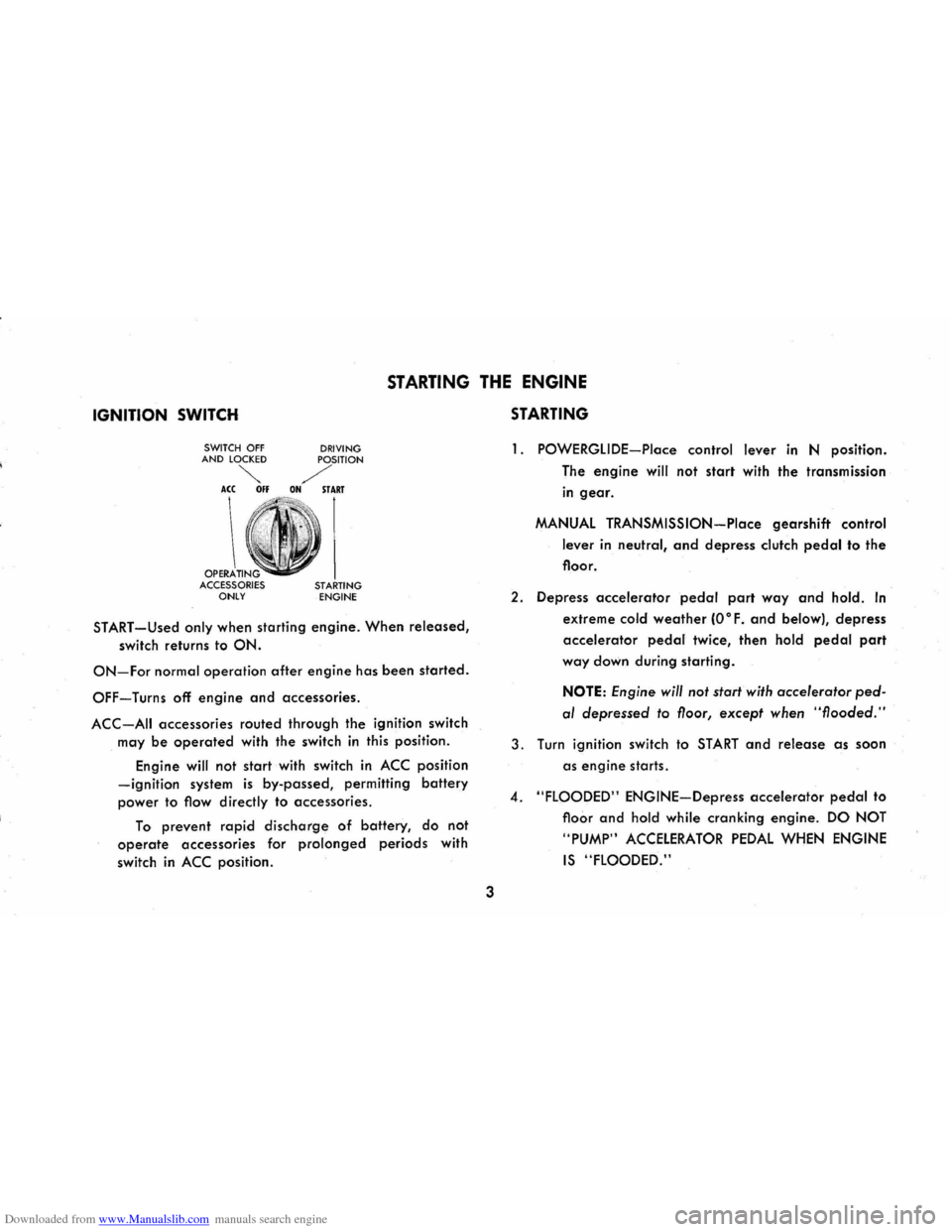
SWITCH OFF AND LOCKED
~ ACC 011
OPERATI ACCESSORIES ONLY
DRIVING
POSITION
/' ON START
STARTING ENGINE
START -Used only when starting engine. When released,
switch returns to ON.
ON-For normal operation after engine has been started.
OFF-Turns off engine and accessories.
ACC-AII accessories routed through the ignition switch
may
be operated with the switch in this position.
Engine
will not start with switch in ACC position
-ignition system is by-passed, permitting battery
power to flow directly to accessories .
To prevent rapid discharge of battery, do not
operate accessories for prolonged periods with
switch
in ACC position.
3
1. POWERGLIDE-Place control lever in N position.
The
engine will not start with the transmission
in gear.
MANUAL TRANSMISSION-Place gearshift control
lever
in neutral, and depress clutch pedal to the
floor.
2. Depress
accelerator pedal part way and hold. In'
extreme cold weather (O°F. and below), depress
accelerator pedal twice, then hold pedal part
way down during starting.
NOTE:
Engine will not start with accelerator ped
al depressed to floor, except when "flooded."
3. Turn ignition switch to START and release as soon
as engine starts.
4. "FLOODED" ENGINE-Depress accelerator pedal to
floor and hold while cranking engine. DO NOT
"PUMP"
ACCELERATOR PEDAL WHEN ENGINE
IS "FLOODED."
Page 11 of 56
Downloaded from www.Manualslib.com manuals search engine INSTRUMENTS
All driving instruments are grouped in the instrument
cluster
which is located immediately in front of the driver
to provide quick reading and maximum convenience and
accessibility. The TEMP-PRESS and GEN-FAN indicators
provide important information concerning the condition
of the engine and should be observed regularly during
operation of the car. The information on these pages
will help you understand the operation of these instru
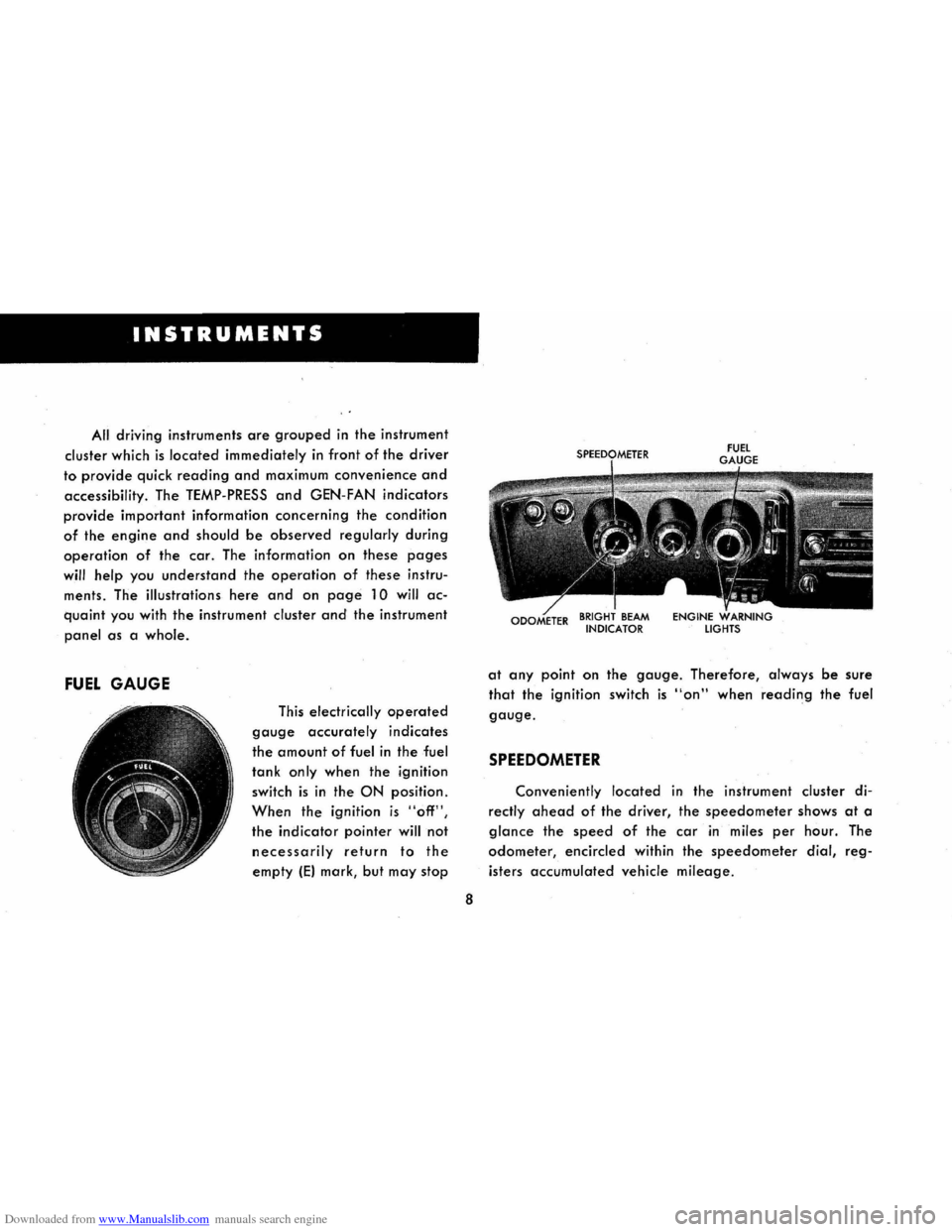
ments. The illustrations here
and on page 10 will ac
quaint you with the instrument cluster and the instrument
panel as a whole.
FUEL GAUGE
This electrically operated
gauge accurately indicates
the amount of fuel in the fuel
tank only when the ignition
switch is in the ON position.
When the ignition is "off",
the indicator pointer will not
necessarily return to the
empty IE) mark, but may stop
8
at any point on the gauge. Therefore, always be sure
that the ignition switch is "on" when reading the fuel
gauge.
SPEEDOMETER
Conveniently located in the instrument cluster di
rectly ahead of the driver, the speedometer shows at a
glance the speed of the car in miles per hour. The
odometer, encircled within the speedometer dial, reg
isters accumulated vehicle mileage.
Page 12 of 56
Downloaded from www.Manualslib.com manuals search engine TEMP-PRESS AND GEN-FAN INDICATORS
These indicators provide a check on the operating
condition of the engine and the generator. Both indi
cators should light with the ignition switch ON before
starting the engine and should go out after the engine
is started. The lights should remain out while engine is
operating, except the GEN-FAN indicator may flicker
when
engine is idling.
CAUTION: If either of these indicators light
while car is
being driven, immediately follow the
procedure outlined under "EMERGENCY OPER
ATING INSTRUCTIONS," so car may be driven
to
the nearest service facility.
EMERGENCY OPERATING INSTRUCTIONS
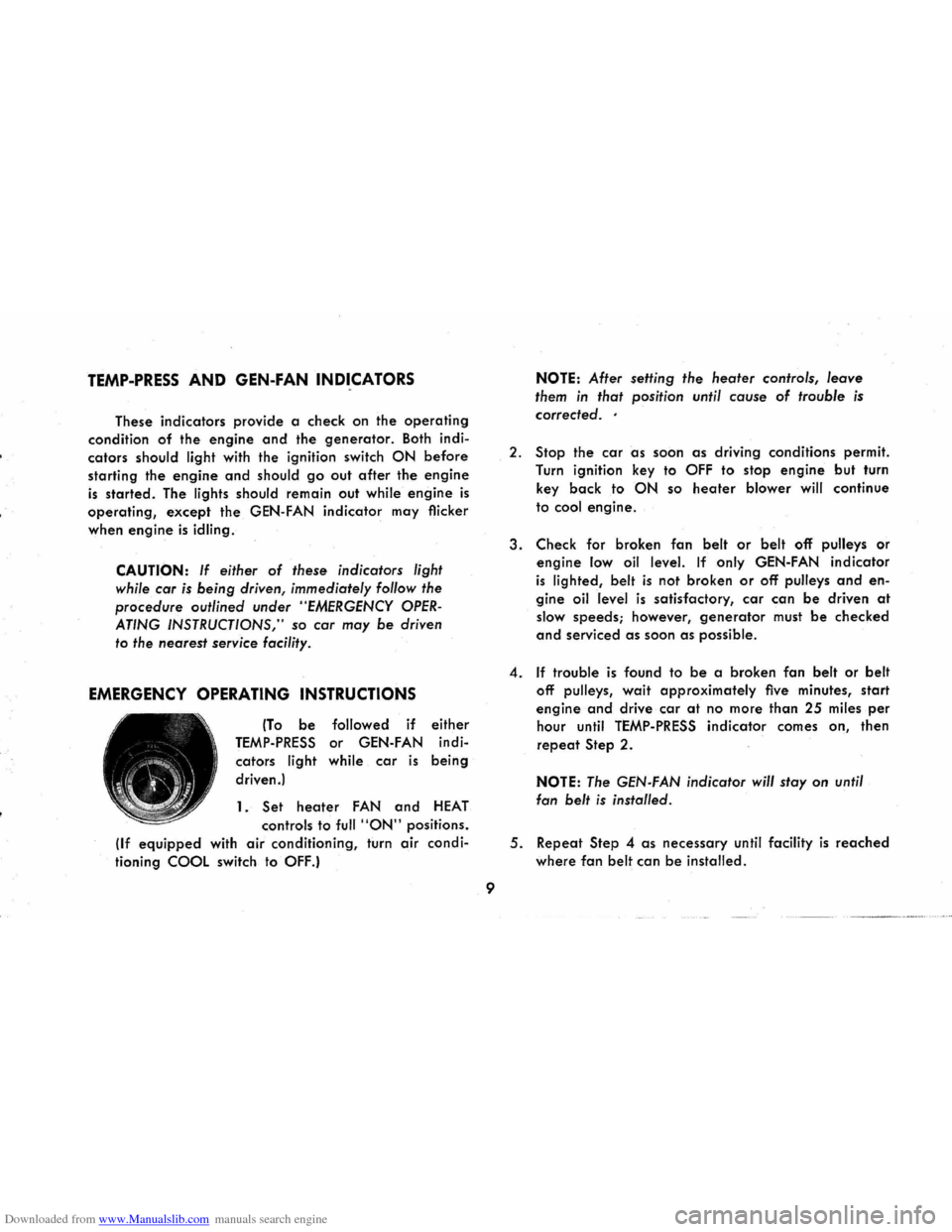
(To be followed if either
TEMP-PRESS or GEN-FAN indi
cators light while car is being
driven.)
1.
Set heater FAN and HEAT
controls to full "ON" positions.
(If
equipped with air conditioning, turn air condi
tioning COOL switch to OFF.)
9
NOTE: After setting the heater controls, leave
them in that position until cause of trouble is
corrected ..
2. Stop the car as soon as driving conditions permit.
Turn ignition key to
OFF to stop engine but turn
key
back to ON so heater blower will continue
to cool engine.
3. Check for broken fan belt or belt off pulleys or
engine low oil level. If only GEN-FAN indicator
is lighted, belt is not broken or off pulleys and en
gine oil level is satisfactory, car can be driven at
slow speeds; however, generator must be checked
and serviced as soon as possible.
4. If trouble is found to be a broken fan belt or belt
off pulleys, wait approximately five minutes, start
engine and drive car at no more than 25 miles per
hour until TEMP-PRESS indicator comes on, then
repeat Step 2.
NOTE: The GEN-FAN indicator will stay on until
fan
belt is installed .
5. Repeat Step 4 as necessary until facility is reached
where fan belt can be installed.
Page 21 of 56
Downloaded from www.Manualslib.com manuals search engine KEYS
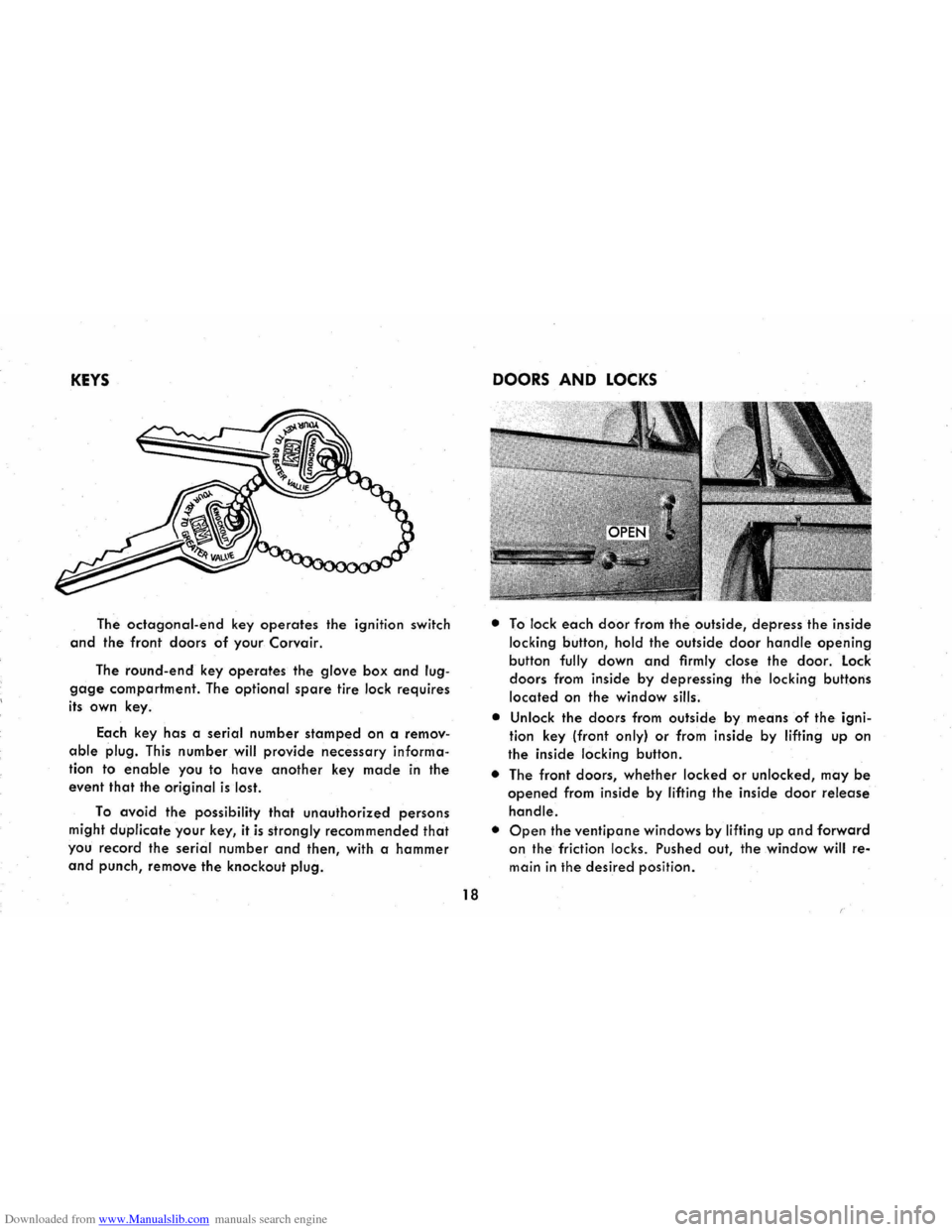
The octagonal-end key operates the ignition switch
and the front doors of your Corvair.
The round-end key operates the glove box and lug
gage compartment. The optional spare tire lock requires
its
own key.
Each key has a
serial number stamped on a remov
able plug. This number will provide necessary informa
tion to enable you to have another key made in the
event
that the original is lost.
To avoid the possibility that unauthorized persons
might duplicate your key, it is strongly recommended that
you record the serial number and then, with a hammer
and punch, remove the knockout plug.
18
DOORS AND LOCKS
• To lock each door from the outside, depress the inside
locking button, hold the outside door handle opening
button fully down and firmly close the door. lock
doors from inside by depressing the locking buttons
located on the window sills.
• Unlock the doors from outside by means of the igni
tion key (front only) or from inside by lifting up on
the inside
locking button.
• The front doors, whether locked or unlocked, may be
opened from inside by lifting the inside door release
handle.
• Open the venti pane windows by lifting up and forward
on the friction locks. Pushed out, the window will re
main in the desired
position.
Page 27 of 56
Downloaded from www.Manualslib.com manuals search engine CORVAIR GREENBRIER
INSTRUMENTS AND CONTROLS
The Corvair Greenbrier instr~ments and controls are
essentially the same as those of the Covair which are de
scribed in preceding pages of this book. However, due to
body construction, various items differ somewhat in
operation and location. The next few pages cover those
items
peculiar to the Corvair Greenbrier only.
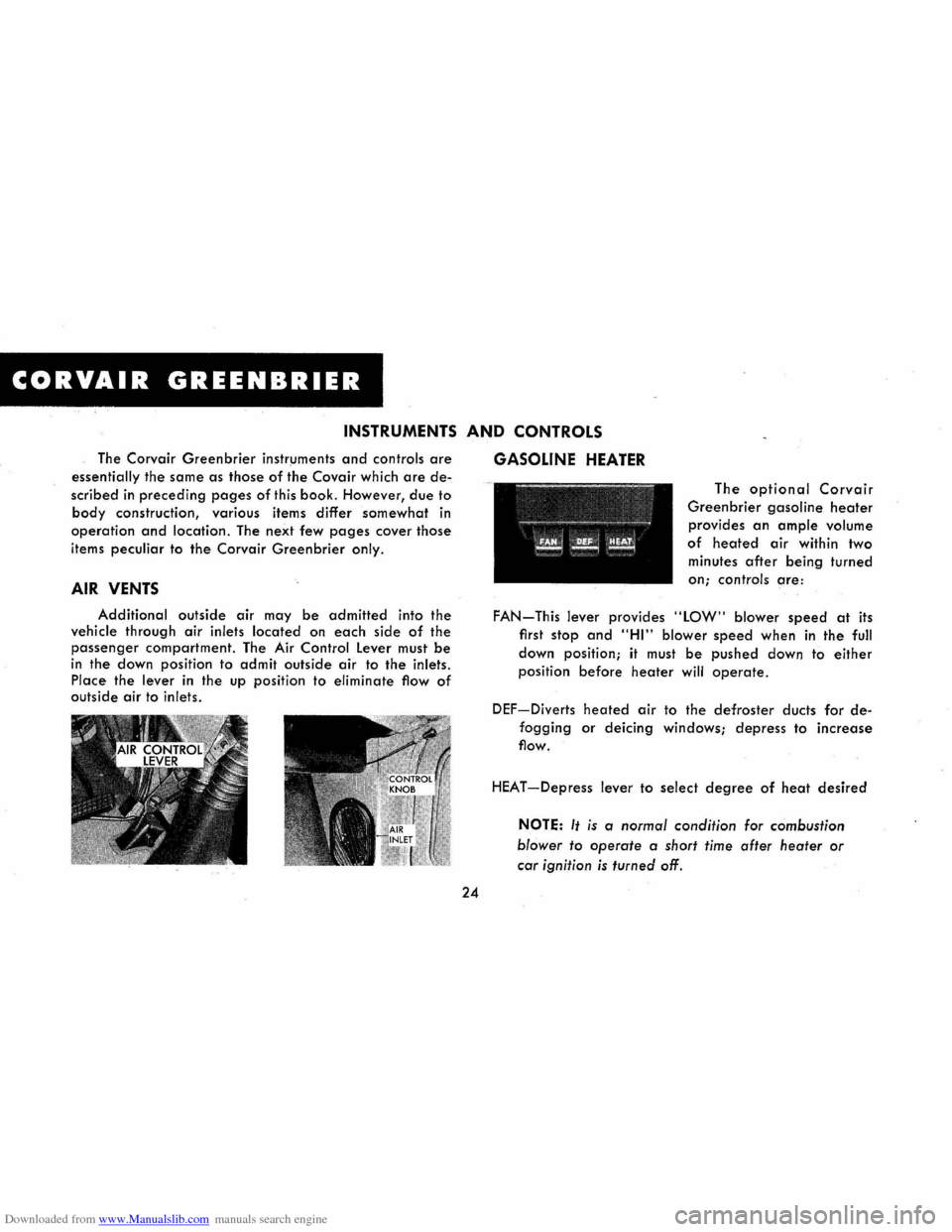
AIR VENTS
Additional outside air may be admitted into the
vehicle through air inlets located on each side of the
passenger compartment. The Air Control Lever must be
in the down position to admit outside air to the inlets.
Place
the lever in the up position to eliminate flow of outside air to inlets.
24
GASOLINE HEATER
The optional Corvair
Greenbrier gasoline heater
provides an ample volume
of heated air within two
minutes
after being turned
on; controls are:
FAN-This lever provides "LOW" blower speed at its
first
stop and "HI" blower speed when in the full
down position; it must be pushed down to either
position before heater will operate.
DEF-Diverts heated air to the defroster ducts for de
fogging or deicing windows; depress to increase
flow.
HEAT -Depress lever to select degree of heat desired
NOTE: It is a normal condition for combustion
blower to operate
a short time after heater or
car ignition
is turned off.
Page 29 of 56
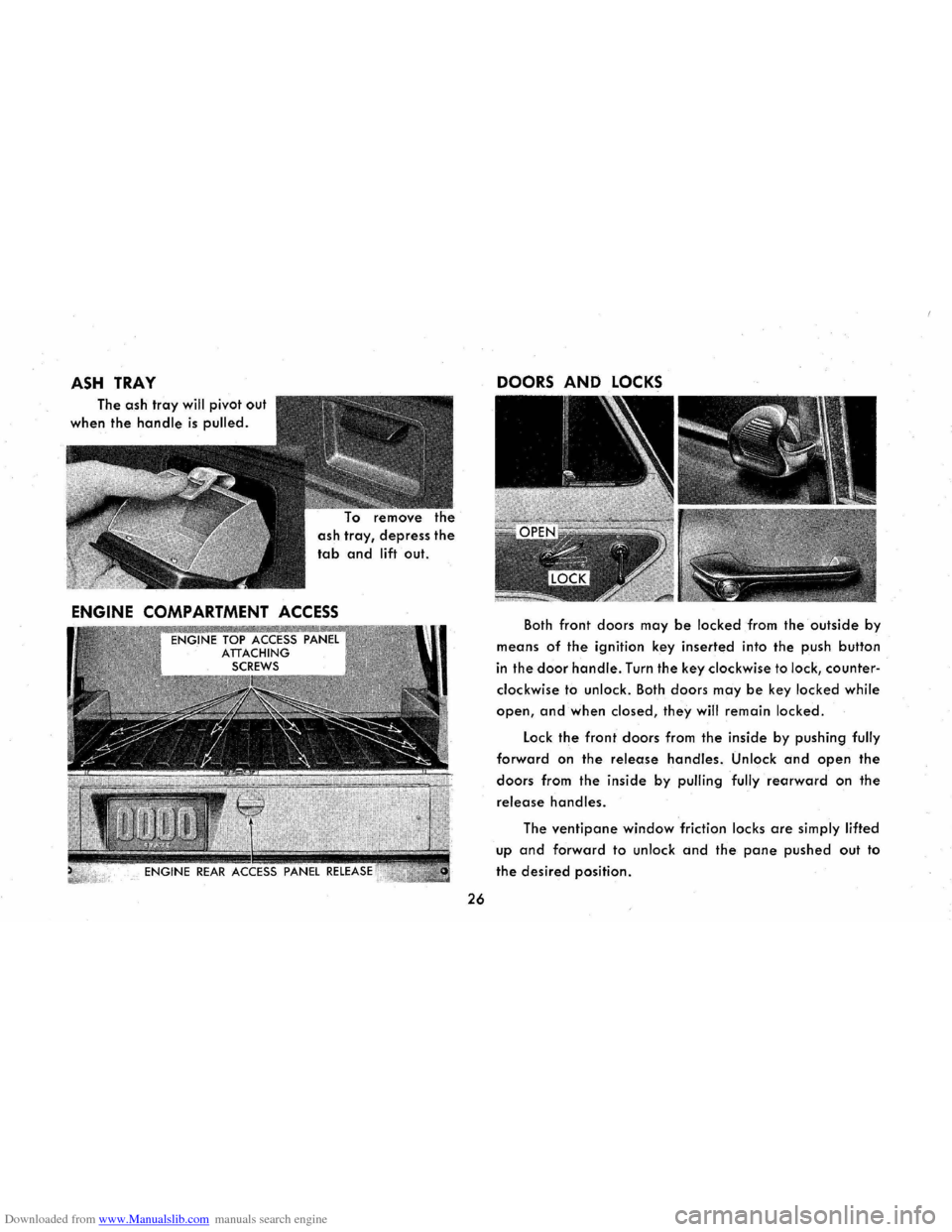
Downloaded from www.Manualslib.com manuals search engine ASH TRAY
The ash tray will pivot out
when the handle is pulled.
ash tray, depress the
tab and lift out.
ENGINE COMPARTMENT ACCESS
26
DOORS AND LOCKS
Both front doors may be locked from the outside by
means of the ignition key inserted into the push button
in the door handle. Turn the key clockwise to lock, counter
clockwise
to unlock. Both doors may be key locked while
open, and when closed, they will remain locked.
lock the front doors from the inside by pushing fully
forward on the release handles. Unlock and open the
doors from the inside by pulling fully rearward on the
release handles.
The ventipane window friction locks are simply lifted
up and forward to unlock and the pane pushed out to
the desired position.
Page 42 of 56
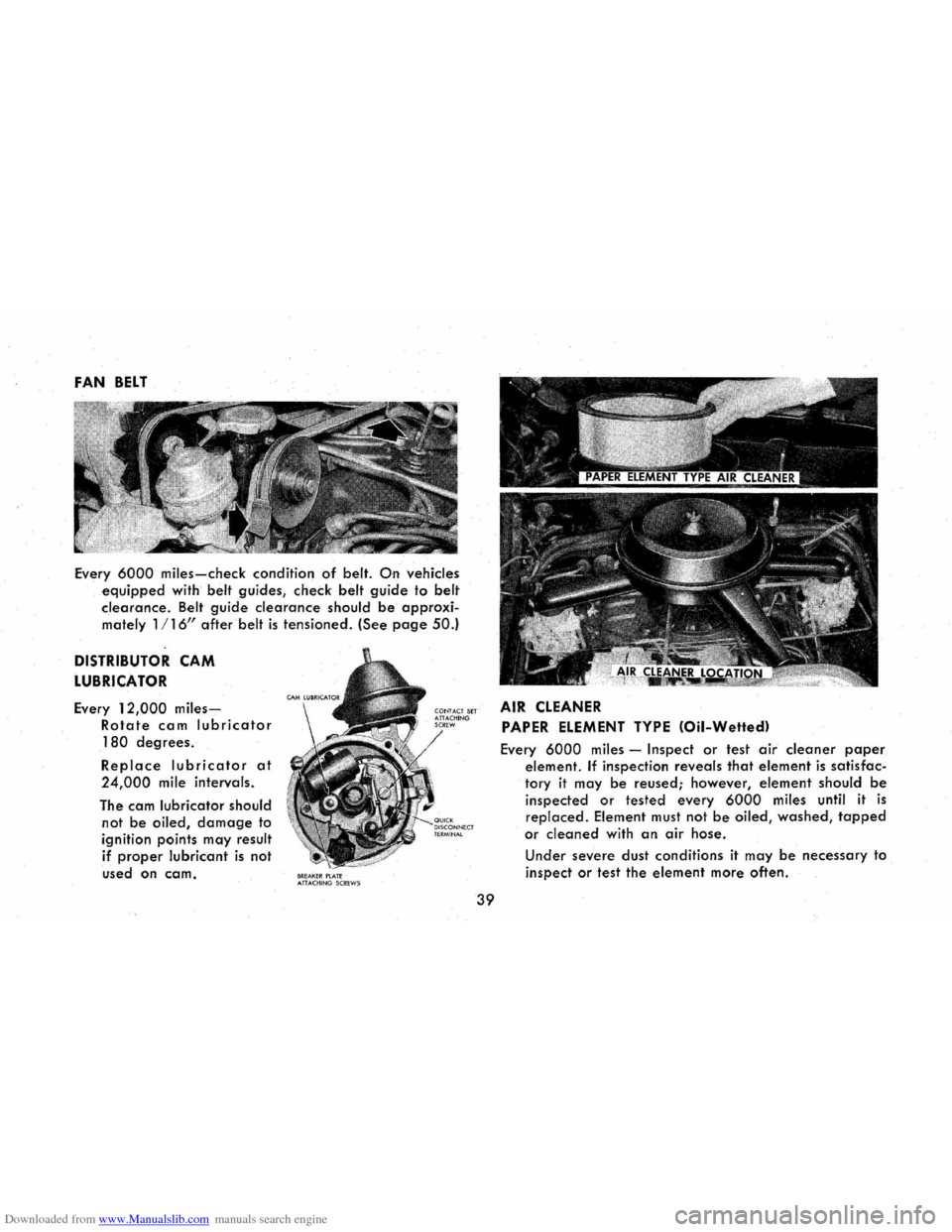
Downloaded from www.Manualslib.com manuals search engine FAN BELT
Every 6000 miles-check condition of belt. On vehicles
. equipped with belt guides, check belt guide to belt
clearance. Belt guide clearance should be approxi
mately 1/ 16/1 after belt is tensioned. (Seepage 50.)
DISTRIBUTOR CAM
LUBRICATOR
Every 12,000 miles-
Rotate cam lubricator
180 degrees.
Replace lubricator at
24,000 mile intervals .
The cam lubricator should
not be oiled, damage to
ignition points
may result
if proper lubricant is not
used on cam.
8R:EAKER PlATE "nACHlNG SCREWS
39
AIR CLEANER
PAPER ELEMENT TYPE (Oil-Wetted)
Every 6000 miles -Inspect or test air cleaner paper
element. If inspection reveals that element is satisfac
tory it may
be reused ; however, element should be
inspected or tested every 6000 miles until it is
replaced. Element must not be oiled, washed, tapped
or cleaned with an air hose.
Under severe dust conditions
it may be necessary to
inspect
or test the element more often.
Page 48 of 56
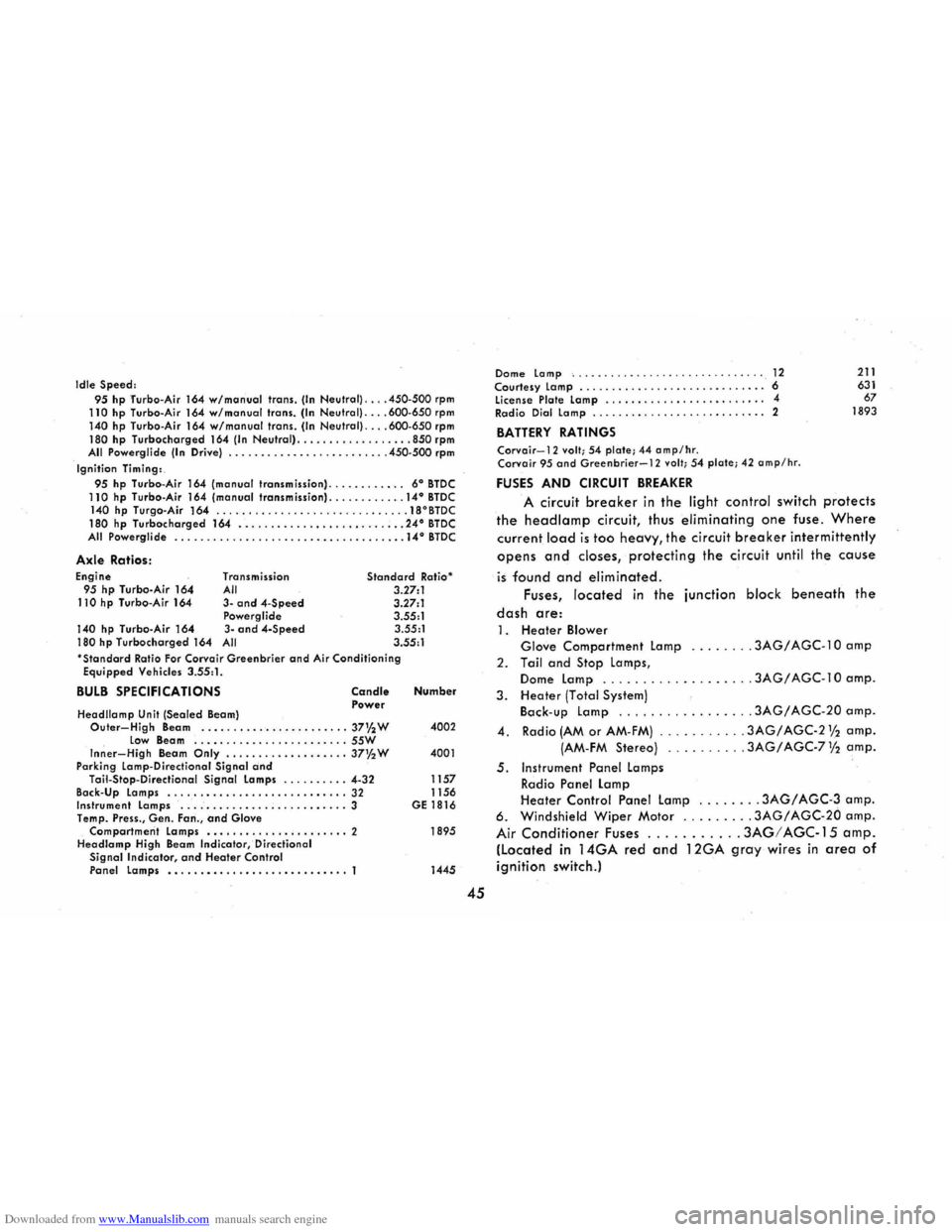
Downloaded from www.Manualslib.com manuals search engine Idle Speed: 95 hp Turbo-Air 164 w/monuol trans. (In Neutral) .... 450-500 rpm 110 hp Turbo-Air 164 w/manual trans. (In Neutral) .... 600-650 rpm 140 hp Turbo-Air 164 w/manualtrans. (In Neutral) .... 600-650 rpm 180 hp Turbocharged 164 (In Neutral) .................. 850 rpm All Powerglide (In Drive) .............. , .......... 450-500 rpm
Ignition Timing:. 95 hp Turbo-Air 164 (manual transmission) ............ 6° BTDC 110 hp Turbo-Air 164 (manual transmission) ............ 14° BTDC 140 hp Turgo-Air 164 .............................. 18°BTDC
180 hp Turbocharged 164 .......................... 24° BTDC All Powerglide ...........................••....•• . 14° BTDC
Axle Ratios: Engine 95 hp Turbo-Air 164 110 hp Turbo-Air 164
140 hp Turbo-Air 164 180 hp Turbocharged 164
Transmission All 3-and 4-Speed Powerglide
3 -and 4-Speed All
Standard Ratio "
3.27:1
3.27:1
3.55:1 3.55:1
3.55: 1 'Standard Ratio For Corvair Greenbrier and Air Conditioning Equipped Vehicles 3.55:1.
BULB SPECIFICATIONS
Headllamp Unit (Sealed Beam)
Candle Power
Outer-High Beam ......•.........•...... 37% W low Beam ....•.............•..... 55W Inner-High Beam Only ................... 37'!z W
Parking lamp-Directional Signal and Tail-Stap-D irectional Signal lamps ... ...•... 4-32
Back-Up lamps ............................ 32 Instrument lamps ....................••.... 3
Temp. Press., Gen. Fan., and Glove Compartment lamps ..•.............•..... 2 Headlamp High Beam Indicator,' Directional Signal Indicator , and Heater Control Panel lamps •.....•..................•.. 1
Number
4002
4001
1157
1156
GE 1816
1895
1445
45
Dome Lomp ' ................... .. ......... 12 Courtesy lamp .........••.................. 6 license Plate lamp .....•..............•.... 4
Radio Dial lamp ........•.......•.......... 2
BATTERY RATINGS
Corvair-12 volt; 54 plate; 44 amp/hr . Corvoir 95 and Greenbrier-12 volt; 54 plate; 42 amp/hr .
FUSES AND CIRCUIT BREAKER
211 631
67
1893
A circuit breaker in the light control switch protects
the head lamp circuit, thus eliminating one fuse. Where
current load is too heavy, the circuit breaker intermittently
opens and closes, protecting the circuit until the cause
is found and eliminated.
Fuses, located in the junction block beneath the
dash are:
1. Healer Blower
Glove Comparlment lamp ........ 3AG/ AGC-1 0 amp
2. Tail and Slop lamps,
Dome lamp ................. .. 3AG / AGC-1 0 amp.
3.
Heater (Total System) Back-up lamp ................. 3AG/ AGC-20 amp.
4. Radio (AM or AM-FM) ........... 3AG/ AGC-2 Y2 amp.
(AM-FM Stereo) .. . .... 3AG/ AGC-71/2 amp.
5. Instrument Panel lamps Radio Panel lamp Heater Conlrol Panel lamp ........ 3AG/ AGC-3 amp. 6. Windshield Wiper Molor ......... 3AG/ AGC-20 amp.
Air Conditioner Fuses ........... 3AG! AGC-15 amp. (Located in 14GA red and 12GA gray wires in area of
ignition switch.)
Page 51 of 56
Downloaded from www.Manualslib.com manuals search engine MINOR TROUBLE SHOOTING PROCEDURES
The chart on the previous page, and the information on the pages
which follow, contains information designed to aid the average
driver to discover, and possibly correct, conditions resulting in minor
mechanical difficulties
in his cor. The chart, designed to point out
possible solutions to severol of the most common automotive mal
functions and point out a logical checking sequence, will lead step
by step to the most
likely causes and corrective procedures. If, after
making the checks and adjustments suggested, the source of the
trouble has not been found and corrected, it is strongly recom.
mended that on Authorized Chevrolet Dealer inspect the vehicle and
make whatever repairs or adjustments are necessary.
FUEL SYSTEM AND ENGINE
If the ignition switch will couse the engine to "turn over" or
"cronk" but the cor will not start, check Steps A through D below.
NOTE: If continual "flooding" of the carburetor is evidenced by a
carburetor wet with fuel or black exhaust smoke, perform the
operation suggested in paragraph D only.
(A) The first and most obvious,
and one of the most frequently overlooked, items to check when
you
have difficulty in starting your
cor is the amount of fuel in the
tonk.
Make it a habit to check the
FUEL GAUGE regularly and most especially at a time when the en
gine will "turn over" but will not
start.
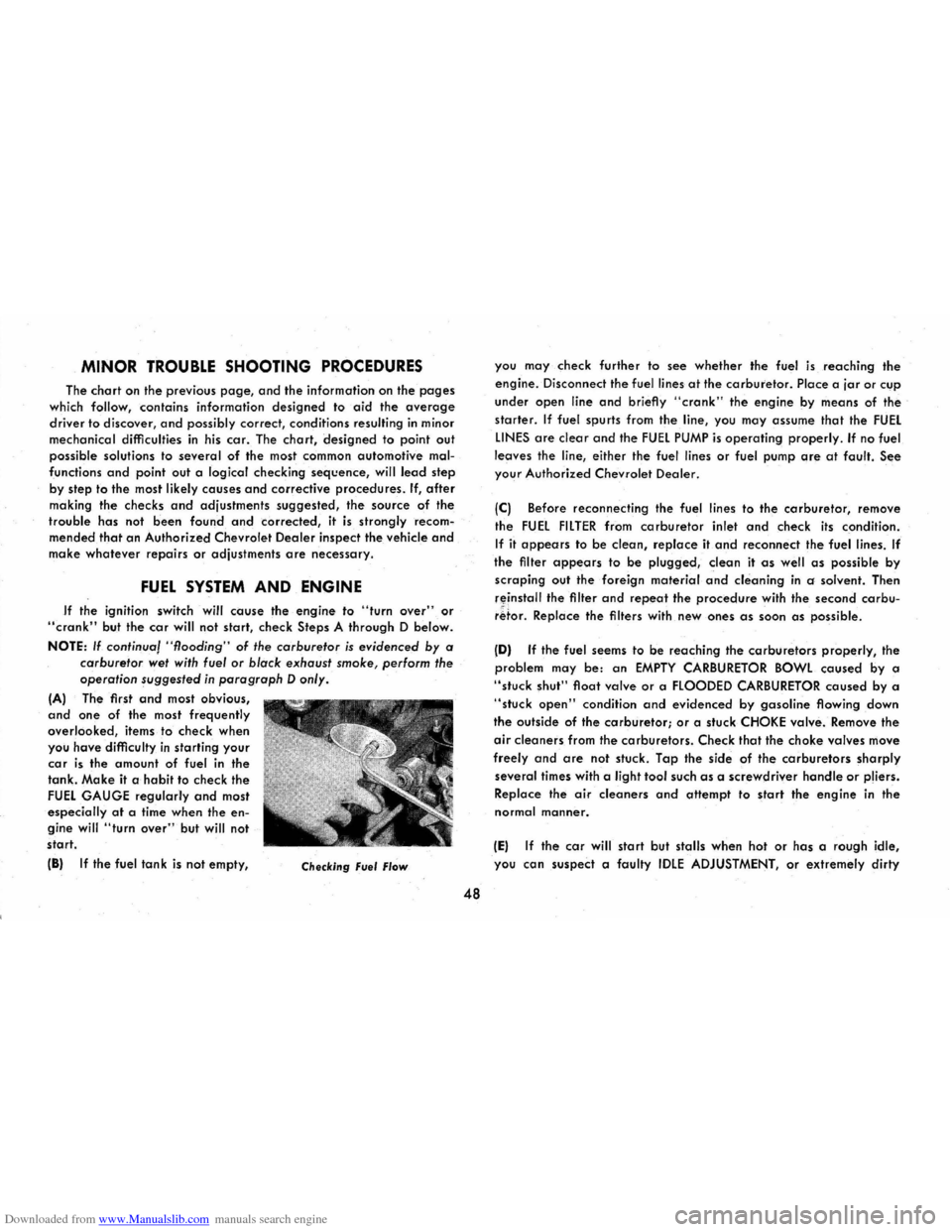
(8) If the fuel tank is not empty, Checking Fuel Flow
48
you may check further to see whether the fuel is reaching the
engine. Disconnect the fuel lines at the carburetor. Place a jar or CliP
under open line and briefly "crank" the engine by means of the
starter. If fuel spurts from the line, you may assume that the FUEL
LINES are dear and the FUEL PUMP is operating properly. If no fuel
leaves the line, either the fuel lines or fuel pump are at fault. See
your Authorized Chevrolet Dealer.
(C) Before reconnecting the fuel lines to the carburetor, remove
the
FUEL FILTER from carburetor inlet and check its condition.
If it appears to be clean, replace it.and reconnect the fuel lines. If
the filter appears to be plugged, clean it as well as possible by
scraping out the foreign material and cleaning in a solvent. Then
r~install the filter and repeat the procedure with the second carbu
r~ior. Replace the filters with new ones as soon as possible .
(0) If the fuel seems to be reaching the carburetors properly, the
problem may
be: an EMPTY CARBURETOR BOWL caused by a
"stuck shut" float valve or a FLOODED CARBURETOR caused by a
"stuck open" condition and evidenced by gasoline flowing down
the outside of the carburetor; or a stuck CHOKE valve. Remove the
air cleaners from the carburetors. Check that the choke valves move
freely and are not stuck. Tap the side of the carburetors sharply
several times with a light tool such as a screwdriver handle or pliers.
Replace the air cleaners and attempt to start the engine in the
normal manner.
(E) If the car will start but stalls when hot or has a rough idle,
you can suspect a faulty IDLE ADJUSTMENT, or extremely dirty
Page 52 of 56
Downloaded from www.Manualslib.com manuals search engine and blocked AIR CLEANER ELEMENTS. Clean and reoil the air
cleaner elements if necessary. Idle adjustment should be performed
by your Chevrolet Dealer.
If the above Fuel System checks and the checks suggested under
the Electrical System following do not correct the malfunction, it is
recommended that you turn to your Authorized Chevrolet Dealer
for further checks , adjustments or repairs.
ELECTRICAL SYSTEM
If, when the ignition key is turned to START, the engine will not
turn
over, you have good reason to suspect electrical trouble.
(F) When there .is no response at all to attempts to start the car,
check the obvious-your AUTOMATIC TRANSMISSION SElECTOR
LEVER must be in neutral position before the engine can be started.
Turning the IGNITION SWITCH rapidly back and forth several
times will sometimes correct a poor internal switch contact.
(G) The
BATTERY may be discharged. If so, lights will be dim and
the horn will have a poor tone if it will blow at all.
Usually a
garage recharge will be necessary to return the battery
to operation. Occasionally, however , a push start and a long drive
will
recharge the battery.
NOTE : If the battery is determined to be dead, and for no apparent
reason , have your Authorized Chevrolet Dealer check the
battery, the GENERATOR and the VOLTAGE REGULATOR .
GENERA TOR trouble should already have been indicated by
the indicator on the instrument panel. Never remove generator
"BAT" lead without first disconnecting battery ground cable.
49
POOR BATTERY CONNECTIONS may be suspected if the car has operated properly a short time before and now not even the horn
will operate. Check both ends of both battery cables. If the con
nections are corroded, a car may sometimes be restored to opera
tion by removing all cable ends, scraping all contacting surfaces clean with a pen knife , and reassembling . If the cables are broken, they must be replaced. The power supply should now be restored unless the battery is dead.
(H) If, however, the lights and horn work properly but the starter will still not turn over, check the STARTER connections. A "click" from the starter solenoid indicates that the wiring to the starter is properly installed . If the wiring seems to be clean and tightly installed, the trouble is probably in the starter itself and should be referred to your Authorized Chevrolet Dealer.
When the engine will "turn over" but will not start, the following
items may be checked along with Fuel System Checks listed
previously .
(I) With a clean dry cloth wipe the ceramic portions of the spark plugs dry. In particularly damp or rainy wellthe'r dampness may be the cause of not starting, especi-: . ally when the engine is cold.
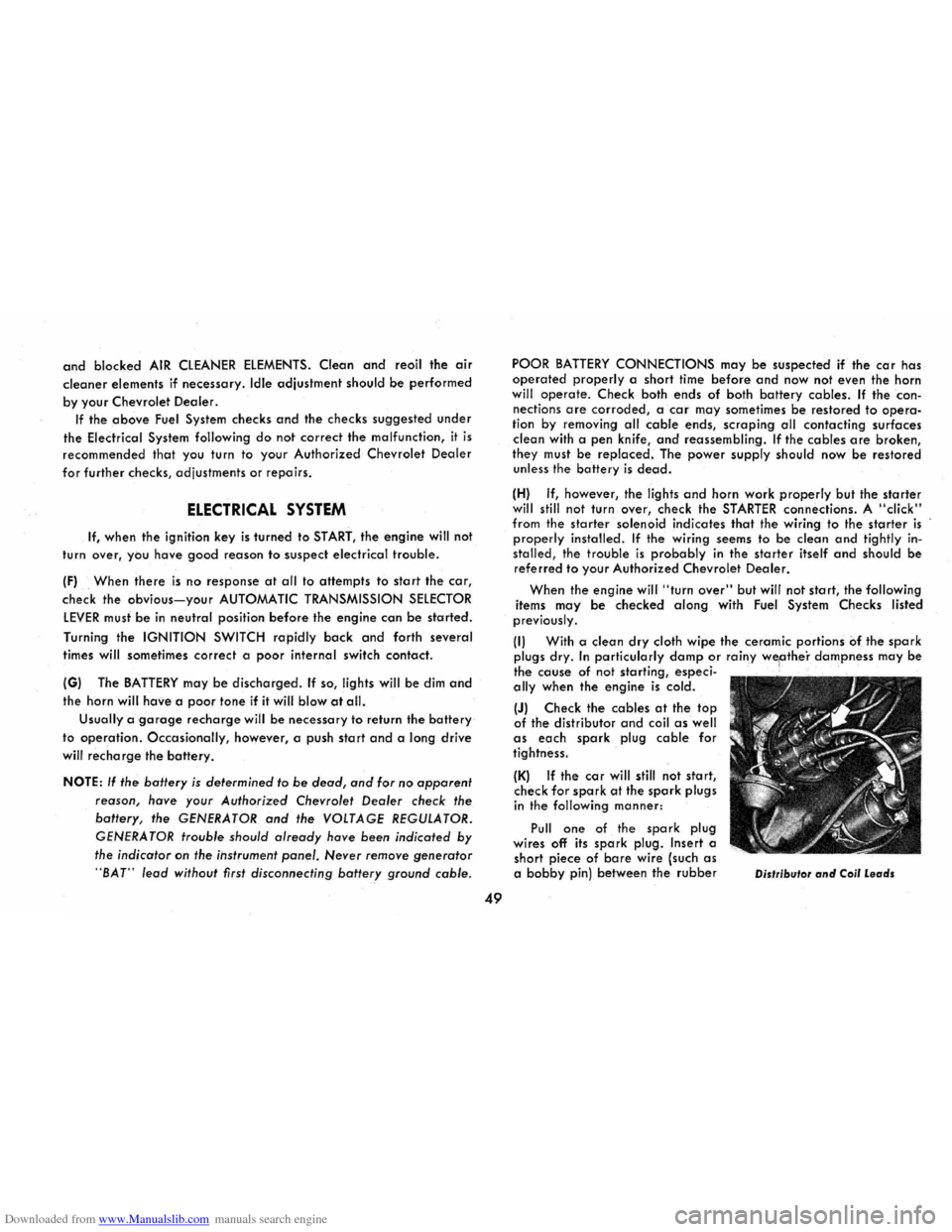
(J) Check the cables at the top of the distributor and coil as well as each spark plug cable for tightness.
(K) If the car will still not start, check for spark at the spark plugs in the following manner:
Pull
one of the spark plug
wires off its spark plug. Insert a
short piece of bare wire (such as a bobby pin) between the rubber Oislribulor and Coil Leads