brakes CHEVROLET CORVETTE 1964 Owners Manual
[x] Cancel search | Manufacturer: CHEVROLET, Model Year: 1964, Model line: CORVETTE, Model: CHEVROLET CORVETTE 1964Pages: 52, PDF Size: 11.2 MB
Page 8 of 52
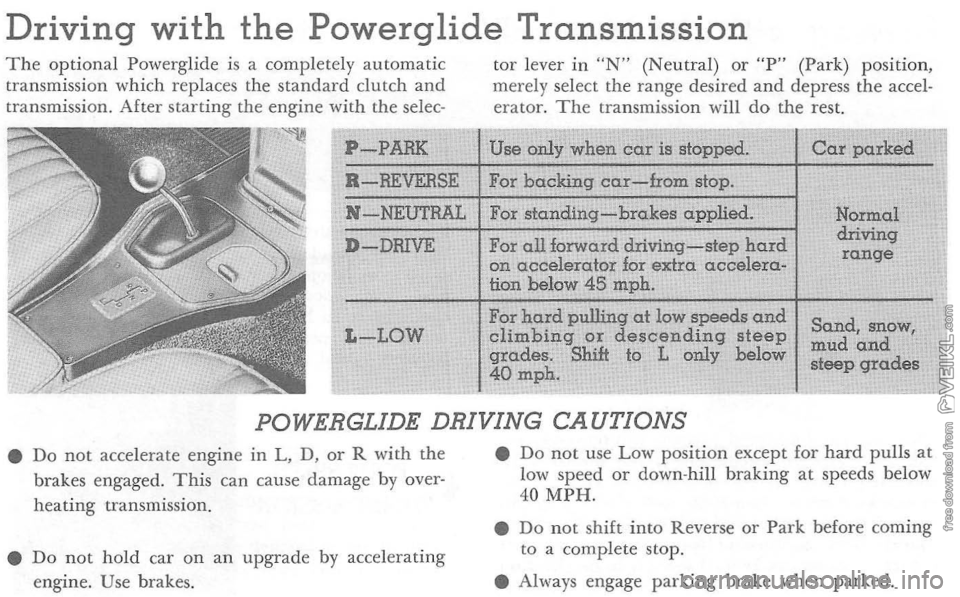
Driving with the Powerg lide Transmission
The optional Powerglide is a completely automatic transmission which replaces the standard clutch and transmission. After starting the engine with the seIce-
P-PARK R-REVERSE N-NEUTRAL
D - DRIVE
L-LOW
tor !ever in "N" (Neutral) or "P" (Park) position, merely select the range desired and depress the accelerator. The transmission will do the rest.
Use only
when car is stopped. Car parked
For backing car-from stop.
For
standing-brakes applied. Normal
For
all forward driving -step hard driving
on
accelerator for extra accelera-range
lion below 45 mph.
For
hard pulling at low speeds and Sand, snow, climbing or descending sleep mud and grades. Shift to L
only
below
steep grades 40 mph. ~I_, ~
POWERGLIDE DRIVING CAUTIONS
• Do not accelerate engine in L, D , or R with the brakes engaged. This can cause damage by overheating transmission.
•
Do not hold car on an upgrade by accelerating engine. Use brakes. •
Do not use Low position except for hard pulls at low
speed or down-hill braking at speeds below
40 MPH.
• Do not shift inw Reverse or Park before coming to a complete stop .
• Always engage
parking brake when parked.
I
J
Page 9 of 52
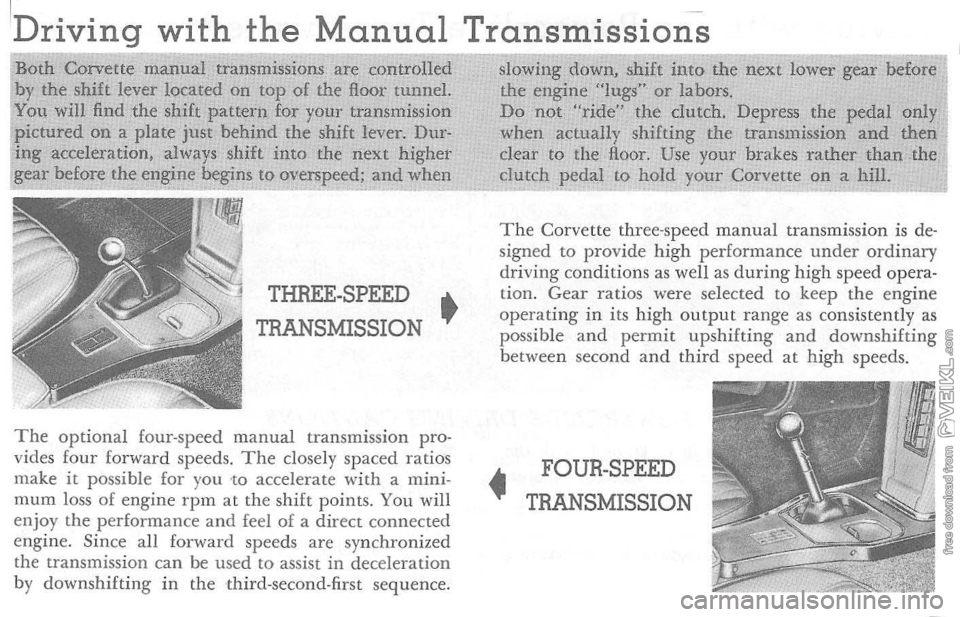
IDriving with the Manual Transmission-s
Both Corvette
manual transmissions are controlled slowing down, shift into the next lower gear before
by the shift lever located on top of the Hoor tunnel. the engine
"lugs" or labors.
You will find the shift pattern for your transmission Do not "ride" the dutch. Depress the pedal only pictured on a plate just behind the shift lever. Dur- when actually shifting the transmission and then ing acceleration, always shift into the next higher clear to the Hoar. Use your brakes rather than the
gear before the engine
begins to oVeISeeed; and ,;h_e_n~ __ cl_u_ tch_ pedal to hold your Corvette on a hill.
THREE-SPEED •
TRANSMISSION
The optional fouf4speed manual transmISSIOn provides four forward speeds. The closely spaced ratios
make it possible for you to accelerate with a mini
mum loss of engine rpm at the shift points. You will
en joy the performance and feel of a direct connecte d
engi ne. Since all forward speeds afe synchronized
the transmission can be used to assist in deceleration
by downshifting in the third-second-first sequence.
The Corvette three-speed manual transmission is designed to provide high performance under ordinary
driving conditions as well as during high speed opera
tion. Gear ratios were selected to keep the engine
operating in its high output range as consistently as possible and permit upshifting and downshifting
between second and third speed at high speeds.
• FOUR-SPEED
TRANSMISSION
Page 12 of 52
CLUTCH AND STEERING ADJUSTMENTS-Your Chevrolet deal!!! '?I.n make these 'adjustments for YQu: • A linkage adjustment to reduce clutch pedal travel to permit .fast release and more rapid gear shifting; • An adjustment to move the steering wheel forward or rearward; _ A linkage IIdjustment to permit
"faster" steering
response.
TRAILERS and their EFFECT on CAR OPERATION
The Corvette is designed primaril y (or passenge r
co nveyance . H owever , it is well known that many owners do pull trailers and have experi e nced very
sa tisfacLOry serv ice.
When a trailer is attached to a car, the car becomes
not only a l oad-carrying vehicle, but a load-pulling vehicle . The d e m a n ds of this type of operation are
very different from those (or which t h e automobile is pri ma rily designed and may present probl ems, such
as spring and tire loading, braking, coo ling, lighting, and steering. Howeve r, careful driving practices will
better s atisfy the requirements of trailer hauling.
If in the opinion of the manufacturer a part or com ponent of a motor vehicle has been advers ely affected
by misuse of the vehicle with trailer loads, such part or
com
ponent will not be covered by the manufacturers warranty .
The size o f and equipment for trailers, including
su ch ite ms as hitc hes and safe t y ch a ins, brakes, ligllls, pO\ve r- wei ght ratios a n d over-all length, are gen erally
su bject to safet y regulations in all states, and i t is the responsibility o f the u ser to m a ke certain that h e is in full compliance with th e regulations of the states
in which h e plans to opera te with a traile r and of t h e Interstate Commerce Commission, i f applicable,
before doing so . Furthe r , when opera tin g a car with a traile r attached, the drive r must realize tha t the performance, steering characte ri stics , a n d brakin g distance of his ca r h ave been altered , and that h e mlls t exe r c ise greater caution t o safe ly handle his
ca r and trailer.
Page 20 of 52
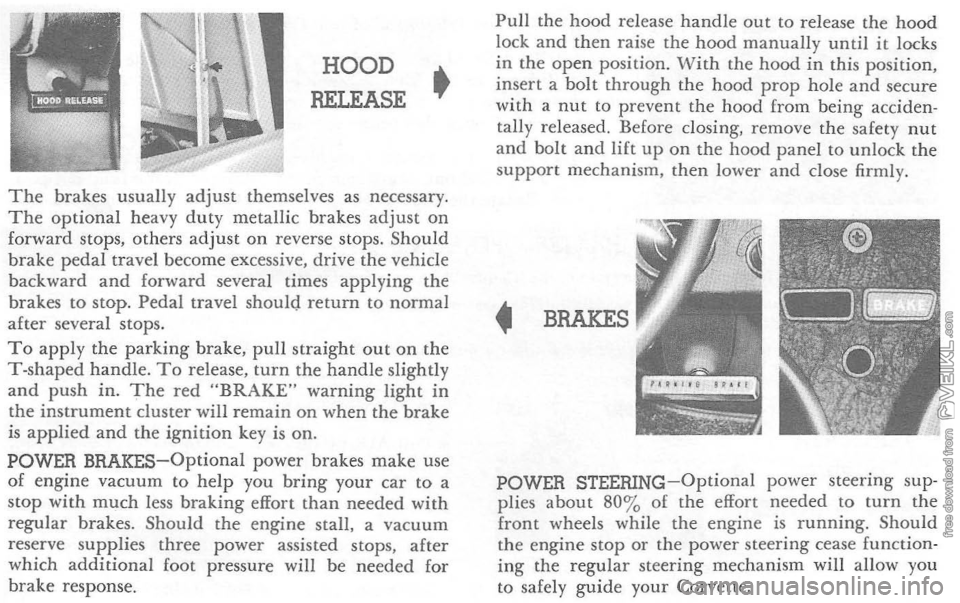
HOOD
RELEASE •
The brakes usually adjust themselves as necessary. The optional heavy duty metallic brakes adjust on forward stops, others adjust on reverse stops. Should
brake pedal travel become excessive, drive the vehicle
back ward
and forward several times applying the
brakes to stop. Pedal travel should return to normal after several stops. To apply the parking brake, pull straight out on the T-shaped handle. To release, turn the handle slightly and push in. The red "BRAKE" warning light in the instrument cluster will remain on when the brake is applied and the ignition key is on. POWER BRAKES-Optional power brakes make use of engine vacuum to help you bring your car to a stop with much less braking effort than needed with regular brakes. Should the engine stall. a vacuum
reserve supplies three power assisted stops, after
which additional foot pressure will be needed for
brake response.
Pull the hood release handle out to release the hood lock and then raise the hood manually until it locks
in the open position . With the hood in this position, insert a bolt through the hood prop hole and secure
with a nut to prevent the hood from being acciden
tally released. Before closing, remove the safety nut
and bolt and lift up on the hood panel to unlock the
support mechanism . then lower and close firmly.
• BRAKES
POWER STEERING-Optional power steering sup
plies about 80 % of the effort needed to turn the front wheels while the engine is running. Should the engine stop or the power steering cease function ing the regular steering mechanism will allow you
to safely guide your Corvette.
Page 37 of 52
FAN BELT
Every 6,000 miles inspect fan belt for wear, fraying,
cracking and tension. Belt should be retightened
only when
it deflects more than Y2" with modera te thumb pressure applied midway between pulleys.
AIR CLEANER
Ev ery
12,000 miles (more often under dusty o r other
adverse driving conditions) rem ove the polyurethan e
eleme nt from its support screen and clean in suit able
solvent such as Kerosene . Squeeze out all solvent,
then soak i n engine oil and squ eeze out. Remove
excess oil
by then squeezing the element in a clean dry cloth.
OIL FILTER
The oil filter should be changed at 6,000 miles or 6 month intervals, whi ch ever occurs first. During pro
l onged dusty driving conditions the filter should be
cha nged more often.
DISTRIBUTOR
Change cam lubricator end for end at 12,000 mile intervals-Replace at 24,00 0 mile intervals.
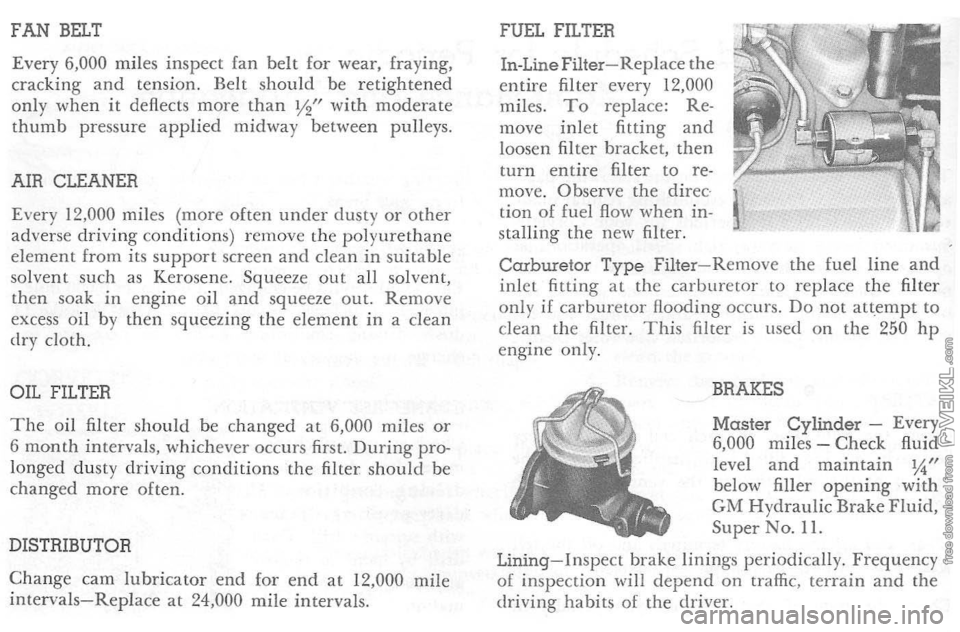
FUEL FILTER
In-Line Filter-Replace
the entire filter every 12,000
miles. To replace: Re
move inlet fitting and
loosen filter bracket, then
turn entire filter
to re
move. 0 hserve the direc
tion of fuel flow when in
stalling the new filter.
Carburetor Type Filter - R emove the fuel line and inlet fitting at the carburetor to replace the filter
only if car bur etor Hooding occurs. Do nor att,cmpt to clean the filter. This filter is used on the 250 hp engine only.
BRAKES
Master Cylinder -Every
6,000 miles - Check fluid
le vel and maintain IA" below filler opening with GM Hydraulic Brake Fluid, Super No. 11.
Lining-Inspe ct brake linings periodi cally. Frequency o[ inspection ,viII depend on traffic, terrain and the
driving habits of the driver.
Page 49 of 52
INDEX Page
Page Hard Top Care
. 29 Pushing Tips. .10 Installation .25 Radio .22
Headlight Operation .17 Rear Compartment 24
Page
Heater .20
Seat
Adjustment .23
Air
Conditioning . .21 High Beam Switch .... 18 Spare Tire Stowage .
33
Ammeter 14 Hood Release . 19 Specificat ions .44-47 Automatic Transmission 7
Ignition Switch . 6 Speedometer 13
Batter y Care .. 34
Jack Stowage . .... 33 Starting 6 Brakes . 19
Lighter 16 Steering Adjustments II Bright Metal Care . .... 27 Light Switch . .. 17 Tachometer .13 Changing
Wheels .34 Lighting System Trouble Checks. 18 Temperature Gauge . 15 Cleaning-Exterior .26-27 Locks . .... 23 T h ermostac .32 Interior
.28 Maintenance and Lubrication . .
35-40 Tire Care .
32
C l ock . 15
Manual Transmission .8-9 10 Tire Chains Cililch Adjustments . .... 11 Metallic Brake Linings 9
. . 10 Towing Tips . Cooling System Care . . 31-32 Odometer 13 Trailer Towing II Courtesy Lights. ... 15 Oil Pressure Gauge. . .. 14 Trip Odometer . .13 D e f
roster
20 Oil Requirements .... 30 Troubl e Shooting Guide .41·43
Doors ... 23 Parking Brakes 19 Turn Signal .18 Folding Top Care .... 28
Plastic \oVindow Care . .. 29 Ventilation 20 Operation ... 25 Polishing Your Corvette . .27 Washing Your Corvette .
26
Removal ... 24 Positraction Rear Axle. Waxing Your Corvette .26
Fuel Gauge ... 15 Power Brakes 19 Whitewall Tire Cleaning .27
Fuel Requirements . 30 Power
Steering . . 19 Windshield Washer .
. 16 G love Box
.24 Powerglide Transmission
7 Windshield Wiper 16