warning lights CHEVROLET CORVETTE 1993 4.G User Guide
[x] Cancel search | Manufacturer: CHEVROLET, Model Year: 1993, Model line: CORVETTE, Model: CHEVROLET CORVETTE 1993 4.GPages: 370, PDF Size: 21.43 MB
Page 168 of 370
Downloaded from www.Manualslib.com manuals search engine c
R
II
I
1 .---
I I
1
,, -' , . x3022
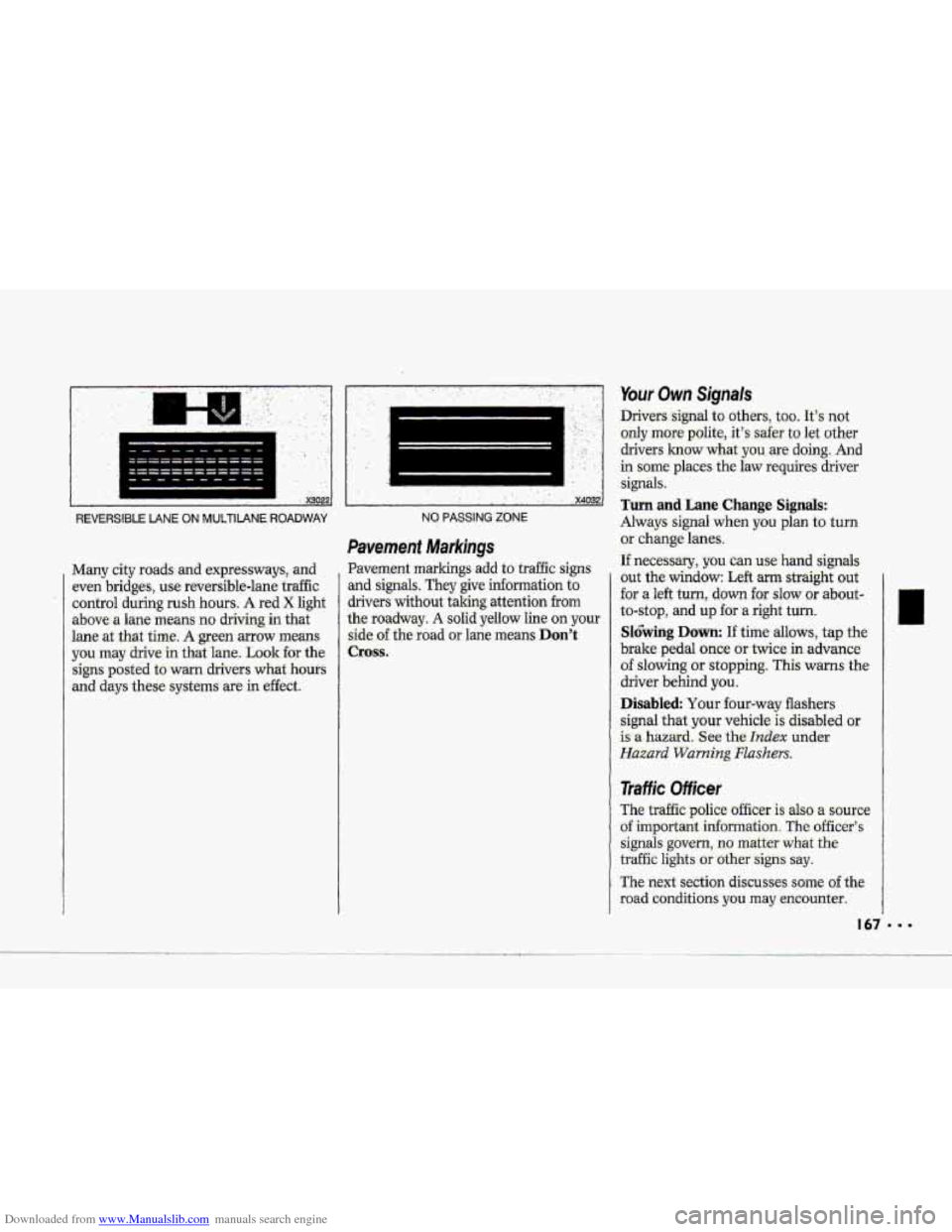
REVERSIBLE LANE ON MUlTIIANE ROADWAY
Many city roads: and expressways, and
even bridges, use reuersible-lane traffic
control during
rush hours. A red X light
above- a lane means no driving in that
lane
at .that time. A green mow means
you may drive in that lane. Look €or the
signs posted to warn drivers
what hours
and days these = ,-.. systems are in effect.
.. ........... ........................ ... ,. ., ,. . ... . ' .' '. , ..
! ' x4032
NO PASSING ZONE
Pavement Markings
Pavement markings add to traffic signs
and signals. They give information to
drivers without iaking attention
from
the roadway. A solid yellow line on your
side of the road or lane means Don't
Cross.
Your Own Signals
Drivers -signal to other.s, too. It's not
only more polite.,. it's safer to let other
drivers
1mow what-you are doing-. And
in some' places the law requires driver
signals:
Turn and Lane Change Signals:
Always signal when you plan to turn
or .change lanes.
If neces-ssary, you can use hand signals
out the window: Left arm straight out
'for a left turn, down for slow :or about-
to-stop, and up for .a right turn.
Sl6bing Down: If time allows, tap the
brake pedal once or twice in advance.
of slowing or stopping. This warns the
driver behind
you.
Disabled Your four-wtiy flashers
signal
that. your vehicle is disabled or
is a hazard. See the hdex under
Hazard Warning Flashers.
Traffic Officer
The traffic police officer is also a source
of important information The officer's
signals govern, no matter what the
traffic lights or othersigns say.
The next section discusses some of the
road conditions you may encounter.
Page 185 of 370
Downloaded from www.Manualslib.com manuals search engine Your Driving and the Road
Skidding (CONT.)
(including engine braking by shifting to
a lower gear). Any sudden change could
cause the tires
to slide. You may not
realize
the surface is slippery until your
vehicle
is skidding. Learn to recognize
warning clues-such as enough water,
ice or packed snow
on the road to make
a ‘‘mirrored surface”-and slow down
when you have any doubt.
Remember: Any anti-lock braking
system
(ABS) helps avoid only the
bralung skid.
Steer the way you want
the vehicle to
go.
Driving at Night
Night driving is more dangerous than.
day driving. One reason is that some
drivers are likely
to be impaired-by
alcohol or drugs, with night vision
problems, or by fatigue.
Here are some tips
on night driving.
Drive defensively. Remember, this is
the most dangerous time.
Don’t drink and drive. (See the Index
under Drunken Dn’ving for mure on
this problem.)
Adjust your inside rearview mirror to
reduce
the glare from headlights
behind you.
Since you can’t see as well, you may
need
to slow down and keep more
space between you and other vehicles.
It’s hard to teil how fast the vehicle
ahead
is going just by looking at its
taillights.
speed roads. Your headlights can light
up only so much road ahead.
Slow down, especially on higher
In remote areas, watch for animals.
If you’re tired, pull off the road in a
safe place and rest.
Page 191 of 370
Downloaded from www.Manualslib.com manuals search engine Your Driving and the Road
Tips on Driving in Fog (CONT.)
something between you and moving
vehicles-space, trees, telephone poles,
a private driveway, anything that
removes you
from other trafic.
If visibility is near zero and you must
stop but are unsure whether you are
away
from the road, turn your lights on,
start your hazard warning flashers, and
sound your horn at intervals or when
you hear approaching traffic.
Pass other vehicles in fog only if you
can see far enough ahead to pass safely.
Even then, be prepared to delay your
pass if you suspect the fog is worse up
ahead. If other vehicles try to pass you,
make it easy for them.
City Driving
One of the biggest problems with city.
streets
is the amount o€ traffic on them.
You’ll want to watch
out for what the
other drivers are doing
and pay
attention
to traffic signals.
Here are ways to increase your safety in
city driving:
* Know the best way to get to where
you-are going.
Try not to drive around
trying to pick out a familiar street or
landmark. Get a city map
and plan
your trip into an unknown part of the
city
just .as you would for a cross-
country trip.
9 Try to use the freeways that rim and
crisscross
most large cities. You’ll
save time
and energy. (See the next
section,
Freeway Driving.)
Treat a green light as a warning
.signal, A traffic light is there because
the corner
is busy .enough to need it.
When a light turns green, and just
before you start to move, check both
ways for vehicles. that have not
cleared
the intersection or may be
running the red light.
Obey all posted speed limits. But
remenher that they are
for ideal road,
weather
and visibility conditions. You
may need to drive bglow the .posted
limit
.in b.ad weather or when visibility
is especially poor,
clear
of intersections when you see or
hear emergency vehicles.
9 Pull to the right (with care) and stop
c
Page 193 of 370
Downloaded from www.Manualslib.com manuals search engine Your Driving and the Road
Driving on the Freeway (CONTJ
~fyou are moving from an outside to a
center lane. on a freeway having more
than two lanes, make sure another
vehic1e;isn't about to move
into the
same spot. Look at the 'vehicles two
lanes over and watch for telltale signs:
turn
signals flashing? an increase in
speed, or
moving toward the edge-of the
lane. Be prepared to delay
your move.
Once you are moving on the freeway,
make certain you allow a reasonable
following distance. Expect
to move
slightly slower at night.
Leaving the Freeway
When you want to leave the freeway,
move to the proper lane well in
advance. Dashing across lanes at the
last minute is dangerous.
If you miss
your exit do not,.under any circum-
stances,
stop and back up. Drive on to
the next
exit.
At each exit point is a deceleration lane.
Ideally it
should be long enough for you
to enter it at freeway speed
(after
signaling, of course) and then do your
braking before
moving onto the ,exit
ramp. Unfortunately, not all deceleration lanes are
long enough-
.some are too short for all the braking.
Decide when
to start braking. If you
must brake on the.through lane, and if
there is traffic close behind you, yau can
allow a little extra tirrie and flash your
brake lights (in addition to your turn
signal)
as extra warning that you are
about to slow down and exit.
The exit ramp
can be curved, sometimes
quite sharply. The exit speed
is usually
posted. Reduce
your speed according to
your speedometer, not-to your sense of
motion. After driving.for any distance at
higher speeds,
you may tend to- think.
you -we going slower than you actually
are. For example,
40 mph (65 I&)
might seem like only 20 mph (32 Wh) .
Obviously, this could lead to serious
trouble on a
ramp designed for 20 rnph
(32 W)!
P
be
Page 205 of 370
Downloaded from www.Manualslib.com manuals search engine Problems on the Road
‘A
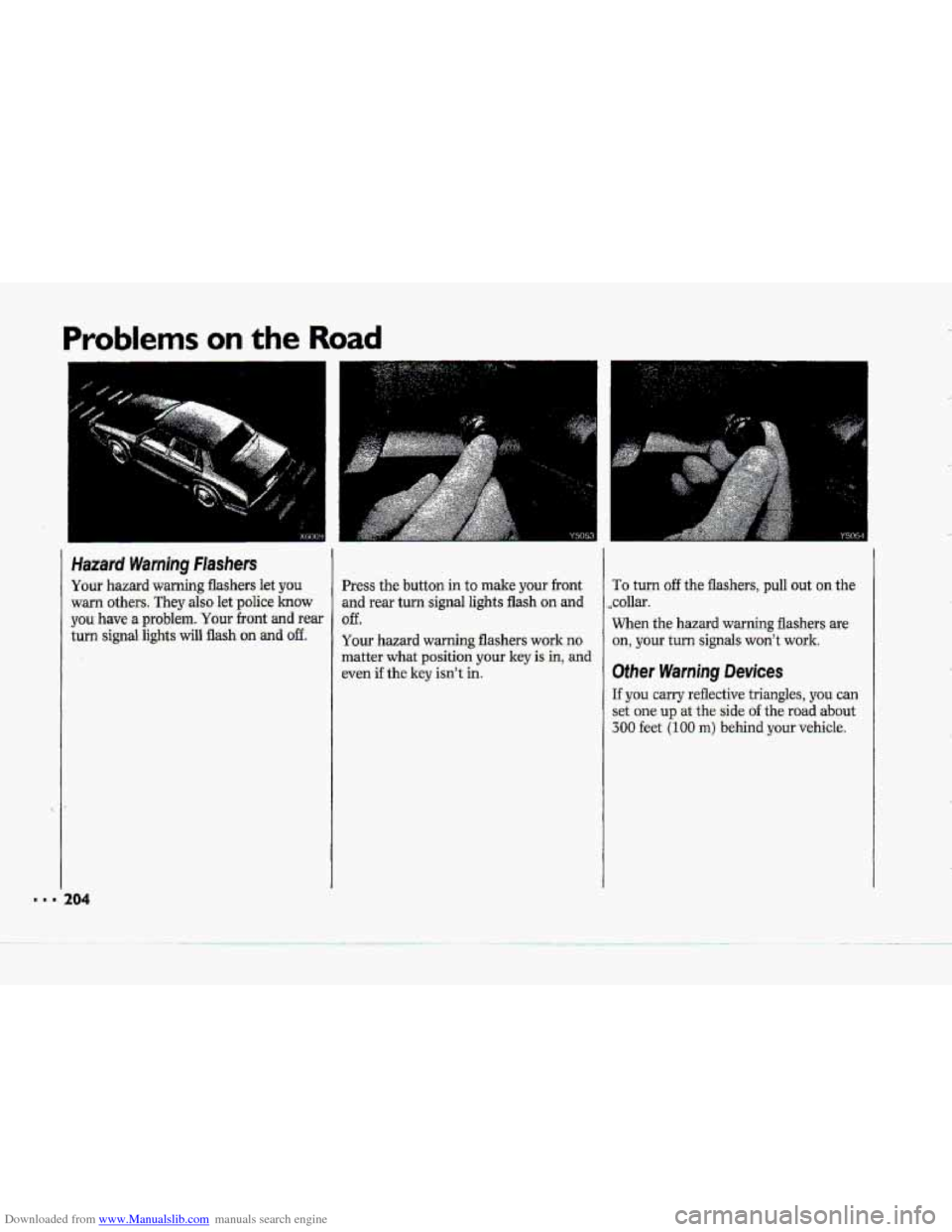
Hazard Warning Flashers
Your hazard warning flashers let you
warn others. They also let police know
you have a problem. Your front and rear
turn signal lights will flash on and off.
204
Press the button in to make your front
and rear turn signal lights flash on and
Off.
Your hazard warning flashers work no
matter what position your key is in, and
even if the key isn’t in.
To turn off the flashers, pull out on the
.*collar.
When the hazard
warning flashers are
on, your turn signals won’t work.
1 Other warning Devices
If you carry reflective triangles, you can
set one up at the side of the road about
300 feet (100 m) behind your vehicle.
Page 238 of 370
Downloaded from www.Manualslib.com manuals search engine c
c-
If You’re Stuck: In Sand, Mud,
Ice or Snow
What you don’t want to do when your
vehicle is stuck is to spin your wheels.
The method
known as “rocking” can
rou must use caution. I help you get out when you’re stuck, but
CAUT/UN I
A: If :you let.your :tires. spin -at
high speed.when the ASR
, . ‘OFE warning light is on, or when
“the SERVICE ASR warning light is
‘on, your tires can explode and you
or others could be injured. And,
spinning your tires with either of
these lights on can cause the
automatic transmission
or other
parts of the vehicle to overheat.
That could cause an engine
compartment fire or other damage.
When you’re stuck, spin the wheels
as little as possible. Don’t spin the
wheels above 35 mph (56 M) as
shown on the speedometer.
Rocking Your Vehicle to Get It Out:
First, turn your steering wheel left and
right. That will clear the area around
your front wheels. You should turn your
ASR system off. Then, shift back and
forth between R (Reverse) and a
forward gear--or if you have a manual
transmission, between 1 or 2 and
R (Reverse)-spinning the wheels as
little as possible. Release the accelerator
pedal while
you shift, and press lightly
on the accelerator pedal when the
transmission is in gear.
If that doesn’t
get
you out after a few tries, you may
need to be towed out.
If you do need to
be towed
out, see the Index under
Towing Your Corvette and Acceleration
Slip Regulation (ASR) System.
237
Page 263 of 370
Downloaded from www.Manualslib.com manuals search engine Service Psr nce Care
262
Rear Axle (CONT~)
What to Use:
To add lubricant when the level
use Me Lubricant (GM Part Na
12345977) or SAE BOW-90 GL-5
lubricant. To completely refill after
-draining, add four ounces (118 mQ af
Limited-Slip Dlfferential Lubricant
Additive (GM Part No. 1052358). Zmn
fill to the bottom of the filler plug hole
with Axle ‘Lubricant (GM Part No.
12345977) o,r SAE 8OW-90 GL-5 gear
lubricant.
Engine Coolant
e foUowing explains your cooling
sgstm and how to add coolant when it
is Im. If you have a problem with
e~@e overheating, see the Index under
Engine Ouerheating.
The proper coolant for your Corvette
* Give freezing protection down to
Give boiling protection up. to 262°F
Protect against rust and corrosion.
Help keep the proper engine
Let the warning lights work as they
-3m (-37°C).
(128°C) ~
temperature.
should.
What to Use:
Use a mixture of one-half clean wafer
(preferably distilled) and one-half
antifreeze that
meets “GM Specification
1825-M,” which won’t damage
aluminum parts. You can also use a
recycled coolant conforming to GM
Specification 1825-M with a complete
coolant
flush and refill. If you have the
LTl engine, use GM Engine Coolant
Supplement (sealer)
with any complete
coolant change.
If you use these, you
don’t need to add anything else.
Page 359 of 370
Downloaded from www.Manualslib.com manuals search engine Brake System Warning Light .......... 106
Brakes, Anti-Lock ........................... 173
Active Light .................................... 117
Service Light ................................. 117
Braking ............................................. 172
Braking Emergencies ....................... 178
. Anti-Lo.ck Brake System .............. ‘173
Braking Technique ........................... I32
“Break-In, ” New Vehicle .................... 59
Bu&ling Up (see Safe@ Belts)
Bulb ‘Replacement
Back-up Light ................................ 277
Center High-Momte-d
Cornering Lights. ........................... 277
Fog Light ....................in................. 275
‘Rear Cargo Light ........................... 278
Side Marker Lights ....................... 277
Taillight ............................................. 2%
.Turn Signals, Front and Rear ....... 276
Bulbs, Replacement .......................... 514
Cpcities and Specifications ........ 389
Carbon Monoxide in
Exhaust ........................ 59, 79, 80, 2
stop Light ............................. 278: 279
Headlight ........................................ 273
158
Cassette Tape Player
Center
Storage Console ....................... 95
Central Control Module ..................... 120
Chains,
Tire ............................. 236, 288
Changing a .Flat .Tire ........................ 225
Charging System Light ..................... 118
Check . Gauges Light ........................ 108
Checking
Brake Fluid .................................... 270
Engine Coolant ............................... 262
(see Audio Systems)
h@e Oil Level .................... 249, 250
Power Steering Fluid ..................... 269
Rear Axle Fluid .............................. 261
Safety Belt Systems ................... ...,.. 37
Transmission Fluids ...... 257,258, 259
Under the Hood .............................. 245
Ch~d Paint Spotting .................... 303
CMd Restraints .................................. 33
CWhn and Safety Belts ............. 32, 36
Cigarette Lighter ................................. 96
Cinch Fawe .................................... 24
Circuit Breakers & Fuses ................. 305
city, Driving ..................................... 190
Checking Things
8
Cleaner. Air ..................................... 254
Aluminum Wheels ................ 296. 301
Carpet ............................................ 292
Cassette Player
.............................. 160
Compact Discs .............................. 160
Convertible
. Rear Window ....................... 125, 298
Top ............................................... 297
“Dulso”’-Coated Molding ............... 294
~ngine .............................................. 301
Fabric .............................................. 290
Fibeiglass Springs ........................ 303
Finis3l ................................................ .OO
Foreign Material .............................. 302
Glass .............................................. 295-
.Hardtop ......................................... 300
hide of Your Corvette ................. 2510
Instrument Panel .......................... 294
Leather or Vinyl ............................ 293
Outside of Your Corvette .............. 296.
Power Antenna .............................. 161
Removable Roof Panels ................. 297
%oft Touch” Surfaces .................... 293
Special Problems ........................... 292
Cleaning
Safety Belts
.................................... 295
Page 360 of 370
Downloaded from www.Manualslib.com manuals search engine r
I i.
P
Underbody Maintenance ............... 302
Warnings ............................... 289, 297
Weatherstrips
................................ 301
Windshield and Wiper Blades ...... 295
Cleaning Your C.onvertible Top ....... 297
Climate Control
................................ 136
Air Conditioner ...................... 136, 142
Automatic Electronic Climate Control
........................................ 140
Heater .................................... 137, 144
Ventilation ............................ 137, 145
Clock, Setting the ............................ 148
Clusters, Instrument Panel .............. 100
Compact Disc Player
(see
Audio Systems)
Compact Spare Tire .......................... 235
Concealed Headlights ......................... 90
Control of a Vehicle ........................... 171
Convertible Hardtop ........................ 128
Convertible
Top ............................... 124
Coolant ............. 216, 262, 263, 311, 317
Adding .. 216,218,222,262,263, 266
Pressure Cap ................................. 268
Convex Outside Mirror ...................... 93
Checking &
High Fill Reservoir
Low Coolant Light ......................... 112
Proper Mixture to Use ........... 217. 262
S.a€ety
Warnings .... 106 ,. 217.263.264. 267
Temperature Gage ........................ 106
Corvette Action Center .................... 343
Cruise Control
................................... -84
Cup Holder ......................................... 96
Curves,
Driving on ........................... 179
Customer Assistance Infomation ... 341
DAB (Delayed Accessory Bus) ........ 57
Daytime Running Lights ................... 90
Defensive Driving
............................ 168
Dead Battery: What to . Do ............... 205
Defogger, Power Mirror .................... 139
Defogger. Rear Window ........... 138. 144
Defrosting Window .......................... 137
Dimensions ...................................... 3 16
Directional Controls. Electronic Climate
.......................................... 145
Door Ajar Light ....................’............. 107
Door Locks .......................................... 43
Dcmnshifting ................................. 69, 73
.Driver Idormation Center ............... 112
Driver Pasition .................................. 23
Driving ............................................. 163
At Night ........................................... 184
City ................................................ 190
Controlling a Skid .......................... 183
Drunken ......................................... 169
Freeway ........................................... 191
Hill and Mountain ....................... 195
Driver’s Side SIR (“Air Bag”) ........... 26
Defensively .................................... 168
In a Foreign Country ..................... 243
In Fog, Mist and Haze .................. 189
In the Rain ...................................... 186
Long Distance ............................... 193
Loss of Control ............................. 183
On Cmes ...................................... 179
Passing .................................... 87, 181
Through Deep Standing Water ....... 65
Winter Driving ............................... 198
Drunken Driving ............................ 169
Electric Outside Mirror Control ..... 93
Electrical Equipment,
Electronic Heating
. and
.Adding
.............................. 65., 146, 304
Air Conditioning ............................. 310
Page 361 of 370
Downloaded from www.Manualslib.com manuals search engine Index
...
'Emergencies. Braking ....................... 178
Emergencies. Steering in ................. 180
Emergency Starting .......................... 205
Emergencies on the Road ................. 203
Emergency Towing .......................... 208
Engine Block Heater ......................... 66
Engine
Engine Coolant Temperature
Gage ............................................... 106
Engine Cooling System .................... 262
Engine Exhaust ..................... 79, 80, 200
Coolant .......... 216, 262, 263, 311, 317
Engine Identification ......................... 304
Engine Oil ........................................ 249
Capacity .......................................... 3 1 f
Energy Conserving ......................... 252
Low Oil Light ................................. I X8
Additives ....................................... 253
Checking 81 Adding .............. 249. 250
Disposing of Used Oil .................... 254
Pressure Gage ............................... 103
Substitute ........................................ 253
Temperature Gage ......................... 104
When to Change ............................. 253
Engine Oil Life Monitor .................. 109
Engine Overheating ......................... 213
160
Engine Power Curves ....................... 319
Engine Power Key ............................. 56
Engine Power Switch ........................ 74
Engine Specifications ....................... 313
Engine, starting
Automatic Transmission ................. 63
Manual Transmission ..................... 65
Ethanol in Gasoline .......................... 242
Exhaust
Dangerous Gas in ....... 59, 79,80, 200
Parking with the.Engine
Expectant Mothers, Use of
Expressway Driving ......................... 191
Extender, Safety Belt .......................... 37
Exterior Appearance
Running ............................ 67, 78, 80
.Safety Belts ...................................... 31
(see Appearance Care)
Rbric cleaning
(see Appearance Care)
Fabric Protection ............................. 291
Fan Warnings ........... 206, 207, 215, 246
Fiberglass Springs ............................ 303
Filliig the Fuel Tank ....................... 244
Filter
Air Cleaner ............................. 254, 312
Oil ........................................... 253, 312
Finish. Damage ................................... 302
Flashers, Hazard
Warning ......................................... 204
Flat Tire ............................................ 224
Storing a .Flat-& cept ZR-l .......... 233
StoMg a .Flat-Z R-1 ..................... 234
Flooded Engine ............................ 62, . 64
System ............................................ 145
Capacities ....................................... 311
Hydraulic Clutch ............................. 260
Power Steering .............................. -269
Rear Axle ................................ 261, 318
Windshield Washer .......... 84,269, 318
plow-Through Ventilation
Pluid
Brake ..................................... 270, 317
Transmission ................. 256, 311, 317
Fluids & Lubricants ........................ 317
Fog, Driving in ................................ 189
Fog Light Bulb Replacement ... 275, 314
Freeway Driving ............................... 191
Fog Lights ............................................ 92