warning light CHEVROLET CORVETTE 1993 4.G Owner's Manual
[x] Cancel search | Manufacturer: CHEVROLET, Model Year: 1993, Model line: CORVETTE, Model: CHEVROLET CORVETTE 1993 4.GPages: 370, PDF Size: 21.43 MB
Page 191 of 370
Downloaded from www.Manualslib.com manuals search engine Your Driving and the Road
Tips on Driving in Fog (CONT.)
something between you and moving
vehicles-space, trees, telephone poles,
a private driveway, anything that
removes you
from other trafic.
If visibility is near zero and you must
stop but are unsure whether you are
away
from the road, turn your lights on,
start your hazard warning flashers, and
sound your horn at intervals or when
you hear approaching traffic.
Pass other vehicles in fog only if you
can see far enough ahead to pass safely.
Even then, be prepared to delay your
pass if you suspect the fog is worse up
ahead. If other vehicles try to pass you,
make it easy for them.
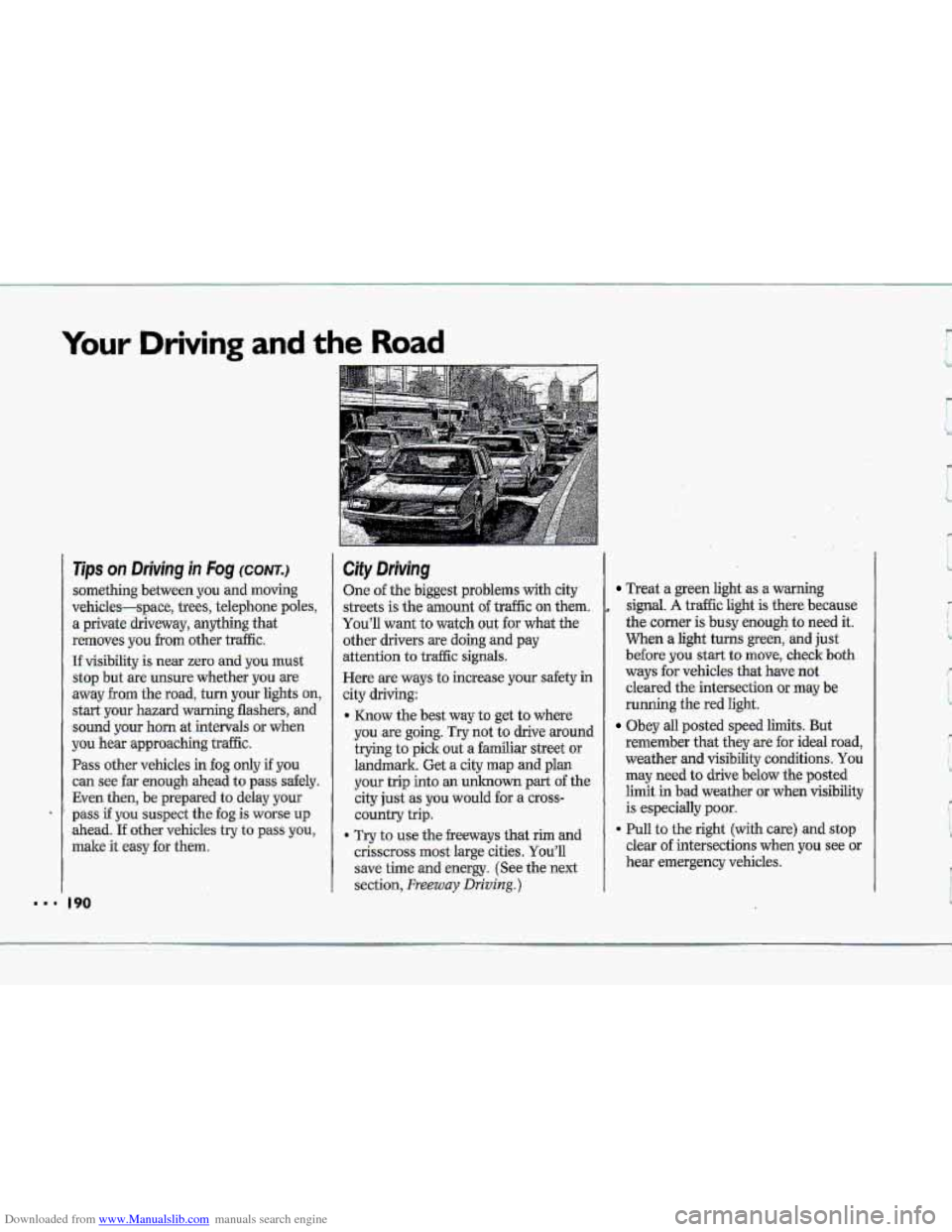
City Driving
One of the biggest problems with city.
streets
is the amount o€ traffic on them.
You’ll want to watch
out for what the
other drivers are doing
and pay
attention
to traffic signals.
Here are ways to increase your safety in
city driving:
* Know the best way to get to where
you-are going.
Try not to drive around
trying to pick out a familiar street or
landmark. Get a city map
and plan
your trip into an unknown part of the
city
just .as you would for a cross-
country trip.
9 Try to use the freeways that rim and
crisscross
most large cities. You’ll
save time
and energy. (See the next
section,
Freeway Driving.)
Treat a green light as a warning
.signal, A traffic light is there because
the corner
is busy .enough to need it.
When a light turns green, and just
before you start to move, check both
ways for vehicles. that have not
cleared
the intersection or may be
running the red light.
Obey all posted speed limits. But
remenher that they are
for ideal road,
weather
and visibility conditions. You
may need to drive bglow the .posted
limit
.in b.ad weather or when visibility
is especially poor,
clear
of intersections when you see or
hear emergency vehicles.
9 Pull to the right (with care) and stop
c
Page 193 of 370
Downloaded from www.Manualslib.com manuals search engine Your Driving and the Road
Driving on the Freeway (CONTJ
~fyou are moving from an outside to a
center lane. on a freeway having more
than two lanes, make sure another
vehic1e;isn't about to move
into the
same spot. Look at the 'vehicles two
lanes over and watch for telltale signs:
turn
signals flashing? an increase in
speed, or
moving toward the edge-of the
lane. Be prepared to delay
your move.
Once you are moving on the freeway,
make certain you allow a reasonable
following distance. Expect
to move
slightly slower at night.
Leaving the Freeway
When you want to leave the freeway,
move to the proper lane well in
advance. Dashing across lanes at the
last minute is dangerous.
If you miss
your exit do not,.under any circum-
stances,
stop and back up. Drive on to
the next
exit.
At each exit point is a deceleration lane.
Ideally it
should be long enough for you
to enter it at freeway speed
(after
signaling, of course) and then do your
braking before
moving onto the ,exit
ramp. Unfortunately, not all deceleration lanes are
long enough-
.some are too short for all the braking.
Decide when
to start braking. If you
must brake on the.through lane, and if
there is traffic close behind you, yau can
allow a little extra tirrie and flash your
brake lights (in addition to your turn
signal)
as extra warning that you are
about to slow down and exit.
The exit ramp
can be curved, sometimes
quite sharply. The exit speed
is usually
posted. Reduce
your speed according to
your speedometer, not-to your sense of
motion. After driving.for any distance at
higher speeds,
you may tend to- think.
you -we going slower than you actually
are. For example,
40 mph (65 I&)
might seem like only 20 mph (32 Wh) .
Obviously, this could lead to serious
trouble on a
ramp designed for 20 rnph
(32 W)!
P
be
Page 199 of 370
Downloaded from www.Manualslib.com manuals search engine your urlvlng ana tne Koaa
Torque Lock
(AUTQMATIC TRANSMISSION)
If you are parking on a hill and you
don’t shift your transmissian into
P (Park) properly, the weight of the
vehicle may put
too much force on the
parking pawl in the transmission. You
may find it difficult to pull the shift
lever out of
P (Ihrlr). This is called
“torque
lock.” To prevent torqu’e lock,
always
be sure to shift into P (Park)
properly before you leave the driver’s
seat.
To find out how, see the Index
under Shifting Into P (Park).
When you are ready to drive, move the
shift lever out
of P (Park) before you
release the parking brake.
If torque lock does occur, you may need
to. have another vehicle push yours a
little uphill to take some of-the pressure
from the transmiss.ion, ‘so you can pull
the
shifi lever out of P (Park).
I98
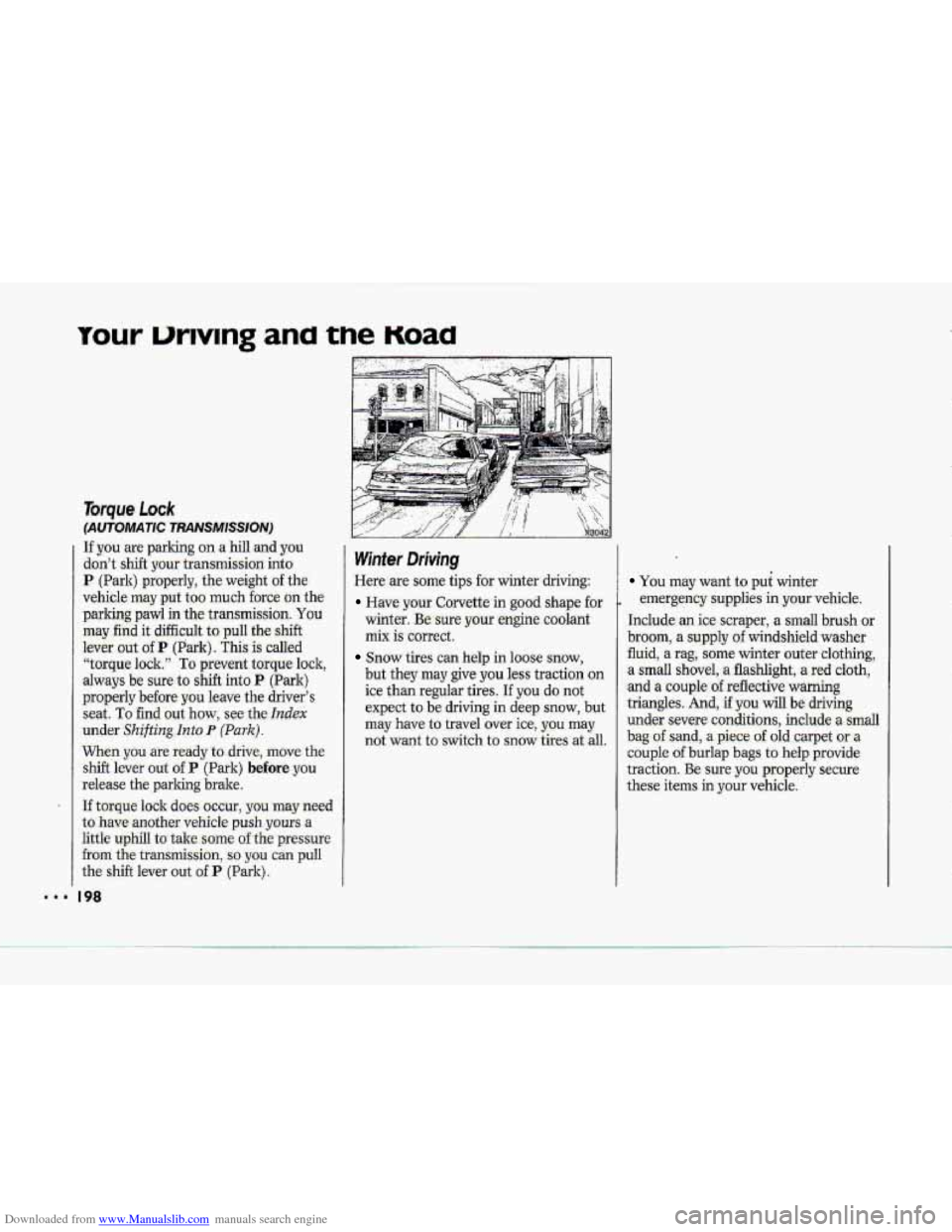
Winter Driving
Here are some tips for winter driving:
Have your Corvette in good shape for
winter.
Be sure your engine coolant
mix is correct.
Snow tires can help in loose snow,
but they may give you less traction on
ice than regular tires. If you do not
expect to be driving
in deep snow, but
may have
to travel over ice, you may
not want to switch to
snow tires at .all.
YOU may want to put winter
emergency supplies in your vehicle.
Include
an ice scraper, a small brush or
broom, a supply of windshield washer
fluid, a rag, some winter outer clothing,
a small shovel, a flashlight, .a red cloth,
and a couple of reflective warning
triangles. And, if-you will be driving
under severe conditions,
include a small
bag of sand, a piece of old carpet or a
couple of burlap bags to help provide
traction. Be sure you properly secure
these items in your vehicle.
Page 205 of 370
Downloaded from www.Manualslib.com manuals search engine Problems on the Road
‘A
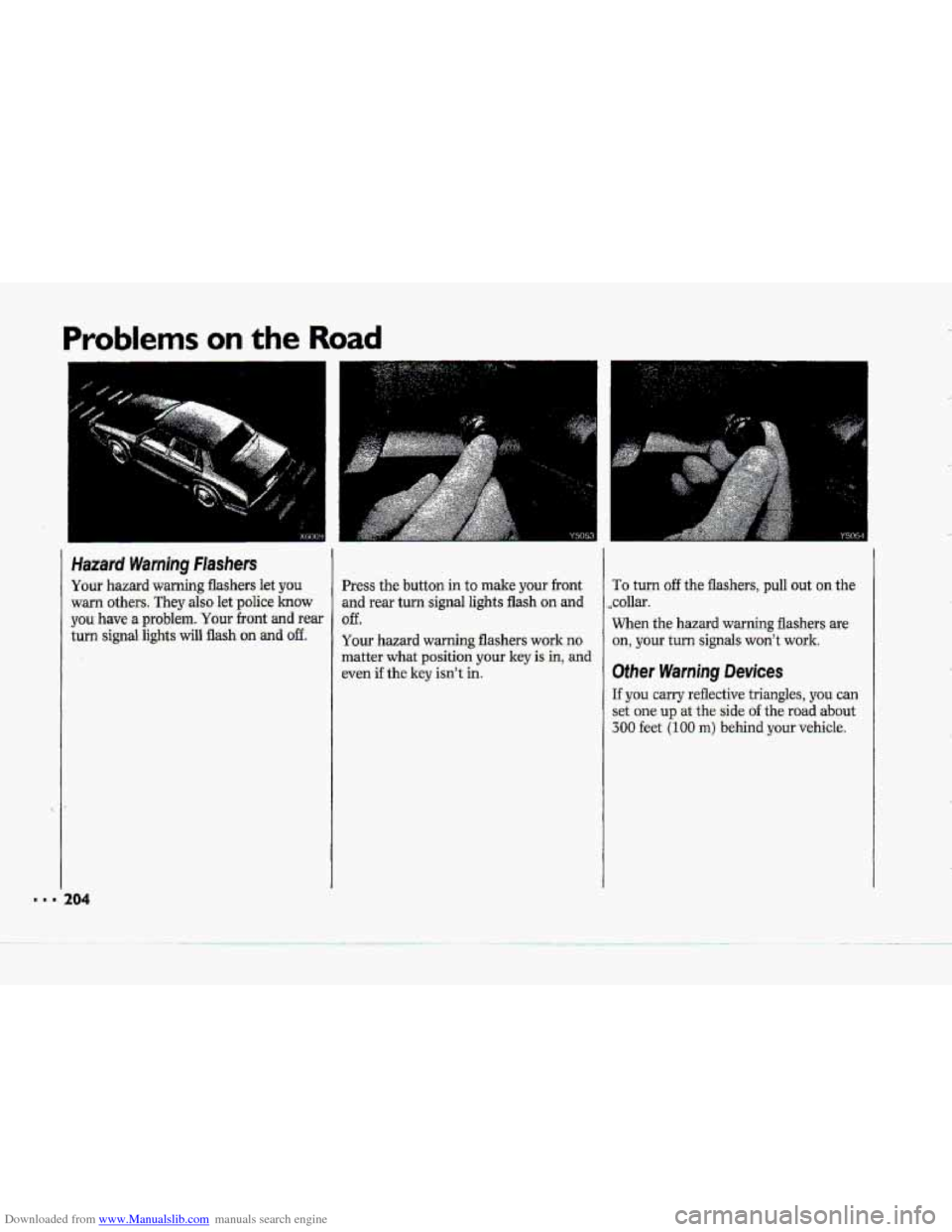
Hazard Warning Flashers
Your hazard warning flashers let you
warn others. They also let police know
you have a problem. Your front and rear
turn signal lights will flash on and off.
204
Press the button in to make your front
and rear turn signal lights flash on and
Off.
Your hazard warning flashers work no
matter what position your key is in, and
even if the key isn’t in.
To turn off the flashers, pull out on the
.*collar.
When the hazard
warning flashers are
on, your turn signals won’t work.
1 Other warning Devices
If you carry reflective triangles, you can
set one up at the side of the road about
300 feet (100 m) behind your vehicle.
Page 214 of 370
Downloaded from www.Manualslib.com manuals search engine F"
!
L
r
i
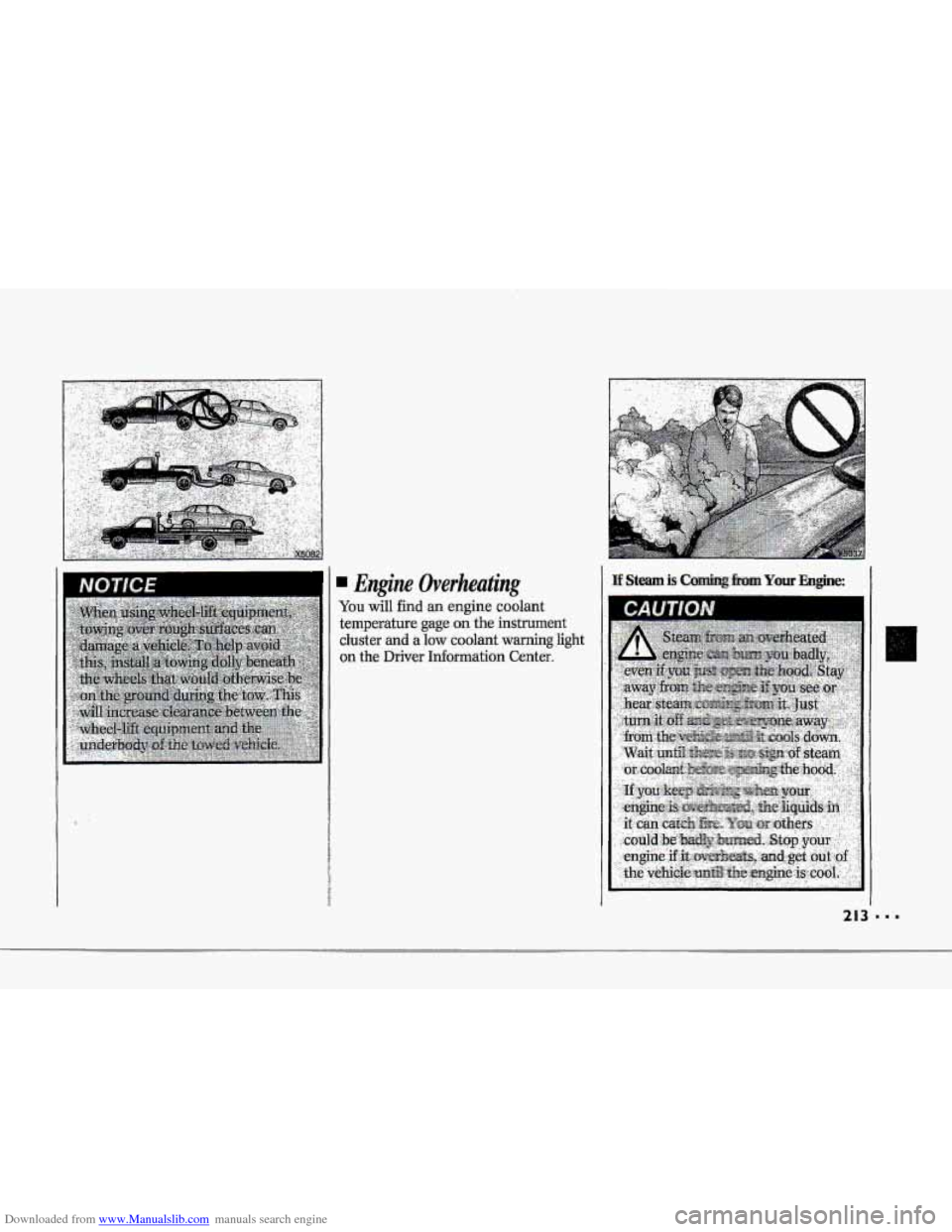
Engine Overheating
Y0.u will find an engine coolant
temperature gage. on. the instrument
cluster and a low coolant warning light
on the Drives In€orrnation Centkr.
Ifsteamis
Page 238 of 370
Downloaded from www.Manualslib.com manuals search engine c
c-
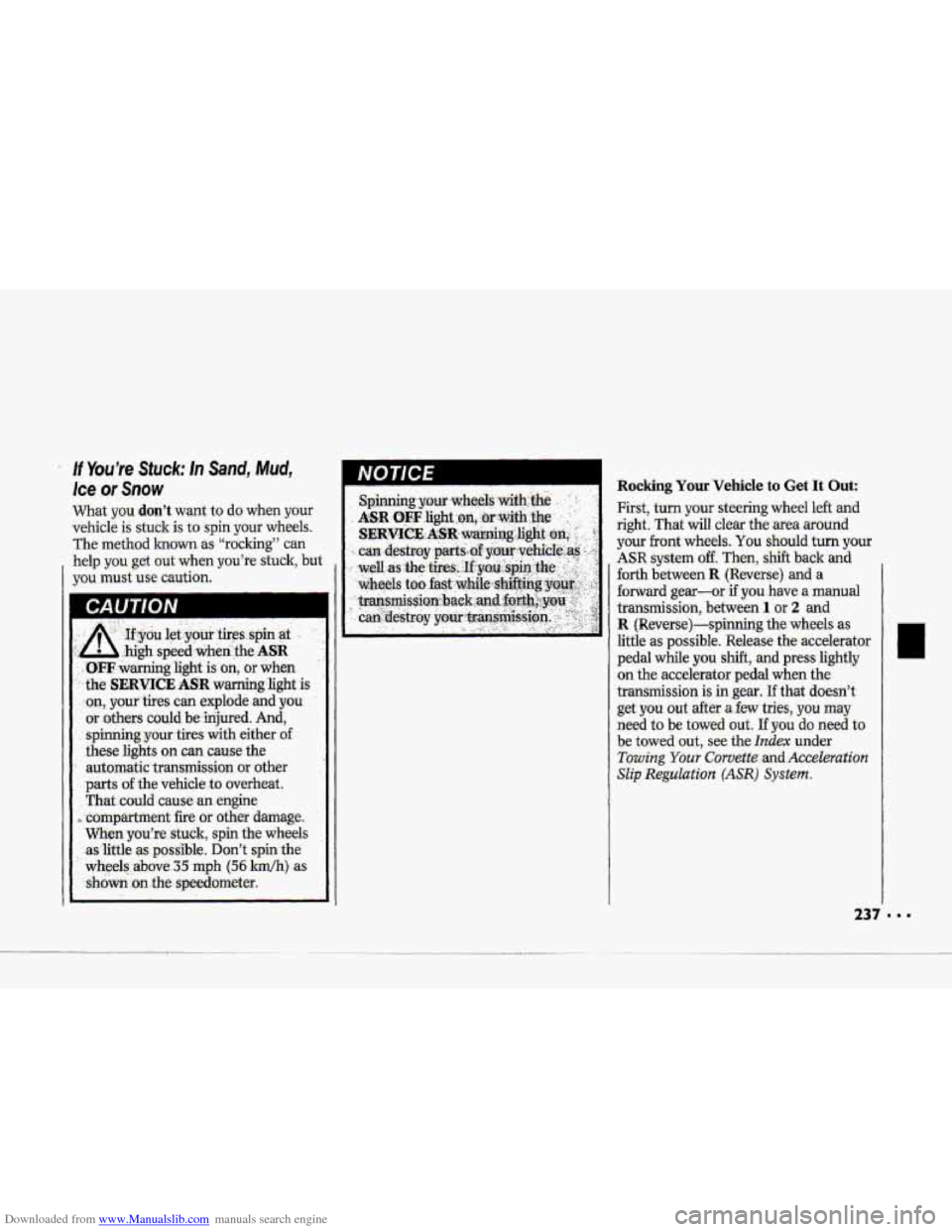
If You’re Stuck: In Sand, Mud,
Ice or Snow
What you don’t want to do when your
vehicle is stuck is to spin your wheels.
The method
known as “rocking” can
rou must use caution. I help you get out when you’re stuck, but
CAUT/UN I
A: If :you let.your :tires. spin -at
high speed.when the ASR
, . ‘OFE warning light is on, or when
“the SERVICE ASR warning light is
‘on, your tires can explode and you
or others could be injured. And,
spinning your tires with either of
these lights on can cause the
automatic transmission
or other
parts of the vehicle to overheat.
That could cause an engine
compartment fire or other damage.
When you’re stuck, spin the wheels
as little as possible. Don’t spin the
wheels above 35 mph (56 M) as
shown on the speedometer.
Rocking Your Vehicle to Get It Out:
First, turn your steering wheel left and
right. That will clear the area around
your front wheels. You should turn your
ASR system off. Then, shift back and
forth between R (Reverse) and a
forward gear--or if you have a manual
transmission, between 1 or 2 and
R (Reverse)-spinning the wheels as
little as possible. Release the accelerator
pedal while
you shift, and press lightly
on the accelerator pedal when the
transmission is in gear.
If that doesn’t
get
you out after a few tries, you may
need to be towed out.
If you do need to
be towed
out, see the Index under
Towing Your Corvette and Acceleration
Slip Regulation (ASR) System.
237
Page 263 of 370
Downloaded from www.Manualslib.com manuals search engine Service Psr nce Care
262
Rear Axle (CONT~)
What to Use:
To add lubricant when the level
use Me Lubricant (GM Part Na
12345977) or SAE BOW-90 GL-5
lubricant. To completely refill after
-draining, add four ounces (118 mQ af
Limited-Slip Dlfferential Lubricant
Additive (GM Part No. 1052358). Zmn
fill to the bottom of the filler plug hole
with Axle ‘Lubricant (GM Part No.
12345977) o,r SAE 8OW-90 GL-5 gear
lubricant.
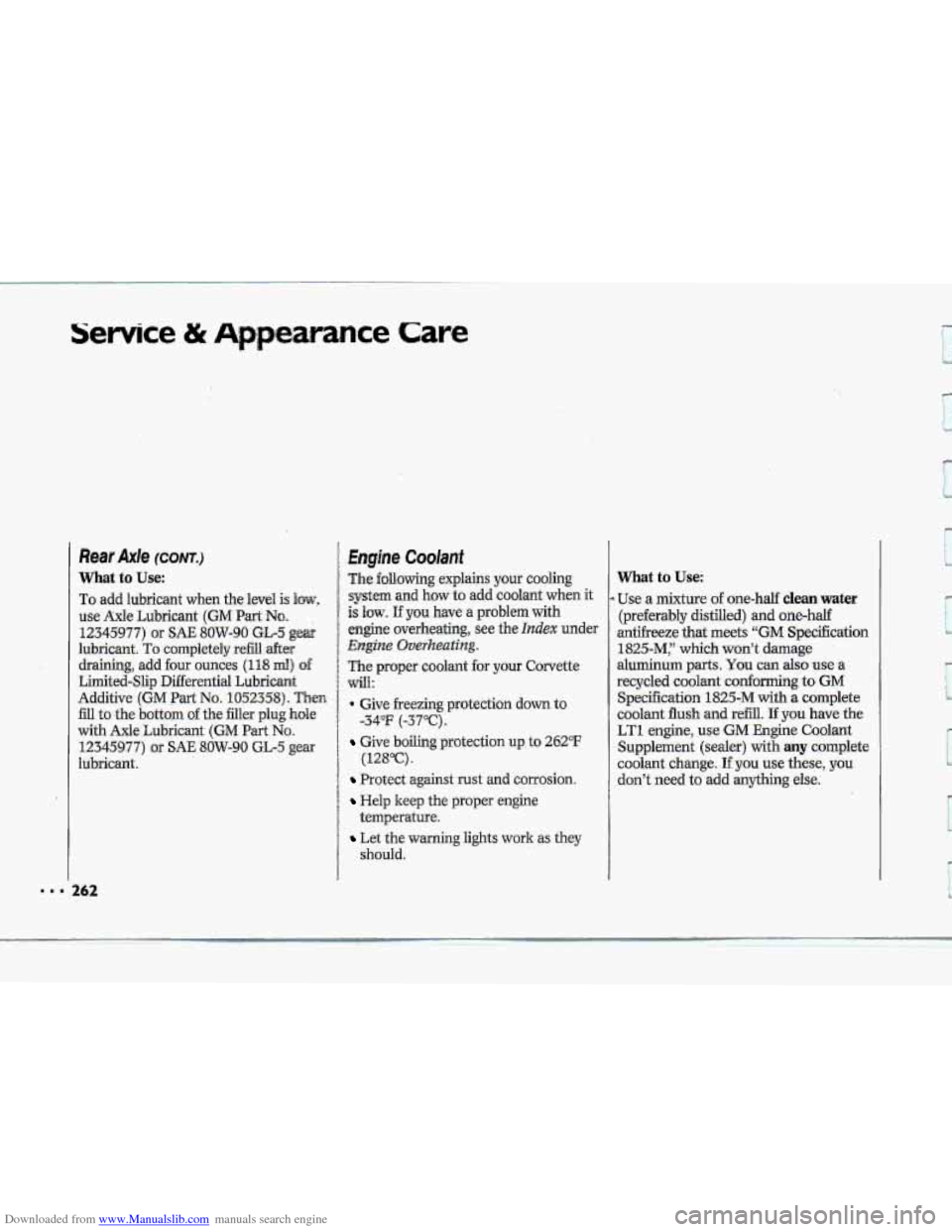
Engine Coolant
e foUowing explains your cooling
sgstm and how to add coolant when it
is Im. If you have a problem with
e~@e overheating, see the Index under
Engine Ouerheating.
The proper coolant for your Corvette
* Give freezing protection down to
Give boiling protection up. to 262°F
Protect against rust and corrosion.
Help keep the proper engine
Let the warning lights work as they
-3m (-37°C).
(128°C) ~
temperature.
should.
What to Use:
Use a mixture of one-half clean wafer
(preferably distilled) and one-half
antifreeze that
meets “GM Specification
1825-M,” which won’t damage
aluminum parts. You can also use a
recycled coolant conforming to GM
Specification 1825-M with a complete
coolant
flush and refill. If you have the
LTl engine, use GM Engine Coolant
Supplement (sealer)
with any complete
coolant change.
If you use these, you
don’t need to add anything else.
Page 272 of 370
Downloaded from www.Manualslib.com manuals search engine c
.-
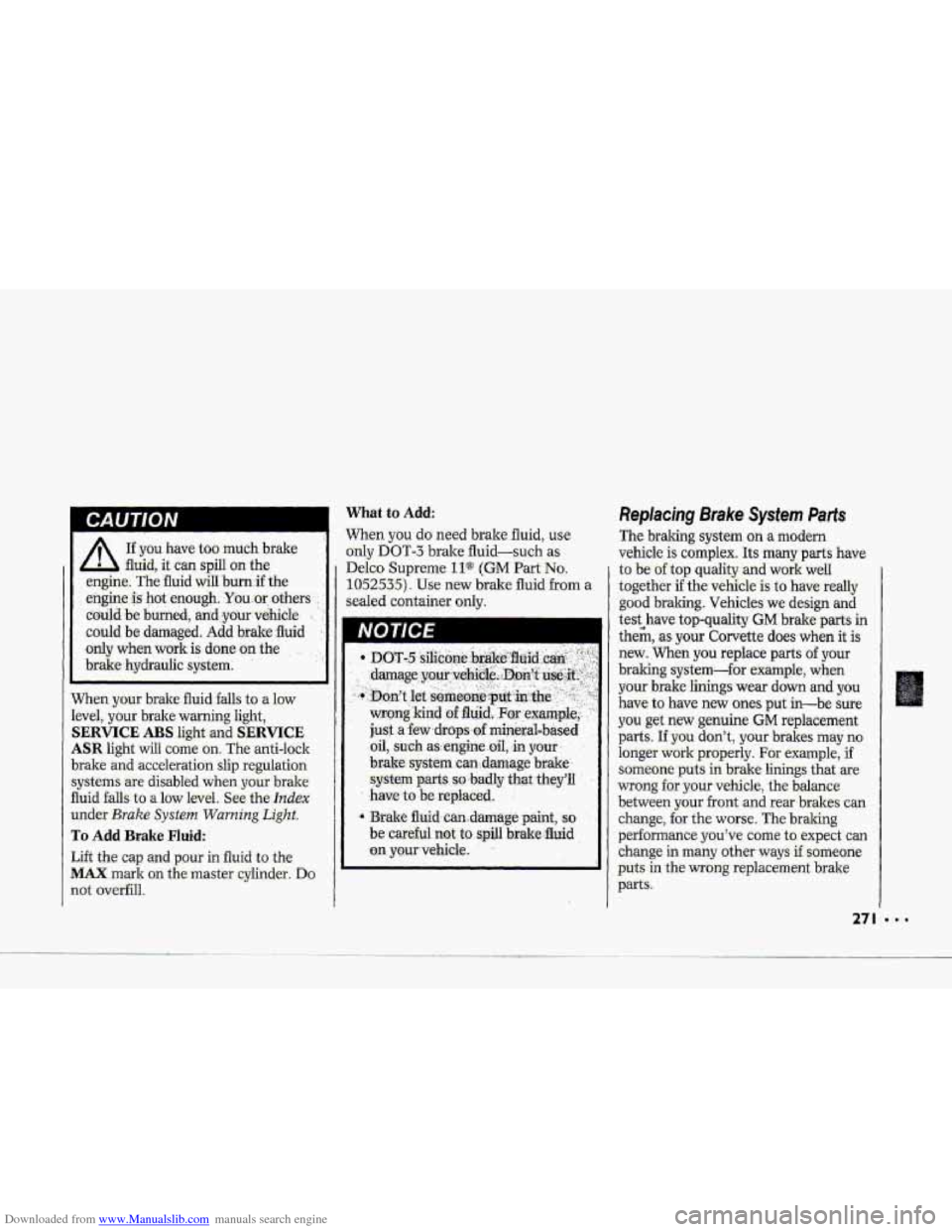
WETen your brake fluid falls to a.low
level,
your brake warning light,
SERVICE ABS light and SERVICE
ASR light will come on. The- anti-lock
brake and .acceleration
slip regulation
systems are disabled when your brake
flu.id falls to
it low level. See thedndex
under
Brake System Warning Light;
To Add Brake Fluid:
Lift the cap and pour in fluid to the
MAX mark on the master cylinder. Do
not oveffiI1.
&%at to Add:
When you do need brake fluid, use-
)nly
DOT-3 brake fluid-such as
lelcrr Supreme 1P (GM Part No.
.052535). Use new brake fluid from a
'eded. container only.
NOTlCE
Replacing Brake System Parts
The braking system on a modern
vehicle is
complex. Its many parts have
to be
of top quality -and work well
together if the vehicle is to haye really
good braking. Vehicles we design and
test have top-quality GM brake-parts in
the&, as
your Corvette does when it is
new. When you replace parts of your
braking 'system-for example, when
your brakelinings wear down and you
have to have new ones put in-be sure
you get new genuine GM replacement
parts. If.you don't, your brakes may no
longer work properly. For example, if
someone.puts
in b.r&e linings that are
wrong for your vehicle, .the balance
between your
front and rear brakes can
change, for the worse. The braking
performance
you've come to expect can
change in many other ways if.-someone
puts
in the wrong replacement brake
parts.
27 I
Page 309 of 370
Downloaded from www.Manualslib.com manuals search engine Service & Appearance Care
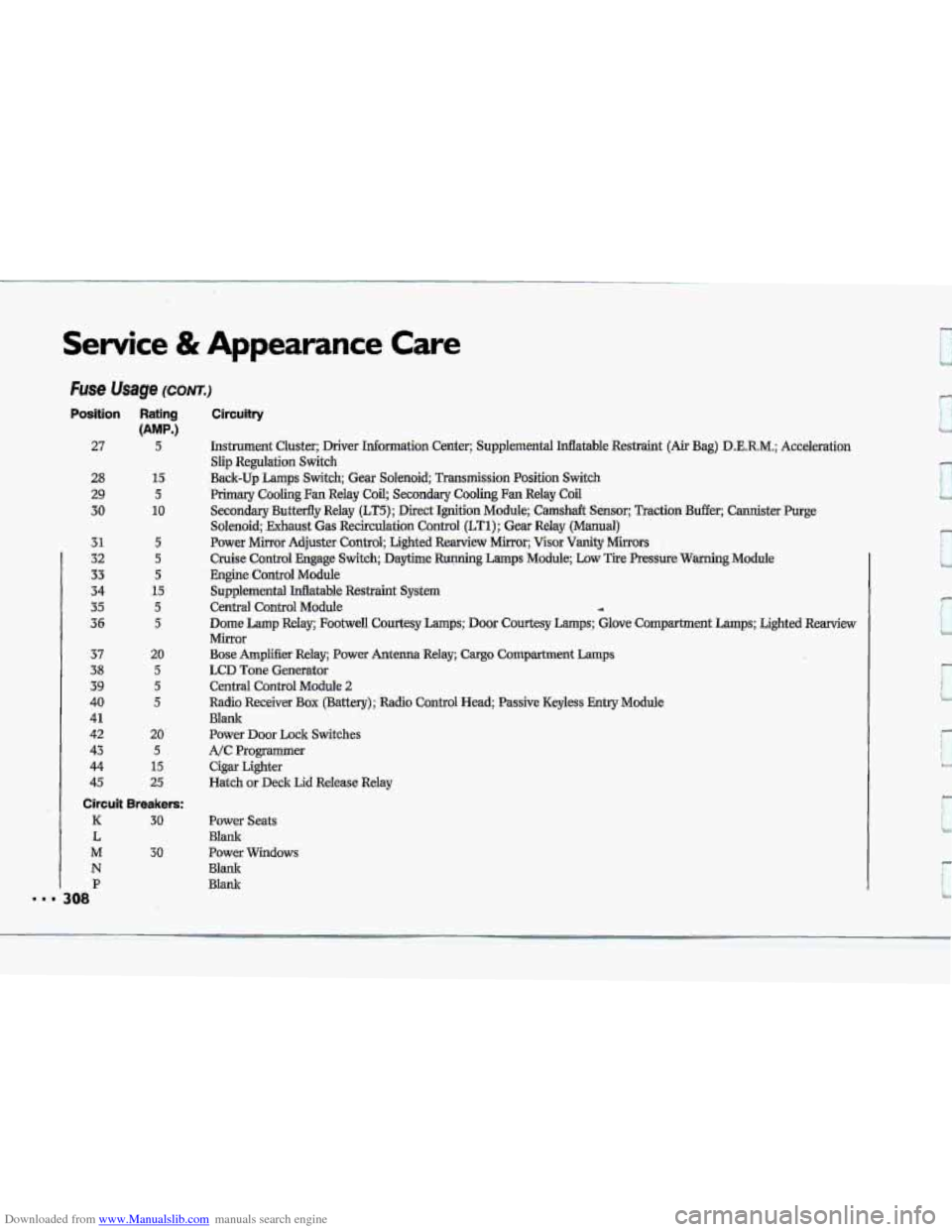
Fuse Usage (CONT.)
Position Rating
(AMP.)
27 5
28 15
29 5
30 10
31 5
32 5
33 5
34 15
35 5
36 5
37 20
38 5
39 5
40 5
41
42 20
43 5
44 15
45 25
Circuit Breakers:
K 30
L
M
N
P
3.0
1 308
Circuitry
Instrument Cluster; Driver Information Center; Supplemental Inflat\
able Restraint (Air Bag) D.E.R.M.; Acceleration
Slip Regulation
Switch
Back-up Lamps Switch Gear Solenoid; Transmission Position Switch
Primary Coaling Fan Relay Coil; Secondary Cooling Fan Relay Coil '
Secondary Butterfly Relay (LT5); Direct Ignition Module; Camshaft Sensor; Traction Buffer; Cannist\
er Purge
Solenoid; Exhaust
Gas Recirculation Control (LT1); Gear Relay (Manual)
Power
Mirror Adjuster Control; Lighted Rearview Mirror; Visor Vanity Mirrors
Cruise Control Engage Switch Daytime Running Lamps Module; Low Tire Pressure Warning Module
Engine Control Module
Supplemental Inflatable Restraint System
Central Control Module
Dome Lamp Relay; Footwell Courtesy Lamps; Do.0~ Cpurtesy Lamps; Glove Compartment Lamps; Lighted Rearview
Mirror
Bose
Amplifier Relay; Power Antenna Relay; Cargo Compartment Lamps
LCD Tone Generator
Central Control Module
2
Radio Receiver Box (Battery); Radio Control Head; Passive Keyless Entry Module
Blank
Power Door Lock Switches
A/C Programmer
Cigar Lighter
Hatch or Deck
Lid Release Relay
4
Power Seats
Blank
Power Windows
Blank
Blank
Page 337 of 370
Downloaded from www.Manualslib.com manuals search engine Maintenance Schedule
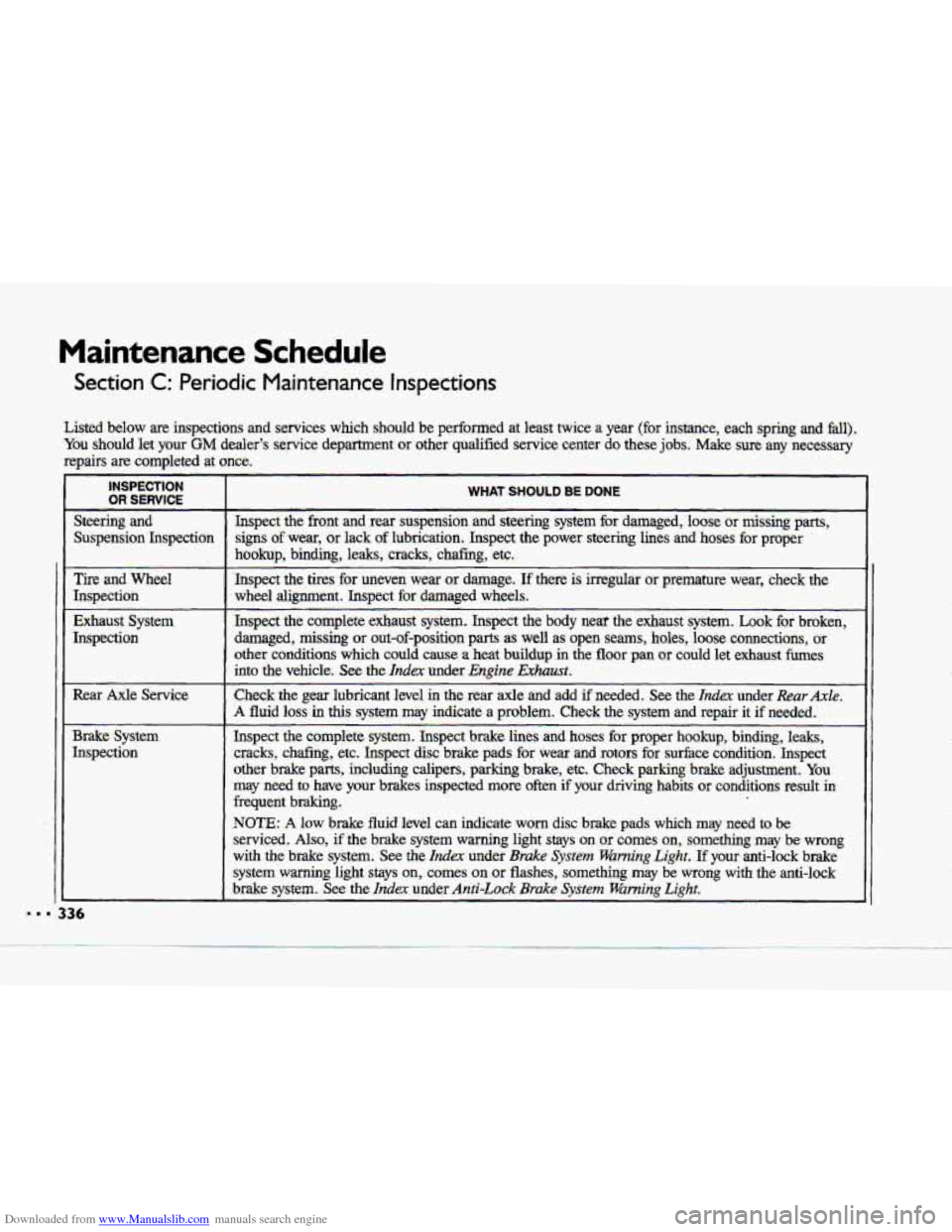
Section C: Periodic Maintenance Inspections
Listed below are inspections and services which should be performed at least twice a year (for instance, each spring and fall).
You should let your- GM dealer's service department or other qualified ssvj,cg [email protected] do these j-obs. Make sure any necessary
repairs are completed
at once.
INSPECTION
OR SERVICE
Steering and
Suspension Inspection
Tire and Wheel
Inspection
Exhaust System
Inspection
~-
Rear Axle Service
Brake System
Inspection
WHAT SHOULD BE DOME
Inspect. the front and rear susp-ension and steering system for damaged, loose or missing parts,
signs of wear, or lack of lubrication. Inspect the power steering lines and hoses. for proper
hookup,
bindmg-, leaks, cracks, chafing, etc.
Inspect the tires for uneven wear or damage. If there is irregular or premature wear, check the
wheel alignment. Inspect for damaged wheels.
Inspect the complete exhaust system. Inspect the
body neat the exhaust system. Look for broken,
damaged, missing or out-of-position parts as well as open seams, holes, loose connections, or
other conditions which could cause a heat buildup in the floor pan or could let exhaust fumes
into the- vehicle.
See the Index under Engine Exhaust.
Check:the gear lubricant leve1.h the rear axle and add if needed. See the Index: under Rear Axle.
A fluid loss in this system;may indicate a problem. Check the system and repair it if needed.
Inspect the complete system. Inspect brake lines and
hoses for proper hookup, binding, leaks,
cracks, chafing, etc. Inspect disc brake pads for wear and rotors for surface condition. Inspect
-other brake parts, .hcluding calipers, parking brake, etc. Check parking brake adju\
stment. You
may need
to have your brakes inspected more often if your driving habits or conditions result in
frequent braking.
NOTE:. A low brake fluid level can indicate worn disc brake pads which may need to be
serviced.
Also, if 'the brake system warning light stays on or comes on, something may be wrong
with .the brake system. See the Index under Brake System Warning Light. 'If your anti-lock brake
systemwarning light stays on, comes on or flashes, something may be wrong with the anti-lock
brake system. See the Index under Anti-Lock Brake System Warning Light.