lights CHEVROLET CORVETTE 1993 4.G Owner's Guide
[x] Cancel search | Manufacturer: CHEVROLET, Model Year: 1993, Model line: CORVETTE, Model: CHEVROLET CORVETTE 1993 4.GPages: 370, PDF Size: 21.43 MB
Page 191 of 370
Downloaded from www.Manualslib.com manuals search engine Your Driving and the Road
Tips on Driving in Fog (CONT.)
something between you and moving
vehicles-space, trees, telephone poles,
a private driveway, anything that
removes you
from other trafic.
If visibility is near zero and you must
stop but are unsure whether you are
away
from the road, turn your lights on,
start your hazard warning flashers, and
sound your horn at intervals or when
you hear approaching traffic.
Pass other vehicles in fog only if you
can see far enough ahead to pass safely.
Even then, be prepared to delay your
pass if you suspect the fog is worse up
ahead. If other vehicles try to pass you,
make it easy for them.
City Driving
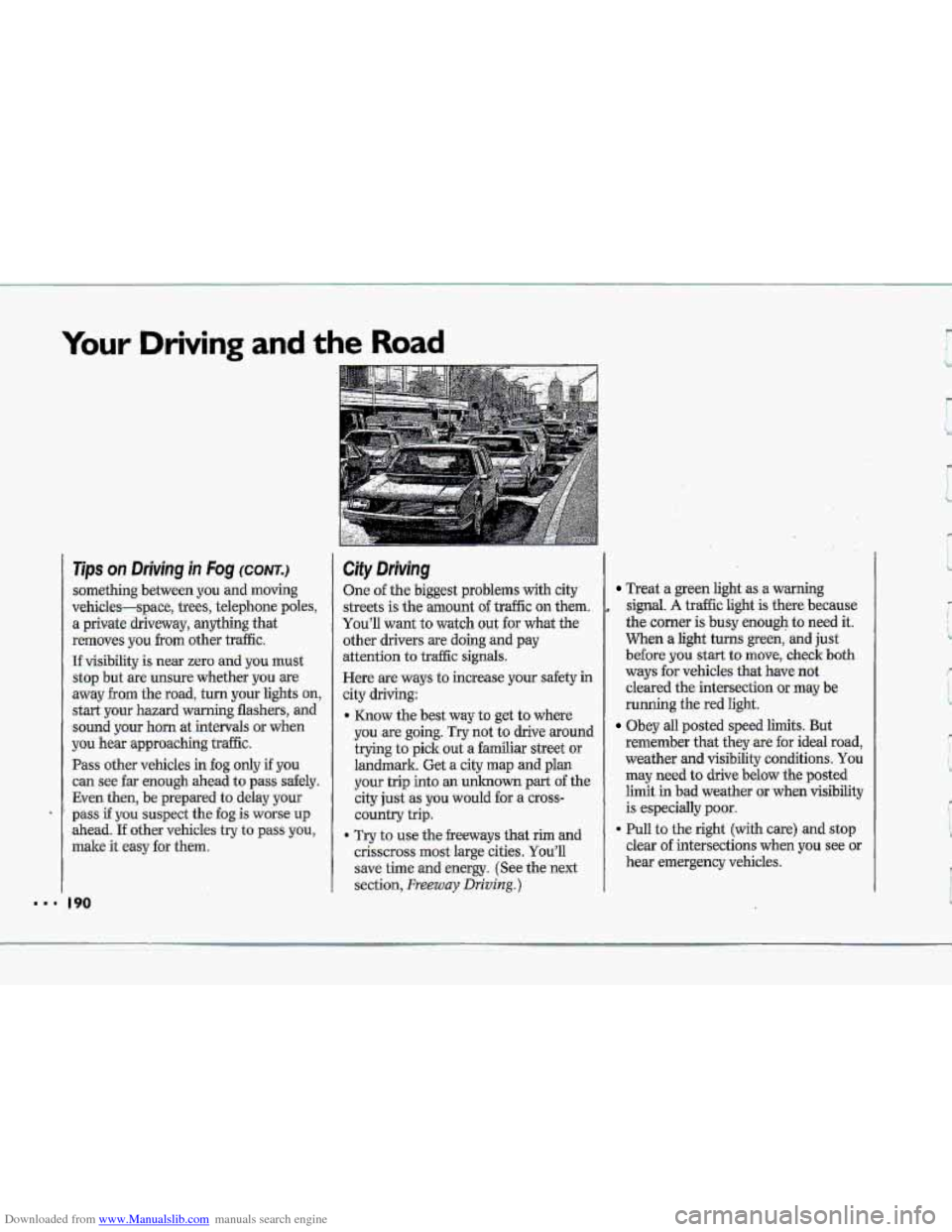
One of the biggest problems with city.
streets
is the amount o€ traffic on them.
You’ll want to watch
out for what the
other drivers are doing
and pay
attention
to traffic signals.
Here are ways to increase your safety in
city driving:
* Know the best way to get to where
you-are going.
Try not to drive around
trying to pick out a familiar street or
landmark. Get a city map
and plan
your trip into an unknown part of the
city
just .as you would for a cross-
country trip.
9 Try to use the freeways that rim and
crisscross
most large cities. You’ll
save time
and energy. (See the next
section,
Freeway Driving.)
Treat a green light as a warning
.signal, A traffic light is there because
the corner
is busy .enough to need it.
When a light turns green, and just
before you start to move, check both
ways for vehicles. that have not
cleared
the intersection or may be
running the red light.
Obey all posted speed limits. But
remenher that they are
for ideal road,
weather
and visibility conditions. You
may need to drive bglow the .posted
limit
.in b.ad weather or when visibility
is especially poor,
clear
of intersections when you see or
hear emergency vehicles.
9 Pull to the right (with care) and stop
c
Page 193 of 370
Downloaded from www.Manualslib.com manuals search engine Your Driving and the Road
Driving on the Freeway (CONTJ
~fyou are moving from an outside to a
center lane. on a freeway having more
than two lanes, make sure another
vehic1e;isn't about to move
into the
same spot. Look at the 'vehicles two
lanes over and watch for telltale signs:
turn
signals flashing? an increase in
speed, or
moving toward the edge-of the
lane. Be prepared to delay
your move.
Once you are moving on the freeway,
make certain you allow a reasonable
following distance. Expect
to move
slightly slower at night.
Leaving the Freeway
When you want to leave the freeway,
move to the proper lane well in
advance. Dashing across lanes at the
last minute is dangerous.
If you miss
your exit do not,.under any circum-
stances,
stop and back up. Drive on to
the next
exit.
At each exit point is a deceleration lane.
Ideally it
should be long enough for you
to enter it at freeway speed
(after
signaling, of course) and then do your
braking before
moving onto the ,exit
ramp. Unfortunately, not all deceleration lanes are
long enough-
.some are too short for all the braking.
Decide when
to start braking. If you
must brake on the.through lane, and if
there is traffic close behind you, yau can
allow a little extra tirrie and flash your
brake lights (in addition to your turn
signal)
as extra warning that you are
about to slow down and exit.
The exit ramp
can be curved, sometimes
quite sharply. The exit speed
is usually
posted. Reduce
your speed according to
your speedometer, not-to your sense of
motion. After driving.for any distance at
higher speeds,
you may tend to- think.
you -we going slower than you actually
are. For example,
40 mph (65 I&)
might seem like only 20 mph (32 Wh) .
Obviously, this could lead to serious
trouble on a
ramp designed for 20 rnph
(32 W)!
P
be
Page 194 of 370
Downloaded from www.Manualslib.com manuals search engine I 9 II
!-
i
Driving a Long Distance
Although most long trips today are
made on freeways, there are still many
made
on regular highways.
Long-distance driving
on freeways and
regular highways is the same in some
ways. The trip has to be planned and
the vehicle prepared, you drive at
higher-than-city speeds, and there are
longer turns behhd the wheel. You’ll
enjoy your
trip more if you and your
vehicle
are in good shape. Here are
some.fips for
a successful long trip.
Before Leaving on a Long Trip
Make sure you’re ready. Try to be well
rested.
If you must start when you’re
not fresh-such as after
a day’s work-
don’t plan to
make too many miles that
first part of the journey. Wear
comfortable clothing and shoes you
can
easily drive in.
Is your vehicle ready for a long trip? If
you keep it serviced and maintained, it’s
ready to
go. If it needs service, have it
done before starting
out. Of course,
you’ll find experienced and able service
experts in Chevrolet dealerships all
across North America. They’ll be ready
and willing to help if you need it. Here
&e some
things you can check
before
a trip:
Windshield Washer Fluid: .Is the
reservoir full? Are ,all windows
clean
inside and outside?
shape?
you checked all levels?
lenses clean?
safe, trouble-hee trip. Is the tread
good enough for lofig-distance
drivhg? Are the tires all inflated to
the recammended pressure?
weather outlook
along your route?
Should you delay your trip a
short
time to avoid a major storm system?
0 Maps: Do you have up-to-date maps?
Wiper Blades: Are they in good
Fuel,, Enme Oil, Other Fluids: Have
Lights: Are they all working? Are the
Tires: They are vitally important to a
Weather Forecasts: What’s the
193
Page 202 of 370
Downloaded from www.Manualslib.com manuals search engine fi
p" , '7
i Y
F"
Run your engbe only as. long -as you
must. This saves fuel. When you run the
engine,
make it go a little faster than
just idle. That is, push the accelerator
slightly. This uses less fuel for the heat
that you get and it keeps the battery
charged. You will need a well-charged
battery
to restart the vehicle, and
possibly €or signaling later on with your
headlights. Let the
heater mn €or a
while.
Then> shut the engine off and close the
window almost all the way to preserve
the heat. Start the engine again and
repeat this only when you feel really
qncomfortable
from the cold. But do it
as little as possible. Preserve the fuel as
long as you can. To help keep warm,
you can get out of the vehicle and do
some fairly vigorous exercises every
haK-hour or so until help comes.
If You're Stuck in Deep Snow
You should twn your ASR system off if
you're stuck in deep snow. See the
Index under Accelerafion Slip
Regulation (ASR) Sysleem. This manual
explains how to get the vehicle out
of
deep snow without damaging it. See the
Index under Rocking Your Vehicle.
Towing a Trailer
Your Corvette is neither designed nor
intended to tow a trailer.
20 I
Page 205 of 370
Downloaded from www.Manualslib.com manuals search engine Problems on the Road
‘A
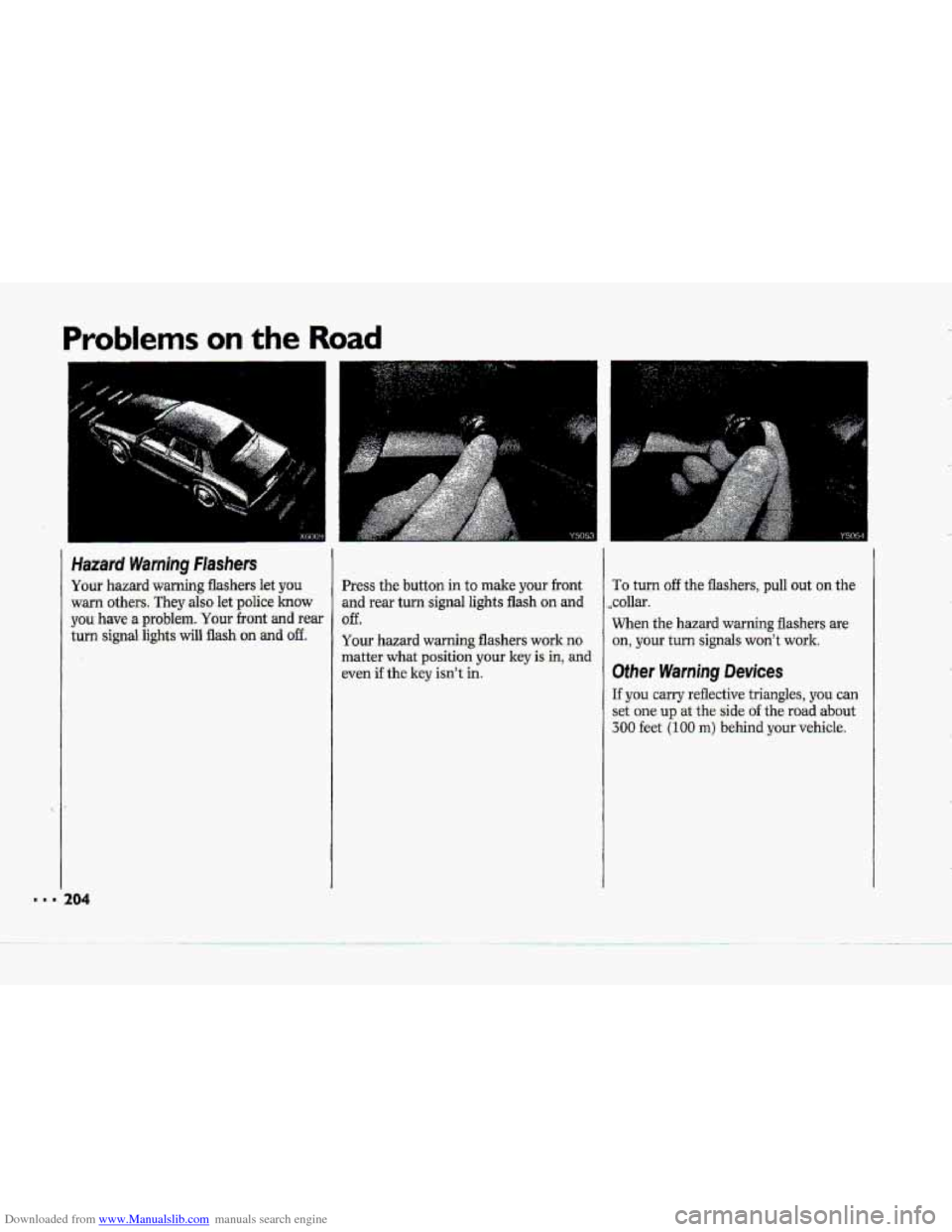
Hazard Warning Flashers
Your hazard warning flashers let you
warn others. They also let police know
you have a problem. Your front and rear
turn signal lights will flash on and off.
204
Press the button in to make your front
and rear turn signal lights flash on and
Off.
Your hazard warning flashers work no
matter what position your key is in, and
even if the key isn’t in.
To turn off the flashers, pull out on the
.*collar.
When the hazard
warning flashers are
on, your turn signals won’t work.
1 Other warning Devices
If you carry reflective triangles, you can
set one up at the side of the road about
300 feet (100 m) behind your vehicle.
Page 207 of 370
Downloaded from www.Manualslib.com manuals search engine Problems on the Road
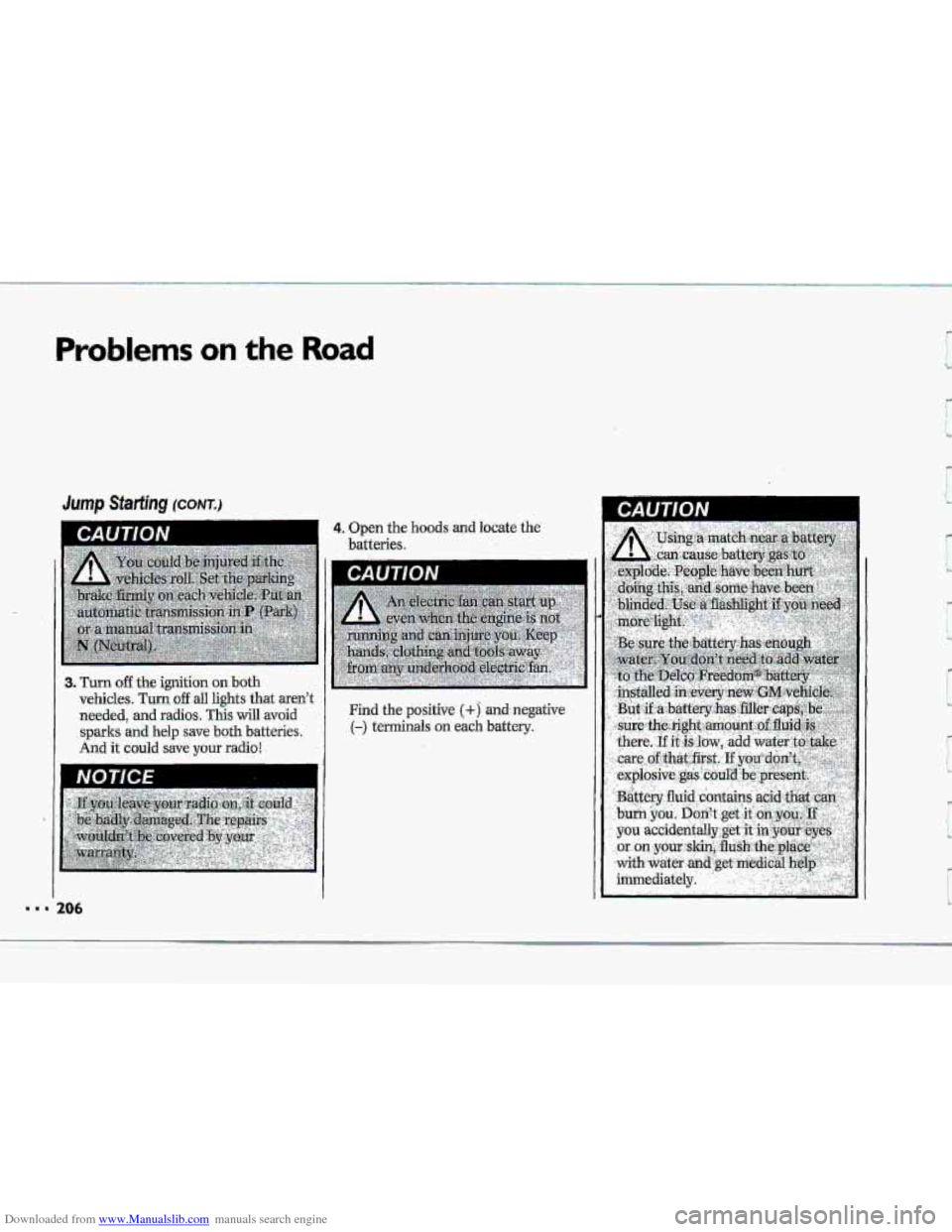
3. Turn off the ignition on both
vehicles. Turn off all lights that aren’t
needed, and radios.
This will avoid
sparks and help save both batteries.
And it could save your radio!
4. Open the hoods and locate the
batteries.
Find the positive
{ + j and, negative
(-) terminals on each battery.
Page 238 of 370
Downloaded from www.Manualslib.com manuals search engine c
c-
If You’re Stuck: In Sand, Mud,
Ice or Snow
What you don’t want to do when your
vehicle is stuck is to spin your wheels.
The method
known as “rocking” can
rou must use caution. I help you get out when you’re stuck, but
CAUT/UN I
A: If :you let.your :tires. spin -at
high speed.when the ASR
, . ‘OFE warning light is on, or when
“the SERVICE ASR warning light is
‘on, your tires can explode and you
or others could be injured. And,
spinning your tires with either of
these lights on can cause the
automatic transmission
or other
parts of the vehicle to overheat.
That could cause an engine
compartment fire or other damage.
When you’re stuck, spin the wheels
as little as possible. Don’t spin the
wheels above 35 mph (56 M) as
shown on the speedometer.
Rocking Your Vehicle to Get It Out:
First, turn your steering wheel left and
right. That will clear the area around
your front wheels. You should turn your
ASR system off. Then, shift back and
forth between R (Reverse) and a
forward gear--or if you have a manual
transmission, between 1 or 2 and
R (Reverse)-spinning the wheels as
little as possible. Release the accelerator
pedal while
you shift, and press lightly
on the accelerator pedal when the
transmission is in gear.
If that doesn’t
get
you out after a few tries, you may
need to be towed out.
If you do need to
be towed
out, see the Index under
Towing Your Corvette and Acceleration
Slip Regulation (ASR) System.
237
Page 250 of 370
Downloaded from www.Manualslib.com manuals search engine Underhood Lights
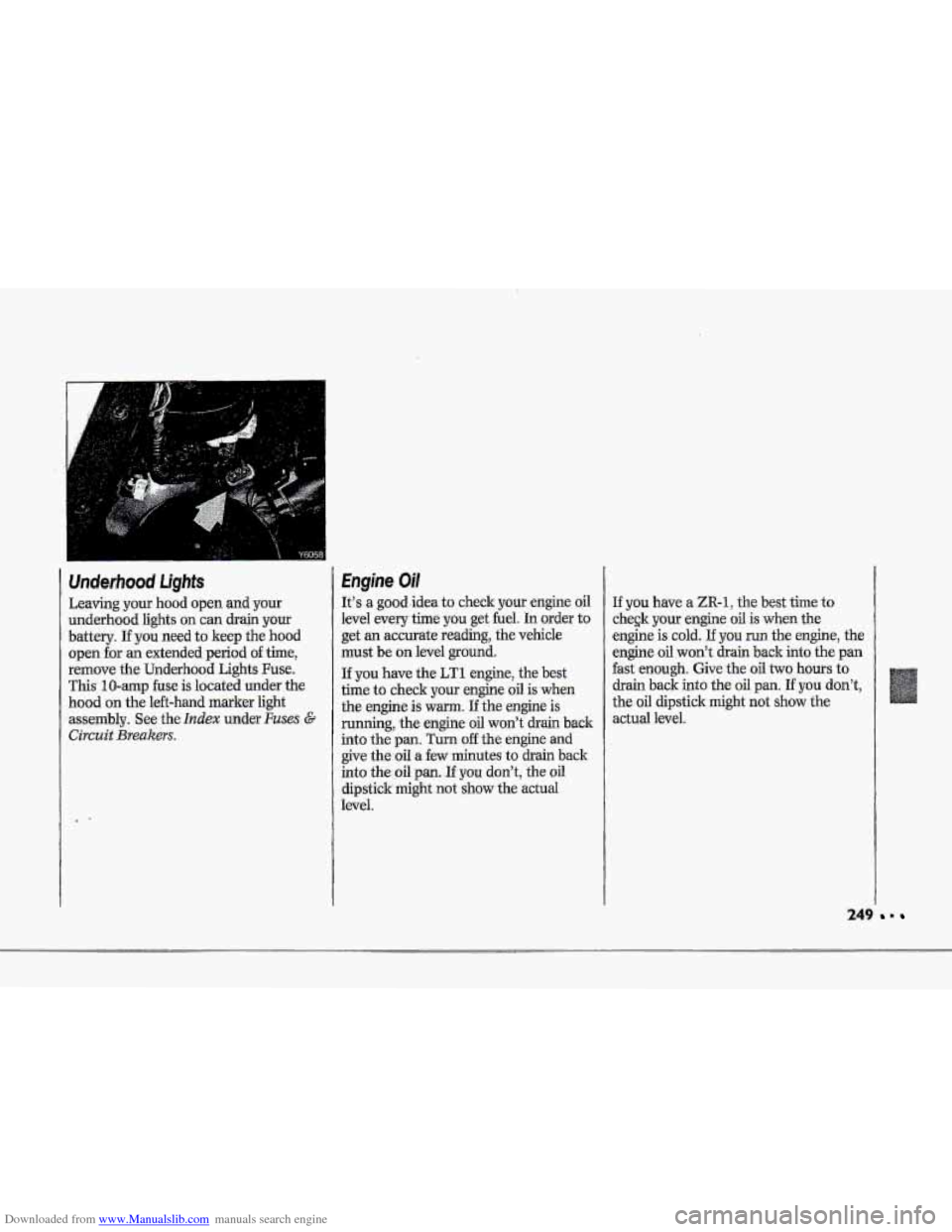
Leaving your hood open and your
underhood lights on can drain your
battery.
If you need to keep the hood
open for an extended period
of time,
remove the Underhood Lights Fuse.
This 1O-amp fuse is located under the
hood on the left-hand marker light
assembly. See the
Index under Fuses &
Circuit Breakers.
Engine Oil
It's a good.idea to check pur engine oil
level every time you get fuel. In order to
get
an accurate reading, the vehicle
must be on level
ground.
If you have the LTl engine, the best
time
to check your engine oil is when
the
engine is warn. If the engine is
mnning, the engine oil won't drain back
into the pan.
Turn off the engine and
give the oil a few minutes to drain back
into the-oil
pan. If you don't, the oil
dipstick might not show the actual
level. If
you have a ZR-1, the best time to
chegk your engine oil is when
the
engine
is cold. If you run the engine, the
engine oil
won't drain back into the pan
fast enough.
Give the oil two hours to
drain
back into the oil pan. If you don't,
the oil dipstick might not
show the
actual level.
249 .
Page 263 of 370
Downloaded from www.Manualslib.com manuals search engine Service Psr nce Care
262
Rear Axle (CONT~)
What to Use:
To add lubricant when the level
use Me Lubricant (GM Part Na
12345977) or SAE BOW-90 GL-5
lubricant. To completely refill after
-draining, add four ounces (118 mQ af
Limited-Slip Dlfferential Lubricant
Additive (GM Part No. 1052358). Zmn
fill to the bottom of the filler plug hole
with Axle ‘Lubricant (GM Part No.
12345977) o,r SAE 8OW-90 GL-5 gear
lubricant.
Engine Coolant
e foUowing explains your cooling
sgstm and how to add coolant when it
is Im. If you have a problem with
e~@e overheating, see the Index under
Engine Ouerheating.
The proper coolant for your Corvette
* Give freezing protection down to
Give boiling protection up. to 262°F
Protect against rust and corrosion.
Help keep the proper engine
Let the warning lights work as they
-3m (-37°C).
(128°C) ~
temperature.
should.
What to Use:
Use a mixture of one-half clean wafer
(preferably distilled) and one-half
antifreeze that
meets “GM Specification
1825-M,” which won’t damage
aluminum parts. You can also use a
recycled coolant conforming to GM
Specification 1825-M with a complete
coolant
flush and refill. If you have the
LTl engine, use GM Engine Coolant
Supplement (sealer)
with any complete
coolant change.
If you use these, you
don’t need to add anything else.
Page 274 of 370
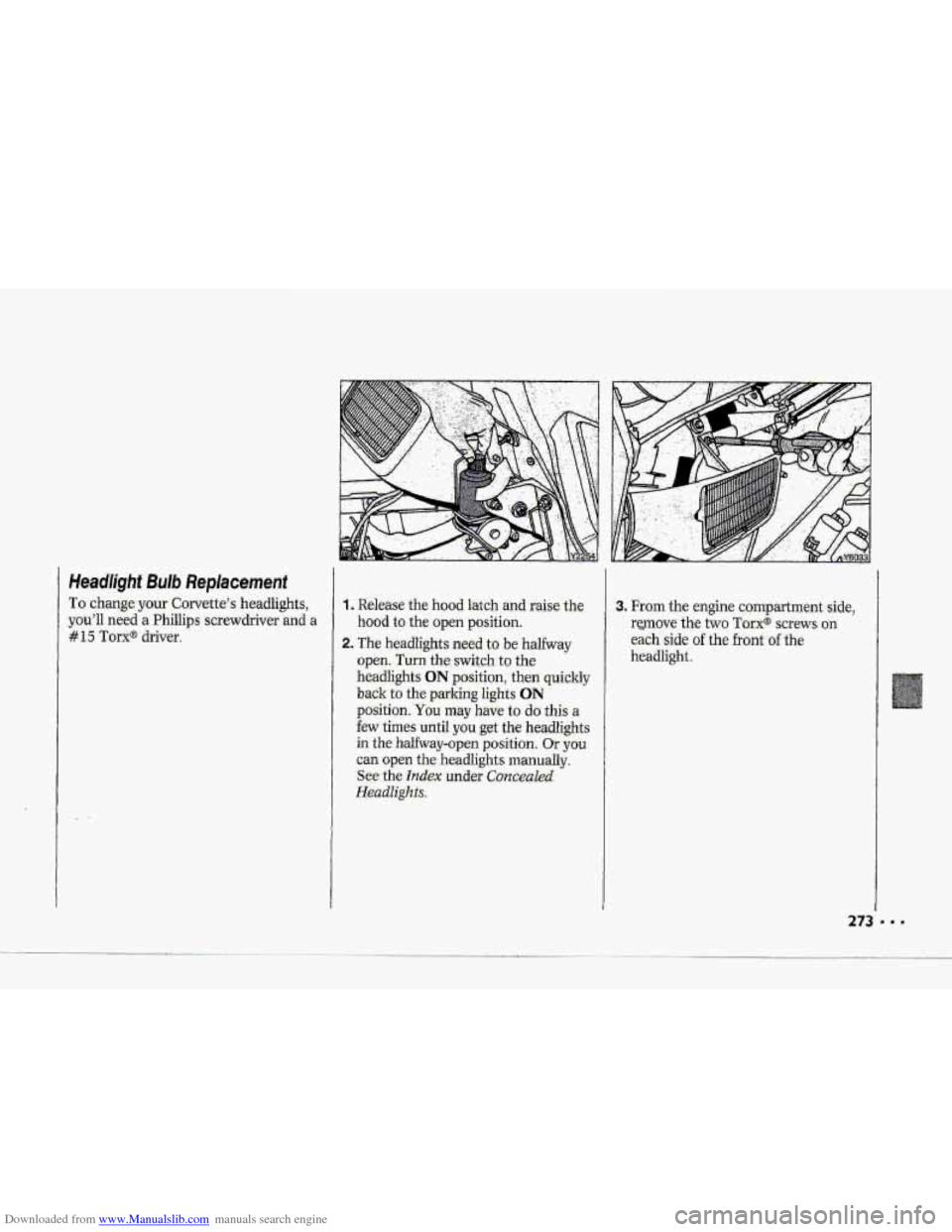
Downloaded from www.Manualslib.com manuals search engine Headlr'ghf Bulb Replacement
TO change your-Corvette's headli,ghts,
you'll need a Phillips screwdriver and a
# 15 Torx@ driver.
'1 .. Release the hood latch and r~ise the
2. The headlights need to be halfway
hood to the open position.
open. Turn theswitch to the
headlights ON position., -then quicldy
back to the p.arking lights ON
position .You hay have to do this a
few times until you get the headlights
in the halfway-open position. Or you
can open the .headlight-s manually.
See the Index urmder Conceukd.
Hmdlighfq.
3. From the engine compartment -side,
rcpove the two Torx@ screws on:
each side of the. front, of the
headlight.