service CHEVROLET CORVETTE 1993 4.G Repair Manual
[x] Cancel search | Manufacturer: CHEVROLET, Model Year: 1993, Model line: CORVETTE, Model: CHEVROLET CORVETTE 1993 4.GPages: 370, PDF Size: 21.43 MB
Page 281 of 370
Downloaded from www.Manualslib.com manuals search engine Service & Appearance Care
I
= * 280
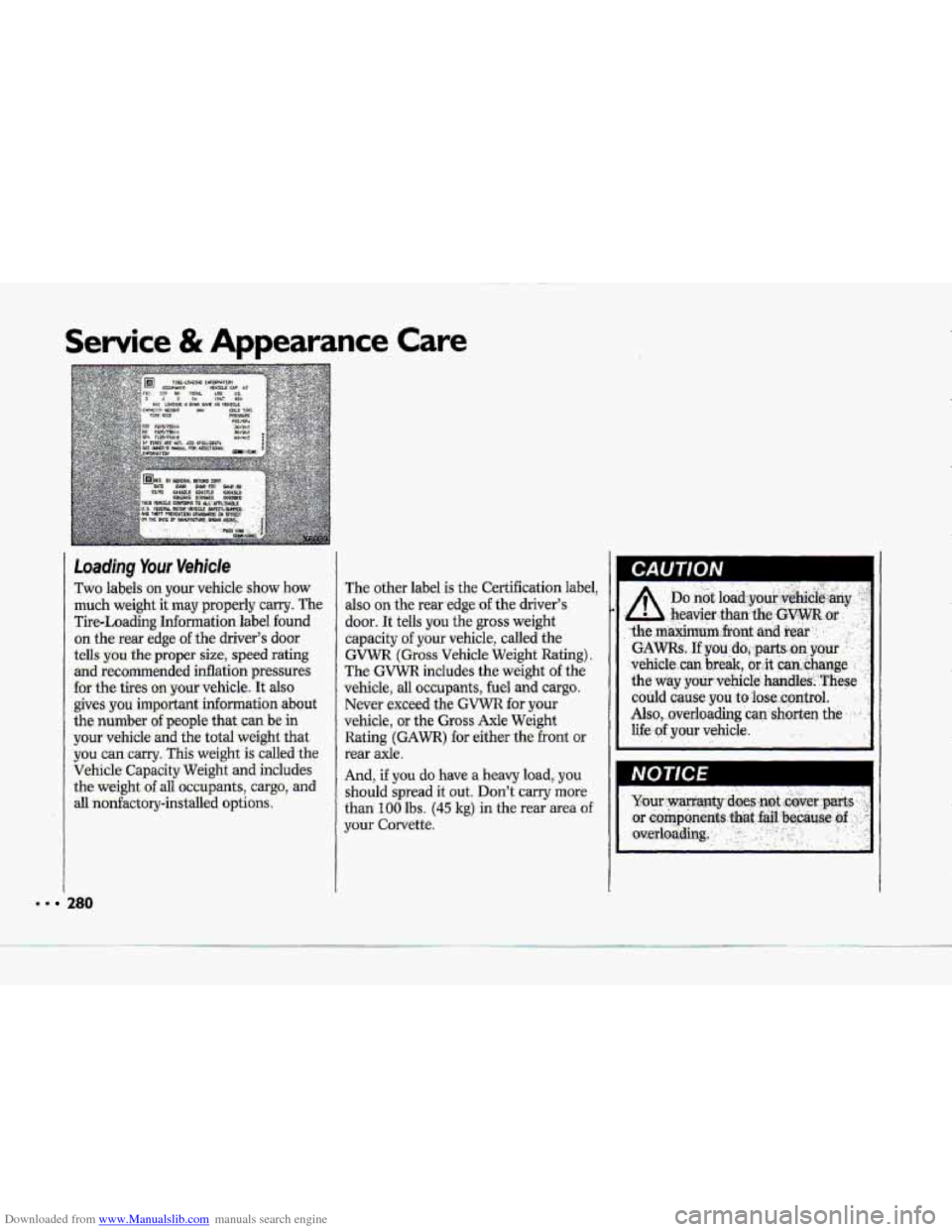
Two labels on your vehicle show how
much weight
it may properly carry. The
Tire-Loading Information label found
on
the rear edge of the driver's door
tells
you the proper size, speed rating
and recommended inflation pressures
€or the tires
on your vehicle. It also
gives you impartant information about
the number
of people that can be in
your vehicle and the total weight that
you can carry. This weight is called the
Vehicle Capacity Weight and includes
the weight of all occupants, cargo, and
all nonfactory-installed options. The other
label is the Certification label,
also on the rear
edge of the driver's
door. It
tells you the gross weight
capacity of
your vehicle, called the
GVWR (Gross Vehicle Weight Rating).
The
GVWR includes the weight of the
vehicle, all occupants, fuel and cargo.
Never exceed the GVWR
for your
vehicle, or the Gross Axle Weight
Rating
(GAWR) for either the front or
rear axle.
And, if you do have a heavy load, you
should spread it out. Don't carry more
than
100 lbs. (45 kg) in the rear area of
your Corvette.
I I
U
i
Page 285 of 370
Downloaded from www.Manualslib.com manuals search engine Sewice & Appearance Care
When It’s Time.for New Tires
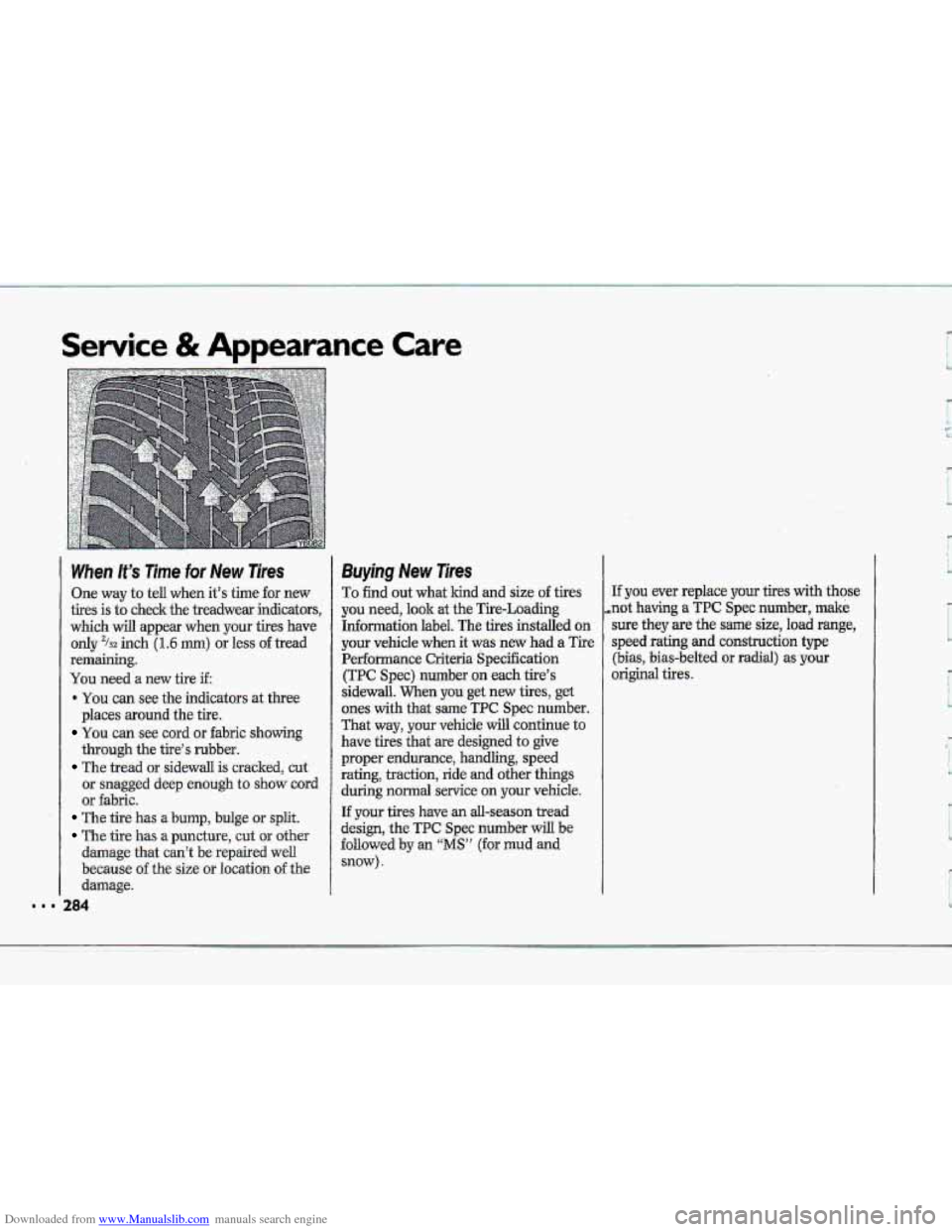
One way to tell when it’s time for new
tires is to check the treadwear indicators,
which will appear when your tires have
only%2 inch (1.6 mm) or less of tread
remaining.
You need a new tire if:
* You can see the indicators at three
You can see cord or fabric showing
The tread or sidewall is cracked, cut
places around the tire.
through the
tire’s rubber.
or snagggd deep enough to show cord
or fabric.
The tire has a bump, bulge or split.
The tire has a puncture, cut or other
damage that can’t he repaired well
because
of the size or location of the
damage.
Buying New Tires
To find out what kind and size of tires
you need, look at the Tire-Loading
Information label. The
tires installed on
your vehicle when it was new had a Tire
Per€omance
Criteria Specification
(TPC Spec) number on each tire’s
sidewall. When
you get new tires, get
ones with that sme TPC Spec number.
That way, your vehicle will continue to
have
tires that are designed to give
proper endurance, handling, speed
rating, traction, ride and other things
during normal service on your vehicle.
If your tires have an all-season tread
design, the TPC Spec number will be
followed by an “MS” (for mud and
snow).
. ... r .: ;.- - .
If yuu ever replace your tires with those
,not having a TPC Spec number, make
SLUT they are the same size, load range,
speed rating and construction
type
(bias, bias-belted or radial) as your
original tires.
G
Page 286 of 370
Downloaded from www.Manualslib.com manuals search engine i
r- 1
F L
Unijiim Tire Quality
Grading
The following information relates to the
system developed by the United States
National
Highway Tr&c Safety
Administration which grades tires by
treadwear, traction and temperature
performance. (This applies only
to
vehicles sold in the United States.)
Treadwear
The treadwear grade is a comparative
rating based on the wear rate of the tire
wh
a specified government test course.
For example, a tire graded 150 would
wear one
and a half (1%) times as well
on the govement course as a tire
graded
100. Therelative performance of
tires depends upon the actual
conditions
of their use, however, and
may depart significantly from the norm
due to variations in driving habits,
service practices and differences in road
characteristics and climate.
Page 287 of 370
Downloaded from www.Manualslib.com manuals search engine ...
Service & Appearance Care
Tra~ti~n-A, 6, C
33% traction grades, from highest to
.lowest are:
A, B, and C. They represent
the tire's ability to stop
on wet pavement
as measured under controlled conditions
on specified ,government test surfaces
of
asphalt and concrete. A tire marked C
may have podr.traction p-erformance.
Warning: The traction grade assigned
to.
this tire is based on braking (straight-
ahead) traction
tests and does not
include cornering (turning) traction.
186.
Temperature-A, B, C
The temperature grades are A (the
highest),
B, and'C, representing the
tire's-resistance to the generation of
heat and its ability to dissipate heat
when tested under controlled conditions
on a specified indoor laboratory test
wheel: Sustained high temperature can
cause the inaterid af the tire to
degenwate.-and
reduce tire @e, and
excessive temperature can
lead to.
sudden tire failure. The-grade
C
corresponds to. a level of performance
which
dl passenger car tires must meet
under:the Federal
Motor Vehicle Sa€ety
Standard
NO.. 109. Grades B.and A
represent higher levels of perfomnance on
the laboratory test wheel than the
minimum
required by law.
Warning: The temperatute grade for
this tire 'is established for a tire that is
properly inftated and not overloaded.
Excessive
speed, underinflation, or
excessive loading, iither separately or in
combination, cah cause heat buildup
and possible
tire failure.
Those grades are
molded on the
sidewalls of passenger car tires.
While the tires available
as standard or
optional equipment on General
Motors
vehicles may vary with. respect to these
grades, all such
tires meet Gene$d.
Motors performance
standards and
have
been appToved for use QII General
Motors vehicles. All passenger type
(P
Metric) tifes .must conform to federal
safety requirements in addition to these.
grades.
Page 289 of 370
Downloaded from www.Manualslib.com manuals search engine Service & Appearance Care
288
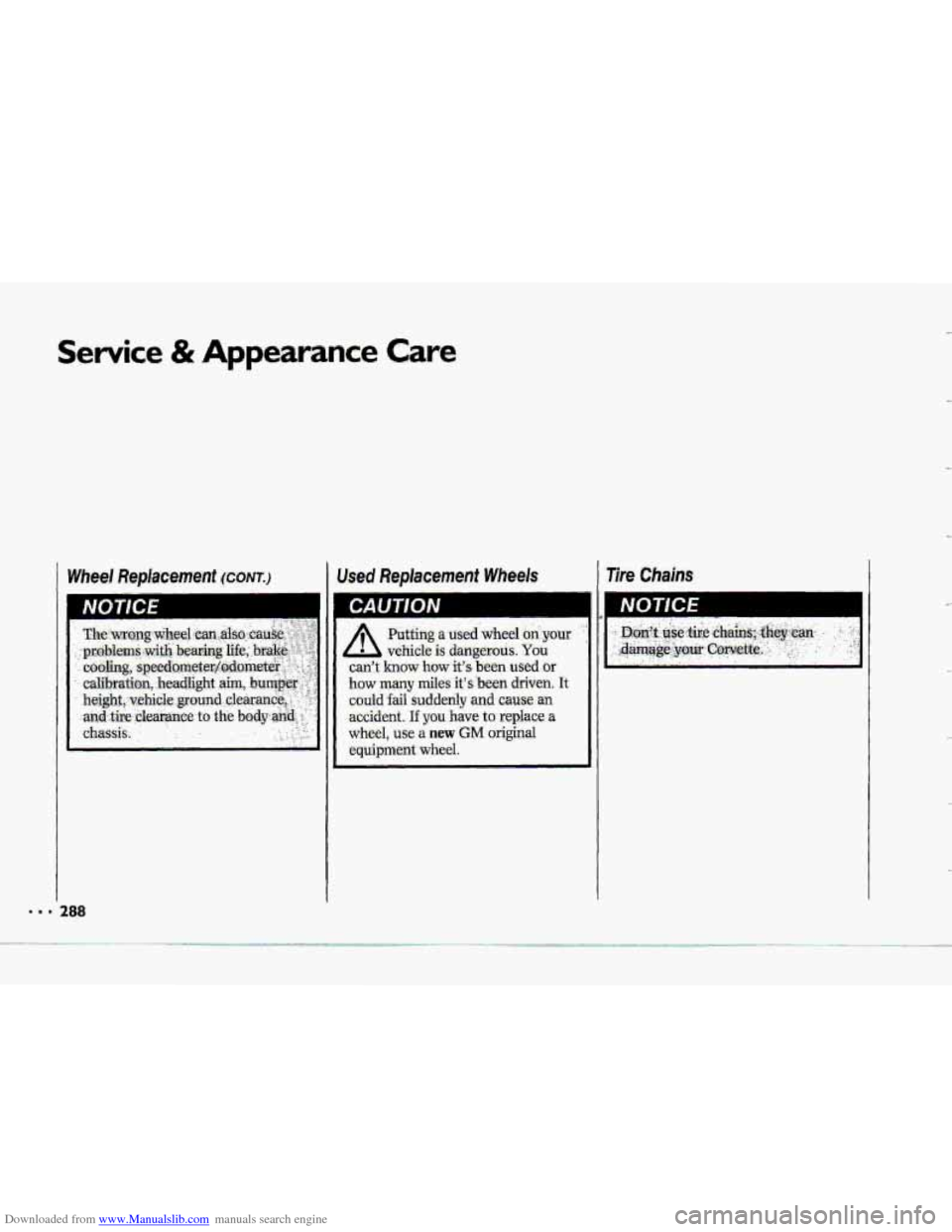
Putting a used -wheel O~YQUK
vehicle is dangerom You
can't know how it's been used.;or
how many miles it's heen driven. It
cwld -fail suddenly and cause- an
.accident, If you have to,replace a
wheel, use a new GM original
equipment wheel.
r
fire Chains
Page 291 of 370
Downloaded from www.Manualslib.com manuals search engine Service & Appearance Care
= = 290
Cleaning the Inside of Your
Coweqe
Use a 'vacuum cleaner often to get rid df
dust and loose dirt. Wipe vinyl with a
clean, damp cloth.
Your Chevralet ,deder has two GM
cleaners-a solvent-type spot lifter and
a foam-type powdered cleaner. They
will clean normal spots and stains very
well.
Here
are some cleaning tips:
Always read the instructions on the
9 Clean up stains as soon as you can-
cleaner label.
before
they set.
9 Use a clean cloth or sponge, and
change to a clean area ,aften.. A so&
brush may be used if stains are
stubborn.
ventilated area only. If you use them,
don't saturate the stained area.
If a ring forms after spot cleaning,
clean the entire area immediately or it
will set.
Use solvent-type cleaners in a well-
. .. ' ;I I.. . . ..
Using Foam-Type Cleaner on
Fabric.
9 Vacuumand brush the; area to .remove.
9 Always clean a whole trim panel or
any loose
dirt.
section. Mask surrounding trim along
stitch or welt lines.
Mix Multi-Purpose Powdered Cleaner
following the directions on the
container label.
* Use suds only and apply with a clean
9 Don't saturate the material.
Don't rub it roughly.
As soon as you've cleaned the secnon,
sponge.
use a sponge to remove the suds.
w
Page 293 of 370
Downloaded from www.Manualslib.com manuals search engine Service & Appe; rance Care
Special Cleaning Problems
Greasy or Oily Stains: Like grease, oil,
butter, margarine, shoe polish, cofEee
with cream, chewing
gum, cosmetic
creams, vegetable oils, wax crayon,
tar
and asphalt.
Carehlly scrape off excess stain.
* Then follow the solvent-type
Shoe polish, wax crayon, tar and
instructions earlier
in this
section.
asphalt will stain
if left on a vehicle
seat fabric.
They should be removed
as
soon as possible. Be careful,
because the cleaner
will dissolve them
and may cause them to bleed.
Non-Greasy Stains: Like catsup,
coffee (black), egg, hit, hit juice,
mill<, soft drinks, wine, vomit, urine and
blood.
Carefully scrape off excess stain, then
sponge the
soiled area with cool
water.
1f.a stain remains, follow the foam-
type instructions
earlier in this
section.
or urine, treat the area with a
waterhaking soda
solution: 1
teaspoon (5 ml) of baking soda to
I cup (250 ml) of lukewarm water.
Finally, if needed, clean lightly with
solvent-type cleaner.
Combination Stains: Like candy, ice
cream, mayonnaise, chili sauce and
udmown stains.
Carefully scrape off excess stain, then
clean with cool water
and allow to
If an odor lingers after cleaning vomit
dry-
. If a stain remains, clean it with
solvent-type cleaner.
Cleaning the Carpeting In Your
Corvette
Your vehicle has a color-fast solution
dyed carpet. To clean this type Of carpet:
Dry Stain: Carefully scrape off excess
stain. Then
use a small .hand brush io
gently remove the rest of the crusted
material.
Wet Stain: Carefully blot the stain with
an absorbent cloth, pap&- towel
or':
sponge.
If the stain persists, treat the area with a
solution of four parts water td one part
household bleach (5.25% solution) and
let stand for approximately one hour.
Then rinse thoroughly with a
detergent/water solution.
Follow this
with three additional rinsings
of water
only, thoroughly blotting the area after
each application.
L Ij
292
Page 295 of 370
Downloaded from www.Manualslib.com manuals search engine Service & Appearance Care
Cleaning the Top of the
lnstrumenf Panel
Use only mild soap and water to dean
the
tap surfaces of the. instrument.
panel. Sprays containing Silicones
or
waxes may cause annoying reflections
in the windshield and even make it
dK1cult to see through the.windshield
under certain conditions.
Cleaning Speaker Covers
Vacuum around. a Delco-BoseB- speaker
cover gently,
so that the- sp.ealref won’t
be damaged. If something gets on one of
them, follow the step earlier under
Using -Sslvsnt-Type Cleaner on Fabric.
Uscas little solvent as you can.
C/eaning “Dulso”-Coated
Molding
Your Corvette’s inside rear window
(hatch area) molding is “Dulso” coated.
For lightly soiled molding, wipe with a
sponge OF a soft lint-free cloth that
has been dampened with water.
+ For heavily soiled molding, use warm
soapy water.
You can recondition molding.showing
‘marks
or- scratches by briskIy wiping
the
area with GM Fabric Cleaner
(solvent type). Don’t
use too much
.cleaner.
If a- ring forms, immediately
repeat the cleaning procedure over
a
slightly larggr area, “feathering”
toward
the center of the ring. If-the
ring
still remains, wipe the entire
molding.
Page 297 of 370
Downloaded from www.Manualslib.com manuals search engine Service & Appearance Care
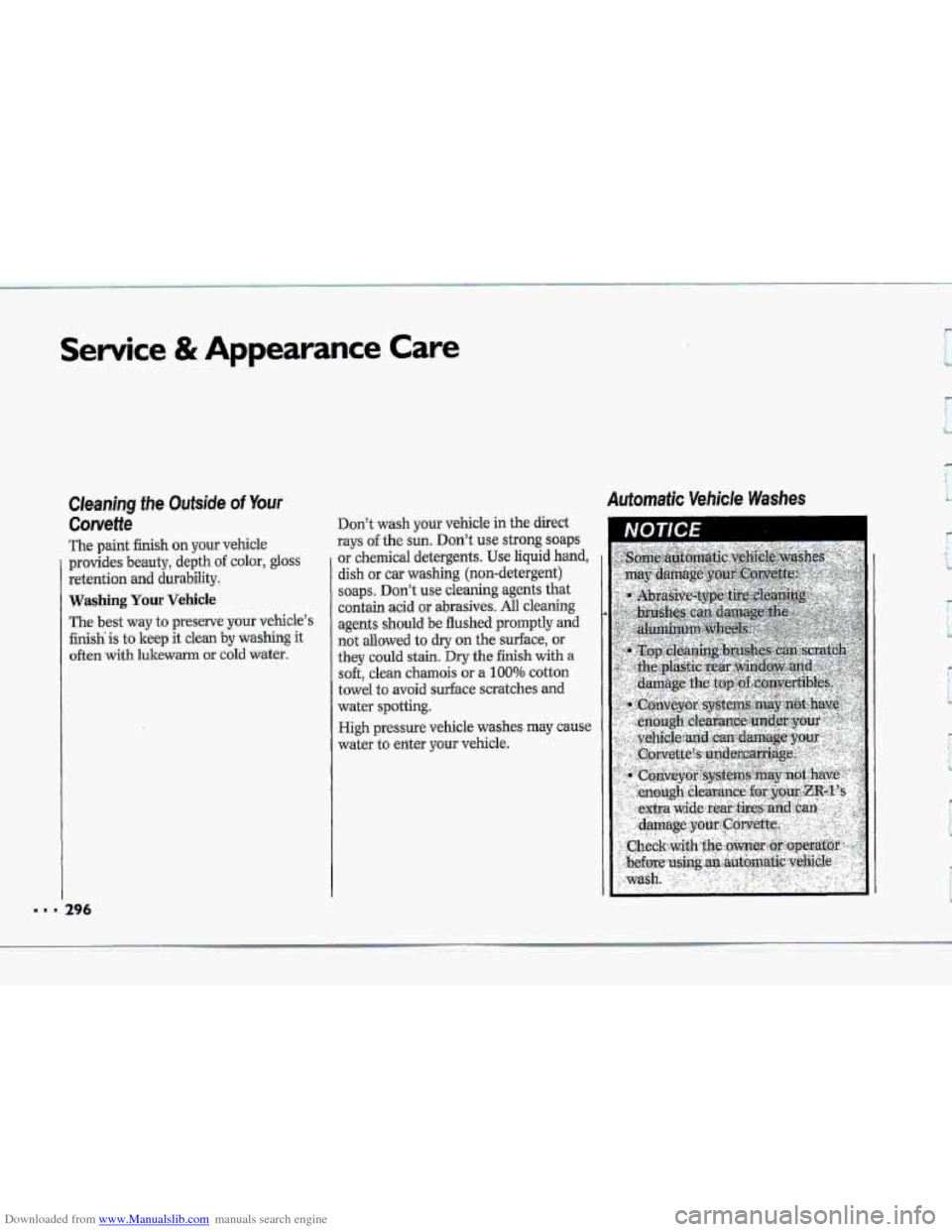
Cleaning the Outside of Your
Corvette
The paint finish on your vehicle
provides beauty, depth
of color, gloss
retention and durability.
Washing Your Vehicle
The best way to preserve your vehicle’s
finish is to keep it clean by washing it
often with lulcwarm or cold water.
Don’t wash your vehicle in the direct
rays
of the sun. Don’t use strong soaps
or chemical detergents. Use liquid hand,
dish or car washing (non-detergent)
soaps. Don’t use cleaning agents that
contain
acid or abrasives. All cleaning
agents should be flushed promptly and
not allowed to dry on the surface, or
they could stain. Dry the finish with a
soft, clean chamois or a 100% cotton
towel
to avoid surface scratches and
water spotting.
High pressure vehicle washes may cause
water to enter your vehicle.
Automatic Vehicle Washes
Page 299 of 370
Downloaded from www.Manualslib.com manuals search engine Service & Appearance Care
NOTICE
I
I a 298
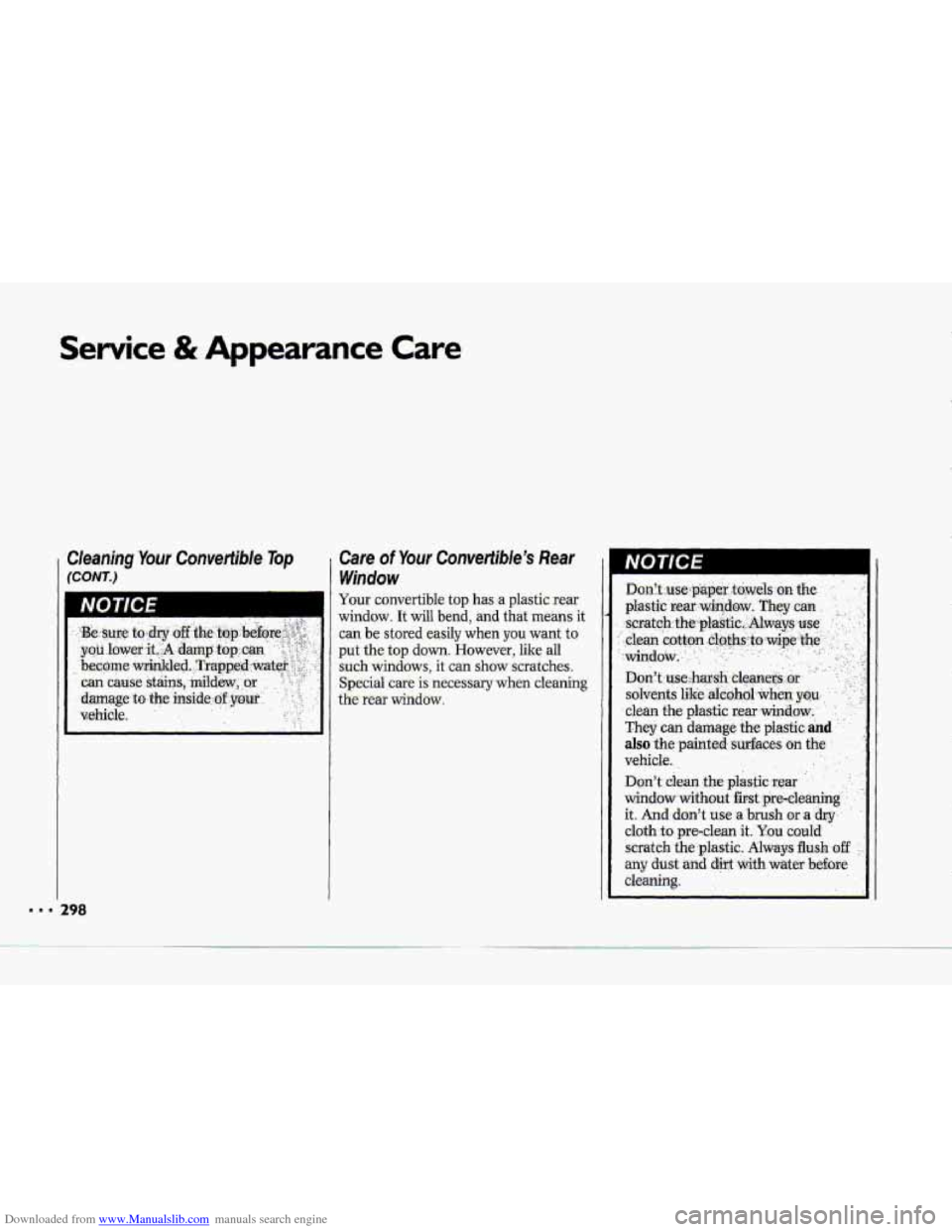
Care of Your Convertible's Rear
Window
Your convertible top has a plastic rear
window. It will
bend, and that means it
can be stored easily when you want to
put the top down. However, like all
such windows, it can show scratches.
Special
care is n :ssarv when cleaning
the rear
windc
Don't use-paper :tuyels on the .. . :
plastic rear window. They can . .
scratch: the. pladic,.. Always use .. - . .>
.' &t$o.n ,eloth,rio:w;i.pe'$h& . . ., ,
window.^ . '-. .- .1 , .. . .. .. .. .. . , .' ~. . . ..
Don't-useharsh cleane?s..or
so1vent.s like' d&.@ohol when you
clean t.he plastic rear window. ..
They can damage the plastic and
also the painted. surfaces on the
vehicle.
Don't clean the plasticrear
window without first pre-cleaning
it.
And don't use a brush or a dry
cloth to pre-clean it. You could
scratch the plastic. Always flush ,off
any dust and dirt with water before
cleaning.
. ~. ..