key CHEVROLET CORVETTE 1994 4.G Owner's Guide
[x] Cancel search | Manufacturer: CHEVROLET, Model Year: 1994, Model line: CORVETTE, Model: CHEVROLET CORVETTE 1994 4.GPages: 274, PDF Size: 15.61 MB
Page 118 of 274
Downloaded from www.Manualslib.com manuals search engine Repeat: Press “REPT” to go to the
beginning of the current track after eight
seconds or more
of play. After eight
seconds or less of play, the player will
return to the beginning of the previous
track.
Search: Press “SRCH’ to go to the
beginning of the next track.
Scan: Press “SCAN” to listen to the first
eight seconds of each track. Press it again
to stop scanning.
Compression: Press “COMP” to make
loud and soft passages more nearly equal
in volume. Press
it again for normal play.
To Stop the Disc Player
0
0
0
Turn the power off or turn the ignition
key
off. The disc stays in the player
and will resume playing at the point
where it stopped.
Press “STOP-PLAY” to stop playing
the disc and switch to radio. Press it
again to restart the disc at the point
where it stopped.
Press “EJCT” to eject the disc and
switch to radio. If the ignition or audio
system is turned
off, the player will
pull the disc back in if you don’t
remove it from the opening within
30 seconds.
Understanding Radio Reception
FM Stereo
FM stereo will give you the best sound.
But FM signals will reach only about
10 to 40 miles (16 to 65 km). And, tall
buildings or hills can interfere with
FM signals, causing the sound to come
and go.
AM
The range for most AM stations is greater
than for
FM, especially at night. The
longer range, however, can cause stations
to interfere with each other. AM can pick
up noise from things like storms and
power lines. Try reducing the treble to
reduce this noise if you ever get it. Care of Your Cassette Tape
Player
A tape player that is not cleaned regularly
can cause reduced sound quality, ruined
cassettes, or a damaged mechanism.
Cassette tapes should be stored in their
cases away from contaminants, direct
sunlight, and extreme heat. If they aren’t,
they may not operate properly or cause
failure of the tape player.
Your tape player should be cleaned
regularly each month or after every 15
hours of use. If
you notice a reduction in
sound quality, try a known good cassette
to see if the tape or the tape player
is
at fault. If this other cassette has no
improvement in sound quality, clean the
tape player.
117.. .
Page 124 of 274
Downloaded from www.Manualslib.com manuals search engine According to the American Medical
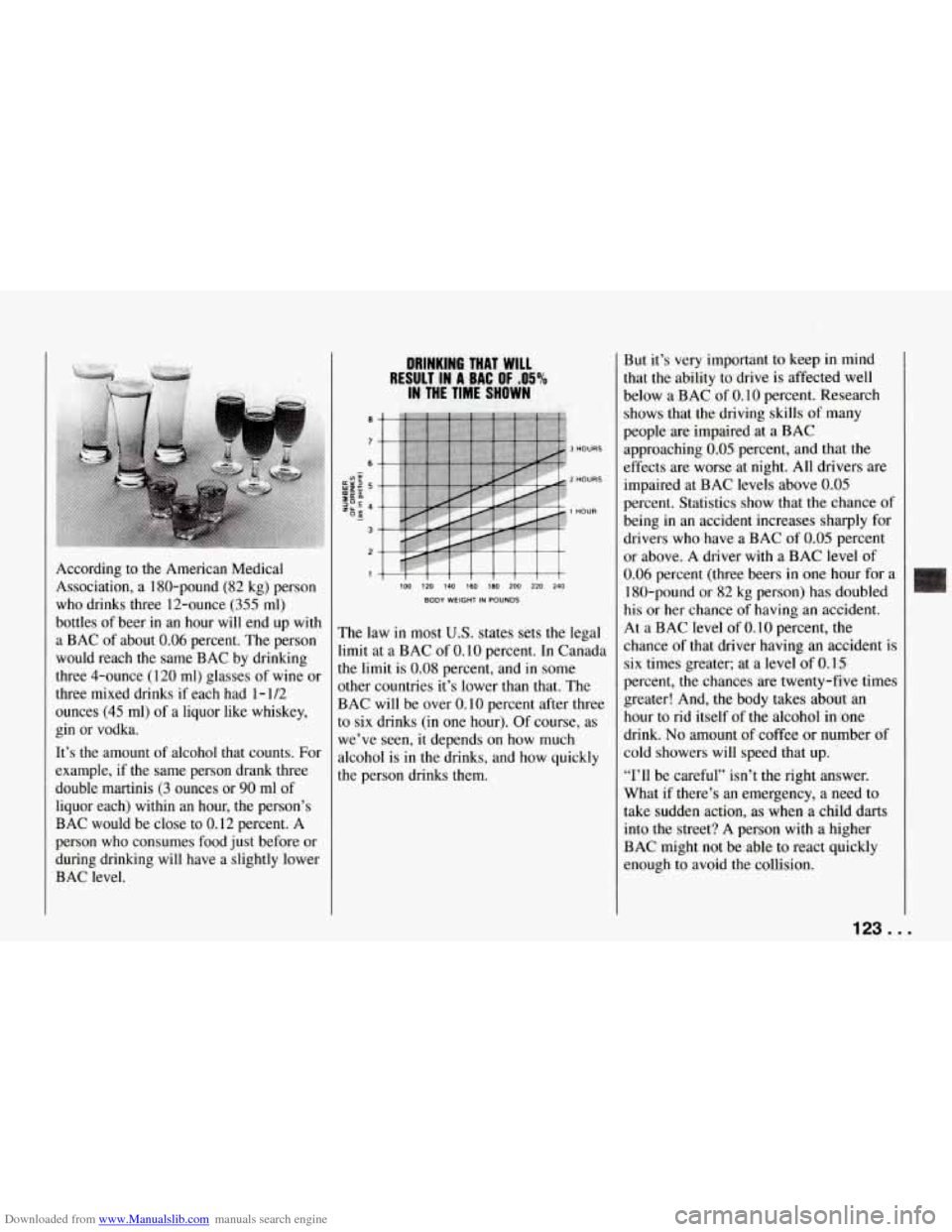
Association, a 180-pound (82 kg) person
who drinks three 12-ounce (355 ml)
bottles
of beer in an hour will end up with
a BAC of about
0.06 percent. The person
would reach the same BAC by drinking
three 4-ounce (1 20
ml) glasses of wine or
three mixed drinks if each had 1
- 1/2
ounces (45 ml) of a liquor like whiskey,
gin or vodka.
It’s the amount of alcohol that counts. For
example, if
the same person drank three
double martinis (3 ounces or
90 ml of
liquor each) within
an hour, the person’s
BAC would be close to 0.12 percent. A
person who consumes food just before or
during drinking will have
a slightly lower
BAC level.
DRIN’KING THAT WILL
IN THE TIME SHOWN
RESULT IN A BAC OF. .OS%
3 HOURS
2 HOURS
1 HOUR
111l1111 IW 120 140 160 1.30 m 220 240
BODY WEIGHT IN POUNDS
The law in most U.S. states sets the legal
limit at a BAC of 0.10 percent.
In Canada
the limit is
0.08 percent, and in some
other countries it’s lower than that. The
BAC will be over
0.10 percent after three
to six drinks (in one hour). Of course, as
we’ve seen, it depends on how much
alcohol is in the drinks, and how quickly
the person drinks them.
.,. c. .-’ .t
But it’s very important to keep in mind
that the ability to drive is affected well
below a BAC of 0.10 percent. Research
shows that the driving skills
of many
people ai-e impaired at a BAC
approaching
0.05 percent, and that the
effects are worse at night. All drivers are
impaired at BAC levels above
0.05
percent. Statistics show that the chance of
being in an accident increases sharply for
drivers who have a BAC of
0.05 percent
or above. A driver with a BAC level of
0.06 percent (three beers in one hour for a
180-pound or 82 kg person) has doubled
his or her chance of having an accident.
At a BAC level of 0.10 percent, the
chance of that driver having an accident is
six times greater; at a level of
0.15.
percent, the chances are twenty-five times
greater! And, the body takes about an
hour to rid itself
of the alcohol in :one
drink.
No amount of coffee or number of
cold showers will speed that
up.
“I’ll be careful” isn’t the right answer.
What if there’s
an emergency, a need to
take sudden action, as when a child darts
into the street? A person with a higher
BAC might not be able to react quickly
enough to avoid the collision.
123 ...
Page 143 of 274
Downloaded from www.Manualslib.com manuals search engine Problems on the Road
Hazard Warning
Flashers
Your hazard warning flashers let you
warn others. They also let police know
you have a problem. Your front and rear
turn signal lights will flash on and off.
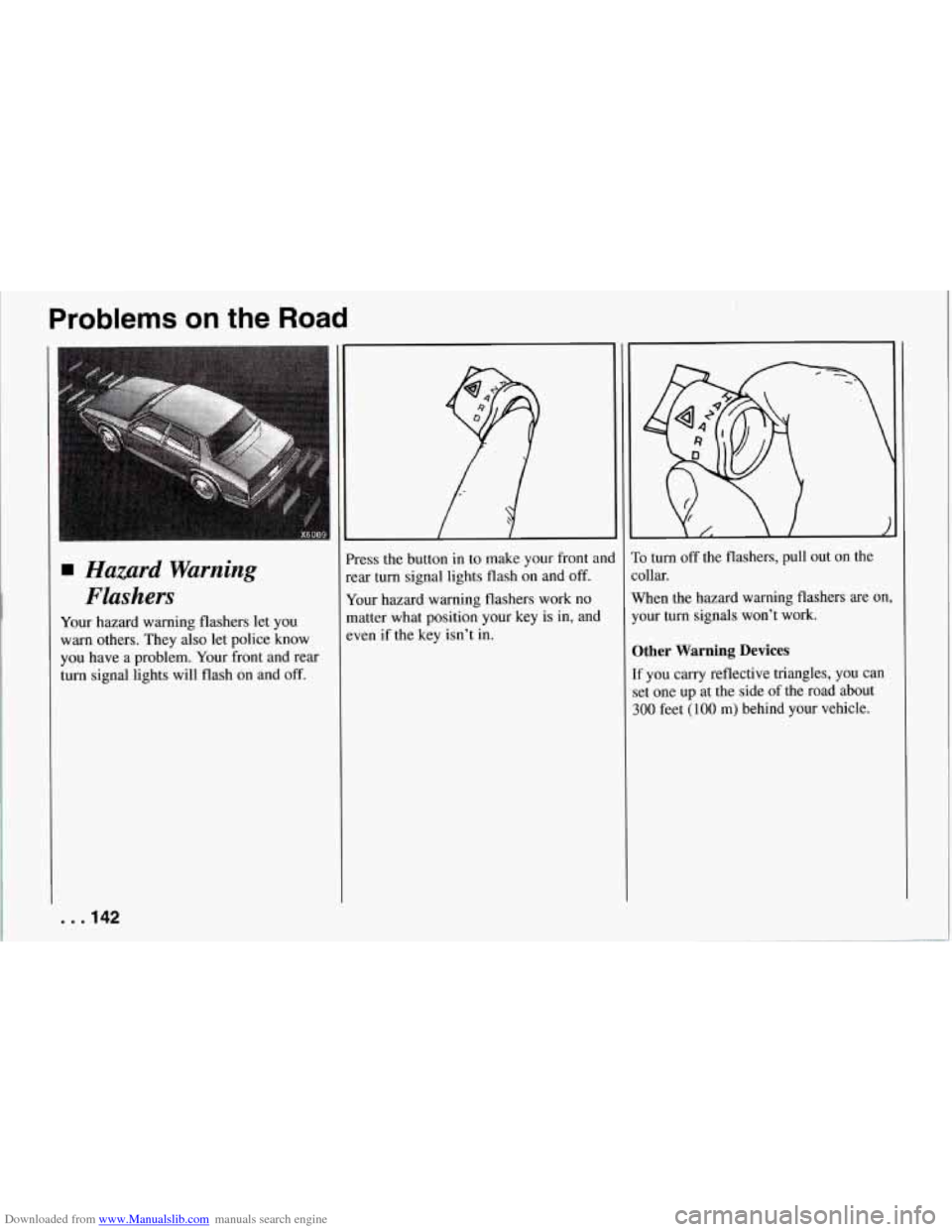
'ress the button in to make your front an(
:ar turn signal lights flash on and off.
lour hazard warning flashers work no
matter what position your
key is in, and
ven if the key isn't in.
'0 turn off the flashers, pull out on the
ollar.
Vhen the hazard warning flashers are
on,
'our turn signals won't work.
Ither Warning Devices
f you carry reflective triangles, you can
et one up at the side of the road about
100 feet (100 m) behind your vehicle.
. . .I42
Page 148 of 274
Downloaded from www.Manualslib.com manuals search engine IC
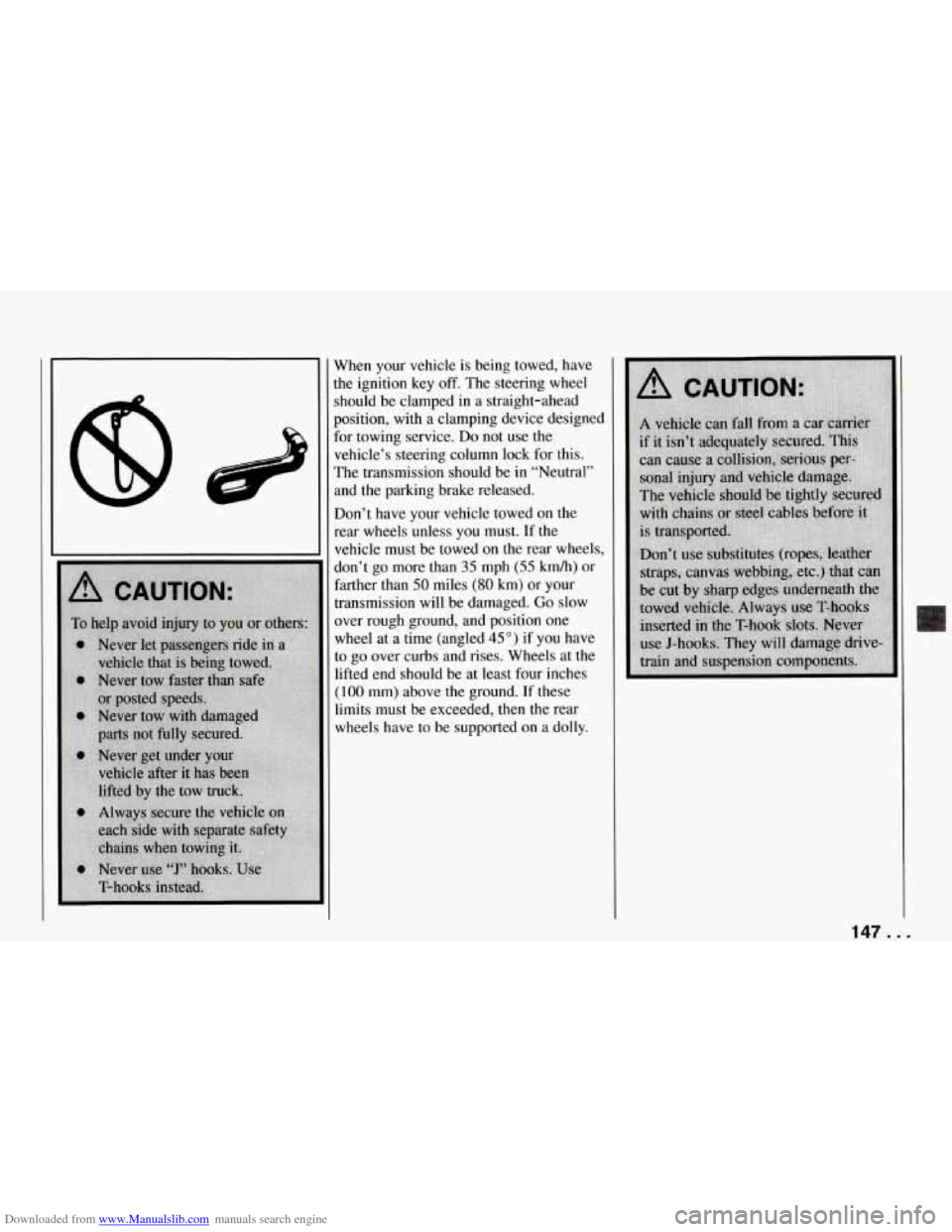
When your vehicle is being towed, have
he ignition key
off. The steering wheel
should be clamped in a straight-ahead
position, with a clamping device designed
For towing service.
Do not use the
vehicle’s steering column lock for this.
The transmission should be in “Neutral”
and the parking brake released.
Don’t have your vehicle towed
on the
rear wheels unless you must. If the
vehicle must be towed on the rear wheels,
don’t go more than
35 mph (55 kmh) or
farther than
50 miles (80 km) or your
transmission will be damaged.
Go slow
mer rough ground, and position one
wheel at a time (angled
45”) if you have
to go over curbs and rises. Wheels at the
lifted end should be at least four inches
(1 00 mm) above the ground. If these
limits must be exceeded, then the rear
wheels have to be supported
on a dolly.
14f ...
Page 161 of 274
Downloaded from www.Manualslib.com manuals search engine Problems on the Road
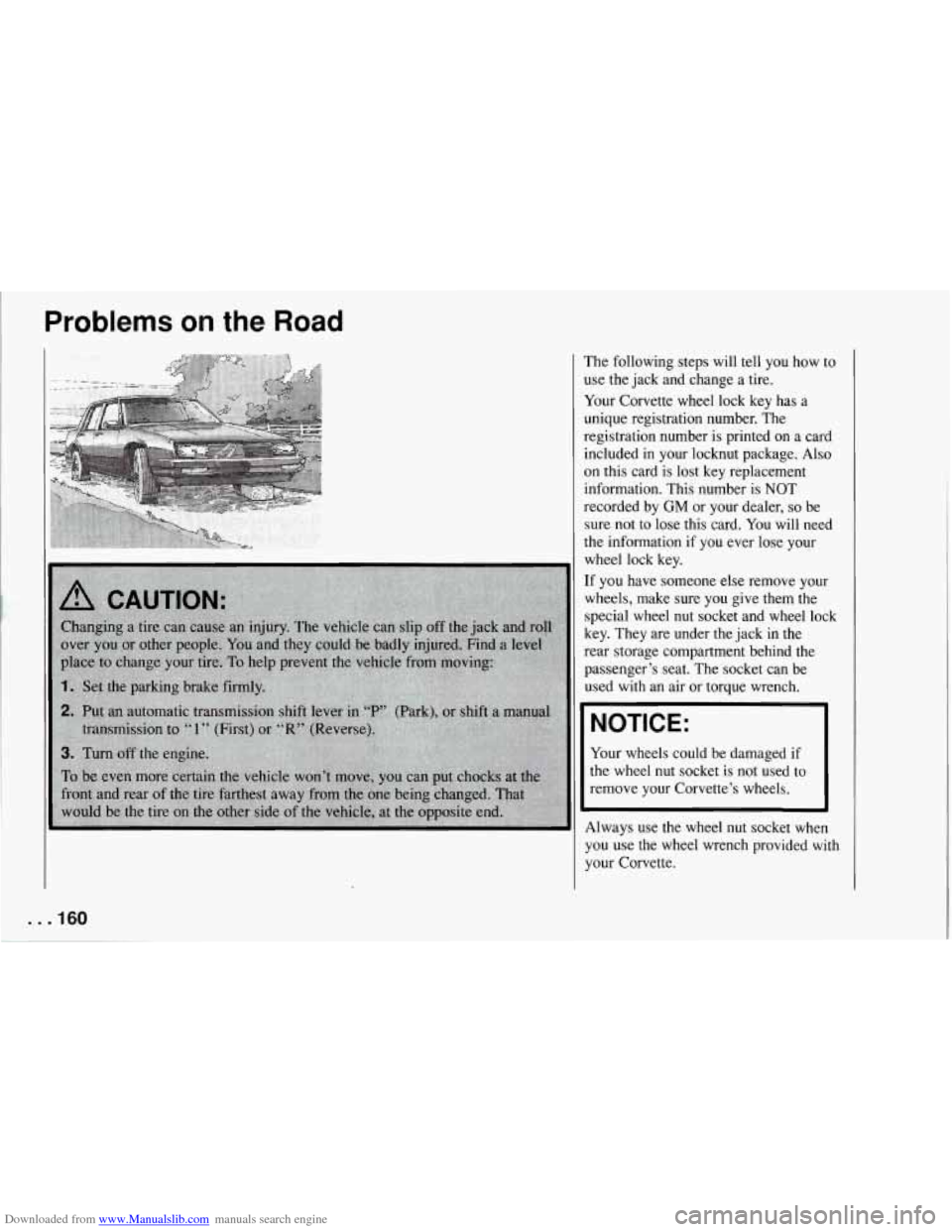
The following steps will tell you how to
use the jack and change a tire.
Your Corvette wheel lock key has a unique registration number. The
registration number is printed on a card
included in your locknut package.
Also
on this card is lost key replacement
information. This number is NOT
recorded by
GM or your dealer, so be
sure not to lose this card. You will need
the information
if you ever lose your
wheel lock key.
If you have someone else remove your wheels, make sure you give them the special wheel nut socket and wheel lock
key. They are under the jack in the
rear storage compartment behind the
passenger’s seat. The socket can be
used with an air or torque wrench.
NOTICE:
Your wheels could be damaged if
the wheel nut socket is not used to
remove your Corvette’s wheels.
Always use the wheel nut socket when
you use the wheel wrench provided with
your Corvette.
. . .I60
Page 162 of 274
Downloaded from www.Manualslib.com manuals search engine I -
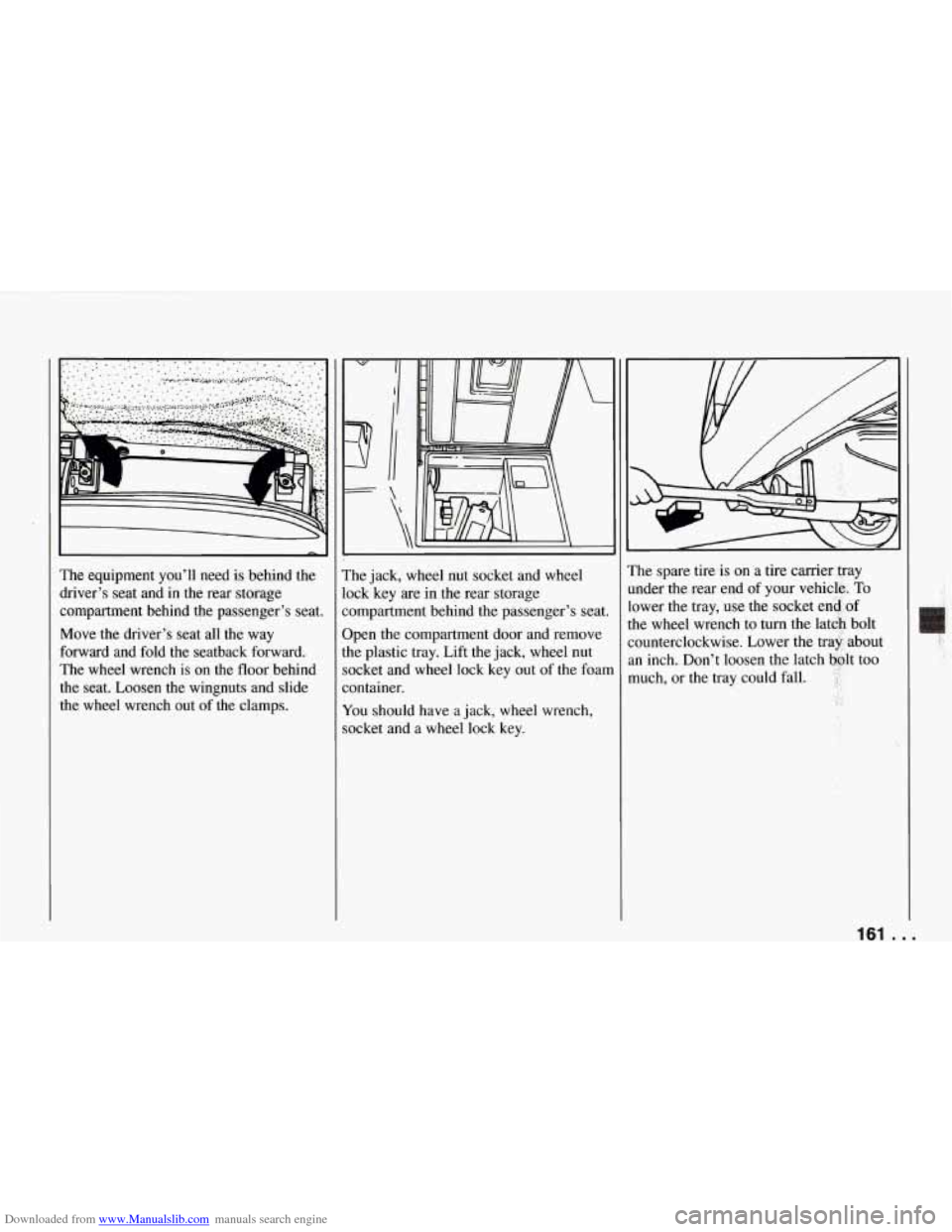
The equipment you’ll need is behind the
driver’s seat and in the rear storage
compartment behind the passenger’s seat.
Move the driver’s seat all the way
forward and fold the seatback forward.
The wheel wrench is on the floor behind
the seat. Loosen the wingnuts and slide
the wheel wrench out of the clamps. The
jack, wheel nut socket and wheel
ock key are in the rear storage
:ompartment behind the passenger’s seat.
]pen the compartment door and remove
,he plastic tray. Lift the jack, wheel nut
socket and wheel lock key out
of the foan
container.
You should have a jack, wheel wrench,
socket and
a wheel lock key. The
spare tire is on a tire carrier Q-ay
mder the rear end of your vehicle,.
To
lower the tray, use the socket end of
:he wheel wrench to turn the latch bolt
:ounterclockwise. Lower the trag- about
an inch. Don’t loosen the latch bplt too
much, or the tray could fall.
,i
161 ...
Page 164 of 274
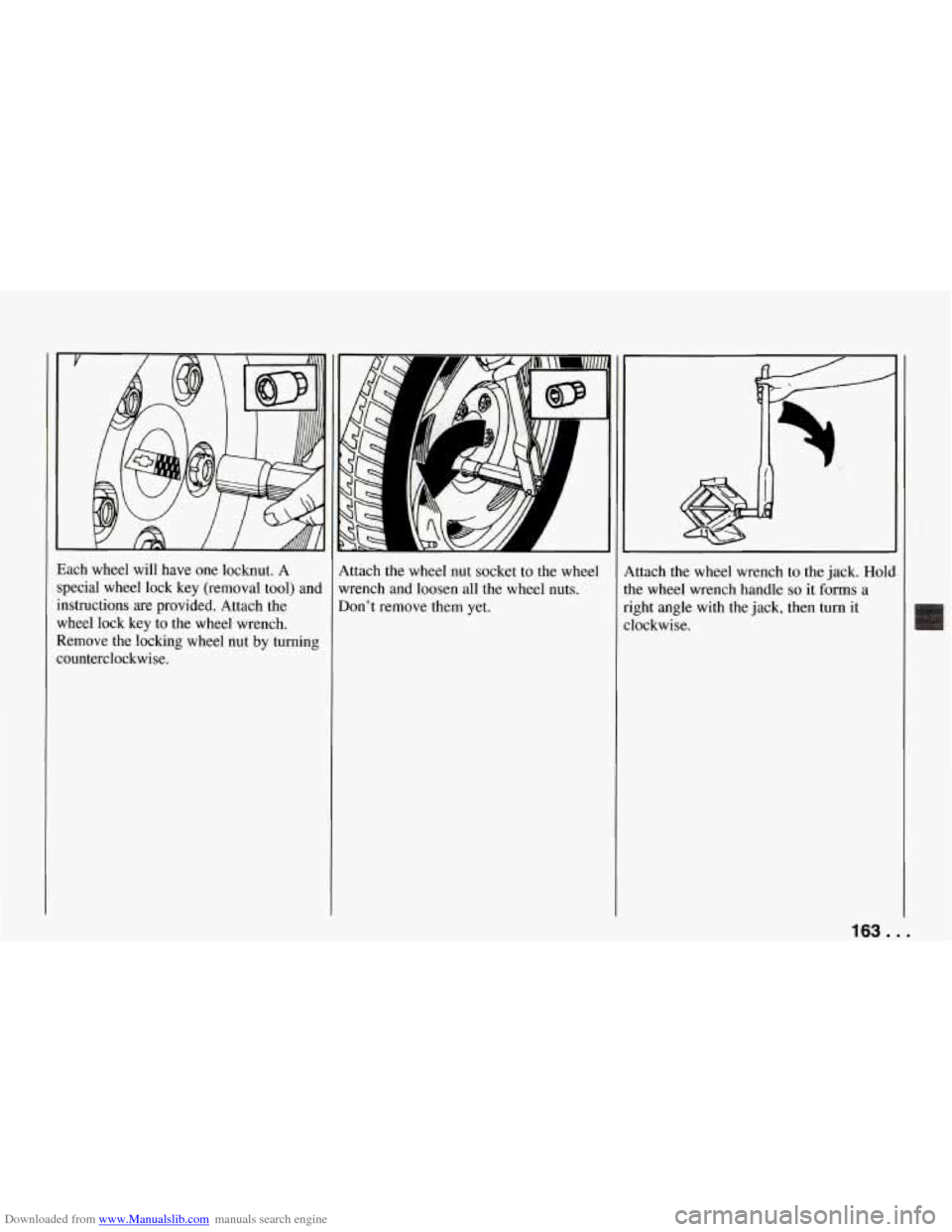
Downloaded from www.Manualslib.com manuals search engine Each wheel will have one locknut. A
special wheel lock key (removal tool) and
instructions are provided. Attach the
wheel lock key to the wheel wrench.
Remove the locking wheel nut by turning
counterclockwise. Attach the wheel nut
socket to the wheel
wrench and loosen all the wheel nuts.
Don’t remove them
yet.
4ttach the wheel wrench to the jack. Holc
he wheel wrench handle
so it forms a
ight angle with the jack, then turn it
lockwise.
163 ...
Page 167 of 274
Downloaded from www.Manualslib.com manuals search engine Problems on the Road
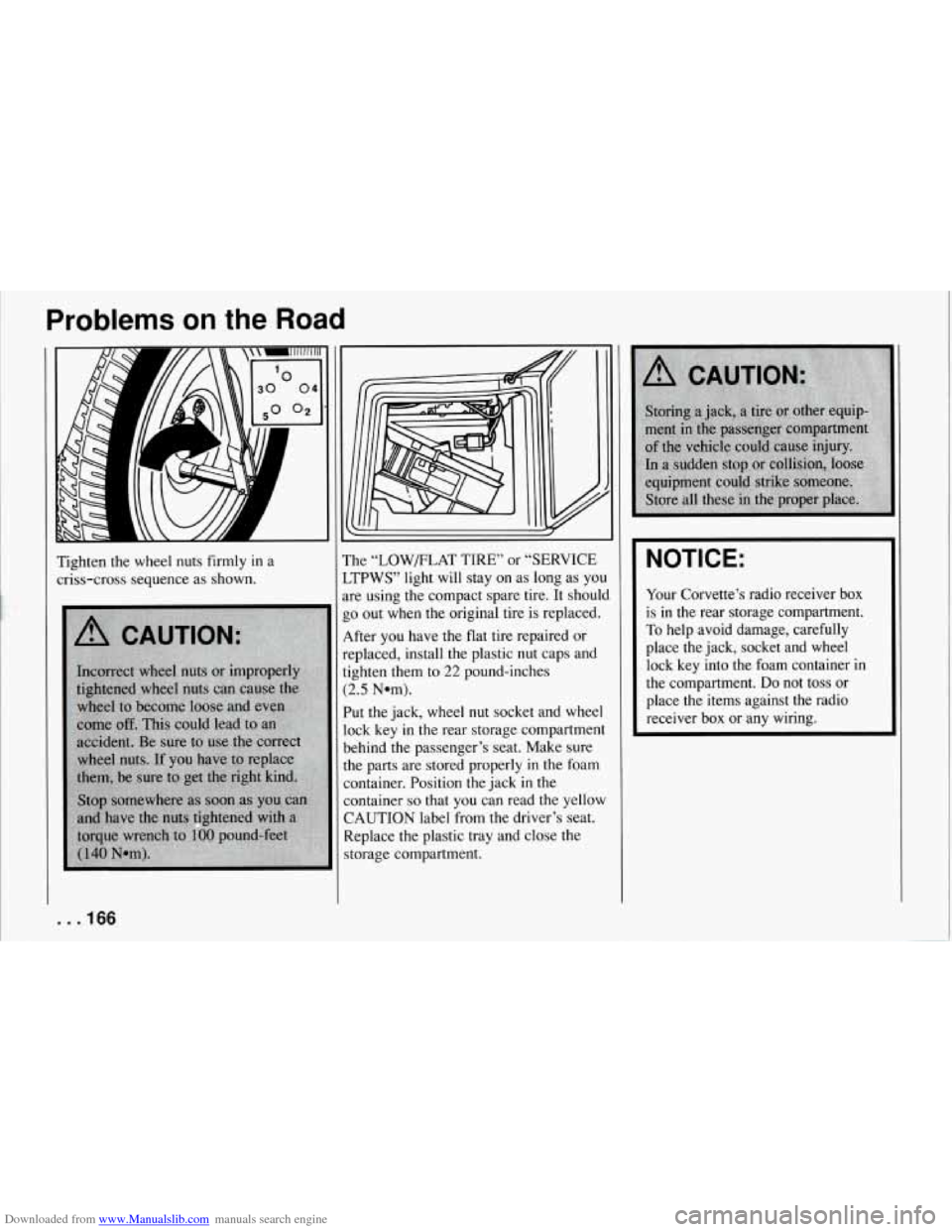
Tighten the wheel nuts firmly in a
criss-cross sequence as shown. The
“LOWELAT TIRE” or “SERVICE
LTPWS” light will stay on as long as you
ire using the compact spare tire. It should
50 out when the original tire is replaced.
9fter you have the flat tire repaired or
eeplaced, install the plastic
nut caps and
lighten them to
22 pound-inches
:2.5 Nom).
Put the jack, wheel nut socket and wheel
.ock
key in the rear storage compartment
3ehind the passenger’s seat. Make sure
:he parts are stored properly
in the foam
Zontainer. Position the jack in the
Zontainer
so that you can read the yellow
CAUTION label from
the driver’s seat.
Replace the plastic tray
and close the
storage compartment.
NOTICE:
Your Corvette’s radio receiver box
is in the rear storage compartment.
To help avoid damage, carefully
place the jack, socket and wheel
lock key into the foam container
in
the compartment. Do not toss or
place the items against the radio
receiver
box or any wiring.
. . .I66
Page 222 of 274
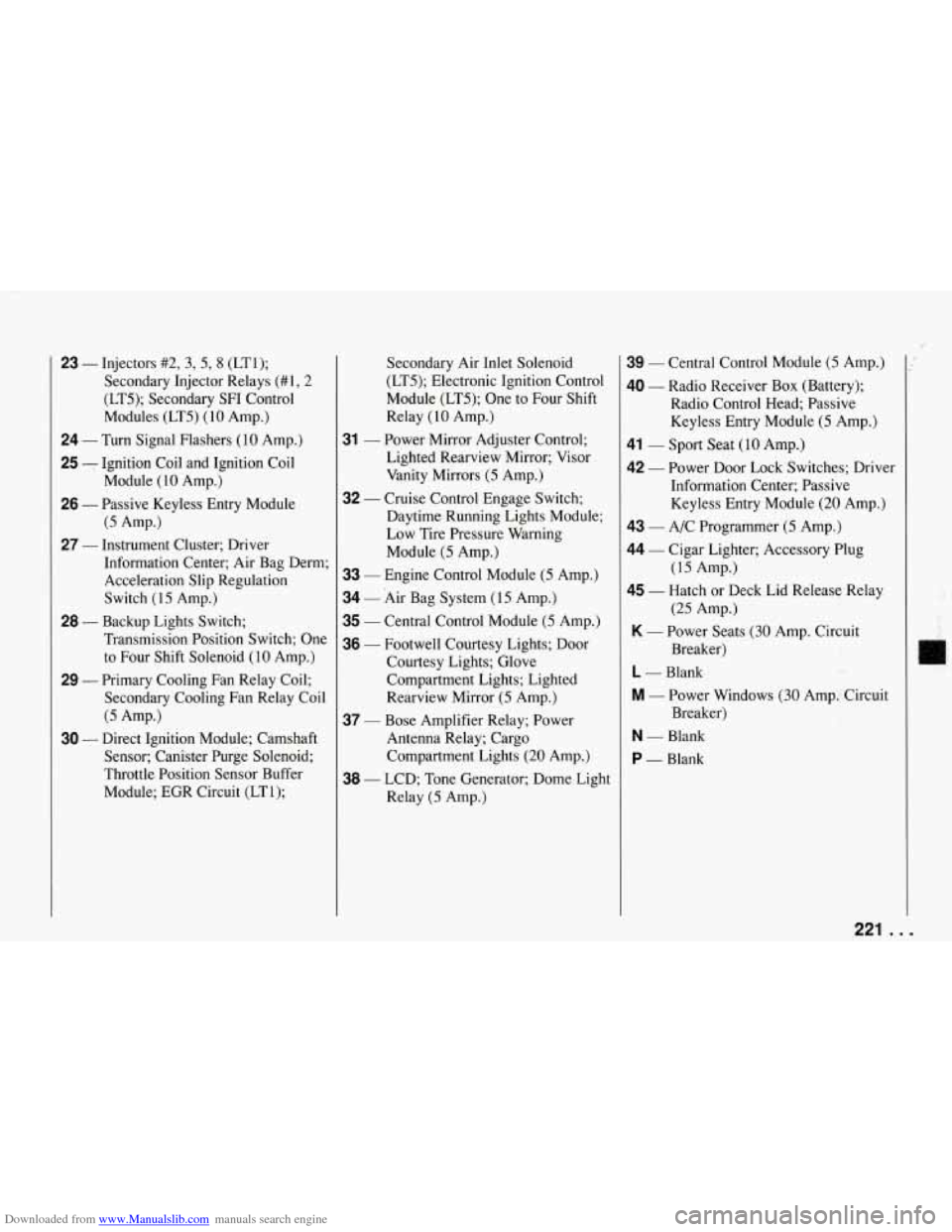
Downloaded from www.Manualslib.com manuals search engine 23 - Injectors #2, 3, 5, 8 (LTI);
Secondary Injector Relays (#1,2
(LT5); Secondary SF1 Control
Modules (LT5)
(10 Amp.)
24 - Turn Signal Flashers (10 Amp.)
25 - Ignition Coil and Ignition Coil
26 - Passive Keyless Entry Module
27 - Instrument Cluster; Driver Module (10 Amp.)
(5 Amp.)
Information Center; Air Bag Derm; Acceleration Slip Regulation
Switch
(15 Amp.)
Transmission Position Switch; One
to Four Shift Solenoid
(10 Amp.)
29 - Primary Cooling Fan Relay Coil;
Secondary Cooling Fan Relay Coil
28 - Backup Lights Switch;
(5 Amp.)
30 - Direct Ignition Module; Camshaft Sensor; Canister Purge Solenoid;
Throttle Position Sensor Buffer
Module; EGR Circuit (LT1);
31
32
Secondary Air Inlet Solenoid
(LT5); Electronic Ignition Control
Module (LT5); One to Four Shift
Relay
( 10 Amp.)
Power Mirror Adjuster Control;
Lighted Rearview Mirror; Visor
Vanity Mirrors
(5 Amp.)
Cruise Control Engage Switch;
Daytime Running Lights Module;
Low Tire Pressure Warning
Module
(5 Amp.)
33 - Engine Control Module (5 Amp.)
34 - Air Bag System (15 Amp.)
35 - Central Control Module (5 Amp.)
36 - Footwell Courtesy Lights; Door
Courtesy Lights; Glove
Compartment Lights; Lighted
Rearview Mirror
(5 Amp.)
37 - Bose Amplifier Relay; Power
Antenna Relay; Cargo
Compartment Lights
(20 Amp.)
Relay
(5 Amp.)
38 - LCD; Tone Generator; Dome Light
39 - Central Control Module (5 Amp.)
40 - Radio Receiver Box (Battery);
Radio Control Head; Passive
Keyless Entry Module
(5 Amp.)
41 - Sport Seat (10 Amp.)
42 - Power Door Lock Switches; Driver
Information Center; Passive
Keyless Entry Module
(20 Amp.)
43 - A/C Programmer (5 Amp.)
44 - Cigar Lighter; Accessory Plug
45 - Hatch or Deck Lid Release Relay
K - Power Seats (30 Amp. Circuit
L - Blank
M - Power Windows (30 Amp: Circuit
N - Blank
P - Blank
(15 Amp.)
(25 Amp.)
Breaker)
Breaker)
221 . I
Page 240 of 274
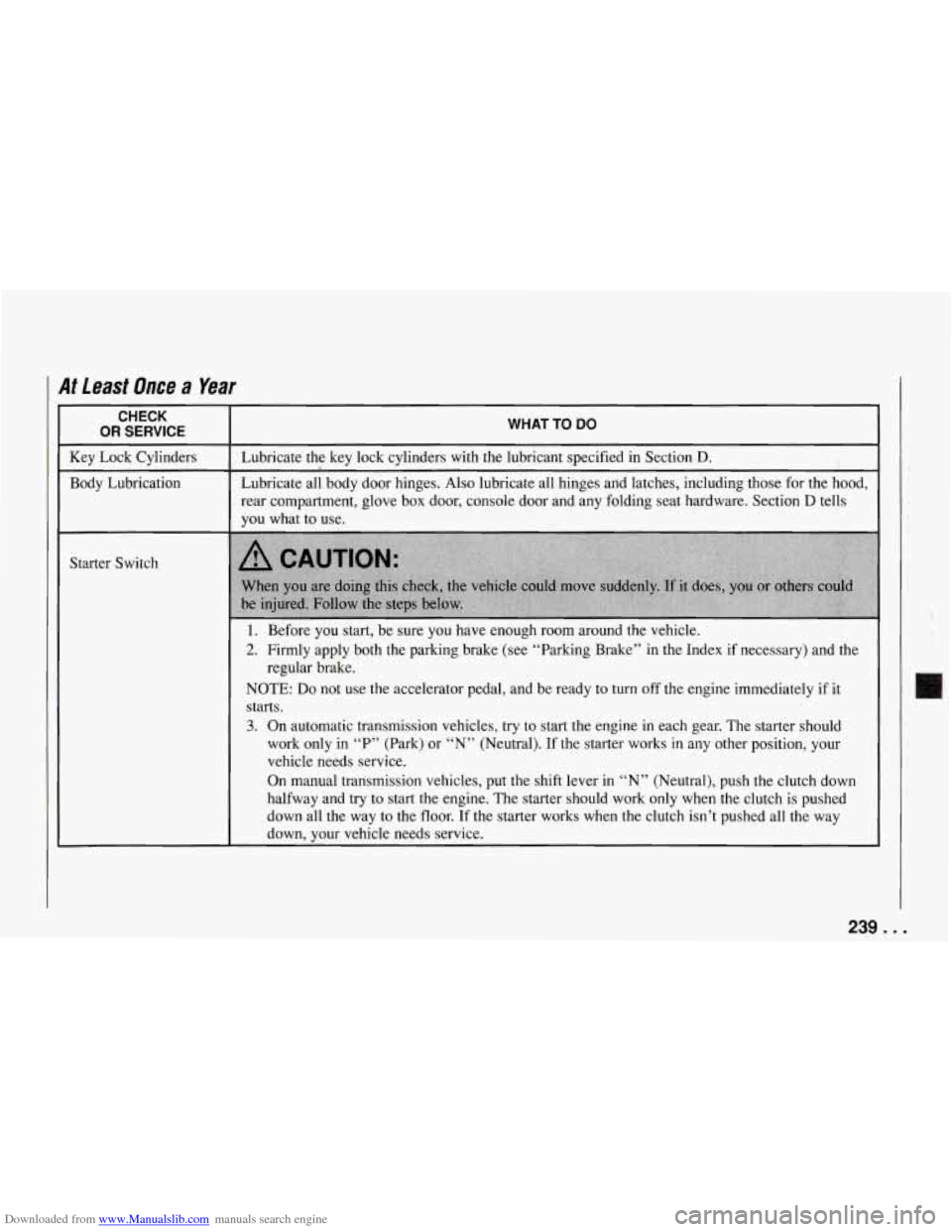
Downloaded from www.Manualslib.com manuals search engine I At Least Once a Year
WHAT TO DO
Lubricate the key lock cylinders with the lubricant specified in Section D.
Lubricate all body door hinges. Also lubricate all hinges and latches, including those for the hood,
rear compartment, glove box door, console door and any folding seat hardware. Section
D tells
you what to use.
1. Before you start, be sure you have enough room around the vehicle.
2. Firmly apply both the parking brake (see “Parking Brake” in the Index if necessary) and the
regular brake.
....
NOTE: Do not use the accelerator pedal, and be ready to turn off the engine immediately if it
starts.
3. On automatic transmission vehicles, try to start the engine in each gear. The starter should
work only in
“P” (Park) or “N” (Neutral). If the starter works in any other position, your
vehicle heeds service.
On manual transmission vehicles, put the shift lever in “N” (Neutral), push the clutch down
halfway and try to start the engine. The starter should work only when the clutch is pushed
down all the way to the floor. If the starter works when the clutch isn’t pushed all the way
down, your vehicle needs service.
r::. ,; II
U
239. . .