check engine CHEVROLET CORVETTE 1994 4.G Workshop Manual
[x] Cancel search | Manufacturer: CHEVROLET, Model Year: 1994, Model line: CORVETTE, Model: CHEVROLET CORVETTE 1994 4.GPages: 274, PDF Size: 15.61 MB
Page 227 of 274
Downloaded from www.Manualslib.com manuals search engine l Service and Appearance Care
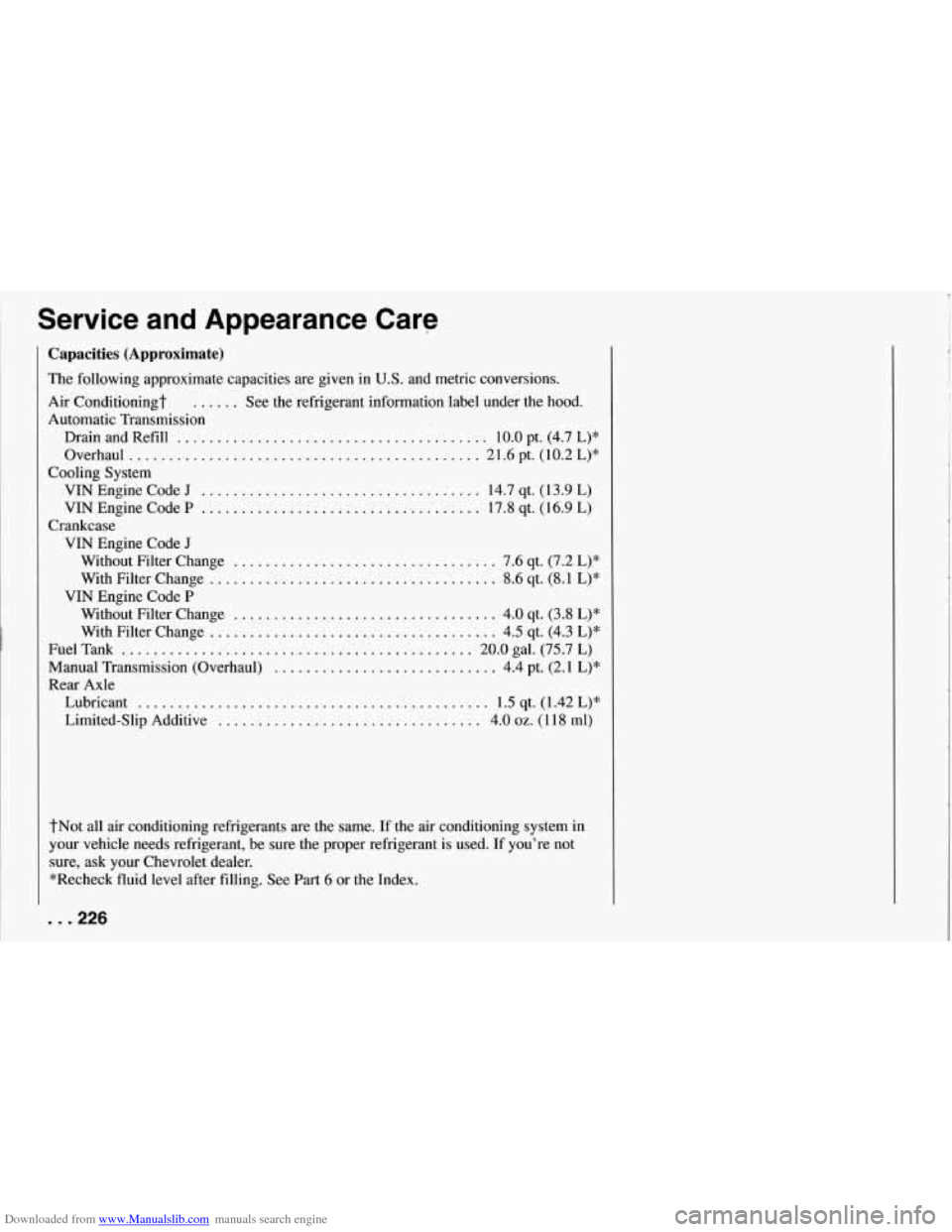
Capacities (Approximate)
The following approximate capacities are given in U.S. and metric conversions.
Air Conditioningt
...... See the refrigerant information label under the hood.
Automatic Transmission
Drain and Refill
....................................... 10.0 pt. (4.7 L)*
Overhaul
............................................ 21.6 pt. (10.2 L)*
VIN Engine Code J ................................... 14.7 qt. (1 3.9 L)
VIN Engine Code
P ................................... 17.8 qt. (16.9 L)
VIN Engine Code J
Cooling System
Crankcase Without Filter Change
................................. 7.6 qt. (7.2 L)*
With Filter Change
.................................... 8.6 qt. (8.1 L)*
Without Filter Change ................................. 4.0 qt. (3.8 L)*
With Filter Change .................................... 4.5 qt. (4.3 L)*
Fuel Tank ............................................ 20.0 gal. (75.7 L)
Manual Transmission (Overhaul)
............................ 4.4 pt. (2.1 L)*
Rear Axle
Lubricant
............................................ 1.5 qt. (1.42 L)*
Limited-Slip Additive
................................. 4.0 oz. (1 18 ml)
VIN Engine
Code
P
tNot all air conditioning refrigerants are the same. If the air conditioning system in
your vehicle needs refrigerant, be sure the proper refrigerant is used. If you’re not
sure, ask your Chevrolet dealer.
*Recheck fluid level after filling. See Part
6 or the Index.
.. .226
Page 230 of 274
Downloaded from www.Manualslib.com manuals search engine IMPORTANT:
KEEP THE ENGINE OIL
AT THE PROPER
LEVEL AND CHANGE AS
RECOMMENDED
This part covers the
maintenance required for your
Corvette
. Your vehicle needs
these services to retain its
safety. dependability and
emission control performance
.
.
Maintenance Schedule
Section
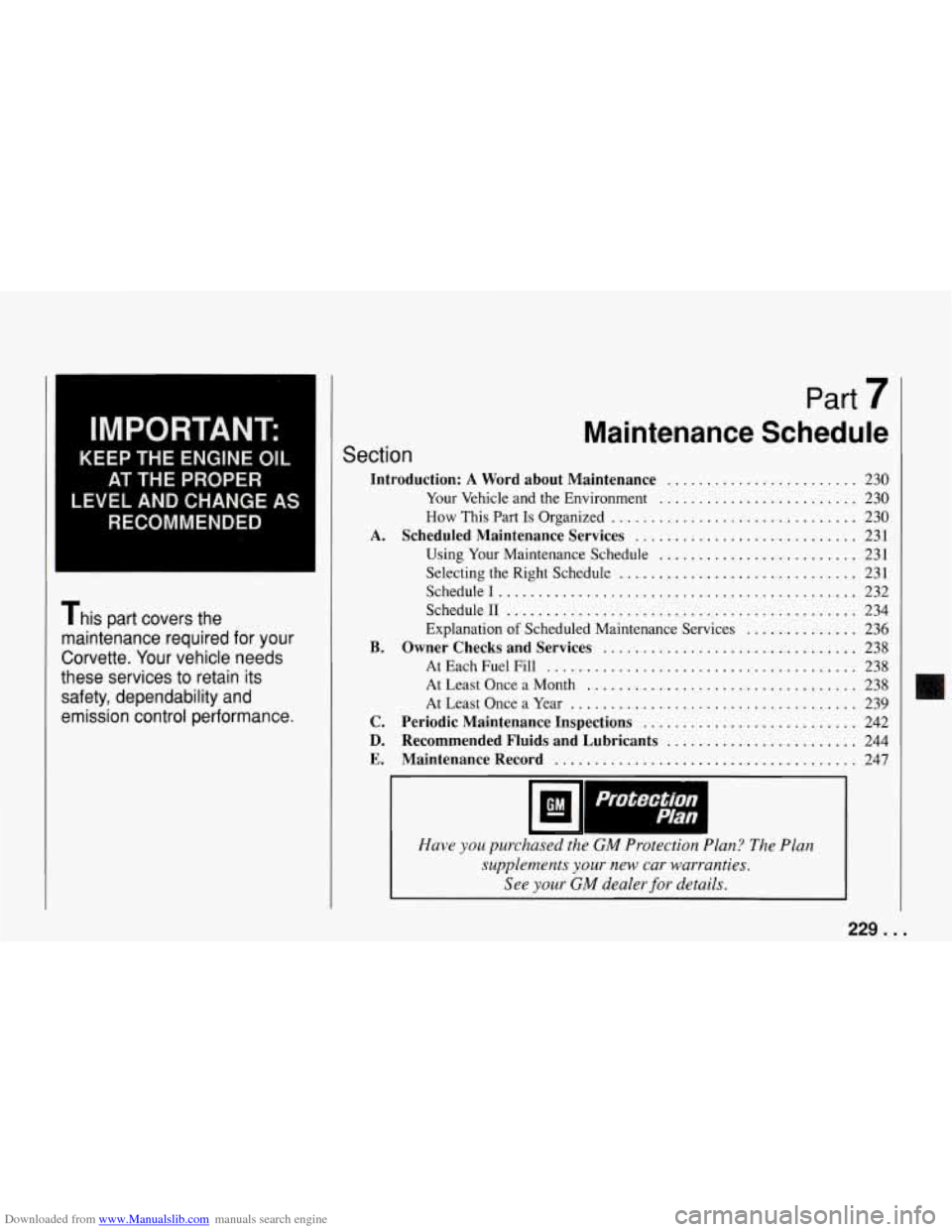
Introduction: A Word about Maintenance ........................ 230
A .
B .
C .
D .
E .
Your Vehicle and the Environment ......................... 230
How This Part Is Organized ............................... 230
Scheduled Maintenance Services ............................ 231
Using Your Maintenance Schedule
......................... 231
Selecting the Right Schedule
.............................. 231
Schedule1
............................................. 232
Schedule11
............................................ 234
Explanation
of Scheduled Maintenance Services .............. 236
Owner Checks and Services ................................ 238
At Each Fuel
Fill ....................................... 238
AtLeastOnceaMonth
.................................. 238
At Least Once
a Year .................................... 239
Periodic Maintenance Inspections ........................... 242
Recommended Fluids and Lubricants ........................ 244
Maintenance Record ...................................... 247
I
Protection
Plan
Have you purchased the GM Protection Plan? The Plan
supplements your new car warranties
.
See your GM dealer for details .
229 ...
Page 231 of 274
Downloaded from www.Manualslib.com manuals search engine Maintenance Schedule
Introduction: A Word about Maintenance
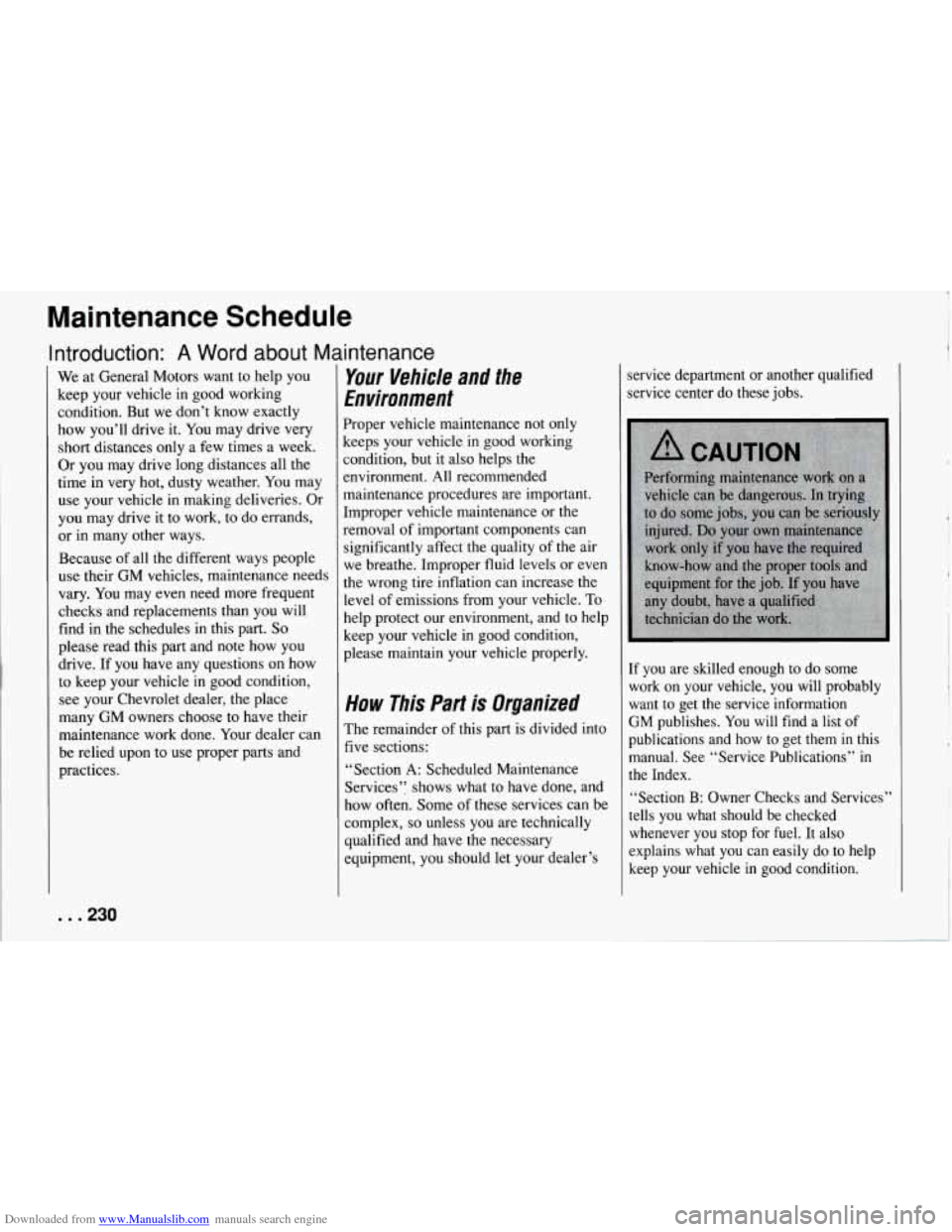
We at General Motors want to help you
keep your vehicle in good working
condition. But we don’t know exactly
how you’ll drive it. You may drive very
short distances only a few times a week.
Or you may drive long distances all the
time in very hot, dusty weather.
You may
use your vehicle in making deliveries. Or
you may drive it to work, to do errands,
or
in many other ways.
Because of all the different ways people
use their GM vehicles, maintenance needs
vary. You may even need more frequent
checks and replacements than you will
find in the schedules in this part.
So
please read this part and note how you
drive. If you have any questions on how
to keep your vehicle in good condition,
see your Chevrolet dealer, the place
many GM owners choose to have their
maintenance work done. Your dealer can
be relied upon to use proper parts and
practices.
Your Vehicle and I
Environment the
Proper vehicle maintenance not only
keeps your vehicle in good working
condition,
but it also helps the
environment. All recommended
maintenance procedures are important.
Improper vehicle maintenance or the
removal of important components can
significantly affect the quality of the air
we breathe. Improper fluid levels or even
the wrong tire inflation can increase the
level of emissions from your vehicle. To
help protect our environment, and to help
keep your vehicle in good condition,
please maintain your vehicle properly.
How This Part is Organized
The remainder of this part is divided into
five sections:
“Section
A: Scheduled Maintenance
Services’: shows what to have done, and
how often. Some of these services can be
complex,
so unless you are technically
qualified and have the necessary
equipment, you should let your dealer’s lified
service department or another
qua
service center do these jobs.
If you are skilled enough to do some
work on your vehicle, you will probably
want to get the service information
GM publishes. You will find a list of
publications and how to get them in this
manual. See “Service Publications”
in
the Index.
“Section B: Owner Checks and Services’’
tells you what should be checked whenever you stop for fuel. It also
explains what you can easily do to help
keep your vehicle in good condition.
1
. . .230
Page 238 of 274
Downloaded from www.Manualslib.com manuals search engine ITEM
NO. SERVICE
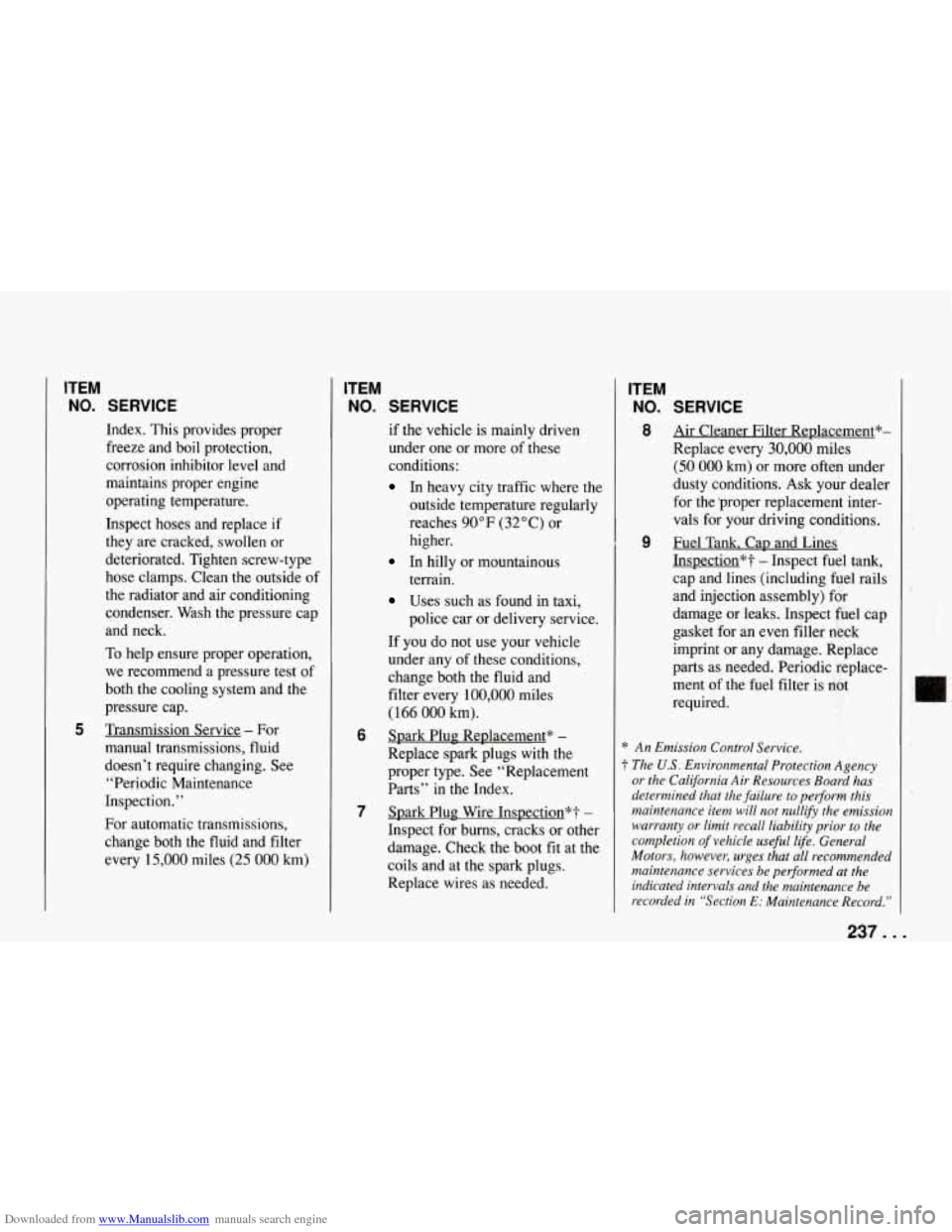
Index. This provides proper
freeze and boil protection,
corrosion inhibitor level and
maintains proper engine
operating temperature.
Inspect hoses and replace if
they are cracked, swollen or
deteriorated. Tighten screw-type
hose clamps. Clean the outside of
the radiator and air conditioning
condenser. Wash the pressure cap
and neck.
To help ensure proper operation,
we recommend a pressure test of
both the cooling system and the
pressure cap.
5 Transmission Service - For
manual transmissions, fluid
doesn’t require changing. See
“Periodic Maintenance
Inspection.”
For automatic transmissions,
change both the fluid and filter
every
15,000 miles (25 000 km)
ITEM
NO. SERVICE
if the vehicle is mainly driven
under one or more of these
conditions:
In heavy city traffic where the
outside temperature regularly
reaches
90 OF (32 O C) or
higher.
In hilly or mountainous
terrain.
Uses such as found in taxi,
police car or delivery service.
If you do not use your vehicle
under any of these conditions,
change both
the fluid and
filter every
100,000 miles
(1 66 000 km).
Replace spark plugs with the
proper type. See “Replacement
Parts” in the Index.
6 Spark Plug Replacement* -
7 Spark Plug Wire Inspection*? -
Inspect for burns, cracks or other
damage. Check the boot fit at the
coils and at the spark plugs.
Replace wires as needed.
ITEM
NO. SERVICE
8 Air Cleaner Filter Replacement*-
Replace every
30,000 miles
(50 000 km) or more often under
dusty conditions. Ask your dealer
for the ’proper replacement inter-
vals for your driving conditions.
Inspection*?
- Inspect fuel tank,
cap and lines (including fuel rails
and injection assembly) for
damage or leaks. Inspect fuel cap
gasket for an even filler neck
imprint or any damage. Replace
parts as needed. Periodic replace-
ment of the fuel filter is not
required.
9 Fuel Tank. Cap and Lines
* An Emission Control Service.
t The U.S. Environmental Protection Agency
or the California Air Resources Board has
determined that the failure to perform this
maintenance item will not nullify the emission
warranty or limit recall liability prior to the
completion
of vehicle useful life. General
Motors, however, urges that all recommended
maintenance services be performed at the
indicated intervals and the maintenance be
recorded in “Section
E: Maintenance Record.”
I -I
237. . .
Page 239 of 274
Downloaded from www.Manualslib.com manuals search engine Maintenance Schedule
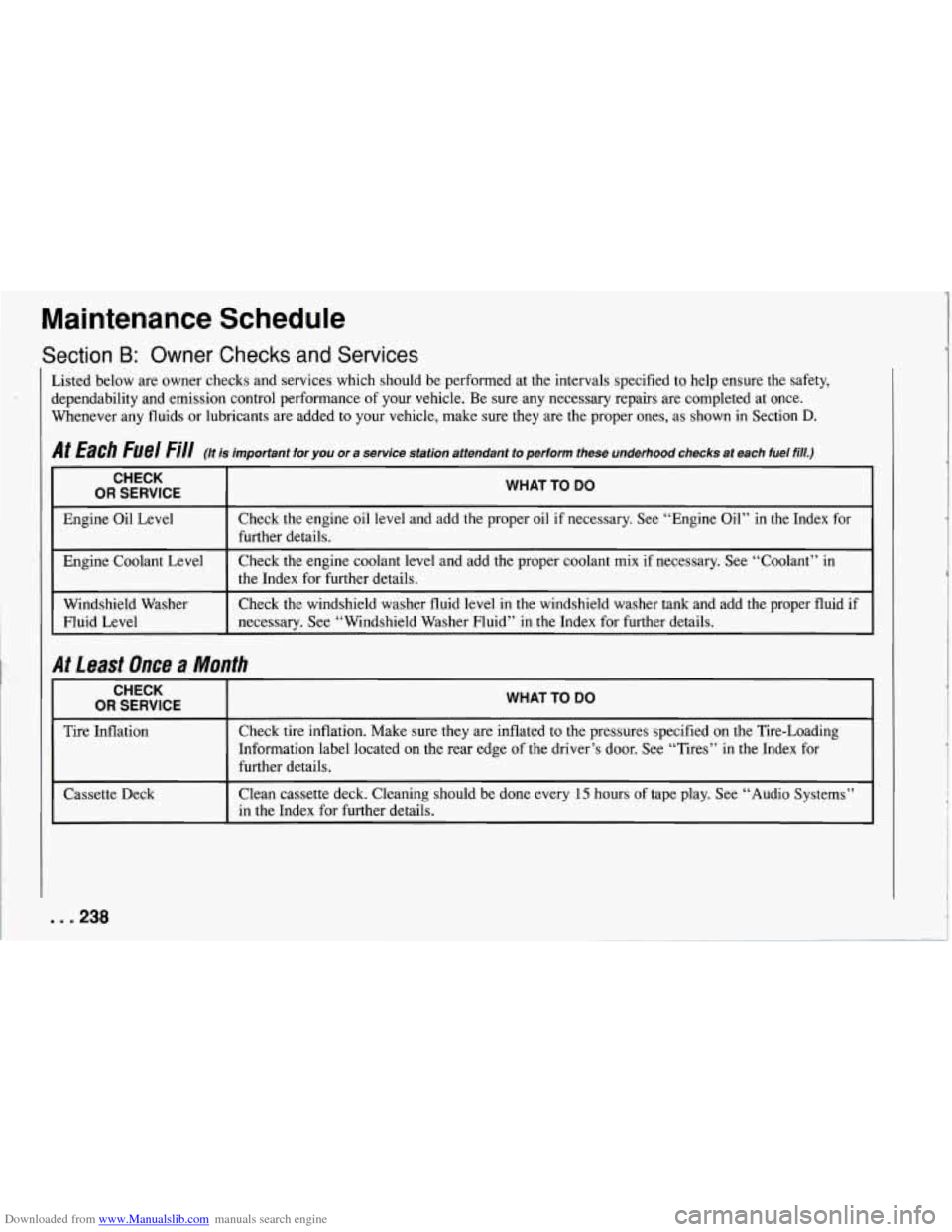
Section B: Owner Checks and Services
isted below are owner checks and services which should be performed at the intervals specified to help ensure the safety,
ependability and emission control performance of your vehicle. Be sure any necessary repairs are completed at once.
Vhenever any fluids or lubricants are added
to your vehicle, make sure they are the proper ones, as shown in Section D.
If Each Fuel Fill (/t is important for you or a service station attendant to perform these underhood checks at each fuel fill.)
i CHECK
OR SERVICE I WHAT TO DO
Engine Oil Level
Check the windshield washer fluid level in the windshield washer
tank and add the proper fluid if
Windshield Washer Check
the engine coolant level and add the proper coolant mix if necessary. See “Coolant” in
Engine Coolant Level Check the
engine oil level and add the proper oil if necessary. See “Engine Oil” in the Index for
Fluid Level necessary.
See “Windshield Washer Fluid” in the Index for further details.
further details.
the
Index for further details.
It Least Once a Month
CHECK
OR SERVICE
Tire Inflation
Cassette Deck
WHAT TO DO
Check tire inflation. Make sure they are inflated to the pressures specified on the Tire-Loading
Information label located on the rear edge
of the driver’s door. See “Tires” in the Index for
further details.
Clean cassette deck. Cleaning should be done every
15 hours of tape play. See “Audio Systems”
in the Index for further details.
. .238
Page 241 of 274
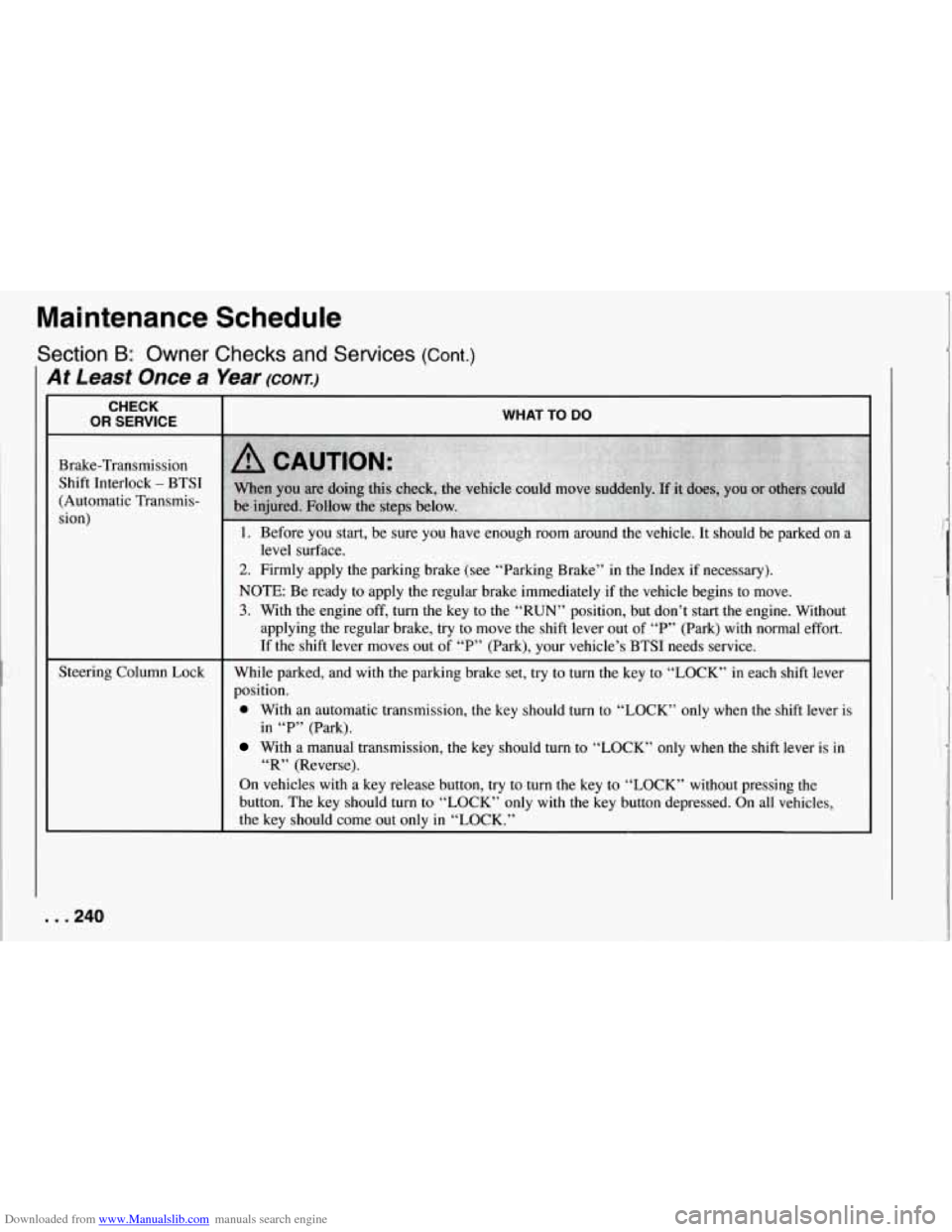
Downloaded from www.Manualslib.com manuals search engine At Least Once a Year (CONT.)
CHECK
OR SERVICE
Brake-Transmission Shift Interlock
- BTSI
(Automatic Transmis-
sion)
Maintenance Schedule
Section B: Owner Checks and Services (Cont.)
Steering Column Lock
WHAT TO DO
1. Before you start, be sure you have enough room around the vehicle. It should be parked on a
2. Firmly apply the parking brake (see “Parking Brake” in the Index if necessary).
NOTE: Be ready to apply the regular brake immediately if the vehicle begins to move.
3. With the engine off, turn the key to the “RUN” position, but don’t start the engine. Without
applying the regular brake, try to move the shift lever out of “P” (Park) with normal effort.
If the shift lever moves out of “P” (Park), your vehicle’s BTSI needs service.
level surface.
While parked, and with the parking brake set,
try to turn the key to “LOCK” in each shift lever
position.
0 With an automatic transmission, the key should turn to “LOCK” only when the shift lever is
With a manual transmission, the key should turn to “LOCK” only when the shift lever is in
On vehicles with a key release button, try to turn the key to “LOCK” without pressing the
button. The key should turn to. “LOCK” only with the key button depressed. On all vehicles,
the key should come out only in “LOCK.”
in
“P” (Park).
“R” (Reverse).
. . .240
Page 242 of 274
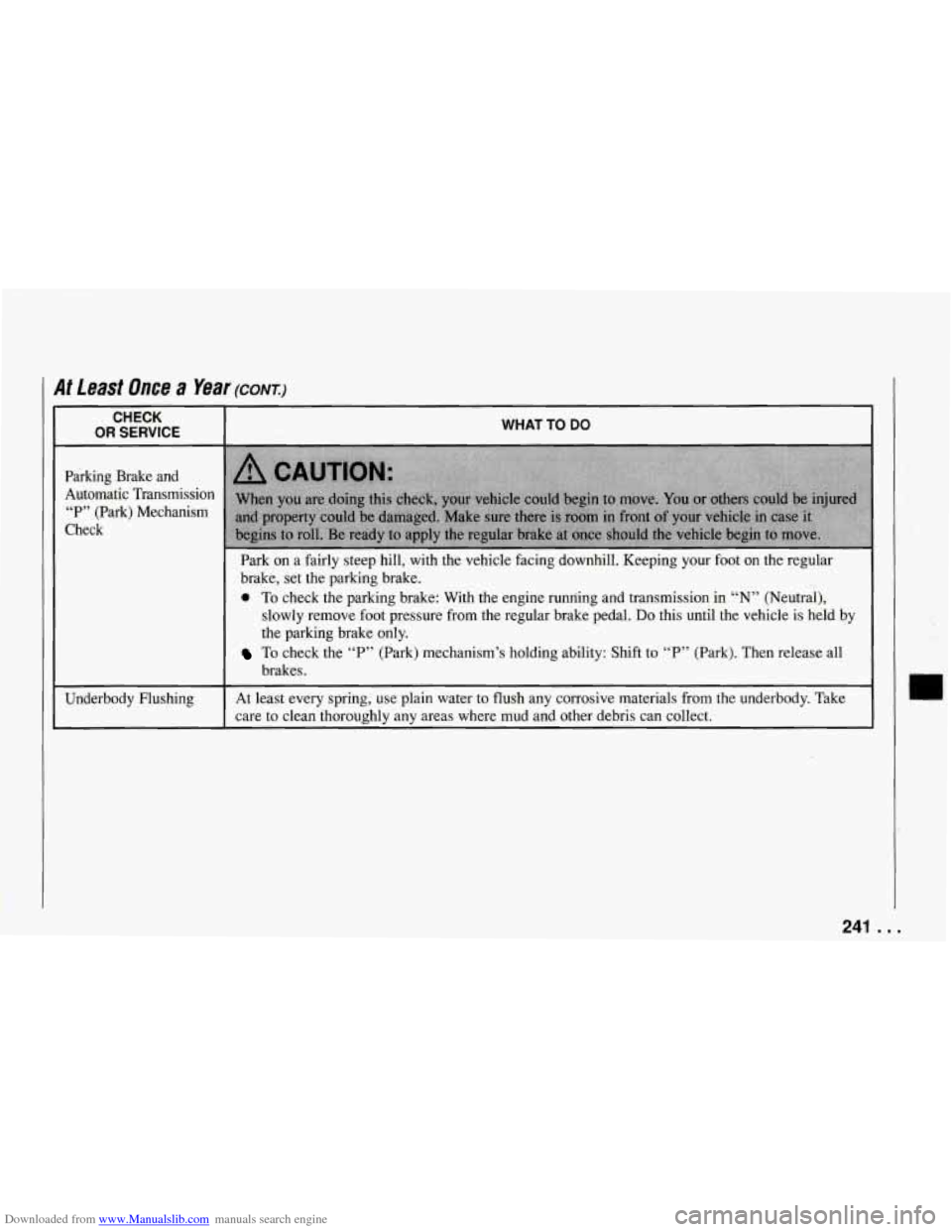
Downloaded from www.Manualslib.com manuals search engine I At Least Once a Year (CONI)
CHECK
OR SERVICE ~~ ~
Parking Brake and
Automatic Transmission “P” (Park) Mechanism
Check
Underbody Flushing
WHAT TO DO
Park on a fairly steep hill, with the vehicle facing downhill. Keeping \
your foot on the regular
brake, set the parking brake.
0 To check the parking brake: With the engine runriing and transmission in “N” (Neutral),
slowly remove foot pressure from the regular brake pedal.
Do this until the vehicle is held by
the parking brake only.
brakes.
To check the “P” (Park) mechanism’s holding ability: Shift to “P” (Park). Then release all
At least every spring, use plain water to flush any corrosive mat\
erials from the underbody. Take
care to clean thoroughly any areas where mud and other debris can collect. I I
241 . . .
Page 243 of 274
Downloaded from www.Manualslib.com manuals search engine Maintenance Schedule
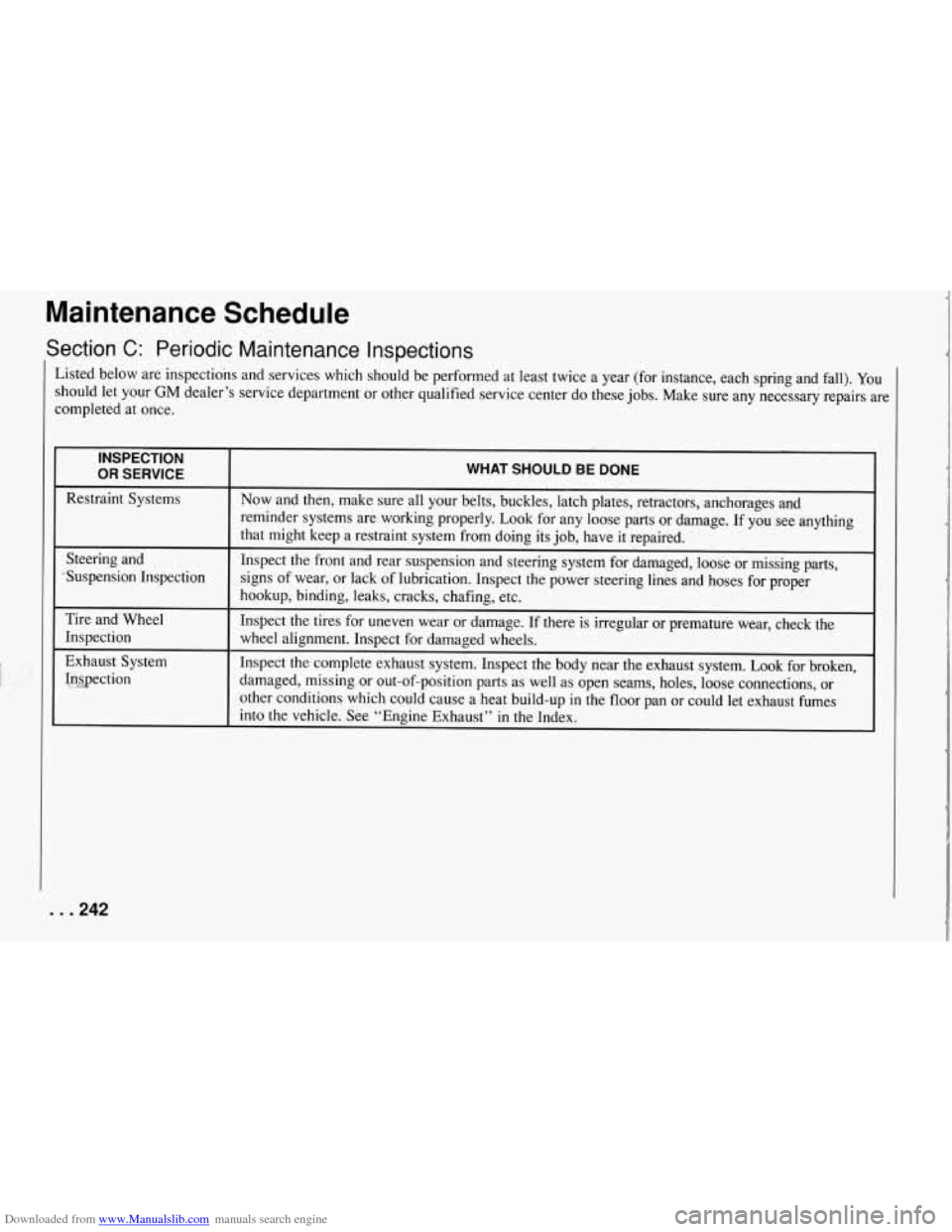
I Section C: Periodic Maintenance Inspections
I
S
isted below are inspections and services which should be performed at least twice a year (for instance, each spring and fall). You
hould let your GM dealer’s service department or other qualified service center do these jobs. Make sure any necessary repairs are
ompleted at once.
INSPECTION
OR SERVICE
Restraint Systems
Steering and
‘Suspension Inspection
Tire and Wheel Inspection
Exhaust System
Inaection
. .242
WHAT SHOULD BE DONE
Now and then, make sure all your belts, buckles, latch plates, retractots, anchorages and
reminder systems are working properly.
Look for any loose parts or damage. If you see anything
that might keep a restraint system from doing its job, have
it repaired.
Inspect the front and rear suspension and steering systenl for damaged, loose or missing parts,
signs of wear, or lack
of lubrication. Inspect the power steering lines and hoses for proper
hookup, binding, leaks, cracks, chafing, etc.
Inspect the tires for uneven wear or damage. If there is irregular or premature wear, check
the
wheel alignment. Inspect for damaged wheels.
Inspect the complete exhaust system. Inspect the body near the \
exhaust system.
Look for broken,
damaged, missing or out-of-position parts as well as open seams, holes, loose connections, or
other conditions which could cause a heat build-up in
the floor pan or could let exhaust fumes
into the vehicle. See “Engine Exhaust”
in the Index.
Page 244 of 274
Downloaded from www.Manualslib.com manuals search engine INSPECTION
OR SERVICE
I WHAT SHOULD BE DONE
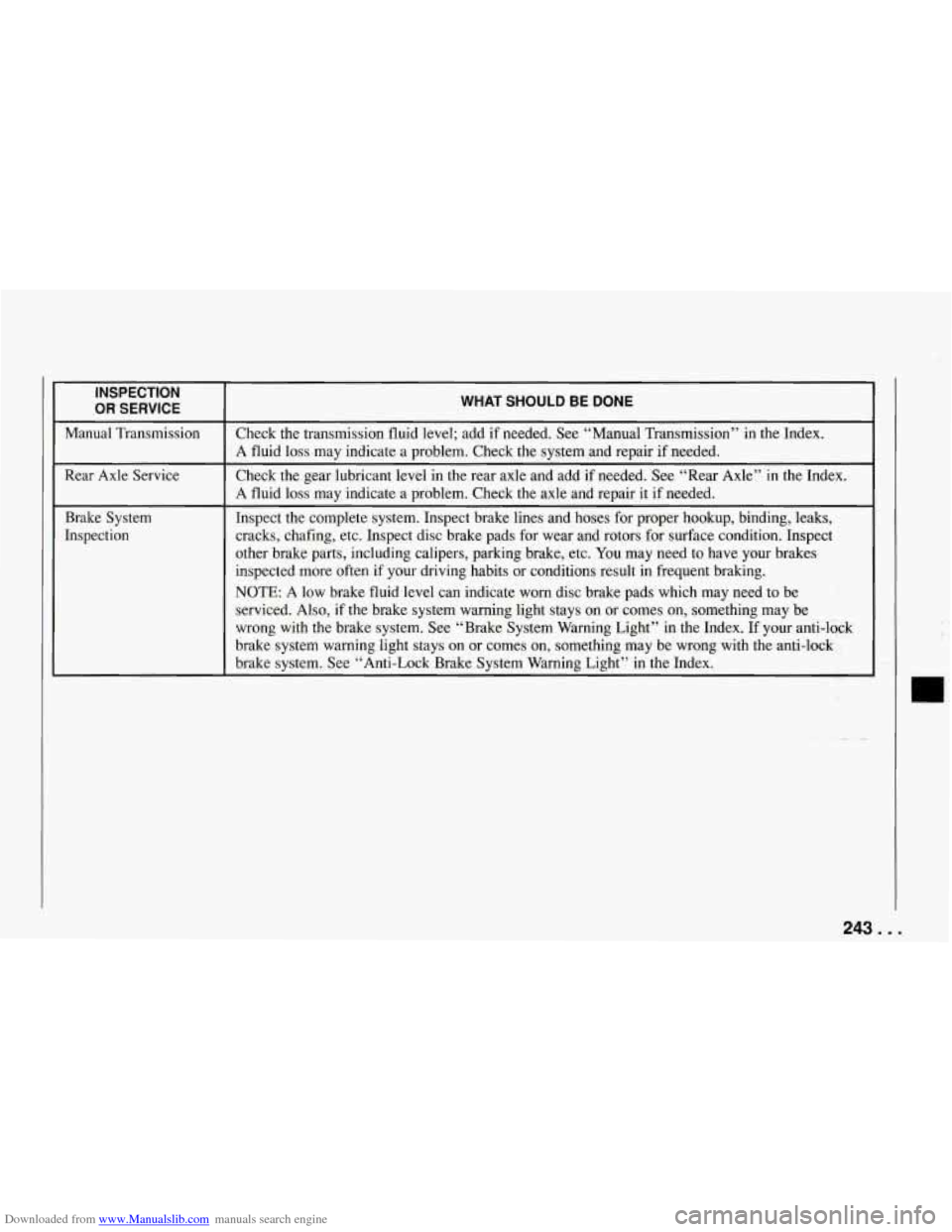
Manual Transmission
Inspect the complete system. Inspect brake lines and hoses for proper hookup, binding, leaks,
Brake System Check the gear lubricant level in the rear axle and add
if needed. See “Rear Axle” in the Index.
Rear Axle Service Check the transmission fluid level;
add if needed. See “Manual Transmission” in the Index.
Inspection cracks, chafing, etc. Inspect disc brake pads
for wear and rotors for surface condition. Inspect
A fluid loss may indicate a problem. Check the system and rep\
air
if needed.
A fluid loss may indicate a problem. Check the axle and repair it
if needed.
other brake parts, including calipers, parking brake, etc. You may need to have your brakes
inspected more often if your driving habits or conditions result in frequent braking.
NOTE: A low brake fluid level can indicate worn disc brake pads whi\
ch may need to be
serviced. Also, if the brake system warning light stays on or comes on, something may be
wrong with the brake system. See “Brake System Warning Light” in the Index.
If your anti-lock
brake system warning light stays on or comes on, something may be wrong with the anti-lock
brake system. See
“ Anti-Lock Brake System Warning Light” in the Index.
I 1
243. . .
Page 258 of 274
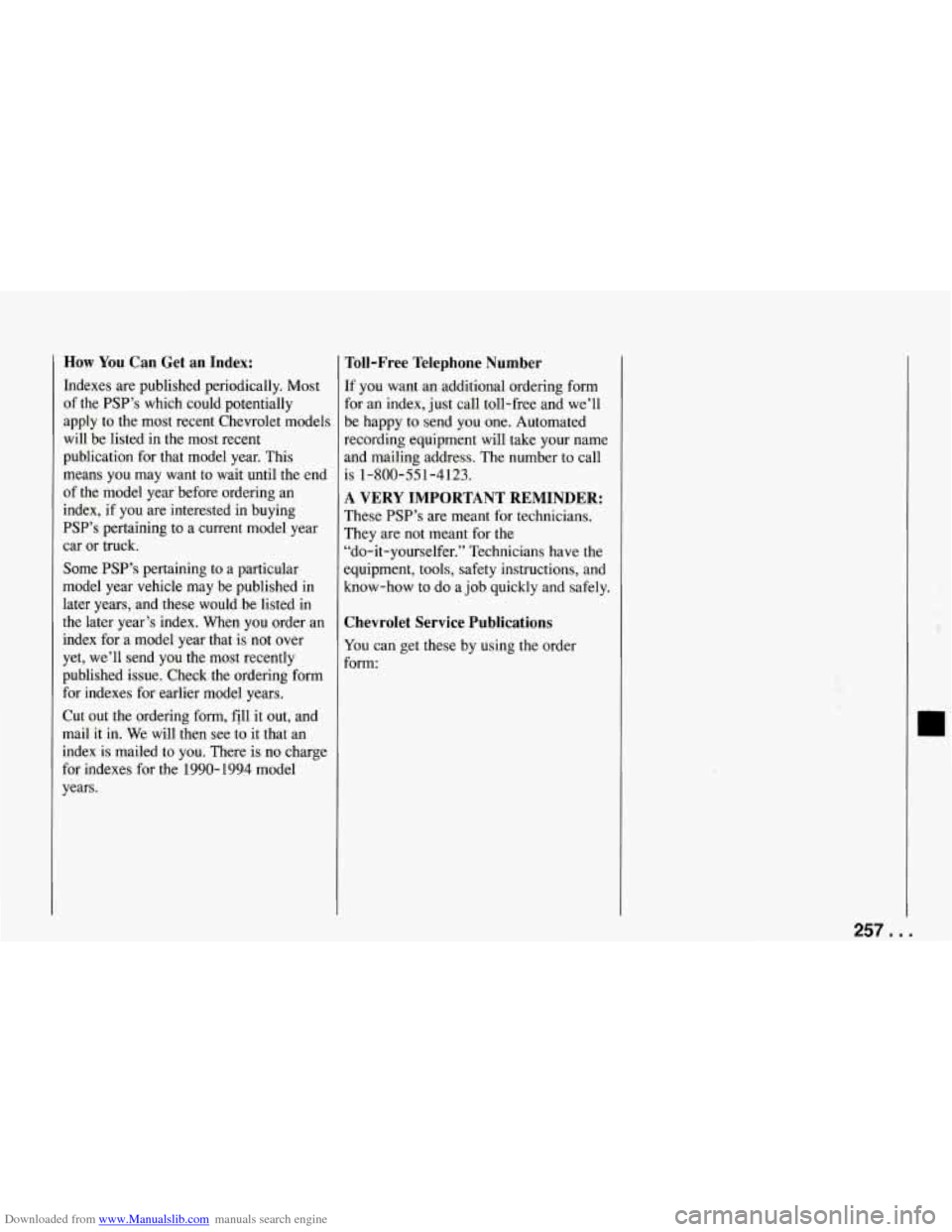
Downloaded from www.Manualslib.com manuals search engine How You Can Get an Index:
Indexes are published periodically. Most
of the
PSP’s which could potentially
apply to the most recent Chevrolet models
will be listed in the most recent
publication for that model year. This
means you may want to wait until the end
of the model year before ordering an
index, if you are interested in buying
PSP’s pertaining to a current model year
car or truck.
Some
PSP’s pertaining to a particular
model year vehicle may be published in
later years, and these would be listed
in
the later year’s index. When you order an
index for a model year that is not over
yet, we’ll send you the most recently
published issue. Check the ordering form
for indexes for earlier model years.
Cut out the ordering form, fjll it out, and
mail it in. We will then see to it that an
index is mailed to you. There is
no charge
for indexes for the
1990- 1994 model
years.
Toll-Free Telephone Number
If you want an additional ordering form
€or an index, just call toll-free and we’ll
be happy to send you one. Automated
recording equipment will take your name
and mailing address. The number to call
is
1-800-551-4123.
A VERY IMPORTANT REMINDER:
These PSP’s are meant for technicians.
They are not meant for the
”do-it-yourselfer.” Technicians have the
equipment, tools, safety instructions, and
know-how to do a job quickly and safely.
Chevrolet Service Publications
You can get these by using the order
Form:
257. . .