key battery CHEVROLET CORVETTE 1994 4.G Owners Manual
[x] Cancel search | Manufacturer: CHEVROLET, Model Year: 1994, Model line: CORVETTE, Model: CHEVROLET CORVETTE 1994 4.GPages: 274, PDF Size: 15.61 MB
Page 39 of 274
Downloaded from www.Manualslib.com manuals search engine Features and Controls
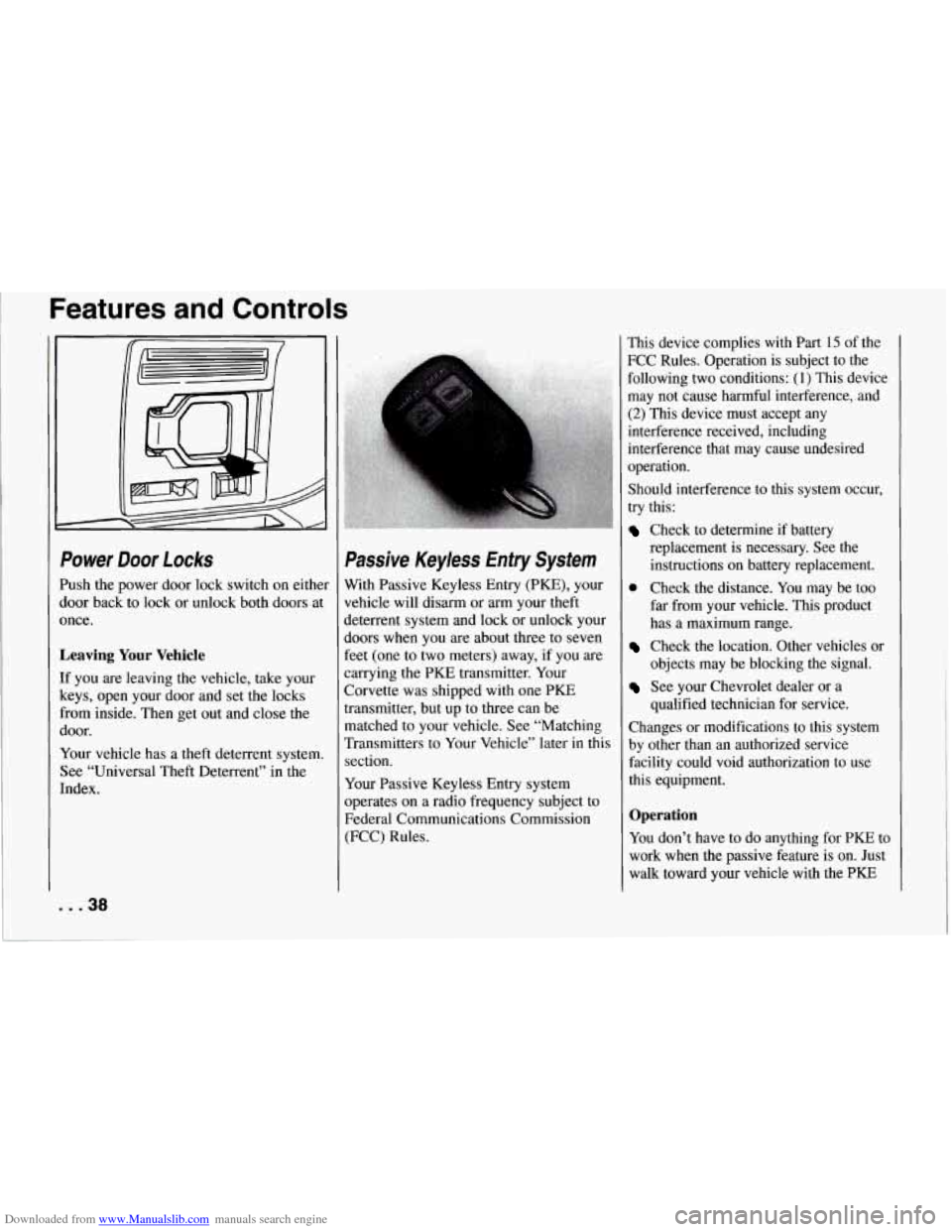
Power Door Locks
Push the power door lock switch on either
door back to lock or unlock both doors at
once.
Leaving Your Vehicle
If you are leaving the vehicle, take your
keys, open your door and set the locks
from inside. Then get out and close the
door.
Your vehicle has a theft deterrent system.
See “Universal Theft Deterrent” in the
Index.
Passive Keyless Entry System
With Passive Keyless Entry (PJSE), your
vehicle will disarm or
arm your theft
deterrent system and lock or unlock your
doors when you are about three to seven
feet (one to two meters) away, if you are
carrying the PKE transmitter. Your
Corvette was shipped with one
PKE
transmitter, but up to three can be
matched to your vehicle. See “Matching
Transmitters to Your Vehicle” later in this
section.
Your Passive Keyless Entry system
operates on a radio frequency subject to
Federal Communications Commission
(FCC) Rules. This
device complies with
Part 15 of the
FCC Rules. Operation is subject to the
following two conditions: (1) This device
may not cause harmful interference, and
(2) This device must accept any
interference received, including
interference that may cause undesired
operation.
Should interference to this system occur,
try this:
Check to determine if battery
replacement is necessary. See the
instructions on battery replacement.
Check the distance. You may be too
far from your vehicle. This product
has
a maximum range.
Check the location. Other vehicles or
objects may be blocking the signal.
See your Chevrolet dealer or a
qualified technician for service.
Changes or modifications to this system
by other than an authorized service
facility could void authorization to use this equipment.
Operation
You don’t have to do anything for PKE to
work when the passive feature
is on. Just
walk toward your vehicle with the PKE
... 38
Page 40 of 274
Downloaded from www.Manualslib.com manuals search engine transmitter, and the system will automatically disarm your theft deterrent
system and unlock the doors. If it’s dark
enough outside, your interior lights will
come on.
If you move out of range, the PKE system
will:
1. Lock the doors after five seconds.
2. Arm the theft deterrent system.
3. Sound the horn to let you know the
4. Turn off the interior lights.
You can also use the buttons on the
transmitter. Press
“DOOR’ to open the
passenger’s door or “HATCH’ to open
the hatch. The “HATCH’ button will only
work when the ignition is
off.
The system has a feature that makes it
difficult for you to lock your keys in your
vehicle. If you leave your keys in the
ignition and lock the doors,
the system
will unlock the doors as soon as they are
closed. If you leave
the keys in the
ignition and move away with the
transmitter, the doors still
will not lock.
You should notice that the horn doesn’t
sound and return to get your keys.
doors
are locked.
[f you shake the transmitter, you may hear
1 slight rattle. This sound is from the
notion sensor inside
the transmitter. It
joes not indicate that anything is wrong
with your transmitter.
The system will allow you to lock your
keys in
the vehicle if you didn’t leave
them in the ignition.
You should,
however, be able to use
the transmitter to
get them out. After
26 seconds of no
motion, the transmitter shuts down to save
the battery. Wait about
30 seconds, then
rock the vehicle. The transmitter should
”wake
up” and unlock the doors.
This system can’t guarantee that you’ll
never be locked out of your vehicle. If
the battery is low or if
the transmitter is
in a place where the signal can’t get to
the antenna, it won’t unlock the doors.
Always remember to take your keys
with you.
PKE Settings
You can use the system for both doors or
just the driver’s door, or you can
turn the
system
off.
To change door settings:
1. Put the ignition key in the ignition,
but don’t
turn it on.
2. Press “DOOR” on the transmitter
until the door locks cycle (about two
seconds).
To turn the system off:
1. Take the ignition key out of the
2. Press “DOOR’ on the transmitter unti
ignition.
the door locks cycle (about two
seconds).
To turn the system back on, just repeat the
steps.
To check that the system is off, turn on
the ignition. The “PASSIVE KEYLESS
ENTRY” light on the Driver Information
Center should not come on. If the light
does come on for a second or two, then
the PKE system is still on.
You can also check whether the system is
on or
off by closing the door and walking
away with the keys and transmitter.
If the
doors lock, the system is on.
If you are working around your vehicle
and keeping your keys with you, you
might want to turn the PKE system
off.
If you don’t, the transmitter will keep
locking and unlocking your doors.
39 . I
Page 41 of 274
Downloaded from www.Manualslib.com manuals search engine Features and Controls
I T
Transmitter Range
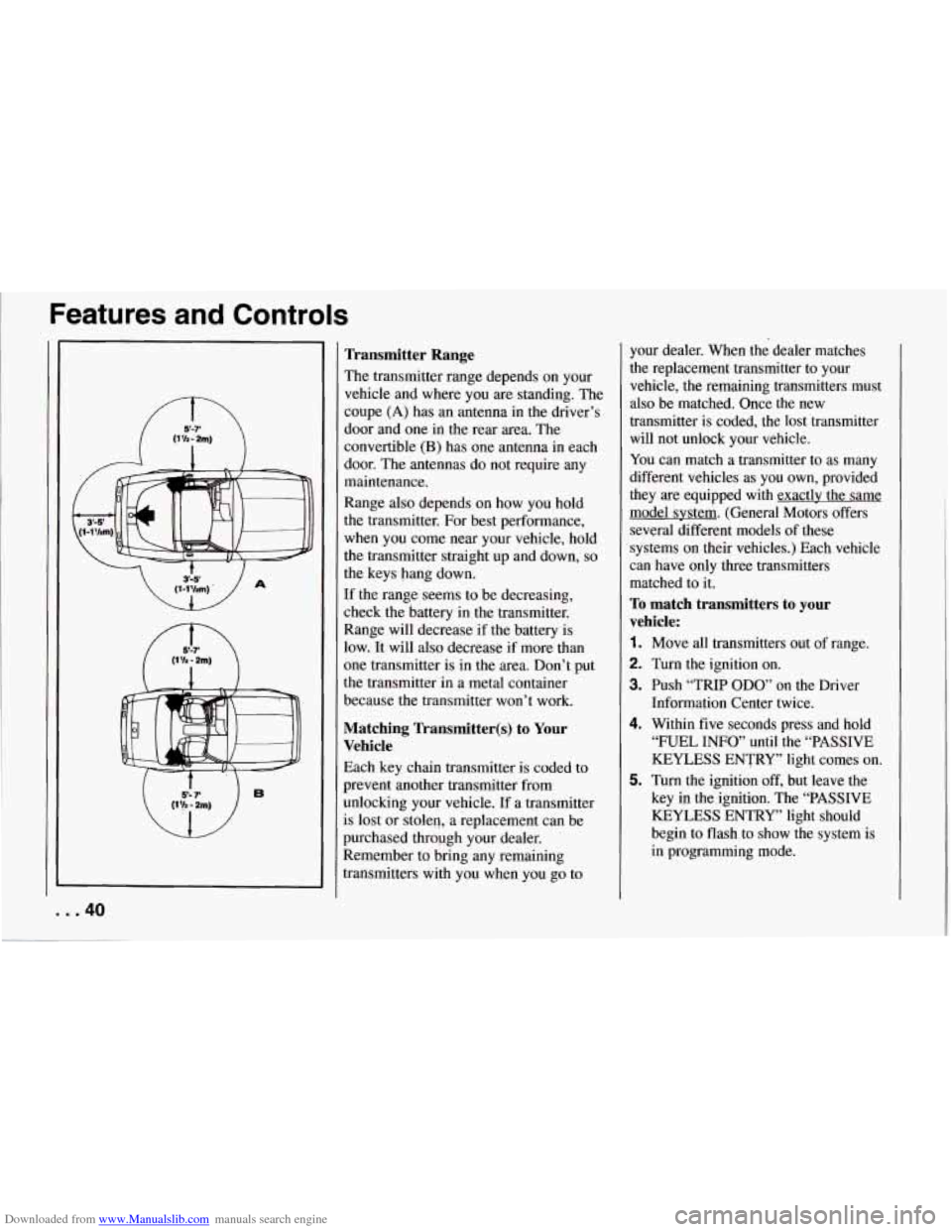
The transmitter range depends on your
vehicle and where you are standing. The
coupe
(A) has an antenna in the driver’s
door and one in the rear area. The
convertible
(B) has one antenna in each
door. The antennas do not require any
maintenance.
Range also depends on how you hold
the transmitter. For best performance,
when you come near your vehicle, hold
the transmitter straight up and down,
so
the keys hang down.
If the range seems to be decreasing,
check the battery
in the transmitter.
Range will decrease if the battery is
low. It will also decrease if more than
one transmitter is in the area. Don’t put
the transmitter in a metal container
because the transmitter won’t work.
Matching Transmitter(s) to Your
Vehicle
Each key chain transmitter is coded to
prevent another transmitter from
unlocking your vehicle. If a transmitter
is lost or stolen, a replacement can be
?urchased through your dealer.
Remember to bring any remaining
:ransmitters with you when you go to your dealer. When the dealer matches
the replacement transmitter
to your
vehicle, the remaining transmitters must
also be matched. Once the new
transmitter is coded, the lost transmitter
will not unlock your vehicle.
You can match a transmitter to as many
different vehicles as you own, provided
they are equipped with exactly the same
model -system. (General Motors offers
several different models of these
systems on their vehicles.) Each vehicle
can have only three transmitters
matched to it.
To match transmitters to your
vehicle:
1. Move all transmitters out of range.
2. Turn the ignition on.
3. Push “TRIP ODO’ on the Driver
Information Center twice.
4. Within five seconds press and hold
“FUEL INFO’ until the “PASSIVE
KEYLESS ENTRY” light comes on.
5. Turn the ignition off, but leave the
key in the ignition. The “PASSIVE
KEYLESS ENTRY” light should
begin to flash to show the system is
in programming mode.
Page 42 of 274
Downloaded from www.Manualslib.com manuals search engine 6. Bring one transmitter into range. The
light will stop flashing and stay on to
show that the code is stored.
7. Move the transmitter out of range.
8. Repeat steps 6 and 7 with each
The programming mode will shut
off if:
0 You don’t program any transmitters
0 You take the key out of the ignition or
0 You have programmed three
The light should
start flashing again.
additional transmitter.
for two minutes.
turn the ignition on.
transmitters.
Battery Replacement
Under normal use, the battery in your
key chain transmitter should last about
18 months.
You can tell the battery is weak if the
transmitter won’t work at
the normal
range in any location.
If you have to
get close to your vehicle before the
transmitter works, it’s probably time to
change the battery.
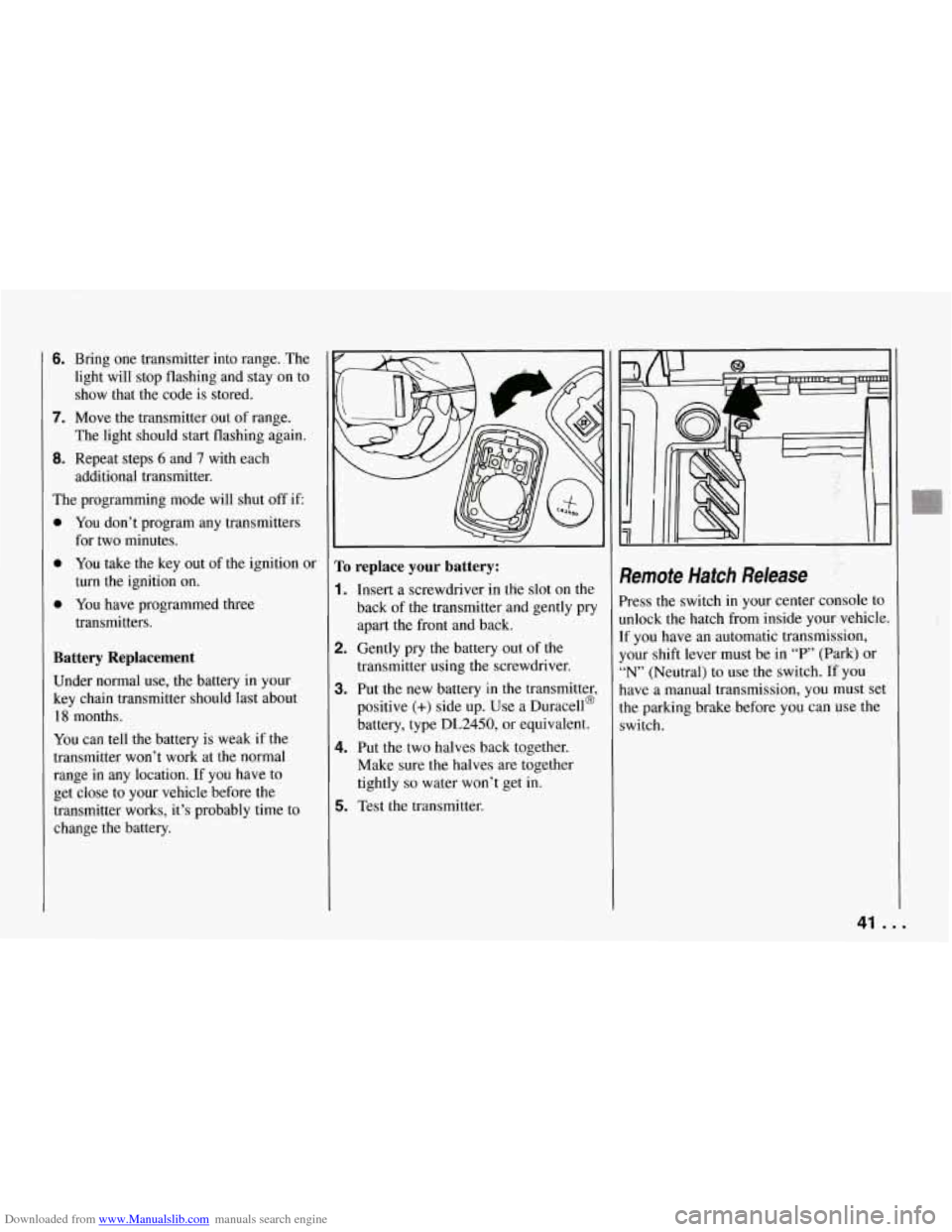
ro replace your battery:
I. Insert a screwdriver in the slot on the
back
of the transmitter and gently pry
apart the front and back.
2. Gently pry the battery out of the
transmitter using the screwdriver.
3. Put the new battery in the transmitter,
positive
(+) side up. Use a Duracell@
battery, type DL2450, or equivalent.
4. Put the two halves back together.
Make sure the halves are together
tightly
so water won’t get in.
5. Test the transmitter.
?emote Hatch Release
’ress the switch in your center console to
mlock the hatch from inside your vehicle
f you have an automatic transmission,
[our shift lever must be
in “P’ (Park) or
‘N’ (Neutral) to use the switch. If you
lave a manual transmission, you must sei
he parking brake before you can use the
;witch.
..
.i ,
41 ...
Page 43 of 274
Downloaded from www.Manualslib.com manuals search engine Features and Controls
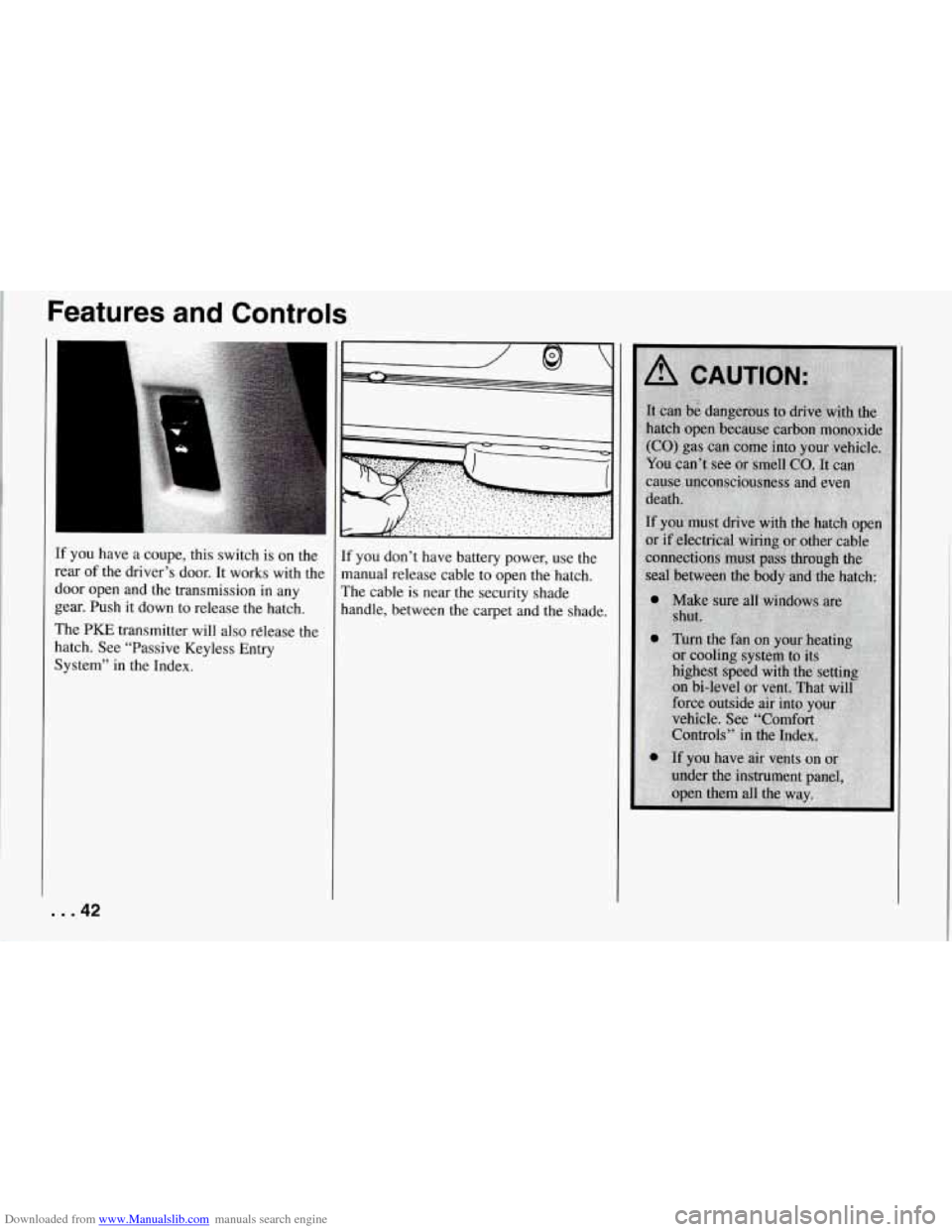
If you have a coupe, this switch is on the
rear of the driver’s door. It works with the
door open and the transmission in any
gear. Push it down to release the hatch.
The PKE transmitter will also release the
hatch. See “Passive Keyless Entry
System” in the Index.
... 42
If you don’t have battery power, use the
manual release cable
to open the-hatch.
The cable is near the security shade
handle, between the carpet and the shade.
Page 45 of 274
Downloaded from www.Manualslib.com manuals search engine Features and Controls
I Universal Theft
Deterrent
‘our Corvette has a theft deterrent
larm system. With this system, the
SECURITY” light will flash as you
pen the door (if your ignition is
off).
‘his light reminds you to arm the theft
eterrent system. Here’s how to do it:
. Open the door.
. Lock the door with the power door
lock switch or the Passive Keyless
Entry system. The “SECURITY” lieht
will come on.
. Close all the doors. The “SECURITY’
light should go
off.
... 44
Now, if a door or the hatch is opened
without the key or Passive Keyless Entry
system, the alarm will go
off. Your horn
will sound for three minutes, then it will
go
off to save battery power.
The theft deterrent system won’t
arm if
you lock the doors with a key or manual
door lock, or if you lock the vehicle after
the doors are closed.
If your passenger stays in the vehicle
when you leave with the keys, have the
passenger lock the vehicle after the doors
are closed. This way the alarm won’t
arm,
and your passenger won’t set it off.
Always use your key or the Passive
Keyless Entry system to unlock a door.
Unlocking a door any other way will set
off the alarm.
If you do set off the alarm
accidentally, there are three ways to stop
it:
Unlock any door with your key.
Put the ignition key in the ignition.
Use the Passive Keyless Entry system.
How to Test the Alarm
1. Make sure the rear hatch is latched.
2. Lower a window.
3. Arm the system.
4. Close the doors and wait five seconds.
5. Reach through the open window and
unlock the door from inside. The
alarm should sound.
6. Turn off the alarm.
If the alarm doesn’t go
off, check to see
if the horn works. If not, check the horn
fuse. See “Fuses and Circuit Breakers” in
the Index. If the horn does work, but the
alarm doesn’t go
off, see your dealer.
Page 48 of 274
Downloaded from www.Manualslib.com manuals search engine Ke
ma
ha! the
ou1
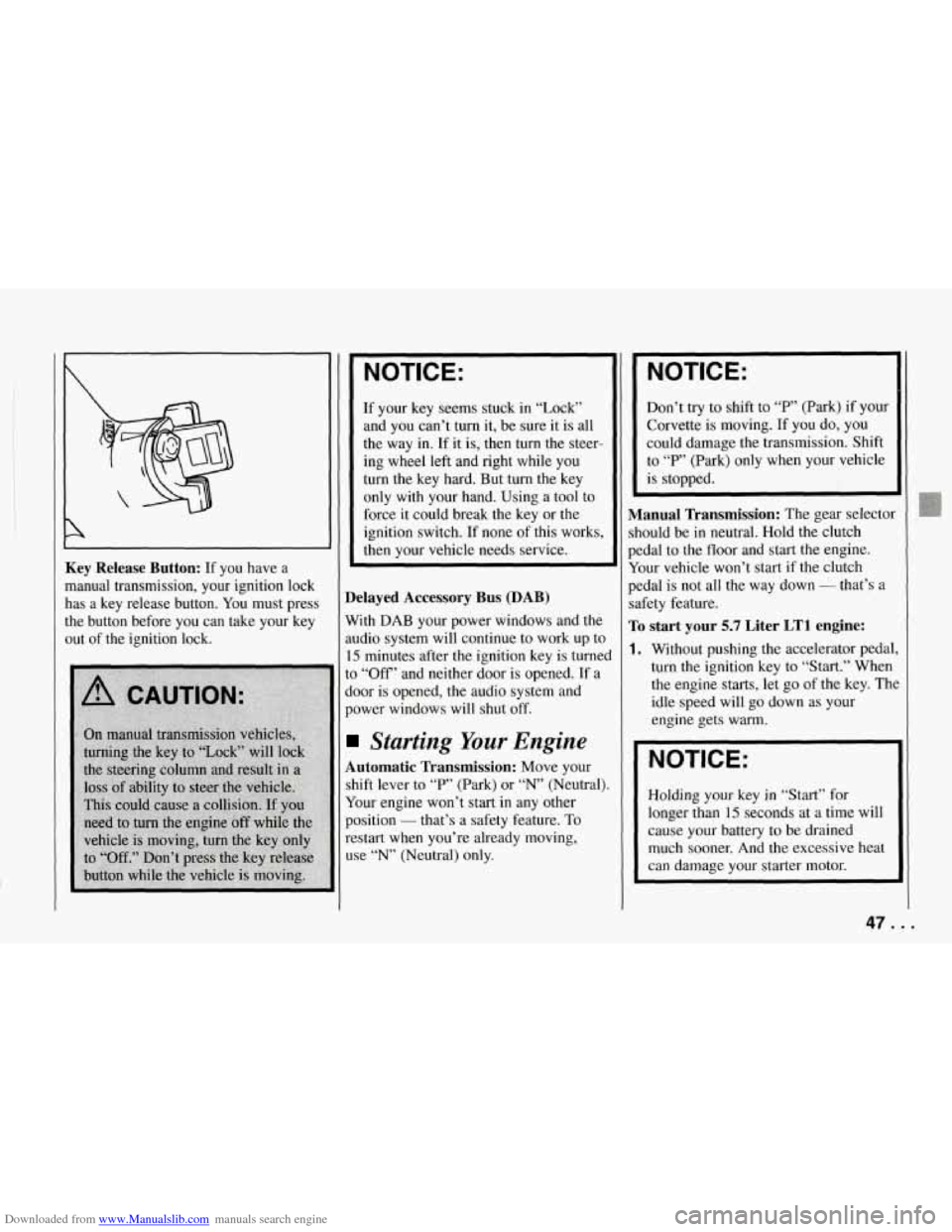
!y Release Button: If you have a
lnual transmission, your ignition lock
; a key release button. You must press
: button before you can take your key
t of the ignition lock.
NOTICE:
If your key seems stuck in “Lock”
and you can’t turn it, be sure it is all
the way in. If it is, then turn the steer-
ing wheel left and right while you
turn the key hard. But turn the key
only with your hand. Using a tool to
force it could break the key or the
ignition switch. If none of this works,
then your vehicle needs service.
Delayed Accessory Bus (DAB)
With DAB your power windows and the
audio system will continue to work up to
15 minutes after the ignition key is turnec
to “Off’ and neither door is opened.
If a
door is opened, the audio system and
power windows will shut
off.
Starting Your Engine
Automatic Transmission: Move your
shift lever to
“P’ (Park) or “N” (Neutral).
Your engine won’t start in any other
position
- that’s a safety feature. To
restart when you’re already moving,
use
“N” (Neutral) only.
NOTICE:
Don’t try to shift to “P” (Park) if your
Corvette is moving. If you do, you
could damage the transmission. Shift
to
“P” (Park) only when your vehicle
is stopped.
ManuaI Transmission: The gear selector
should be
in neutral. Hold the clutch
pedal to the
floor and start the engine.
Your vehicle won’t start if the clutch
pedal is not all the way down
- that’s a
safety feature.
To start your 5.7 Liter LTl engine:
1. Without pushing the accelerator pedal
turn the ignition key to “Start.” When
the engine starts, let go of the key. Thl
idle speed will go down as your
engine gets warm.
NOTICE:
Holding your key in “Start” for
longer than 15 seconds at a time will
cause your battery to be drained
much sooner. And the excessive heat
can damage your starter motor.
47 ...
Page 49 of 274
Downloaded from www.Manualslib.com manuals search engine Features and Controls
2. If it doesn’t start within 10 seconds,
push the accelerator pedal all the
way to the floor, while you hold the
ignition key in “Start.” When the
engine starts, let go of the key and
let up on the accelerator pedal. Wait
about
15 seconds between each try to
help avoid draining your battery.
When starting your engine in very cold
weather (below
0°F or - 18 “C), do this:
1.
2.
With your foot off the accelerator
pedal, turn the ignition key to “Start”
and hold it there. When the engine
starts, let go of the key. Use the
accelerator pedal to maintain engine
speed, if you have to, until your
engine has run for a while.
If your engine still won’t start (or
starts but then stops), it could be
flooded with too much gasoline. Try
pushing your accelerator pedal all the
way to
the floor and holding it there
as you hold the key in “Start” for
about three seconds. If
the vehicle
starts briefly but then stops again, do
the same thing, but this time keep the
pedal down for five or six seconds.
This clears the extra gasoline from
the engine.
NOTICE:
Your engine is designed to work with
the electronics in your vehicle. If you
add electrical parts or accessories,
you could chimge the way the fuel
injection system operates. Before
adding electrical equipment, check
with your dealer. If you don’t, your
engine might not perform properly.
If you ever have to have your vehicle
towed, see
the part of this manual
that tells how to do it without
damaging your vehicle. See “Towing
Your Vehicle”
in the Index.
Ib start your 5.7 Liter LT5 engine:
1. Without pushing the accelerator pedal
turn your ignition key to “Start.”
When the engine starts, let go of
the
key. The idle speed will go down as
your engine gets warm.
NOTICE:
Holding your key in “Start” for
longer than
15 seconds at a time will
cause your battery to be drained
much sooner. And the excessive heat
can damage your starter motor.
2. If it doesn’t start within 3 seconds,
push the accelerator pedal about one-third of the way down, while you
hold the ignition key
in “Start.” When
the engine starts, let go of the key and
let up on the accelerator pedal. Wait
about
15 seconds between each try to
help avoid draining your battery.
When starting your engine in very cold weather (below
0°F or -18”C), do this:
1.
2.
With your foot off the accelerator
pedal,
turn the ignition key to “Start”
and hold it there. After two seconds,
push the accelerator pedal down just a
little. When the engine starts, let go of
the key. Use the accelerator pedal to
maintain engine speed, if you have to,
until your engine has
run for a while.
If your engine still won’t start (or
starts but then stops), it could be
flooded with too much gasoline. Try
pushing your accelerator pedal all the way to the floor and holding it there
as you hold the key in “Start” for
about three seconds. If the vehicle
starts briefly but then stops again, do
the same thing, but this time keep
the
pedal down for five or six seconds.
This clears the extra gasoline from
the engine.
... 48
Page 222 of 274
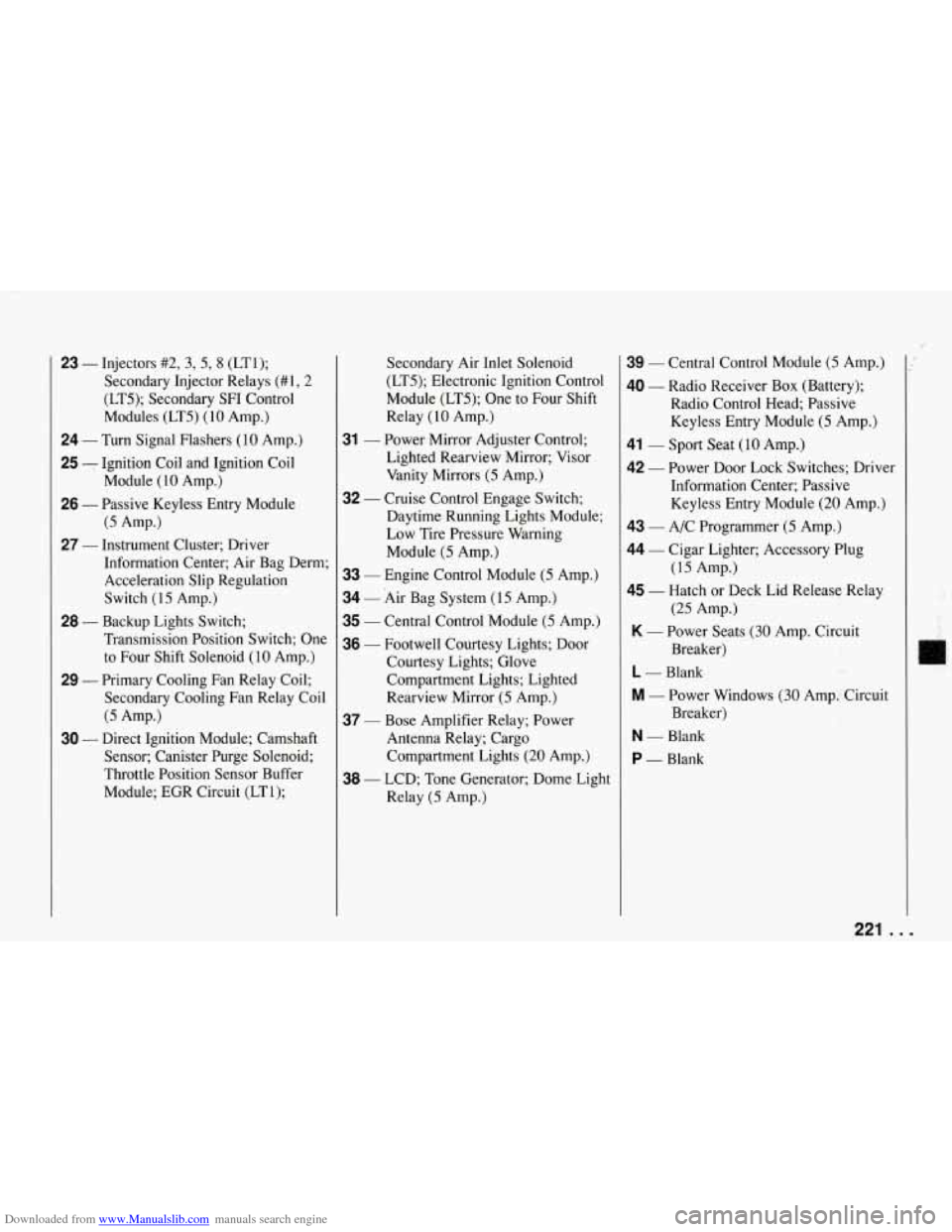
Downloaded from www.Manualslib.com manuals search engine 23 - Injectors #2, 3, 5, 8 (LTI);
Secondary Injector Relays (#1,2
(LT5); Secondary SF1 Control
Modules (LT5)
(10 Amp.)
24 - Turn Signal Flashers (10 Amp.)
25 - Ignition Coil and Ignition Coil
26 - Passive Keyless Entry Module
27 - Instrument Cluster; Driver Module (10 Amp.)
(5 Amp.)
Information Center; Air Bag Derm; Acceleration Slip Regulation
Switch
(15 Amp.)
Transmission Position Switch; One
to Four Shift Solenoid
(10 Amp.)
29 - Primary Cooling Fan Relay Coil;
Secondary Cooling Fan Relay Coil
28 - Backup Lights Switch;
(5 Amp.)
30 - Direct Ignition Module; Camshaft Sensor; Canister Purge Solenoid;
Throttle Position Sensor Buffer
Module; EGR Circuit (LT1);
31
32
Secondary Air Inlet Solenoid
(LT5); Electronic Ignition Control
Module (LT5); One to Four Shift
Relay
( 10 Amp.)
Power Mirror Adjuster Control;
Lighted Rearview Mirror; Visor
Vanity Mirrors
(5 Amp.)
Cruise Control Engage Switch;
Daytime Running Lights Module;
Low Tire Pressure Warning
Module
(5 Amp.)
33 - Engine Control Module (5 Amp.)
34 - Air Bag System (15 Amp.)
35 - Central Control Module (5 Amp.)
36 - Footwell Courtesy Lights; Door
Courtesy Lights; Glove
Compartment Lights; Lighted
Rearview Mirror
(5 Amp.)
37 - Bose Amplifier Relay; Power
Antenna Relay; Cargo
Compartment Lights
(20 Amp.)
Relay
(5 Amp.)
38 - LCD; Tone Generator; Dome Light
39 - Central Control Module (5 Amp.)
40 - Radio Receiver Box (Battery);
Radio Control Head; Passive
Keyless Entry Module
(5 Amp.)
41 - Sport Seat (10 Amp.)
42 - Power Door Lock Switches; Driver
Information Center; Passive
Keyless Entry Module
(20 Amp.)
43 - A/C Programmer (5 Amp.)
44 - Cigar Lighter; Accessory Plug
45 - Hatch or Deck Lid Release Relay
K - Power Seats (30 Amp. Circuit
L - Blank
M - Power Windows (30 Amp: Circuit
N - Blank
P - Blank
(15 Amp.)
(25 Amp.)
Breaker)
Breaker)
221 . I
Page 262 of 274
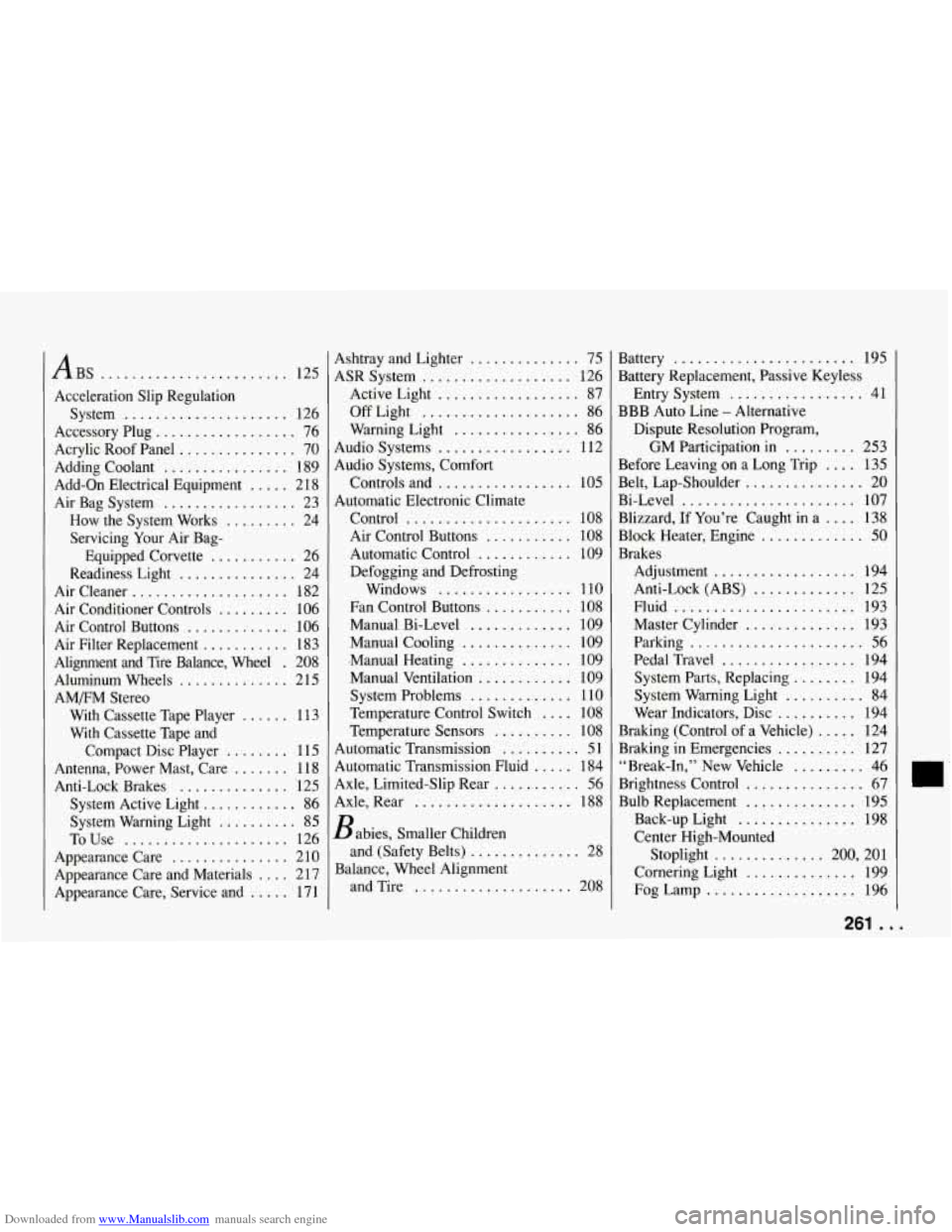
Downloaded from www.Manualslib.com manuals search engine ABS ........................ 125
Acceleration Slip Regulation
System
..................... 126
Accessory Plug
.................. 76
Acrylic Roof Panel
............... 70
Adding Coolant
................ 189
Add-on Electrical Equipment
..... 21 8
Air Bag System ................. 23
How the System Works
......... 24
Servicing Your Air Bag-
Equipped Corvette
........... 26
Readiness Light
................ 24
Air Cleaner
.................... 182
Air Conditioner Controls
......... 106
Air Control Buttons
............. 106
Air Filter Replacement
........... 183
Alignment and Tire Balance. Wheel
. 208
Aluminum Wheels
.............. 2 15
AMPM Stereo
With Cassette Tape Player
...... 11 3
With Cassette Tape and
Compact Disc Player
........ 11 5
Antenna. Power Mast. Care
....... 11 8
Anti-Lock Brakes
.............. ‘125
System Active Light
............ 86
System Warning Light
.......... 85
To Use
..................... 126
Appearance Care
............... 21 0
Appearance Care and Materials .... 21 7
Appearance Care. Service and
..... 171 Ashtray and
Lighter
.............. 75
ASR System
................... 126
Active Light
.................. 87
Off Light .................... 86
Warning Light
................ 86
Audio Systems
................. 112
Audio Systems. Comfort Controls and
................. 105
Automatic Electronic Climate
Control
..................... 108
Air Control Buttons
........... 108
Automatic Control
............ 109
Defogging and Defrosting
Windows
................. 110
Fan
Control Buttons ........... 108
Manual Bi-Level
............. 109
Manual Cooling
.............. 109
-Manual Heating
.............. 109
Manual Ventilation
............ 109
System Problems
............. 110
Temperature Control Switch .... 108
Temperature Sensors
.......... 108
Automatic Transmission
.......... 5 1
Automatic Transmission Fluid
..... 184
Axle. Limited-Slip Rear
........... 56
Axle. Rear
.................... 188
Babies. Smaller Children
Balance. Wheel Alignment and
(Safety Belts)
.............. 28
and Tire
.................... 208 Battery
....................... 195
Battery Replacement. Passive Keyless
Entry System
................. 41
BBB Auto Line
. Alternative
Dispute Resolution Program.
GM Participation in
......... 253
Before Leaving on a Long Trip
.... 135
Belt. Lap-Shoulder
............... 20
Bi-Level
...................... 107
Blizzard. If You’re Caught in a
.... 138
Block Heater. Engine
............. 50
Brakes Adjustment
.................. 194
Anti-Lock (ABS)
............. 125
Fluid
....................... 193
Master Cylinder
.............. 193
Parking
...................... 56
PedalTravel
................. 194
System Parts. Replacing
........ 194
System Warning Light
.......... 84
Wear Indicators. Disc
.......... 194
Braking (Control of a Vehicle)
..... 124
Braking in Emergencies
.......... 127
“Break.In.
.. New Vehicle ......... 46
Brightness Control
............... 67
Bulb Replacement
.............. 195
Back-up Light
............... 198
Center High-Mounted Stoplight
.............. 200. 201
Cornering Light
.............. 199
Fog Lamp
................... 196
261 ...