power steering CHEVROLET CORVETTE 1994 4.G Owners Manual
[x] Cancel search | Manufacturer: CHEVROLET, Model Year: 1994, Model line: CORVETTE, Model: CHEVROLET CORVETTE 1994 4.GPages: 274, PDF Size: 15.61 MB
Page 47 of 274
Downloaded from www.Manualslib.com manuals search engine Features and Controls
NOTICE:
Your modern Corvette doesn’t need
an elaborate “break-in.” But it will
perform better in the long run if you
follow these guidelines:
0 Keep your speed at 55 mph
(88 km/h) or less for the first
500 miles (804 km).
Don’t drive at any one speed
- fast or slow - for the
fist
500 miles (804 km).
Don’t make full-throttle
starts.
Avoid malung hard stops for
the first
200 miles (322 km)
or so. During this time your
new brake linings
aren’t yet
broken in.
Hard stops with
new linings can mean
premature wear and earlier
replacement. Follow this
“breaking-in” guideline
every time you get new
brake linings.
I
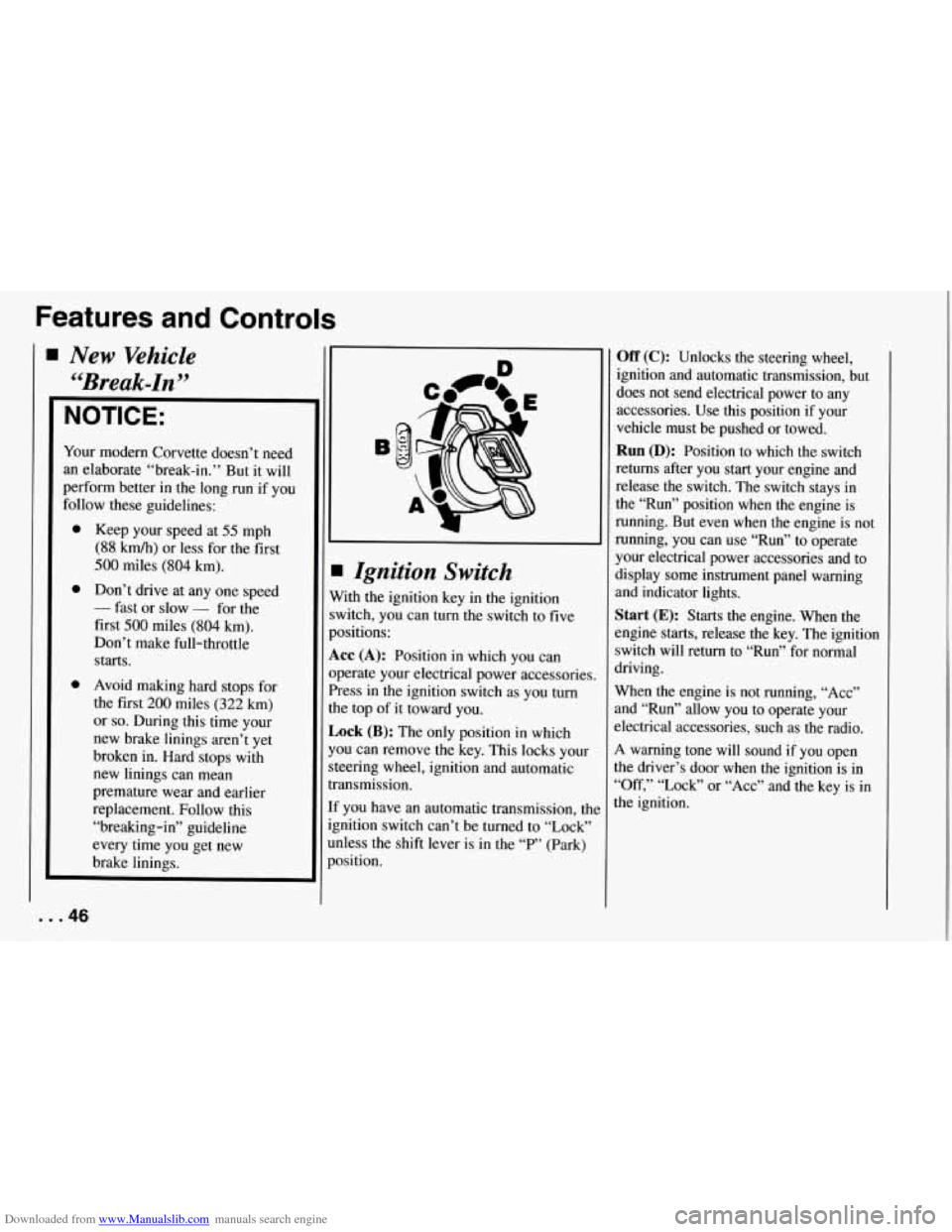
Ignition Switch
With the ignition key in the ignition
switch, you can turn the switch to five
positions:
Acc (A): Position in which you can
operate your electrical power accessories.
Press in the ignition switch as you turn
the top of it toward you.
Lock (B): The only position in which
you can remove the key. This locks your
steering wheel, ignition and automatic
transmission.
If you have an automatic transmission, tht
ignition switch can’t be turned to “Lock”
unless the shift lever
is in the “P” (Park)
position.
... 46
Off (C): Unlocks the steering wheel,
ignition and automatic transmission, but
does not send electrical power to any
accessories. Use
this position if your
vehicle must be pushed
or towed.
Run (D): Position to which the switch
returns after you start your engine and
release the switch. The switch stays in
the “Run” position when the engine is
running. But even when the engine is not
running, you can use “Run” to operate
your electrical power accessories and to
display some instrument panel warning
and indicator lights.
Start (E): Starts the engine. When the
engine
starts, release the key. The ignition
switch will return to “Run” for normal
driving.
When the engine is not running, “Acc”
and “Run” allow you to operate your
slectrical accessories, such as the radio.
A warning tone will sound if you open
the driver’s door when the ignition is in
“Off,’’ “Lock” or “Acc” and the key is in
the ignition.
Page 61 of 274
Downloaded from www.Manualslib.com manuals search engine Features and Controls
Follow the proper steps to be sure your
vehicle won’t move. See “Shifting into
‘P’ (Park)” in the Index.
... 60
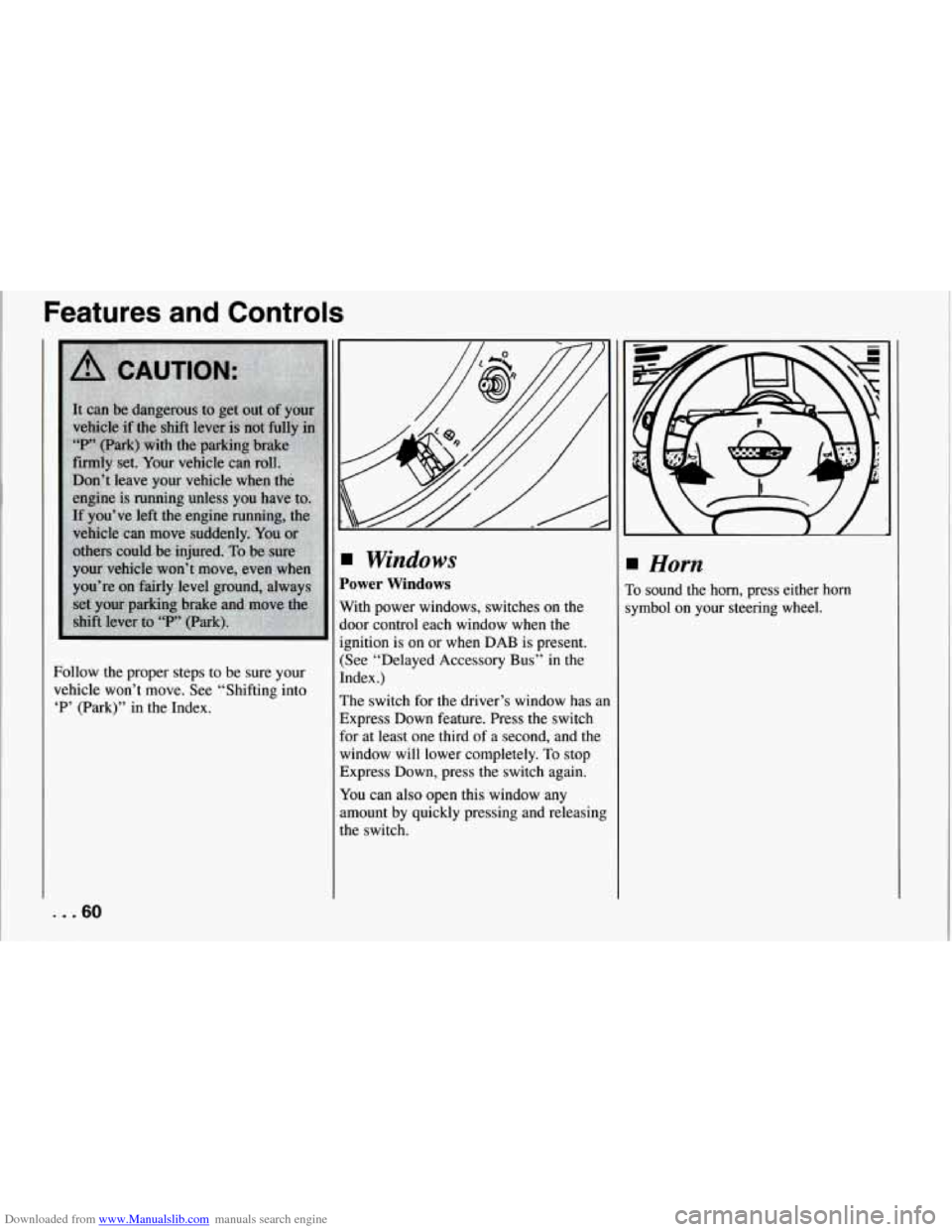
Windows
Power Windows
With power windows, switches on the
door control each window when the
ignition is on or when DAB is present.
(See “Delayed Accessory Bus”
in the
Index.)
The switch for the driver’s window has ai
Express Down feature. Press the switch
for at least one third
of a second, and the
window will lower completely.
To stop
Express Down, press the switch again.
You can also open this window any
amount by quickly pressing and releasint
the switch.
I Horn
:o sound the horn, press either horn
ymbol
on your steering wheel.
Page 128 of 274
Downloaded from www.Manualslib.com manuals search engine The
comc
prob
Whe
will
drivi Systc
SERVICE
ASR
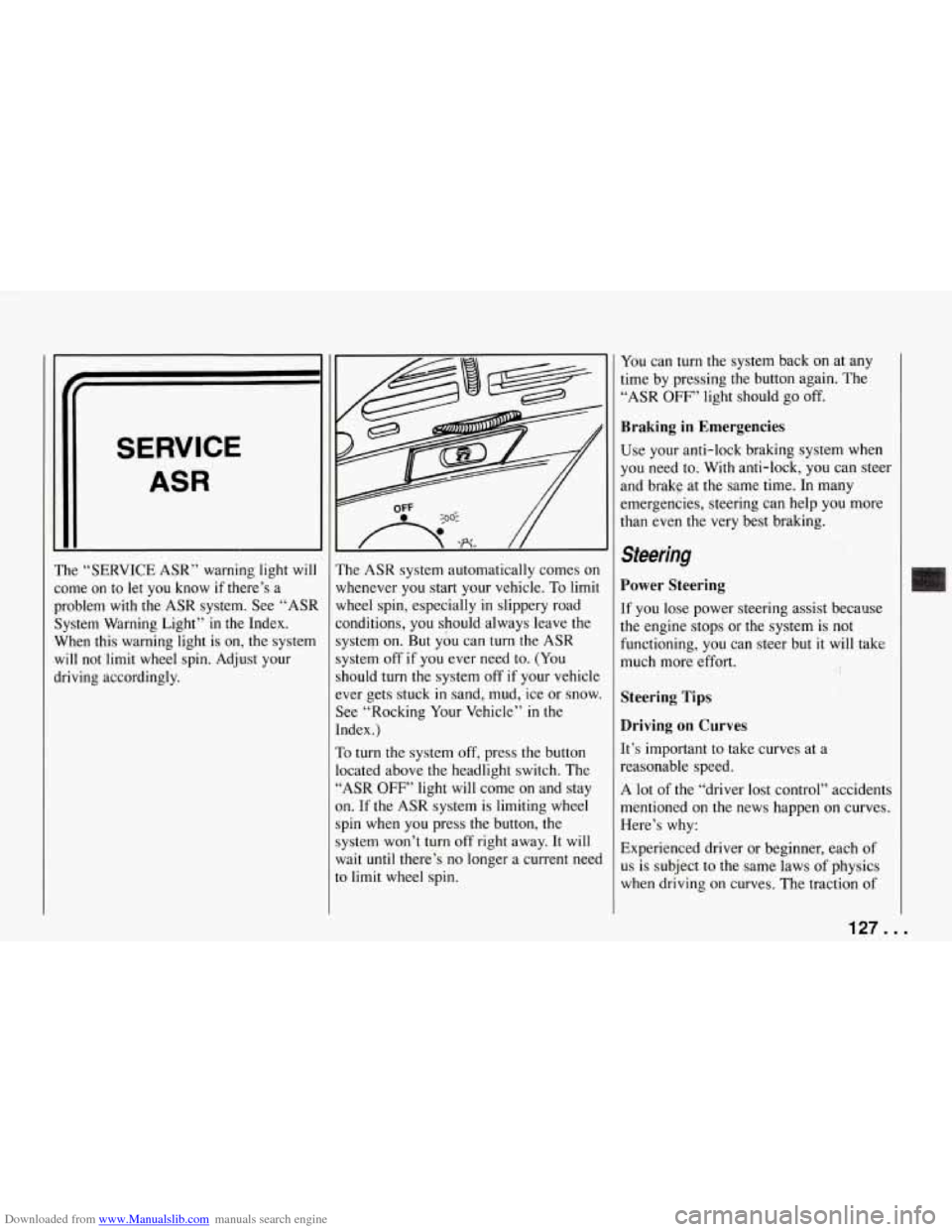
“SERVICE ASR“ warning light will
2 on
to let you know if there’s a
lem with the ASR system. See “ASR
:m Warning Light” in the Index.
n this warning light is on, the system
not limit wheel spin. Adjust your
ng accordingly. The
ASR system automatically comes on
whenever you start your vehicle. To limit
wheel spin, especially in slippery road
conditions, you should always leave the
system on. But you can turn the ASR
system off
if you ever need to. (You
should turn the system off if your vehicle
ever gets stuck
in sand, mud, ice or snow.
See “Rocking Your Vehicle” in the
Index.)
To
turn the system off, press the button
located above the headlight switch. The
“ASR
OFF’ light will come on and stay
on. If the ASR system is limiting wheel
spin when you press the button, the
system won’t turn off right away. It will
wait until there’s no longer a current
need
to limit wheel spin.
You can turn the system back on at any
time by pressing the button again. The
“ASR
OFF’ light should go off.
Braking in Emergencies
Use your anti-lock braking system when
you need to. With anti-lock, you can steer
and brakG at the same time. In many
emergencies, steering can help you more
than even the very best braking.
Steering
; .1
,.
Power Steering
If you lose power steering assist because
the engine stops or the system is not
functioning, you can steer but it will take
much more effort.
Steering Tips
Driving on Curves
It’s important to take curves at a
reasonable speed.
A lot
of the “driver lost control” accidents
mentioned
on the news happen on curves.
Here’s why:
Experienced driver or beginner, each
of
us is subject to the same laws of physics
when driving on curves. The traction of
127 ...
Page 172 of 274
Downloaded from www.Manualslib.com manuals search engine Here you will find information
about the care of your Corvette
.
This part begins with service
and fuel information. and then it
shows how
to check important
fluid and lubricant levels
. There
is also technical information
about your vehicle. and a section devoted
to its
appearance care
.
Part 6
Service & Appearance Care
Service ........................................................
Fuel ..........................................................
Checking Things under the Hood ...................................
HoodRelease .................................................
Engineoil .................................................
Aircleaner ........................... ...................
Automatic Transmission Fluid ..................................
Manual Transmission Fluid ......................................
Hydraulic Clutch ...............................................
RearAxle ....................................................
Enginecoolant ................................................
Power Steering Fluid ...........................................
Windshield Washer Fluid ........................................
Brake Master Cylinder ..........................................
Battery ......................................................
Bulb Replacement ...............................................
Windshield Wiper Blades ..........................................
Tires ..........................................................
Appearancecare ................................................
Appearance Care Materials Chart ...................................
Vehicle Identification Number (VIN) ................................
Service Parts Identification Label ...................................
Add-on Electrical Equipment ......................................
Fuses and Circuit Breakers ........................................
Replacement Bulbs ..............................................
Capacities and Specifications ...................................
LoadingYourVehicle ............................................
172
173
175
175
178
182 184
186
187
188
188
191
192
193
195
195
202
202
204
210
217
218
218
218
219
223
224
171 ..
Page 177 of 274
Downloaded from www.Manualslib.com manuals search engine Service and Appearance Care
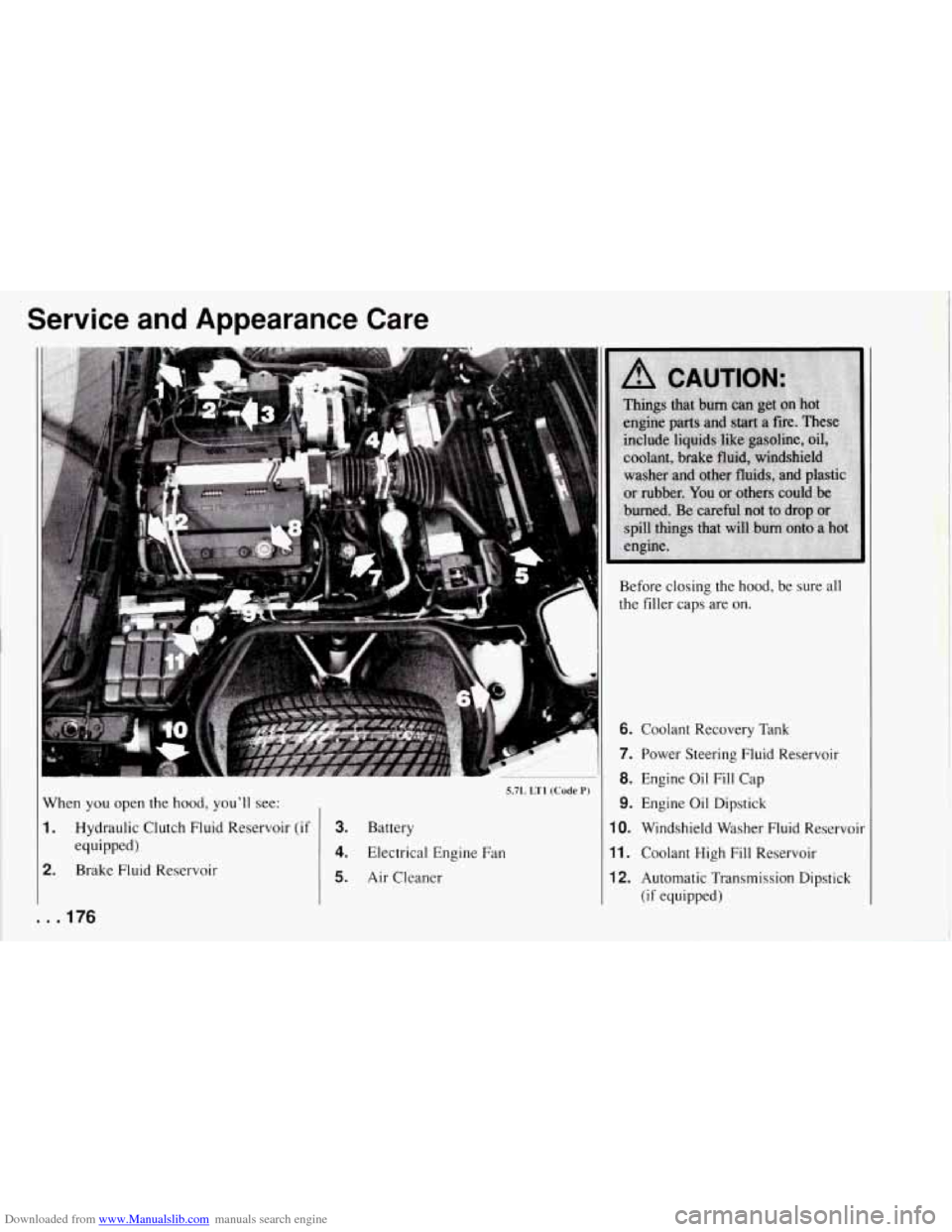
When you open the hood, you'll see:
1. Hydraulic Clutch Fluid Reservoir (if
2. Brake Fluid Reservoir
equipped)
. . .I76
1
Before closing the hood, be sure all
the filler caps are on.
'*?-
5.7L LTI (Code P)
3. Battery
4. Electrical Engine Fan
5. Air Cleaner
6. Coolant Recovery Tank
7. Power Steering Fluid Reservoir
8. Engine Oil Fill Cap
9. Engine Oil Dipstick
10. Windshield Washer Fluid Reservoir
11. Coolant High Fill Reservoir
12. Automatic Transmission Dipstick
(if equipped)
I
Page 178 of 274
Downloaded from www.Manualslib.com manuals search engine r
k
"1
5.7L LT5 (Code J)
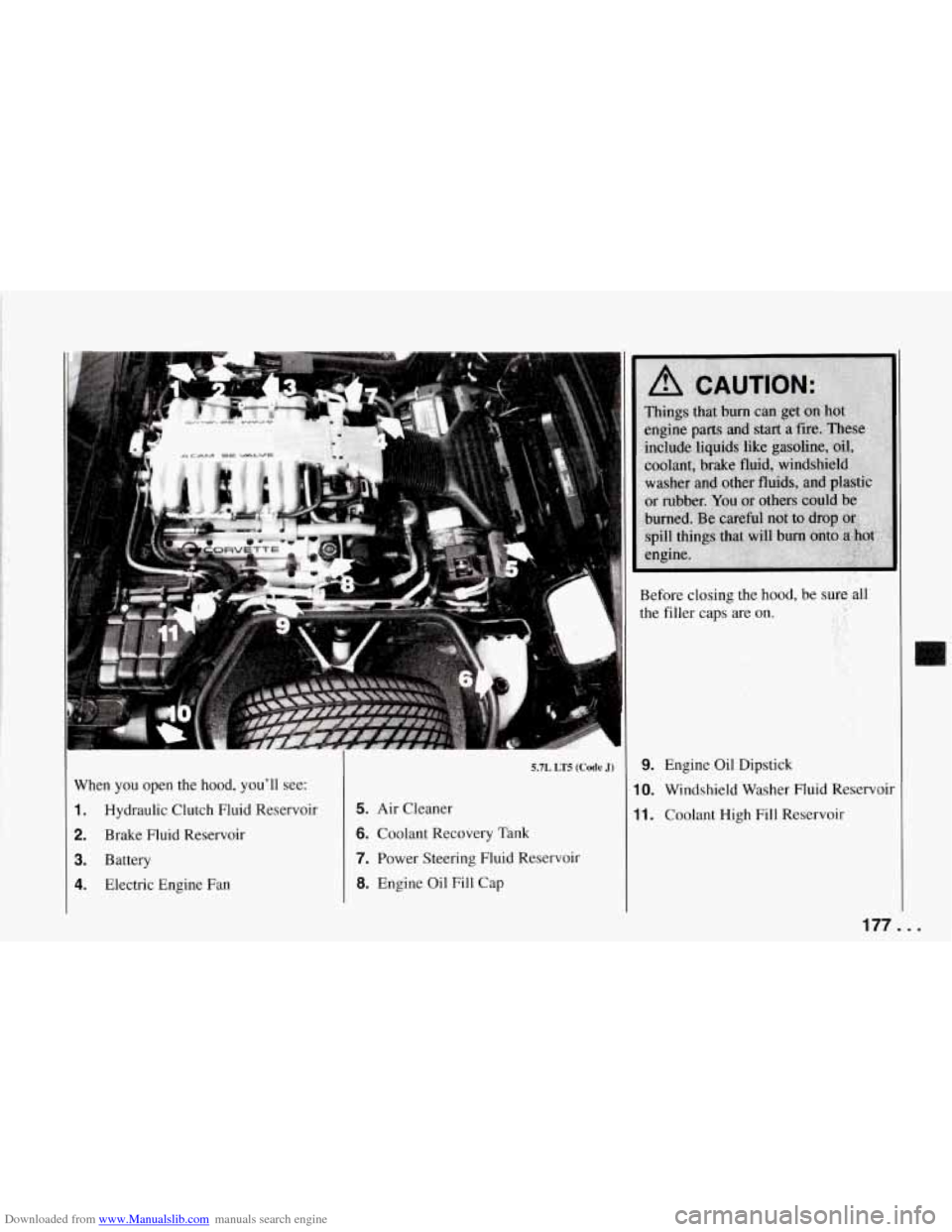
When you open the hood, you'll see:
1. Hydraulic Clutch Fluid Reservoir 5. Air Cleaner
2. Brake Fluid Reservoir 6. Coolant Recovery Tank
3. Battery 7. Power Steering Fluid Reservoir
4. Electric Engine Fan 8. Engine Oil Fill Cap Before closing
the hood, be
sureall
the filler caps are on. . ..
'., , ,.
9. Engine Oil Dipstick
10. Windshield Washer Fluid Reservoir
11. Coolant High Fill Reservoir
177..
Page 192 of 274
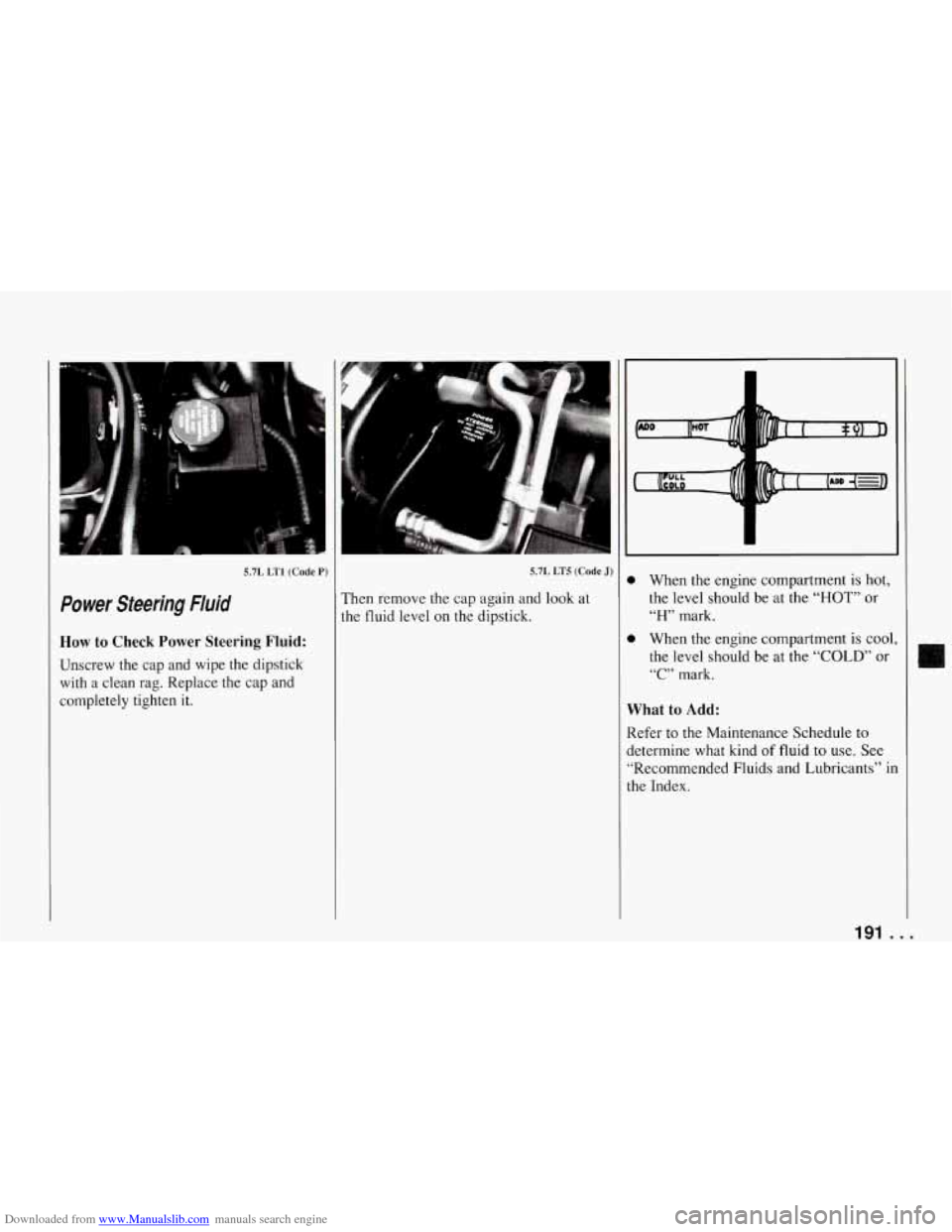
Downloaded from www.Manualslib.com manuals search engine 5.7L LT1 (Code P)
Power Steering Fluid
How to Check Power Steering Fluid:
Unscrew the cap and wipe the dipstick with a clean rag. Replace the cap and
completely tighten it.
5.7L LT5 (Code J)
Then remove the cap again and look at
the fluid level on the dipstick.
0 When the engine compartment is hot,
the level should be at the
“HOT” or
“H” mark.
0 When the engine compartment is cool
the level should be at
the “COLD” or
“C” mark.
What to Add:
Refer to the Maintenance Schedule to
determine what kind
of fluid to use. See
“Recommended Fluids and Lubricants” il
the Index.
191 .
T
-
3
1
..
Page 193 of 274
Downloaded from www.Manualslib.com manuals search engine Service and Appearance Care
NOTICE:
When adding power steering ,fluid or
making a complete fluid change,
always use the proper fluid. Failure
to use the proper fluid can cause
leaks and damage hoses and seals.
L
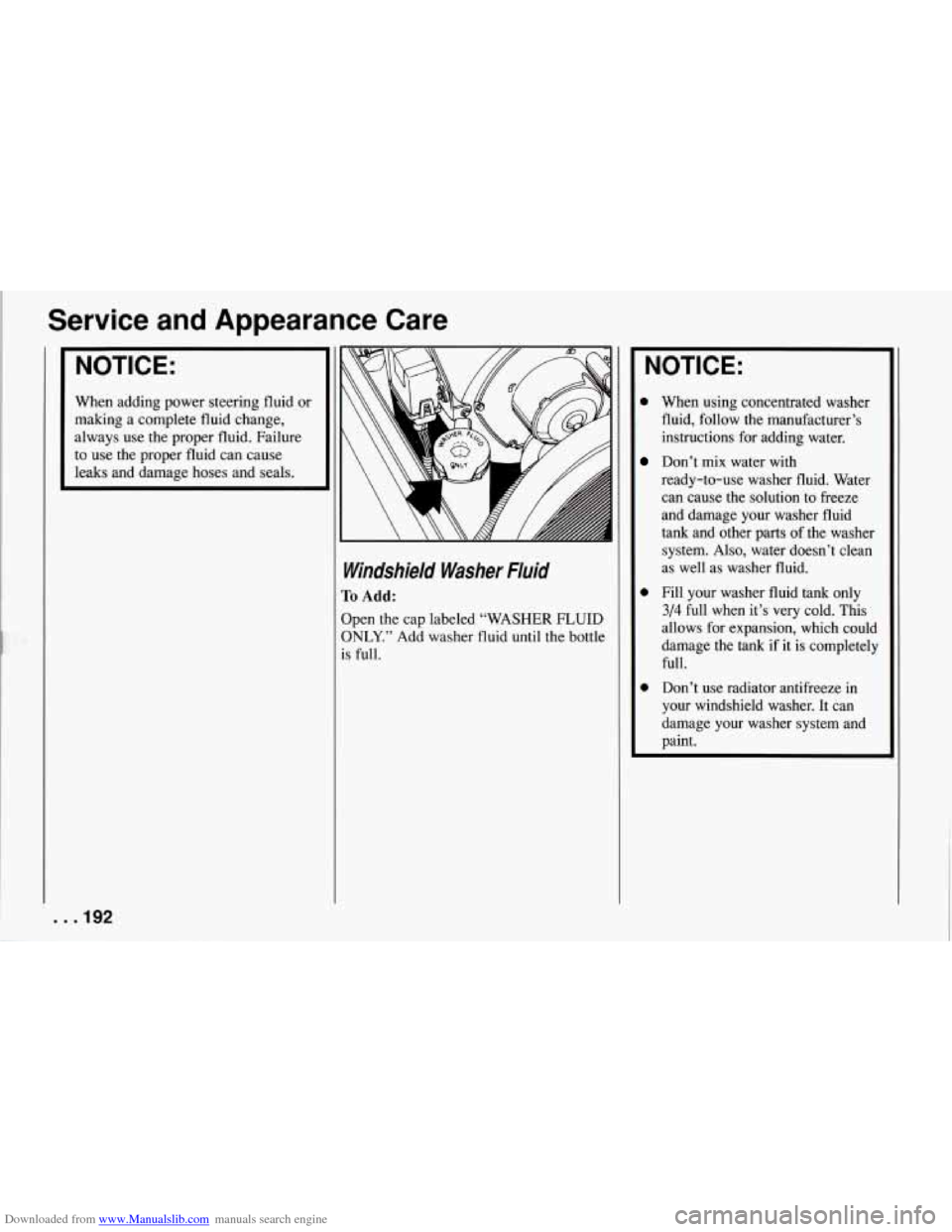
Windshield Washer Fluid
To Add:
Open the cap labeled “WASHER FLUID
ONLY.” Add washer fluid until the bottle
is full.
NOTICE:
0 When using concentrated washer
fluid, follow the manufacturer’s
instructions for adding water.
Don’t mix water with
ready-to-use washer fluid. Water
can cause the solution to freeze
and damage your washer fluid
tank and other parts of the washer
system. Also, water doesn’t clean
as well as washer fluid.
0 Fill your washer fluid tank only
3/4 full when it’s very cold. This
allows for expansion, which could
damage the tank if it is completely
full.
0 Don’t use radiator antifreeze in
your windshield washer. It can
damage your washer system and
paint.
. . .I92
Page 243 of 274
Downloaded from www.Manualslib.com manuals search engine Maintenance Schedule
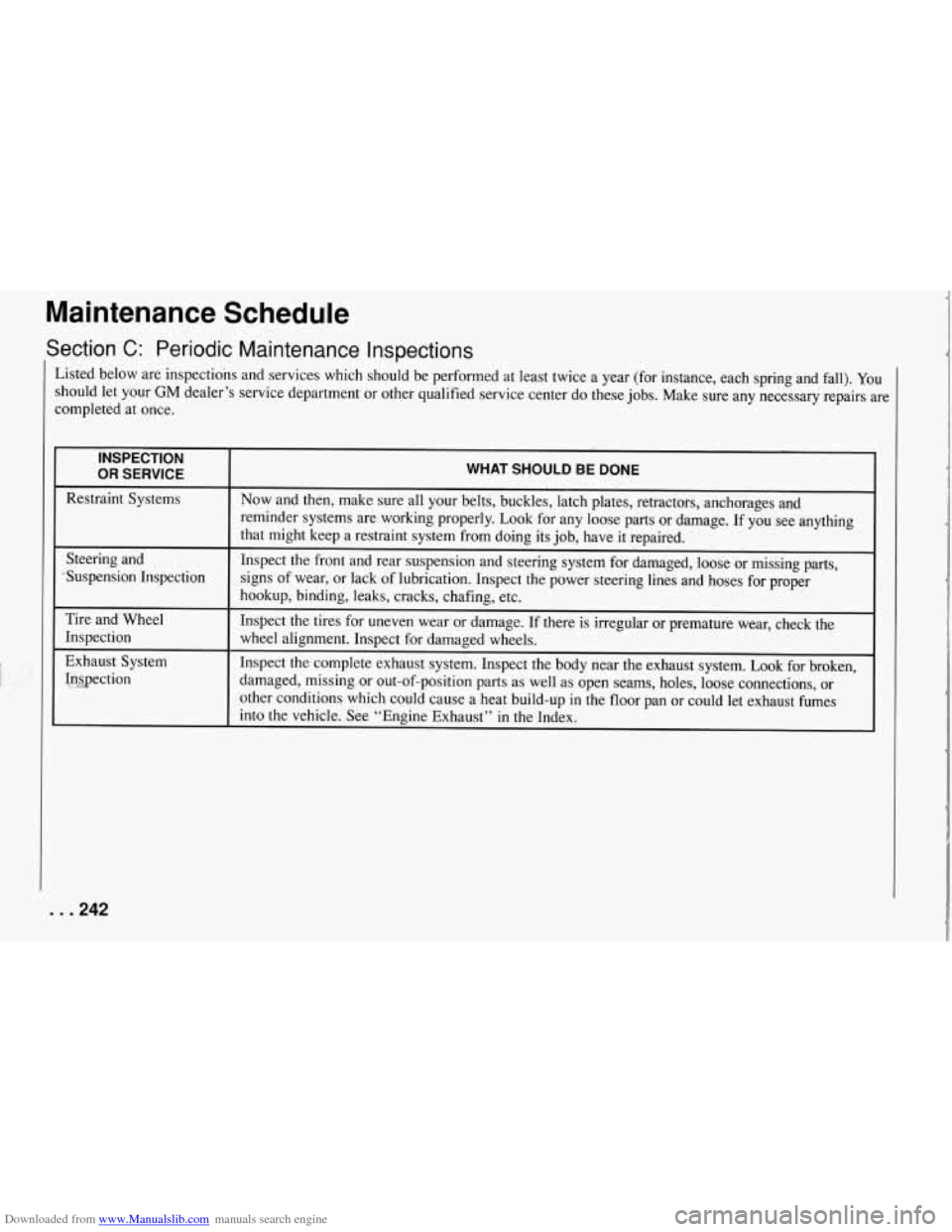
I Section C: Periodic Maintenance Inspections
I
S
isted below are inspections and services which should be performed at least twice a year (for instance, each spring and fall). You
hould let your GM dealer’s service department or other qualified service center do these jobs. Make sure any necessary repairs are
ompleted at once.
INSPECTION
OR SERVICE
Restraint Systems
Steering and
‘Suspension Inspection
Tire and Wheel Inspection
Exhaust System
Inaection
. .242
WHAT SHOULD BE DONE
Now and then, make sure all your belts, buckles, latch plates, retractots, anchorages and
reminder systems are working properly.
Look for any loose parts or damage. If you see anything
that might keep a restraint system from doing its job, have
it repaired.
Inspect the front and rear suspension and steering systenl for damaged, loose or missing parts,
signs of wear, or lack
of lubrication. Inspect the power steering lines and hoses for proper
hookup, binding, leaks, cracks, chafing, etc.
Inspect the tires for uneven wear or damage. If there is irregular or premature wear, check
the
wheel alignment. Inspect for damaged wheels.
Inspect the complete exhaust system. Inspect the body near the \
exhaust system.
Look for broken,
damaged, missing or out-of-position parts as well as open seams, holes, loose connections, or
other conditions which could cause a heat build-up in
the floor pan or could let exhaust fumes
into the vehicle. See “Engine Exhaust”
in the Index.
Page 245 of 274
Downloaded from www.Manualslib.com manuals search engine Maintenance Schedule
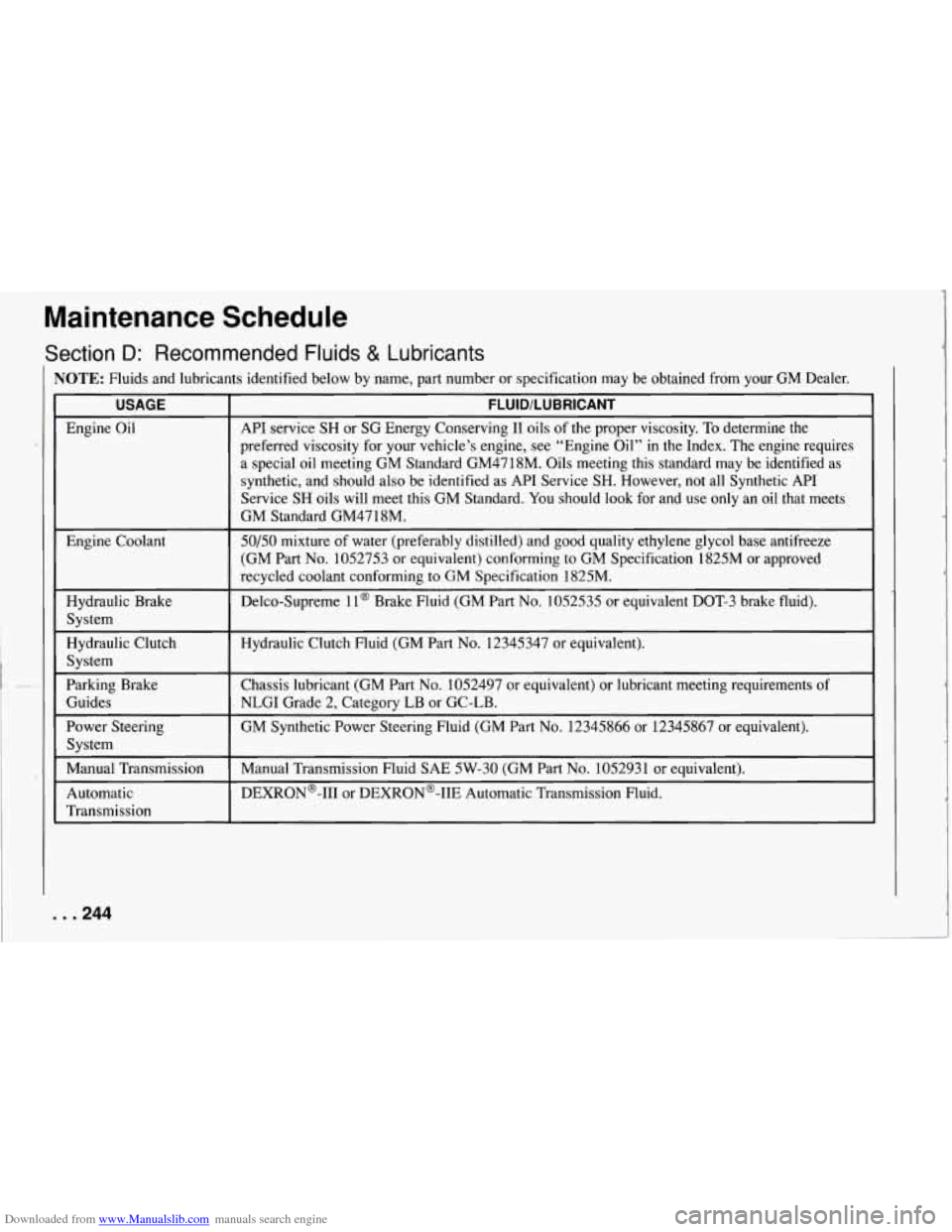
Section D: Recommended Fluids & Lubricants
NOTE: Fluids and lubricants identified below by name, part number or specification may be obtained from your GM Dealer.
USAGE FLUID/LUBRICANT
Engine Oil
API service SH or SG Energy Conserving I1 oils of the proper viscosity. To determine the
preferred viscosity for your vehicle’s engine, see “Engine Oil” in the Index. The engine requires
a special oil meeting GM Standard GM4718M. Oils meeting this stan\
dard may be identified as
synthetic, and should also be identified as API Service SH. However, not all Synthetic API
Service SH oils will meet this GM Standard.
You should look for and use only an oil that meets
GM Standard GM4718M.
Engine Coolant
50/50 mixture of water (preferably distilled) and good quality ethylene glycol base antifreeze
(GM Part No. 1052753 or equivalent) conforming to GM Specification 1825M or approved
recycled coolant conforming to GM Specification 1825M.
Hydraulic Brake Delco-Supreme
ll@ Brake Fluid (GM Part No. 1052535 or equivalent DOT-3 brake fluid).
System
Hydraulic Clutch System Hydraulic Clutch Fluid
(GM Part No. 12345347 or equivalent).
Parking Brake
Chassis lubricant (GM Part No. 1052497 or equivalent) or lubricant meeting requirements of
Guides NLGI Grade 2, Category LB or GC-LB.
Power Steering
GM Synthetic Power Steering Fluid (GM Part
No. 12345866 or 12345867 or equivalent).
System
Manual Transmission
Transmission DEXRON@-I11 or
DEXRON@-IIE Automatic Transmission Fluid.
Automatic Manual Transmission Fluid
SAE 5W-30 (GM Part
No. 1052931 or equivalent).
. . .244