check engine light CHEVROLET CORVETTE 1995 4.G User Guide
[x] Cancel search | Manufacturer: CHEVROLET, Model Year: 1995, Model line: CORVETTE, Model: CHEVROLET CORVETTE 1995 4.GPages: 386, PDF Size: 20.15 MB
Page 120 of 386
Downloaded from www.Manualslib.com manuals search engine For LTPWS to work properly, you must drive your
Corvette faster than
25 mph (40 km/h) and for more
than
2 miles (4 km). The system will not warn you
before
you begin to drive that a tire is flat.
When the LOWLFLAT TIRE light comes
on, check the
tire pressure in all four road tires as soon as you can.
Adjust the tire pressure as needed to those shown
on the
Tire-Loading Information label on the driver’s door.
If
the light stays on after the tire pressure is adjusted, see
your dealer. The
LTPWS sensor is directly opposite the valve stem
on the tire. Take care when servicing or having your
tires serviced. The sensors may not work properly
if
damaged. To prevent damage to the sensors, see the
1995 Corvette Service Manual for correct tire mounting
and dismounting procedures.
The LOWELAT TIRE light may come on if your
vehicle is close to another vehicle that has
LTPWS and
has a tire with low pressure.
LTPWS can warn you about a low tire, but
it does not
replace normal tire maintenance. See “Tires” in the
Index.
NOTICE:
Driving with a flat tire may damage the tire, the
wheel or the tire pressure sensor installed inside
the tire
on the wheel rim. Using tire sealants may
also damage the sensor.
If you have EMTs, see “Extended Mobility Tires”
in the Index.
2-77
Page 121 of 386
Downloaded from www.Manualslib.com manuals search engine Service LTPWS Light (Option)
I
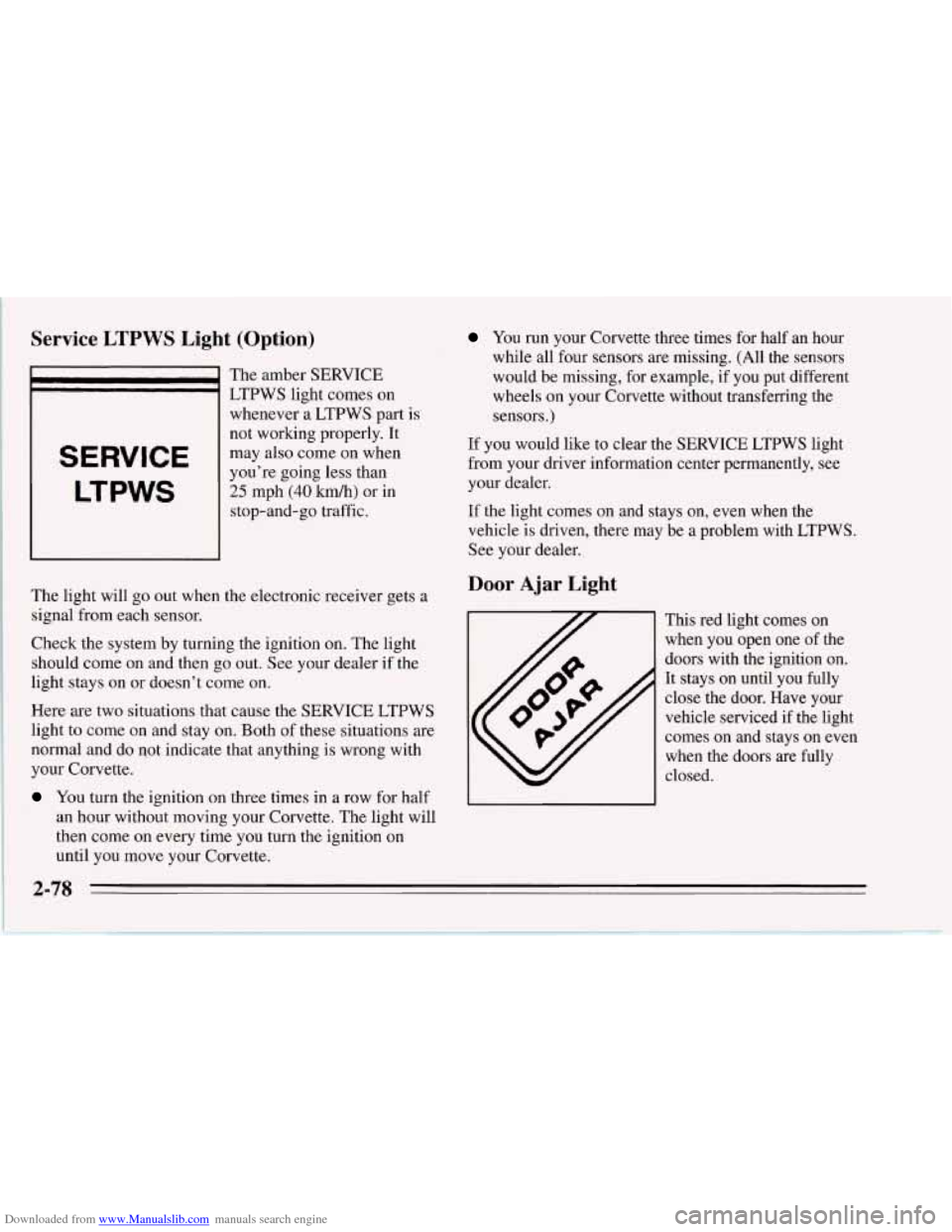
SERVICE
LTPWS
The amber SERVICE
LTPWS light comes on
whenever a LTPWS part is
not working properly. It
may also come on when
you’re going less than
25 mph (40 km/h) or in
stop-and-go traffic.
The light will
go out when the electronic receiver gets a
signal from each sensor.
Check the system by turning the ignition on. The light
should come on and then
go out. See your dealer if the
light stays on or doesn’t come on.
Here
are two situations that cause the SERVICE LTPWS
light to come on and stay on. Both of these situations are
normal and do qot indicate that anything is wrong with
your Corvette.
You turn the ignition on three times in a row for half
an hour without moving your Corvette. The light will
then come on every time you turn the ignition on
until you move your Corvette.
You run your Corvette three times for half an hour
while all four sensors
are missing. (All the sensors
would be missing, for example, if you put different
wheels on your Corvette without transferring the
sensors.)
If you would like to clear the SERVICE LTPWS light
from your driver information center permanently, see
your dealer.
If the light comes on and stays on, even when the
vehicle is driven, there may be a problem with LTPWS.
See your dealer.
Door Ajar Light
This red light comes on
when you open one of the
doors with the ignition on.
It stays on until you fully
close the door. Have your
vehicle serviced
if the light
comes on and stays on even
when the doors are fully
closed.
2-78
Page 123 of 386
Downloaded from www.Manualslib.com manuals search engine Malfunction Indicator Lamp (Service
Engine Soon Light)
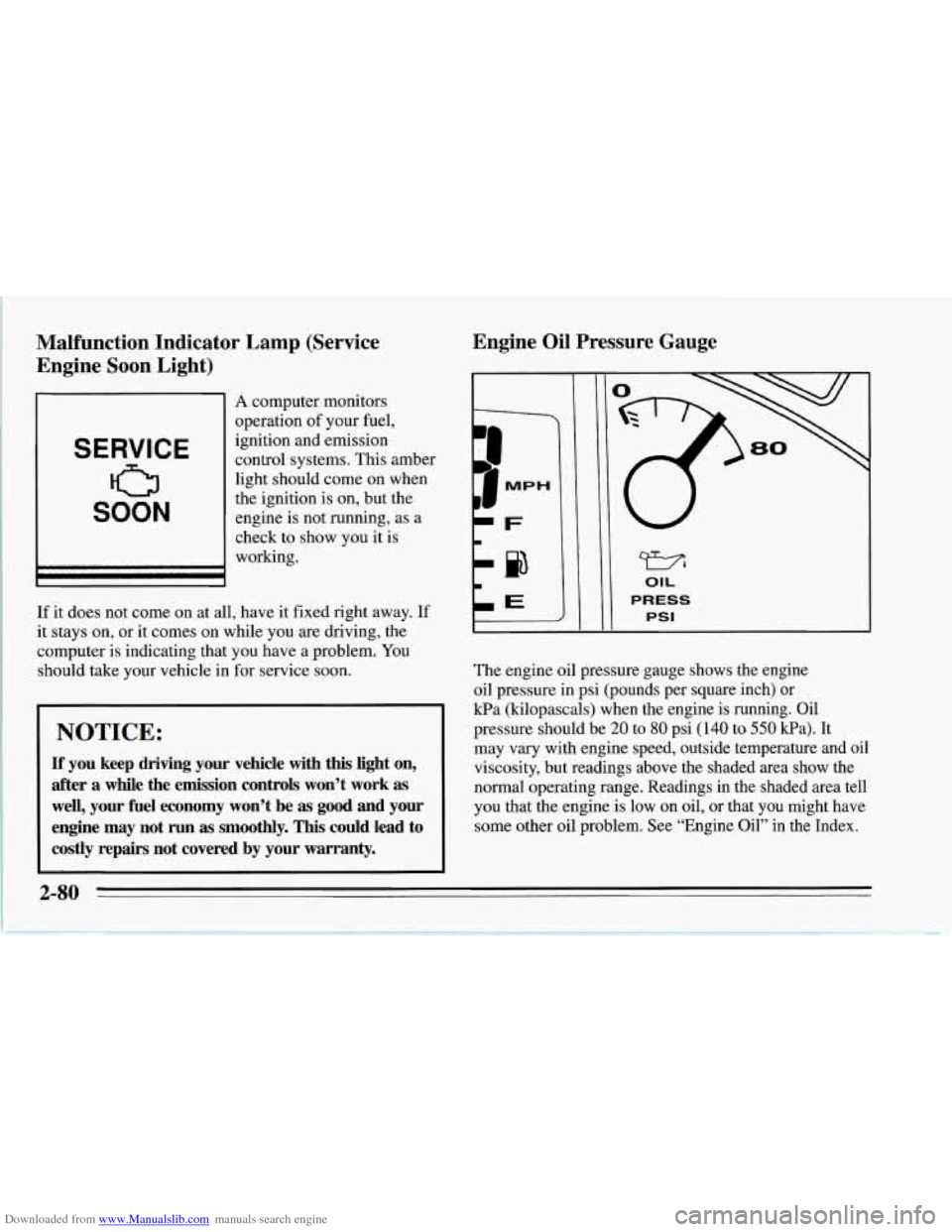
SERVICE
0
SOON
I
A computer monitors
operation
of your fuel,
ignition and emission
control systems. This amber
light should come on when
the ignition is on, but the
engine is not running, as a
check to show you it is
working.
If it does not come
on at all, have it fixed right away. If
it stays on, or it comes on while you are driving, the
computer is indicating that you have
a problem. You
should take your vehicle in for service soon.
NOTICE:
If you keep driving your vehicle with this light on,
after
a while the emission controls won’t work as
well, your fuel economy won’t be as good and your
engine may not
run as smoothly. This could lead to
costly repairs not covered by your warranty.
Engine Oil Pressure Gauge
-1
OIL
PRESS
PSI
The engine oil pressure gauge shows the engine
oil pressure in psi (pounds per square inch) or
kPa (kilopascals) when the engine is running. Oil
pressure should be
20 to 80 psi (140 to 550 Ea). It
may vary with engine speed, outside temperature and oil
viscosity, but readings above the shaded area show the
normal operating range. Readings in the shaded area tell
you that the engine is low on oil, or that you might have
some other oil problem. See “Engine Oil” in the Index.
2-80
Page 125 of 386
Downloaded from www.Manualslib.com manuals search engine I 1=1 1 I -1 I
r .
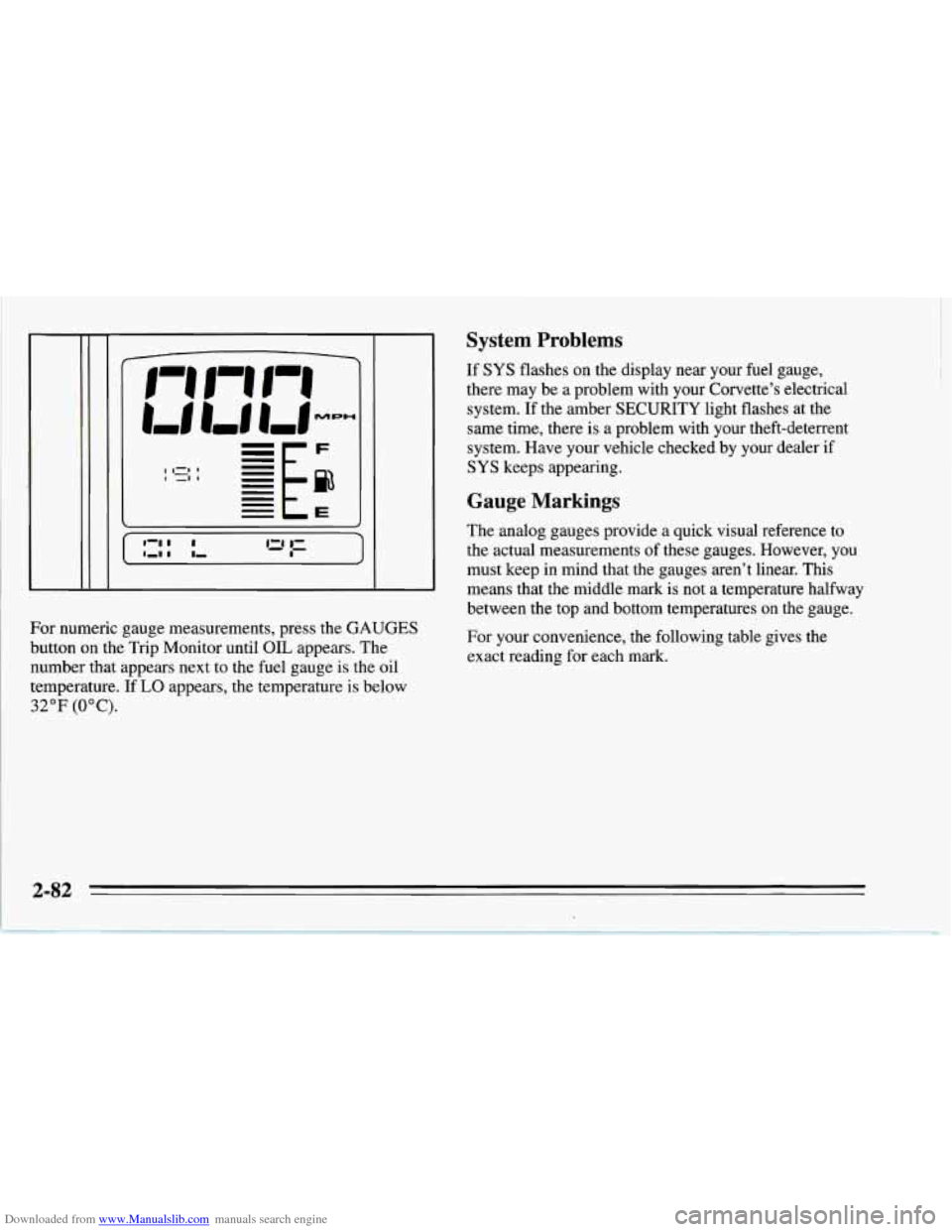
For numeric gauge measurements, press the GAUGES
button on the Trip Monitor until OIL appears. The
number that appears next to the fuel gauge is the oil
temperature.
If LO appears, the temperature is below
32°F (OOC).
System Problems
If SYS flashes on the display near your fuel gauge,
there may be a problem with your Corvette’s electrical
system. If the amber SECURITY light flashes at the
same time, there
is a problem with your theft-deterrent
system. Have your vehicle checked by your dealer
if
SYS keeps appearing.
Gauge Markings
The analog gauges provide a quick visual reference to
the actual measurements of these gauges. However, you
must keep in mind that the gauges aren’t linear. This
means that the middle mark is not a temperature halfway
between the top and bottom temperatures on the gauge.
For your convenience, the following table gives the
exact reading for each mark.
Page 128 of 386
Downloaded from www.Manualslib.com manuals search engine It’s normal for the transmission fluid temperature to
vary, depending on the type of driving you do and
weather conditions. If you drive on long grades on a hot
day, the transmission fluid temperature will be higher
than normal driving on a cold day. If you drive your
Corvette at high speeds with a lot of stop-and-go or fast
accelerations, your transmission fluid temperature may
also be higher.
If the transmission fluid exceeds
280°F (138 “C), the
CHECK GAUGES light will come on and HI
AUTO
will be displayed next to the transmission fluid
temperature when you toggle through the GAUGES
button. You should move the shift lever to DRIVE (D)
and continue driving at a slower, constant speed.
Monitor the transmission fluid temperature and allow
it
to cool to 180°F (82°C) to 200°F (93°C). Then, you
should check the transmission fluid level for a low fill or
overfill condition and bring your Corvette in for service
as soon as possible (see “Automatic Transmission Fluid”
in the Index). Also, check the engine coolant
temperature. If it’s too hot, see “Cooling System” in the
Index.
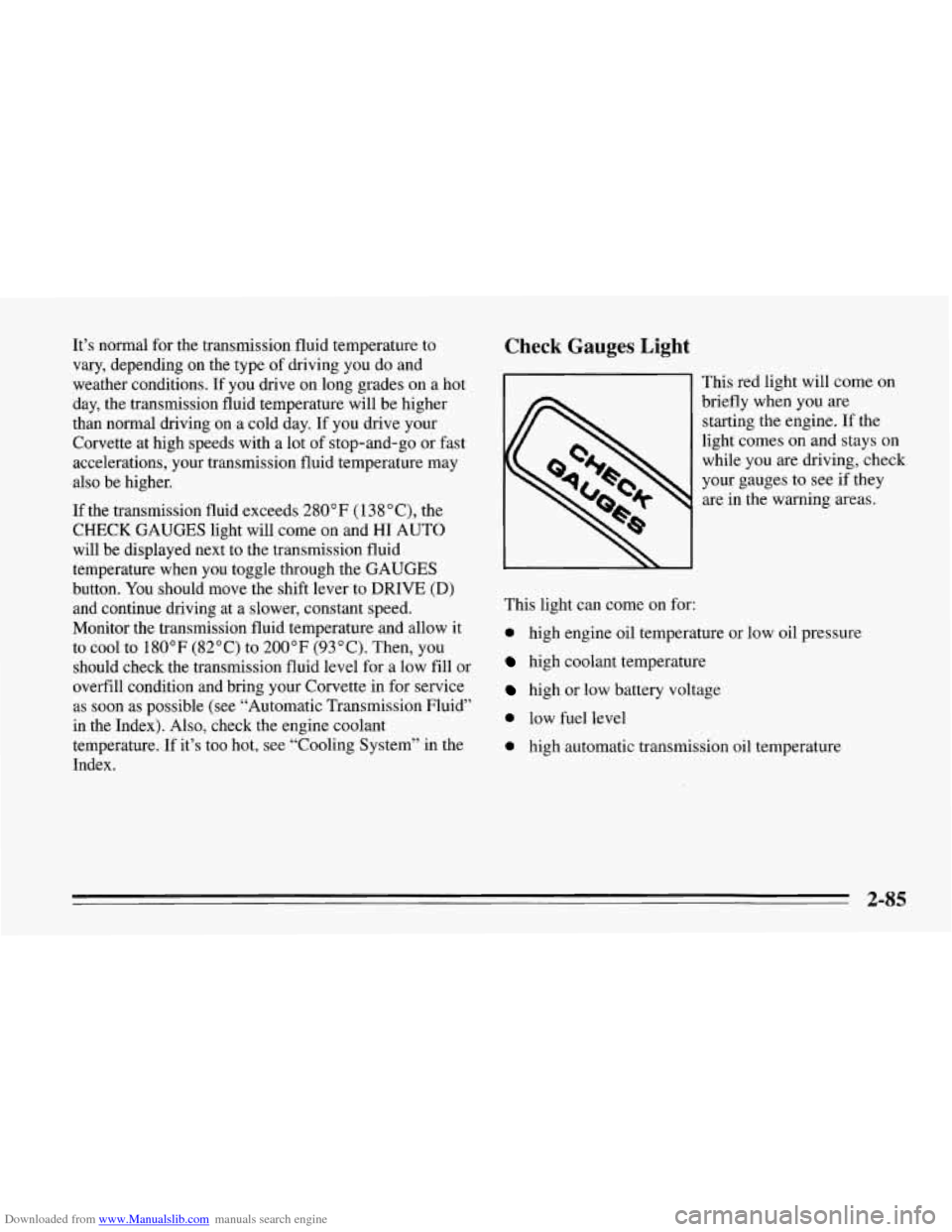
Check Gauges Light
This red light will come on
briefly when you are
starting the engine. If the
light comes on and stays on
while
you are driving, check
your gauges to see if they
are
in the warning areas.
This light can come
on for:
0 high engine oil temperature or low oil pressure
high coolant temperature
high or low battery voltage
0 low fuel level
0 high automatic transmission oil temperature
2-85
Page 151 of 386
Downloaded from www.Manualslib.com manuals search engine Defogging and Defrosting Windows
Your vehicle has several settings for clearing your
windows. The air conditioner compressor will run to
help remove moisture from the air.
To defrost the windshield quickly, press the arrows on
the
TEMP SET switch to set a comfortable temperature.
Press DEFROST and the fan will go to high speed. After
the windows are clear, you can lower the speed using the
downward arrow or
AUTO FAN.
With the automatic system, to warm passengers while
keeping the windshield clear? press the arrows on the
TEMP SET switch to set a comfortable temperature. Press
HEATER and DEFROST at the same time and, if you
don’t like the automatic setting, press the
arrows on the fan
speed switch.
To defrost the side windows quickly, press the arrows on
the
TEMP SET switch to set a comfortable temperature.
Then press DEFROST and,
if you don’t like the automatic
setting, press the arrows on the fan speed switch.
System Problems
If the light above an air control button flashes when you
turn on the ignition, your system may have an electrical
problem. The flashing will continue for one minute, then
stop.
The flashing light could also mean the refrigerant level
is too low in your system. The light will continue to
flash, even if refrigerant is added, until the system is
reset. Have your system checked and serviced if needed.
To reset your system:
1. Turn your ignition key to OFF or LOCK.
2. Remove the courtesy lamps and radio fuses from the
main fuse panel and wait one minute. See “Fuses and
Circuit Breakers” in the Index.
3. Put the fuses back in and start your vehicle.
The light shouldn’t come on and your system should be
working properly. If you still have a problem, see your
dealer.
Page 176 of 386
Downloaded from www.Manualslib.com manuals search engine 0
0
0
Do not get too close to the vehicle you want to pass
while you’re awaiting an opportunity. For one thing,
following too closely reduces your area of vision,
especially if you’re following a larger vehicle. Also,
you won’t have adequate space if the vehicle ahead
suddenly slows or stops. Keep back a reasonable
distance.
When it looks like a chance to pass is coming up,
start to accelerate but stay in the right lane and don’t
get too close. Time your move
so you will be
increasing speed as the time comes to move into the
other lane.
If the way is clear to pass, you will have a
“running start” that more than makes up for the
distance you would lose by dropping back. And if
something happens to cause you to cancel your pass,
you need only slow down and drop back again and
wait for another opportunity.
If other cars are lined up to pass a slow vehicle, wait
your turn. But take care that someone isn’t trying to
pass you as you pull out to pass the slow vehicle.
Remember to glance over your shoulder and check
the blind spot.
Check your mirrors, glance over your shoulder, and
start your left lane change signal before moving out
of the right lane to pass. When you are far enough
ahead of the passed vehicle to see its front in your
inside mirror, activate your right lane change signal
and move back into the right lane. (Remember that
your right outside mirror
is convex. The vehicle you
just passed may seem to be farther away from you
than it really
is.)
two-lane roads. Reconsider before passing the next
vehicle.
0 Try not to pass more than one vehicle at a time on
0 Don’t overtake a slowly moving vehicle too rapidly.
Even though the brake lights are not flashing, it may
be slowing down or starting to turn.
0 If you’re being passed, make it easy for the
following driver to get ahead of you. Perhaps you
can ease a little to the right.
4-13
Page 179 of 386
Downloaded from www.Manualslib.com manuals search engine You can be temporarily blinded by approaching lights. It
can take a second or two, or even several seconds, for
your eyes to readjust to the dark. When you are faced
with severe glare (as from a driver who doesn’t lower
the high beams, or a vehicle with misairned headlamps),
slow down a little. Avoid staring directly into the
approaching lights.
Keep your windshield and all the glass on your vehicle
clean
-- inside and out. Glare at night is made much
worse by dirt on the glass. Even the inside of the glass
can build up a film caused by dust. Dirty glass makes
lights dazzle and flash more than clean glass would,
making the pupils of your eyes contract repeatedly.
Remember that your headlamps light
up far less of a
roadway when you are
in a turn or curve. Keep your
eyes moving; that way, it’s easier
to pick out dimly
lighted objects. Just as your headlamps should
be
checked regularly for proper aim, so should your eyes
be examined regularly. Some drivers suffer from night
blindness
-- the inability to see in dim light -- and aren’t
even aware of it.
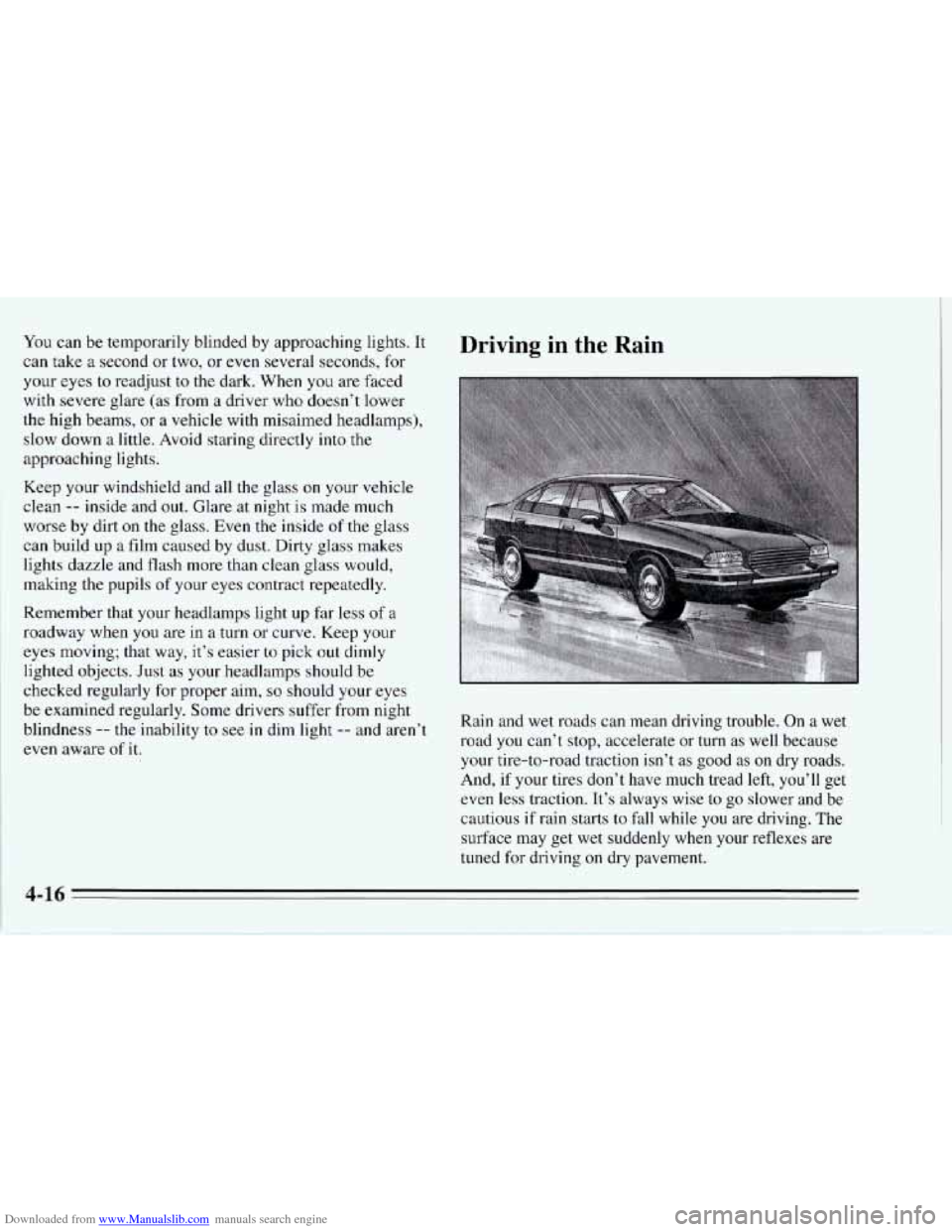
Driving in the Rain
Rain and wet roads can mean driving trouble. On a wet
road you can’t stop, accelerate or turn as well because
your tire-to-road traction isn’t as good as
on dry roads.
And,
if your tires don’t have much tread left, you’ll get
even
less traction. It’s always wise to go slower and be
cautious
if rain starts to fall while you are driving. The
surface may get wet suddenly when your reflexes are
tuned for driving on dry pavement.
4-16
Page 182 of 386
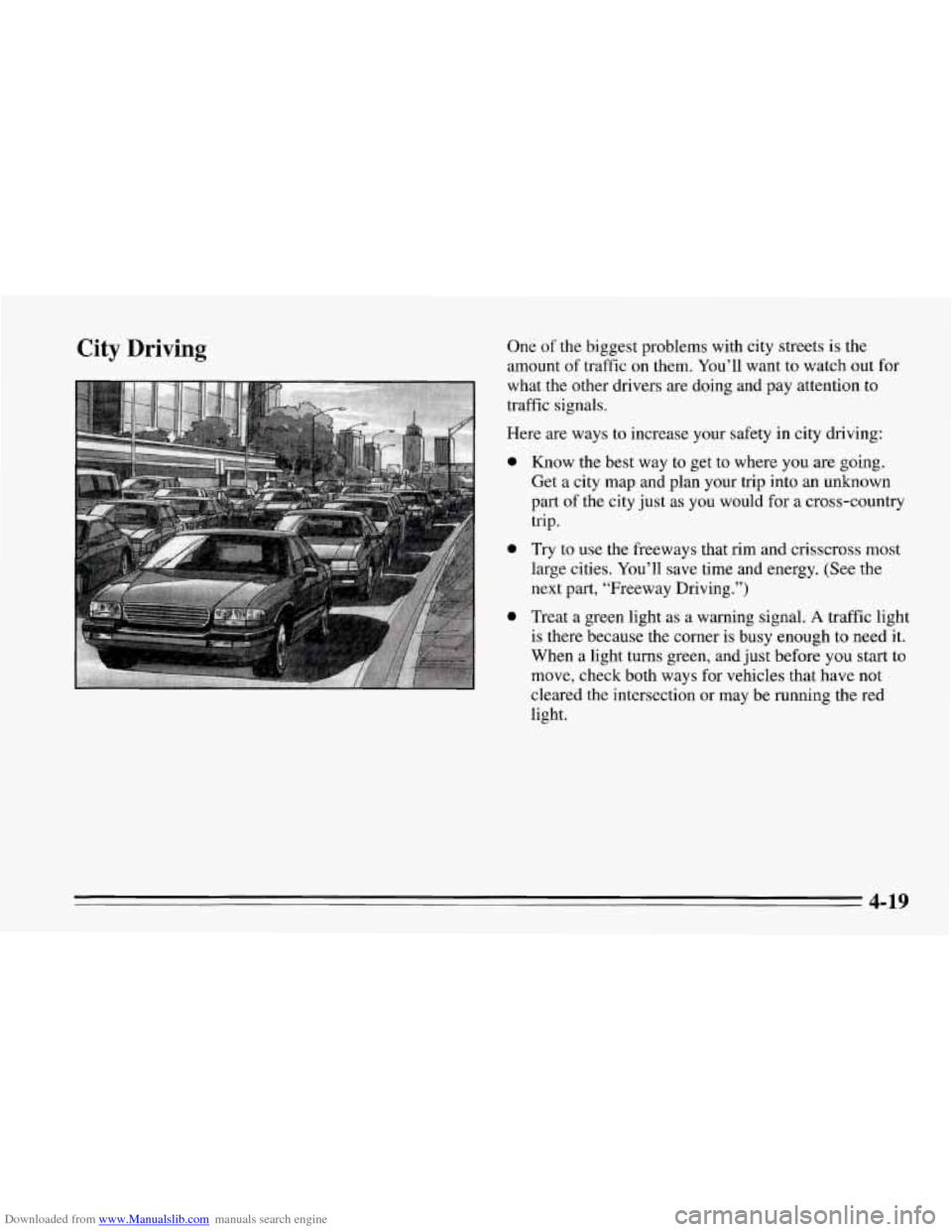
Downloaded from www.Manualslib.com manuals search engine City Driving One of the biggest problems with city streets is the
amount of traffic on them. You’ll want to watch out for
what the other drivers are doing and pay attention to
traffic signals.
Here are ways to increase your safety in city driving:
0 Know the best way to get to where you are going.
Get a city map and plan your trip into an unknown
part
of the city just as you would for a cross-country
trip.
0 Try to use the freeways that rim and crisscross most
large cities.
You’ll save time and energy. (See the
next part, “Freeway Driving.”)
0 Treat a green light as a warning signal. A traffic light
is there because the corner is busy enough to need it.
When a light turns green, and just before
you start to
move, check both ways for vehicles that have not
cleared the intersection or may be running the red
light.
4-19
Page 183 of 386
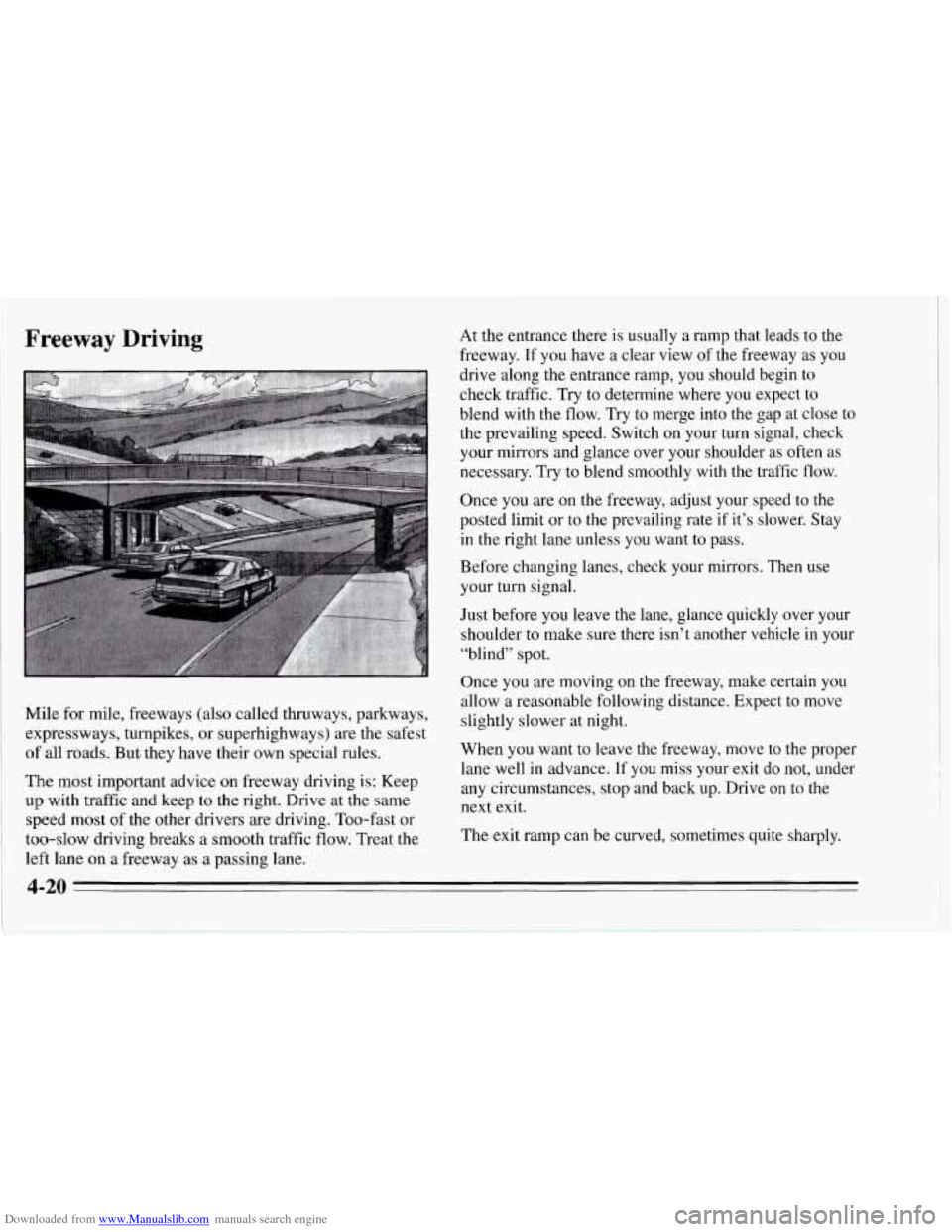
Downloaded from www.Manualslib.com manuals search engine Freeway Driving
Mile for mile, freeways (also called thruways, parkways,
expressways, turnpikes, or superhighways) are the safest
of all roads. But they have their own special rules.
The most important advice on freeway driving is: Keep
up with traffic and keep to the right. Drive at the same
speed most of the other drivers are driving. Too-fast or
too-slow driving breaks a smooth traffic flow. Treat the
left lane
on a freeway as a passing lane. At
the entrance there is usually a ramp that leads to the
freeway. If you have a clear view of the freeway as you
drive along the entrance ramp, you should begin to
check traffic. Try to determine where you expect to
blend with the flow. Try to merge into the gap at close to
the prevailing speed. Switch on your turn signal, check
your mirrors and glance over your shoulder
as often as
necessary. Try to blend smoothly with the traffic flow.
Once you are on the freeway, adjust your speed to the
posted limit or to the prevailing rate if it’s slower. Stay
in the right lane unless you want to pass.
Before changing lanes, check your mirrors. Then use
your turn signal.
Just before you leave the lane, glance quickly over your
shoulder to make sure there isn’t another vehicle in your
“blind” spot.
Once
you are moving on the freeway, make certain you
allow a reasonable following distance. Expect to move
slightly slower at night.
When you want to leave the freeway, move to the proper
lane well in advance.
If you miss your exit do not, under
any circumstances, stop and back up. Drive
on to the
next exit.
The exit ramp can be curved, sometimes quite sharply.
4-20