cooling CHEVROLET CORVETTE 1995 4.G User Guide
[x] Cancel search | Manufacturer: CHEVROLET, Model Year: 1995, Model line: CORVETTE, Model: CHEVROLET CORVETTE 1995 4.GPages: 386, PDF Size: 20.15 MB
Page 211 of 386
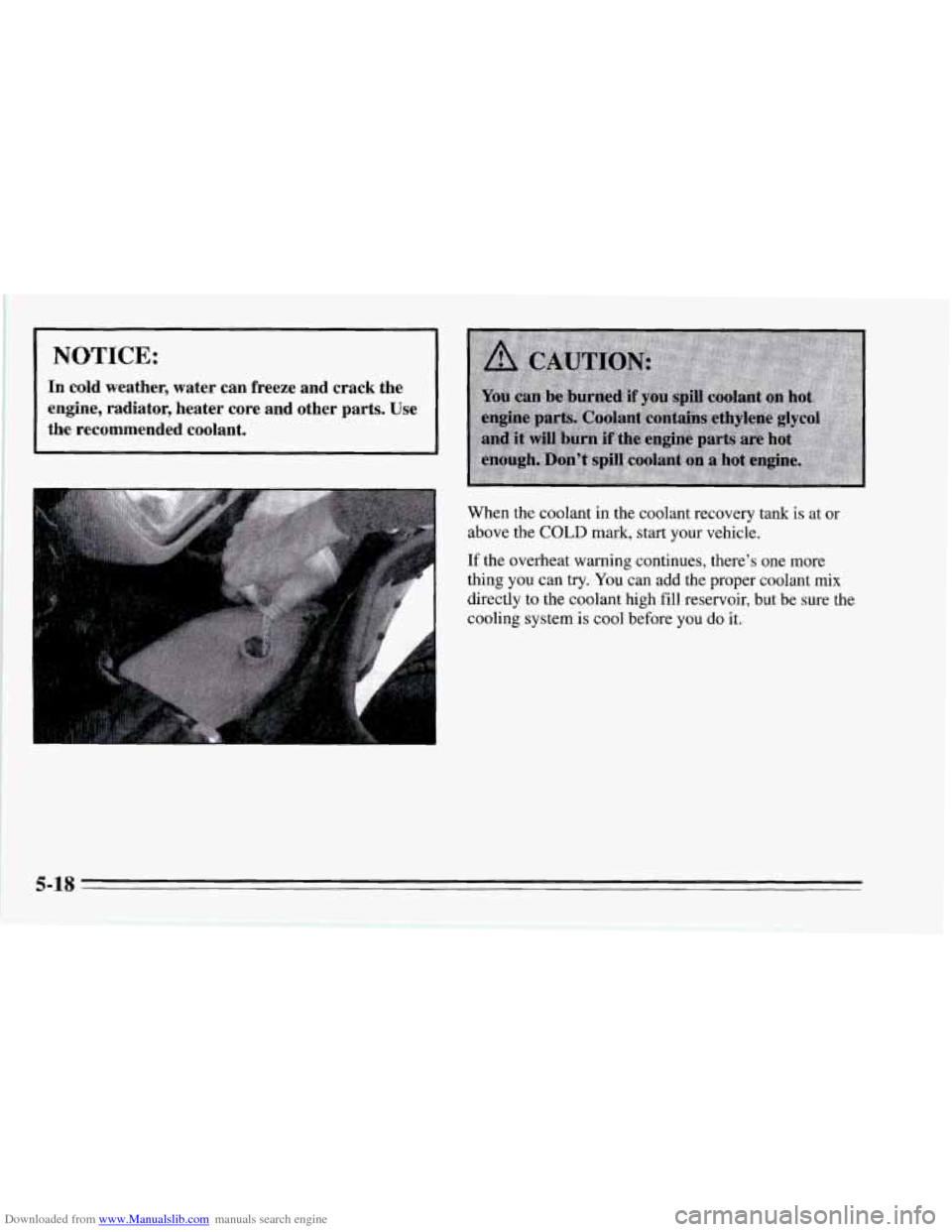
Downloaded from www.Manualslib.com manuals search engine In cold weather, water can freeze and crack the
engine, radiator, heater core and other parts. Use
the recommended coolant.
When the coolant in the coolant recovery tank is at or
above the
COLD mark, start your vehicle.
If the overheat warning continues, there's one more
thing you can try.
You can add the proper coolant mix
directly to the coolant high fill reservoir, but be sure the
cooling system
is cool before you do it.
Page 213 of 386
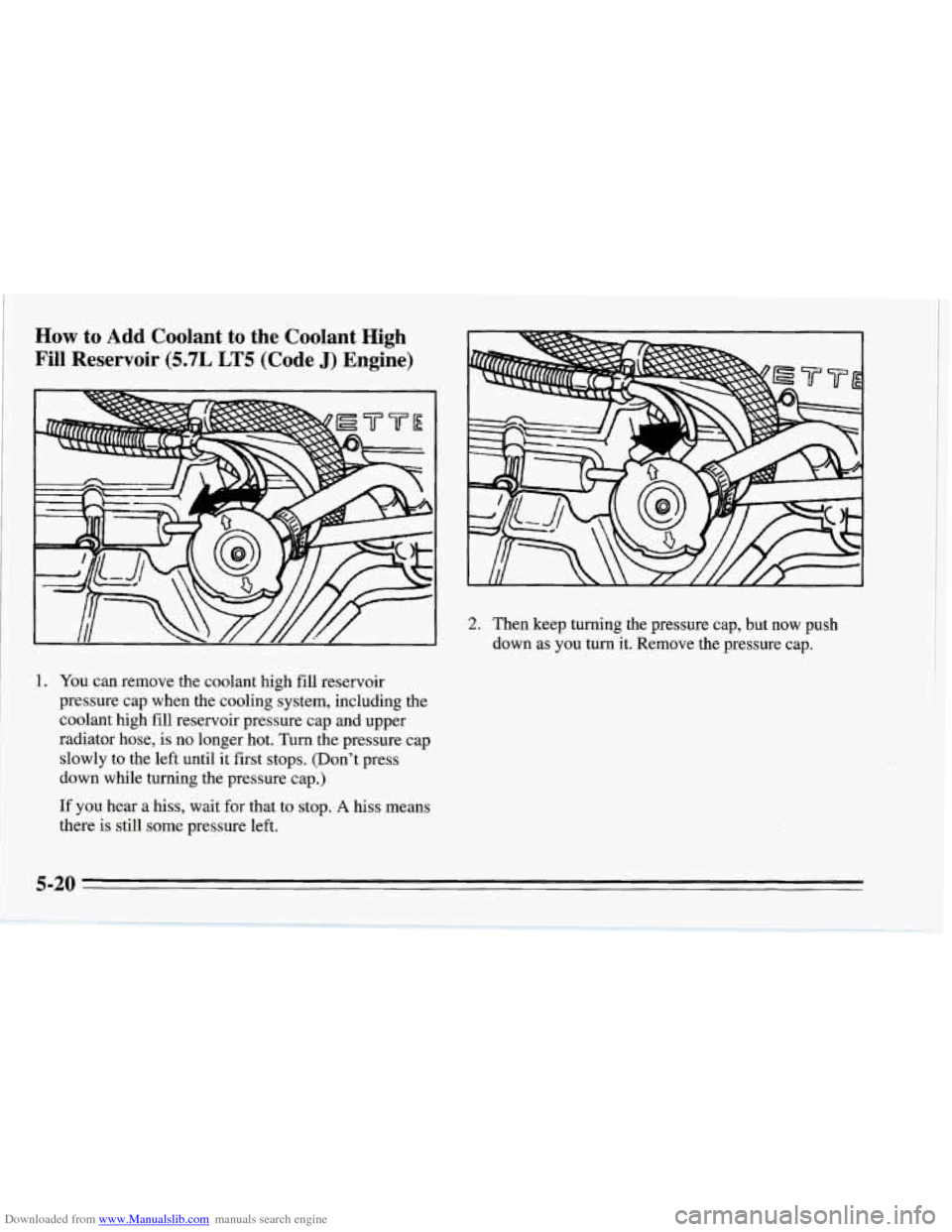
Downloaded from www.Manualslib.com manuals search engine How to Add Coolant to the Coolant High
Fill Reservoir
(5.7L LT5 (Code J) Engine)
2. Then keep turning the pressure cap, but now push
down as you turn it. Remove the pressure cap.
1. You can remove the coolant high fill reservoir
pressure cap when the cooling system, including the
coolant high fill reservoir pressure cap and upper
radiator hose, is no longer hot. Turn the pressure cap
slowly to the left until it first stops. (Don’t press
down while turning the pressure cap.)
If you hear a
hiss, wait for that to stop. A hiss means
there is still
some pressure left.
5-20
Page 217 of 386
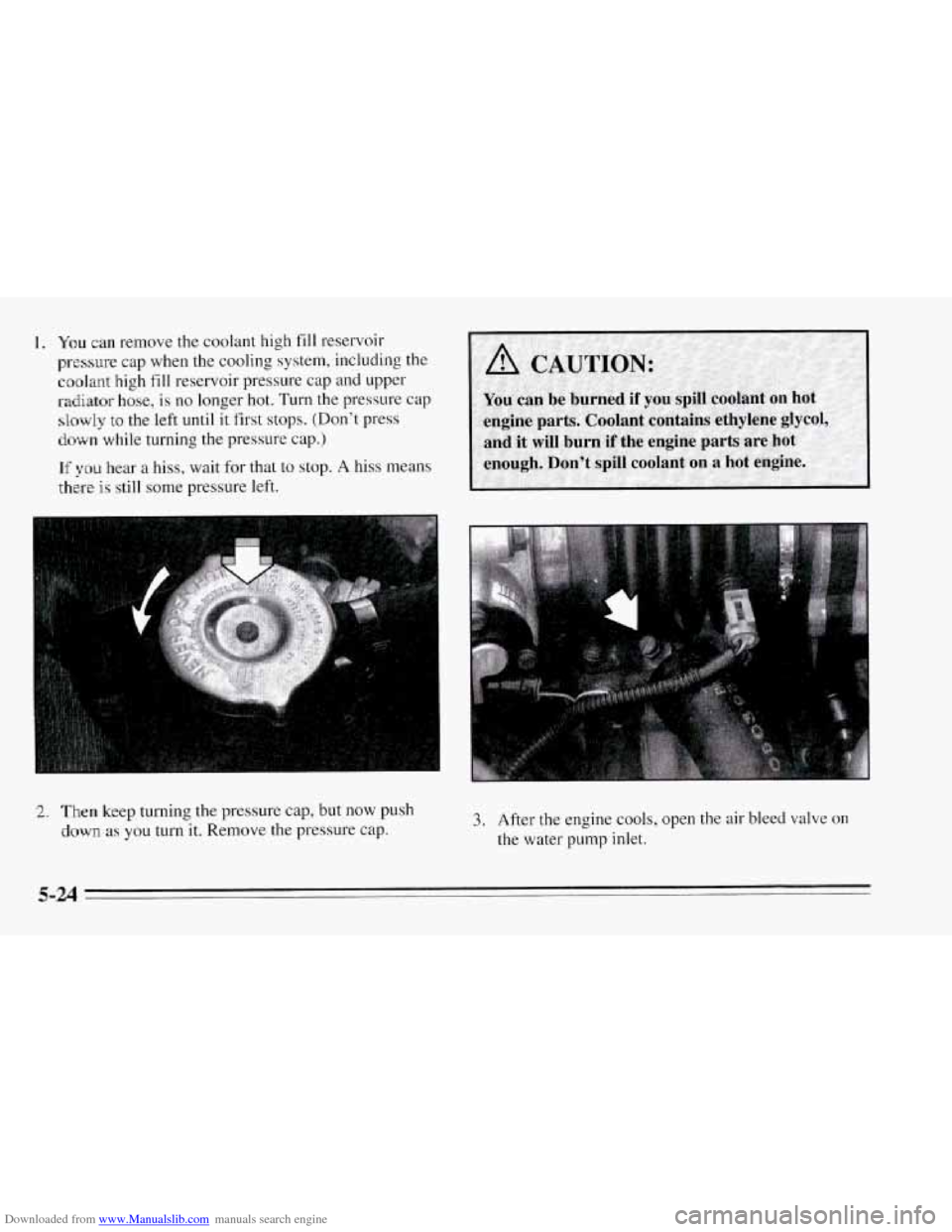
Downloaded from www.Manualslib.com manuals search engine 1. You can remove the coolant high fill reservoir
pressure cap when the cooling system, including the
coolant high fill reservoir pressure cap and upper
radiator hose, is no longer hot. Turn the pressure cap
slowly to the left until it first stops. (Don’t press
down while turning the pressure cap.)
If
you hear a hiss, wait for that to stop. A hiss means
there
is still some pressure left.
2.. Then keep turning the pressure cap, but now push
down as you turn it. Remove the pressure cap. 3. After the engine cools, open the air bleed valve on
the water pump inlet.
5-24
Page 262 of 386

Downloaded from www.Manualslib.com manuals search engine What to Use What to Use
To add lubricant when the level is low, use Axle
Lubricant (GM Part
No. 12345977) or SAE SOW-90
GL-5 gear lubricant.
To completely refill after draining,
add
4 ounces (1 18 ml) of Limited-Slip Differential
Lubricant Additive (GM Part
No. 1052358). Then fill to
the bottom of the filler plug hole with Axle Lubricant
(GM Part
No. 12345977) or SAE 8OW-90 GL-5 gear
lubricant.
Engine Coolant
The following explains your cooling system and how to
add coolant when it is low.
If you have a problem with
engine overheating or if you need to add coolant to your
high fill reservoir, see “Engine Overheating” in the
Index.
The proper coolant for your Corvette will:
Give freezing protection down to -34°F (-37°C).
Give boiling protection up to 262 “F (128 ” C).
Protect against rust and corrosion.
Help keep the proper engine temperature.
Let the warning lights work as they should. Use a mixture
of one-half
clean water (preferably
distilled) and one-half antifreeze that meets
“GM
Specification 1825M,” which won’t damage aluminum
parts.
You can also use a recycled coolant conforming to
GM Specification 1825M with a complete coolant flush
and refill. Use GM Engine Coolant Supplement (sealer)
with any complete coolant flush and refill. If
you use
this mixture, you don’t need to add anything else.
6-27
Page 289 of 386
Downloaded from www.Manualslib.com manuals search engine Wheel Alignment and Tire Balance
The wheels on your vehicle were aligned and balanced
carefully at the factory
to give you the longest tire life
and best overall performance.
In most cases, you will not need to have your wheels
aligned again. However,
if you notice unusual tire wear
or your vehicle pulling one way or the other, the
alignment may need to be reset.
If you notice your
vehicle vibrating when driving
on a smooth road, your
wheels may need to be rebalanced.
Wheel Replacement
Replace any wheel that is bent, cracked, or badly rusted
or corroded. If wheel nuts keep coming loose, the wheel,
wheel bolts, and wheel nuts should be replaced.
If the
wheel leaks air, replace it (except some aluminum
wheels, which can sometimes be repaired). See your
Chevrolet dealer
if any of these conditions exist.
Your dealer will know the lund of wheel you need.
Each new wheel should have the same load carrying capacity, diameter, width, offset, and be mounted the
same way as the one it replaces.
If you need to replace any of your wheels, wheel bolts,
or wheel nuts, replace them only with new
GM original equipment parts.
This way, you will be sure to have the
right wheel, wheel bolts, and wheel nuts for your
Corvette model.
I NOTICE:
The wrong wheel can also cause problems with
bearing life, brake cooling,
speedometer/odometer calibration, headlamp aim, bumper height, vehicle ground clearance,
and tire clearance to the body and chassis.
6-54
Page 306 of 386
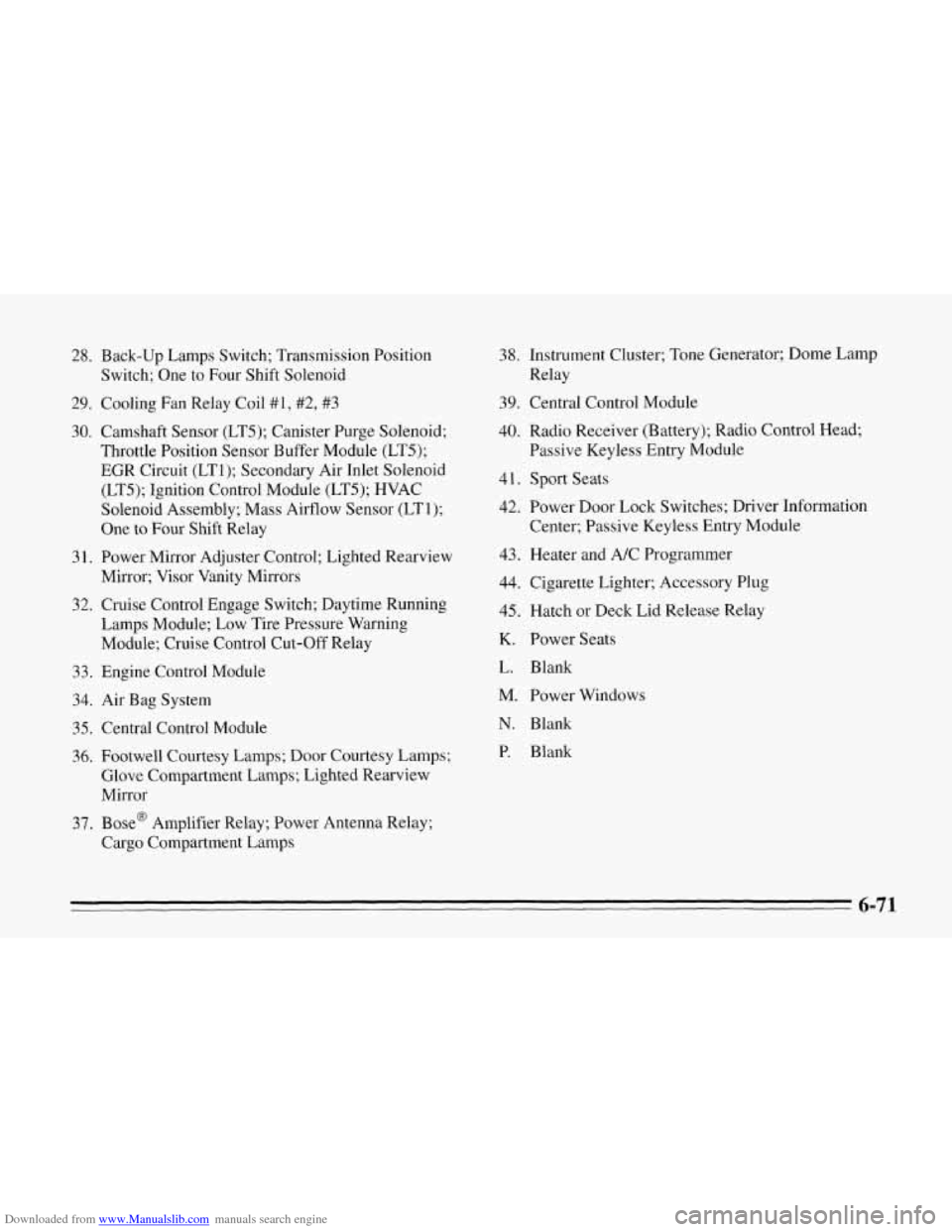
Downloaded from www.Manualslib.com manuals search engine 28. Back-up Lamps Switch; Transmission Position
Switch; One to Four Shift Solenoid
29. Cooling Fan Relay Coil
#I, #2, #3
30. Camshaft Sensor (LT5); Canister Purge Solenoid;
Throttle Position Sensor Buffer Module (LT5);
EGR Circuit (LT1); Secondary Air Inlet Solenoid
(LT5); Ignition Control Module (LT5); HVAC
Solenoid Assembly; Mass Airflow Sensor (LT 1);
One
to Four Shift Relay
3 1. Power Mirror Adjuster Control; Lighted Rearview
Mirror; Visor Vanity Mirrors
32. Cruise Control Engage Switch; Daytime Running
Lamps Module; Low Tire Pressure Warning
Module; Cruise Control Cut-Off Relay
33. Engine Control Module
34. Air Bag System
35. Central Control Module
36. Footwell Courtesy Lamps; Door Courtesy Lamps;
Glove Compartment Lamps; Lighted Rearview
Mirror
37, Bose@ Amplifier Relay; Power Antenna Relay;
Cargo Compartment Lamps
38. Instrument Cluster; Tone Generator; Dome Lamp
Relay
39. Central Control Module
40, Radio Receiver (Battery); Radio Control Head;
Passive Keyless Entry Module
41. Sport Seats
42. Power Door Lock Switches; Driver Information
Center; Passive Keyless Entry Module
43. Heater and A/C Programmer
44. Cigarette Lighter; Accessory Plug
45. Hatch or Deck Lid Release Relay
K. Power Seats
L. Blank
M. Power Windows
N. Blank
P. Blank
6-71
Page 307 of 386
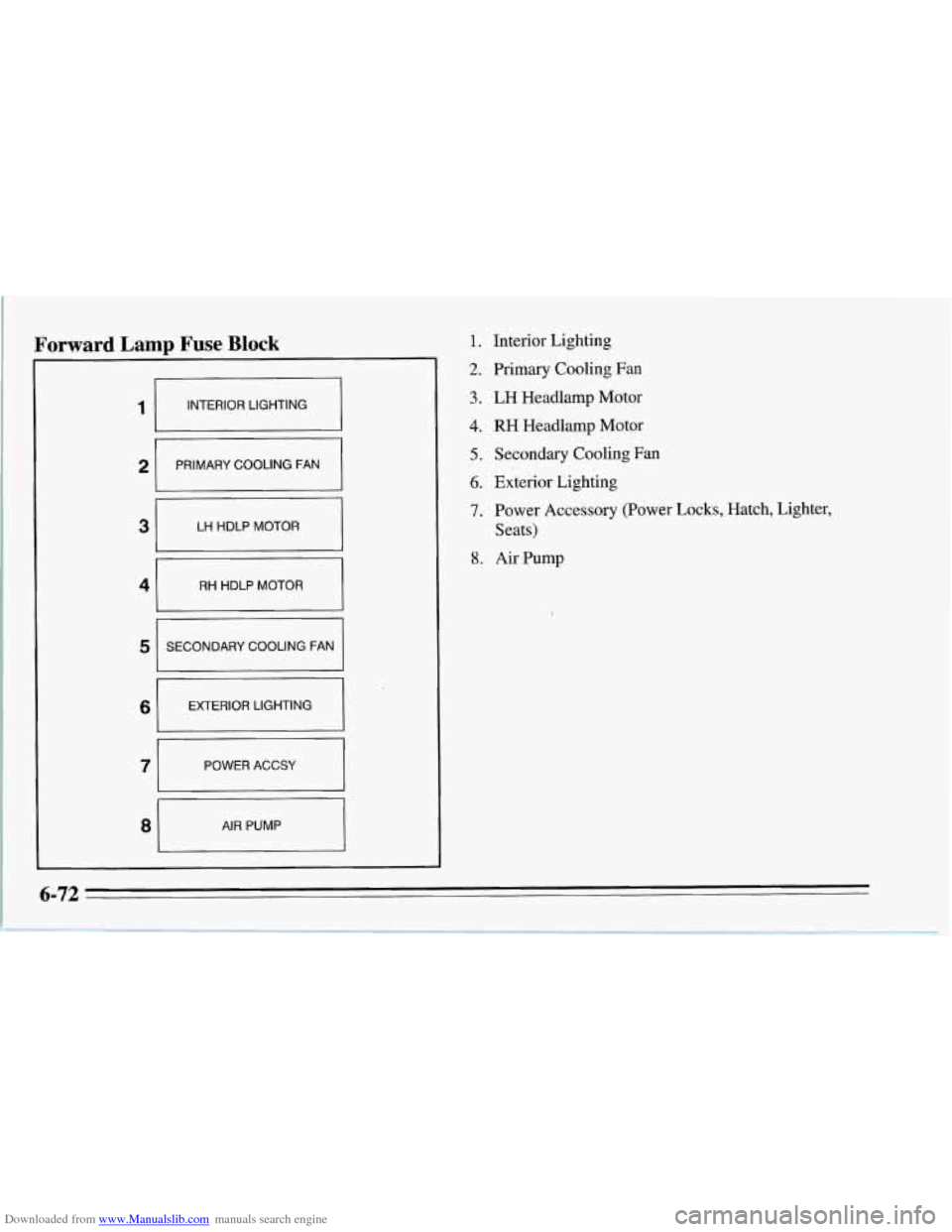
Downloaded from www.Manualslib.com manuals search engine Forward Lamp Fuse Block -
INTERIOR LIGHTING
PRIMARY COOLING FAN
LH HDLP
MOTOR
RH HDLP MOTOR
EXTERIOR LIGHTING
POWER
ACCSY
AIR PUMP
1. Interior Lighting
2. Primary Cooling Fan
3. LH Headlamp Motor
4. RH Headlamp Motor
5. Secondary Cooling Fan
6. Exterior Lighting
7. Power Accessory (Power Locks, Hatch, Lighter,
Seats)
8. Air Pump
6-72
Page 313 of 386

Downloaded from www.Manualslib.com manuals search engine Capacities (Approximate)
Air Conditioning? ............................ See the refrigerant information lab
The following approximate capacities are given in U.S. and metric conversions.
Automatic Transmission
Drain and Refill ....................... 10.0 pt. (4.7 L)*
Overhaul
....... ............. 21.6pt. (10.2L)*
VIN Engine Code J .................... 14.7 qt. (13.9 L)
VIN Engine Code P .................... 17.8 qt. (16.9 L)
Cooling System
Crankcase
VIN Engine Code J
Without Filter Change ................... 7.6 qt. (7.2 L)*
With Filter Change
..................... 8.6 qt. (8.1 L)*
Without Filter Change ................... 4.0 qt. (3.8 L)*
With Filter Change
..................... 4.5 qt. (4.3 L)*
Fuel Tank
........................... 20.0 gal. (75.7 L)
Manual Transmission (Overhaul)
.......... 4.4 pt. (2.1 L)*
Lubricant
............................. 1.5 qt. (1.42 L)
Limited Slip Additive
................... 4.0 oz. (1 18 ml)
VIN
Engine Code
P
Rear Axle
7 Not all air conditioning refrigerants are the same.
If the air conditioning system in your vehicle needs
refrigerant, be sure the proper refrigerant is used.
If you’re not sure, ask your Chevrolet dealer.
el und er
the hood.
* Recheck fluid level after filling. See Section 6 or
the Index.
6-78
Page 319 of 386
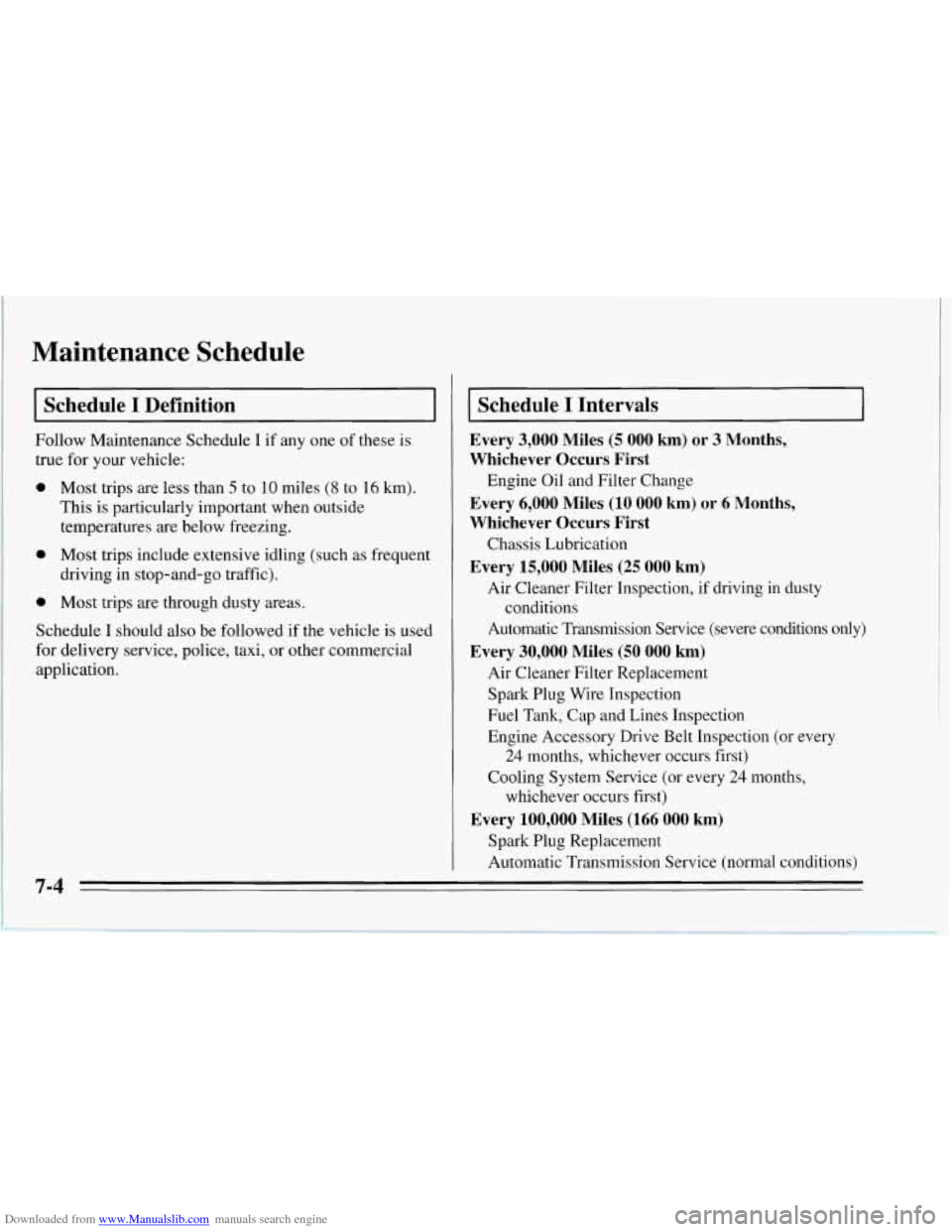
Downloaded from www.Manualslib.com manuals search engine Maintenance Schedule
I Schedule I Definition I
Follow Maintenance Schedule I if any one of these is
true for your vehicle:
0 Most trips are less than 5 to 10 miles (8 to 16 km).
This is particularly important when outside
temperatures are below freezing.
0 Most trips include extensive idling (such as frequent
driving in stop-and-go traffic).
0 Most trips are through dusty areas.
Schedule
I should also be followed if the vehicle is used
for delivery service, police, taxi, or other commercial
application.
Schedule I Intervals
Every 3,000 Miles (5 000 km) or 3 Months,
Whichever Occurs First
Every 6,000 Miles
(10 000 km) or 6 Months,
Whichever Occurs First
Chassis Lubrication
Every 15,000 Miles (25 000 km)
Air Cleaner Filter Inspection, if driving in dusty
Automatic Transmission Service (severe conditions only)
Every 30,000 Miles (50 000 km)
Air Cleaner Filter Replacement
Spark Plug Wire Inspection
Fuel Tank, Cap and Lines Inspection
Engine Accessory Drive Belt Inspection (or every
24 months, whichever occurs first)
Cooling System Service (or every
24 months,
whichever occurs first)
Spark Plug Replacement
Automatic Transmission Service (normal conditions)
Engine Oil and Filter Change
conditions
Every 100,000 Miles (166 000 km)
7-4
Page 320 of 386
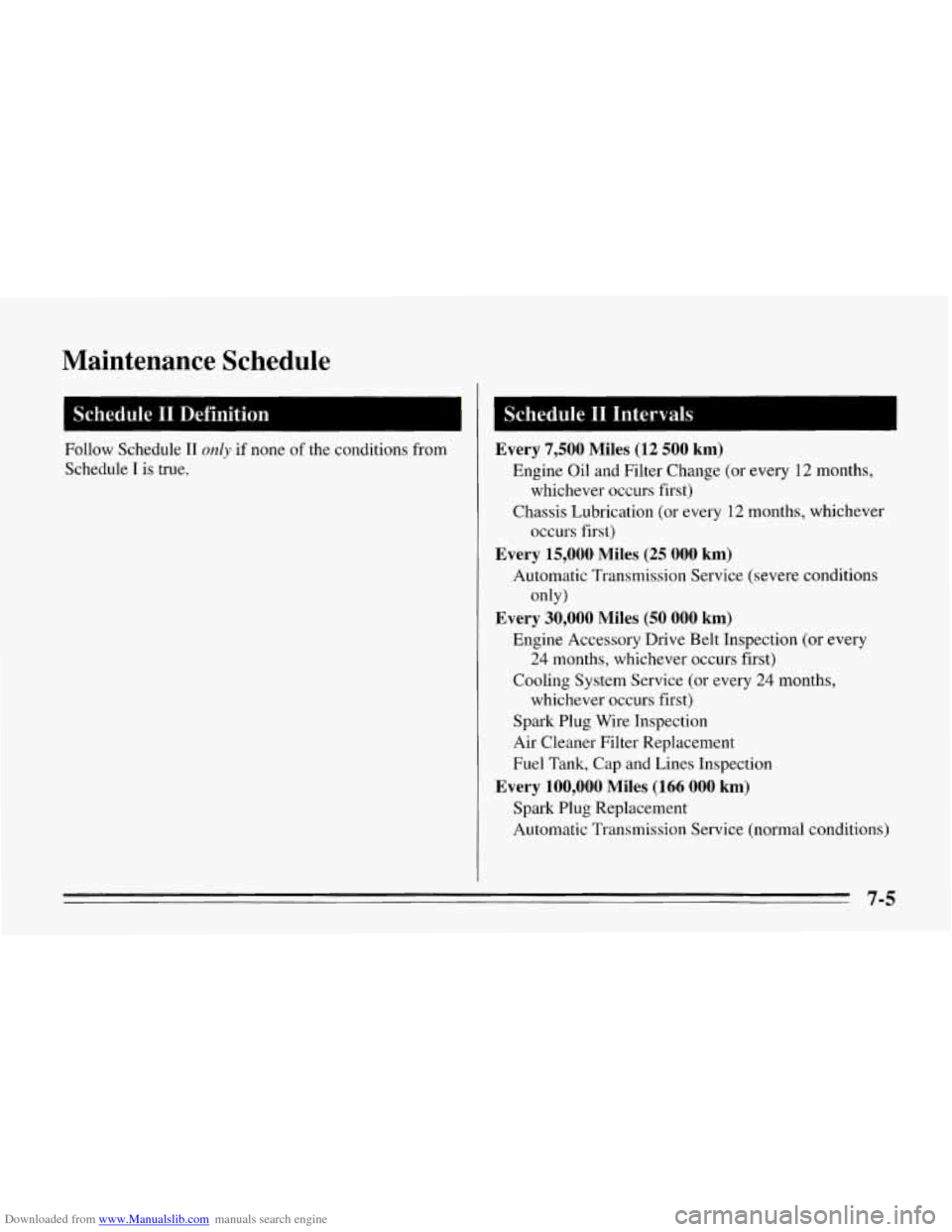
Downloaded from www.Manualslib.com manuals search engine Maintenance Schedule
Follow Schedule I1 only if none of the conditions from
Schedule
I is true.
I Schedule I1 Intervals I
Every 7,500 Miles (12 500 km)
whichever occurs first)
occurs first)
Engine
Oil and Filter Change (or every
12 months,
Chassis Lubrication (or every
12 months, whichever
Every 15,000 Miles (25 000 km)
Automatic Transmission Service (severe conditions
only
1
Every 30,000 Miles (50 000 km)
Engine Accessory Drive Belt Inspection (or every
24 months, whichever occurs first)
Cooling System Service (or every
24 months,
whichever occurs first)
Spark Plug Wire Inspection
Air Cleaner Filter Replacement
Fuel Tank, Cap and Lines Inspection
Every 100,000 Miles (166 000 km)
Spark Plug Replacement
Automatic Transmission Service (normal conditions)
7-5