transmission CHEVROLET CORVETTE 1995 4.G User Guide
[x] Cancel search | Manufacturer: CHEVROLET, Model Year: 1995, Model line: CORVETTE, Model: CHEVROLET CORVETTE 1995 4.GPages: 386, PDF Size: 20.15 MB
Page 70 of 386
Downloaded from www.Manualslib.com manuals search engine SECOND (2): This position gives you more power but
lower fuel economy. You can use SECOND
(2) on hills.
It can help control your speed as you go down steep
mountain roads, but then you would also want to use
your brakes off and on.
FIRST (1): This position gives you even more power
(but lower fuel economy) than SECOND
(2). You can
use
it on very steep hills, or in deep snow or mud. If the
selector lever is put in FIRST
(l), the transmission
won’t shift into first gear until the vehicle
is going
slowly enough.
NOTICE:
If your rear wheels can’t rotate, don’t try to
drive. This might happen if you were stuck in
very deep sand or mud or were up against
a solid
object. You could damage your transmission.
Also, if you stop when going uphill, don’t hold
your vehicle there with only the accelerator
pedal. This could overheat and damage the
transmission. Use your brakes or shift into
PARK
(P) to hold your vehicle in position on a
hill.
Maximum engine speed is limited to protect driveline
components from improper operation.
2-27
Page 71 of 386
Downloaded from www.Manualslib.com manuals search engine Manual Transmission
Six-Speed
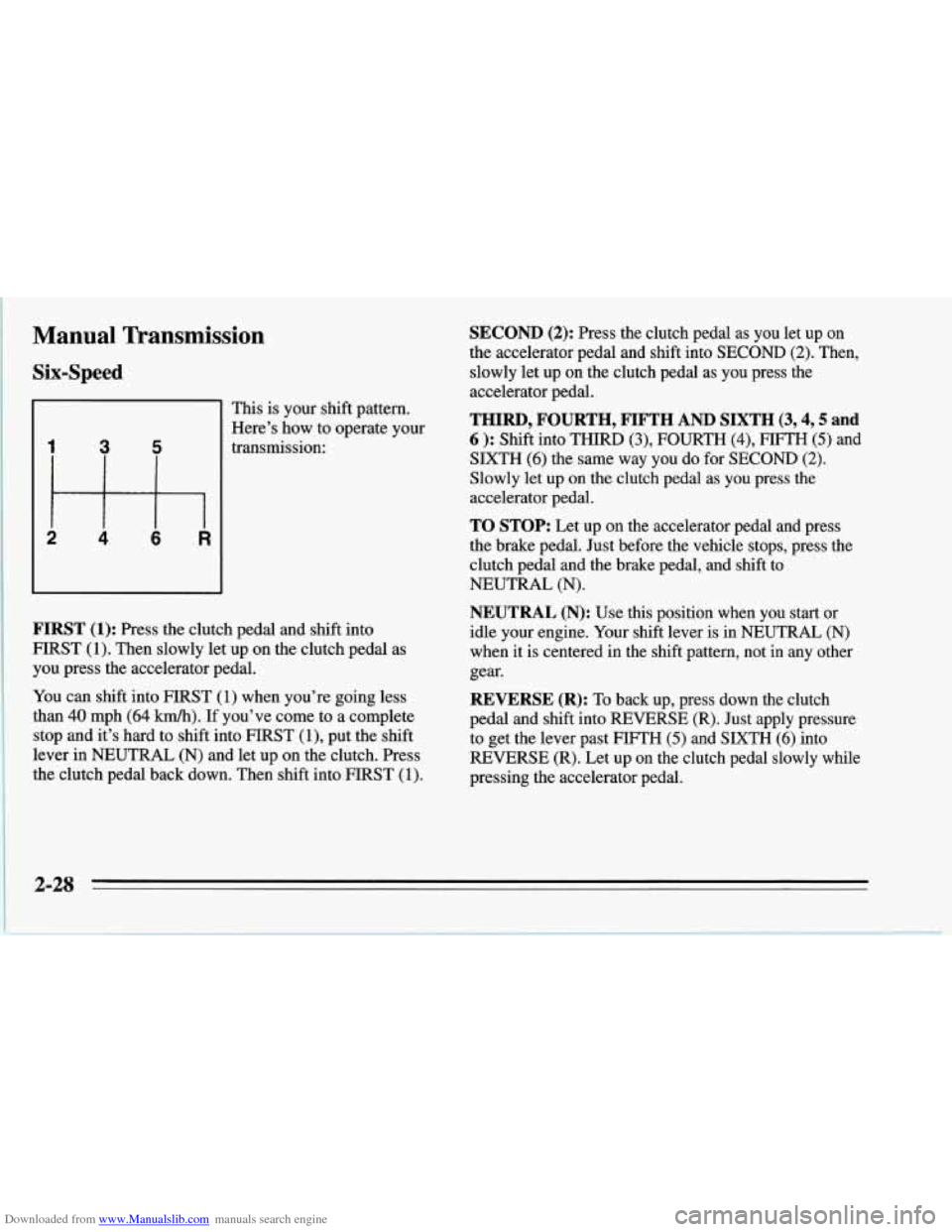
I This is your shift pattern.
Here’s how to operate your
transmission:
1
ttFl
2 4 6 .R
FIRST (1): Press the clutch pedal and shift into
FIRST (1). Then slowly let up on the clutch pedal as
you press the accelerator pedal.
You can shift into FIRST (1) when you’re going less
than
40 mph (64 km/h). If you’ve come to a complete
stop and it’s hard to shift into FIRST
(1), put the shift
lever in NEUTRAL (N) and let up on the clutch. Press
the clutch pedal back down. Then shift into FIRST
(1).
SECOND (2): Press the clutch pedal as you let up on
the accelerator pedal and shift into SECOND
(2). Then,
slowly let up on the clutch pedal as you press the
accelerator pedal.
THIRD, FOURTH, FIFTH AND SIXTH (3,4,5 and
6 ): Shift into THIRD (3), FOURTH (4), FIFTH (5) and
SIXTH
(6) the same way you do for SECOND (2).
Slowly let up on the clutch pedal as you press the
accelerator pedal.
TO STOP: Let up on the accelerator pedal and press
the brake pedal. Just before the vehicle stops, press the
clutch pedal and the brake pedal, and shift to
NEUTRAL
(N).
NEUTRAL (N): Use this position when you start or
idle your engine. Your shift lever is in NEUTRAL (N)
when it is centered in the shift pattern, not in any other
gear.
REVERSE (R): To back up, press down the clutch
pedal and shift into REVERSE (R). Just apply pressure
to get the lever past FIFTH
(5) and SIXTH (6) into
REVERSE
(R). Let up on the clutch pedal slowly while
pressing the accelerator pedal.
2-28
Page 72 of 386
Downloaded from www.Manualslib.com manuals search engine Shift Speeds (Manual Transmission)
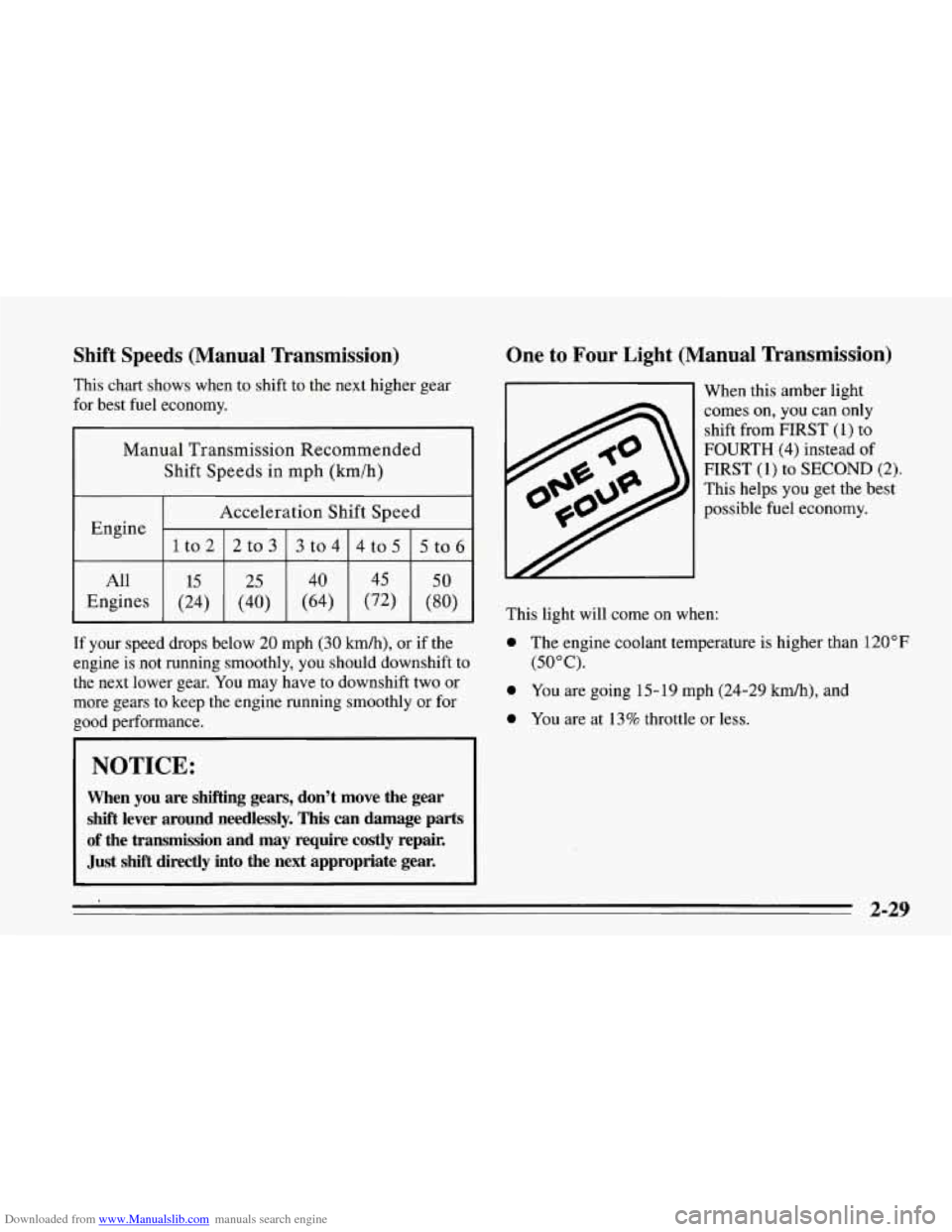
This chart shows when to shift to the next higher gear
for best fuel economy.
Manual Transmission Recommended
Shift Speeds in mph
(krn/h)
Acceleration Shift Speed
1to2
5to6 4to5
3to4
2to3
Engine
All
(80) (72)
(64)
(40)
(24) Engines
50 45 40
25 15
If your speed drops below 20 mph (30 kmk), or if the
engine is not running smoothly, you should downshift to
the next lower gear. You may have to downshift two or
more gears to keep the engine running smoothly or for
good performance.
NOTICE:
When you are shifting gears, don’t move the gear
shift lever around needlessly. This can damage parts
of the transmission and may require costly repair.
Just
shift directly into the next appropriate gear.
One to Four Light (Manual Transmission)
This light will come on when: When
this amber light
comes
on, you can only
shift from
FIRST (1) to
FOURTH
(4) instead of
FIRST (1) to SECOND (2).
This helps you get the best
possible fuel economy.
0 The engine coolant temperature is higher than 120°F
(50°C).
0 You are going 15-19 mph (24-29 km/h), and
0 You are at 13% throttle or less.
2-29
Page 73 of 386
Downloaded from www.Manualslib.com manuals search engine Downshifting (Manual Transmission)
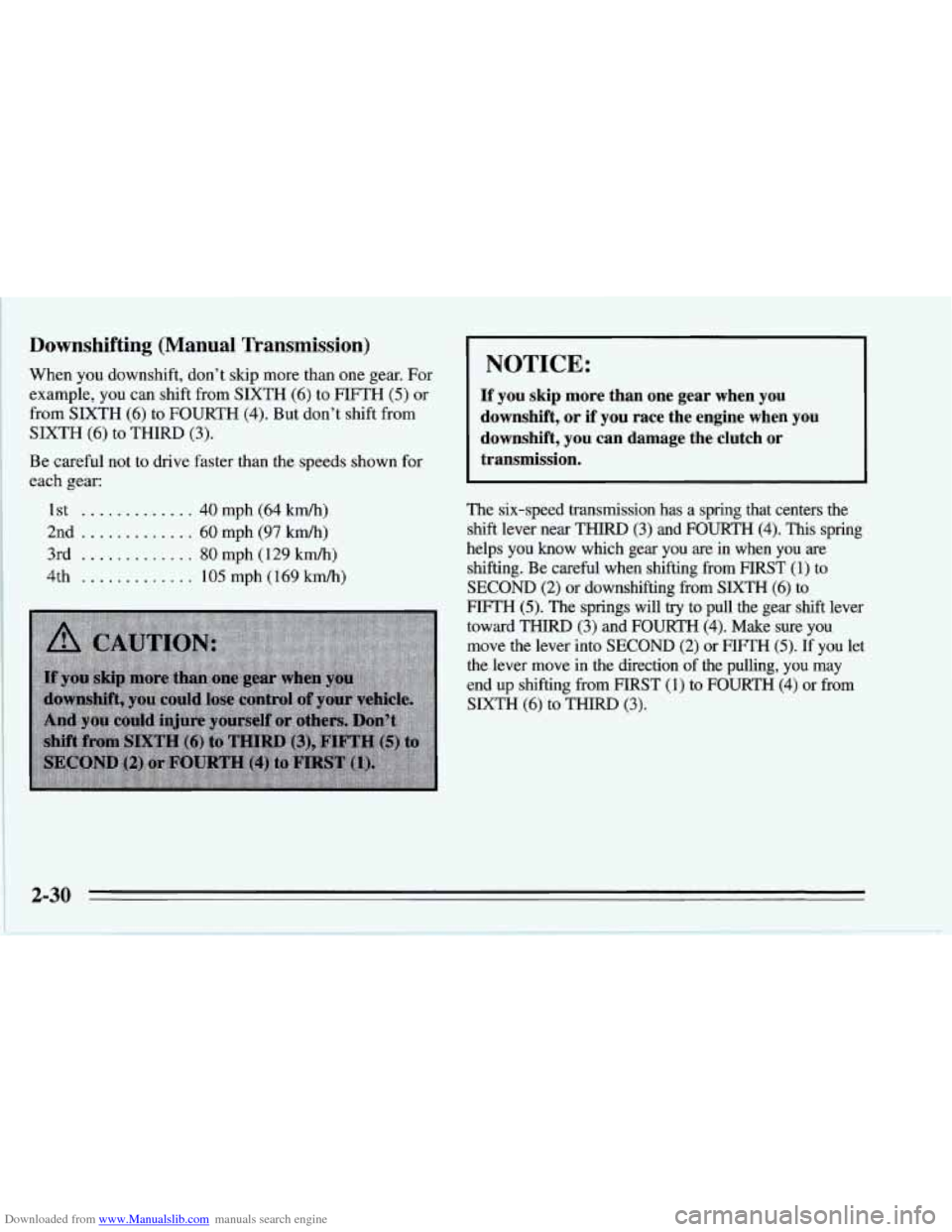
When you downshift, don’t skip more than one gear. For
example, you can shift from SIXTH (6) to FIFTH (5) or
from SIXTH (6) to FOURTH
(4). But don’t shift from
SIXTH
(6) to THIRD (3).
Be careful not to drive faster than the speeds shown for
each gear:
1st
......
2nd .........
3rd . . . .
4th . .
. . 40 mph (64 km/h)
. . 60 mph (97 km/h)
. . 80 mph (129 km/h)
. . 105 mph (169M)
NOTICE:
If you skip more than one gear when you
downshift, or if you race the engine when you
downshift, you can damage the clutch
or
transmission.
The six-speed transmission has a spring that centers the
shift lever near THIRD
(3) and FOURTH (4). This spring
helps you know which gear you
are in when you are
shifting. Be careful when shifting from FIRST (1) to
SECOND (2) or downshifting from SIXTH (6) to
FIFTH (5). The springs will try to pull the gear shift lever
toward
THIRD (3) and FOURTH (4). Make sure you
move the lever into SECOND (2)
or FIFTH (5). If you let
the lever move in the direction of the pulling, you may
end
up shifting from FIRST (1) to FOURTH (4) or from
SIXTH (6) to THIRD (3).
Page 76 of 386
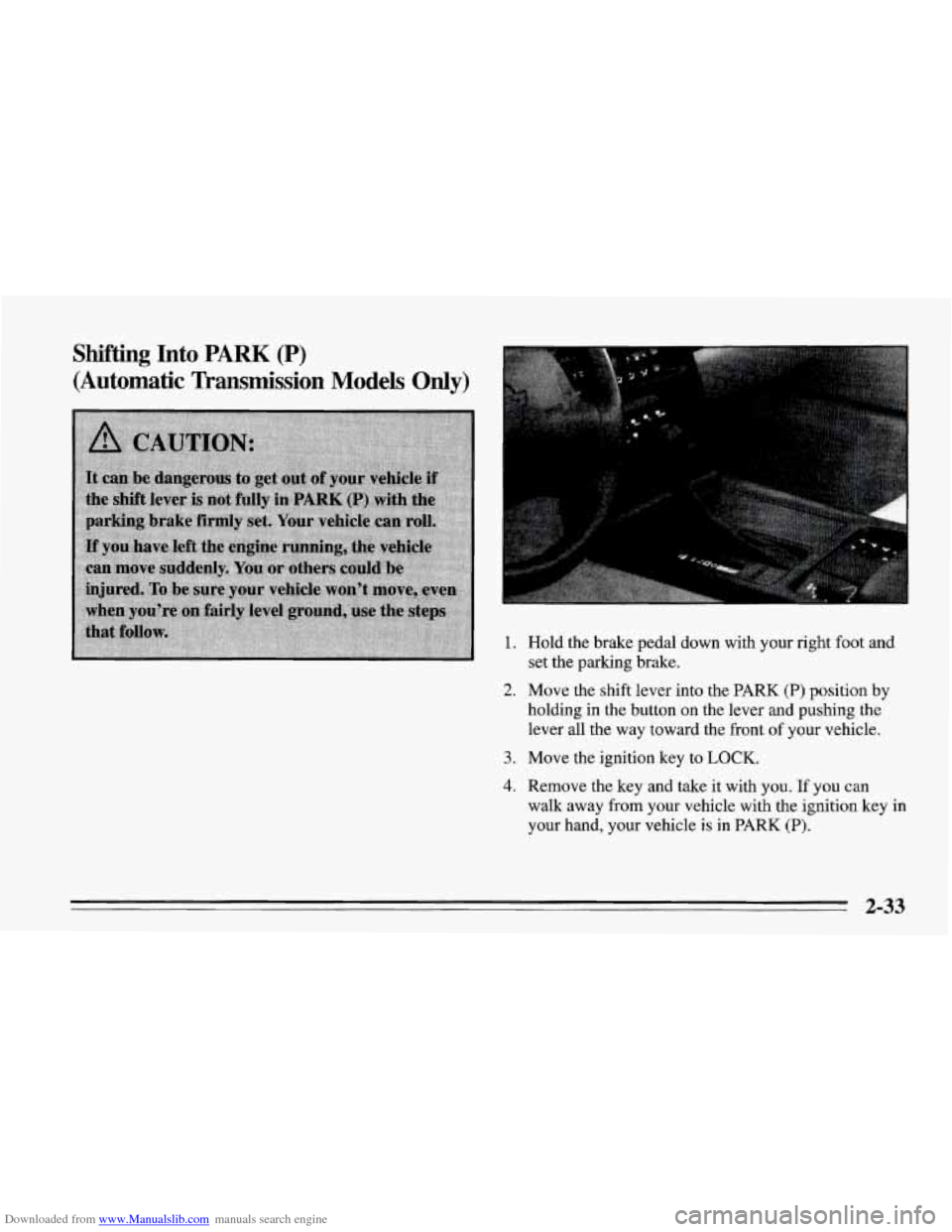
Downloaded from www.Manualslib.com manuals search engine Shifting Into PARK (P)
(Automatic Transmission Models Only)
I
1. Hold the brake pedal down with your right foot and
set the parking brake.
holding in the button on the lever and pushing the
lever
all the way toward the front of your vehicle.
2. Move the shift lever into the PARK (P) position by
3. Move the ignition key to LOCK.
4. Remove the key and take it with you. If you can
walk away from your vehicle with the ignition key in
your hand, your vehicle
is in PARK (P).
2-33
Page 77 of 386
Downloaded from www.Manualslib.com manuals search engine Leaving Your Vehicle With the
Engine Running (Automatic Transmission Models Onlv)
Y‘
Torque Lock (Automatic Transmission)
If you are parking on a hill and you don’t shift your
transmission into PARK (P) properly, the weight of the
vehicle may put too much force
on the parking pawl in
the transmission. You may find it difficult to pull
the
shift lever out of PARK (P). This is called “torque lock.”
To prevent torque lock, set the parking brake and then
shift into PARK (P) properly before you leave the driver’s seat.
To find
out how, see “Shifting Into
PARK
(P)” in the Index.
When you are ready to drive, move the shift lever out of
PARK
(P) before you release the parking brake.
If “torque lock” does occur, you may need to have
another vehicle push yours a little uphill to take some
(
the pressure from the transmission, so you can pull the
shift lever out of PARK (P).
Shifting Out of PARK (P)
(Automatic Transmission)
Your Corvette has a brake-transmission shift interlock.
You have to fully apply your regular brake before you
can shift from PARK
(P) when the ignition is in the
RUN position. See “Automatic Transmission” in the
Index.
If you cannot shift out of PARK
(P), ease pressure on
the shift lever
-- push the shift lever all the way into
PARK
(P) and release the shift lever button as you
maintain brake application. Then press the shift lever
button and move the shift lever into the gear you wish.
2-34
Page 78 of 386
Downloaded from www.Manualslib.com manuals search engine If you ever hold the brake pedal down but still can’t
shift out of PARK
(P), try this:
1. Turn the key to OFF,
2. Apply and hold the brake until the end of Step 4.
3. Shift to NEUTRAL (N).
4. Start the vehicle and then shift to the drive gear you
want.
5. Have the vehicle fixed as soon as you can.
Parking Your Vehicle
(Manual Transmission)
Before you get out of your vehicle, put your manual
transmission in
REVERSE (R) and firmly apply the
parking brake.
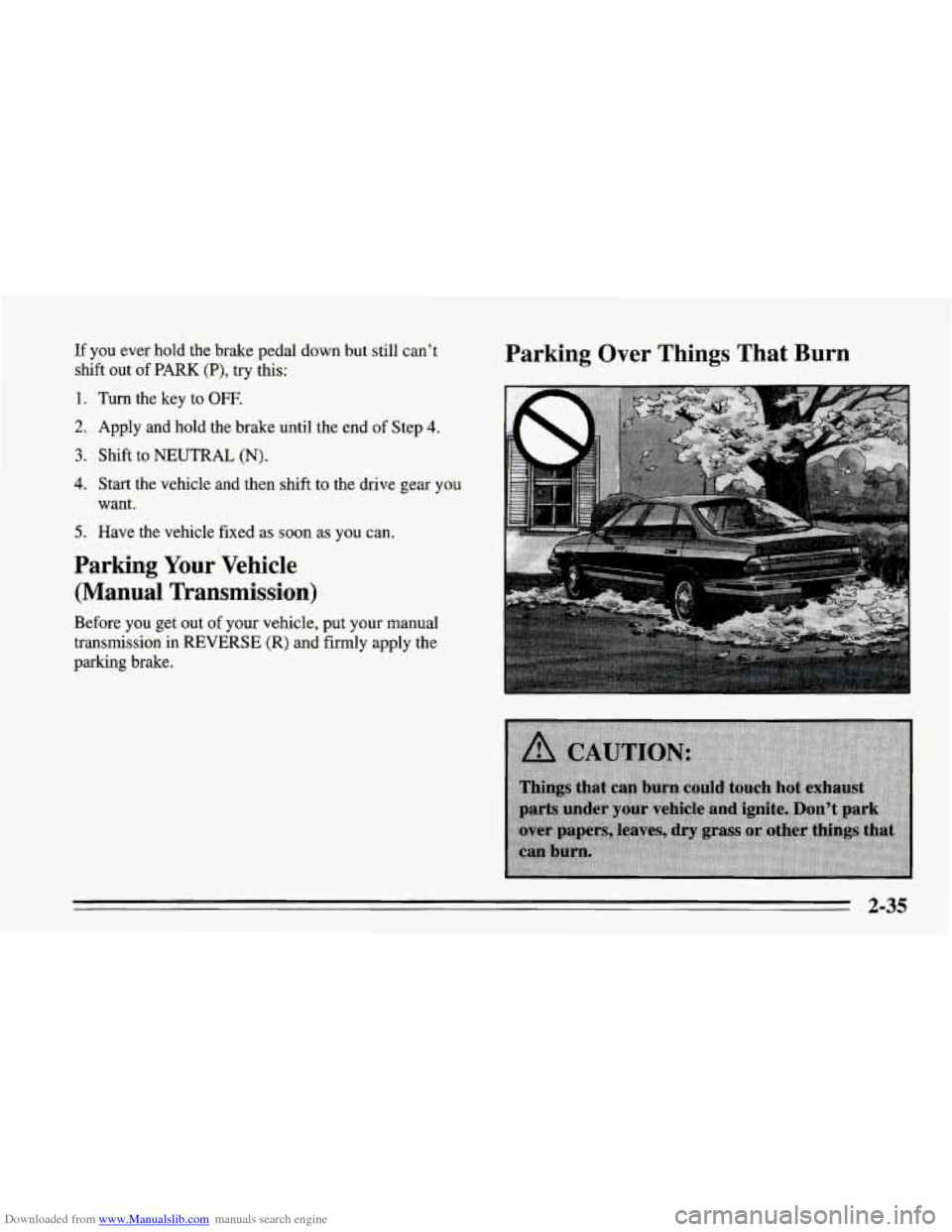
Parking Over Things That Burn
2-35
Page 88 of 386
Downloaded from www.Manualslib.com manuals search engine To Increase Speed While Using Cruise Control
There are two ways to go to a higher speed. Here’s the
first:
Use the accelerator pedal to get to the higher speed.
Push the button at the end of the lever, then release
the button and the accelerator pedal. You’ll now
cruise at the higher speed.
Here’s the second way to go to a higher speed:
Move the cruise switch to R/A. Hold it there until
you get up to the speed you want,
and then release
the switch.
To increase your speed in very small amounts, move
the switch to
R/A for less than half a second and then
release it. Each time you do this, your vehicle will
go
about 1 mph (1.6 km/h) faster.
To Reduce Speed While Using Cruise Control
There are two ways to reduce your speed while using
cruise control:
Push in the button at the end of the lever until you
reach the lower speed you want, then release it.
0 To slow down in very small amounts, push the
button for less than half a second. Each time you
do this, you’ll go 1 mph (1.6 km/h) slower.
Passing Another Vehicle While Using Cruise Control
Use the accelerator pedal to increase your speed. When
you take your foot off the pedal, your vehicle will slow
down to the cruise control speed you set earlier.
Using Cruise Control on Hills
How well your cruise control will work on hills depends
upon your speed, load, and the steepness
of the hills.
When going up steep hills, you may have to step on the
accelerator pedal to maintain your speed. When going
downhill, you may have to brake or shift to a lower gear
to keep your speed down. Of course, applying the brake
takes you out of cruise control. Many drivers find ths to
be too much trouble and don’t use cruise control on
steep hills.
To Get Out of Cruise Control
There are several ways to turn off the cruise control:
Step lightly on the brake pedal or push the clutch
pedal, if you have a manual transmission;
OR
0 Move the cruise switch to OFF,
To Erase Speed Memory
When you turn off the cruise control or the ignition,
your cruise control set speed memory is erased.
2-45
Page 95 of 386
Downloaded from www.Manualslib.com manuals search engine Roof Panel (Coupe)
Until you are sure you can remove the panel alone, have
someone help you.
Removing the Roof Panel
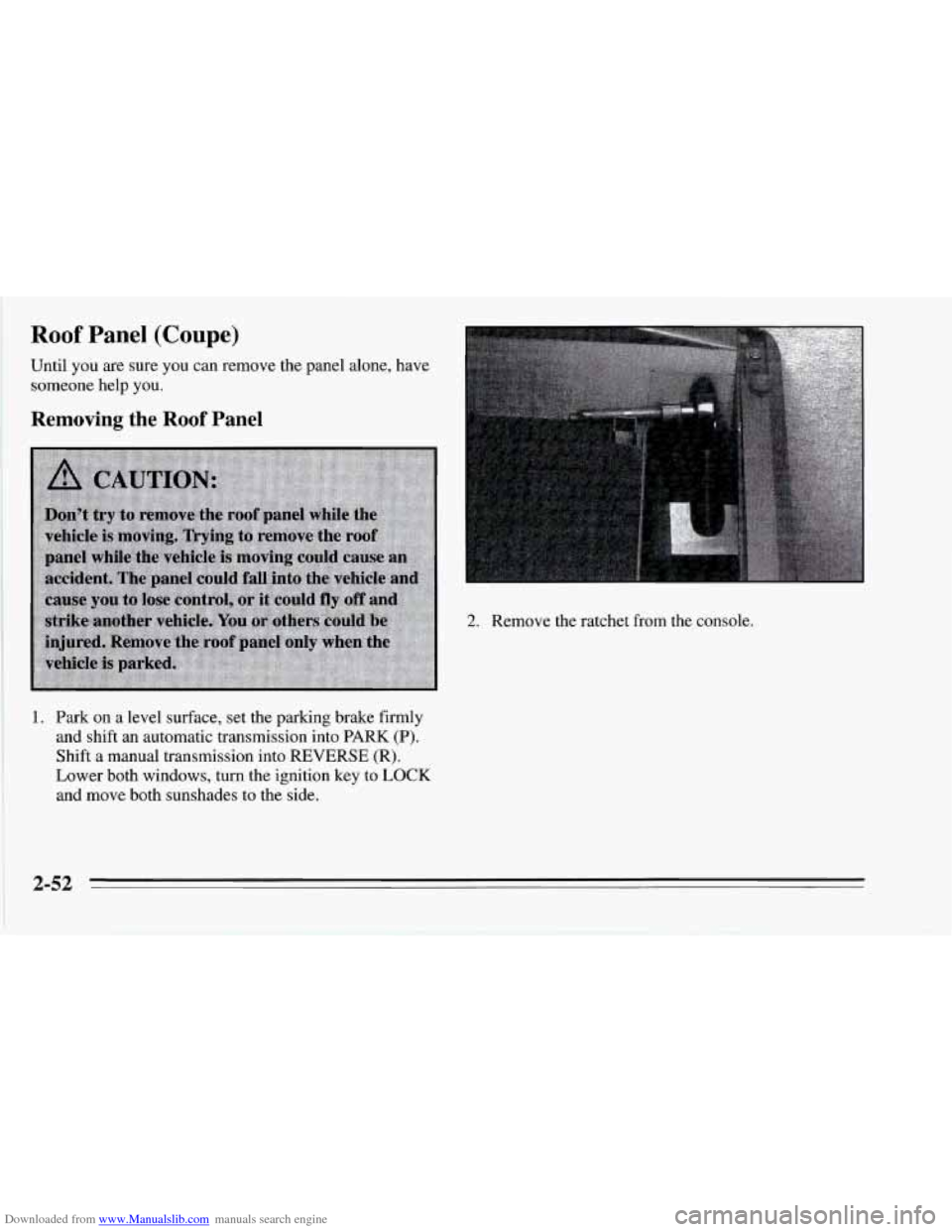
2. Remove the ratchet from the console.
1. Park on a level surface, set the parking brake firmly
and shift an automatic transmission into PARK
(P).
Shift a manual transmission into REVERSE (R).
Lower both windows, turn the ignition key to LOCK
and move both sunshades to the side.
2-52
Page 99 of 386
Downloaded from www.Manualslib.com manuals search engine Installing the Roof Panel 3. Lower the roof panel onto the vehicle, rear edge first,
and place the rear guide pins into the holes in the
roof opening.
4. Lower the front of the roof panel, and align the front
guide pins.
5. Tighten the rear bolts part way.
I
_____~~
NOTICE:
If you tighten bolts that are improperly started,
the threads can become stripped. Be sure all bolts are properly started before you tighten them.
1. Park on a level surface, set the parking brake firmly
and shift an automatic transmission into
PARK (P).
Shift a manual transmission into REVERSE (R).
Lower both windows, turn the ignition key to LOCK
and move both sunshades to the side.
2. If the roof panel is stored in the rear area, remove it
by reversing the steps under “Storing the Roof
Panel” above.
6. Use the ratchet to start the front bolts. If the bolts are
hard to start, tighten the rear bolts some more.
Holding down the panel on the outside will also
help.
7. Fully tighten the rear bolts, then the front bolts.
If you hear a popping noise when you drive, the bolts
may not be tight enough. Be sure to tighten them
securely.