ignition CHEVROLET CORVETTE 1995 4.G Owner's Manual
[x] Cancel search | Manufacturer: CHEVROLET, Model Year: 1995, Model line: CORVETTE, Model: CHEVROLET CORVETTE 1995 4.GPages: 386, PDF Size: 20.15 MB
Page 88 of 386
Downloaded from www.Manualslib.com manuals search engine To Increase Speed While Using Cruise Control
There are two ways to go to a higher speed. Here’s the
first:
Use the accelerator pedal to get to the higher speed.
Push the button at the end of the lever, then release
the button and the accelerator pedal. You’ll now
cruise at the higher speed.
Here’s the second way to go to a higher speed:
Move the cruise switch to R/A. Hold it there until
you get up to the speed you want,
and then release
the switch.
To increase your speed in very small amounts, move
the switch to
R/A for less than half a second and then
release it. Each time you do this, your vehicle will
go
about 1 mph (1.6 km/h) faster.
To Reduce Speed While Using Cruise Control
There are two ways to reduce your speed while using
cruise control:
Push in the button at the end of the lever until you
reach the lower speed you want, then release it.
0 To slow down in very small amounts, push the
button for less than half a second. Each time you
do this, you’ll go 1 mph (1.6 km/h) slower.
Passing Another Vehicle While Using Cruise Control
Use the accelerator pedal to increase your speed. When
you take your foot off the pedal, your vehicle will slow
down to the cruise control speed you set earlier.
Using Cruise Control on Hills
How well your cruise control will work on hills depends
upon your speed, load, and the steepness
of the hills.
When going up steep hills, you may have to step on the
accelerator pedal to maintain your speed. When going
downhill, you may have to brake or shift to a lower gear
to keep your speed down. Of course, applying the brake
takes you out of cruise control. Many drivers find ths to
be too much trouble and don’t use cruise control on
steep hills.
To Get Out of Cruise Control
There are several ways to turn off the cruise control:
Step lightly on the brake pedal or push the clutch
pedal, if you have a manual transmission;
OR
0 Move the cruise switch to OFF,
To Erase Speed Memory
When you turn off the cruise control or the ignition,
your cruise control set speed memory is erased.
2-45
Page 89 of 386
Downloaded from www.Manualslib.com manuals search engine Lamps
0
0
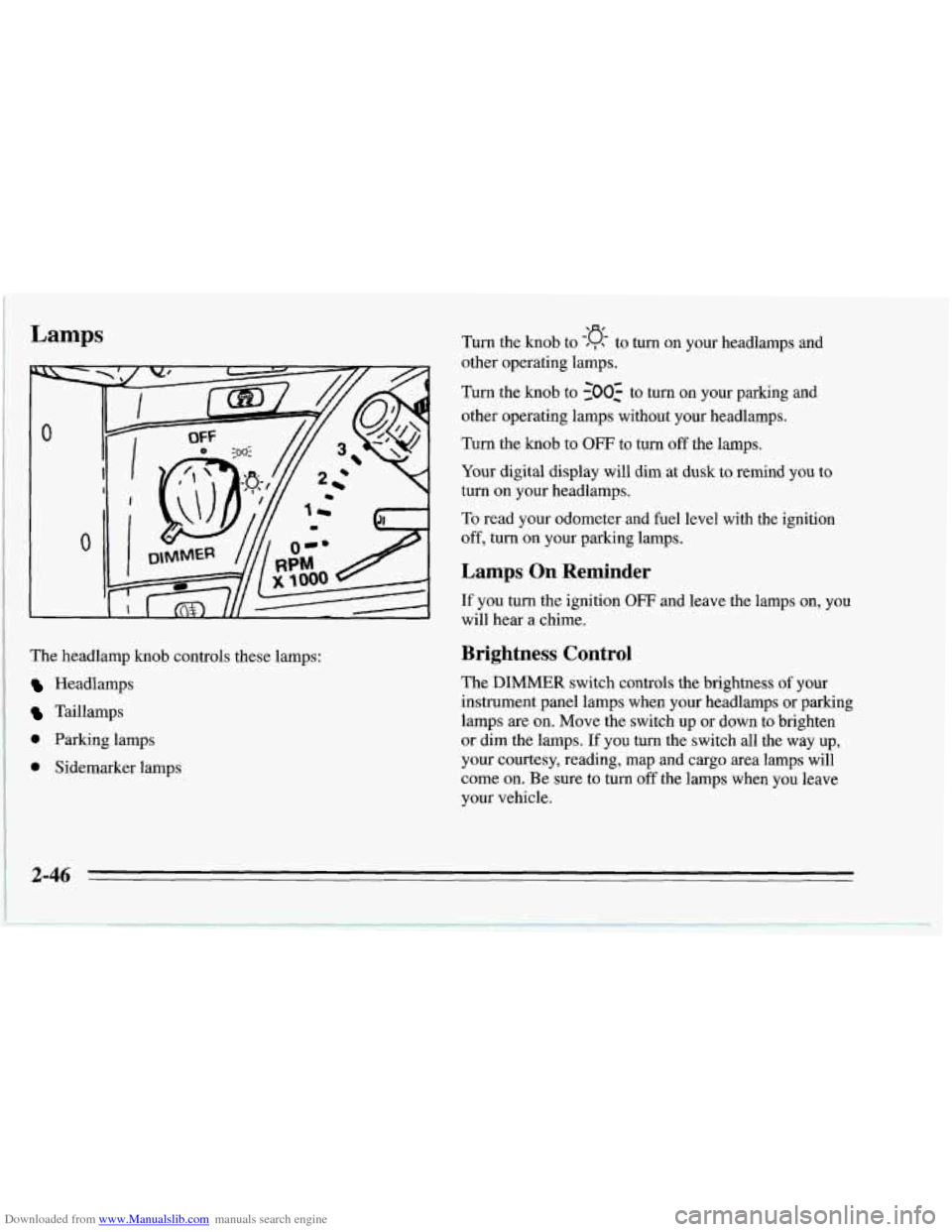
The headlamp knob controls these lamps:
Headlamps
Taillamps
0 Parking lamps
0 Sidemarker lamps Turn the knob to
0, to turn on your
headlamps and
other operating lamps.
Turn the knob to
Turn the knob to
OFF to turn off the lamps.
Your digital display will dim at dusk to remind you to
turn on your headlamps.
To read your odometer and
fuel level with the ignition
off, turn on your parking
lamps.
Lamps On Reminder
If you turn the ignition OFF and leave the lamps on, you
will hear a chime.
Brightness Control
The DIMMER switch controls the brightness of your
instrument panel lamps when your headlamps or parking
lamps are on. Move the switch up
or down to brighten
or dim the lamps. If you turn the switch all the way
up,
your courtesy, reading, map and cargo area lamps will
come
on. Be sure to turn off the lamps when you leave
your vehicle.
-‘a-
2-46
Page 90 of 386
Downloaded from www.Manualslib.com manuals search engine Headlamp Doors
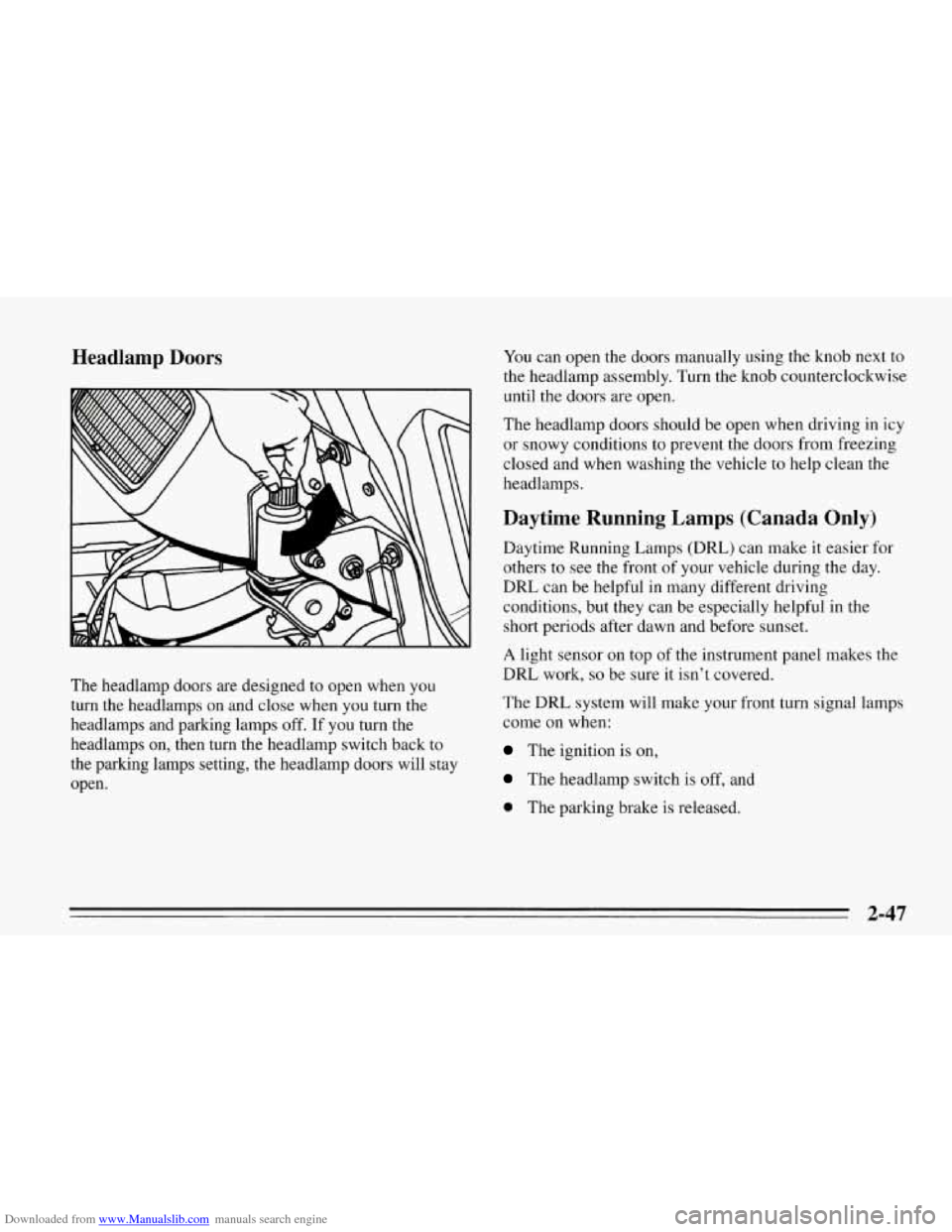
The headlamp doors are designed to open when you
turn the headlamps on and close when you turn the
headlamps and parking lamps off. If you turn the
headlamps on, then turn the headlamp switch back to
the parking lamps setting, the headlamp doors will stay
open. You
can open the doors manually using the knob next to
the headlamp assembly. Turn the knob counterclockwise
until the doors are open.
The headlamp doors should be open when driving in icy
or snowy conditions to prevent the doors from freezing
closed and when washing the vehicle to help clean the
headlamps.
Daytime Running Lamps (Canada Only)
Daytime Running Lamps (DRL) can make it easier for
others to see the front of your vehicle during the day.
DRL can be helpful in many different driving
conditions, but they can be especially helpful in the
short periods after dawn and before sunset.
A light sensor on top of the instrument panel makes the
DRL work,
so be sure it isn’t covered.
The DRL system will make your front turn signal lamps
come on when:
The ignition is on,
The headlamp switch is off, and
0 The parking brake is released.
2-47
Page 92 of 386
Downloaded from www.Manualslib.com manuals search engine Interior Lamps Mirrors
Courtesy Lamps
When any door or the hatch is opened, the interior lamps will go on (unless it’s bright outside). The lamps will
stay
on for about 30 seconds or until you turn on the ignition.
Front Map Lamps
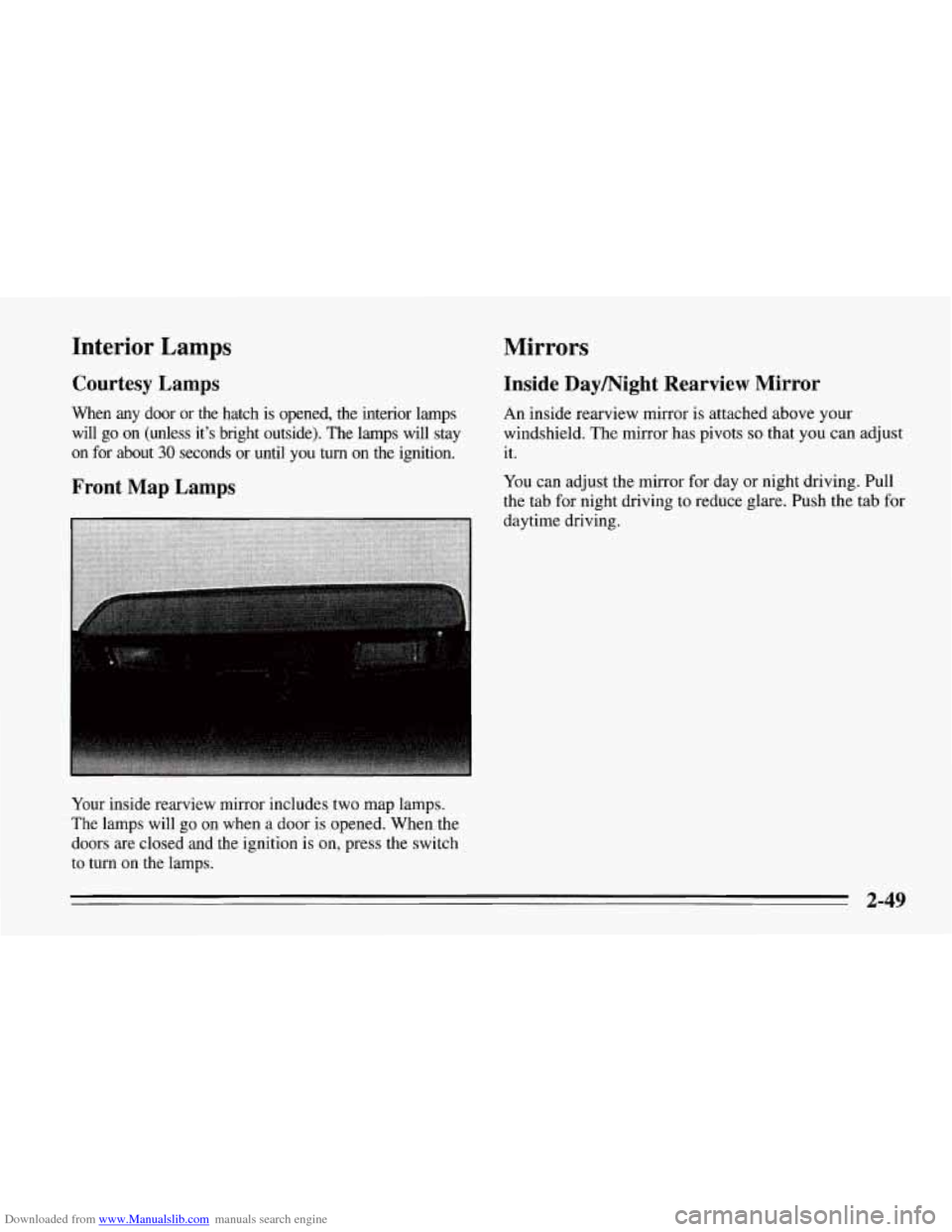
Your inside rearview mirror includes two map lamps.
The lamps will go on when a door is opened. When the
doors are closed and the ignition is
on, press the switch
to turn
on the lamps.
Inside Daymight Rearview Mirror
An inside rearview mirror is attached above your
windshield. The mirror has pivots
so that you can adjust
it.
You can adjust the mirror for day or night driving.
Pull
the tab for night driving to reduce glare. Push the tab for
daytime driving.
2-49
Page 94 of 386
Downloaded from www.Manualslib.com manuals search engine Sun Visors Covered Visor Vanity Mirror
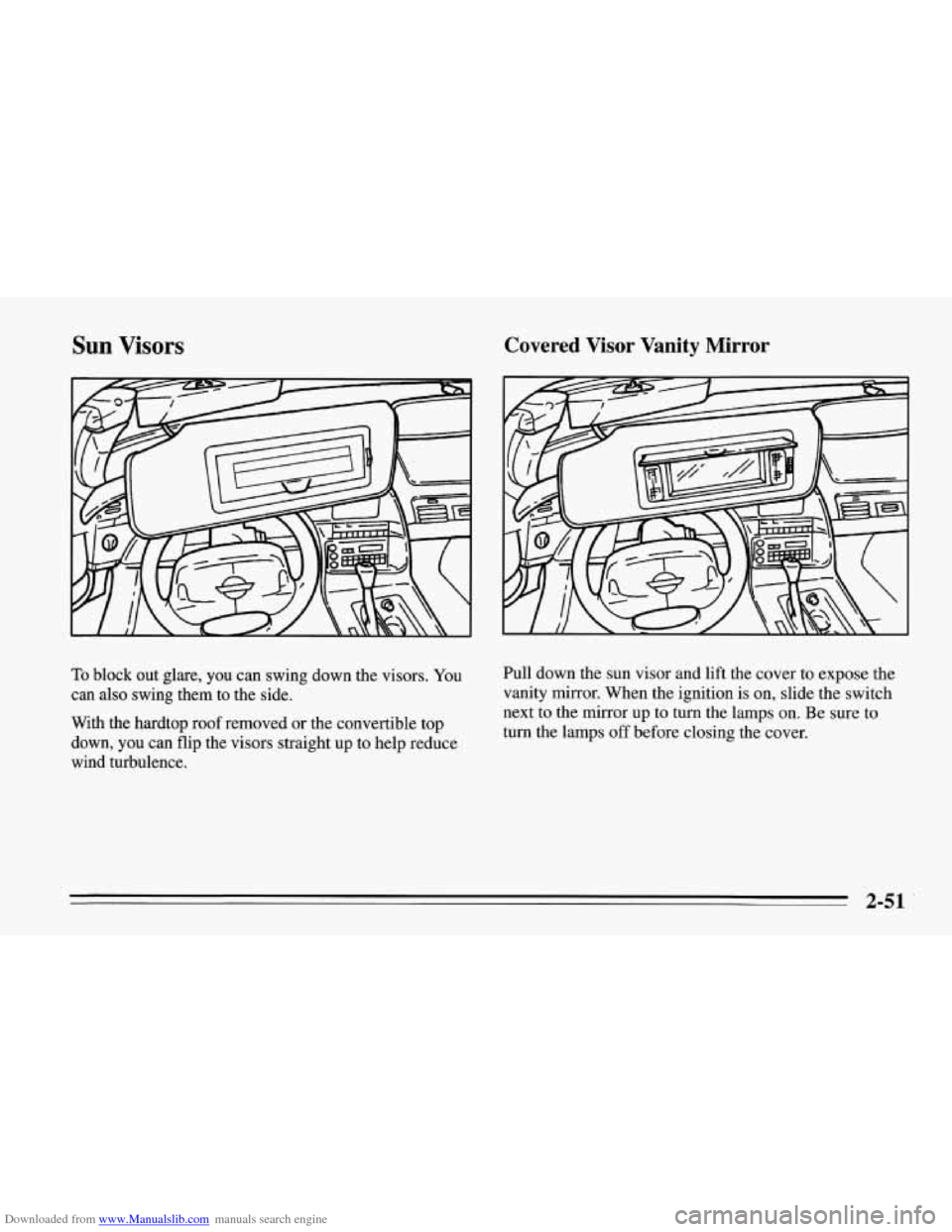
To block out glare, you can swing down the visors. You
can also swing them to the side.
With the hardtop roof removed
or the convertible top
down, you can flip the visors straight up to help reduce
wind turbulence. Pull down the sun visor and lift
the cover to expose the
vanity mirror. When the ignition is on, slide the switch
next to the mirror up to turn the lamps on. Be sure to
turn the lamps off before closing the cover.
2-51
Page 95 of 386
Downloaded from www.Manualslib.com manuals search engine Roof Panel (Coupe)
Until you are sure you can remove the panel alone, have
someone help you.
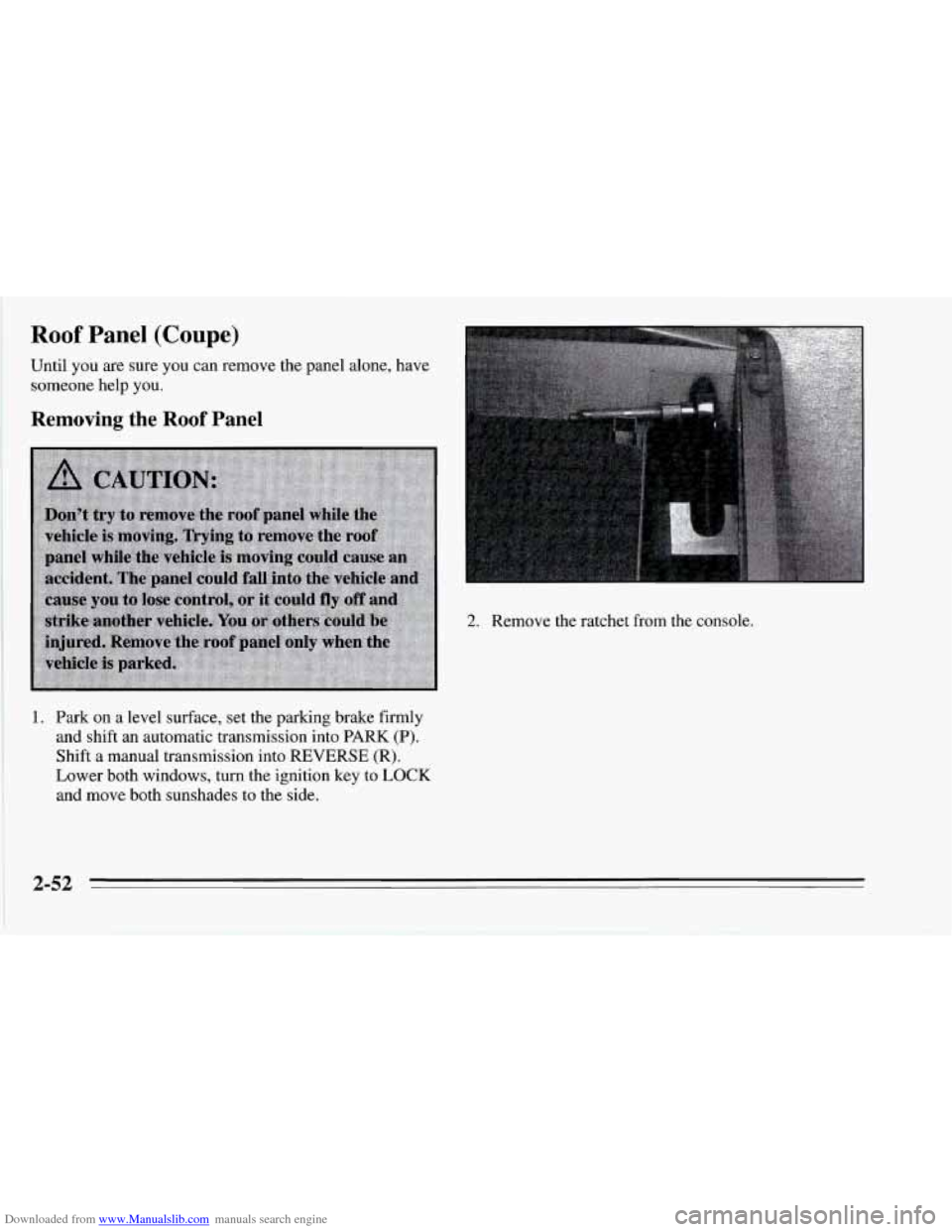
Removing the Roof Panel
2. Remove the ratchet from the console.
1. Park on a level surface, set the parking brake firmly
and shift an automatic transmission into PARK
(P).
Shift a manual transmission into REVERSE (R).
Lower both windows, turn the ignition key to LOCK
and move both sunshades to the side.
2-52
Page 99 of 386
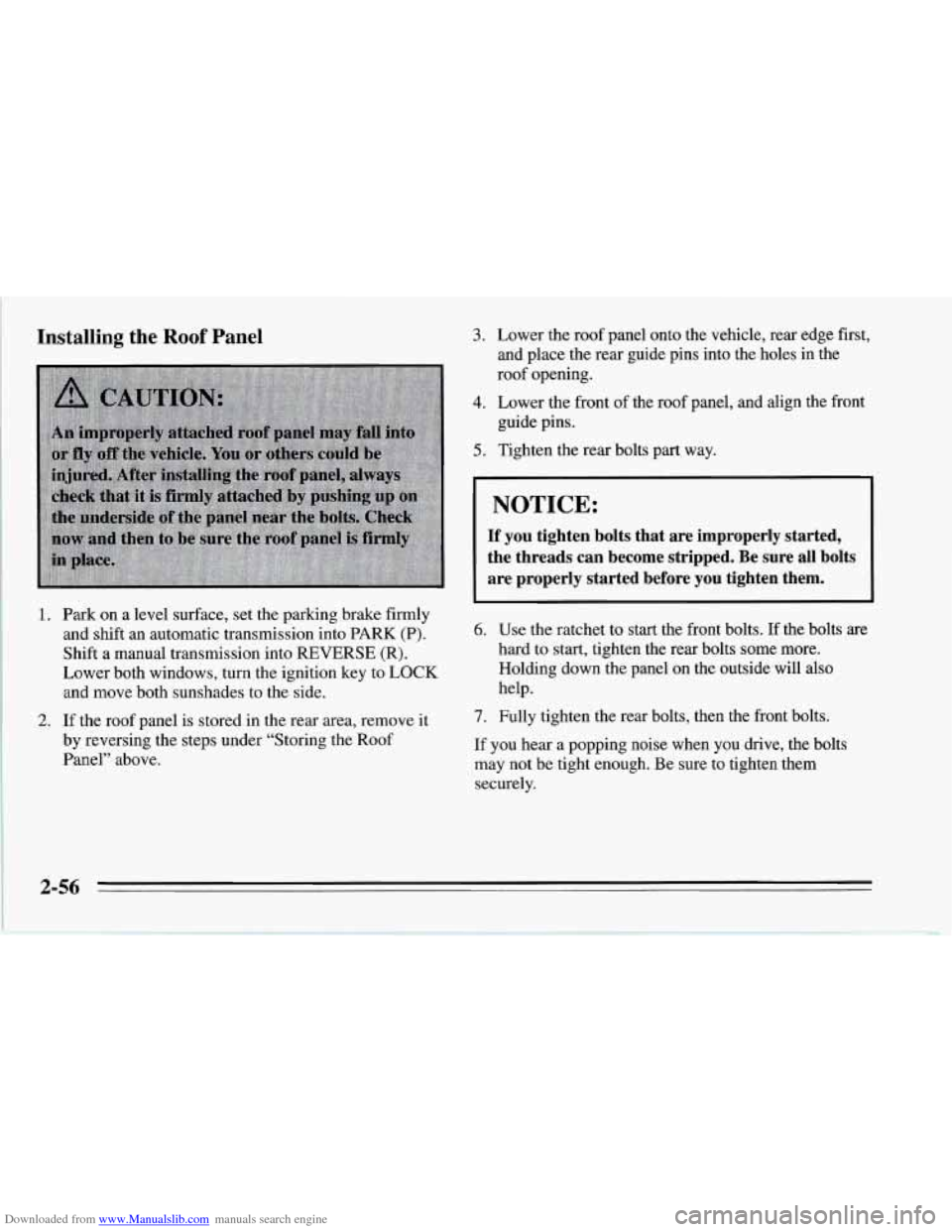
Downloaded from www.Manualslib.com manuals search engine Installing the Roof Panel 3. Lower the roof panel onto the vehicle, rear edge first,
and place the rear guide pins into the holes in the
roof opening.
4. Lower the front of the roof panel, and align the front
guide pins.
5. Tighten the rear bolts part way.
I
_____~~
NOTICE:
If you tighten bolts that are improperly started,
the threads can become stripped. Be sure all bolts are properly started before you tighten them.
1. Park on a level surface, set the parking brake firmly
and shift an automatic transmission into
PARK (P).
Shift a manual transmission into REVERSE (R).
Lower both windows, turn the ignition key to LOCK
and move both sunshades to the side.
2. If the roof panel is stored in the rear area, remove it
by reversing the steps under “Storing the Roof
Panel” above.
6. Use the ratchet to start the front bolts. If the bolts are
hard to start, tighten the rear bolts some more.
Holding down the panel on the outside will also
help.
7. Fully tighten the rear bolts, then the front bolts.
If you hear a popping noise when you drive, the bolts
may not be tight enough. Be sure to tighten them
securely.
Page 106 of 386
Downloaded from www.Manualslib.com manuals search engine 4. Remove the four screws that attach the console door.
5. Remove the console door.
6. Remove the trim plate by pulling up and back.
7. Disconnect the plug by pulling forward on the plastic
locking tab and pull the plug into the console.
The plug has three separate wires:
0 The orange wire connects to the battery.
The pink wire connects to the ignition. Power is only
0 The black wire connects to the ground.
available in
RUN.
NOTICE:
When using the accessory plug:
0
0
0
0
Don’t splice wires directly into the
accessory plug wire.
If done incorrectly,
splicing might cause damage to your
electrical system.
The maximum load
of any electrical
equipment should not exceed
10 amps.
Be sure to turn
off any electrical equipment
when not in use. Leaving electrical
equipment on for extended periods can
drain your battery.
Do not use this plug if the electrical
equipment requires frequent connecting
and disconnecting. This may cause
excessive wear on the accessory plug and
damage your electrical system.
After you’ve installed the electrical equipment, put the
trim panel and console lid back in place and install the
screws
.
2-63
Page 108 of 386
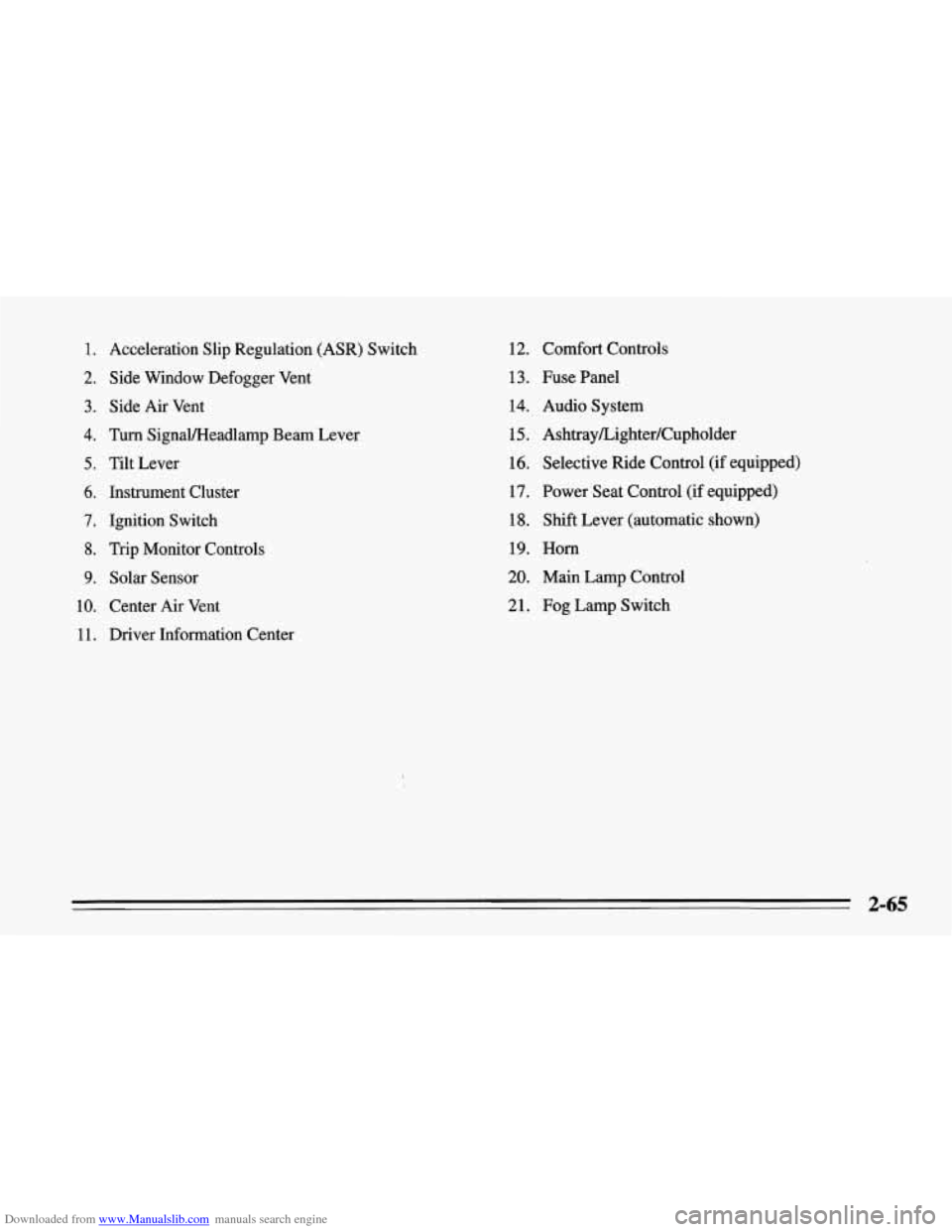
Downloaded from www.Manualslib.com manuals search engine 1. Acceleration Slip Regulation (ASR) Switch
2. Side Window Defogger Vent
3. Side Air Vent
4. Turn SignaVHeadlamp Beam Lever
5. Tilt Lever
6. Instrument Cluster
7. Ignition Switch
8. Trip Monitor Controls
9. Solar Sensor
10. Center Air Vent
11. Driver Information Center
12. Comfort Controls
13. Fuse Panel
14.. Audio System
15. AshtrayLighterKupholder
16. Selective Ride Control (if equipped)
17. Power Seat Control (if equipped)
18. Shift Lever (automatic shown)
19. Horn
20. Main Lamp Control
21. Fog Lamp Switch
2-65
Page 112 of 386
Downloaded from www.Manualslib.com manuals search engine Your vehicle also has a driver information center that
works along with the warning lights and gauges. See
“Driver Information Center” in the Index.
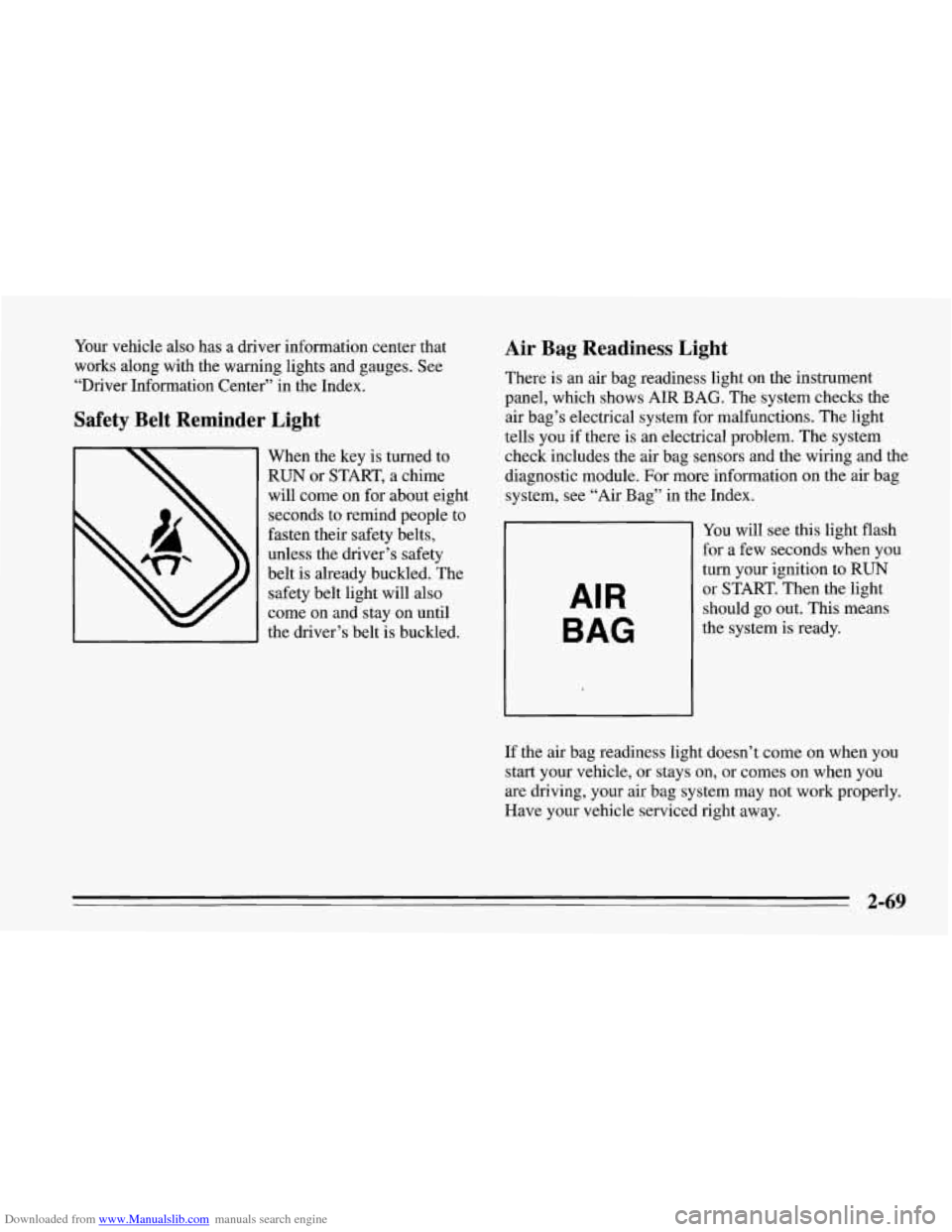
Safety Belt Reminder Light
When the key is turned to
RUN or START, a chime
will come on for about eight
seconds to remind people to
fasten their safety belts,
unless the driver’s safety
belt is already buckled. The
safety belt light will also
come on and stay on until
the driver’s belt is buckled.
Air Bag Readiness Light
There is an air bag readiness light on the instrument
panel, which shows AIR BAG. The system checks the
air bag’s electrical system for malfunctions. The light
tells you
if there is an electrical problem. The system
check includes the air bag sensors and the wiring and the
diagnostic module. For more information on the air bag
system, see “Air Bag” in the Index.
AIR
BAG
You will see this light flash
for a few seconds when you
turn your ignition to RUN
or START. Then the light
should go out. This means
the system is ready.
If the air bag readiness light doesn’t come on when
you
start your vehicle, or stays on, or comes on when you
are driving, your air bag system may not work properly.
Have your vehicle serviced right away.
2-69