tow CHEVROLET CORVETTE 1995 4.G Owner's Manual
[x] Cancel search | Manufacturer: CHEVROLET, Model Year: 1995, Model line: CORVETTE, Model: CHEVROLET CORVETTE 1995 4.GPages: 386, PDF Size: 20.15 MB
Page 200 of 386
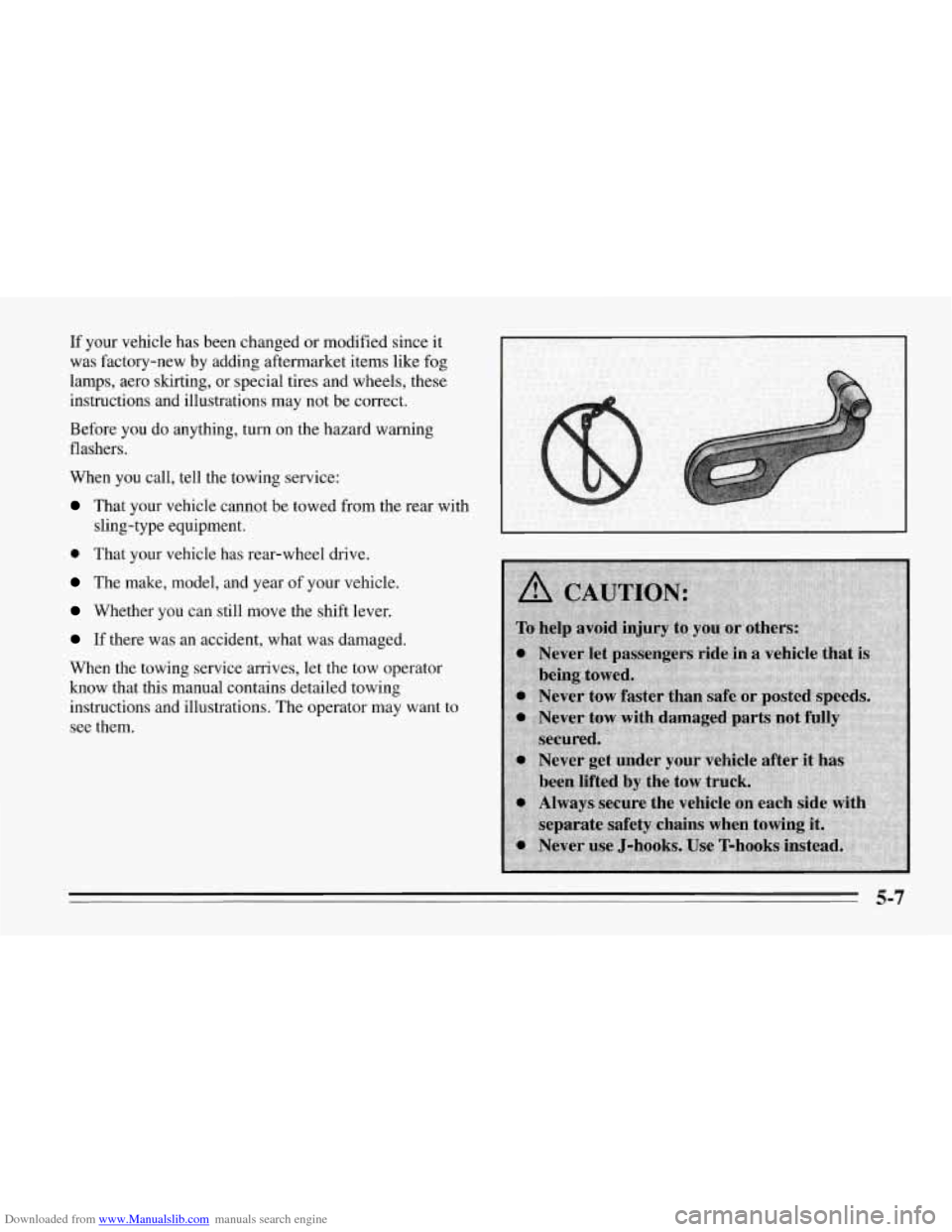
Downloaded from www.Manualslib.com manuals search engine If your vehicle has been changed or modified since it
was factory-new by adding aftermarket items like fog
lamps, aero skirting,
or special tires and wheels, these
instructions and illustrations may not be correct.
Before you do anything, turn
on the hazard warning
flashers.
When you call, tell the towing service:
That your vehicle cannot be towed from the rear with
sling-type equipment.
0 That your vehicle has rear-wheel drive.
The make, model, and year of your vehicle.
Whether you can still move the shift lever.
If there was an accident, what was damaged.
When the towing service arrives, let the tow operator
know that this manual contains detailed towing
instructions and illustrations. The operator may want to
see them.
5-7
Page 201 of 386
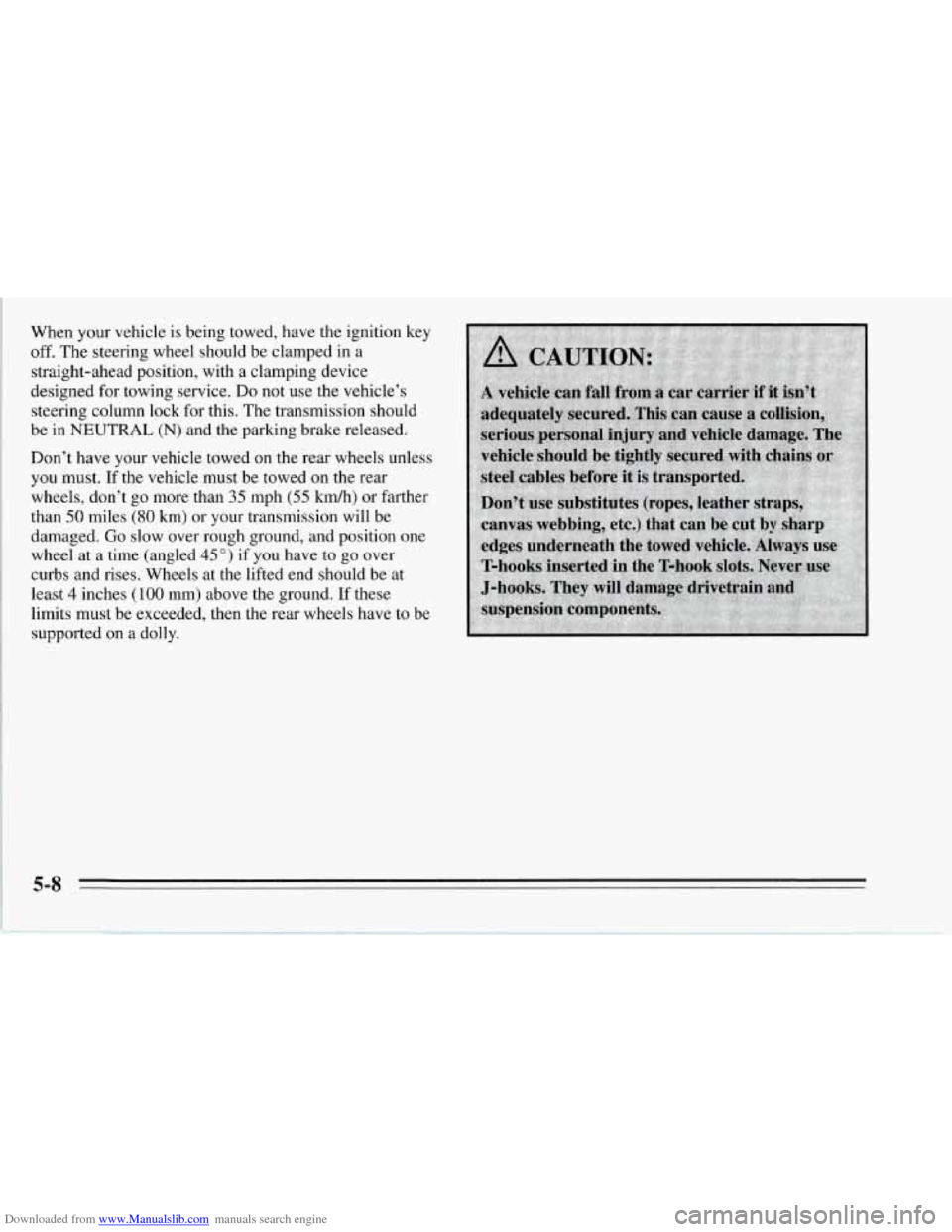
Downloaded from www.Manualslib.com manuals search engine When your vehicle is being towed, have the ign
off. The steering wheel should be clamped in a
straight-ahead position, with a clamping device
designed for towing service.
Do not use the veh .ition key
icle's
steering column lock for this. The transmission should
be in
NEUTRAL (N) and the parking brake released.
Don't have your vehicle towed on the rear wheels unless
you must.
If the vehicle must be towed on the rear
wheels, don't
go more than 35 mph (55 km/h) or farther
than
50 miles (80 km) or your transmission will be
damaged.
Go slow over rough ground, and position one
wheel at a time (angled
45 ") if you have to go over
curbs and rises. Wheels at the lifted end should be at
least
4 inches (100 mm) above the ground. If these
limits must be exceeded, then the rear wheels have to be
supported on a dolly.
-
Page 202 of 386
Downloaded from www.Manualslib.com manuals search engine Front Towing Hook-Ups
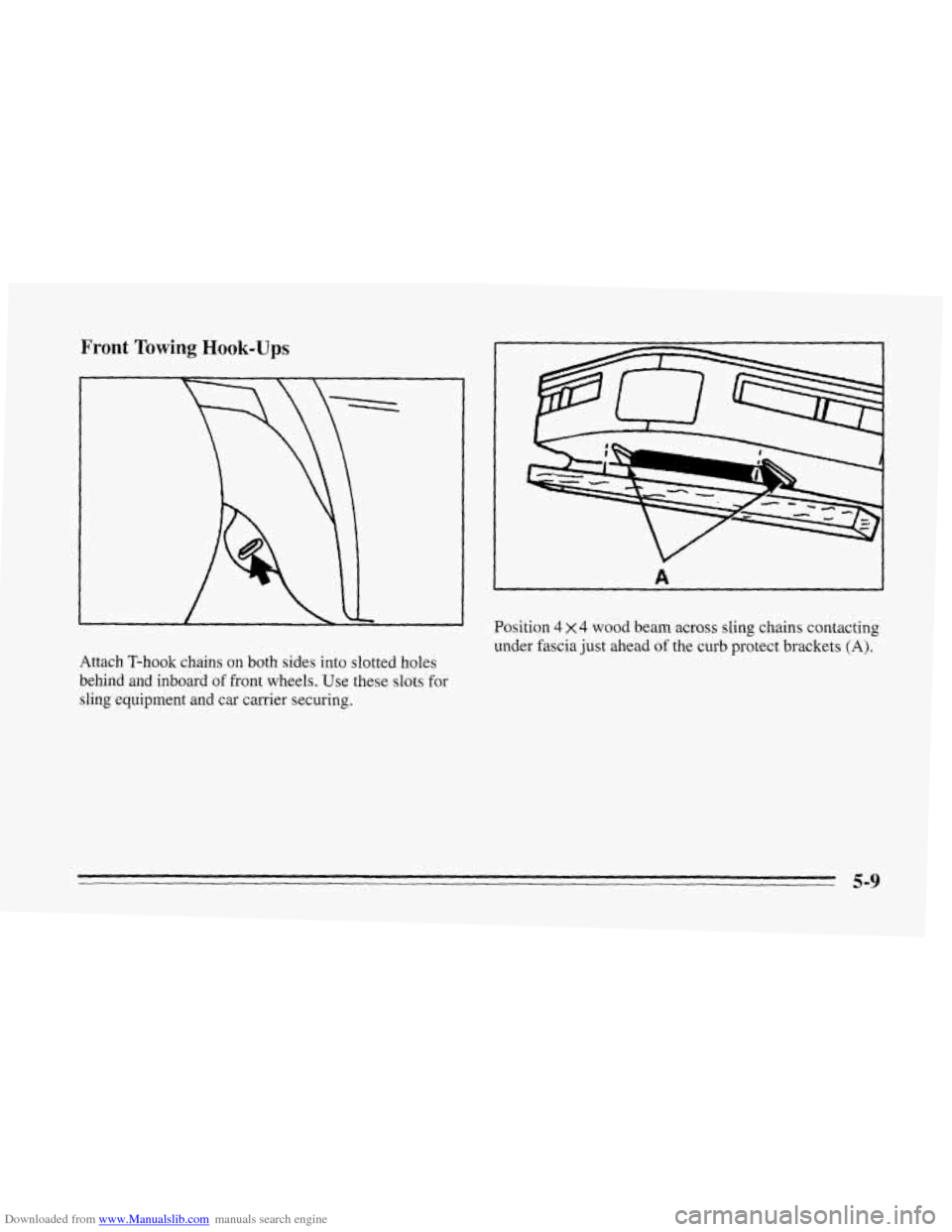
Position 4 x4 wood beam across sling chains contacting
under fascia just ahead of the curb protect brackets
(A).
Attach T-hook chains on both sides into slotted holes
behind and inboard
of front wheels. Use these slots for
sling equipment and car carrier securing.
A 1
5-9
Page 204 of 386
Downloaded from www.Manualslib.com manuals search engine Rear Towing Hook-Ups
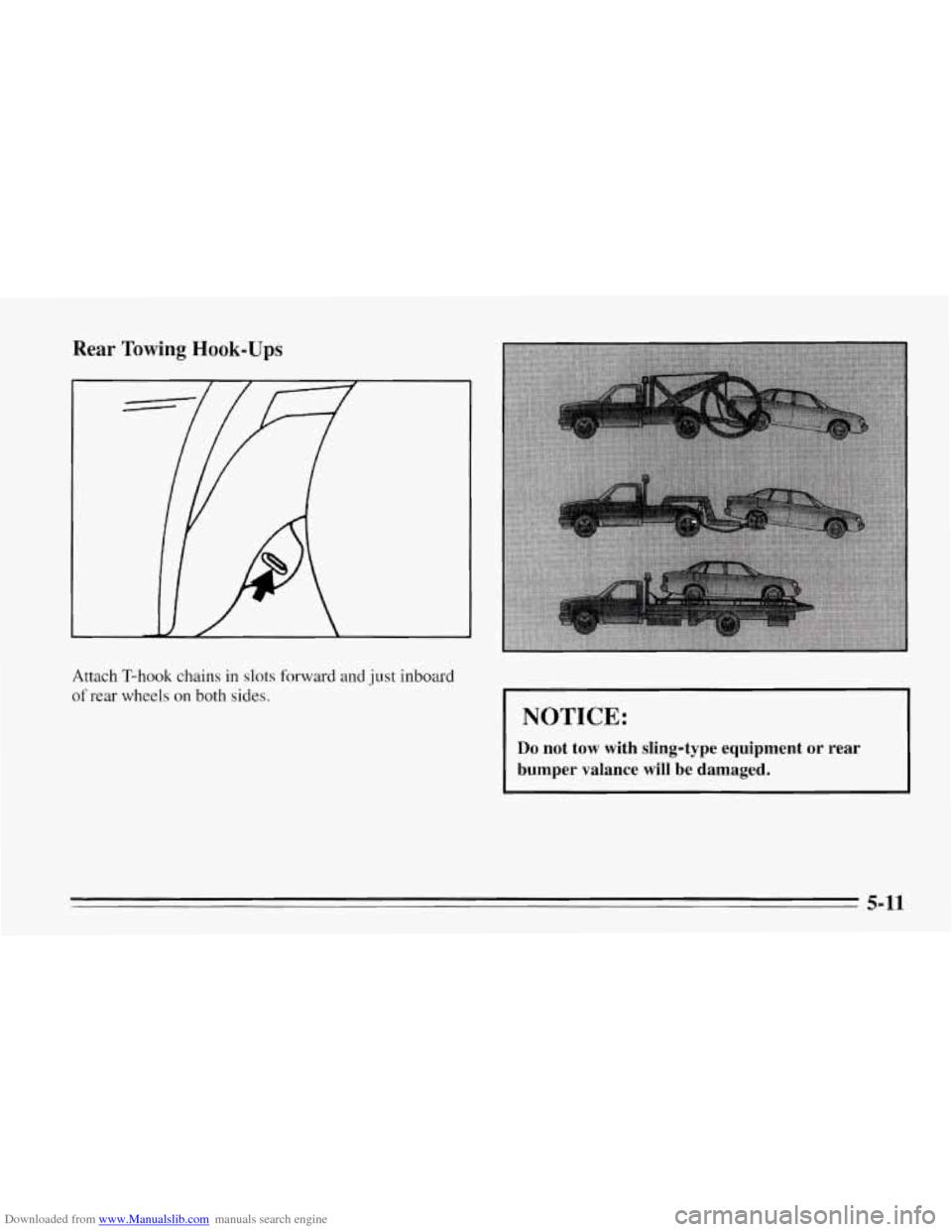
Attach T-hook chains in slots forward and just inboard
of rear wheels on both sides.
NOTICE:
Do not tow with sling-type equipment or rear
bumper valance will be damaged.
5-11
Page 205 of 386
Downloaded from www.Manualslib.com manuals search engine NOTICE:
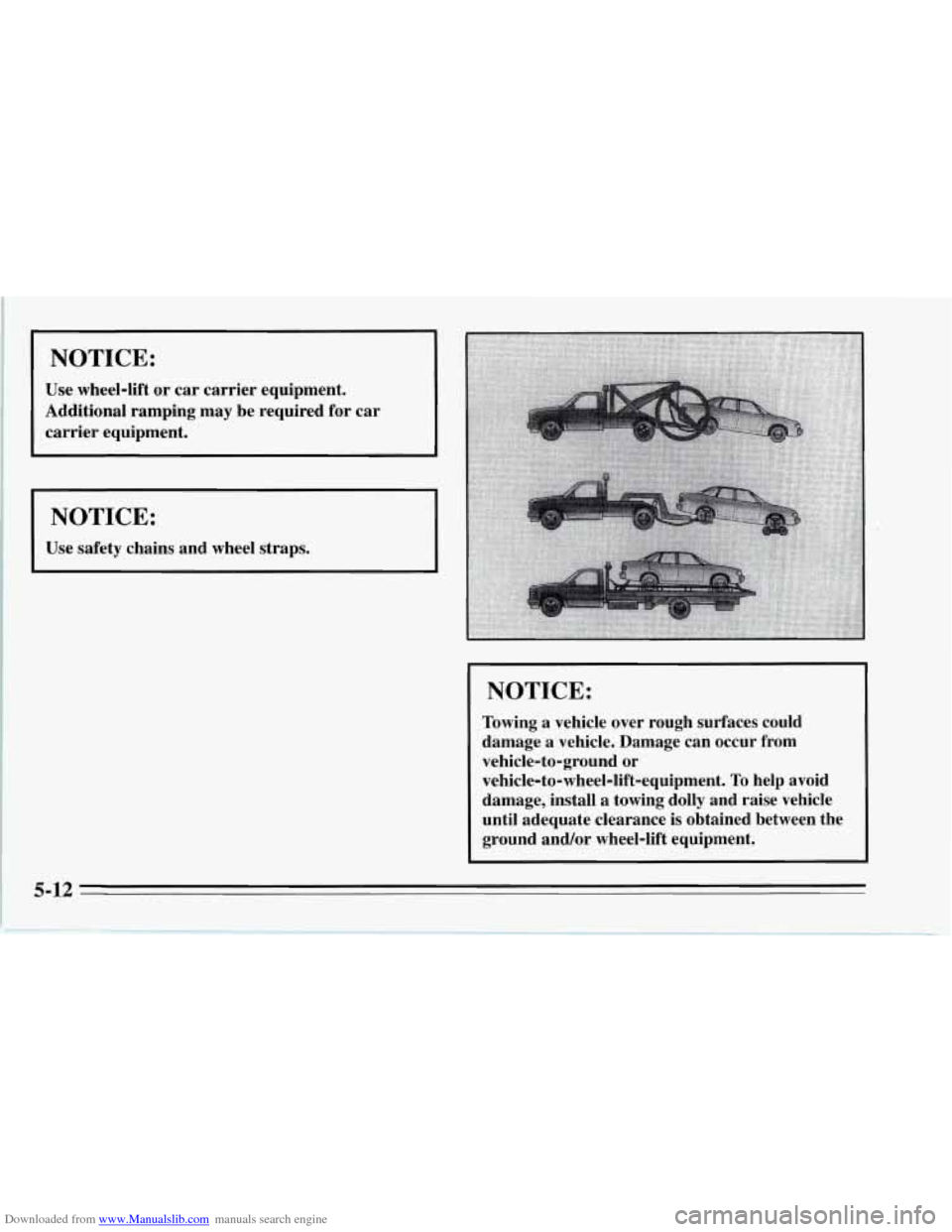
Use wheel-lift or car carrier equipment.
Additional ramping may be required for car carrier equipment.
NOTICE:
Use safety chains and wheel straps.
NOTICE:
Towing a vehicle over rough surfaces could
damage
a vehicle. Damage can occur from
vehicle-to-ground or
vehicle-to-wheel-lift-equipment. To help avoid
damage, install
a towing dolly and raise vehicle
until adequate clearance
is obtained between the
ground and/or wheel-lift equipment.
5-12
Page 219 of 386
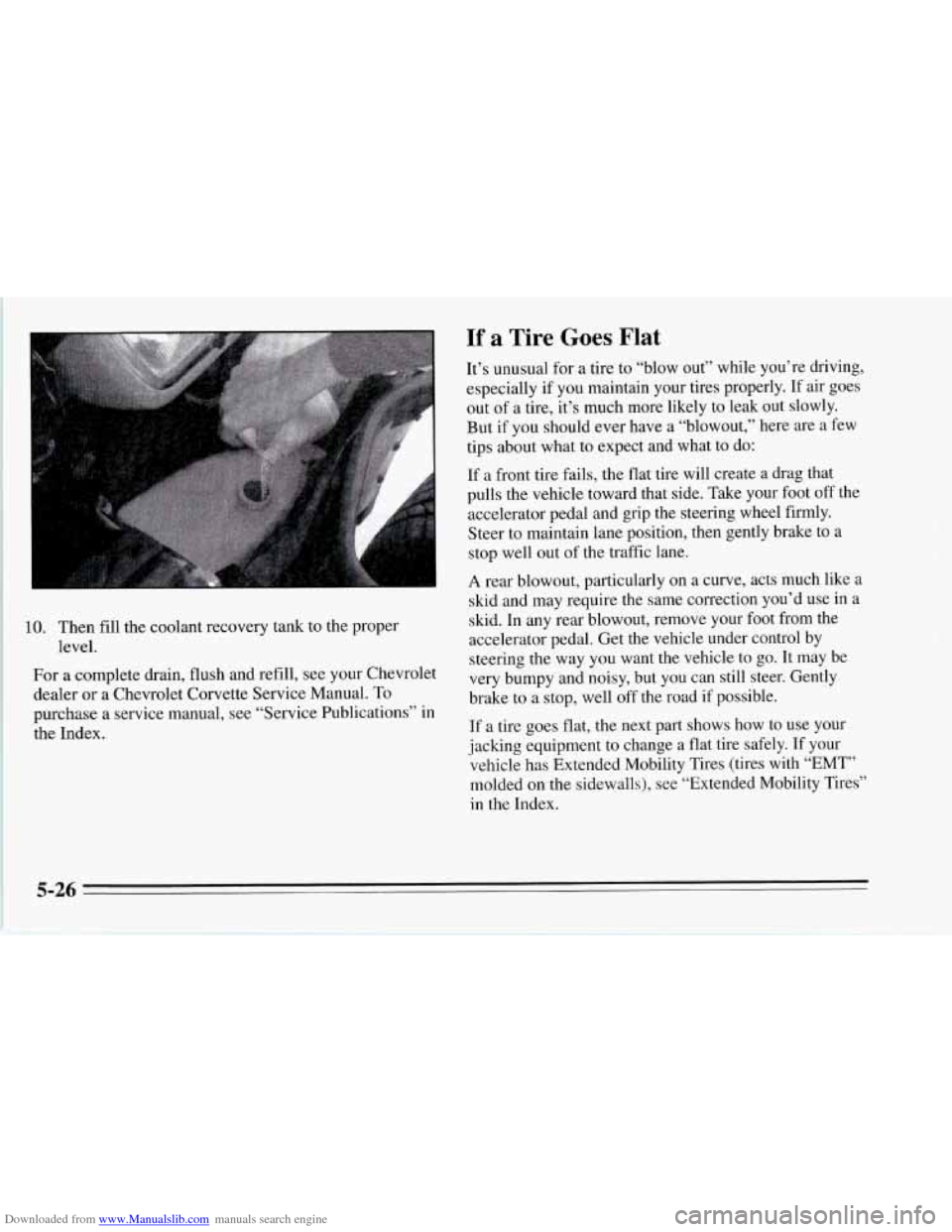
Downloaded from www.Manualslib.com manuals search engine 10. Then fill the coolant recovery tank
level. to the proper
For a complete drain, flush and refill, see your Chevrolet
dealer
or a Chevrolet Corvette Service Manual. To
purchase a service manual, see “Service Publications” in
the Index.
If a Tire Goes Flat
It’s unusual for a tire to “blow out” while you’re driving,
especially if you maintain your tires properly. If air goes
out of a tire, it’s much more likely to leak out slowly.
But if you should ever have
a “blowout,” here are a few
tips about what to expect and what
to do:
If a front tire fails, the flat tire will create a drag that
pulls the vehicle toward that side. Take your foot off the
accelerator pedal and grip the steering wheel firmly.
Steer to maintain lane position, then gently brake to a
stop well out of the traffic lane.
A rear blowout, particularly on a curve, acts much like a
skid and may require the same correction you’d use in a
skid. In any rear blowout, remove your foot from the
accelerator pedal. Get the vehicle under control by
steering the way you want the vehicle to
go. It may be
very bumpy and noisy, but you can still steer. Gently
brake to a stop, well off the road if possible.
If a tire goes flat, the next part shows how to use your
jacking equipment to change a flat tire safely. If your
vehicle has Extended Mobility Tires (tires with “EMT”
molded on the sidewalls), see “Extended Mobility Tires”
in the Index.
5-26
Page 228 of 386
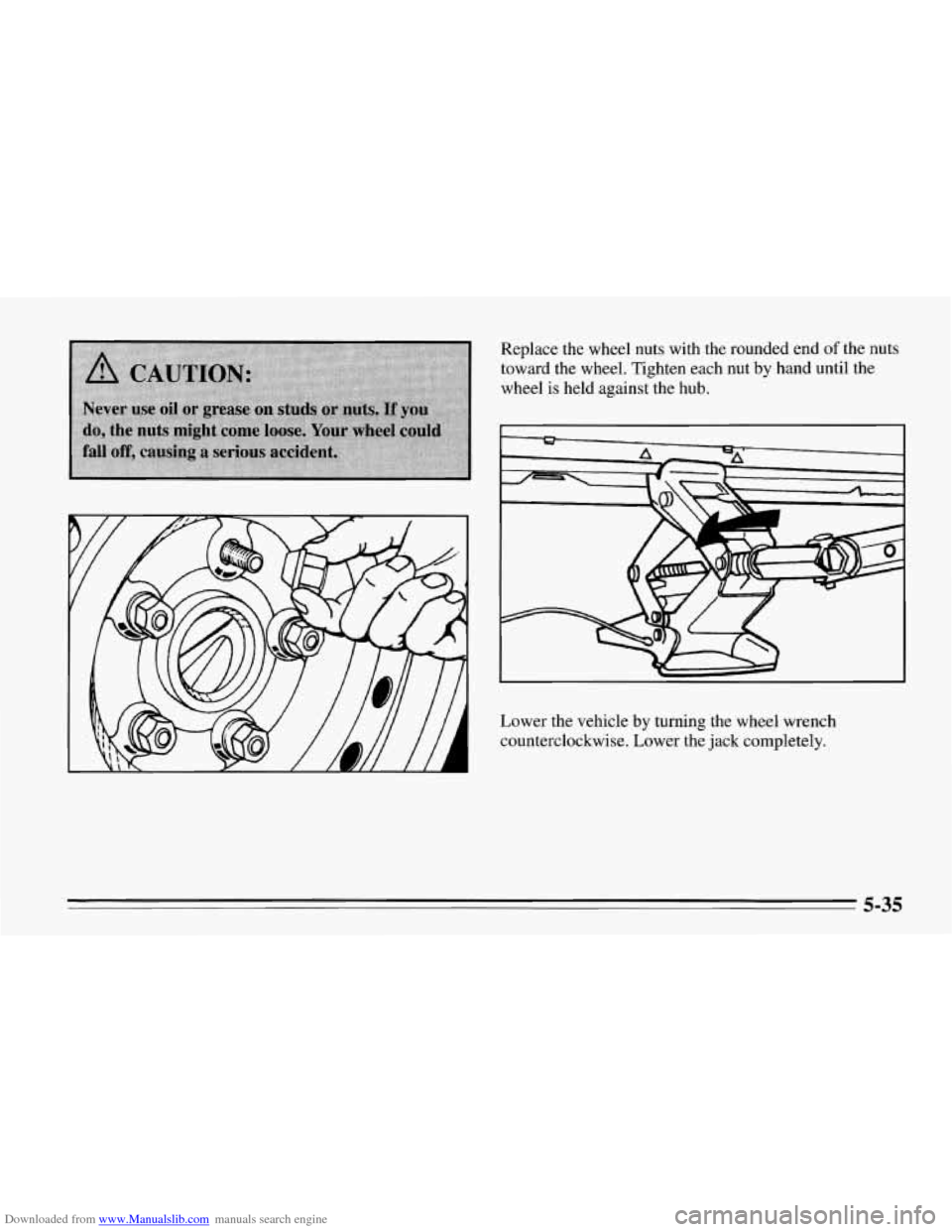
Downloaded from www.Manualslib.com manuals search engine Replace the wheel nuts with the rounded end of the nuts
toward the wheel. Tighten each nut by hand until the
wheel
is held against the hub.
Lower the vehicle by turning the wheel wrench
counterclockwise. Lower the jack completely.
5-35
Page 230 of 386
Downloaded from www.Manualslib.com manuals search engine NOTICE:
Your Corvette’s radio receiver box is in the rear
storage compartment.
To help avoid damage,
carefully place the jack, socket and wheel lock
key into the foam container in the compartment.
Do not toss or place the items against the radio
receiver box or any wiring.
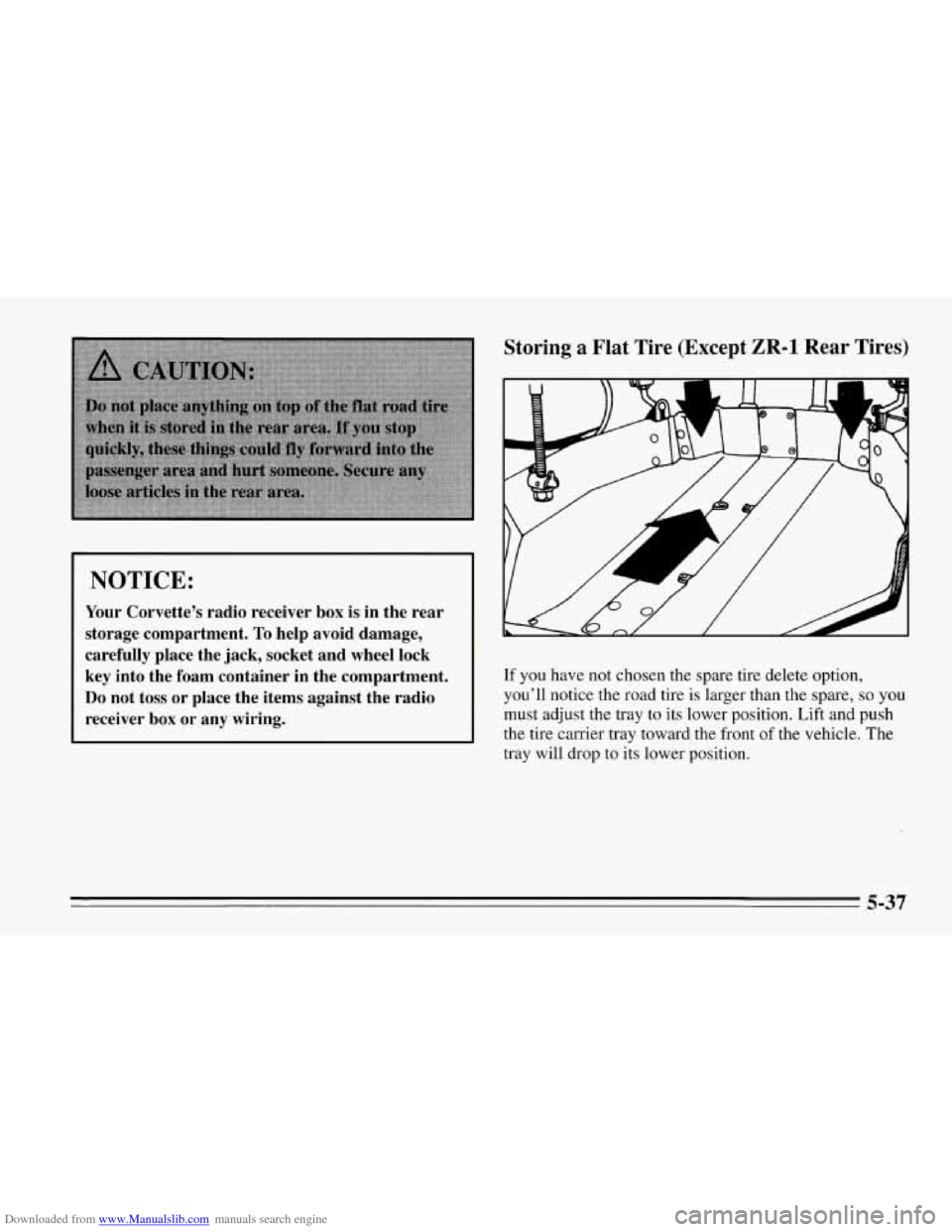
Storing a Flat Tire (Except ZR-1 Rear Tires)
If you have not chosen the spare tire delete option,
you’ll notice the road tire is larger than the spare,
so you
must adjust the tray to its lower position. Lift and
push
the tire carrier tray toward the front of the vehicle. The
tray will drop to its lower position.
5-37
Page 231 of 386
Downloaded from www.Manualslib.com manuals search engine F
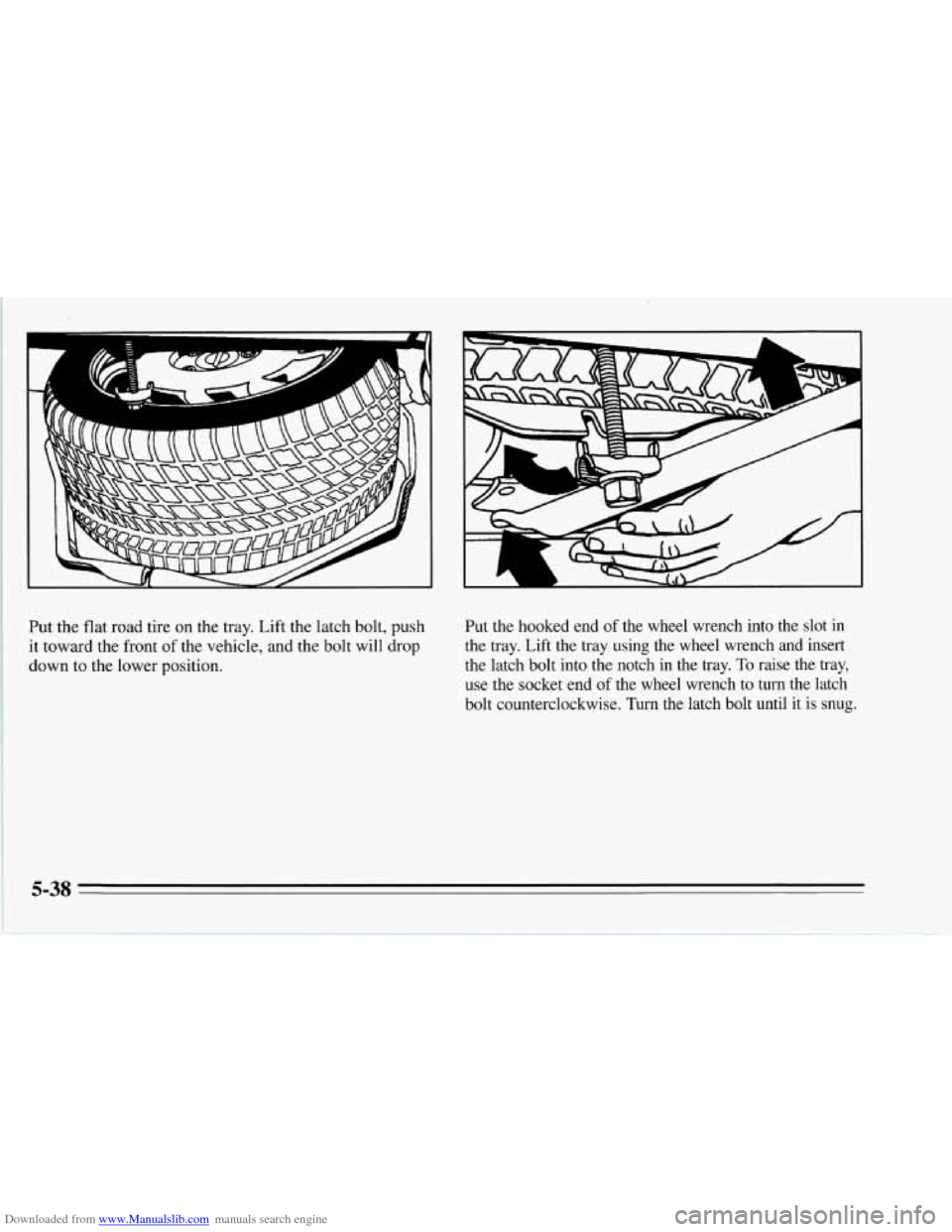
Put the flat road tire on the tray. Lift the latch bolt, push
it toward the front
of the vehicle, and the bolt will drop
down to the lower position. Put
the hooked end of the wheel wrench into the slot in
the tray. Lift the tray using the wheel wrench and insert
the latch bolt into the notch in the tray.
To raise the tray,
use the socket end
of the wheel wrench to turn the latch
bolt counterclockwise. Turn the latch bolt until it is snug.
5-38
Page 235 of 386
Downloaded from www.Manualslib.com manuals search engine I NOTICE:
Spinning your wheels can destroy parts of your
vehicle as well as the tires. If you spin the wheels
too fast while shifting your transmission back
and forth, you can destroy your transmission.
For information about using tire chains on your vehicle,
see “Tire Chains” in the Index.
Rocking your vehicle to get it out:
First, turn your steering wheel left and right. That will
clear the area around your front wheels. You should turn
your ASR system off. (See
“ASR System” in the Index.)
Then shift back and forth between REVERSE (R) and a
forward gear (or with a manual transmission, between
FIRST
(1) or SECOND (2) gear and REVERSE (R)),
spinning the wheels as little as possible. Release the
accelerator pedal while you shift, and press lightly on
the accelerator pedal when the transmission is in gear.
If
that doesn’t get you out after a few tries, you may need
to be towed out. If you do need to be towed out, see
“Towing Your Vehicle” in the Index.
5-42