belt CHEVROLET CORVETTE 1995 4.G Owner's Guide
[x] Cancel search | Manufacturer: CHEVROLET, Model Year: 1995, Model line: CORVETTE, Model: CHEVROLET CORVETTE 1995 4.GPages: 386, PDF Size: 20.15 MB
Page 174 of 386
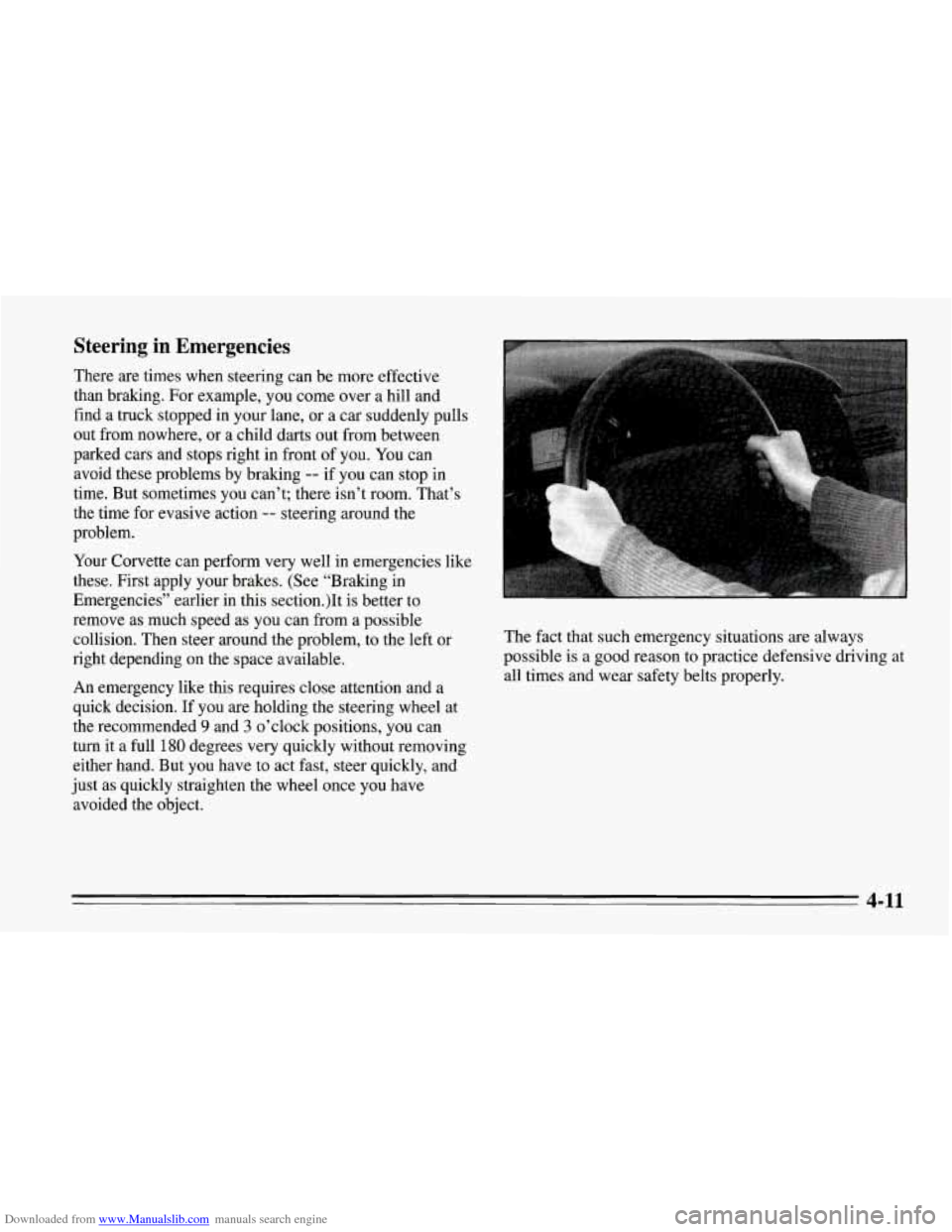
Downloaded from www.Manualslib.com manuals search engine An emergency like this requires close attention and a
quick decision. If you are holding the steering wheel at
the recommended
9 and 3 o'clock positions, you can
turn it a full
180 degrees very quickly without removing
either hand. But you have to act fast, steer quickly, and
just as quickly straighten the wheel once you have
avoided the object. The
fact that such emergency situations are always
possible is a good reason
to practice defensive driving at
all times and wear safety belts properly.
4-11
Page 287 of 386
Downloaded from www.Manualslib.com manuals search engine Buying New Tires
To find out what kind and size of tires you need, look at
the Tire-Loading Information label.
The tires installed on your vehicle when it was new had
a Tire Performance Criteria Specification (TPC Spec)
number on each tire’s sidewall. When you get new tires,
get ones with that same TPC Spec number. That way,
your vehicle will continue to have tires that are designed
to give proper endurance, handling, speed rating,
traction, ride and other things during normal service on
your vehicle. If your tires have an all-season tread
design, the TPC number will be followed by an
“MS”
(for mud and snow).
If you ever replace your tires with those not having a
TPC Spec number, make sure they are the same size,
load range, speed rating and construction type (bias,
bias-belted or radial) as your original tires.
Uniform Tire Quality Grading
The following information relates to the system
developed
by the United States National Highway
Traffic Safety Administration which grades tires by
treadwear, traction and temperature performance. (This
applies only to vehicles sold in the United States.)
Treadwear
The treadwear grade is a comparative rating based on
the wear rate of the tire when tested under controlled
conditions on
a specified government test course. For
6-52
Page 294 of 386
Downloaded from www.Manualslib.com manuals search engine You can remove scratches from a Dulso-coated molding
by wiping briskly with the solvent-type cleaner
described earlier. If a ring forms, repeat the procedure
over a larger area, feathering toward the center of the
ring.
If the ring still remains, wipe the whole molding.
Cleaning the Top of the Instrument Panel
Use only mild soap and water to clean the top surfaces
of the instrument panel. Sprays containing silicones or
waxes may cause annoying reflections in the windshield
and even make it difficult to see through the windshield
under certain conditions.
Cleaning Speaker Covers
Vacuum around a speaker cover gently, so that the
speaker won’t be damaged.
If something gets on one
of them, follow the steps earlier under “Using
Solvent-Type Cleaner on Fabric.” Use as little solvent
as you can.
Care of Safety Belts
Keep belts clean and dry.
Glass
Glass should be cleaned often. GM Glass Cleaner (GM
Part
No. 1050427) or a liquid household glass cleaner
will remove normal tobacco smoke and dust films.
Don’t use abrasive cleaners on glass, because they may
cause scratches. Avoid placing decals on the inside rear
window, since they may have to be scraped off later.
If
abrasive cleaners are used on the inside of the rear
window, an electric defogger element may be damaged.
Any temporary license should not be attached across the
defogger grid.
6-59
Page 312 of 386
Downloaded from www.Manualslib.com manuals search engine Replacement Parts
Flat Ratchet Wrench (Convertible Hardtop Only) ................... GM Part No. 10137741 or equivalent
Serpentine Belt
VIN Engine Code J ........................................................ GM Part No. 10067477
VIN Engine Code P
........................................................ GM Part No. 10230259
VIN Engine Code
J .......................................................... 4 1-907 (0.050" Gap)
GM Part No. 5614247 and GM Part No. 5614355 or equivalent
VIN Engine Code
P .......................................................... 41 -906 (0.050" Gap)
GM
Part No. 5614244 or equivalent
Tom@ Wrench ................................................. GM Part No. 1017231 1 or equivalent
Spark Plug
Wheel Nuts
Wheel Nut Torque ........................................................... 100 1b. ft. (140 Nam)
6-77
Page 315 of 386

Downloaded from www.Manualslib.com manuals search engine Power Curves -- LT5 Engine Belt Routing -- LTl (Code P) Engine
Power Curves
LT5 Engine 450 r - 450
- 400
- 350 5
- 300 g
200 g
d
3
- 250 $ U -
- 150 Y
- 100 m
- 50
w
ENGINE SPEED-RPM Belt Routing -- LT5 (Code J) Engine
6-80
Page 319 of 386
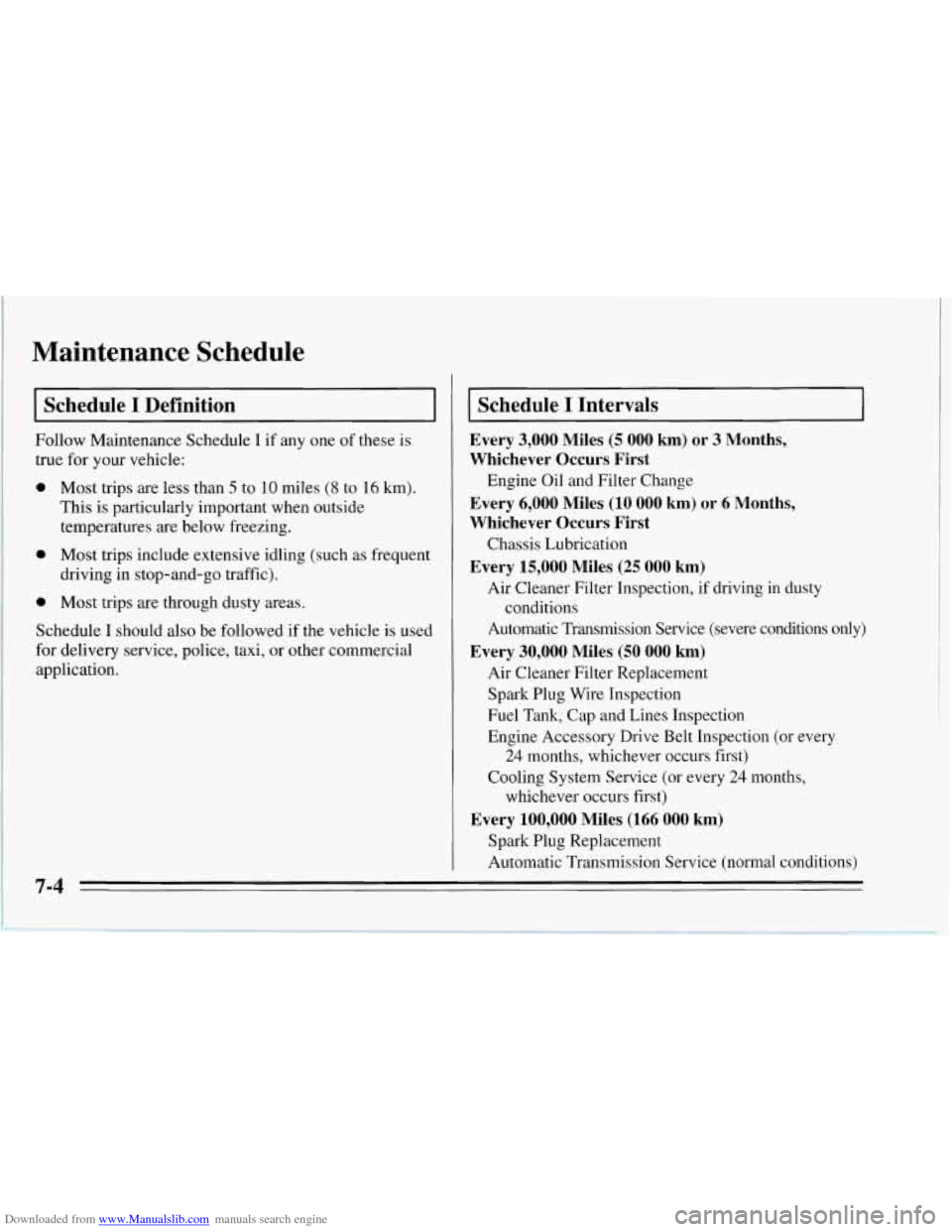
Downloaded from www.Manualslib.com manuals search engine Maintenance Schedule
I Schedule I Definition I
Follow Maintenance Schedule I if any one of these is
true for your vehicle:
0 Most trips are less than 5 to 10 miles (8 to 16 km).
This is particularly important when outside
temperatures are below freezing.
0 Most trips include extensive idling (such as frequent
driving in stop-and-go traffic).
0 Most trips are through dusty areas.
Schedule
I should also be followed if the vehicle is used
for delivery service, police, taxi, or other commercial
application.
Schedule I Intervals
Every 3,000 Miles (5 000 km) or 3 Months,
Whichever Occurs First
Every 6,000 Miles
(10 000 km) or 6 Months,
Whichever Occurs First
Chassis Lubrication
Every 15,000 Miles (25 000 km)
Air Cleaner Filter Inspection, if driving in dusty
Automatic Transmission Service (severe conditions only)
Every 30,000 Miles (50 000 km)
Air Cleaner Filter Replacement
Spark Plug Wire Inspection
Fuel Tank, Cap and Lines Inspection
Engine Accessory Drive Belt Inspection (or every
24 months, whichever occurs first)
Cooling System Service (or every
24 months,
whichever occurs first)
Spark Plug Replacement
Automatic Transmission Service (normal conditions)
Engine Oil and Filter Change
conditions
Every 100,000 Miles (166 000 km)
7-4
Page 320 of 386
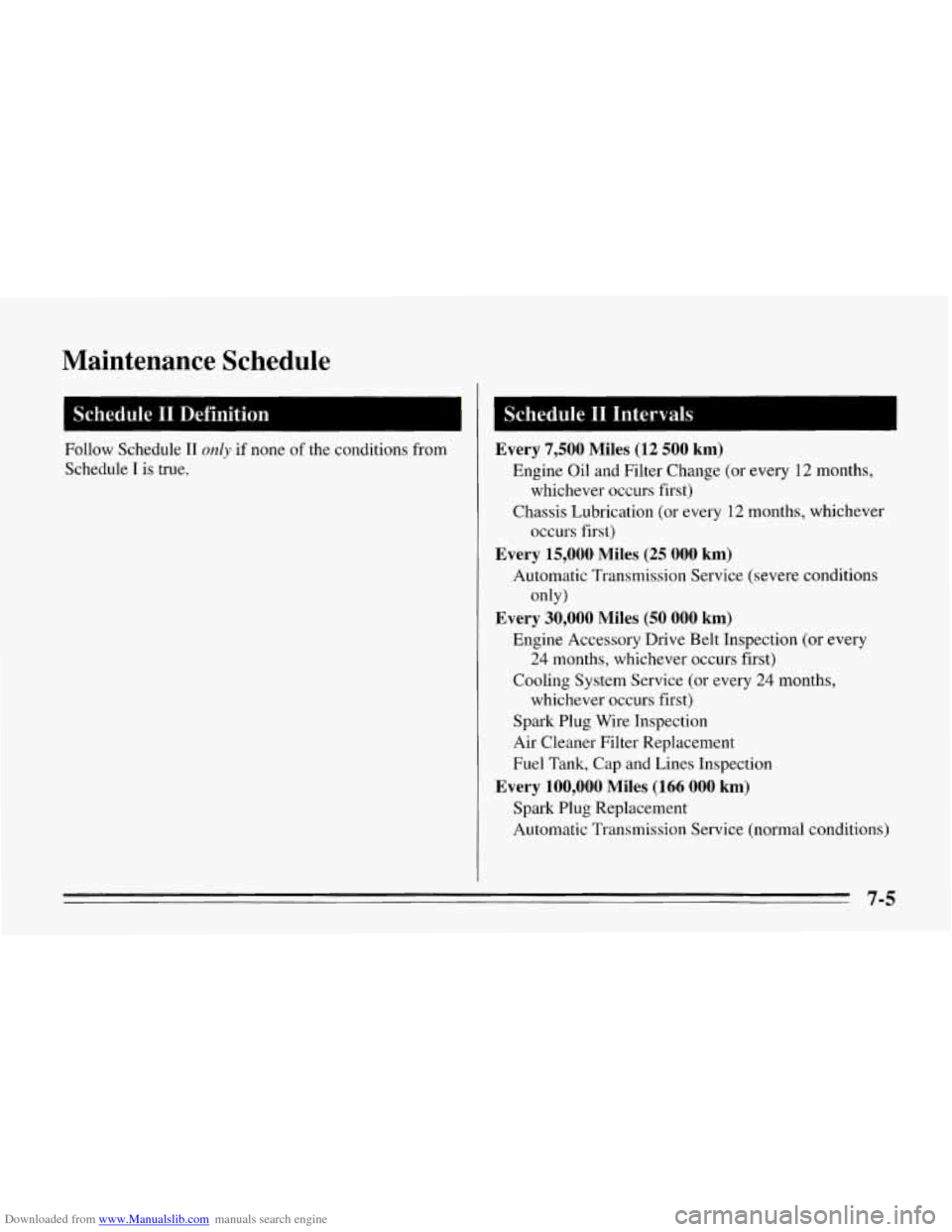
Downloaded from www.Manualslib.com manuals search engine Maintenance Schedule
Follow Schedule I1 only if none of the conditions from
Schedule
I is true.
I Schedule I1 Intervals I
Every 7,500 Miles (12 500 km)
whichever occurs first)
occurs first)
Engine
Oil and Filter Change (or every
12 months,
Chassis Lubrication (or every
12 months, whichever
Every 15,000 Miles (25 000 km)
Automatic Transmission Service (severe conditions
only
1
Every 30,000 Miles (50 000 km)
Engine Accessory Drive Belt Inspection (or every
24 months, whichever occurs first)
Cooling System Service (or every
24 months,
whichever occurs first)
Spark Plug Wire Inspection
Air Cleaner Filter Replacement
Fuel Tank, Cap and Lines Inspection
Every 100,000 Miles (166 000 km)
Spark Plug Replacement
Automatic Transmission Service (normal conditions)
7-5
Page 327 of 386
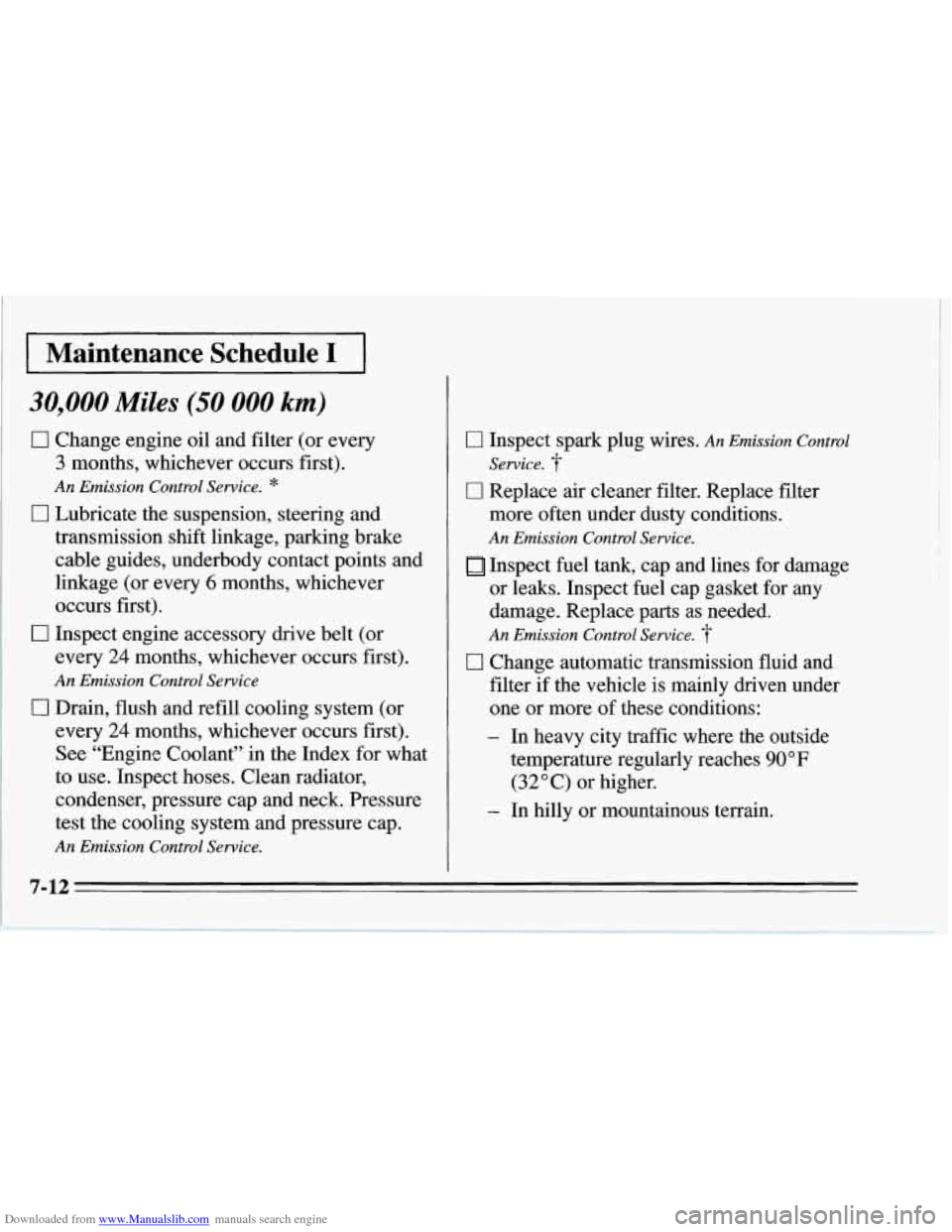
Downloaded from www.Manualslib.com manuals search engine Maintenance Schedule I
30,000 Miles (50 000 km)
0 Change engine oil and filter (or every [7 Inspect spark plug wires. An Emission Control
3 months, whichever occurs first). Service. -f-
An Emission Control Service. * [7 Replace air cleaner filter. Replace filter
17 Lubricate the suspension, steering and more often under dusty conditions.
transmission shift linkage, parking brake
An Emission Control Service.
cable guides, underbody contact Points and Inspect fuel tank, cap and lines for damage
linkage (or every
6 months, whichever or leaks. Inspect fuel cap gasket for any
occurs first). damage. Replace parts as needed.
every
24 months, whichever occurs first). 0 Change automatic transmission fluid and
An Emission Control Service filter if the vehicle is mainly driven under
every
24 months, whichever occurs first). - In heavy city traffic where the outside
See “Engine Coolant” in the Index for what temperature regularly reaches 90 O F
to use. Inspect hoses. Clean radiator, (32 O C) or higher.
condenser, pressure cap and neck. Pressure
test the cooling system and pressure cap.
0 Inspect engine accessory drive belt (or An Emission Control Service. -f-
0 Drain, flush and refill cooling system (or one or more of these conditions:
- In hilly or mountainous terrain.
An Emission Control Service.
7-12
Page 334 of 386
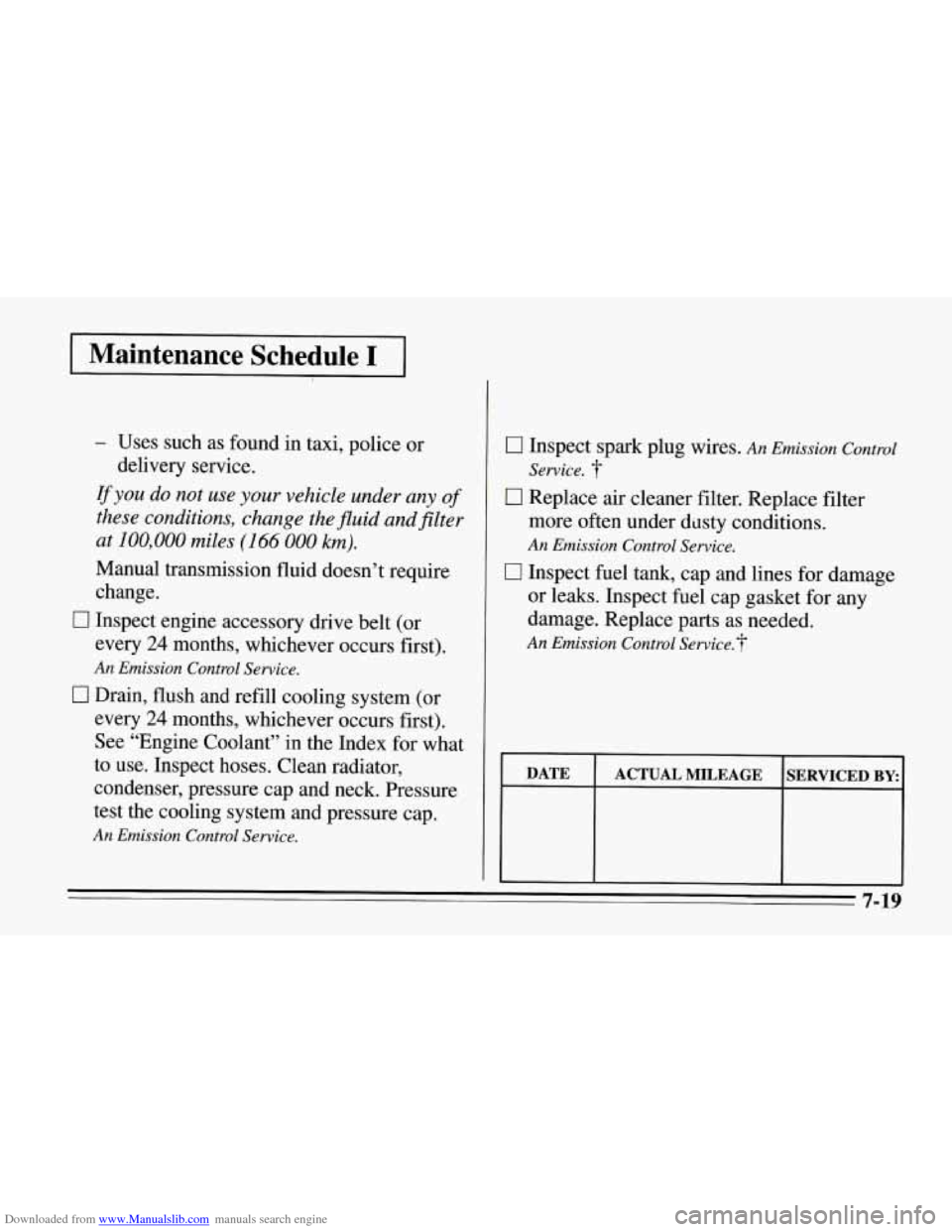
Downloaded from www.Manualslib.com manuals search engine Maintenance Schedule I
- Uses such as found in taxi, police or
Ifyou do not use your vehicle under any of
these conditions, change the fluid and filter
at
100,000 miles (1 66 000 km).
Manual transmission fluid doesn’t require
change.
every
24 months, whichever occurs first).
0 Drain, flush and refill cooling system (or
every
24 months, whichever occurs first).
See “Engine Coolant” in the Index for what
to use. Inspect hoses. Clean radiator,
condenser, pressure cap and neck. Pressure
test the cooling system and pressure cap.
An Emission Control Service.
delivery service.
I7 Inspect engine accessory drive belt (or
An Emission Control Service.
0 Inspect spark plug wires. An Emission Control
0 Replace air cleaner filter. Replace filter
Sewice.
more often under dusty conditions.
An Emission Control Service.
0 Inspect fuel tank, cap and lines for damage
or leaks. Inspect fuel cap gasket for any
damage. Replace parts as needed.
An Emission Control Service.?
DATE
SERVICED BY: ACTUAL MILEAGE
A
7-19
Page 340 of 386
Downloaded from www.Manualslib.com manuals search engine I Maintenance Schedule I I
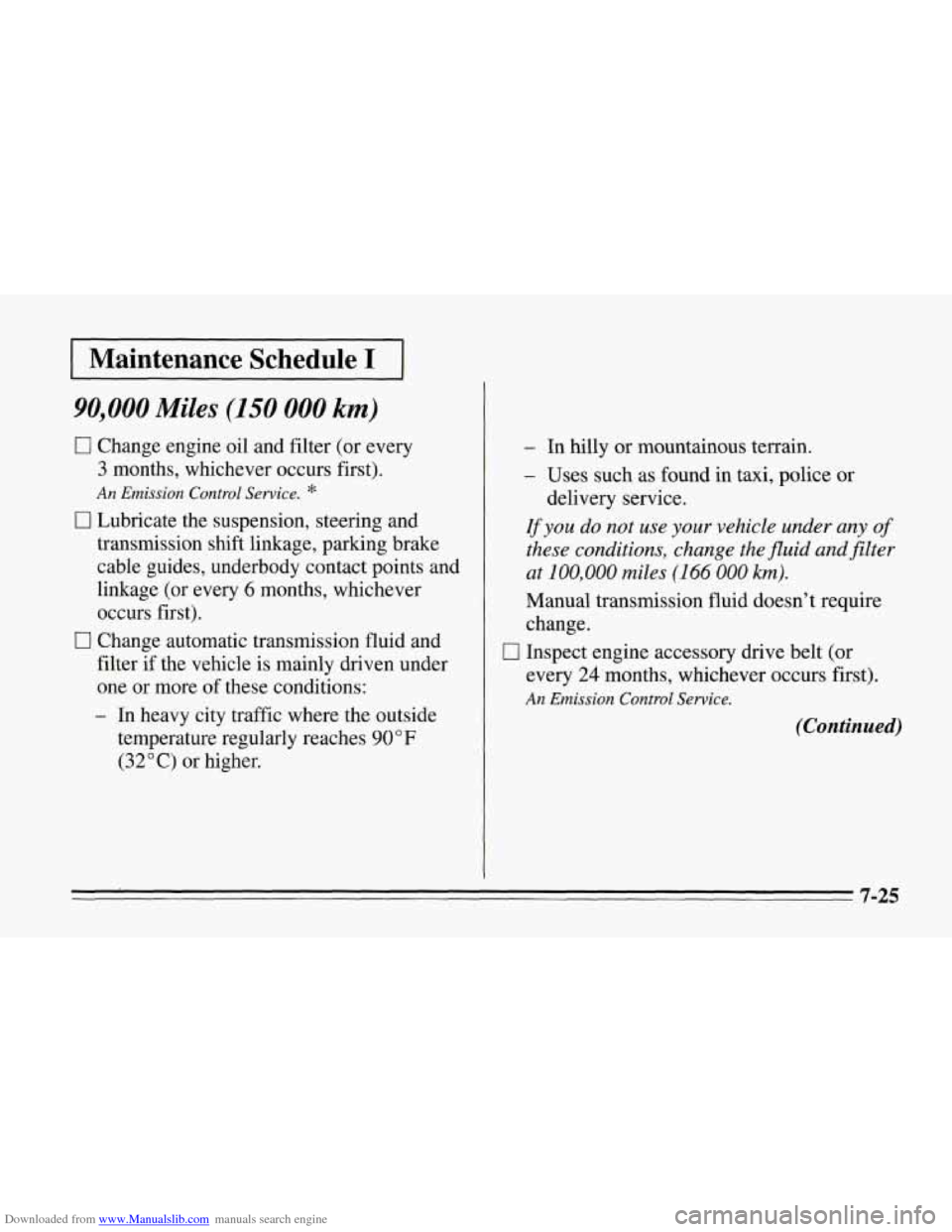
90,000 Miles (150 000 km)
0 Change engine oil and filter (or every
3 months, whichever occurs first).
0 Lubricate the suspension, steering and
An Emission Control Service. *
transmission shift linkage, parlung brake
cable guides, underbody contact points and
linkage (or every
6 months, whichever
occurs first).
0 Change automatic transmission fluid and
filter
if the vehicle is mainly driven under
one or more of these conditions:
- In heavy city traffic where the outside
temperature regularly reaches
90 O F
(32 O C) or higher.
- In hilly or mountainous terrain.
- Uses such as found in taxi, police or
If you do not use your vehicle under any of
these conditions, change the fluid and filter
at
100,000 miles (1 66 000 km).
Manual transmission fluid doesn’t require
change.
every
24 months, whichever occurs first).
An Emission Control Service.
delivery service.
0 Inspect engine accessory drive belt (or
(Continued)
7-25