parking CHEVROLET CORVETTE 1995 4.G Owners Manual
[x] Cancel search | Manufacturer: CHEVROLET, Model Year: 1995, Model line: CORVETTE, Model: CHEVROLET CORVETTE 1995 4.GPages: 386, PDF Size: 20.15 MB
Page 52 of 386

Downloaded from www.Manualslib.com manuals search engine To replace your battery: Remote Hatch Release
1.
2.
3.
4.
5.
Insert a screwdriver in the slot on the back of the
transmitter and gently pry apart the front and back.
Gently pry the battery out of the transmitter using the
screwdriver.
Put the new battery in the transmitter, positive
(+)
side up. Use a Duracell@ battery, type DL2450, or
equivalent.
Put the two halves back together. Make sure the
halves are together tightly
so water won’t get in.
Test the transmitter. Press the
switch in your center console to unlock the
hatch from inside your vehicle. If you have an automatic
transmission, your shift lever must be in
PARK (P) or
NEUTRAL (N) to use the switch. If you have a manual
transmission, you must set the parking brake before you
can use the switch when the vehicle
is running. If you
have a manual transmission and the vehicle is not
running, you may use the switch in any gear.
2-9
Page 55 of 386
Downloaded from www.Manualslib.com manuals search engine Parking at Night
Park in a lighted spot, close all windows and lock your
vehicle. Remember to keep your valuables out of sight.
Put them in
a storage area, or take them with you.
Parking Lots
If you park in a lot where someone will be watching
your vehicle, it’s best to lock it up and take your keys.
But what if you have to leave your ignition key? What
if
you have to leave something valuable in your vehicle?
Put your valuables in a storage area, like your rear
Lock the rear storage compartment and center
0 Lock all the doors except the driver’s.
Then take the door key with you.
storage
compartment or center console.
console.
Universal Theft Deterrent
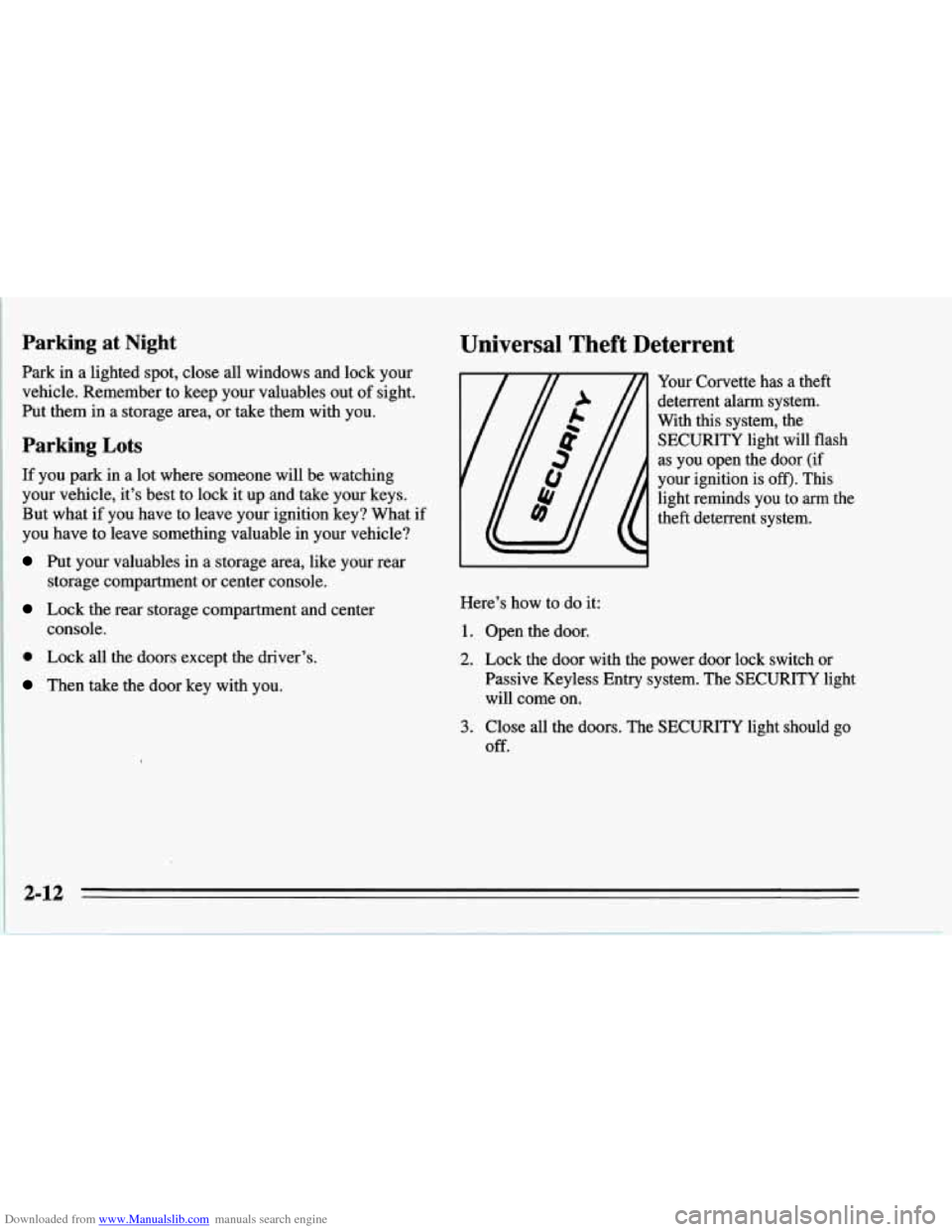
Your Corvette has a theft
deterrent alarm system.
With this system, the
SECURITY light will flash
as you open the door (if
your ignition is
off). This
light reminds you to arm the
theft deterrent system.
Here’s how to do it:
1. Open the door.
2. Lock the door with the power door lock switch or
Passive Keyless Entry system. The SECURITY light
will come on.
3. Close all the doors. The SECURITY light should go
Off.
2-1 2 I - --
Page 67 of 386
Downloaded from www.Manualslib.com manuals search engine I NOTICE:
After you’ve used the coolant heater, be sure to store the cord
as it was before to keep it away
from moving engine parts. If you don’t, it could
be damaged.
How long should you keep the coolant heater plugged
in? The answer depends on the weather, the kind
of oil
you have, and some other things. Instead
of trying to list
everything here, we ask that you contact your Chevrolet
dealer in the area where you’ll be parking your vehicle.
The dealer can give you the best advice for that
particular area.
Automatic Transmission
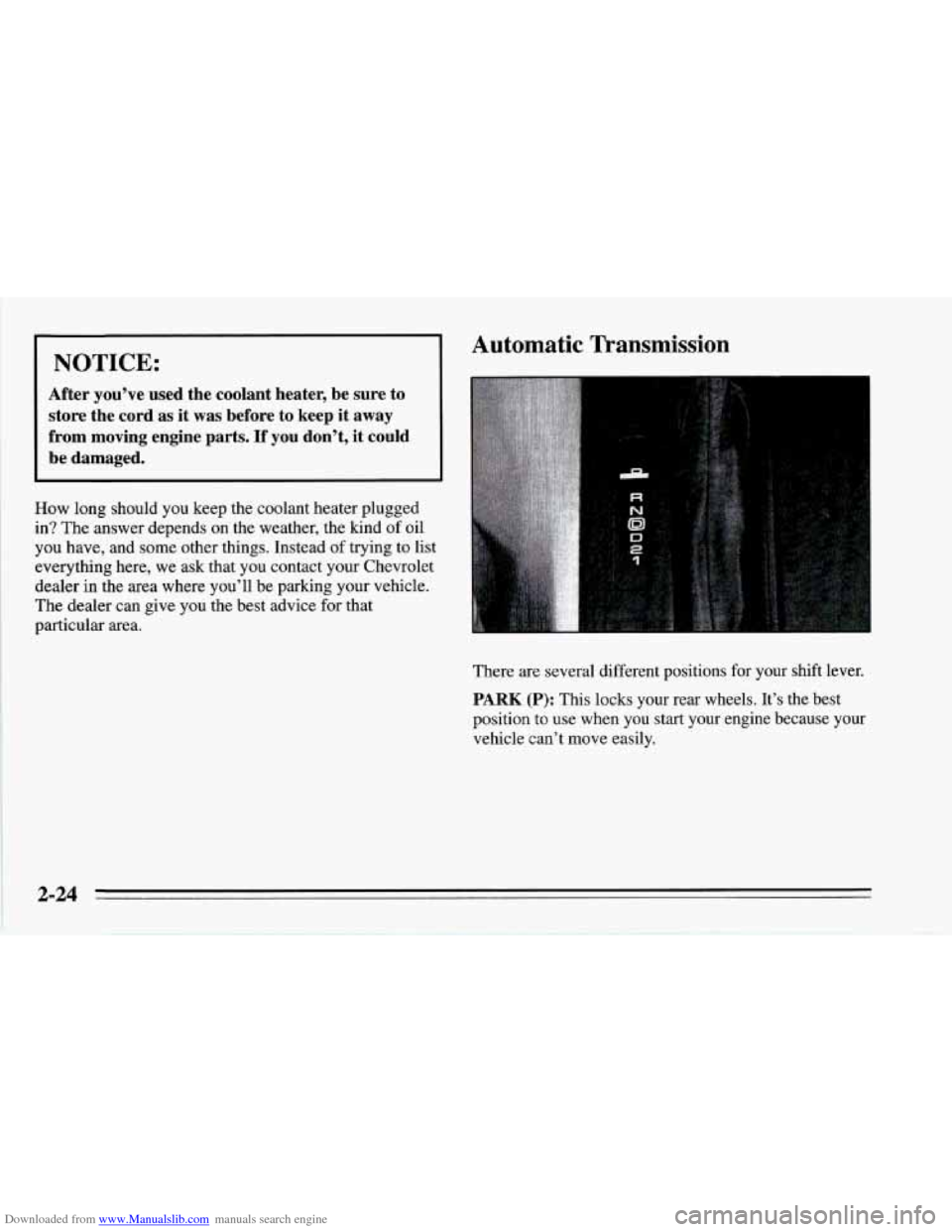
There are several different positions for your shift lever.
PARK (P): This locks your rear wheels. It’s the best
position
to use when you start your engine because your
vehicle can’t move easily.
2-24
Page 75 of 386
Downloaded from www.Manualslib.com manuals search engine Parking Brake
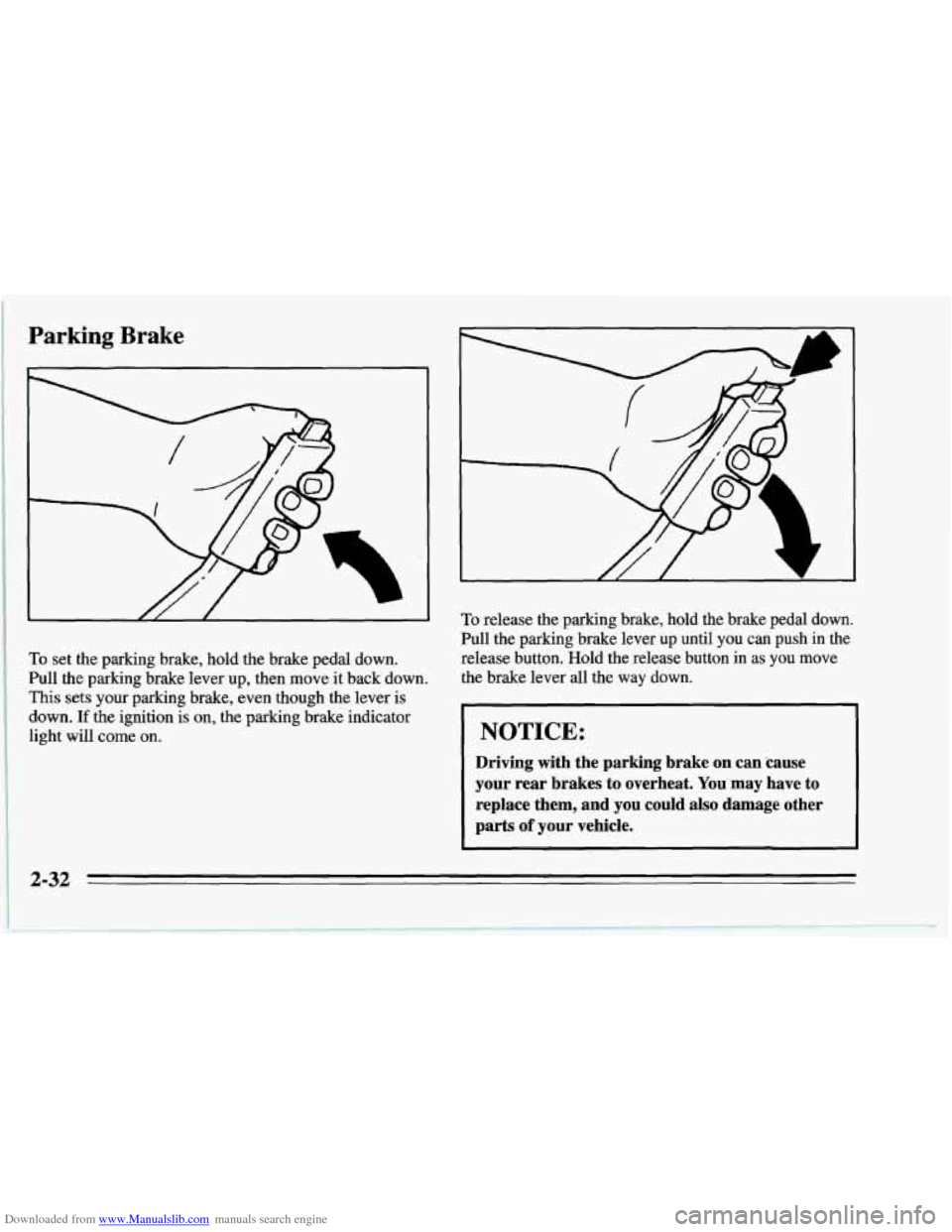
To set the parking brake, hold the brake pedal down.
Pull the parking brake lever up, then move it back down.
This sets your parking brake, even though the lever is
down.
If the ignition is on, the parking brake indicator
light will come on.
To release the parking brake, hold the brake pedal down.
Pull the parking brake lever up until you can push in the
release button. Hold the release button in
as you move
the brake lever all the way down.
NOTICE:
Driving with the parking brake on can 'cause
your rear brakes to overheat. You may have to
replace them, and you could also damage other
parts
of your vehicle.
2-32
Page 76 of 386
Downloaded from www.Manualslib.com manuals search engine Shifting Into PARK (P)
(Automatic Transmission Models Only)
I
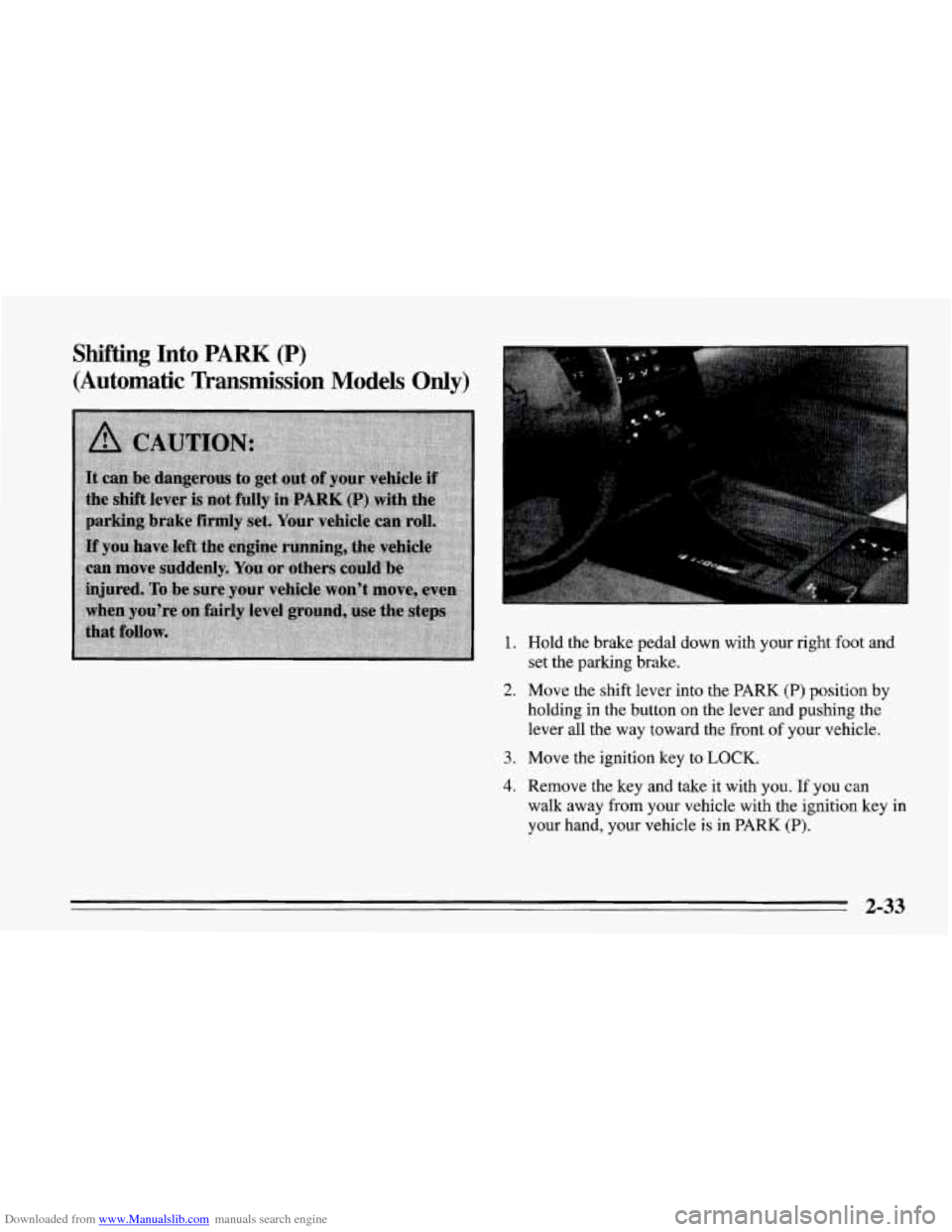
1. Hold the brake pedal down with your right foot and
set the parking brake.
holding in the button on the lever and pushing the
lever
all the way toward the front of your vehicle.
2. Move the shift lever into the PARK (P) position by
3. Move the ignition key to LOCK.
4. Remove the key and take it with you. If you can
walk away from your vehicle with the ignition key in
your hand, your vehicle
is in PARK (P).
2-33
Page 77 of 386
Downloaded from www.Manualslib.com manuals search engine Leaving Your Vehicle With the
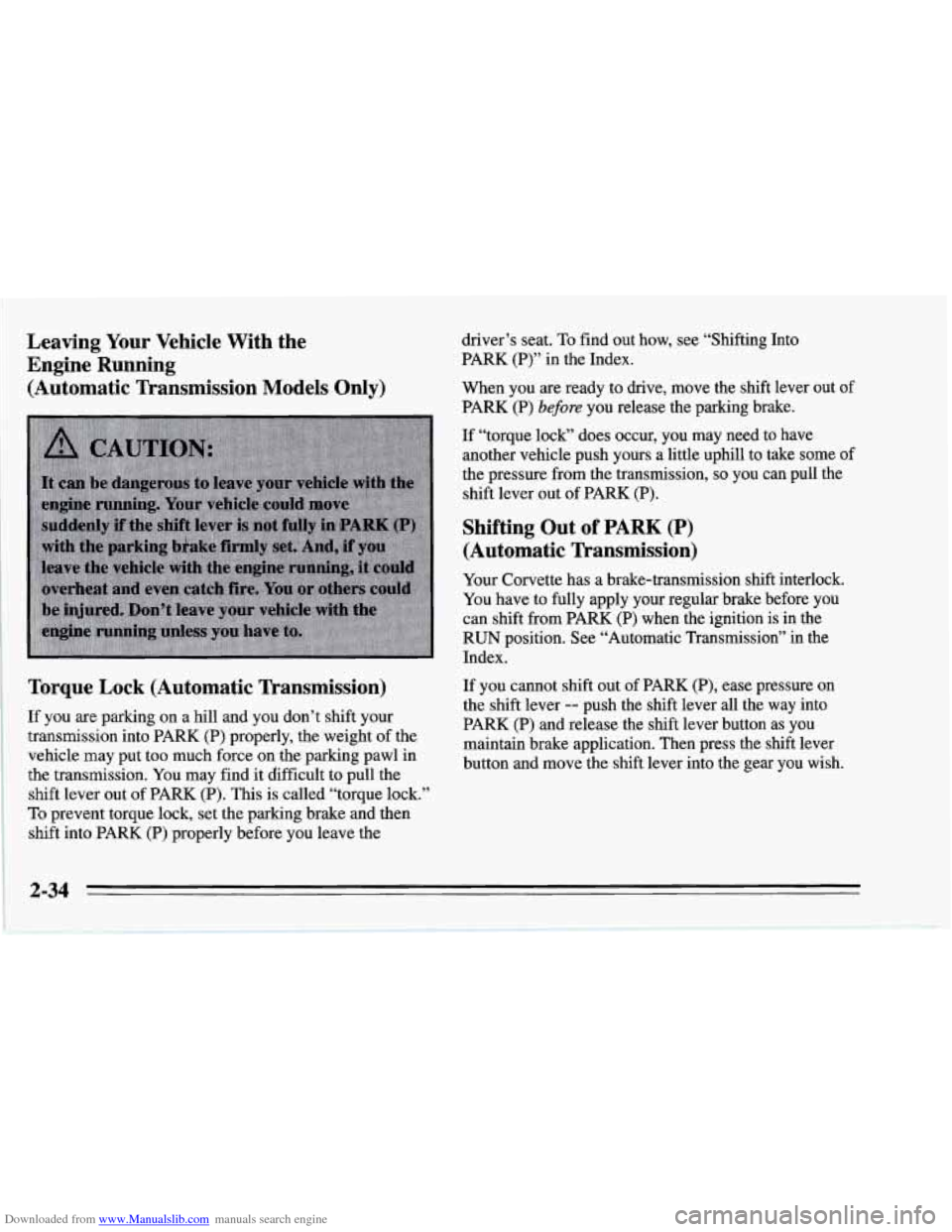
Engine Running (Automatic Transmission Models Onlv)
Y‘
Torque Lock (Automatic Transmission)
If you are parking on a hill and you don’t shift your
transmission into PARK (P) properly, the weight of the
vehicle may put too much force
on the parking pawl in
the transmission. You may find it difficult to pull
the
shift lever out of PARK (P). This is called “torque lock.”
To prevent torque lock, set the parking brake and then
shift into PARK (P) properly before you leave the driver’s seat.
To find
out how, see “Shifting Into
PARK
(P)” in the Index.
When you are ready to drive, move the shift lever out of
PARK
(P) before you release the parking brake.
If “torque lock” does occur, you may need to have
another vehicle push yours a little uphill to take some
(
the pressure from the transmission, so you can pull the
shift lever out of PARK (P).
Shifting Out of PARK (P)
(Automatic Transmission)
Your Corvette has a brake-transmission shift interlock.
You have to fully apply your regular brake before you
can shift from PARK
(P) when the ignition is in the
RUN position. See “Automatic Transmission” in the
Index.
If you cannot shift out of PARK
(P), ease pressure on
the shift lever
-- push the shift lever all the way into
PARK
(P) and release the shift lever button as you
maintain brake application. Then press the shift lever
button and move the shift lever into the gear you wish.
2-34
Page 78 of 386
Downloaded from www.Manualslib.com manuals search engine If you ever hold the brake pedal down but still can’t
shift out of PARK
(P), try this:
1. Turn the key to OFF,
2. Apply and hold the brake until the end of Step 4.
3. Shift to NEUTRAL (N).
4. Start the vehicle and then shift to the drive gear you
want.
5. Have the vehicle fixed as soon as you can.
Parking Your Vehicle
(Manual Transmission)
Before you get out of your vehicle, put your manual
transmission in
REVERSE (R) and firmly apply the
parking brake.
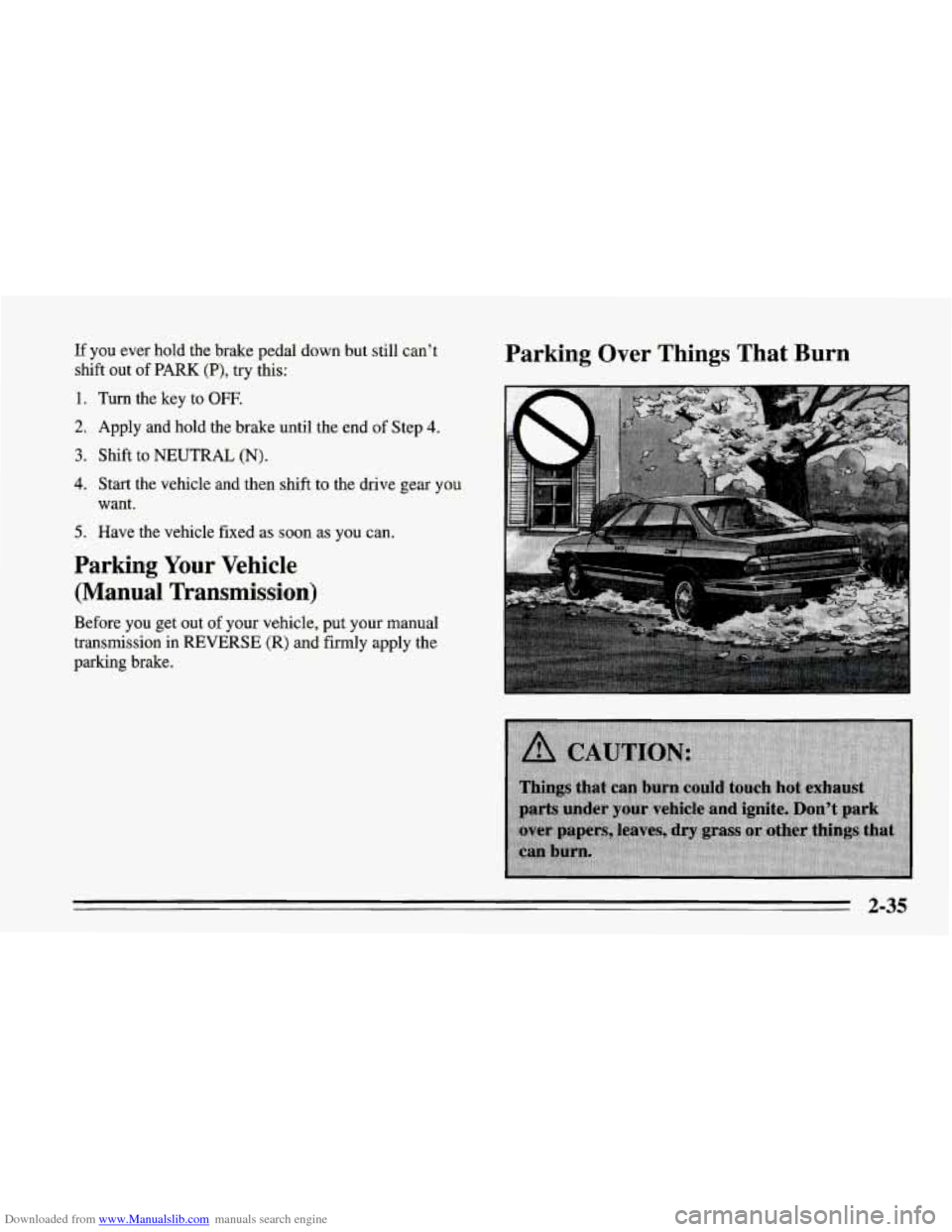
Parking Over Things That Burn
2-35
Page 89 of 386
Downloaded from www.Manualslib.com manuals search engine Lamps
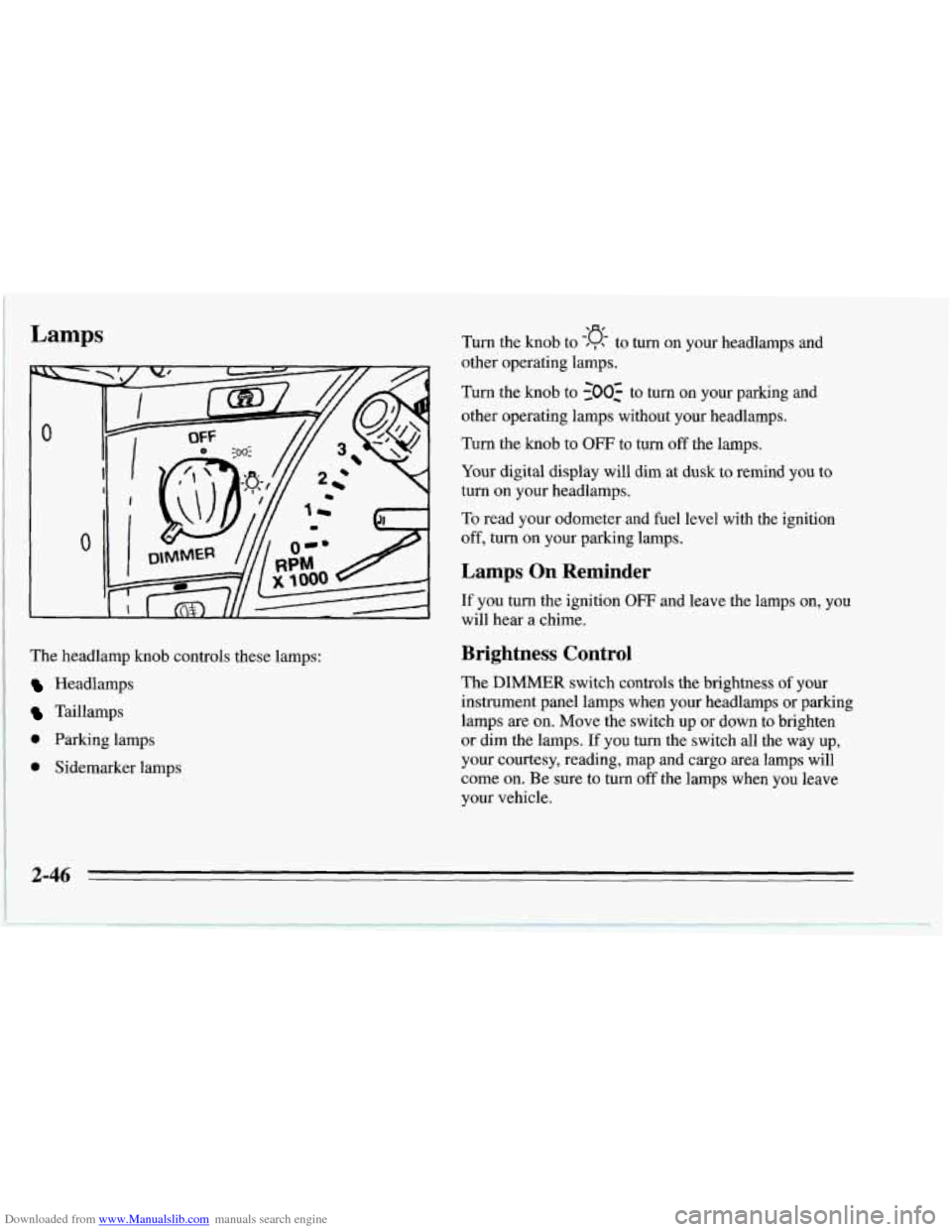
0
0
The headlamp knob controls these lamps:
Headlamps
Taillamps
0 Parking lamps
0 Sidemarker lamps Turn the knob to
0, to turn on your
headlamps and
other operating lamps.
Turn the knob to
Turn the knob to
OFF to turn off the lamps.
Your digital display will dim at dusk to remind you to
turn on your headlamps.
To read your odometer and
fuel level with the ignition
off, turn on your parking
lamps.
Lamps On Reminder
If you turn the ignition OFF and leave the lamps on, you
will hear a chime.
Brightness Control
The DIMMER switch controls the brightness of your
instrument panel lamps when your headlamps or parking
lamps are on. Move the switch up
or down to brighten
or dim the lamps. If you turn the switch all the way
up,
your courtesy, reading, map and cargo area lamps will
come
on. Be sure to turn off the lamps when you leave
your vehicle.
-‘a-
2-46
Page 90 of 386
Downloaded from www.Manualslib.com manuals search engine Headlamp Doors
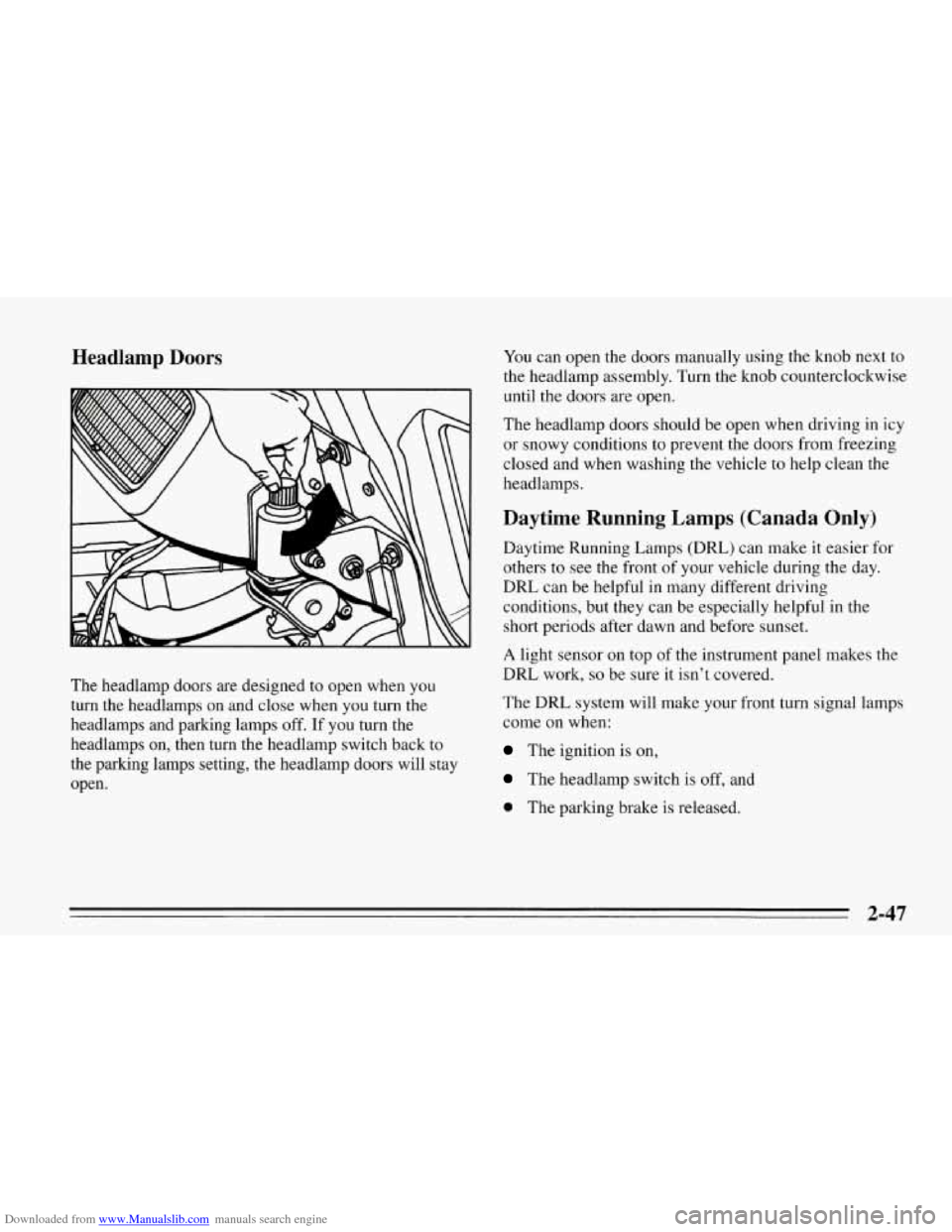
The headlamp doors are designed to open when you
turn the headlamps on and close when you turn the
headlamps and parking lamps off. If you turn the
headlamps on, then turn the headlamp switch back to
the parking lamps setting, the headlamp doors will stay
open. You
can open the doors manually using the knob next to
the headlamp assembly. Turn the knob counterclockwise
until the doors are open.
The headlamp doors should be open when driving in icy
or snowy conditions to prevent the doors from freezing
closed and when washing the vehicle to help clean the
headlamps.
Daytime Running Lamps (Canada Only)
Daytime Running Lamps (DRL) can make it easier for
others to see the front of your vehicle during the day.
DRL can be helpful in many different driving
conditions, but they can be especially helpful in the
short periods after dawn and before sunset.
A light sensor on top of the instrument panel makes the
DRL work,
so be sure it isn’t covered.
The DRL system will make your front turn signal lamps
come on when:
The ignition is on,
The headlamp switch is off, and
0 The parking brake is released.
2-47
Page 91 of 386
Downloaded from www.Manualslib.com manuals search engine When the DRL are on, only your front turn signal lamps
will be
on. The taillamps, sidemarker and other lamps
won’t
be on. Your instrument panel won’t be lit up either.
When it’s dark enough outside, your front turn signal
lamps will go out and your headlamps will come on.
The other lamps that come on with your headlamps will
also come on.
When it’s bright enough outside, the regular lamps will
go off, and your front turn signal lamps come on.
As with any vehicle, you should turn on the regular
headlamp system any time you need
it.
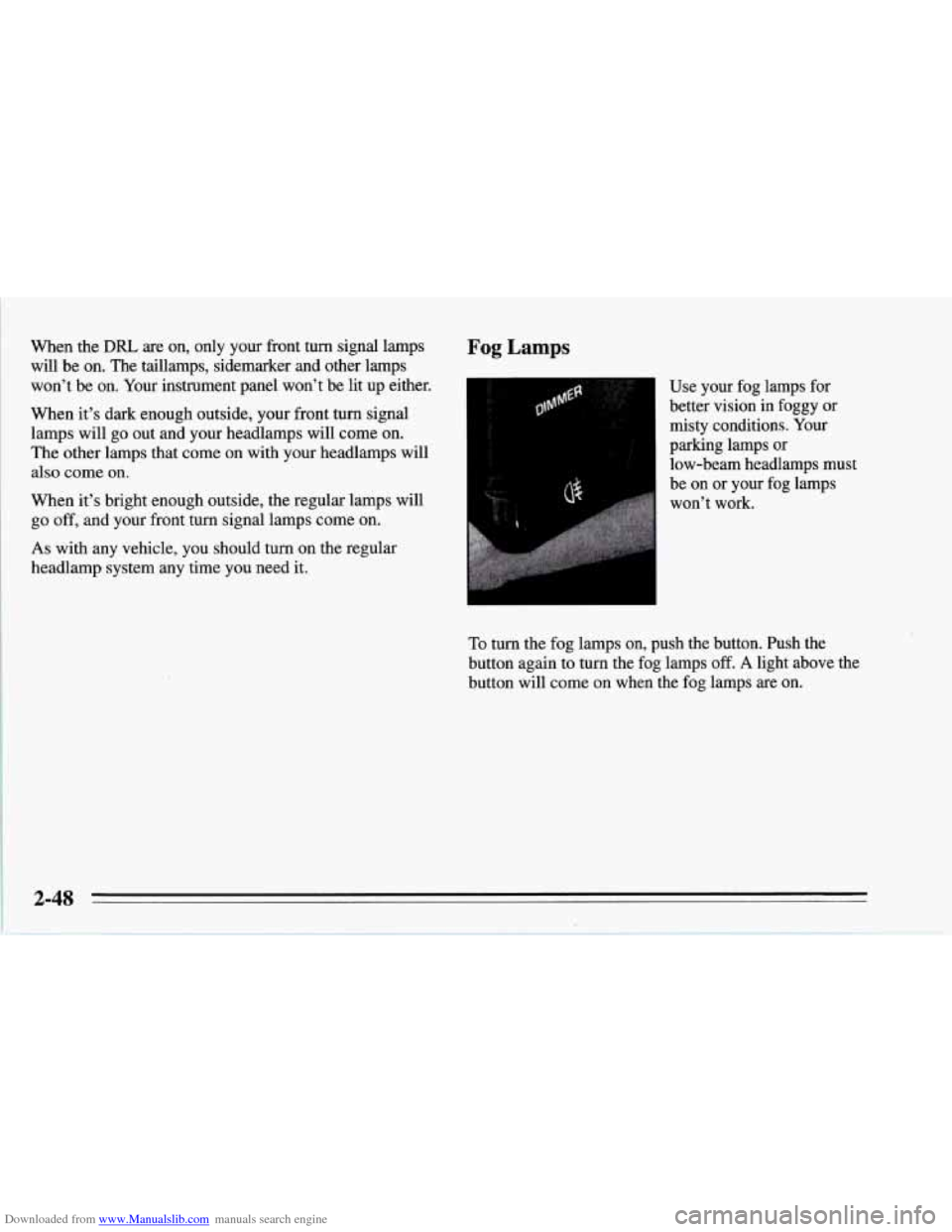
Fog Lamps
Use your fog lamps for
better vision in foggy or
misty conditions. Your
parking lamps
or
low-beam headlamps must
be on or your fog lamps
won’t work.
To turn the fog lamps on, push the button. Push the
button again
to turn the fog lamps off. A light above the
button will come on when the fog lamps are on.
2-48