power steering CHEVROLET CORVETTE 1995 4.G Owners Manual
[x] Cancel search | Manufacturer: CHEVROLET, Model Year: 1995, Model line: CORVETTE, Model: CHEVROLET CORVETTE 1995 4.GPages: 386, PDF Size: 20.15 MB
Page 59 of 386
Downloaded from www.Manualslib.com manuals search engine Ignition Switch
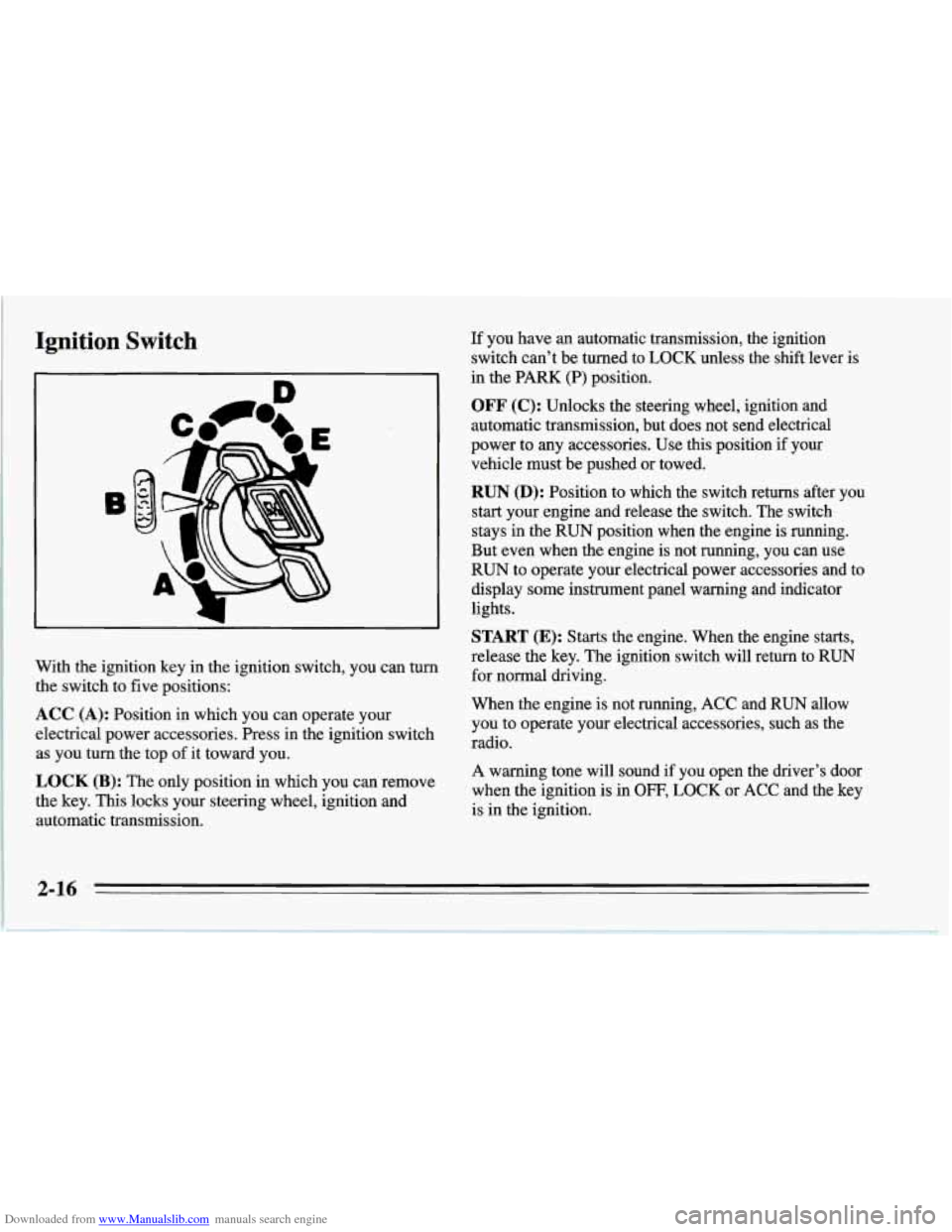
With the ignition key in the ignition switch, you can turn
the switch to five positions:
ACC (A): Position in which you can operate your
electrical power accessories. Press in the ignition switch as you turn the top of it toward you.
LOCK (B): The only position in which you can remove
the key.
This locks your steering wheel, ignition and
automatic transmission. If
you have an automatic transmission, the ignition
switch can’t be turned to LOCK unless the shift lever is
in the PARK (P) position.
OFF (C): Unlocks the steering wheel, ignition and
automatic transmission, but does not send electrical
power to any accessories. Use this position
if your
vehicle. must be pushed or towed.
RUN (D): Position to which the switch returns after you
start your engine and release the switch. The switch
stays in the
RUN position when the engine is running.
But even when the engine is not running, you can use
RUN to operate your electrical power accessories and to
display some instrument panel warning and indicator
lights.
START (E): Starts the engine. When the engine starts,
release
the key. The ignition switch will return to RUN
for normal driving.
When
the engine is not running, ACC and RUN allow
you to operate your electrical accessories, such as the
radio.
A warning tone will sound if you open the driver’s door
when the ignition
is in OFF, LOCK or ACC and the key
is in the ignition.
Page 173 of 386
Downloaded from www.Manualslib.com manuals search engine Steering
Power Steering
If you lose power steering assist because the engine
stops or the system is not functioning, you can steer but
it will take much more effort.
Steering Tips
Driving on Curves
It’s important to take curves at a reasonable speed.
A lot of the “driver lost control” accidents mentioned on
the news happen on curves. Here’s why:
Experienced driver or beginner, each of us is subject to
the same laws of physics when driving on curves. The
traction of the tires against the road surface makes it
possible for the vehicle to change its path when you turn
the front wheels. If there’s no traction, inertia will keep
the vehicle going in the same direction. If you’ve ever
tried to steer a vehicle on wet
ice, you’ll understand this. The
traction you can get in a curve depends
on the
condition
of your tires and the road surface, the angle at
which the curve is banked, and your speed. While you’re
in a curve, speed is the one factor you can control.
Suppose you’re steering through a sharp curve. Then you
suddenly accelerate. Both control systems
-- steering and
acceleration
-- have to do their work where the tires meet
the road. Unless your
ASR system is on, adding the
sudden acceleration can demand too much of those
places.
You can lose control.
What should you do
if this ever happens? Ease up on the
accelerator pedal, steer the vehicle the way you want to
go, and slow down.
Speed limit signs near curves warn that you should
adjust your speed. Of course, the posted speeds are
based on good weather and road conditions. Under less
favorable conditions you’ll want to go slower.
If you need to reduce your speed as you approach a
curve, do
it before you enter the curve, while your front
wheels are straight ahead.
Try to adjust your speed
so you can “drive” through the
curve. Maintain a reasonable, steady speed. Wait to
accelerate until you are out of the curve, and then
accelerate gently into the straightaway.
4-10
Page 244 of 386
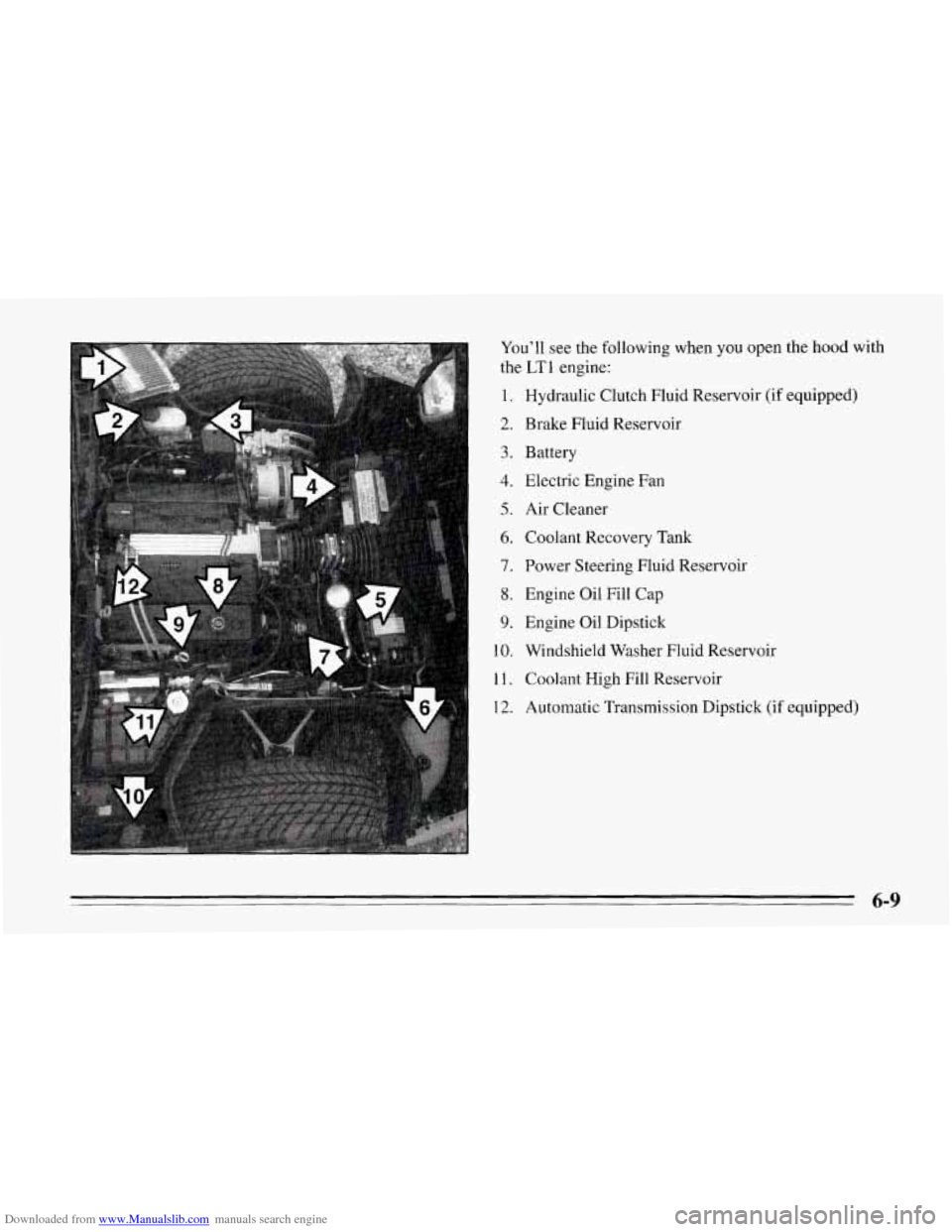
Downloaded from www.Manualslib.com manuals search engine You’ll see the following when you open the hood with
the
LTl engine:
1.
2.
3.
4.
5.
6.
7.
8.
9.
10.
11.
12.
Hydraulic Clutch Fluid Reservoir (if equipped)
Brake Fluid Reservoir
Battery
Electric Engine Fan
Air Cleaner
Coolant Recovery Tank Power Steering Fluid Reservoir
Engine Oil Fill Cap
Engine Oil Dipstick Windshield Washer Fluid Reservoir
Coolant High
Fill Reservoir
Automatic Transmission Dipstick (if equipped)
6-9
Page 246 of 386
Downloaded from www.Manualslib.com manuals search engine 5.
6.
7.
8.
9.
10.
11.
Air Cleaner Coolant Recovery Tank
Power Steering Fluid Reservoir
Engine Oil Fill Cap
Engine Oil Dipstick
Windshield Washer Fluid Reservoir
Coolant High Fill Reservoir
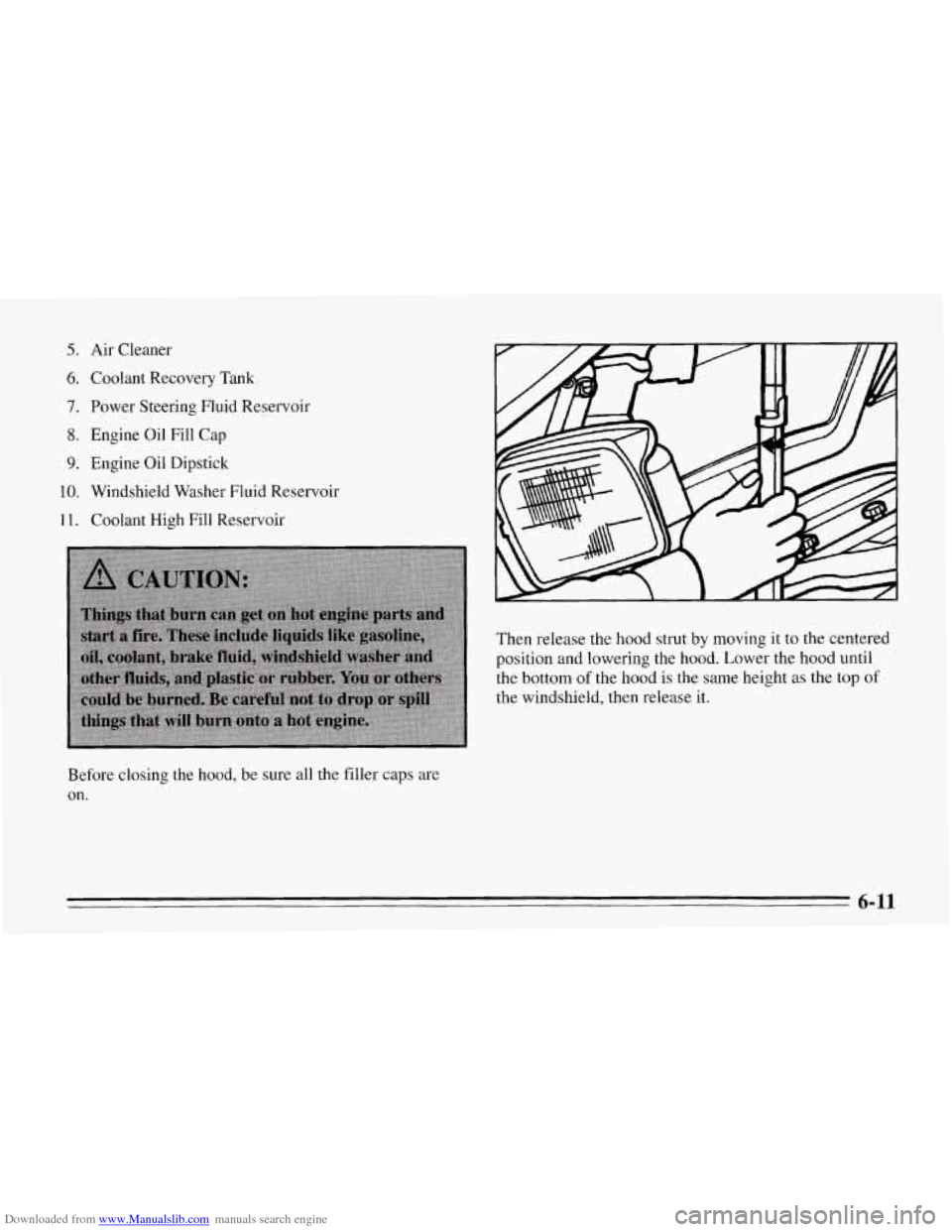
Then release the hood strut by moving it
to the centered
position and lowering the hood. Lower the hood until
the bottom of the hood is the same height as the top of
the windshield, then release it.
Before closing the hood, be sure all the filler caps are
on,
6-11
Page 265 of 386
Downloaded from www.Manualslib.com manuals search engine 1
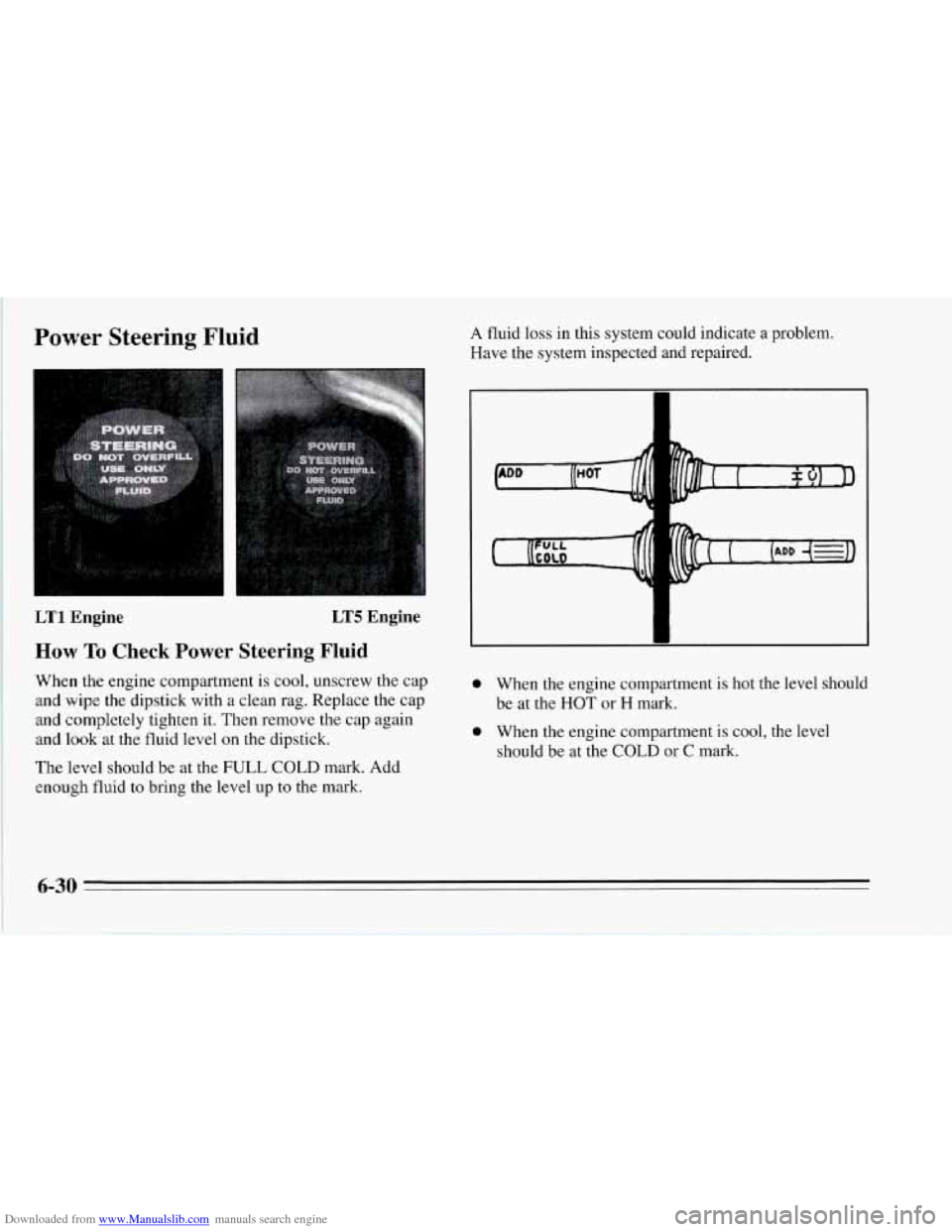
Power Steering Fluid A fluid loss in this system could indicate a problem.
Have the system inspected and repaired.
LTl Engine LT5 Engine
How To Check Power Steering Fluid
When the engine compartment is cool, unscrew the cap
and wipe the dipstick with a clean rag. Replace the cap
and completely tighten it. Then remove the cap again
and look at the fluid level on the dipstick.
The level should be at the FULL COLD mark. Add
enough fluid to bring the level up to the mark.
I
0 When the engine compartment is hot the level should
be at the
HOT or H mark.
0 When the engine compartment is cool, the level
should be at the COLD
or C mark.
6-30
Page 266 of 386
Downloaded from www.Manualslib.com manuals search engine What to Add
Refer to the Maintenance Schedule to determine what
kind of fluid to use. See “Recommended Fluids
and
Lubricants” in the Index.
NOTICE:
When adding power steering fluid or making a
complete fluid change, always use the proper
fluid. Failure to use the proper fluid can cause
leaks and damage hoses and seals.
Windshield Washer Fluid
What to Use
When you need windshield washer fluid, be sure to read
the manufacturer’s instructions before use. If you will be
operating your vehicle
in an area where the temperature
may fall below freezing, use a fluid that has sufficient
protection against freezing.
To Add
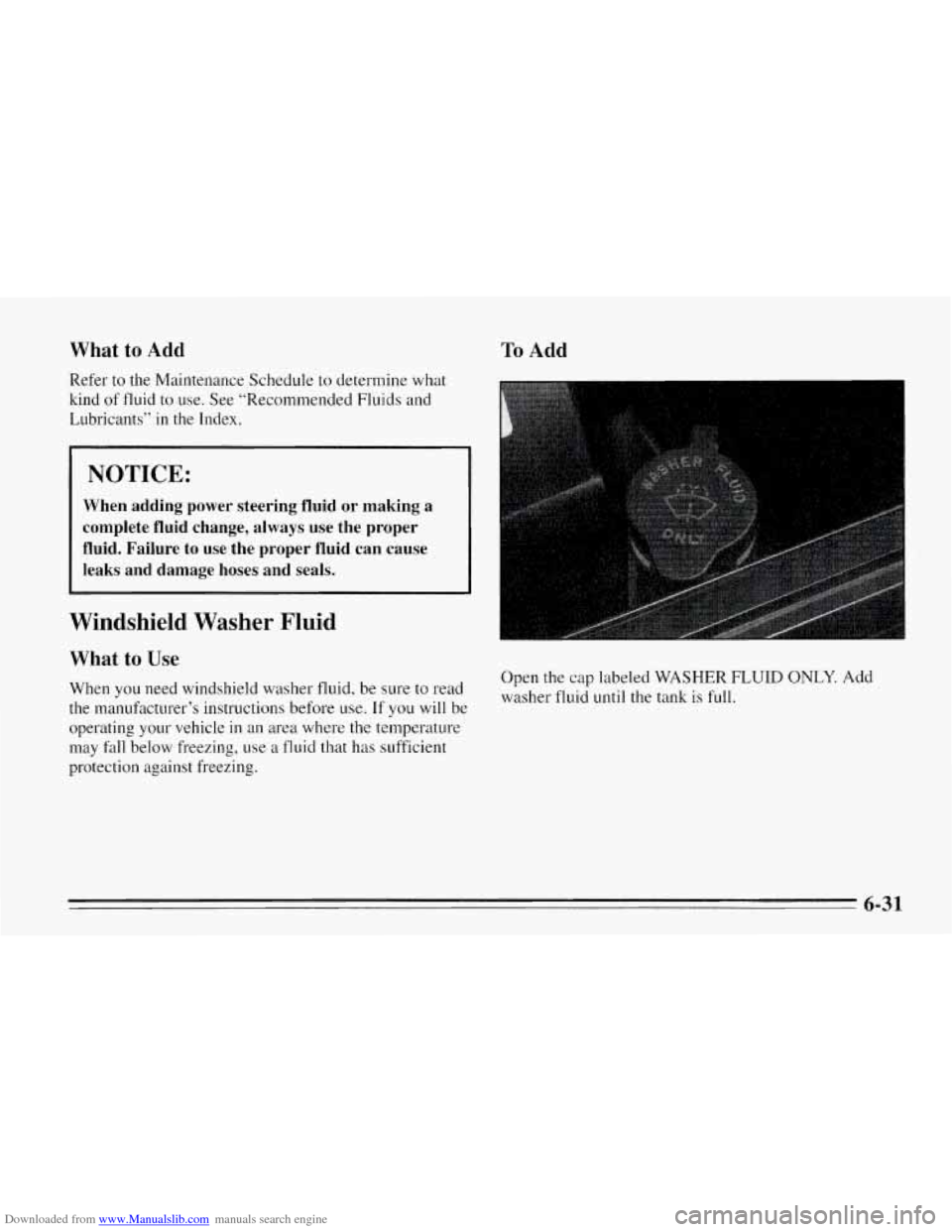
Open the cap labeled WASHER FLUID ONLY. Add
washer fluid until the tank is full.
6-31
Page 359 of 386
Downloaded from www.Manualslib.com manuals search engine Part C: Periodic Maintenance
Inspections
Listed below are inspections and services which should be
performed at least twice a year (for instance, each spring
and fall). You should let your GM dealer’s service
department or other qualified service center do these jobs.
Make sure any necessary repairs
are completed at once.
Restraint Systems
Now and then, make sure all your belts, buckles, latch
plates, retractors, anchorages and reminder systems are
working properly. Look for any loose parts or damage.
If you see anything that might keep a restraint system
from doing its job, have it repaired.
Steering and Suspension Inspection
Inspect the front and rear suspension and steering
system for damaged, loose or missing parts, signs of
wear,
or lack of lubrication. Inspect the power steering
lines and hoses for proper hookup, binding, leaks,
cracks, chafing, etc.
Tire and Wheel Inspection
Inspect the tires for uneven wear or damage. If there is
irregular or premature wear, check the wheel alignment.
Inspect for damaged wheels.
Exhaust System Inspection
Inspect the complete exhaust system. Inspect the body near
the exhaust system. Look for broken, damaged, missing or
out-of-position parts as well as open seams, holes, loose
connections, or other conditions which could cause a heat
build-up in the floor pan or could let exhaust fumes into
the vehicle. See “Engine Exhaust” in the Index.
Manual Transmission
Check the transmission fluid level; add if needed. See
“Manual Transmission” in the Index.
A fluid loss may
indicate a problem. Check the system and repair
if needed.
Rear Axle Service
Check the gear lubricant level in the rear axle and add if
needed. See “Rear Axle” in the Index. A fluid loss may
indicate a problem. Check the axle and repair it if needed.
Brake System Inspection
Inspect the complete system. Inspect brake lines and
hoses for proper hookup, binding, leaks, cracks, chafing,
etc. Inspect disc brake pads for wear and rotors for
surface condition. Inspect other brake parts, including
calipers, parking brake, etc.
You may need to have your
brakes inspected more often if your driving habits or
conditions result in frequent braking.
7-44
Page 361 of 386
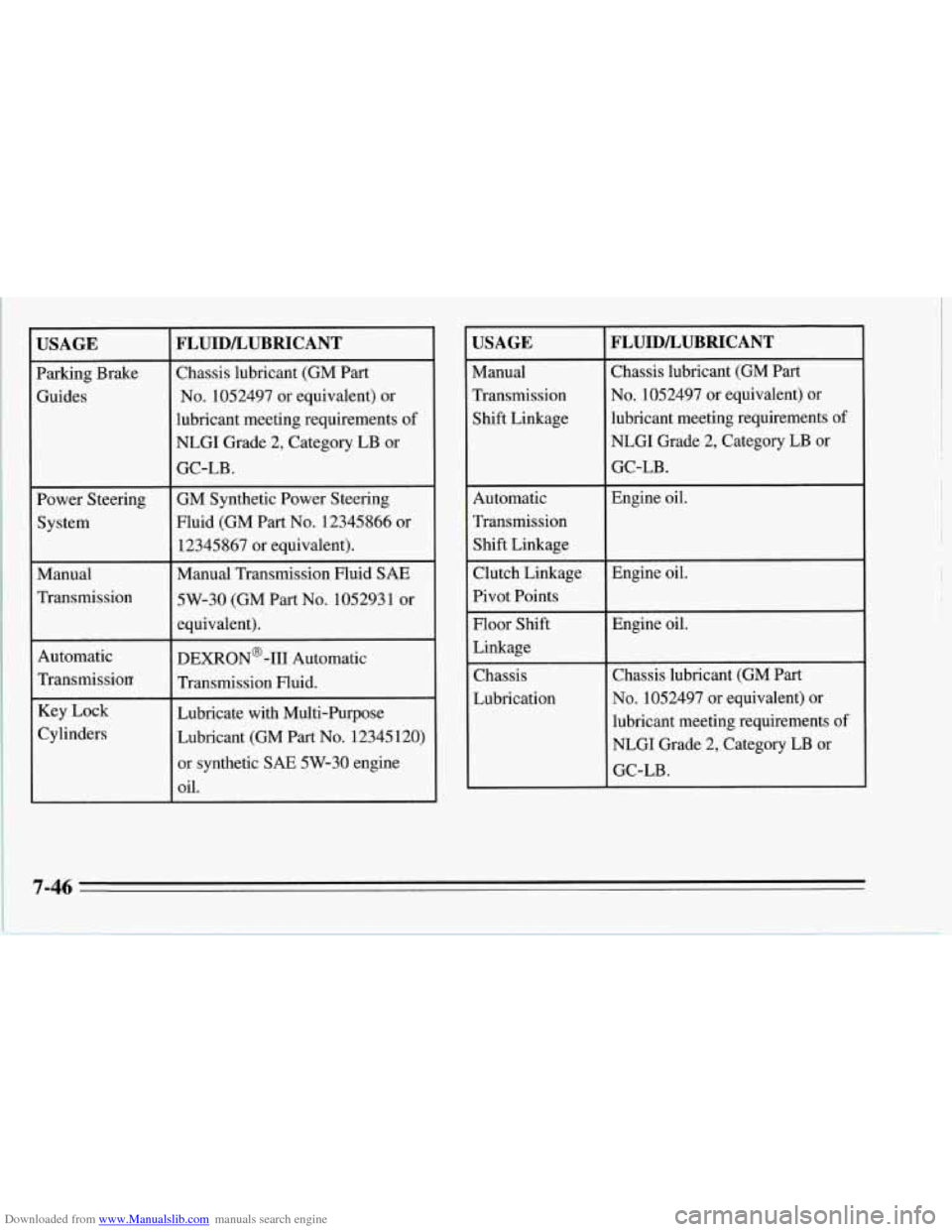
Downloaded from www.Manualslib.com manuals search engine USAGE
Parking Brake
Guides Power Steering
System
Manual
Transmission
Automatic
Transmission Key Lock
Cylinders
FLUIDLUBRICANT
Chassis lubricant (GM Part
No. 1052497 or equivalent) or
lubricant meeting requirements of
NLGI Grade
2, Category LB or
GC-LB.
GM Synthetic Power Steering
Fluid (GM Part
No. 12345866 or
12345867 or equivalent).
Manual Transmission Fluid SAE
5W-30
(GM Part No. 105293 1 or
equivalent).
DEXRON@-111 Automatic
Transmission Fluid.
Lubricate with Multi-Purpose
Lubricant (GM Part
No. 12345120)
or synthetic
SAE 5W-30 engine
oil.
USAGE
Manual
Transmission Shift Linkage
~~~
Automatic
Transmission
Shift Linkage
Clutch Linkage
Pivot Points
Floor Shift
Linkage
Chassis
Lubrication
FLUIDLUBRICANT
Chassis lubricant (GM Part
No. 1052497 or equivalent) or
lubricant meeting requirements of
NLGI Grade 2, Category LB or
GC-LB.
Engine oil.
Engine oil. Engine oil.
Chassis lubricant (GM
Part
No. 1052497 or equivalent) or
lubricant meeting requirements of
NLGI Grade 2, Category LB or
GC-LB.
7-46
Page 374 of 386
Downloaded from www.Manualslib.com manuals search engine Index
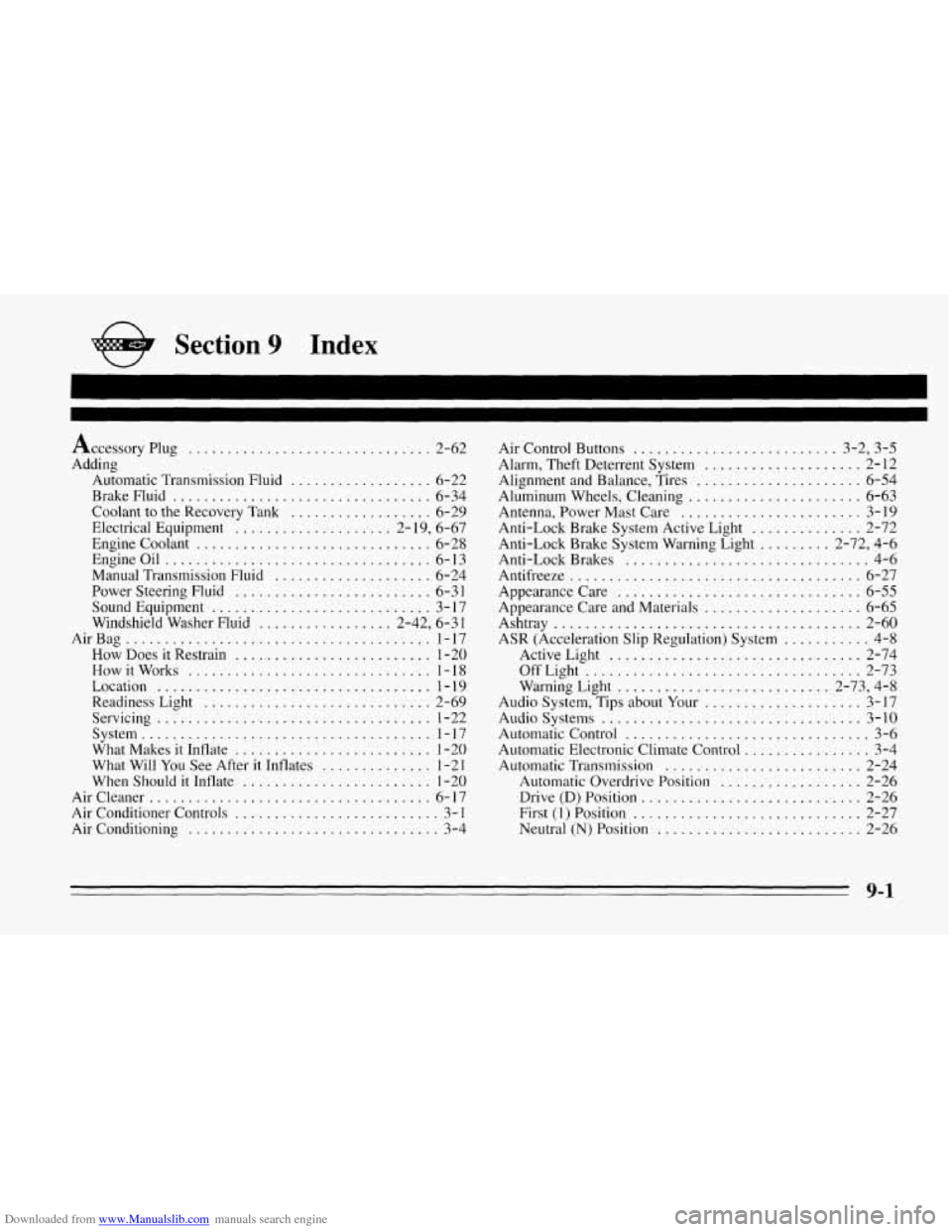
Accessory Plug ............. ............. 2-62
Adding Automatic Transmission Fluid
................ 6-22
Brake Fluid
...................... ...... 6-34
Coolant to the Recovery Tank
....... ........ 6-29
Electrical Equipment .................... 2- 19. 6-67
Engine Coolant
.............................. 6-28
Engineoil
.................................. 6-13
Manual Transmission Fluid
.................... 6-24
Power Steering Fluid
......................... 6-3 1
SoundEquipment ............................ 3-17
Windshield Washer Fluid
................. 2-42. 6-3 1
AirBag ....................................... 1-17
How Does it Restrain ......................... 1-20
How it Works ............................... 1 - I8
Location
................................... 1-19
Readiness Light
............................. 2-69
Servicing ................................... 1-22
System
..................................... 1-17
What Makes
it Inflate ......................... 1-20
What Will
You See After it Inflates .............. 1-2 1
When Should it Inflate ........................ 1-20
Air Cleaner
.................................... 6- 17
Air Conditioner Controls .......................... 3- 1
Air Conditioning ................................ 3-4 Air Control
Buttons
.......................... 3.2. 3.5
Alignment and Balance. Tires ..................... 6-54
Antenna. Power Mast Care
....................... 3-19
Anti-Lock Brake System Active Light
.............. 2-72
Anti-Lock Brake System Warning Light
......... 2.72. 4.6
Anti-Lock Brakes
............................... 4-6
Antifreeze ..................................... 6-27
Appearance Care
............................... 6-55
Appearance Care and Materials
.................... 6-65
Ashtray
....................................... 2-60
ASR (Acceleration Slip Regulation) System
........... 4-8
Active Light
................................ 2-74
OffLight
................................... 2-73
Warning Light
........................... 2.73. 4.8
Audio System. Tips about Your .................... 3-17
Audio Systems
................................. 3- IO
Automatic Control ............................... 3-6
Automatic Electronic Climate Control ................ 3-4
Automatic Transmission
......................... 2-24
Automatic Overdrive Position
.................. 2-26
Drive
(D) Position ............................ 2-26
First
(1) Position ............................. 2-27
Neutral
(N) Position .......................... 2-26
Alarm. Theft Deterrent
System
.................... 2-12
Aluminum Wheels. Cleaning
...................... 6-63
9-1
Page 376 of 386
Downloaded from www.Manualslib.com manuals search engine Check Gauges Light ............................. 2-85
Checking Your Restraint Systems
.................. 1-30
Checking Automatic Transmission Fluid
.................. 6-21
BrakeFluid
................................. 6-33
Engine Coolant
.............................. 6-28
Manual Transmission Fluid
.................... 6-23
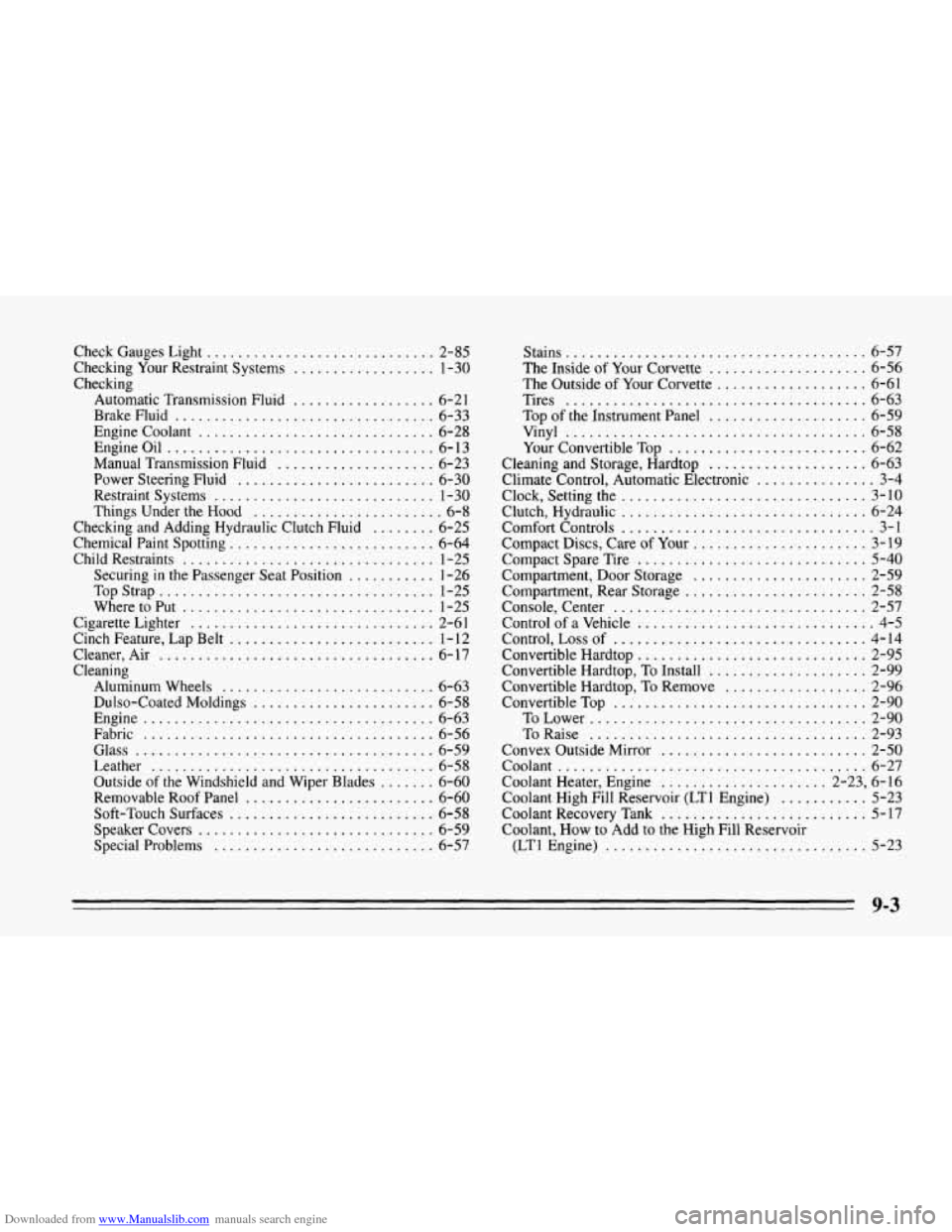
Power Steering Fluid
......................... 6-30
Restraint Systems
............................ 1-30
Things Under the
Hood ........................ 6-8
Checking and Adding Hydraulic Clutch Fluid
........ 6-25
Chemical Paint Spotting
.......................... 6-64
Child Restraints
................................ 1-25
Securing in the Passenger Seat Position
........... 1-26
TopStrap
................................... 1-25
WheretoPut
................................ 1-25
Cigarette Lighter
............................... 2-6 1
Cinch Feature. Lap Belt
.......................... 1- 12
Cleaner. Air
................................... 6-17
Cleaning Aluminum Wheels
........................... 6-63
Dulso-Coated Moldings ....................... 6-58
Engine
..................................... 6-63
Fabric
..................................... 6-56
Glass
...................................... 6-59
Leather
.................................... 6-58
Outside
of the Windshield and Wiper Blades ....... 6-60
Removable Roof Panel
........................ 6-60
Soft-Touch Surfaces
.......................... 6-58
Speakercovers
.............................. 6-59
Special Problems
............................ 6-57
EngineOil
.................................. 6-13
Stains
...................................... 6-57
The Inside
of Your Corvette .................... 6-56
The Outside of Your Corvette
................... 6-61
Tires
...................................... 6-63
Top
of the Instrument Panel .................... 6-59
Your Convertible Top
......................... 6-62
Cleaning and Storage. Hardtop
.................... 6-63
Climate Control. Automatic Electronic
............... 3-4
Clock. Setting the
............................... 3-10
Clutch. Hydraulic
............................... 6-24
Comfort Controls
................................ 3-1
Compact Discs. Care of Your
...................... 3-19
Compact Spare Tire
............................. 5-40
Compartment. Door Storage ...................... 2-59
Console. Center
................................ 2-57
Control
of a Vehicle .............................. 4-5
Control. Loss of ................................ 4-14
Convertible Hardtop
............................. 2-95
Convertible Hardtop.
To Install .................... 2-99
Convertible Hardtop. To Remove
.................. 2-96
ConvertibleTop
................................ 2-90
ToLower
................................... 2-90
ToRaise
................................... 2-93
Convex Outside Mirror
.......................... 2-50
Coolant ....................................... 6-27
Coolant Heater. Engine
..................... 2-23. 6- 16
Coolant High Fill Reservoir
(LT1 Engine) ........... 5-23
Coolant. How to Add to the High Fill Reservoir
Vinyl
...................................... 6-58
Compartment.
Rear Storage ....................... 2-58
Coolant Recovery Tank
.......................... 5-17
(LTl Engine)
................................. 5-23