tow CHEVROLET CORVETTE 1996 4.G User Guide
[x] Cancel search | Manufacturer: CHEVROLET, Model Year: 1996, Model line: CORVETTE, Model: CHEVROLET CORVETTE 1996 4.GPages: 386, PDF Size: 20.12 MB
Page 79 of 386
Downloaded from www.Manualslib.com manuals search engine nrn and Lane Change Signals
The turn signal has two upward (for right) and two
downward (for left) positions. These positions allow you
to signal a turn or a lane change.
To signal a turn, move the multifunction lever all the
way up or down. When the turn is finished,
the lever
will return automatically.
A chime will remind you if you leave your turn signal
on for more than
1 mile (1.6 km) of driving.
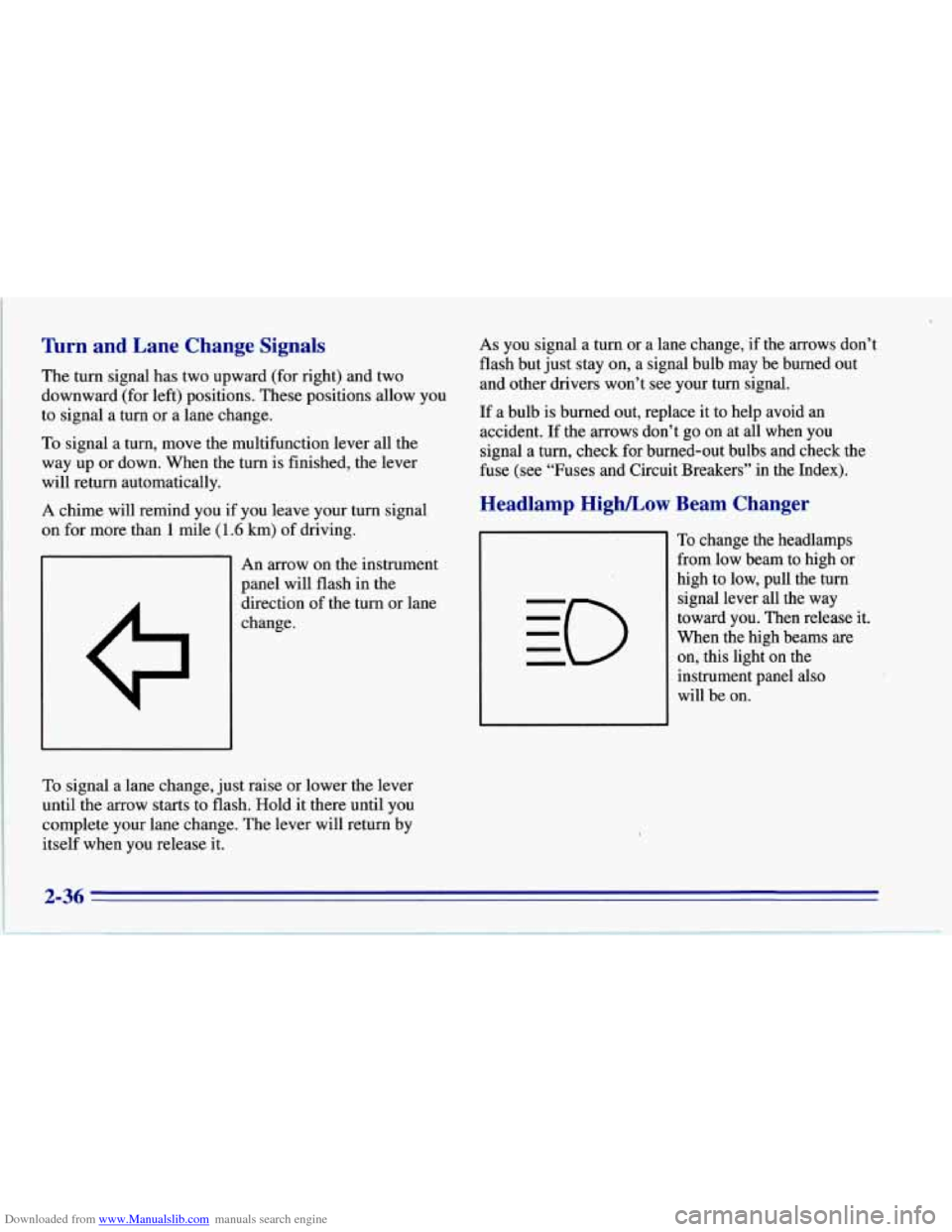
An arrow on the instrument
panel will flash in the
direction of the turn or lane
change.
To signal a lane change, just raise or lower the lever
until the
arrow starts to flash. Hold it there until you
complete your lane change. The lever will return by
itself when you release it.
As you signal a turn or a lane change, if the arrows don’t
flash but just stay on, a signal bulb may be burned out
and other drivers won’t see your turn signal.
If a bulb is burned out, replace it to help avoid an
accident.
If the arrows don’t go on at all when you
signal a turn, check for burned-out bulbs and check the
fuse (see “Fuses and Circuit Breakers” in the Index).
Headlamp High/Low Beam Changer
To change the headlamps
from low beam to high or
high to low, pull the turn
signal lever all the way
toward you. Then release it.
When the high beams
are
on, this light on the
instrument panel also
will be on.
Page 100 of 386
Downloaded from www.Manualslib.com manuals search engine NOTICE:
Don’t lift the front edge of the roof panel higher
than
8 inches (200 mm) when the corners are in
the brackets.
If you do, you could damage the
roof panel.
3.
4.
5.
6.
Lower the front of the roof panel, centering it over
the latch pin.
Pull the release toward you and press down on the
roof panel.
Push the release forward until it latches.
Gently lift up on the roof panel to be sure it is locked
in place.
Installing the Roof Panel
” * IJTION :
An improperly attached roof panel may fall into
or
fly off the vehicle. You or others could be
injured. After installing the roof panel, always
check that
it is firmly attached by pushing up on
the underside of the panel near the bolts. Check
now and then to be sure the roof panel is firmly
in place.
I
1. Park on a level surface, set the parking brake firmly
and shift an automatic transmission into PARK (P).
Shift a manual transmission into
REVERSE (R).
Lower both windows, turn the ignition key to
LOCK
and move both sunshades to the side.
2. If the roof panel is stored in the rear area, remove it
by reversing the steps described previously under
“Storing the Roof Panel.”
2-57
Page 104 of 386
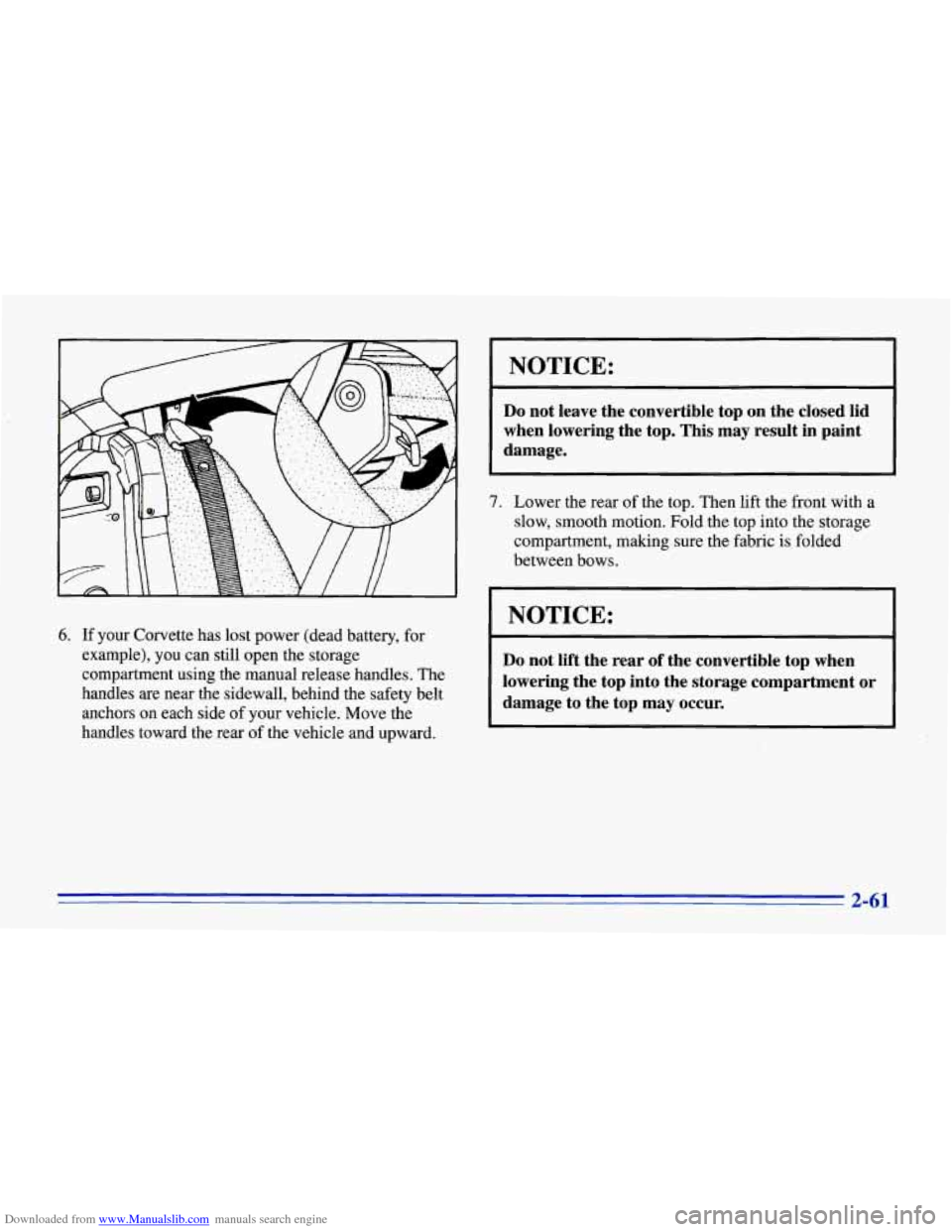
Downloaded from www.Manualslib.com manuals search engine 6. If your Corvette has lost power (dead battery, for
example), you can still open the storage
compartment using the manual release handles. The
handles are near the sidewall, behind the safety belt
anchors on each side of your vehicle. Move the
handles toward the rear of the vehicle and upward.
1
NOTICE:
Do not leave the convertible top on the closed lid
when lowering the top. This may result in paint
damage.
7. Lower the rear of the top. Then lift the front with a
slow, smooth motion. Fold the top into the storage
compartment, making sure the fabric is folded
between bows.
NOTICE:
r
Do not lift the rear of the convertible top when
lowering the top into the storage compartment
or
damage to the top may occur.
2-61
Page 105 of 386
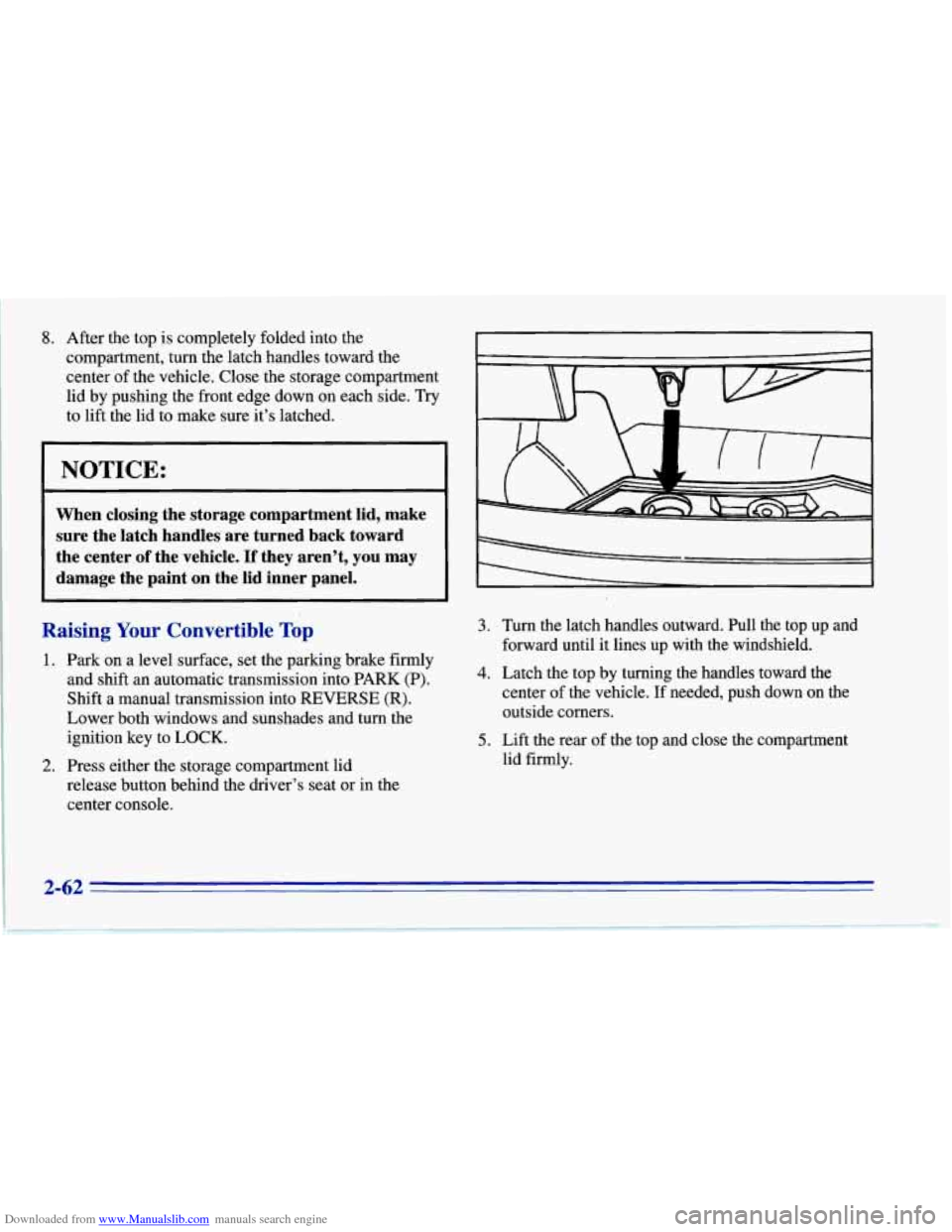
Downloaded from www.Manualslib.com manuals search engine 8. After the top is completely folded into the
compartment, turn the latch handles toward the
center of the vehicle. Close the storage compartment
lid by pushing the front edge down on each side. Try
to lift the lid to make sure it’s latched.
NOTICE:
When closing the storage compartment lid, make
sure the latch handles are turned back toward
the center
of the vehicle. If they aren’t, you may
damage the paint on the lid inner panel.
I
Raising Your Convertible Top
1.
2.
Park on a level surface, set the parking brake firmly
and shift an automatic transmission into PARK (P).
Shift a manual transmission into REVERSE
(R).
Lower both windows and sunshades and turn the
ignition key to LOCK.
Press either the storage compartment lid
release button behind the driver’s seat
or in the
center console.
3.
4.
5.
Turn the latch handles outward. Pull the top up and
forward until it lines up with the windshield.
Latch the top by turning the handles toward the
center of the vehicle. If needed, push down on the
outside corners.
Lift the rear
of the top and close the compartment
lid firmly.
2-62
Page 121 of 386
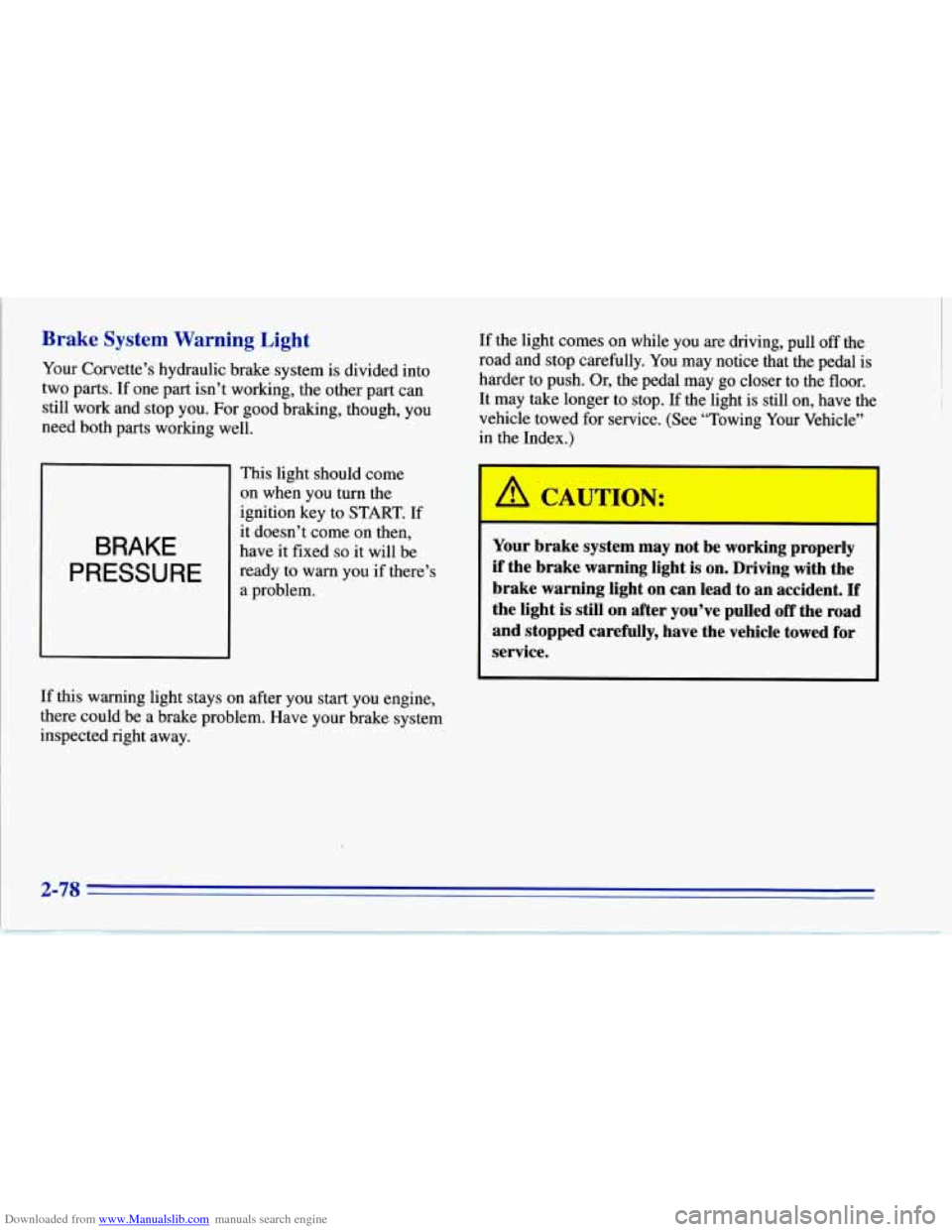
Downloaded from www.Manualslib.com manuals search engine Brake System Warning Light
Your Corvette’s hydraulic brake system is divided into
two parts. If one part isn’t working, the other part can
still work and stop you. For good braking, though, you
need both parts working well.
BRAKE
PRESSURE
This light should come
on when you turn the
ignition key to START.
If
it doesn’t come on then,
have it fixed
so it will be
ready to warn you if there’s
a problem. If
the light comes on while you are driving, pull
off the
road and stop carefully. You may notice that the pedal is
harder to push. Or, the pedal may go closer to the floor.
It may take longer to stop. If the light is still on, have the
vehicle towed for service. (See “Towing Your Vehicle”
in the Index.)
A TT-T~=T
vce. Your brake system may not be working properly
if the brake warning light
is on. Driving with the
brake warning light
on can lead to an accident. If
the light is still on after you’ve pulled off the road
and stopped carefully, have the vehicle towed for
If this warning light stays on after you start you engine,
there could be a brake problem. Have your brake system
inspected right away.
Page 190 of 386
Downloaded from www.Manualslib.com manuals search engine A CAUTION:
Do not load your vehicle any heavier than the
GVWR, or either the maximum front or rear
GAWR.
If you do, parts on your vehicle can break,
or it can change the way your vehicle handles.
These could cause you
to lose control. Also,
overloading can shorten the life
of your vehicle.
NOTICE:
Your warranty does not cover parts or
components that fail because
of overloading.
If you put things inside your vehicle -- like suitcases?
tools, packages or anything else
-- they will go as fast as
the vehicle goes.
If you have to stop or turn quickly, or
if there is a crash, they’ll keep going.
A CAUTION:
-
Things you put inside your vehicle can strike
and injure people in
a sudden stop or turn, or in
a crash.
Put things in the rear area of your vehicle.
Try to spread the weight evenly.
Never stack heavier things, like suitcases,
inside the vehicle
so that some of them are
above the tops
of the seats.
Don’t leave an unsecured child restraint in
your vehicle.
When, you carry something inside the
vehicle, secure it whenever you can.
Towing A Trailer
Your Corvette is neither designed nor intended to tow
a trailer.
4-29
Page 197 of 386
Downloaded from www.Manualslib.com manuals search engine 11. Try to start the vehicle with the dead battery.
If it won’t start after a few tries, it probably
needs service.
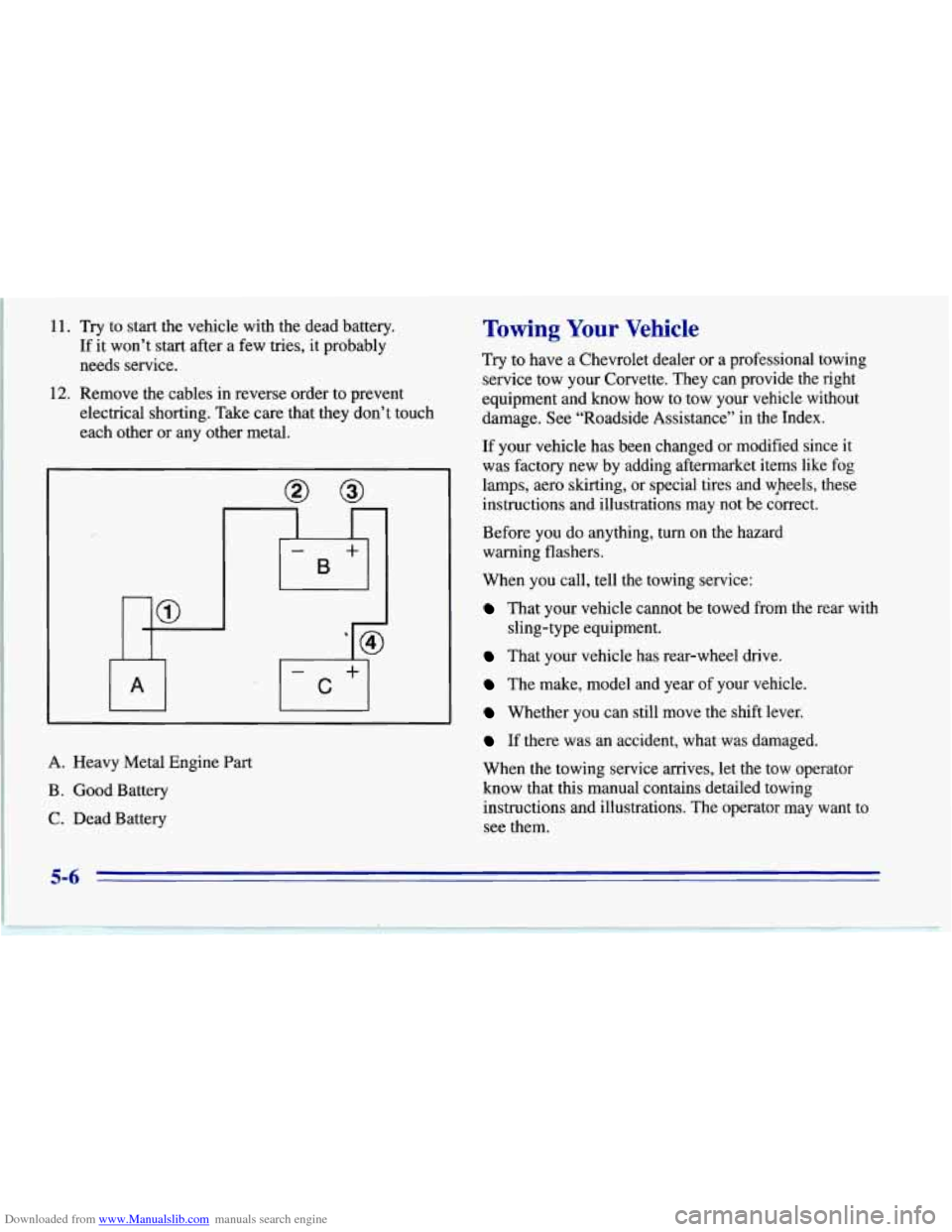
12. Remove the cables in reverse order to prevent
electrical shorting. Take care that they don’t touch
each other or any other metal.
I
AI
A. Heavy Metal Engine Part
B. Good Battery
C. Dead Battery
Towing Your Vehicle
Try to have a Chevrolet dealer or a professional towing
service tow your Corvette. They can provide the right
equipment and know how to tow your vehicle without
damage. See “Roadside Assistance” in the Index.
If your vehicle has been changed or modified since it
was factory new by adding aftermarket items like fog
lamps, aero skirting, or special tires and wbeels, these
instructions and illustrations may not be cbrrect.
Before you do anything, turn on the hazard
warning flashers.
When you call, tell the towing service:
That your vehicle cannot be towed from the rear with
That your vehicle has rear-wheel drive.
The make, model and year of your vehicle.
Whether you can still move the shift lever.
If there was an accident, what was damaged.
When the towing service arrives, let the tow operator
know that this manual contains detailed towing
instructions and illustrations. The operator may want to
see them.
sling-type equipment.
5-6
Page 198 of 386
Downloaded from www.Manualslib.com manuals search engine A CAUTION:
To help avoid injury to you or others:
Never let passengers ride in a vehicle that is
0 Never tow faster than safe or posted speeds.
0 Never tow with damaged parts not
fully secured.
0 Never get under your vehicle after it has
been lifted by the tow truck.
0 Always secure the vehicle on each side with
separate safety chains when towing it.
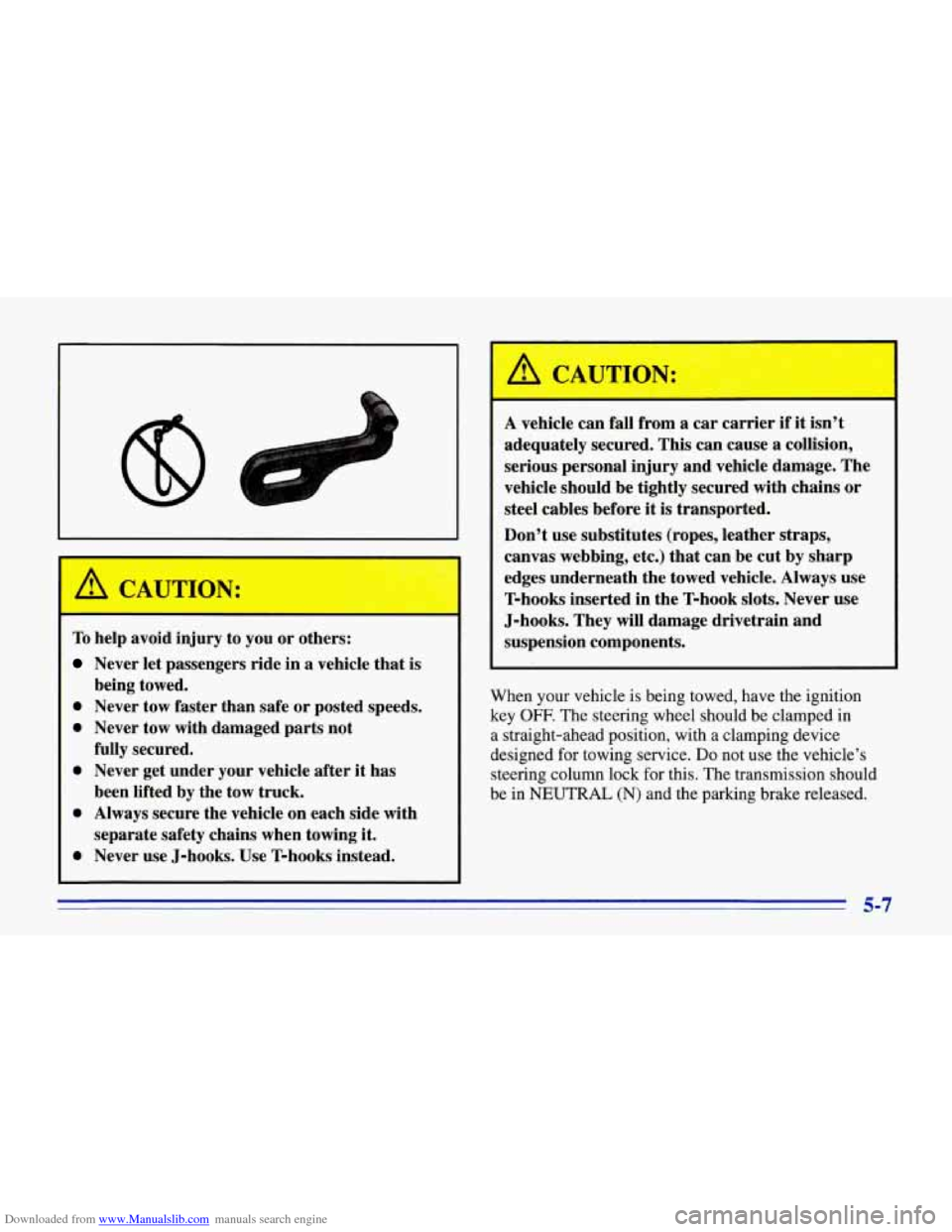
0 Never use J-hooks. Use T-hooks instead.
being towed.
A vehicle
can fall from a car carrier if it isn’t
adequately secured. This can cause a collision,
serious personal injury and vehicle damage. The
vehicle should be tightly secured with chains or
steel cables before
it is transported.
Don’t use substitutes (ropes, leather straps,
canvas webbing, etc.) that can be cut by sharp
edges underneath the towed vehicle. Always use
T-hooks inserted in the T-hook slots. Never use
J-hooks. They will damage drivetrain and
suspension components.
When your vehicle is being towed, have the ignition
key
OFF. The steering wheel should be clamped in
a straight-ahead position, with a clamping device
designed for towing service.
Do not use the vehicle’s
steering column lock for this. The transmission should
be in
NEUTRAL (N) and the parking brake released.
5-7
Page 199 of 386
Downloaded from www.Manualslib.com manuals search engine Front Towing
Tow Limits -- 35 mph (56 km/h), 50 miles (80 km)
Don't have your vehicle towed on the rear wheels unless
you must. If the vehicle must be towed on the rear
wheels, don't exceed the above limits or your
transmission will be damaged.
Go slow over rough
ground, and position one wheel at a time (angled
45 ") if
you have to go over curbs and rises. Wheels at the lifted
end should be at least
4 inches (100 mm) above the
ground. If these limits must be exceeded, then the rear
wheels have to be supported on a dolly.
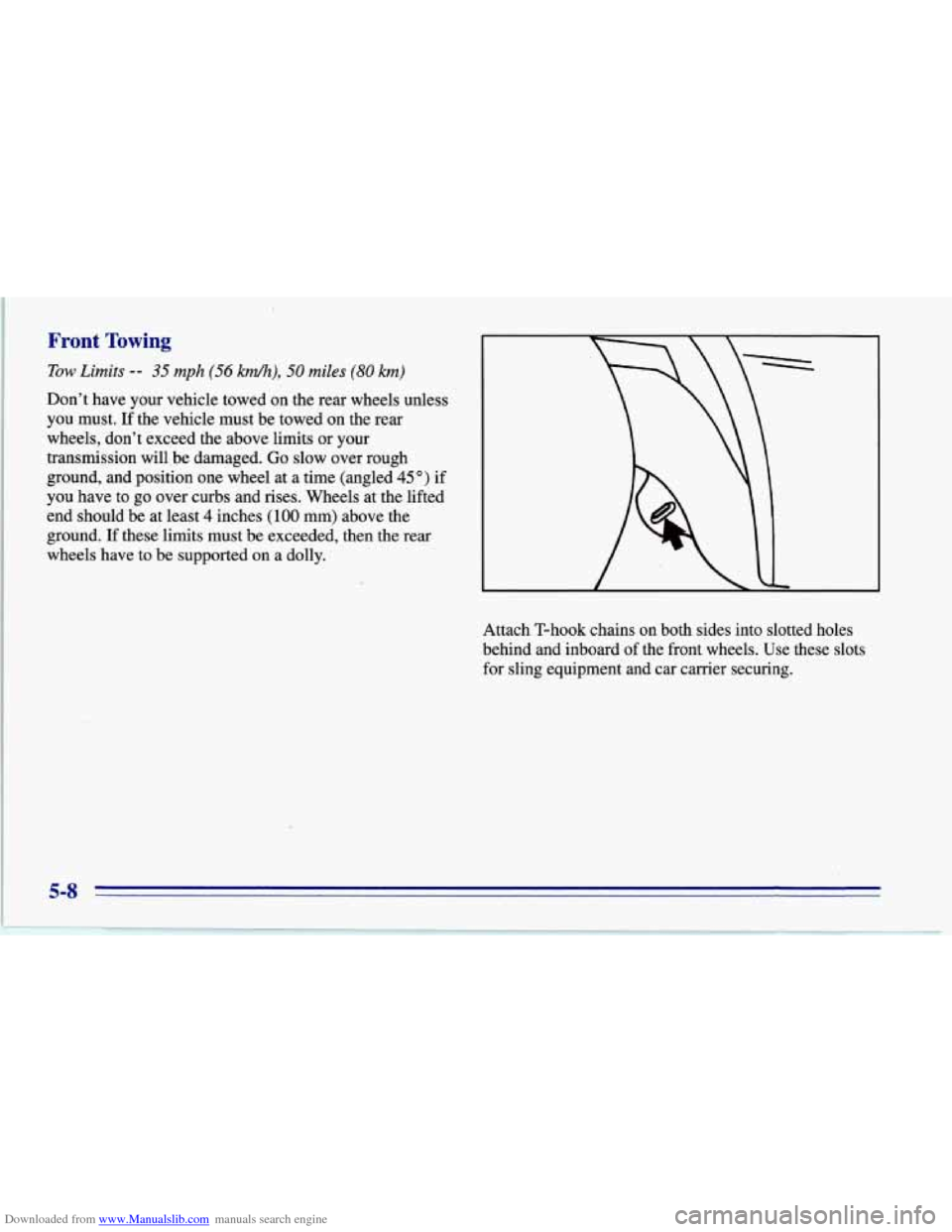
Attach T-hook chains on both sides into slotted holes
behind and inboard of the front wheels. Use these slots
for sling equipment and car carrier securing.
Page 201 of 386
Downloaded from www.Manualslib.com manuals search engine
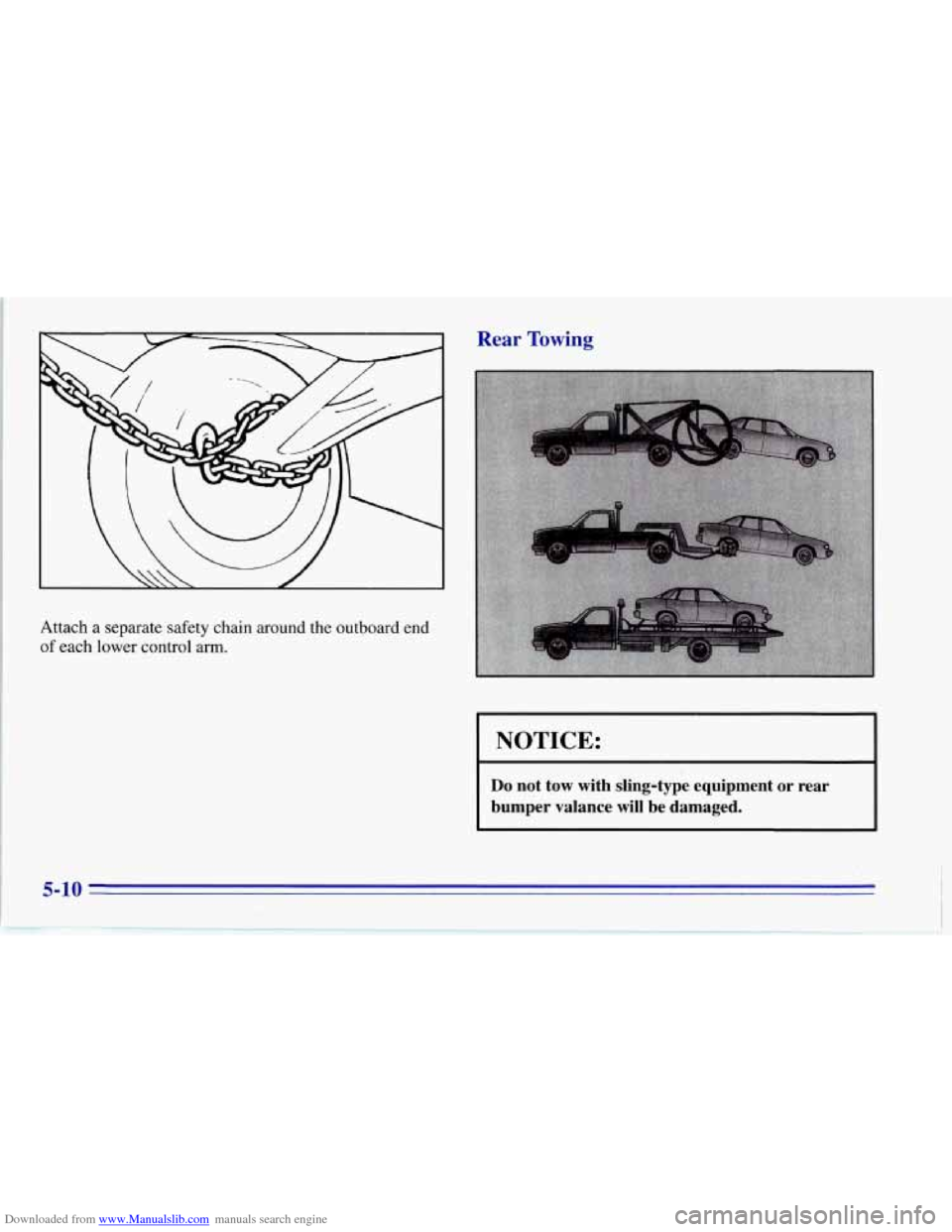
Attach a separate safety chain around the outboard end
of each lower control arm.
Rear Towing
I NOTICE: I
Do not tow with sling-type equipment or rear
bumper valance will be damaged.
5-10