check engine CHEVROLET CORVETTE 1996 4.G Repair Manual
[x] Cancel search | Manufacturer: CHEVROLET, Model Year: 1996, Model line: CORVETTE, Model: CHEVROLET CORVETTE 1996 4.GPages: 386, PDF Size: 20.12 MB
Page 288 of 386
Downloaded from www.Manualslib.com manuals search engine Cleaning the Outside of the
Windshield and Wiper Blades
If the windshield is not clear after using the windshield
washer, or if the wiper blade chatters when running, wax
or other material may be on the blade or windshield.
Clean the outside of the windshield with GM
Windshield Cleaner, Bon-Ami Powder@ (GM Part
No. 1050011). The windshield is clean if beads do not
form when you rinse
it with water.
If you use a glass treatment or conditioner containing
ethyl alcohol or ethyl sulfate on your glass, be sure to
remove the acrylic roof panel,
if so equipped. These
products may damage the panel.
Clean the blade by wiping vigorously with a cloth
soaked in full-strength windshield washer solvent.
Then rinse the blade with water.
Wiper blades should be checked on a regular basis and
replaced when worn.
Weatherstrips
Silicone grease on weatherstrips will make them last
longer, seal better, and not stick
or squeak. Apply
silicone grease with a clean cloth at least every six
months. During very cold, damp weather more frequent application
may be required. (See “Recommended
Fluids and Lubricants” in the Index.)
Cleaning a Removable Roof Panel
Special care is necessary when cleaning, removing
and/or storing the roof panel.
Flush with water to remove dust and dirt, then dry
the panel.
Clean the panel with GM Glass Cleaner. Leave the
cleaner on the panel for one minute, then wipe the
panel with a soft, lint-free cloth.
Don’t use abrasive cleaning materials.
If water drops are frequently allowed to dry on the roof
panel, impurities in the water will adhere
to the top.
These impurities may destroy the finish. When the panel
gets wet, you should dry it
off.
I NOTICE:
Do not use a glass treatment or conditioner
containing ethyl alcohol or ethyl sulfate on the
roof panel. These products may damage the
panel.
6-57
Page 289 of 386
Downloaded from www.Manualslib.com manuals search engine Cleaning the Outside of Your Corvette
The paint finish on your vehicle providqs beauty, depth
of color, gloss retention and durability.
Washing Your Vehicle
The best way to preserve your vehicle’s finish is to keep
it clean
by washing it often with lukewarm or cold
water.
Don’t wash your vehicle in the direct rays of the sun.
Don’t
use strong soaps or chemical detergents. Use
liquid hand, dish or car washing (mild detergent) soaps.
Don’t
use cleaning agents that are petroleum based,
or that contain acid or abrasives. All cleaning agents
should be flushed promptly and not allowed to dry on
the surface, or they could stain. Dry the finish with a
soft, clean chamois or a
100% cotton towel to avoid
surface scratches and water spotting. High
pressure car washes may cause water to enter your
vehicle.
NOTICE:
Conveyor systems on some automatic car washes
may damage a Corvette. They may not have enough clearance for the undercarriage or for the
extra wide rear tires
on Grand Sport Coupe
models.
Check with the manager before using a car wash,
I
Finish Care
Occasional waxing or mild polishing of your Corvette
by hand may be necessary to remove residue from the
paint finish. You can get GM-approved cleaning
products from your dealer. (See “Appearance Care and
Materials” in the Index.)
Page 295 of 386
Downloaded from www.Manualslib.com manuals search engine Electrical System
Add-on Electrical Equipment
NOTICE:
Don’t add anything electrical to your Corvette
unless you check with your dealer first. Some
electrical equipment can damage your vehicle
and the damage wouldn’t be covered by your
warranty. Some add-on electrical equipment can
keep other components from working as they
should.
Your vehicle has an air bag system. Before attempting to
add anything electrical to your Corvette, see “Servicing
Your Air Bag-Equipped Corvette” in the Index.
Headlamps
The headlamp wiring is protected by a circuit breaker.
An electrical overload will cause the lamps
to go on and
off,
or in some cases to remain off. If this happens, have
your headlamp wiring checked right away.
Windshield Wipers
The windshield wiper motor is protected by a fuse and
an internal circuit breaker.
If the motor overheats due to
heavy snow, etc., the wiper will stop until the motor
cools. If the overload is caused by some electrical
problem and not snow, etc., be sure to get it fixed.
Power Windows and Other Power Options
Circuit breakers protect the power windows and other
power accessories. When the current load is too heavy,
the circuit breaker opens and closes, protecting the
circuit until the problem is fixed or goes away.
Page 307 of 386
Downloaded from www.Manualslib.com manuals search engine Capacities (Approximate)
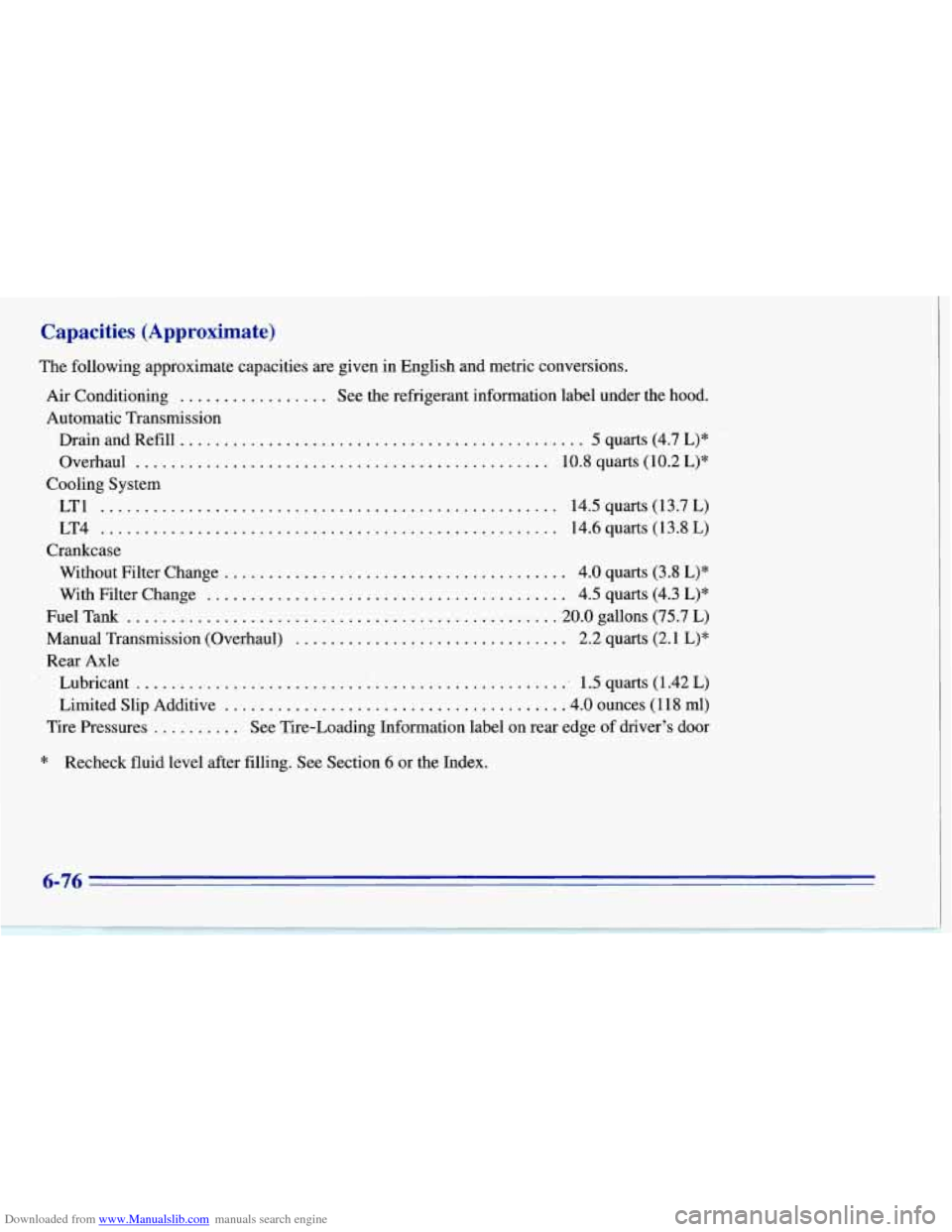
The following approximate capacities are given in English and metric conversions.
Air Conditioning ................. See the refrigerant information label under the hood.
Automatic Transmission
Drain and Refill
.............................................. 5 quarts (4.7 L)*
Overhaul
............................................. 10.8 quarts (10.2 L)*
LT1 ........... ................................... 14.5 quarts (13.7 L)
LT4
.................................................... 14.6quarts(13.8L)
Without Filter Change
....................................... 4.0 quarts (3.8 L)*
With Filter Change ......................................... 4.5 quarts (4.3 L)*
FuelTank ................................ ............. 20.0 gallons (75.7 L)
Manual Transmission (Overhaul)
............................. 2.2 quarts (2.1 L)*
Rear Axle
Lubricant
.................................................. 1.5 quarts (1.42 L)
Limited Slip Additive
...................................... .4.0 ounces (1 18 ml)
Tire Pressures
.......... See Tire-Loading Information label on rear edge of driver’s door
Cooling System
Crankcase
* Recheck fluid level after filling. See Section 6 or the Index.
6-76
Page 313 of 386
Downloaded from www.Manualslib.com manuals search engine How This Section is Organized
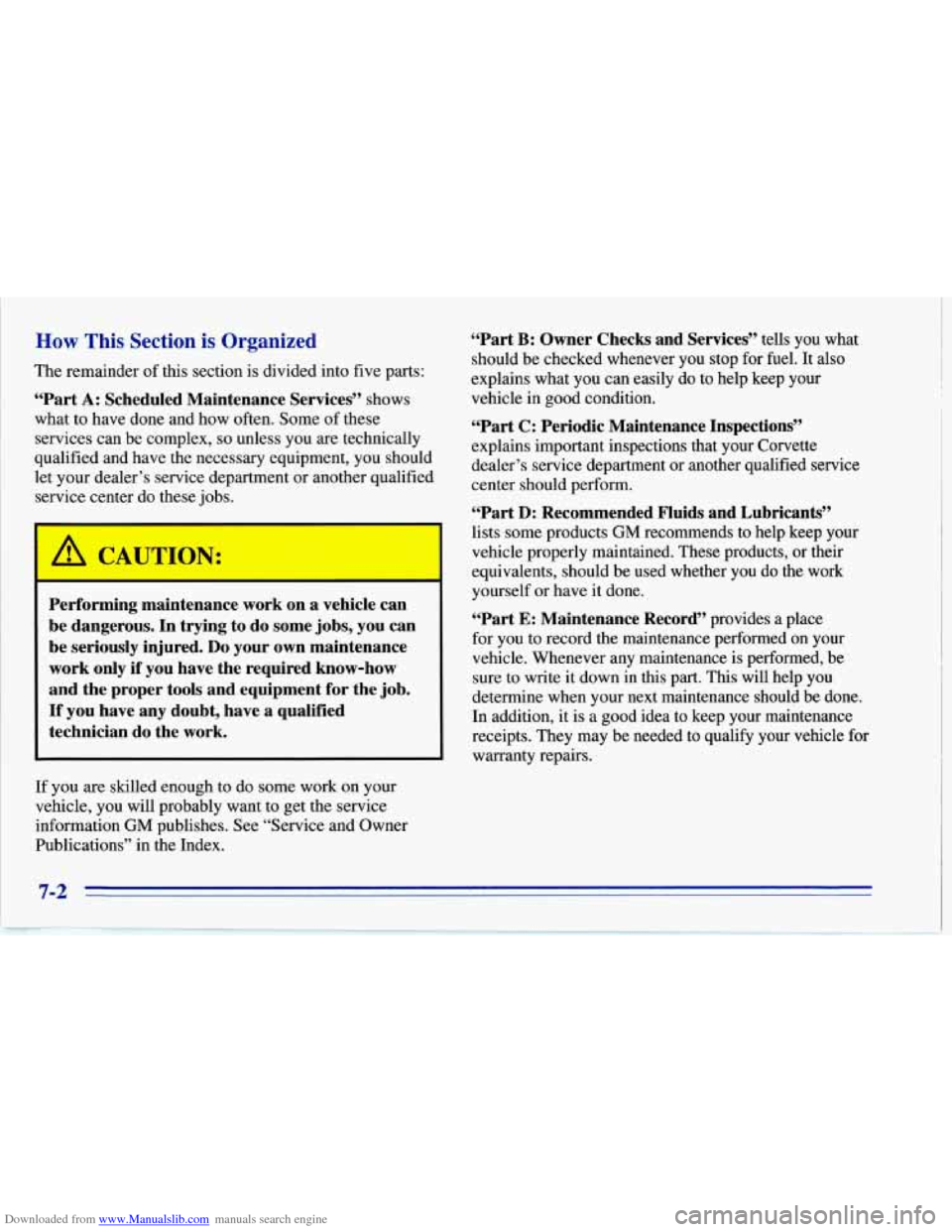
The remainder of this section is divided into five parts:
“Part A: Scheduled Maintenance Services” shows
what to have done and how often. Some of these
services can be complex,
so unless you are technically
qualified and have the necessary equipment, you should
let your dealer’s service department or another qualified
service center do these jobs.
Performing maintenance work on a vehicle can
be dangerous. In trying to do some jobs, you can
be seriously injured.
Do your own maintenance
work only
if you have the required know-how
and the proper tools and.equipment for the job.
If you have any doubt, have a qualified
technician do the work. “Part
B: Owner
Checks and Services’’ tells you what
should be checked whenever you stop for fuel. It also
explains what you can easily do to help keep your
vehicle in good condition.
“Part C: Periodic Maintenance Inspections”
explains important inspections that your Corvette
dealer’s service department or another qualified service
center should perform.
“Part D: Recommended Fluids and Lubricants”
lists some products GM recommends to help keep your
vehicle properly maintained. These products, or their
equivalents, should be used whether you do the work
yourself
or have it done.
“Part E: Maintenance Record’’ provides a place
for you to record the maintenance performed
on your
vehicle. Whenever any maintenance is performed, be
sure to write it down in this part.
This will help you
determine when your next maintenance should be done.
In addition, it is a good idea to keep your maintenance
receipts. They may be needed to qualify your vehicle for
warranty repairs.
If you are skilled enough to do some work on your
vehicle, you will probably want to get the service
information
GM publishes. See “Service and Owner
Publications” in the Index.
7-2
Page 314 of 386
Downloaded from www.Manualslib.com manuals search engine Part A: Scheduled Maintenance
Services
Using Your Maintenance Schedule
We at General Motors want to help you keep your
vehicle in good working condition. But we don’t know
exactly how you’ll drive it. You may drive
very short
distances only a few times a week. Or you may drive
long distances all the time in very hot, dusty weather.
You may use your vehicle in making deliveries. Or
you may drive it to work,
to do errands or in many
other ways.
Because of all the different ways people use their
GM
vehicles, maintenance needs vary. You may even need
more frequent checks and replacements than you’ll find
in the schedules in this section.
So please read this
section and note how you drive. If you have any
questions
on how to keep your vehicle in good
condition, see your Corvette dealer.
This part tells you the maintenance services you should
have done and when you should schedule them. If you
go to your dealer for your service needs, you’ll know
that GM-trained and supported service people will
perform the work using genuine
GM parts. The
proper fluids and lubricants to use are listed in
Part D. Make sure whoever services your vehicle
uses these. All parts should be replaced and all
necessary repairs done before you or anyone else
drives the vehicle.
These schedules are for vehicles that:
carry passengers and cargo within recommended
limits. You will find these limits on your vehicle’s
Tire-Loading Information label. See “Loading Your
Vehicle’’ in the Index.
are driven on reasonable road surfaces within legal
driving limits.
use the recommended fuel. See “Fuel” in the Index.
Selecting the Right Schedule
First you’ll need to decide which of the two schedules is
right for your vehicle. Here’s how to decide which
schedule to follow:
7-3
Page 351 of 386
Downloaded from www.Manualslib.com manuals search engine Part B: Owner Checks and Services
Listed below are owner checks and services which
should be performed at the intervals specified to help
ensure the safety, dependability and emission control
performance of your vehicle.
Be sure any necessary repairs are completed at once.
Whenever any fluids
or lubricants are added to your
vehicle, make sure they are the proper ones, as shown
in Part
D.
At Each Fuel Fill
It is important for you or a service station attendant to
pegorm these underhood checks at each fuel
fill.
Engine Oil Level Check
Check the engine oil level and add the proper oil if necessary.
See “Engine Oil” in the Index for further details.
Engine Coolant Level Check
Check the engine coolant level and add the proper
coolant mix if necessary. See “Engine Coolant” in the
Index for further details.
Windshield Washer Fluid Level Check
Check the windshield washer fluid level in the
windshield washer tank and add the proper fluid if
necessary. See “Windshield Washer Fluid” in the
Index for further details.
At Least Once a Month
Tire Inflation Check
Make sure tires are inflated to the correct pressures. See
“Tires” in the Index for further details.
Cassette Deck Service
Clean cassette deck. Cleaning should be done every
50 hours of tape play. See “Audio Systems” in the
Index for further details.
Power Antenna Service
Clean power antenna mast. See “Audio Systems” in
the Index for further details.
7-40
Page 352 of 386
Downloaded from www.Manualslib.com manuals search engine At Least Twice a Year Automatic Transmission Check
Restraint System Check
Make sure the safety belt reminder light and all your
belts, buckles, latch plates, retractors and anchorages are
working properly. Look for any other loose or damaged
safety belt system parts. If
you see anything that might
keep a safety belt system from doing its job, have it
repaired. Have any torn or frayed safety belts replaced.
Also look for any opened or broken air bag covers, and
have them repaired or replaced. (The air bag system
does not need regular maintenance.)
Manual Transmission Check
Check the transmission fluid level; add if needed. See
“Manual Transmission” in the Index. A fluid loss
may indicate a problem. Check the system and repair
if needed. Check the transmission fluid level;
add if needed. See
“Automatic Transmission” in the Index. A fluid loss
may indicate a problem. Check the system and repair
if needed.
At Least Once a Year
Key Lock Cylinders Service
Lubricate the key lock cylinders with the lubricant
specified in Part
D.
Body Lubrication Service
Lubricate all body door hinges. Also lubricate all
hinges and latches, including those for the hood,
rear compartment, console door and any folding
seat hardware. Part
D tells you what to use. More
frequent lubrication may be required when exposed
to a corrosive environment.
7-41
Page 353 of 386
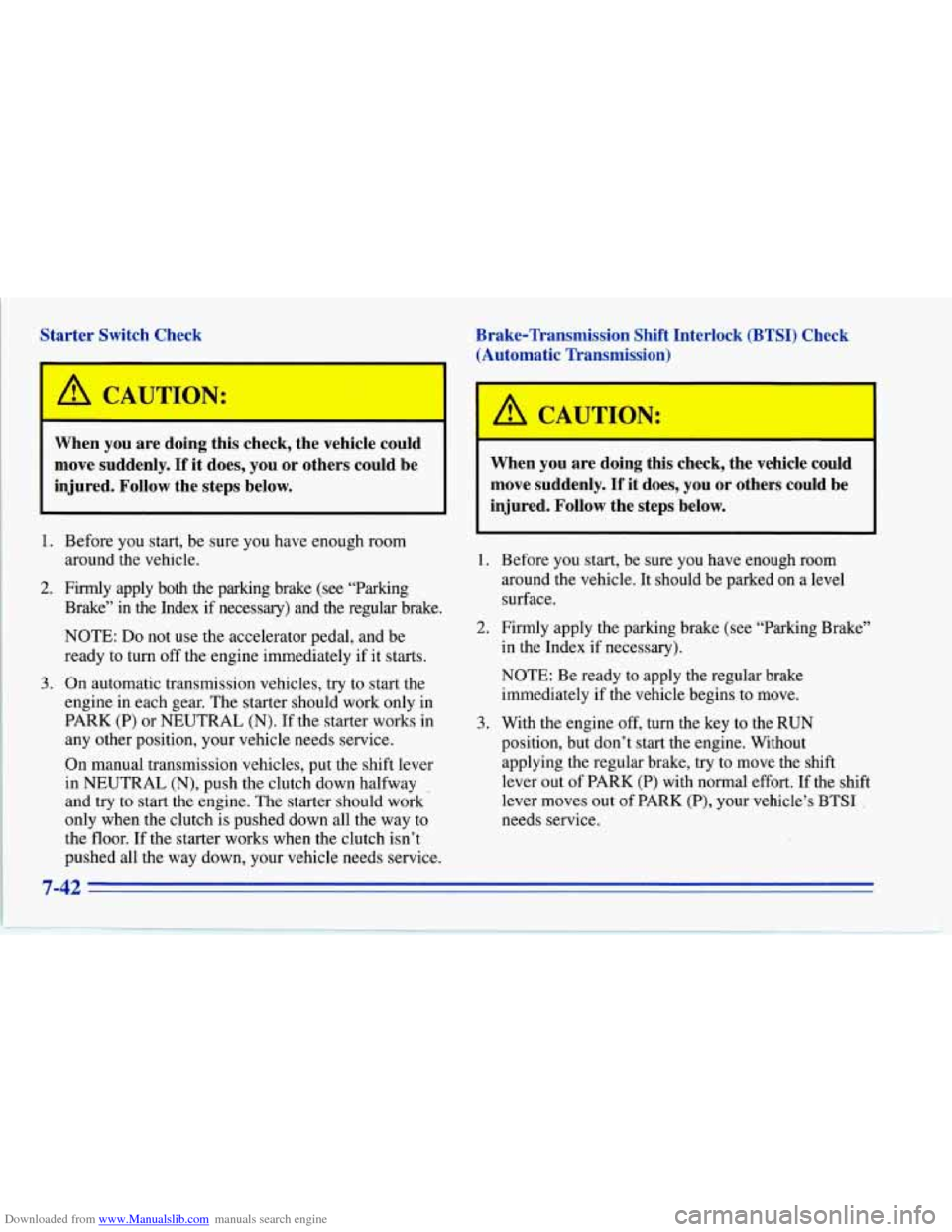
Downloaded from www.Manualslib.com manuals search engine Starter Switch Check Brake-Transmission Shift Interlock (BTSI) Check
(Automatic Transmission)
?:
When you are doing this check, the vehicle could
move suddenly. If it does, you or others could be injured. Follow the steps below.
1. Before you start, be sure you have enough room
around the vehicle.
2. Firmly apply both the parking brake (see “Parking
Brake” in the Index if necessary) and the regular brake.
NOTE: Do not use the accelerator pedal, and be
ready
to turn off the engine immediately if it starts.
3. On automatic transmission vehicles, try to start the
engine in each gear. The starter should work only in
PARK (P) or NEUTRAL (N). If the starter works
in
any other position, your vehicle needs service.
On manual transmission vehicles, put the shift lever
in NEUTRAL (N), push the clutch down halfway
and try to start the engine. The starter should work
only when the clutch
is pushed down all the way to
the floor. If the starter works when the clutch isn’t
pushed all the way down, your vehicle needs service.
When you are doing this check, the vehicle could
move suddenly. If it does, you or others could be
injured. Follow the steps below.
1. Before you start, be sure you have enough room
around the vehicle. It should be parked on a level surface.
2. Firmly apply the parking brake (see “Parking Brake”
in the Index if necessary).
NOTE: Be ready to apply the regular brake
immediately if the vehicle begins to move.
3. With the engine off, turn the key to the RUN
position, but don’t start the engine. Without applying the regular brake, try
to move the shift
lever out of PARK (P) with normal effort. If the shift
lever moves out
of PARK (P), your vehicle’s BTSI .
needs service.
7-42
Page 354 of 386
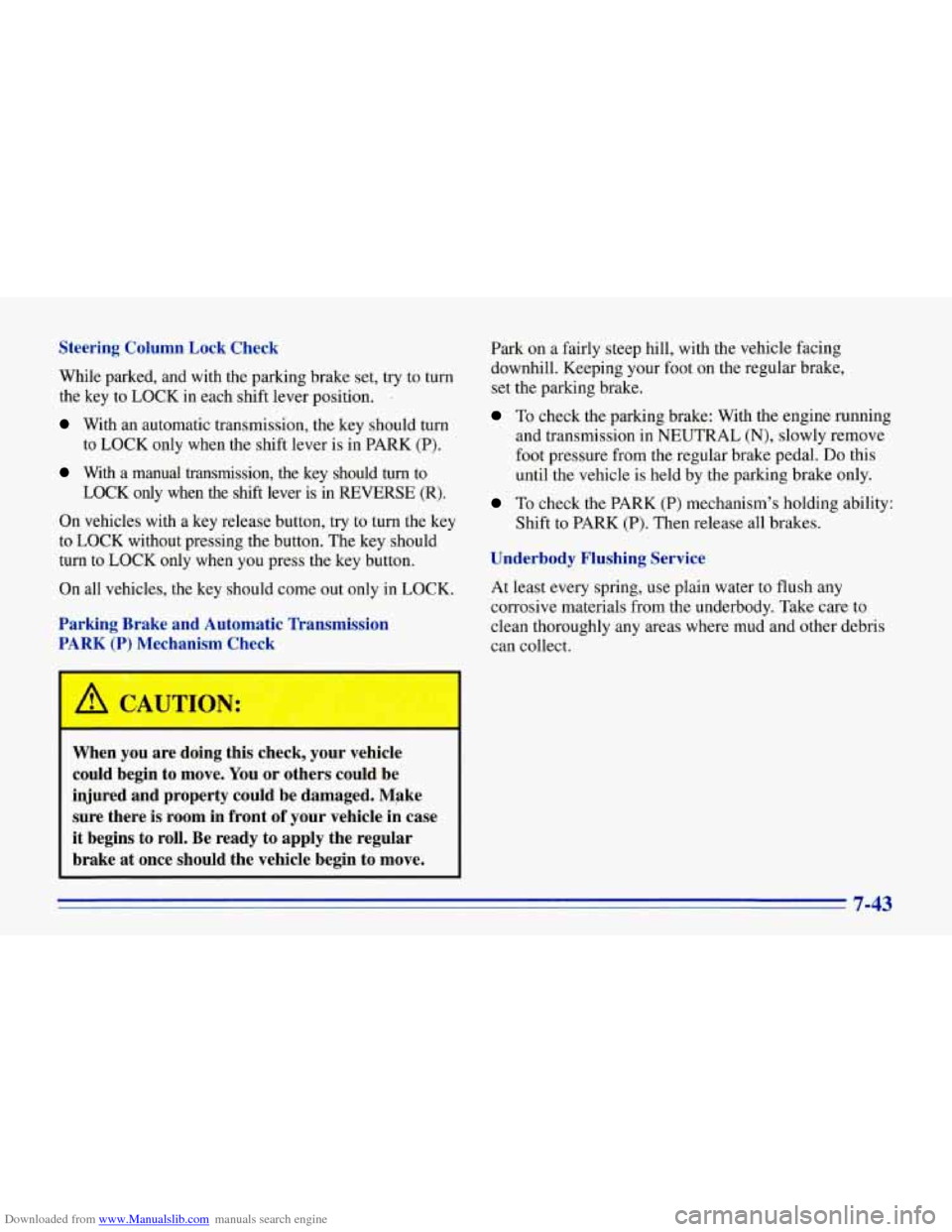
Downloaded from www.Manualslib.com manuals search engine Steering Column Lock Check While parked, and with the parking brake set, try to turn
the key to LOCK in each shift lever position.
.
With an automatic transmission, the key should turn
With a manual transmission, the key should turn to
On vehicles with a key release button, try to turn the key
to LOCK without pressing the button. The key should
turn to LOCK only when you press the key button. to LOCK only when the
shift lever is in PARK (P).
LOCK only when the shift lever is in REVERSE (R).
On all vehicles, the key should come out only in LOCK.
Parking Brake and Automatic Transmission
PARK (P) Mechanism Check
A LAUTIO,.
When you are doing this check, your vehicle
could begin to move. You or others could be
injured and property could be damaged. Make
sure there is room in front
of your vehicle in case
it begins to roll. Be ready to apply the regular
brake
at once should the vehicle begin to move. Park
on a fairly steep hill, with the vehicle facing
downhill. Keeping your foot on the regular brake,
set the parking brake.
To check the parking brake: With the engine running
and transmission in NEUTRAL
(N), slowly remove
foot pressure from the regular brake pedal.
Do this
until the vehicle is held by the parking brake only.
To check the PARK (P) mechanism’s holding ability:
Shift to PARK (P). Then release all brakes.
Underbody Flushing Service At least every spring, use plain water to flush any
corrosive materials from the underbody. Take care to
clean thoroughly any areas where mud and other debris
can collect.
7-43