engine overheat CHEVROLET CORVETTE 1996 4.G Owners Manual
[x] Cancel search | Manufacturer: CHEVROLET, Model Year: 1996, Model line: CORVETTE, Model: CHEVROLET CORVETTE 1996 4.GPages: 386, PDF Size: 20.12 MB
Page 2 of 386
Downloaded from www.Manualslib.com manuals search engine n
The 1996 Corvette Owner’s Manual
Seats and Restraint Systems ............................................................... 1-1
This section tells you how to use your seats and safety belts properly. It also explains the air bag system.
Features and Controls .................................................................. 2-1
This section explains how to start and operate your Corvette.
Comfort Controls and Audio Systems ..................................................... 3-1
This section tells you how to adjust the ventilation and comfort controls and how to operate your
audio system.
Here you’ll find helpful information and tips about the road and how to drive under different conditions.
YourDrivingandtheRoad .............................................................. 4-1
ProblemsontheRoad .................................................................. 5-1
This section tells you what to do if you have a problem while driving, such as a flat tire or overheated
engine, etc.
Service and Appearance Care.. .......................................................... 6-1
Maintenanceschedule .................................................................. 7-1
Customer Assistance Information ........................................................ 8-1
Here the manual tells you how to keep your Corvette running properly and looking good.
This section tells you when to perform vehicle maintenance and what fluids and lubricants to use.
This section tells you how to contact Chevrolet for assistance and how to get service and owner publications.
It also gives you information on “Reporting Safety Defects” on page
8-9.
Index ........................................................................\
......... 9-1
Here’s an alphabetical listing of almost every subject in this manual. You can use it to quickly find
something you want to read.
i
Page 63 of 386
Downloaded from www.Manualslib.com manuals search engine Engine Coolant Heater (Canada Only)
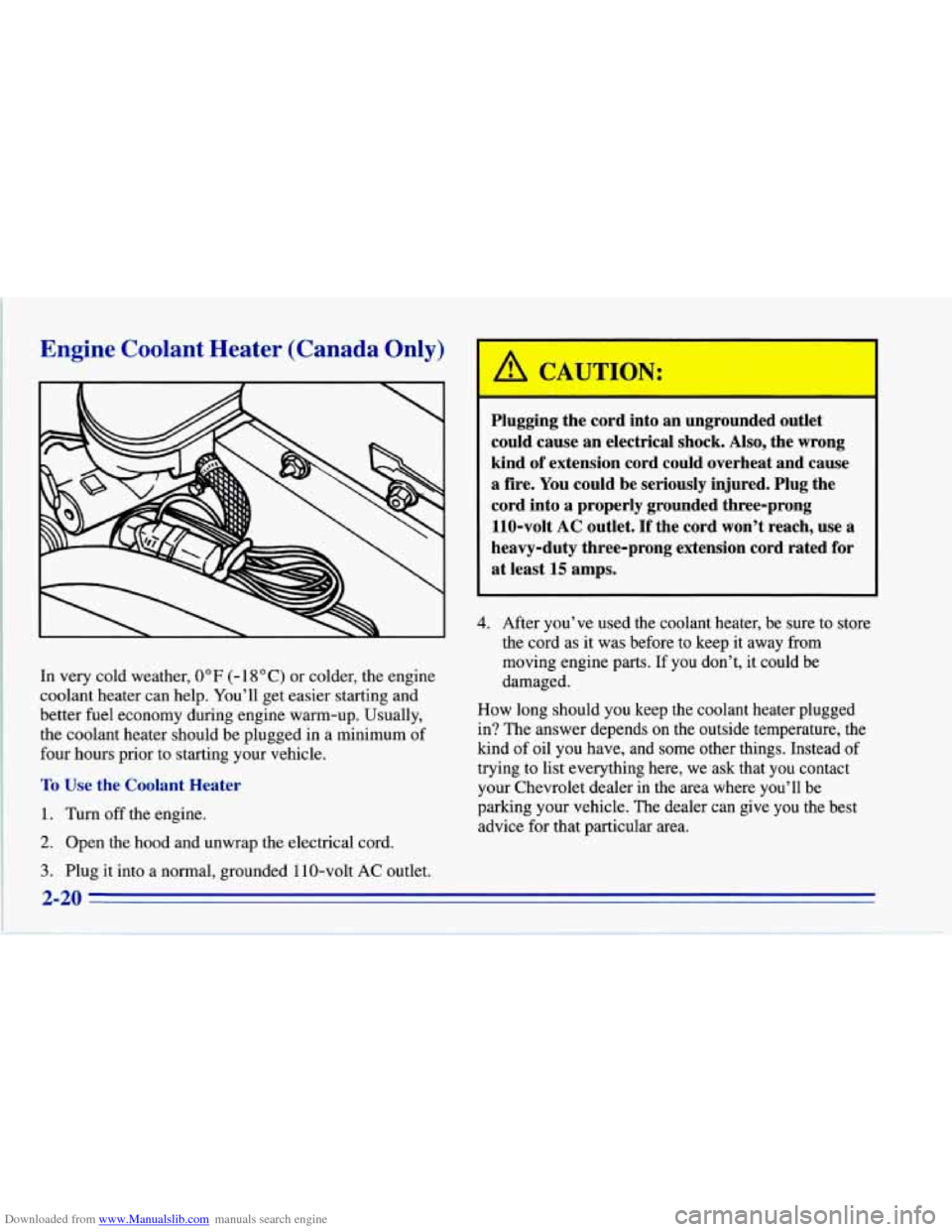
In very cold weather, 0°F (- 18 O C) or colder, the engine
coolant heater can help. You’ll get easier starting and
better fuel economy during engine warm-up. Usually,
the coolant heater should be plugged in a minimum of
four hours prior to starting your vehicle.
To Use the Coolant Heater
1. Turn off the engine.
2. Open the hood and unwrap the electrical cord.
3. Plug it into a normal, grounded 110-volt AC outlet.
A CAUTION:
Plugging the cord into an ungrounded outlet
could cause an electrical shock. Also, the wrong
kind of extension cord could overheat and cause
a fire. You could be seriously injured. Plug the
cord into
a properly grounded three-prong
110-volt
AC outlet. If the cord won’t reach, use a
heavy-duty three-prong extension cord rated for
at least
15 amps.
4. After you’ve used the coolant heater, be sure to store
the cord as it was before to keep
it away from
moving engine parts. If you don’t, it could be
damaged.
How long should you keep the coolant heater plugged
in? The answer depends on the outside temperature, the
kind of
oil you have, and some other things. Instead of
trying to list everything here, we ask that you contact
your Chevrolet dealer in the area where you’ll be
parking your vehicle. The dealer can give you the best
advice for that particular area.
Page 66 of 386
Downloaded from www.Manualslib.com manuals search engine AUTOMATIC OVERDRIVE (0): This position is for
normal driving.
If you need more power for passing, and
you’re:
Going less than about 35 mph (56 km/h), push your
accelerator pedal about halfway down.
Going about 35 mph (56 km/h) or more, push the
accelerator all the way down.
You’ll shift down to the next gear and have more power.
DRIVE (D): This position is also used for normal
driving, however, it offers more power and lower fuel
economy than AUTOMATIC OVERDRIVE
(0).
Here are some times you might choose DRIVE (D)
instead
of AUTOMATIC OVERDRIVE (0):
0 When driving on hilly, winding roads
When going down a steep hill
SECOND (2): This position gives you more power but
lower fuel economy. You can use SECOND
(2) on hills.
It can help control your speed as you go down steep
mountain roads, but then you would also want to use
your brakes off and on.
FIRST (1): This position gives you even more power
(but lower fuel economy) than SECOND
(2). You can
use it on very steep hills, or in deep snow or mud. If the
selector lever is put in
FIRST (I), the transmission
won’t shift into first gear until the vehicle is going
slowly enough.
I NOTICE:
If your rear wheels can’t rotate, don’t try to
drive. This might happen
if you were stuck in
very deep sand or mud or were up against a solid
object.
You could damage your transmission.
Also, if you stop when going uphill, don’t hold
your vehicle there with only the accelerator
pedal. This could overheat and damage the
transmission. Use your brakes or shift into
PARK (P) to hold your vehicle in position
on a hill.
Maximum engine speed is limited to protect driveline
components from improper operation.
2-23
Page 72 of 386
Downloaded from www.Manualslib.com manuals search engine Shifting Into PARK (P) (Automatic
Transmission
Mode’ 0 ly)
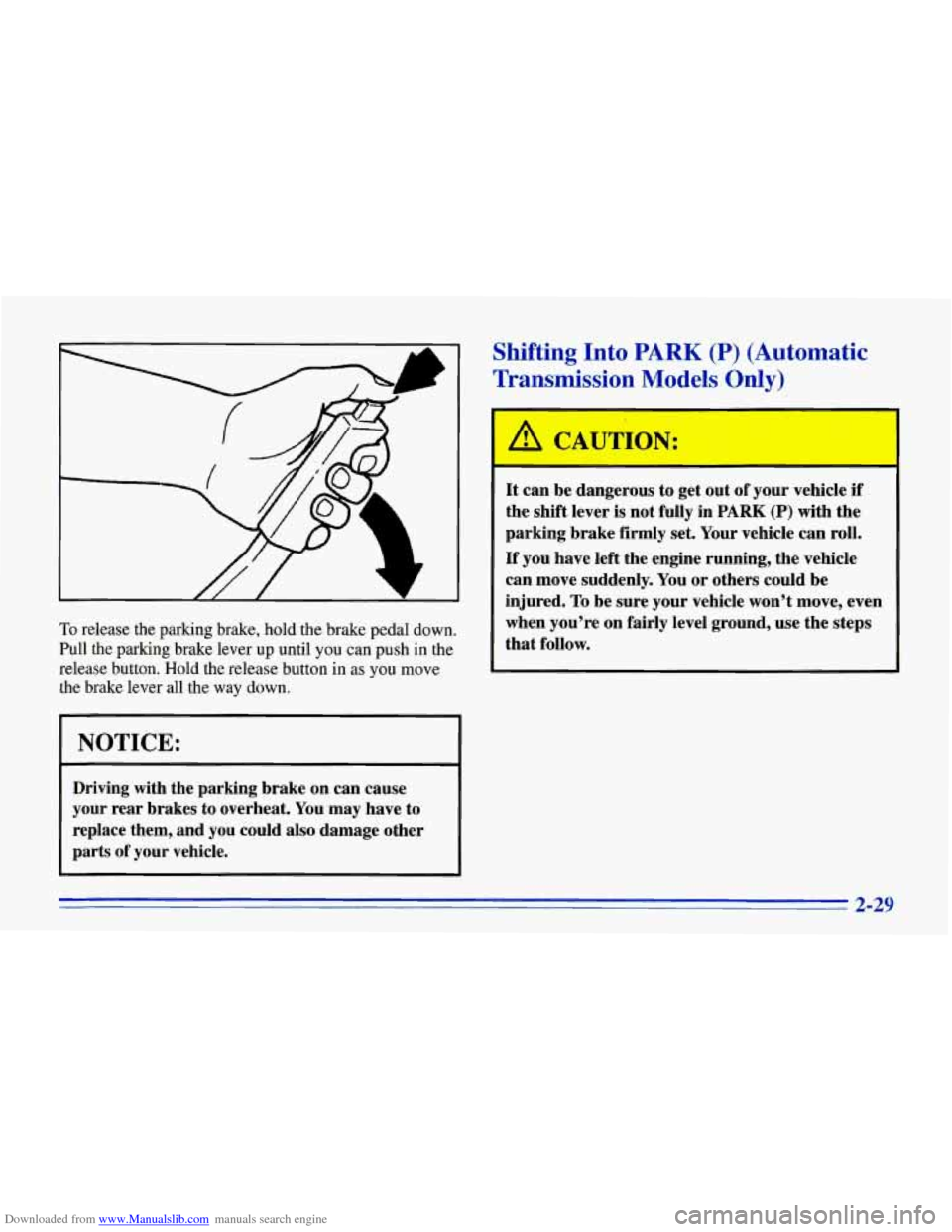
To release the parking brake, hold the brake pedal down.
Pull the parking brake lever up until you can push in the
release button. Hold the release button in as you move
the brake lever all the way down.
NOTICE:
Driving with the parking brake on can cause
your rear brakes to overheat. You may have to
replace them, and you could also damage other
parts
of your vehicle.
It can be dangerous to get out of yqur vehicle if
the shift lever
is not fully in PARK (P) with the
parking brake firmly set. Your vehicle can roll.
If you have left the engine running, the vehicle
can move suddenly. You or others could be
injured.
To be sure your vehicle won’t move, even
when you’re on fairly level ground, use the steps
that follow.
2-29
Page 73 of 386
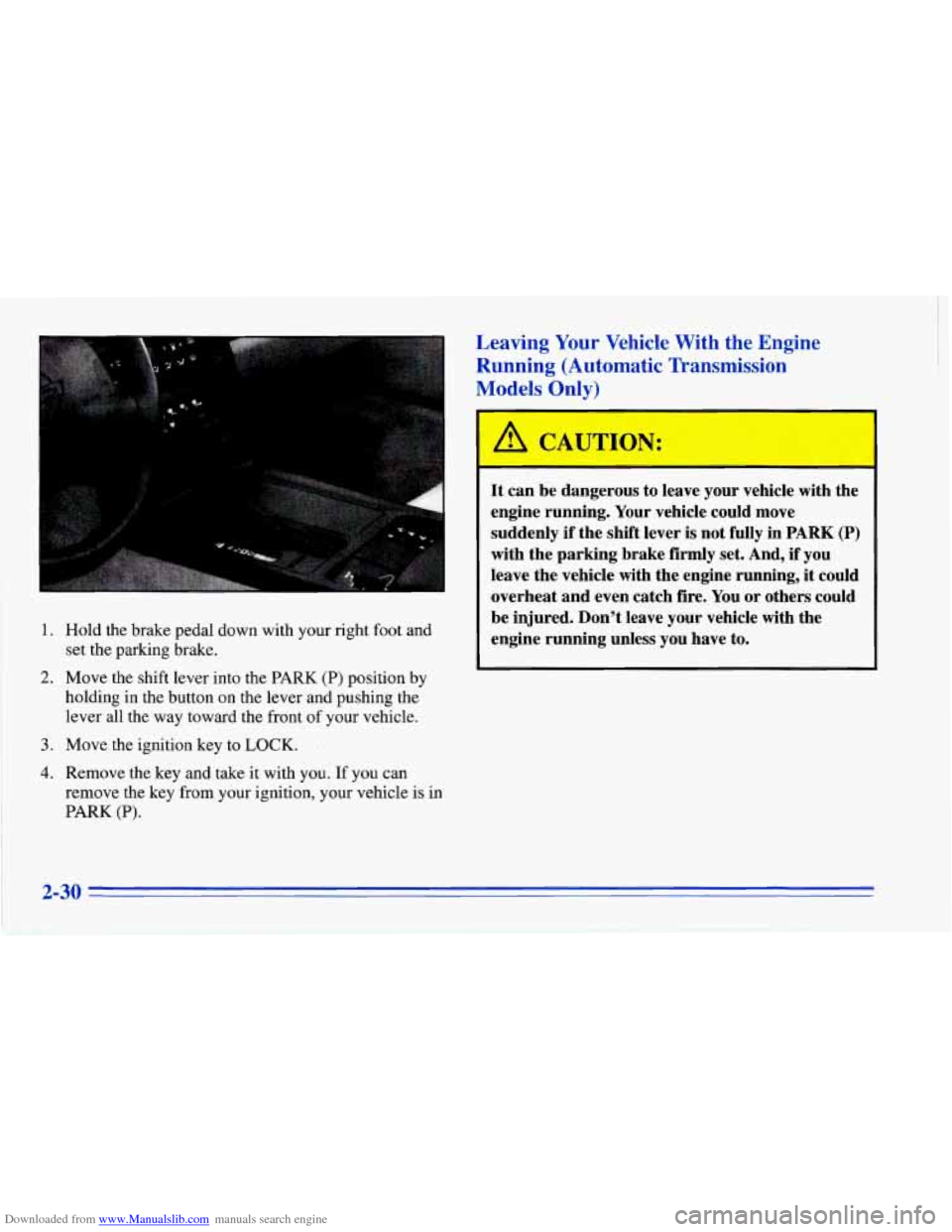
Downloaded from www.Manualslib.com manuals search engine 1. Hold the brake pedal down with your right foot and
set the parking brake.
2. Move the shift lever into the PARK (P) position by
holding in the button on the lever and pushing the
lever all the way toward the front
of your vehicle.
3. Move the ignition key to LOCK.
4. Remove the key and take it with you. If you can
remove the key from your ignition, your vehicle is in
PARK
(P).
Leaving Your Vehicle With the Engine
Running (Automatic Transmission
Models Only)
It can be dangerous to leave your vehicle with the
engine running. Your vehicle could move
suddenly
if the shift lever is not fully in PARK (P)
with the parking brake firmly set. And, if you
leave the vehicle with the engine running, it could
overheat and even catch fire. You
or others could
be injured. Don’t leave your vehicle with the
engine running unless you have to.
2-30
Page 94 of 386
Downloaded from www.Manualslib.com manuals search engine NOTICE:
Don’t hold a cigarette lighter in with your hand
while it is heating. If
you do, it won’t be able to
back away from the heating element when it’s
ready. That can make it overheat, damaging the
lighter and the heating element.
Sun Visors
To block out glare, you can swing down the visors. You
can also swing them to the side.
With the hardtop roof removed or the convertible top
down, you can flip the visors straight up to help reduce
wind turbulence.
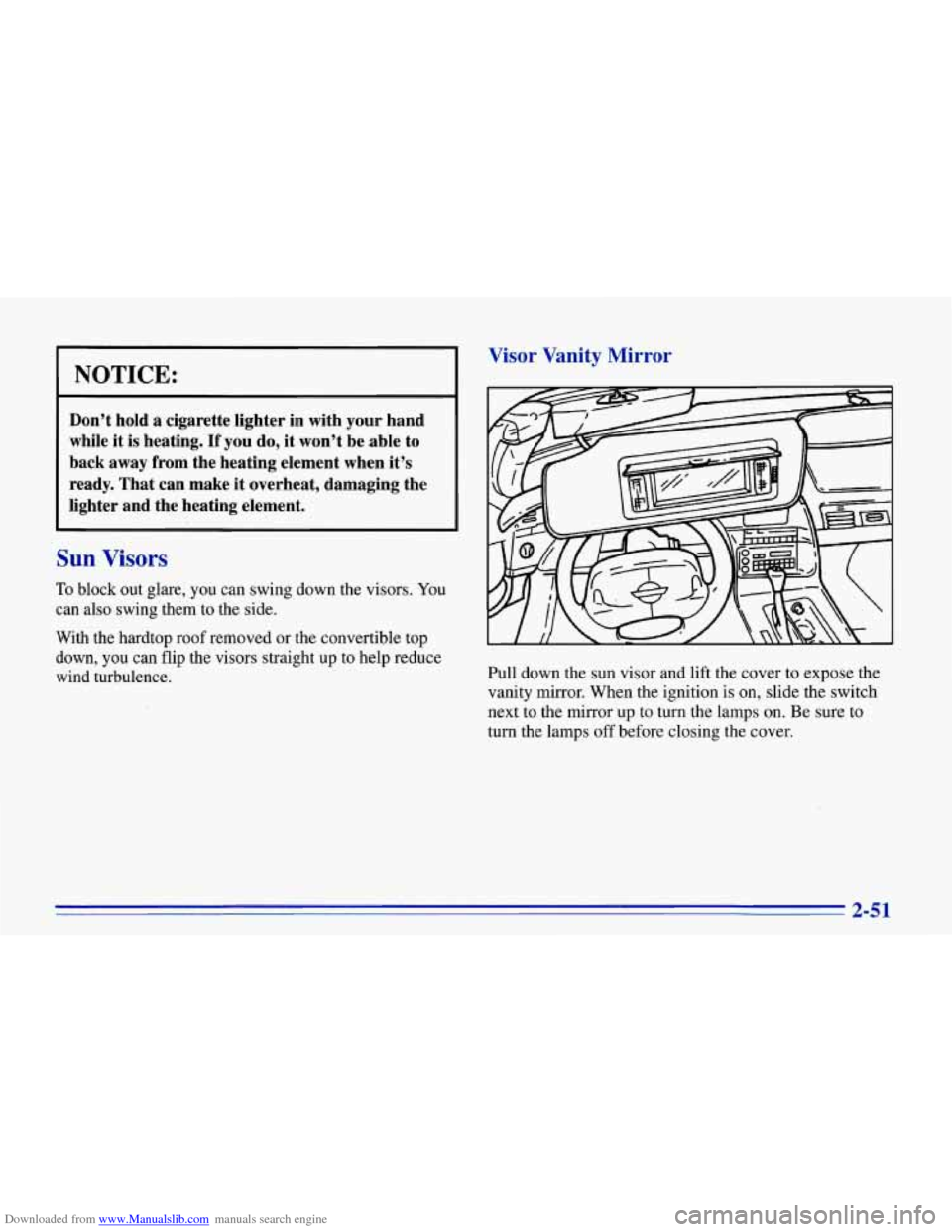
Visor Vanity Mirror
Pull down the sun visor and lift the cover to expose the
vanity mirror. When the ignition is on, slide the switch
next to the mirror up to turn the lamps on. Be sure to
turn the lamps off before closing the cover.
2-51
Page 125 of 386
Downloaded from www.Manualslib.com manuals search engine Engine Coolant Temperature Gauge
185
TEMP
HH
“F
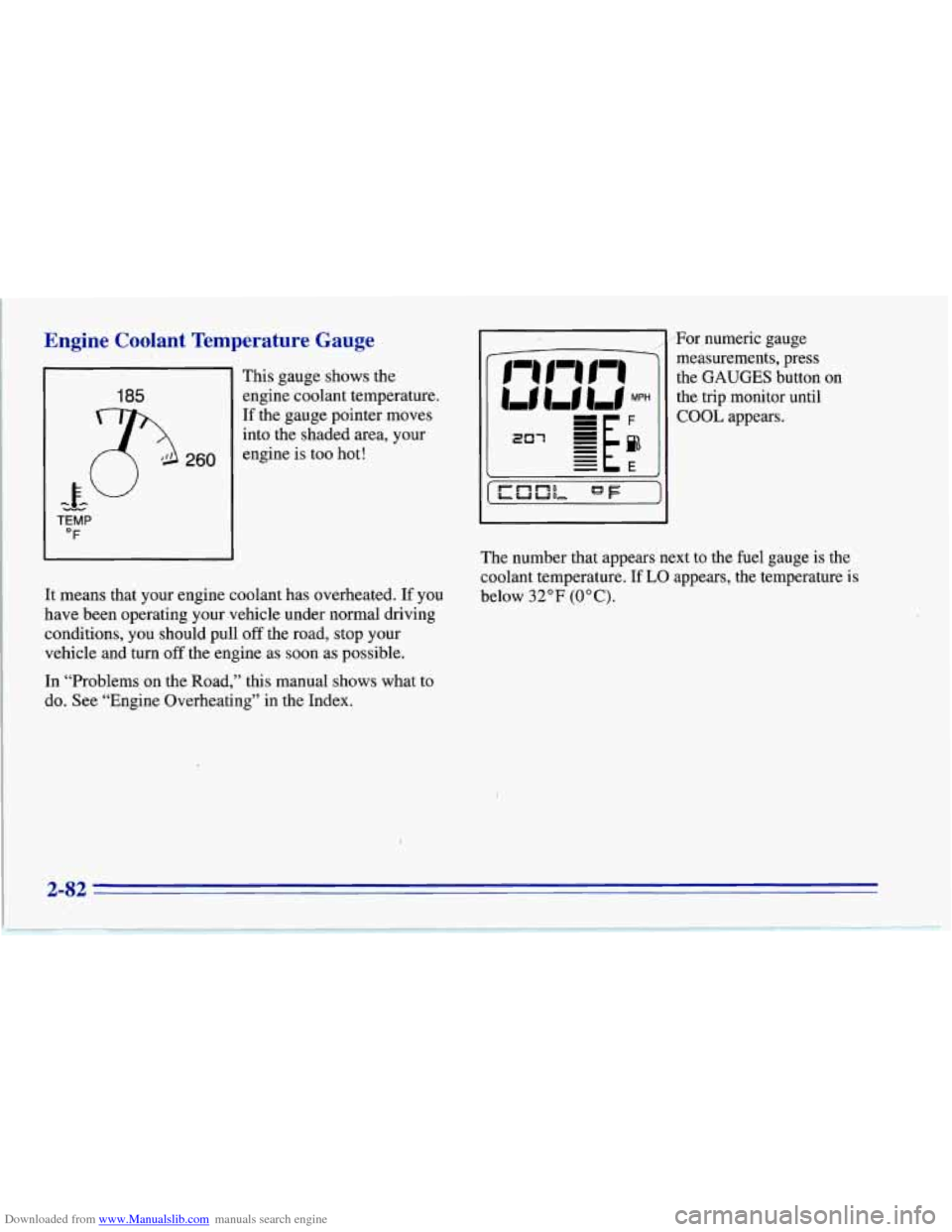
This gauge shows the
engine coolant temperature.
If the gauge pointer moves
into the shaded area, your
engine is too hot!
The number that appears next to the fuel gauge is the
-~ 1- -For numeric gauge
measurements, pies
the GAUGES button
on
I coolant temperature. If LO appears, the temperature is
It means that your engine coolant has overheated. If you below 32”~ (0°C).
have been operating your vehicle under normal driving
conditions, you should pull
off the road, stop your
vehicle and turn
off the engine as soon as possible.
In “Problems on the Road,” this manual shows what to
do. See “Engine Overheating” in the Index.
2-82
Page 126 of 386
Downloaded from www.Manualslib.com manuals search engine Low Coolant Warning Light
LOW
COOLANT
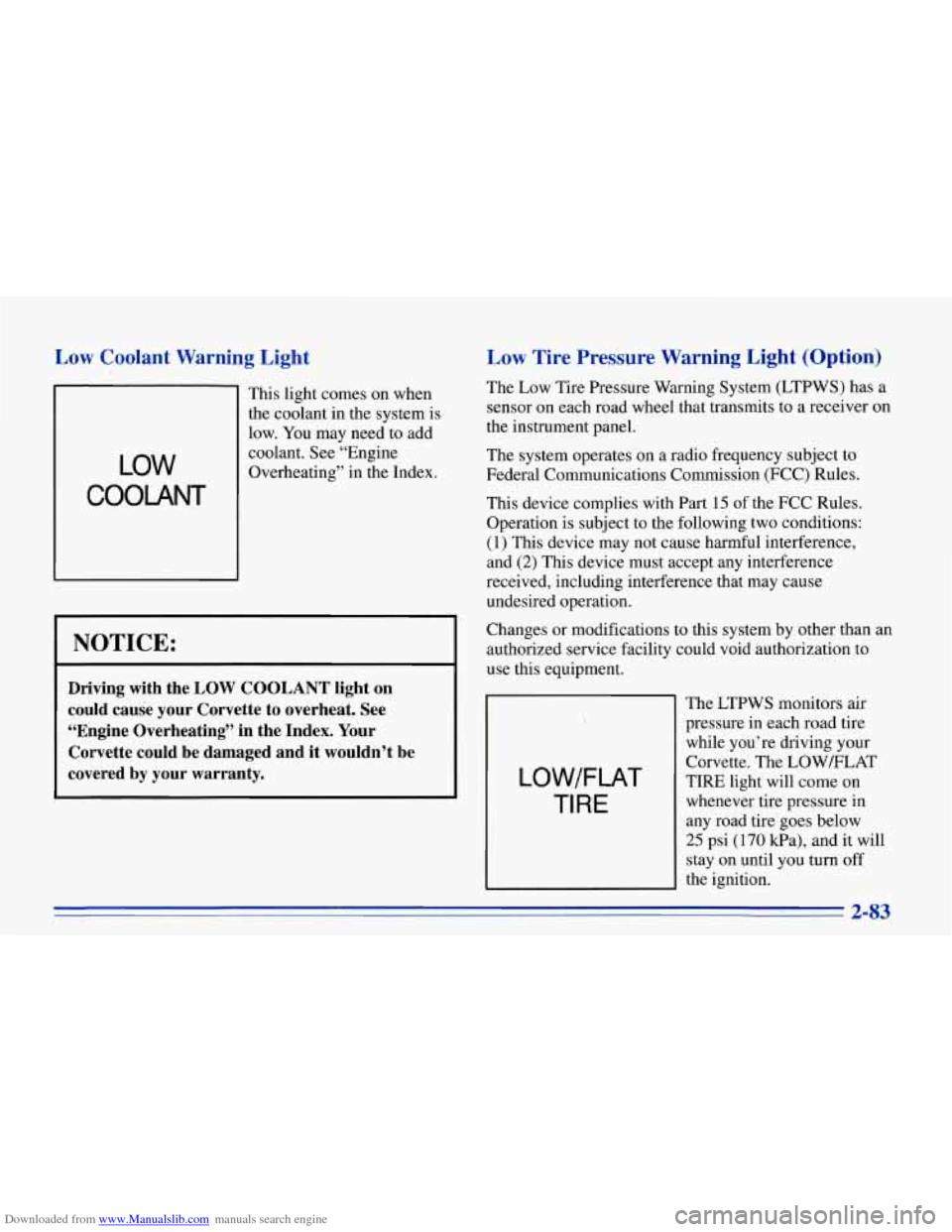
This light comes on when
the coolant in the system is
~ low. You may need to add
~ coolant. See “Engine
~ Overheating” in the Index.
I NOTICE:
Driving with the LOW COOLANT light on
could cause your Corvette to overheat. See
“Engine Overheating” in the Index. Your
Corvette could be damaged and it wouldn’t be
covered by your warranty.
Low Tire Pressure Warning Light (Option)
The Low Tire Pressure Warning System (LTPWS) has a
sensor on each road wheel that transmits to a receiver on
the instrument panel.
The system operates
on a radio frequency subject to
Federal Communications Commission (FCC) Rules.
This device complies with Part
15 of the FCC Rules.
Operation is subject to the following two conditions:
(1) This device may not cause harmful interference,
and
(2) This device must accept any interference
received, including interference that may cause
undesired operation.
Changes or modifications to this system by other than an
authorized service facility could void authorization to
use this equipment.
LOW/FLAT
TI RE
The LTPWS monitors air
pressure in each road tire
while you’re driving your
Corvette. The LOWELAT
TIRE light will come on
whenever tire pressure in
any road tire goes below
25 psi (170 kPa), and it will
stay on until
you turn off
the ignition.
2-83
Page 133 of 386
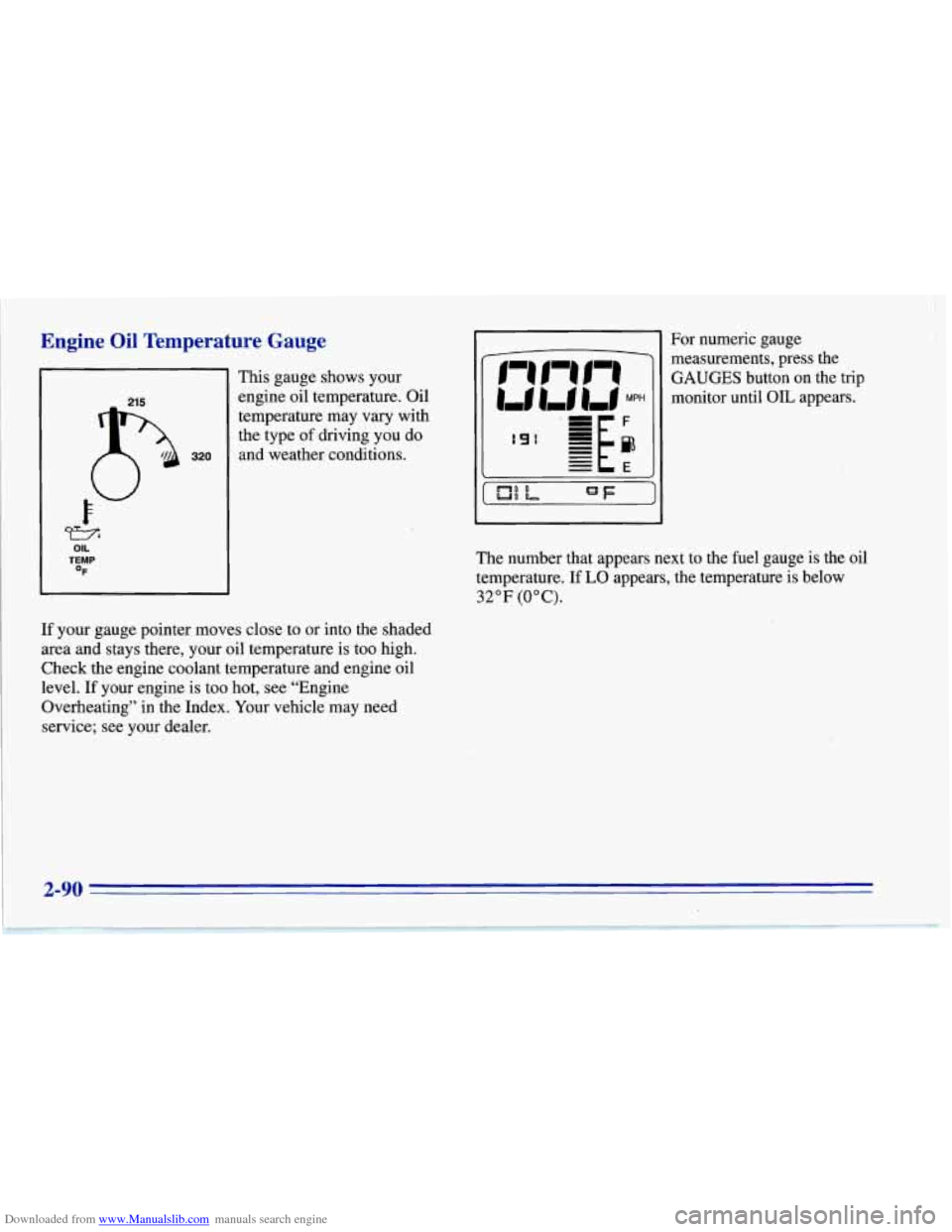
Downloaded from www.Manualslib.com manuals search engine Engine Oil Temperature Gauge
320
OIL TEMP OF
This gauge shows your
engine oil temperature. Oil
temperature may vary with
the type
of driving you do
and weather conditions.
If your gauge pointer moves close to or into the shaded
area and stays there, your oil temperature is too high.
Check the engine coolant temperature and engine oil
level.
If your engine is too hot, see “Engine
Overheating” in the Index. Your vehicle may need
service; see your dealer.
I,
For numeric gauge
measurements, press the GAUGES button on the trip
monitor until
OIL appears.
The number that appears next to the fuel gauge is the oil
temperature.
If LO appears, the temperature is below
32°F (OOC).
2-90
Page 204 of 386
Downloaded from www.Manualslib.com manuals search engine Engine Overheating
You will find an engine coolant temperature gauge on
the instrument cluster and a
LOW COOLANT light on
the Driver Information Center.
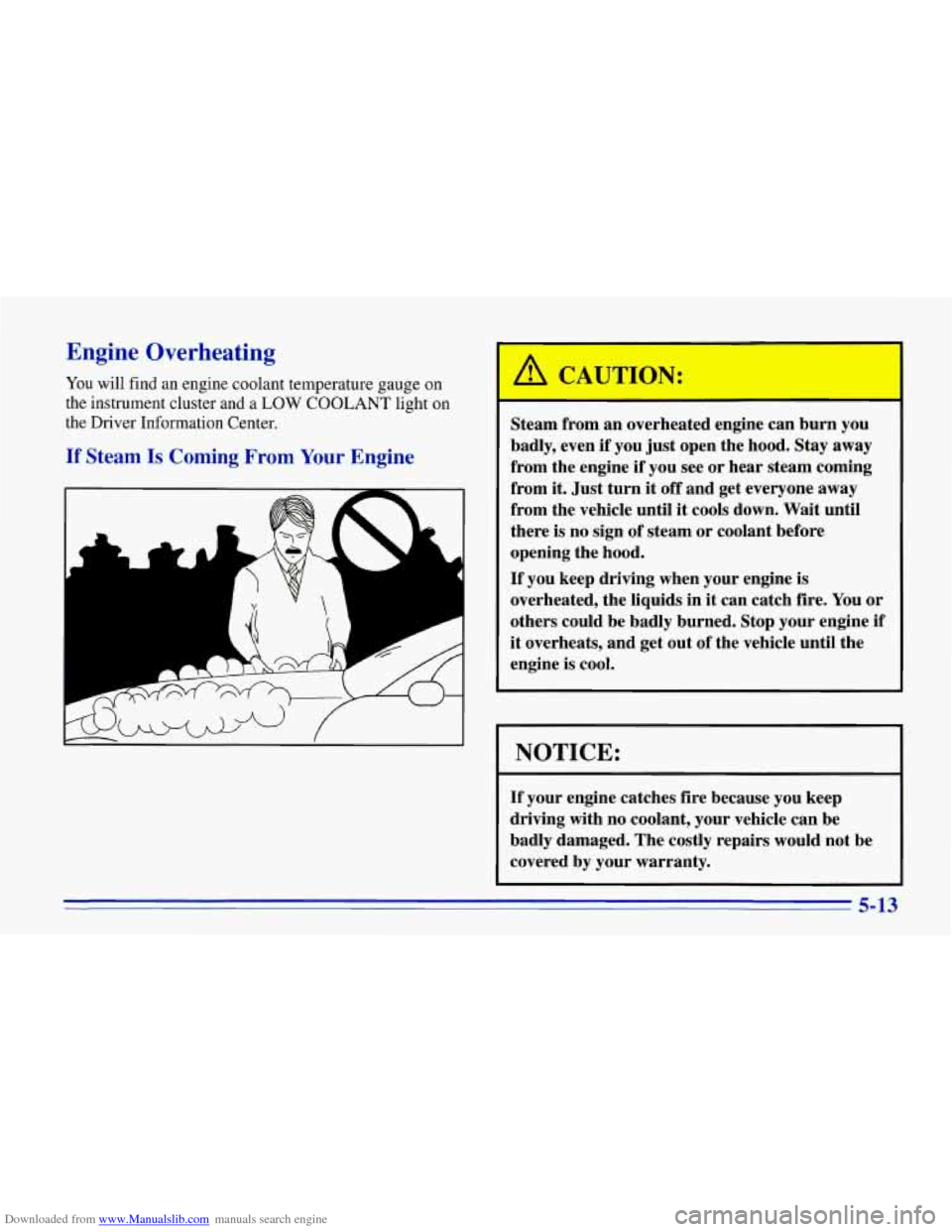
If Steam Is Coming From Your Engine
Steam from an overheated engine can burn you
badly, even if you just open the hood. Stay away
from the engine
if you see or hear steam coming
from it. Just turn it
off and get everyone away
from the vehicle until it cools down. Wait until
there is no sign of steam or coolant before
opening the hood.
If you keep driving when your engine is
overheated, the liquids in it can catch fire.
You or
others could be badly burned. Stop your engine if
it overheats, and get out of the vehicle until the
engine is cool.
I NOTICE:
If your engine catches fire because you keep
driving with no coolant, your vehicle can be
badly damaged. The costly repairs would not be
covered by your warranty.