towing CHEVROLET CORVETTE 1996 4.G Owners Manual
[x] Cancel search | Manufacturer: CHEVROLET, Model Year: 1996, Model line: CORVETTE, Model: CHEVROLET CORVETTE 1996 4.GPages: 386, PDF Size: 20.12 MB
Page 62 of 386
Downloaded from www.Manualslib.com manuals search engine START for about three seconds. If the vehicle starts
briefly but then stops again, do the same thing, but
this time keep the pedal down for five or six seconds.
This clears the extra gasoline from the engine.
I NOTICE:
Your engine is designed to work with the
electronics in your vehicle.
If you add electrical
parts or accessories, you could change the
way
the engine operates. Before adding electrical
equipment, check with your dealer.
If you don’t,
your engine might not perform properly.
If you ever have to have your vehicle towed, see
the part of this manual that tells how to do it
without damaging your vehicle. See “Towing
Your Vehicle” in the Index.
Racing or Other Competitive Driving
See your Warranty Book before using your Corvette for
racing or other competitive driving.
NOTICE:
If you use your Corvette for racing or other
competitive driving, your engine may use more
oil than it would with normal use. Low oil levels
can damage the engine. Be sure to check the oil
level often during racing or other competitive
driving and keep the level at or near the upper
mark on the engine oil dipstick.
You may need to
add oil. See “Engine Oil” in the Index.
2-19
Page 121 of 386
Downloaded from www.Manualslib.com manuals search engine Brake System Warning Light
Your Corvette’s hydraulic brake system is divided into
two parts. If one part isn’t working, the other part can
still work and stop you. For good braking, though, you
need both parts working well.
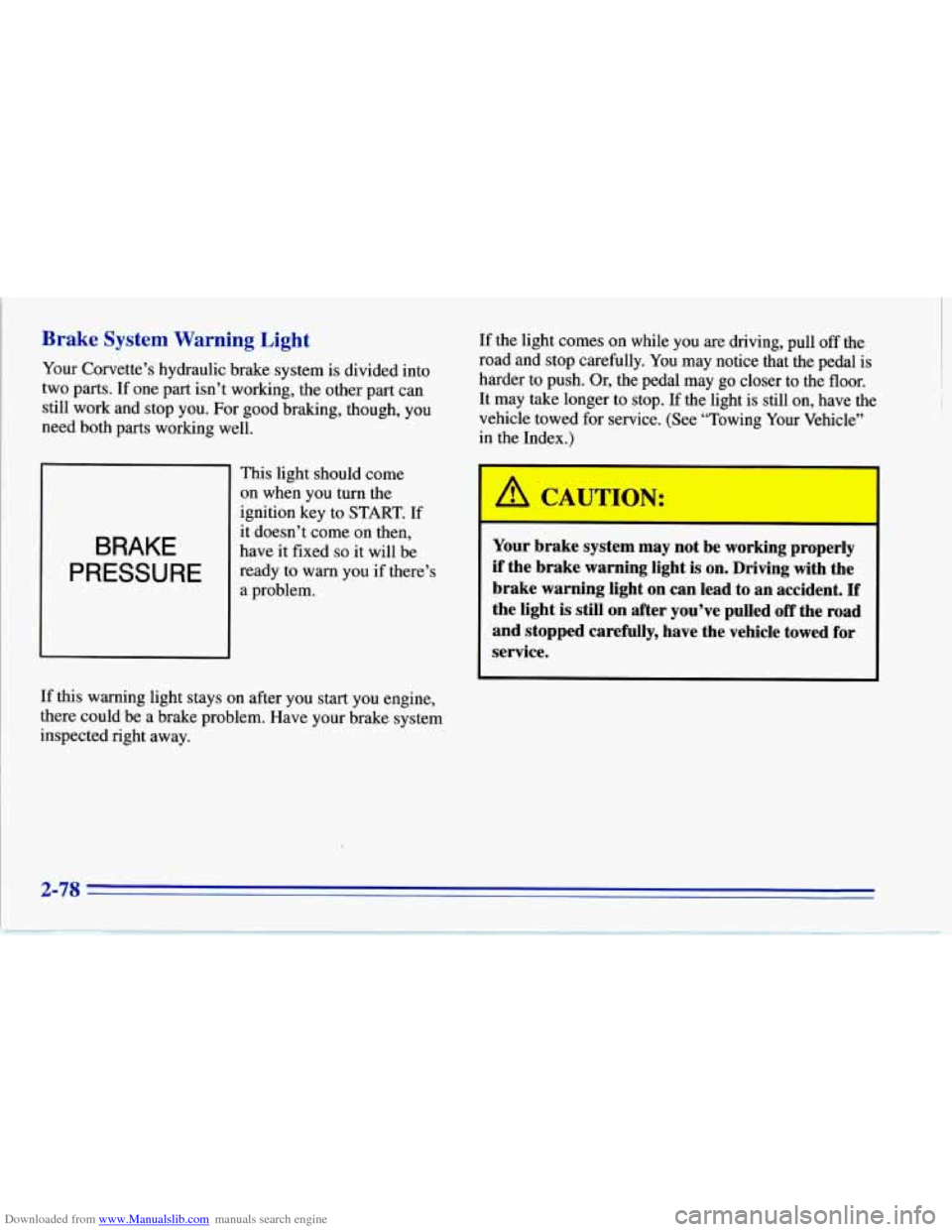
BRAKE
PRESSURE
This light should come
on when you turn the
ignition key to START.
If
it doesn’t come on then,
have it fixed
so it will be
ready to warn you if there’s
a problem. If
the light comes on while you are driving, pull
off the
road and stop carefully. You may notice that the pedal is
harder to push. Or, the pedal may go closer to the floor.
It may take longer to stop. If the light is still on, have the
vehicle towed for service. (See “Towing Your Vehicle”
in the Index.)
A TT-T~=T
vce. Your brake system may not be working properly
if the brake warning light
is on. Driving with the
brake warning light
on can lead to an accident. If
the light is still on after you’ve pulled off the road
and stopped carefully, have the vehicle towed for
If this warning light stays on after you start you engine,
there could be a brake problem. Have your brake system
inspected right away.
Page 190 of 386
Downloaded from www.Manualslib.com manuals search engine A CAUTION:
Do not load your vehicle any heavier than the
GVWR, or either the maximum front or rear
GAWR.
If you do, parts on your vehicle can break,
or it can change the way your vehicle handles.
These could cause you
to lose control. Also,
overloading can shorten the life
of your vehicle.
NOTICE:
Your warranty does not cover parts or
components that fail because
of overloading.
If you put things inside your vehicle -- like suitcases?
tools, packages or anything else
-- they will go as fast as
the vehicle goes.
If you have to stop or turn quickly, or
if there is a crash, they’ll keep going.
A CAUTION:
-
Things you put inside your vehicle can strike
and injure people in
a sudden stop or turn, or in
a crash.
Put things in the rear area of your vehicle.
Try to spread the weight evenly.
Never stack heavier things, like suitcases,
inside the vehicle
so that some of them are
above the tops
of the seats.
Don’t leave an unsecured child restraint in
your vehicle.
When, you carry something inside the
vehicle, secure it whenever you can.
Towing A Trailer
Your Corvette is neither designed nor intended to tow
a trailer.
4-29
Page 197 of 386
Downloaded from www.Manualslib.com manuals search engine 11. Try to start the vehicle with the dead battery.
If it won’t start after a few tries, it probably
needs service.
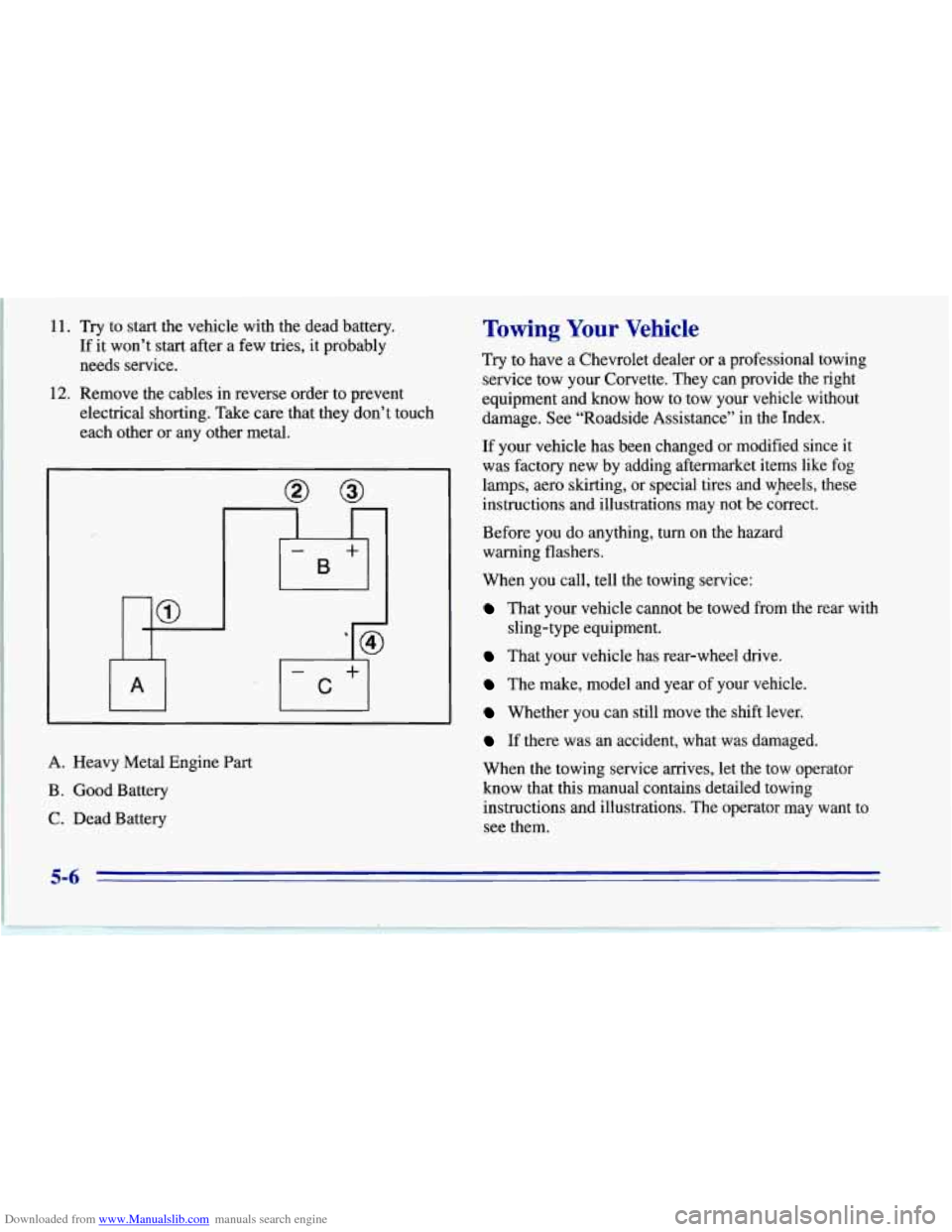
12. Remove the cables in reverse order to prevent
electrical shorting. Take care that they don’t touch
each other or any other metal.
I
AI
A. Heavy Metal Engine Part
B. Good Battery
C. Dead Battery
Towing Your Vehicle
Try to have a Chevrolet dealer or a professional towing
service tow your Corvette. They can provide the right
equipment and know how to tow your vehicle without
damage. See “Roadside Assistance” in the Index.
If your vehicle has been changed or modified since it
was factory new by adding aftermarket items like fog
lamps, aero skirting, or special tires and wbeels, these
instructions and illustrations may not be cbrrect.
Before you do anything, turn on the hazard
warning flashers.
When you call, tell the towing service:
That your vehicle cannot be towed from the rear with
That your vehicle has rear-wheel drive.
The make, model and year of your vehicle.
Whether you can still move the shift lever.
If there was an accident, what was damaged.
When the towing service arrives, let the tow operator
know that this manual contains detailed towing
instructions and illustrations. The operator may want to
see them.
sling-type equipment.
5-6
Page 198 of 386
Downloaded from www.Manualslib.com manuals search engine A CAUTION:
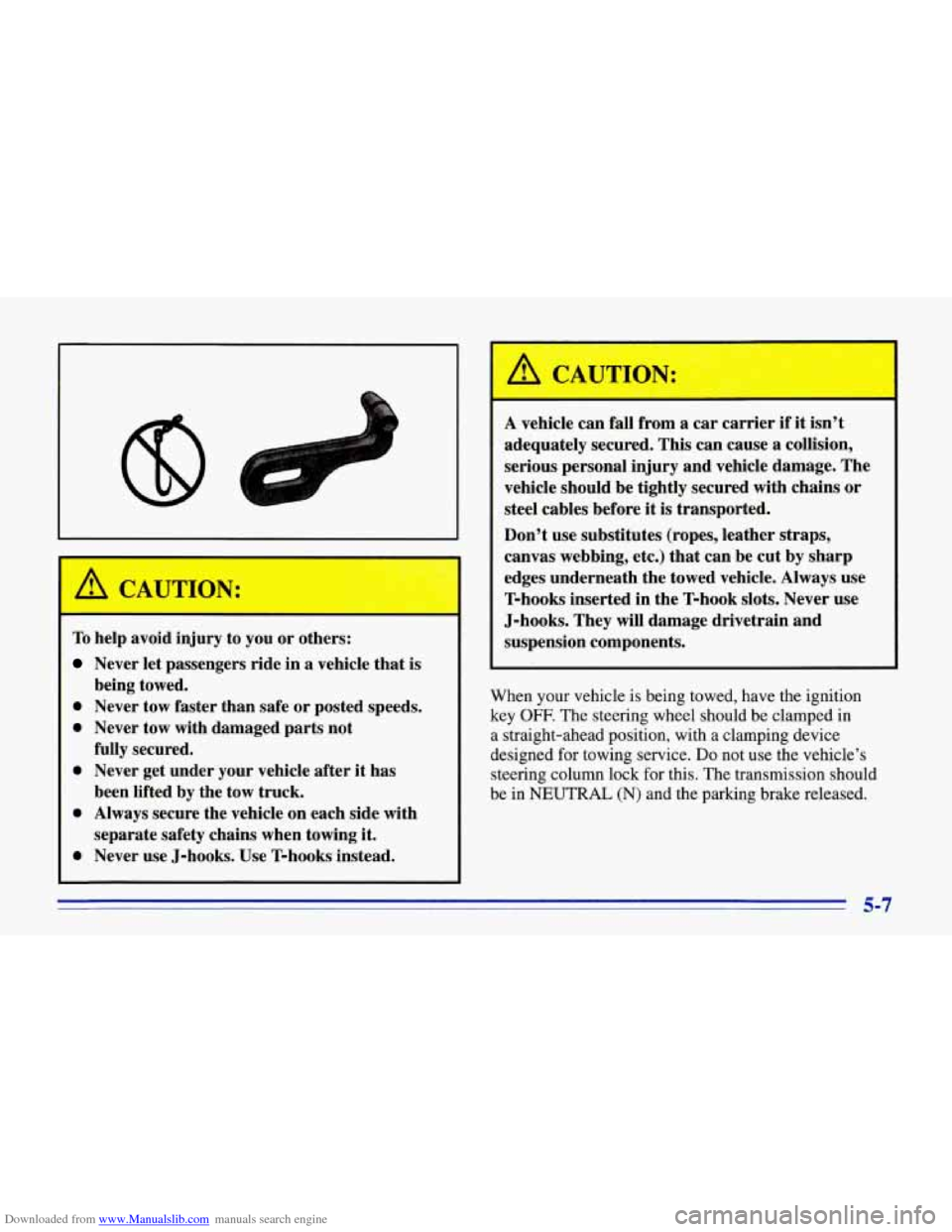
To help avoid injury to you or others:
Never let passengers ride in a vehicle that is
0 Never tow faster than safe or posted speeds.
0 Never tow with damaged parts not
fully secured.
0 Never get under your vehicle after it has
been lifted by the tow truck.
0 Always secure the vehicle on each side with
separate safety chains when towing it.
0 Never use J-hooks. Use T-hooks instead.
being towed.
A vehicle
can fall from a car carrier if it isn’t
adequately secured. This can cause a collision,
serious personal injury and vehicle damage. The
vehicle should be tightly secured with chains or
steel cables before
it is transported.
Don’t use substitutes (ropes, leather straps,
canvas webbing, etc.) that can be cut by sharp
edges underneath the towed vehicle. Always use
T-hooks inserted in the T-hook slots. Never use
J-hooks. They will damage drivetrain and
suspension components.
When your vehicle is being towed, have the ignition
key
OFF. The steering wheel should be clamped in
a straight-ahead position, with a clamping device
designed for towing service.
Do not use the vehicle’s
steering column lock for this. The transmission should
be in
NEUTRAL (N) and the parking brake released.
5-7
Page 199 of 386
Downloaded from www.Manualslib.com manuals search engine Front Towing
Tow Limits -- 35 mph (56 km/h), 50 miles (80 km)
Don't have your vehicle towed on the rear wheels unless
you must. If the vehicle must be towed on the rear
wheels, don't exceed the above limits or your
transmission will be damaged.
Go slow over rough
ground, and position one wheel at a time (angled
45 ") if
you have to go over curbs and rises. Wheels at the lifted
end should be at least
4 inches (100 mm) above the
ground. If these limits must be exceeded, then the rear
wheels have to be supported on a dolly.
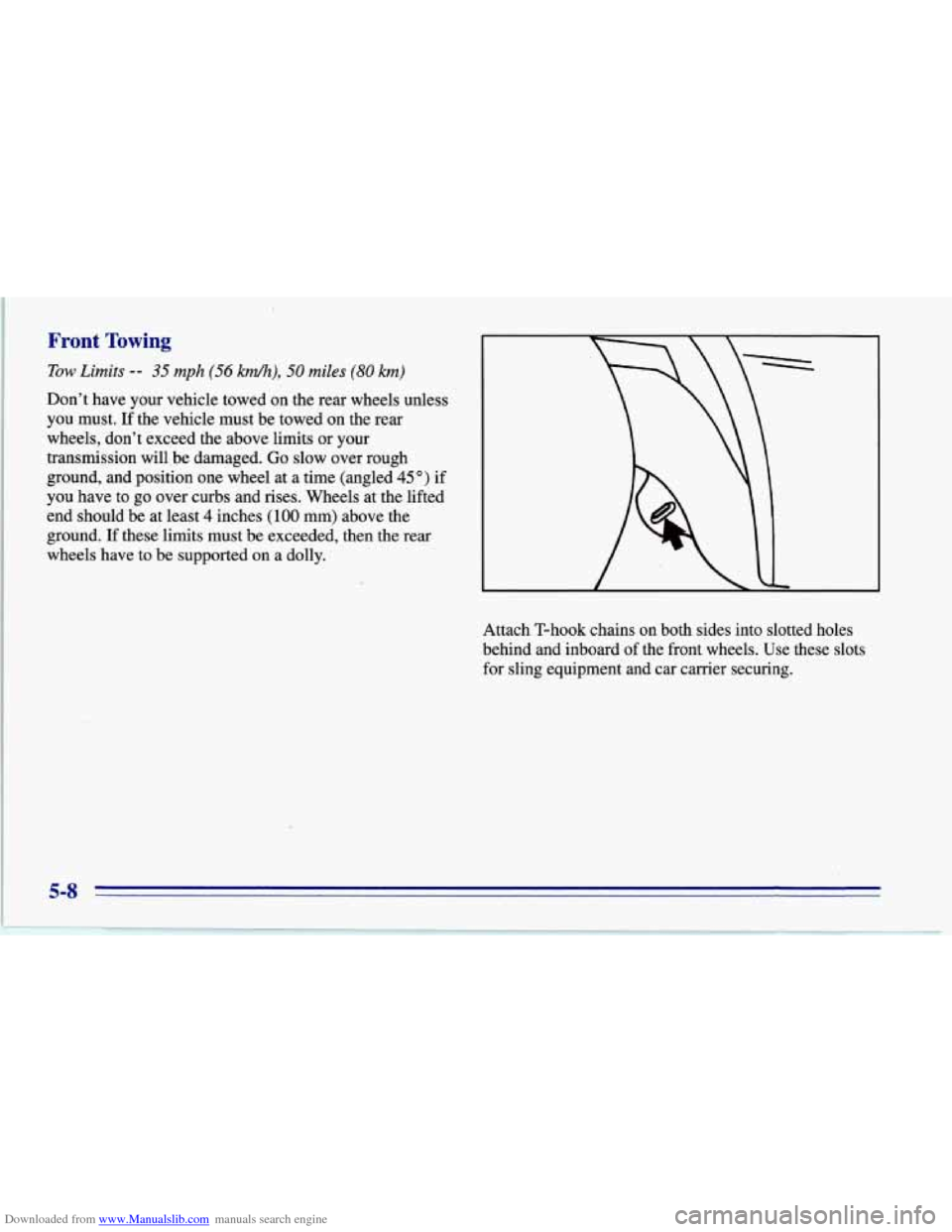
Attach T-hook chains on both sides into slotted holes
behind and inboard of the front wheels. Use these slots
for sling equipment and car carrier securing.
Page 201 of 386
Downloaded from www.Manualslib.com manuals search engine
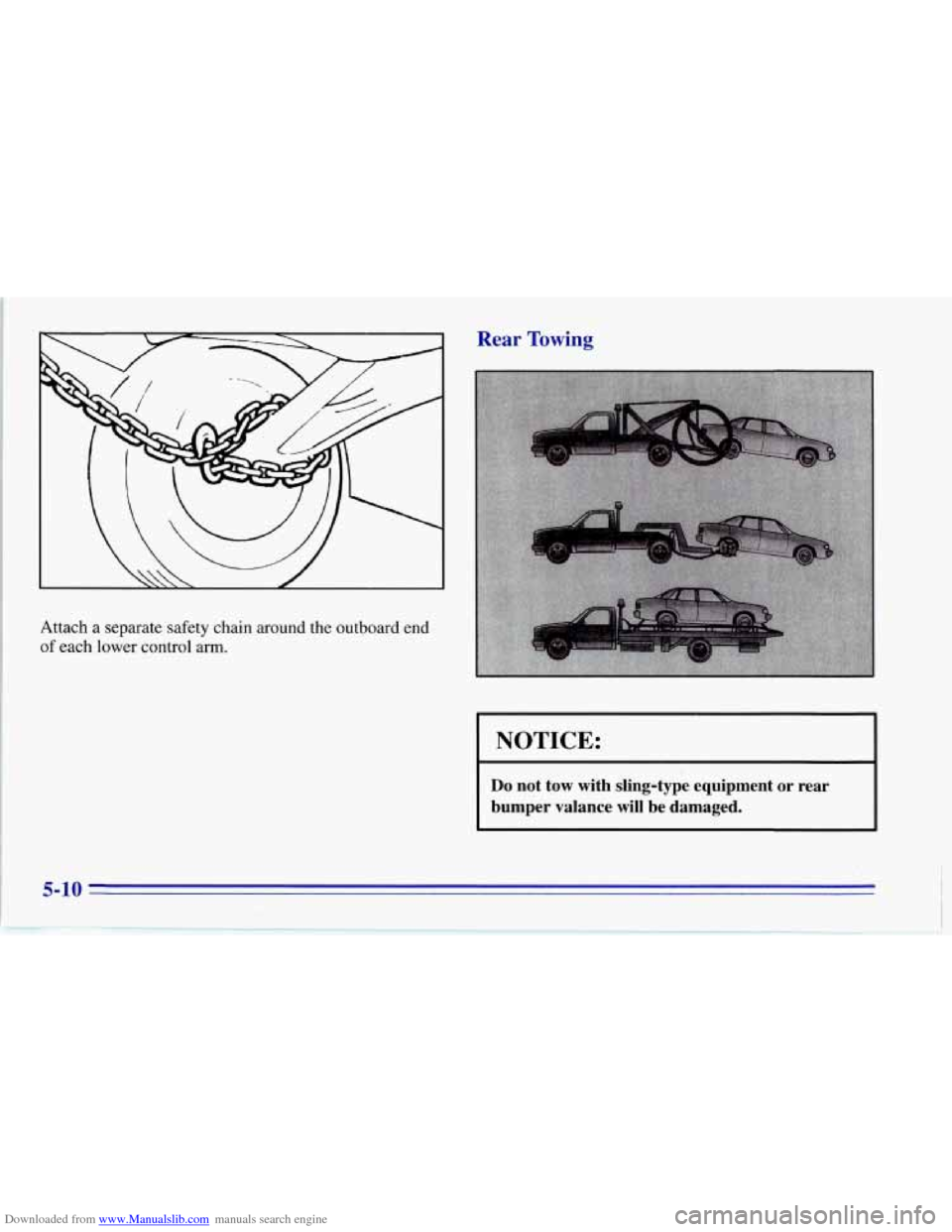
Attach a separate safety chain around the outboard end
of each lower control arm.
Rear Towing
I NOTICE: I
Do not tow with sling-type equipment or rear
bumper valance will be damaged.
5-10
Page 202 of 386
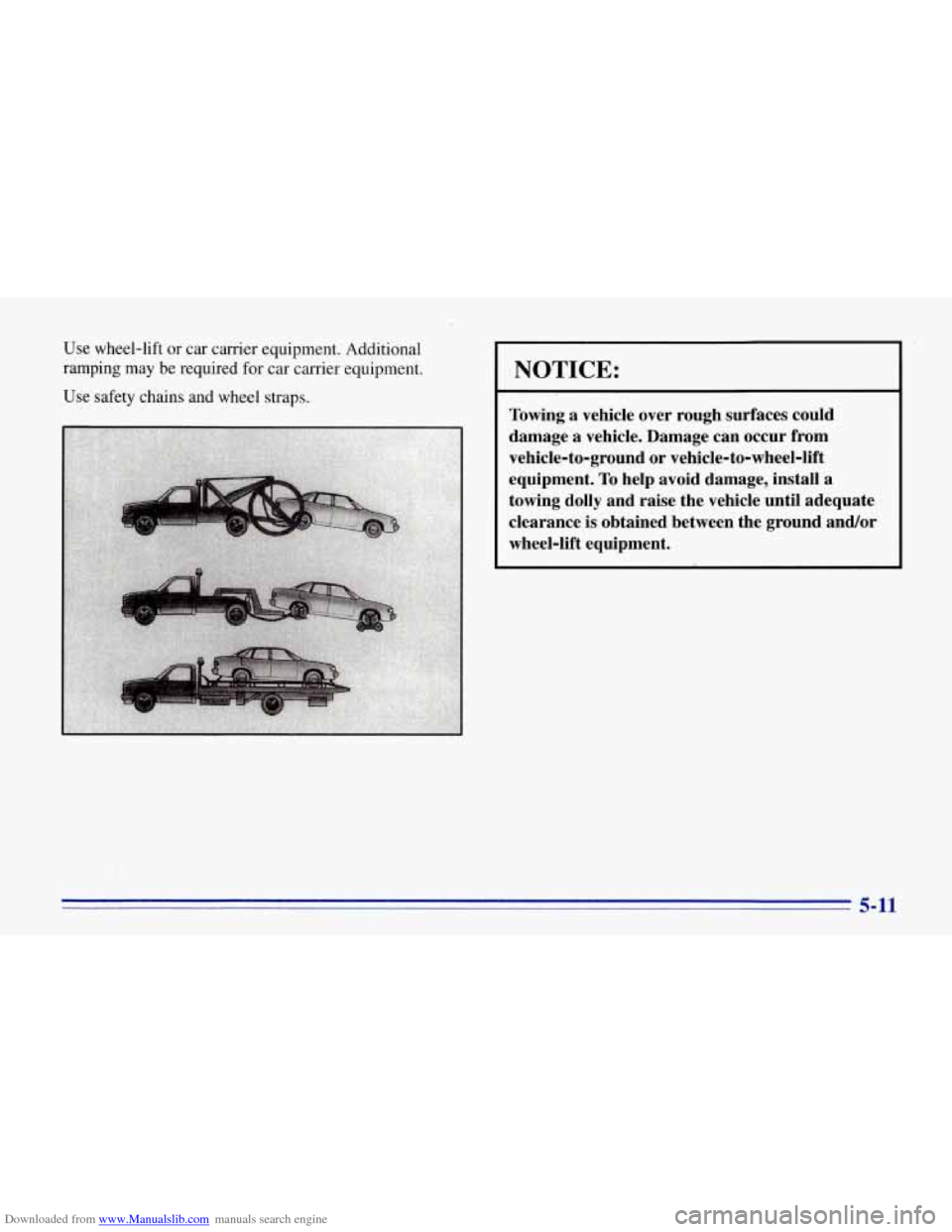
Downloaded from www.Manualslib.com manuals search engine Use wheel-lift or car carrier equipment. Additional
ramping may be required
for car carrier equipment.
Use safety chains and wheel straps.
NOTICE:
Towing a vehicle over rough surfaces could
damage a vehicle. Damage can occur from
vehicle-to-ground or vehicle-to-wheel-lift
equipment.
To help avoid damage, install a
towing dolly and raise the vehicle until adequate
clearance is obtained between- the ground and/or
wheel-lift equipment.
5-11
Page 231 of 386
Downloaded from www.Manualslib.com manuals search engine I NOTICE:
Spinning your wheels can destroy parts of your
vehicle as well as the tires. If you spin the wheels
too fast while shifting your transmission back
and forth, you can destroy your transmission.
For information about using tire chains on your vehicle,
see “Tire Chains” in the Index.
Rocking Your Vehicle to Get it Out
First, turn your steering wheel left and right. That will
clear the area around your front wheels. You should turn
your ASR system off. (See “ASR System” in the Index.)
Then shift back and forth between REVERSE (R) and a
forward gear (or with a manual transmission, between
FIRST
(1) or SECOND (2) and REVERSE (R)),
spinning the wheels as little as possible. Release the
accelerator pedal while you shift, and press lightly on
the accelerator pedal when the transmission is in gear. If
that doesn’t get you out after a few tries, you may need
to be towed out. If you do need to be towed out, see
“Towing Your Vehicle” in the Index.
5-40
_I
Page 365 of 386
Downloaded from www.Manualslib.com manuals search engine Chevrolet Roadside Assistance
Program
n
L
Available in the United States and Canada only to
enhance Chevrolet's strong commitment
to customer
satisfaction, Chevrolet is excited to announce the
establishment of the ChevroletIGeo Roadside Assistance
Center.
As the owner of a 1996 ChevroletIGeo,
membership in Roadside Assistance is free. Roadside
Assistance is available 24 hours a day,
365 days a year, by calling 1-800-CHEV-USA
(1-800-243-8872). This toll-free number will provide
you over-the-phone roadside assistance with minor
mechanical problems. If your problem cannot be
resolved over the phone, our advisors have access to a
nationwide network of dealer recommended service
providers. Roadside membership is free, however, some
services may incur costs.
Roadside offers two levels of service to the customer,
Basic Care and Courtesy" Care:
0 Toll-free number, 1 -800-CHEV-USA
0 Free towing for warranty repairs
0 Basic over-the-phone technical advice
0 Available dealer services at reasonable costs (i.e.,
wrecker services, locksmithkey service,
glass repair, etc.)