cooling CHEVROLET CORVETTE 1997 5.G User Guide
[x] Cancel search | Manufacturer: CHEVROLET, Model Year: 1997, Model line: CORVETTE, Model: CHEVROLET CORVETTE 1997 5.GPages: 356, PDF Size: 18.43 MB
Page 230 of 356
Downloaded from www.Manualslib.com manuals search engine 1 A CAUTION:
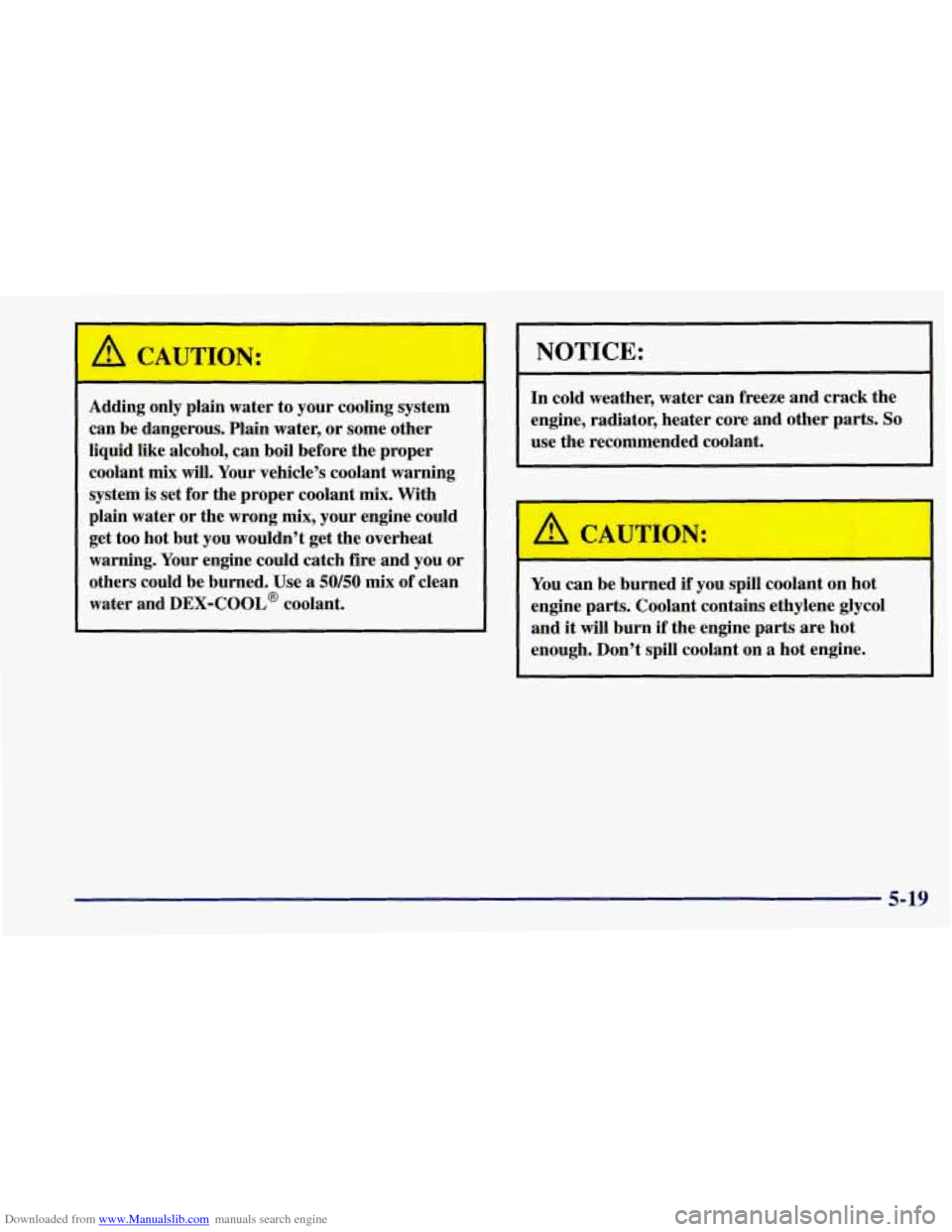
~ Adding only plain water to your cooling system
can be dangerous. Plain water, or some other
liquid like alcohol, can boil before the proper
coolant mix will. Your vehicle’s coolant warning
system is set for the proper coolant mix. With
plain water or the wrong mix, your engine could
get too hot but you wouldn’t get the overheat
warning. Your engine could catch fire and you or
others could be burned. Use
a 50150 mix of clean
water and DEX-COOL@ coolant.
NOTICE:
~
In cold weather, water can freeze and crack the
engine, radiator, heater core and other parts.
So
use the recommended coolant.
A CAUTIOK
You can be burned if you spill coolant on hot
engine parts. Caolant contains ethylene glycol
and it will burn if the engine parts are hot
enough. Don’t spill coolant on a hot engine.
5-19
Page 231 of 356
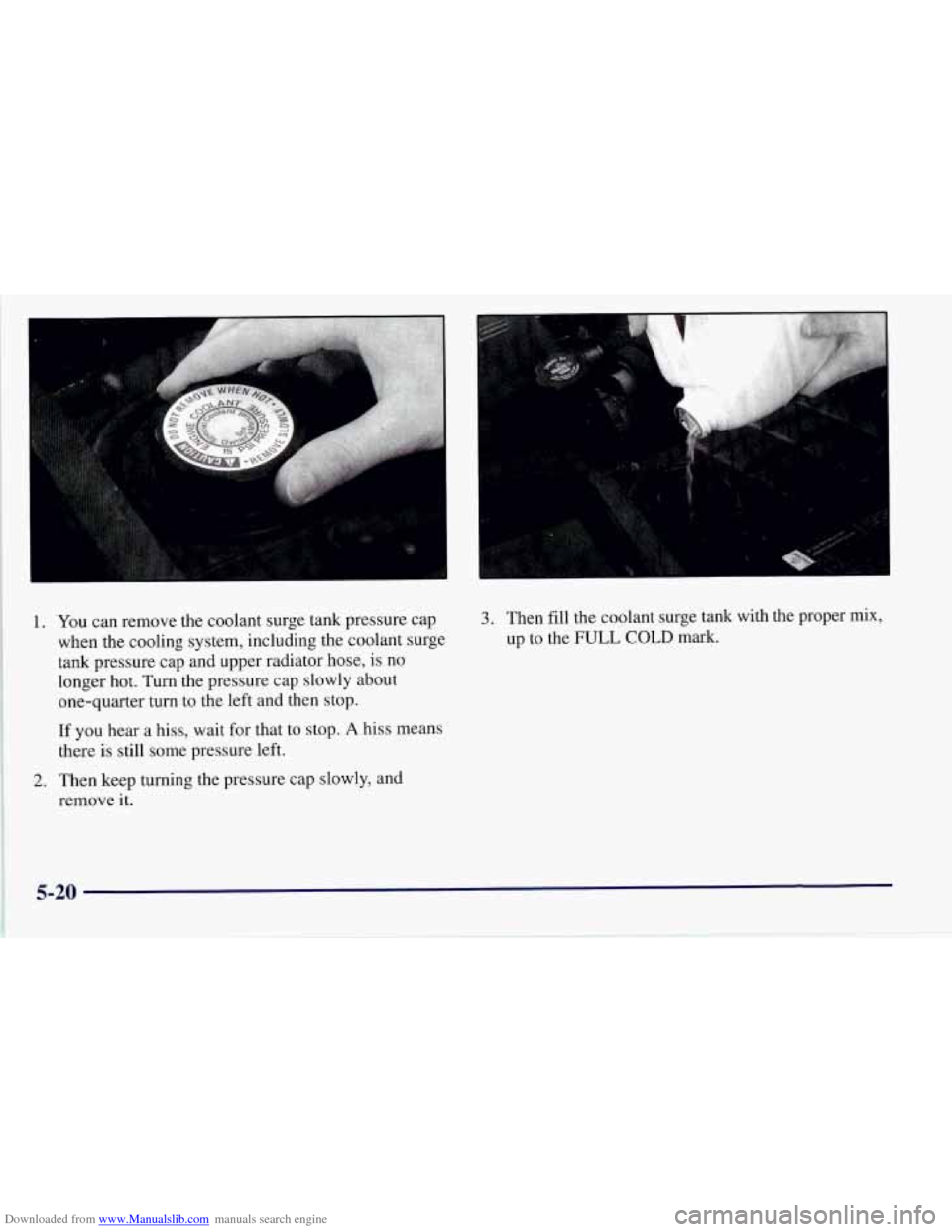
Downloaded from www.Manualslib.com manuals search engine 1. You can remove the coolant surge tank pressure cap
when the cooling system, including the coolant surge
tank pressure cap and upper radiator hose, is no
longer hot. Turn the pressure cap slowly about
one-quarter turn to the left and then stop. 3. Then fill the coolant surge tank with the proper mix,
up
to the FULL COLD mark.
2.
If you hear a hiss, wait for that to stop. A hiss means
there
is still some pressure left.
Then keep turning the pressure cap slowly, and
remove it.
5-20
Page 257 of 356
Downloaded from www.Manualslib.com manuals search engine Rear Axle
When to Check Lubricant
Refer to the Maintenance Schedule to determine how
often to check the lubricant. See “Periodic Maintenance
Inspections” in the Index.
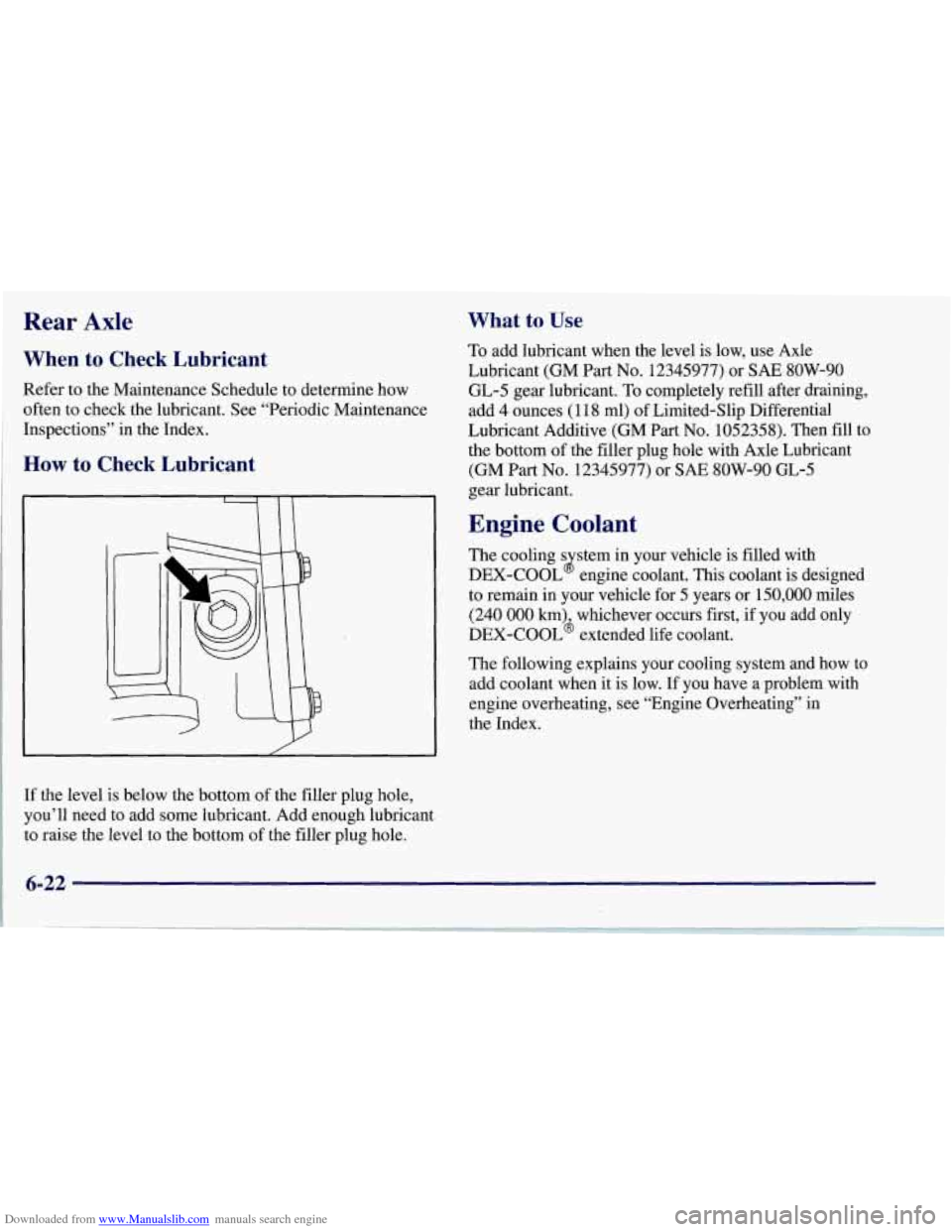
How to Check Lubricant
If the level is below the bottom of the filler plug hole,
you’ll need to add some lubricant. Add enough lubricant
to raise the level to the bottom of the filler plug hole.
What to Use
To add lubricant when the level is low, use Axle
Lubricant (GM
Part No. 12345977) or SAE 8OW-90
GL-5 gear lubricant. To completely refill after draining,
add
4 ounces (1 18 ml) of Limited-Slip Differential
Lubricant Additive (GM
Part No. 1052358). Then fill to
the bottom of the filler plug hole with Axle Lubricant
(GM
Part No. 12345977) or SAE 8OW-90 GL-5
gear lubricant.
Engine Coolant
The cooling s stem in your vehicle is filled with
DEX-COOL engine coolant. This coolant is designed
to remain in your vehicle for
5 years or 150,000 miles
(240
000 km) whichever occurs first, if you add only
DEX-COOL6 extended life coolant.
8
The following explains your cooling system and how to
add coolant when it is low.
If you have a problem with
engine overheating, see “Engine Overheating” in
the Index.
6-22
Page 258 of 356
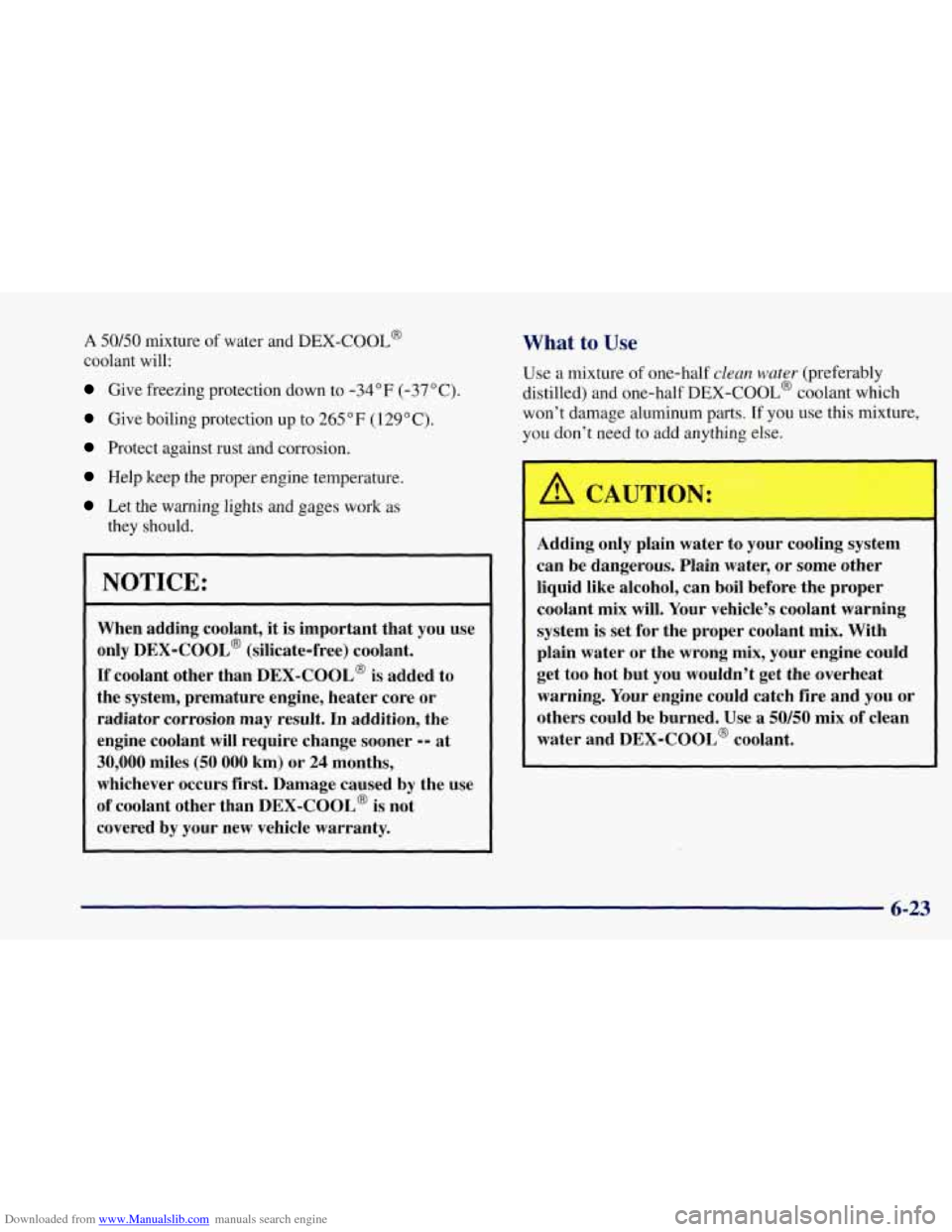
Downloaded from www.Manualslib.com manuals search engine A 50/50 mixture of water and DEX-COOL@
coolant will:
Give freezing protection down to -34°F (-37°C).
Give boiling protection up to 265 "F (129" C).
Protect against rust and corrosion.
Help keep the proper engine temperature,
Let the warning lights and gages work as
they should.
NOTICE:
When adding coolant, it is important that you use
only
DEX-COOL@ (silicate-free) coolant.
If coolant other than DEX-COOL@ is added to
the system, premature engine, heater core or
radiator corrosion
may result. In addition, the
engine coolant will require change sooner
-- at
30,000 miles (50 000 km) or 24 months,
whichever occurs first. Damage caused
by the use
of coolant other than DEX-COOL@ is not
covered by your new vehicle warranty.
What to Use
Use a mixture of one-half clean water (preferably
distilled) and one-half
DEX-COOL' coolant which
won't damage aluminum parts.
If you use this mixture,
you don't need to add anything else.
Adding only plain water to your cooling system
can be dangerous. Plain water, or some other
liquid like alcohol, can boil before the proper
coolant mix will. Your vehicle's coolant warning
system
is set for the proper coolant mix. With
plain water or the wrong mix, your engine could
get too hot but you wouldn't get the overheat
warning. Your engine could catch fire and
you or
others could be burned. Use
a 50/50 mix of clean
water and DEX-COOL@ coolant.
I
6-23
Page 259 of 356
Downloaded from www.Manualslib.com manuals search engine NOTICE:
If you use an improper coolant mix, your engine
could overheat and be badly damaged. The
repair cost wouldn’t be covered by your
warranty. Too much water in the mix can freeze
and crack the engine, radiator, heater core and
other parts.
If you have to add coolant more than four times a year,
have your dealer check your cooling system.
NOTICE:
If you use the proper coolant, you don’t have to
add extra inhibitors or additives which claim to
improve the system. These can be harmful.
Checking Coolant
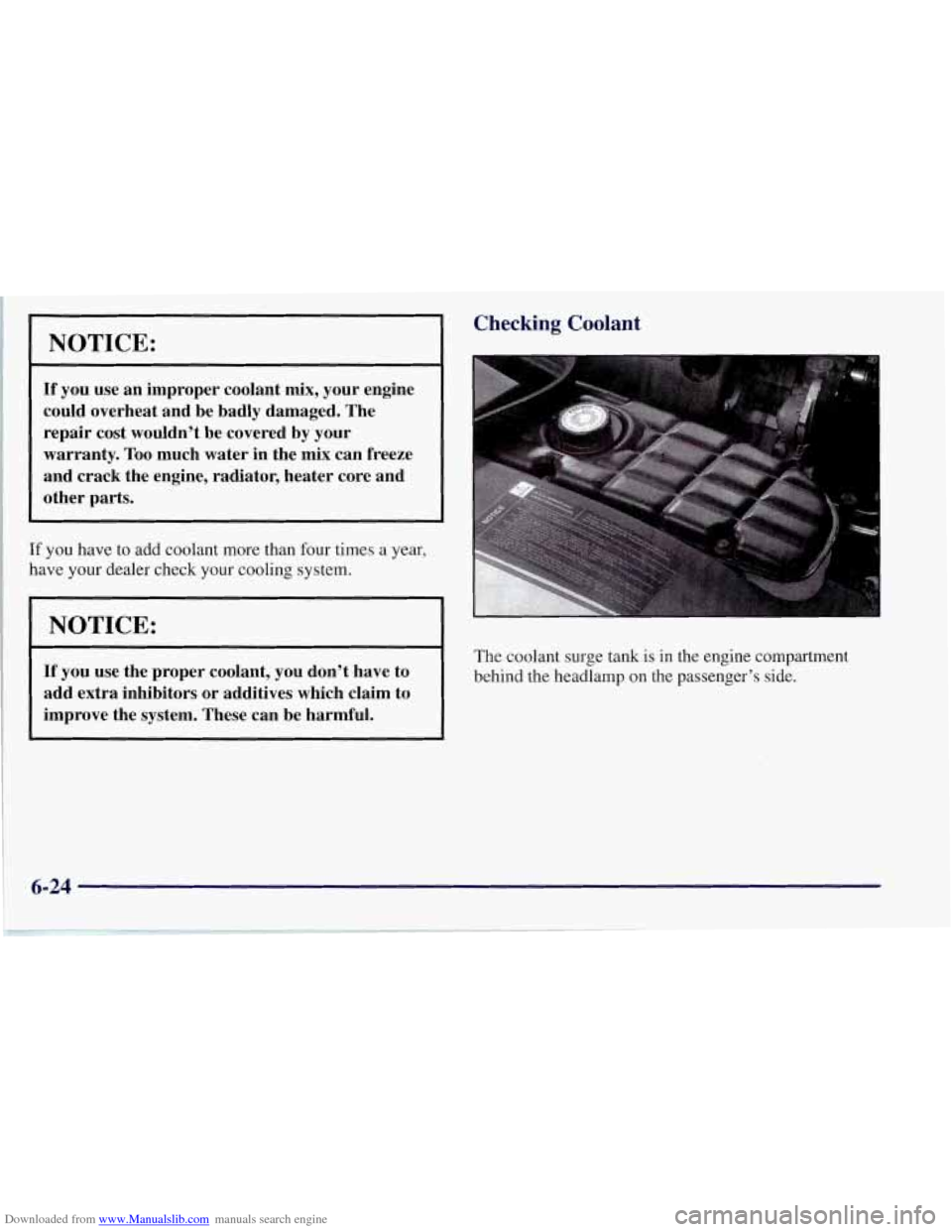
The coolant surge tank is in the engine compartment
behind the headlamp on the passenger’s side.
6-24
Page 270 of 356
Downloaded from www.Manualslib.com manuals search engine Front Turn Signal Lamps
1. Remove the front fascia close out panel
attaching bolts.
2. Remove the front fascia close out panel.
3. Grasp the cooling duct and pull to release it from the
front fascia, then reposition it. This will give you
better access to the bulb.
4. Squeeze the tab on the socket and turn it to the left to
5. Remove the bulb from the socket.
6. Reverse the steps with a new bulb.
remove the
socket with the bulb.
Front Sidemarker Lamps
Lamps” described previously.
1. Follow the first three steps in “Front Turn Signal
2. Turn the socket to the left one-quarter of a turn and
pull it out.
3. Pull the bulb straight out of the socket.
4. Reverse the steps with a new bulb.
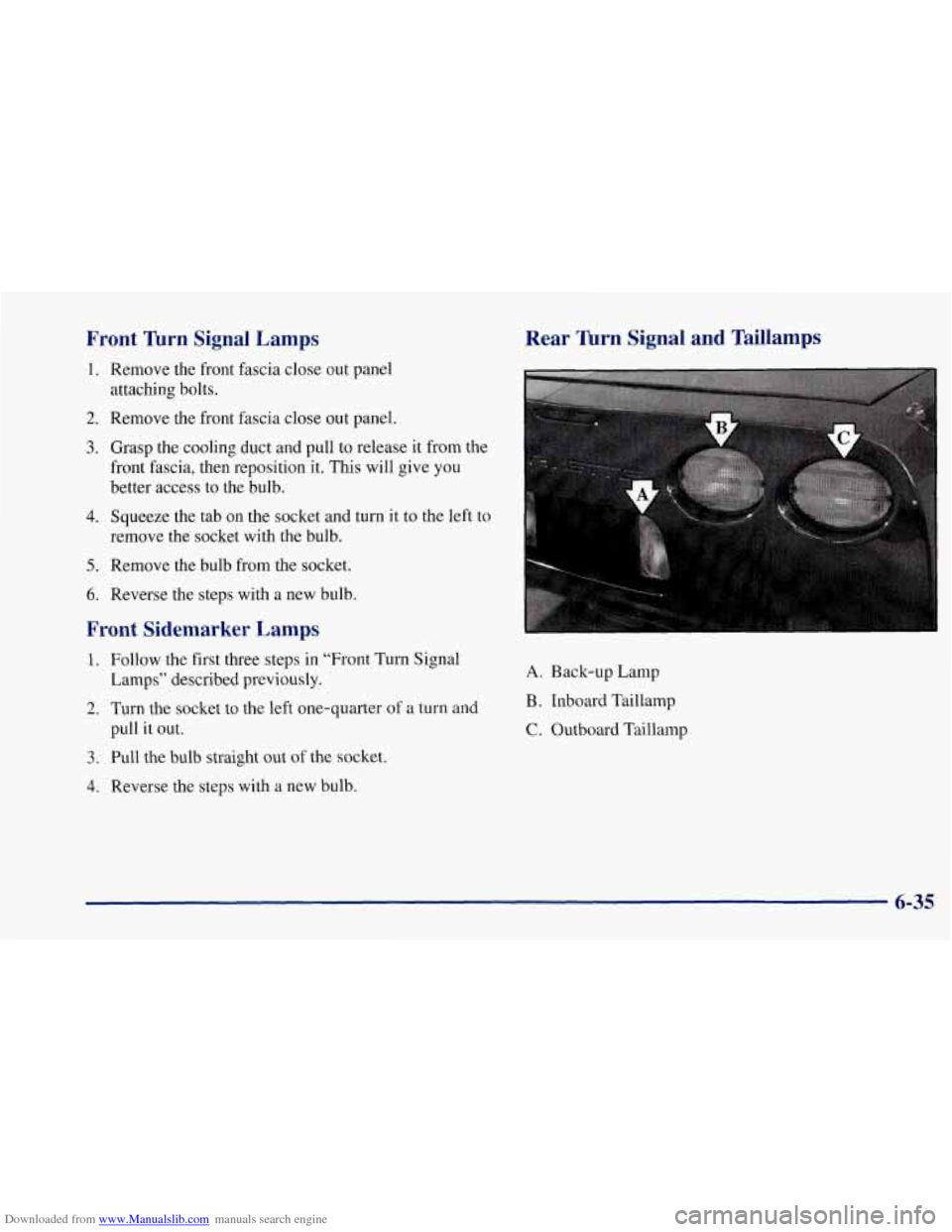
Rear Turn Signal and Taillamps
A. Back-up Lamp
B. Inboard Taillamp
C. Outboard Taillamp
6-35
Page 283 of 356
Downloaded from www.Manualslib.com manuals search engine Wheel Alignment and Tire Balance
The wheels on your vehicle were aligned and balanced
carefully at the factory to give you the longest tire life
and best overall performance.
Scheduled wheel alignment and wheel balancing
are not
needed. However, if you notice unusual tire wear or
your vehicle pulling one way or the other, the alignment
may need to be reset. If you notice your vehicle
vibrating when driving on a smooth road, your wheels may need to be rebalanced.
Wheel Replacement
Replace any wheel that is bent, cracked, or badly rusted
or corroded. If wheel nuts keep coming loose, the wheel,
wheel bolts and wheel nuts should be replaced. If the
wheel leaks air, replace it (except some aluminum
wheels, which can sometimes be repaired). See your
Chevrolet dealer if any of these conditions exist.
Your dealer will know the kind of wheel you need.
Each new wheel should have the same load-carrying
capacity, diameter, width, offset and be mounted the
same way as the one it replaces.
If you need to replace any of your wheels, wheel bolts
or wheel nuts, replace them only with new
GM original
equipment parts. This way, you will be sure to have the
right wheel, wheel bolts and wheel nuts for your
Corvette.
Using the wrong replacement wheels, wheel bolts
or wheel nuts on your vehicle can be dangerous. It
could affect the braking and handling
of your
vehicle, make your
tires lose air and make you lose
control. You could have
a collision in which you or
others could be injured. Always use the correct
wheel, wheel bolts and wheel nuts for replacement.
NOTICE:
The wrong wheel can also cause problems with
bearing life, brake cooling, speedometer or
odometer calibration, headlamp aim, bumper
height, vehicle ground clearance and tire
clearance to the body and chassis.
Page 302 of 356
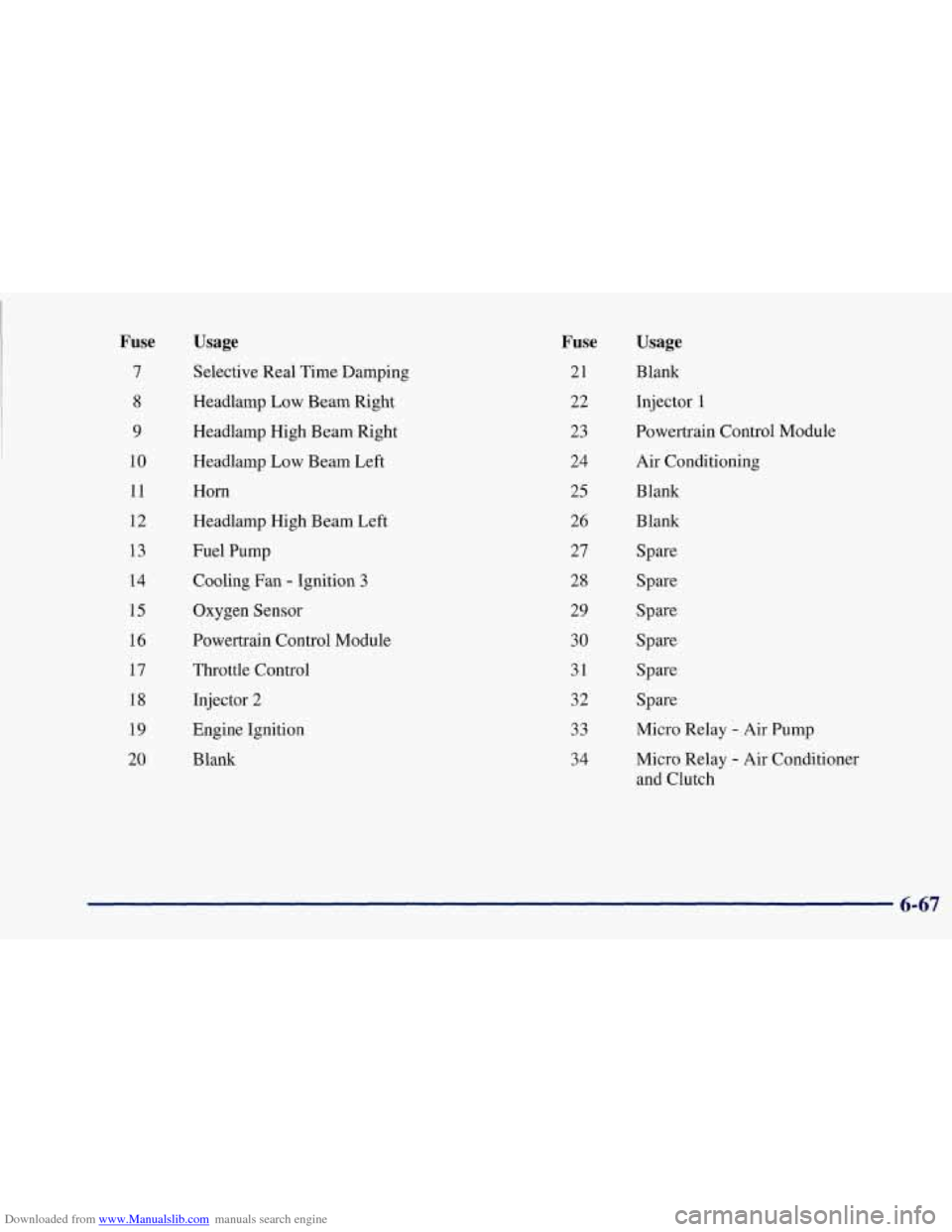
Downloaded from www.Manualslib.com manuals search engine Fuse
7
8
9
10 11
12
13
14
15
16
17
18
19
20
Usage
Selective Real Time Damping
Headlamp
Low Beam Right
Headlamp High Beam Right
Headlamp
Low Beam Left
Horn
Headlamp High Beam Left
Fuel Pump Cooling Fan
- Ignition 3
Oxygen Sensor
Powertrain Control Module
Throttle Control
Injector 2
Engine Ignition
Blank
Fuse
21
22
23
24
25
26 27
28
29
30 31
32
33
34
Usage
Blank
Injector
1
Powertrain Control Module
Air Conditioning
Blank
Blank
Spare Spare
Spare
Spare
Spare
Spare
Micro Relay
- Air Pump
Micro Relay
- Air Conditioner
and Clutch
6-67
Page 303 of 356
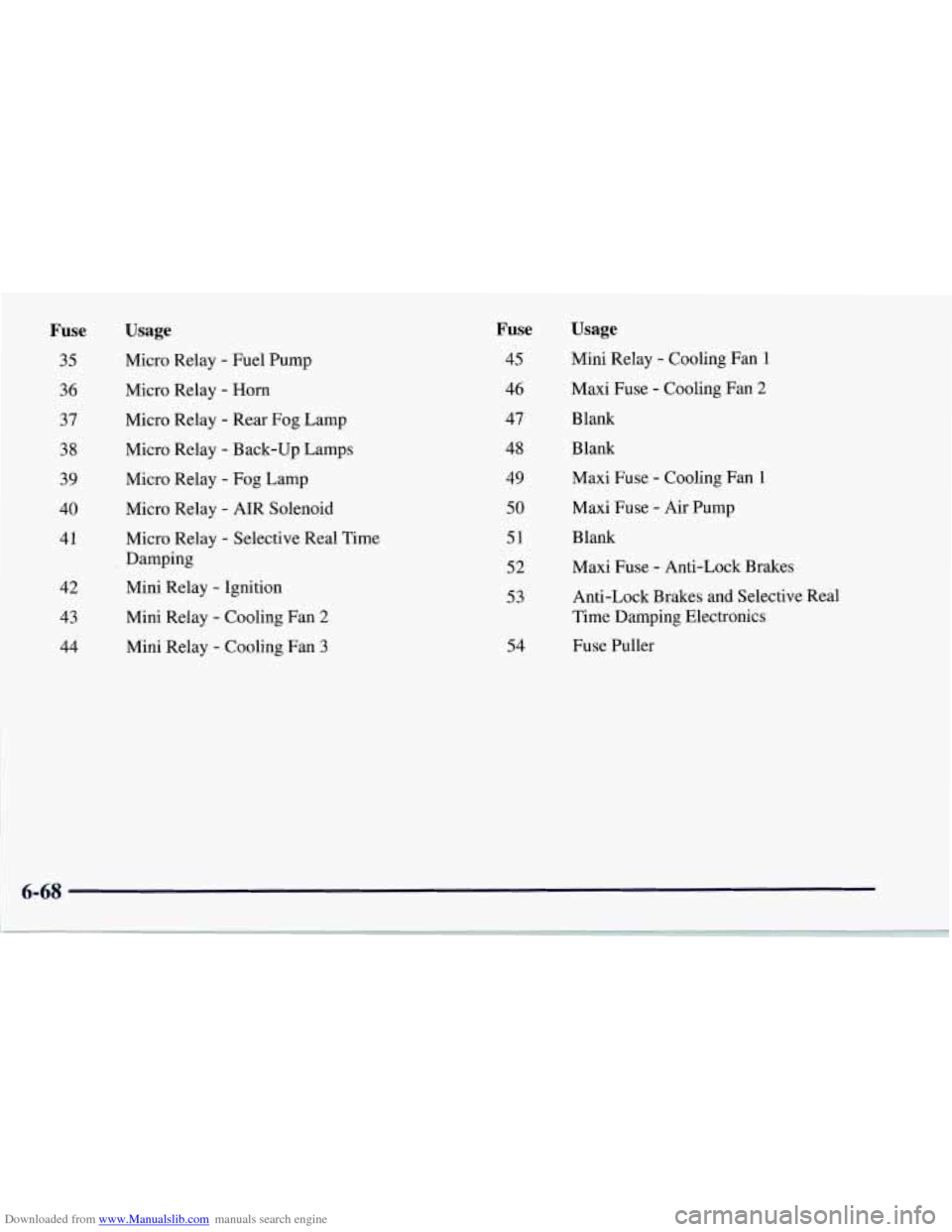
Downloaded from www.Manualslib.com manuals search engine Fuse
35
36
37
38 39
40
41
42
43
44
Usage
Micro Relay - Fuel Pump
Micro Relay
- Horn
Micro Relay - Rear Fog Lamp
Micro Relay
- Back-up Lamps
Micro Relay
- Fog Lamp
Micro Relay
- AIR Solenoid
Micro Relay
- Selective Real Time
Damping
Mini Relay
- Ignition
Mini Relay
- Cooling Fan 2
Mini Relay
- Cooling Fan 3
Fuse
45
46
47
48
49
50
51
52
53
54
Usage
Mini Relay - Cooling Fan 1
Maxi Fuse - Cooling Fan 2
Blank
Blank
Maxi Fuse
- Cooling Fan 1
Maxi Fuse - Air Pump
Blank
Maxi Fuse
- Anti-Lock Brakes
Anti-Lock Brakes and Selective Real
Time Damping Electronics
Fuse Puller
Page 319 of 356
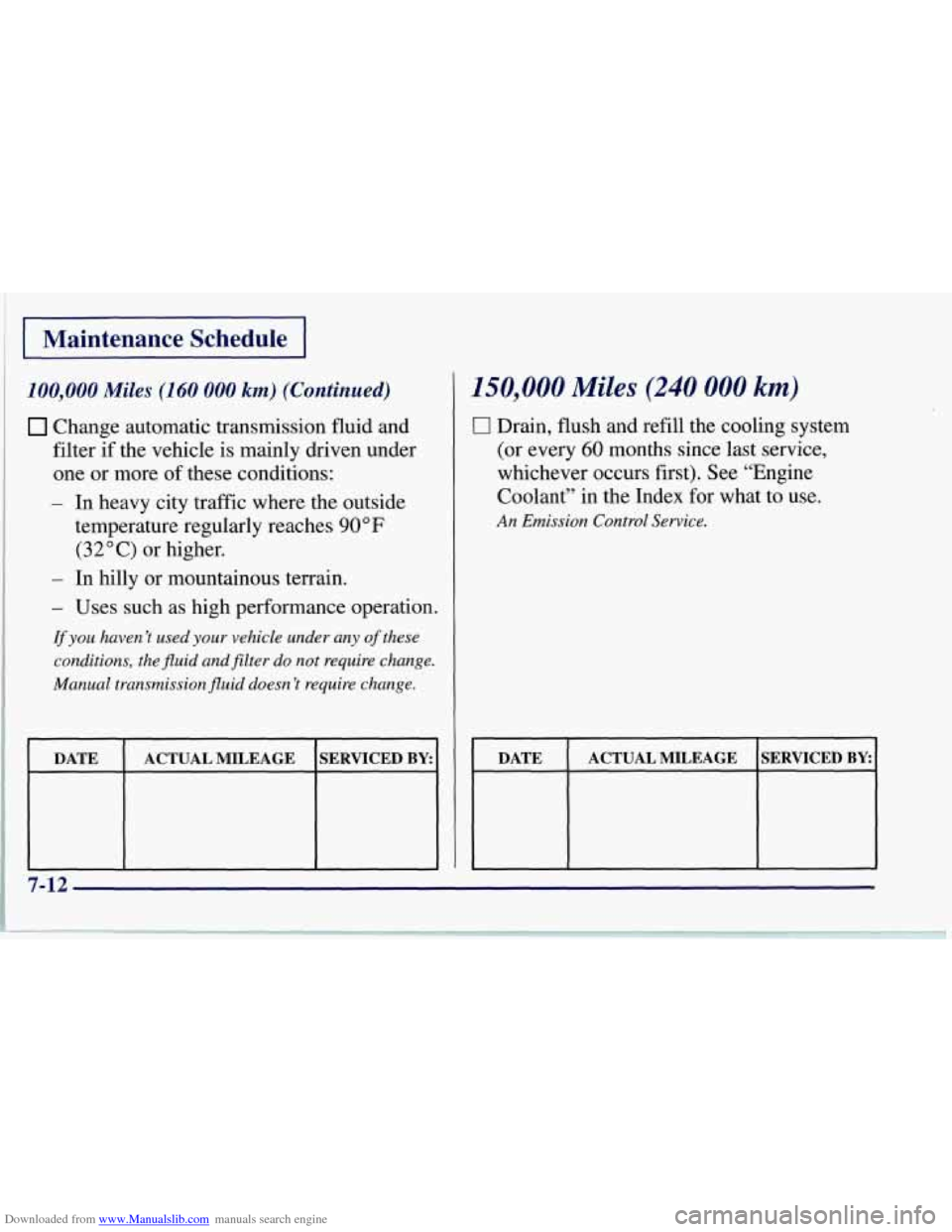
Downloaded from www.Manualslib.com manuals search engine Maintenance Schedule
100,000 Miles (160 000 km) (Continued)
Change automatic transmission fluid and
filter if the vehicle is mainly driven under
one or more of these conditions:
- In heavy city traffic where the outside
temperature regularly reaches
90°F
(32°C) or higher.
- In hilly or mountainous terrain.
- Uses such as high performance operation.
If you haven ’t used your vehicle under any of these
conditions, the fluid and filter do not require change.
Manual transmission fluid doesn
’t require change.
DATE SERVICED BY: ACTUAL MILEAGE
150,000 Miles (240 000 km)
Cl Drain, flush and refill the cooling system
(or every
60 months since last service,
whichever occurs first). See “Engine
Coolant’’ in the Index for what to use.
An Emission Control Service.
DATE SERVICED BY: ACTUAL MILEAGE
- I
7-12