heating CHEVROLET CORVETTE 1997 5.G User Guide
[x] Cancel search | Manufacturer: CHEVROLET, Model Year: 1997, Model line: CORVETTE, Model: CHEVROLET CORVETTE 1997 5.GPages: 356, PDF Size: 18.43 MB
Page 149 of 356
Downloaded from www.Manualslib.com manuals search engine Comfort Controls Manual Comfort Controls
This section tells you how to make your air system
work for you. Your comfort control system uses
ozone-friendly
R- 134a refrigerant.
With these systems you can control the heating,
cooling and ventilation in your Corvette. Your vehicle
also has a flow-through ventilation system described
later in this section.
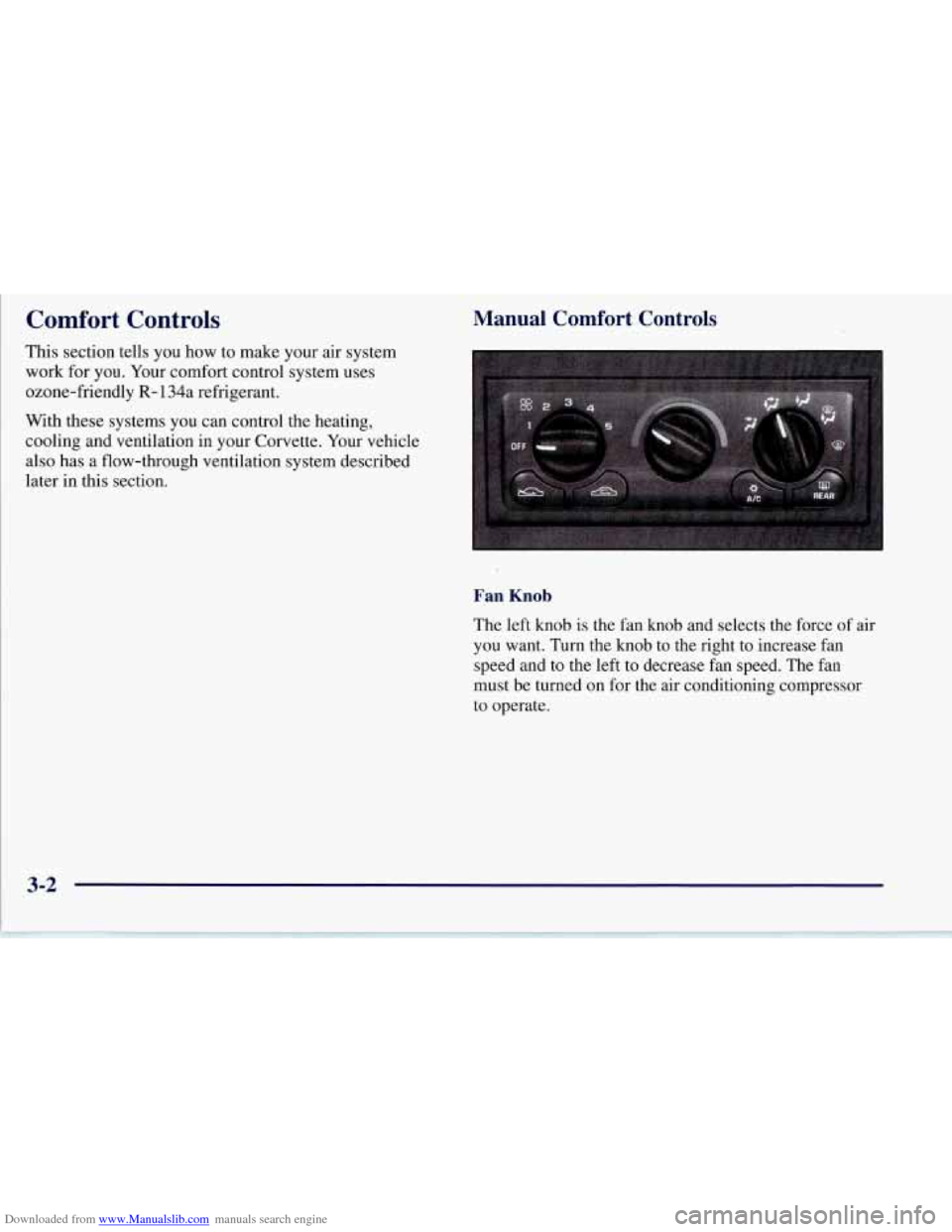
Fan Knob
The left knob is the fan knob and selects the force of air
you want. Turn the knob to the right to increase fan
speed and to the left to decrease fan speed. The fan
must be turned on for the air conditioning compressor
to operate.
Page 153 of 356
Downloaded from www.Manualslib.com manuals search engine Driver Set Temperature Knob
The DRIVER knob changes the temperature on the
driver's side of the vehicle. Turn the knob to the right
to increase the temperature and to the left to decrease
the temperature. Whenever you turn this knob, the
temperature will be displayed for approximately
five seconds along with the current fan speed and
air delivery mode.
When adjusting the temperature, start with a driver-set temperature of
73 "F (23 "C) until you determine your
comfort zone. If you choose
60°F (16"C), the system
will remain at maximum cooling and will not
automatically adjust fan speed or air delivery.
If you
choose
90°F (32"C), the system will remain at
maximum heating and will not automatically adjust fan
speed or air delivery. Choosing either maximum setting
will not cause the system to heat or cool any faster.
Turning
the knob past either maximum setting has no
effect on the operation of the system.
Passenger Temperature Offset
The PASSENGER knob changes the temperature on the
passenger's side of the vehicle. When the knob is in the
12 o'clock position, the passenger's temperature is the
same as the driver's. Turn the knob to the right for
warmer air on the passenger's side, to the left for cooler
air. If the driver set temperature is set at
60°F (16" C) or
90°F (32°C)' turning the passenger knob has no effect
because the system is locked at a maximum setting.
Automatic Operation
Press the AUTO button to place the entire system in
the automatic mode. After a five second display of
the current settings, only the word AUTO and the
outside temperature will be shown on the digital display.
The system will operate to achieve your comfort set
temperature as quickly as possible. If you have set the
driver temperature at
60°F (16°C) or 90°F (32"C), the
system will not operate automatically until a different
temperature is selected. The AUTO control system
works best with the windows up and the removable
roof installed.
3-6
Page 154 of 356
Downloaded from www.Manualslib.com manuals search engine A Typical Cold Weather Example:
Your vehicle has been parked outside ~ver~~ight in
cold weather (below 32 OF/ 0" C) and you have set
the driver temperature at 73 OF (23
"C) and have selected
the AUTO mode. The system will automatically adjust
the temperature output to maximum heating. The fan
will start at a low speed. This
is to avoid blowing cold
air into the vehicle. The length of the delay depends
on the amount of time since the engine was last started,
the outside temperature and the engine coolant
temperature. As the coolant warms up, the fan speed
will gradually increase. Air will flow to the floor with
some air to the windshield to prevent fogging under
most normal conditions.
As the interior
of the vehicle warms up to your comfort
set temperature, the fan speed will decrease and the
temperature output may become cooler. If the interior
temperature continues to warm up due to heating from
the sun or outside temperature increases, the system
may switch to other air delivery modes (typically
DEFOG or BI-LEVEL).
A vpical Hot Weather Example:
Your vehicle has Seen parked outside all day in hot
weather (above
70 OF/ 2 1 O C) and you have set the
driver temperature at
73 "F (23 O C) and have selected
the AUTO mode. The system will automatically adjust
the temperature output to maximum cooling. The blower
will start at a low speed momentarily to push the hot
air to the floor of the vehicle and then
go to a higher
blower speed with cold airflow out of the instrument
panel outlets. A small amount of airflow will continue
through the lower ducts to cool the floor area.
The air intake may start in the recirculated mode for
maximum cooling performance. As the interior of the
vehicle cools down to your comfort set temperature,
the fan speed will decrease and the temperature output
may become warmer. The air intake may shift from
recirculation to fresh air mode.
If the interior continues
to cool due to a decrease in the amount
of heat the
vehicle is absorbing from the sun or a decrease in the
outside temperature, the system could switch to other air
delivery modes (typically BI-LEVEL or DEFOG).
3-7
Page 159 of 356
Downloaded from www.Manualslib.com manuals search engine Heating
The heater works best if you keep your windows closed.
Maximum heating will occur when airflow direction
is in the lower mode and the temperature control knob
(on a manual climate control system) is all the way in
the red area. These settings will be selected by the
Automatic Electronic Dual Climate Control System if
operating in AUTO when maximum heating is required.
The BI-LEVEL setting is designed for use on sunny
days when the air is only moderately warm or cool.
On days like these, the sun may adequately warm
your upper body, but your lower body may not be
warm enough. The BI-LEVEL setting will direct
cooler airflow to your upper body and warmer air
to the floor area.
If you have the optional engine coolant heater and use
it during cold weather
0°F (- 18OC) or lower, your
heating system will provide heat more quickly because
the coolant is already warmed. See “Engine Coolant
Heater” in the Index.
Defogging and Defrosting
To rapidly defrost the windshield, the FRONT defrost
mode (electronic dual climate control system) or defrost
mode (manual control system) should be used and the
fan speed should be adjusted to the highest speed. With
the manual control system,
turn the temperature control
knob all the way to the red area.
To keep the windshield clear and provide heated air to
the floor area of
the vehicle, use the DEFOG setting.
Your vehicle is equipped with side window defogger
vents located near the side rearview mirrors.
3-12
Page 212 of 356
Downloaded from www.Manualslib.com manuals search engine e Section 5 Problems on the Road
Here you’ll find what to do about some problems that can occur on the road.
5-2
5-3
5-8
5-13
Hazard Warning Flashers
Jump Starting
Towing Your Vehicle
Engine Overheating
5- 16 Cooling System
5-22 If a Tire Goes Flat
5-22 If You’re Stuck: In Sand, Mud, Ice or Snow
5-1
Page 224 of 356
Downloaded from www.Manualslib.com manuals search engine Engine Overheating
You will find an engine coolant temperature gage on the
instrument cluster and a COOLANT OVER TEMP
message on the Driver Information Center.
Overheated Engine Protection
Operating
Mode
Should a low coolant condition exist and the messages
COOLANT OVERTEMP and REDUCED ENGINE
POWER
are displayed, along with the CHECK
ENGINE light, an overheat protection mode which alternates firing groups of four cylinders helps prevent
engine damage. In this mode, you will notice a loss in
power and engine performance. This operating mode allows your vehicle to be driven to a safe place in an
emergency; you may drive up to
50 miles (80 km).
NOTICE:
After driving in the overheated engine protection
operating mode, to avoid engine damage, allow
the engine to cool before attempting any repair.
The engine
oil will be severely degraded. Repair
the cause of coolant
loss, change the oil and reset
the oil life monitor. See “Engine Oil, When to
Change” in the Index.
I I
5-13
Page 228 of 356
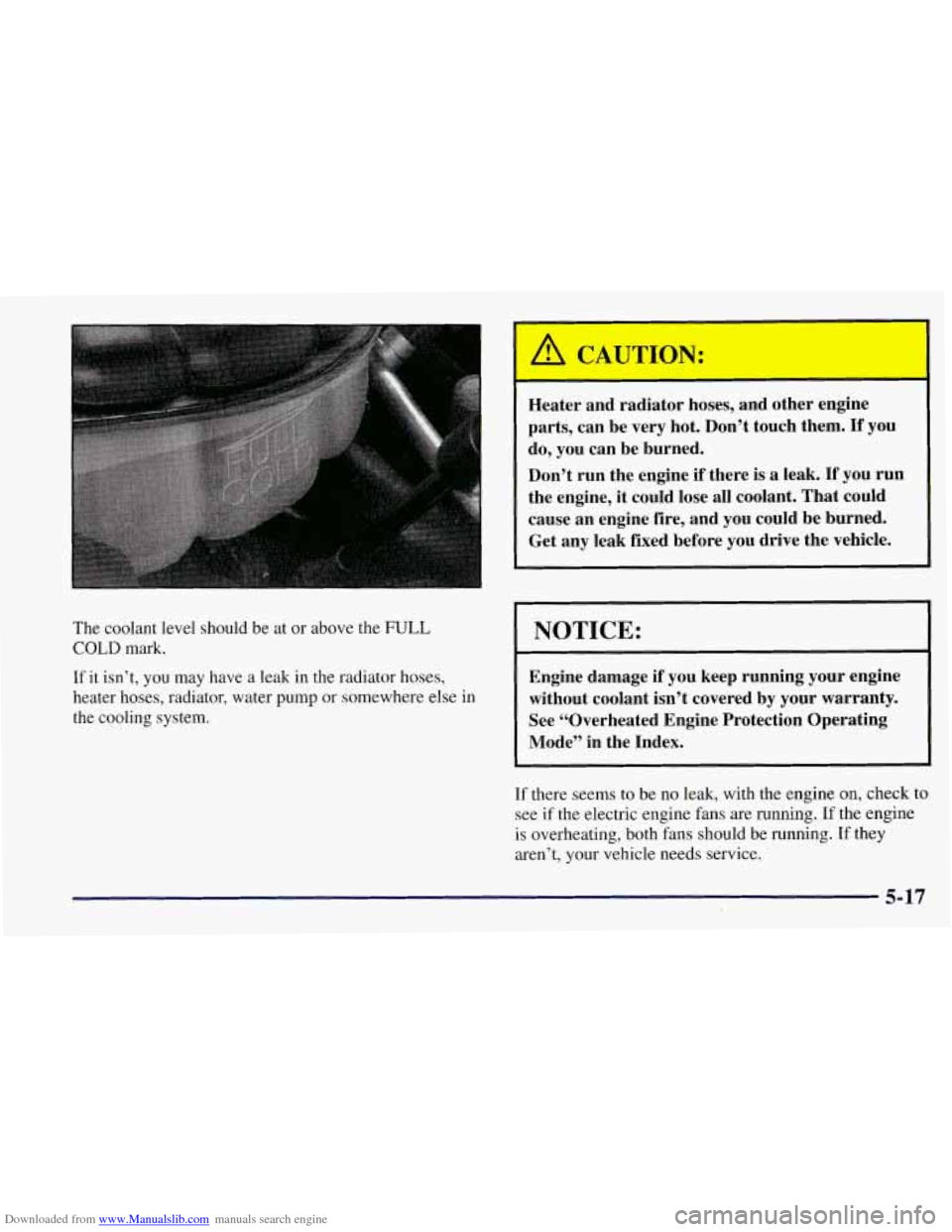
Downloaded from www.Manualslib.com manuals search engine The coolant level should be at or above the FULL
COLD mark.
If it isn’t, you may have
a leak in the radiator hoses,
heater hoses, radiator, water pump or somewhere else in
the cooling system.
Heater and radiator hoses, and other engine
parts, can be very hot. Don’t touch them.
If you
do, you can be burned.
Don’t run the engine if there is
a leak. If you run
the engine, it could lose all coolant. That could
cause an engine fire, and you could be burned.
Get any leak fixed before you drive the vehicle.
1 NOTICE:
Engine damage if you keep running your engine
without coolant isn’t covered by your warranty.
See “Overheated Engine Protection Operating
Mode” in the Index.
If there seems to be no leak, with the engine on, check to
see if the electric engine fans
are running. If the engine
is overheating, both fans should be running.
If they
aren’t, your vehicle needs service.
5-17
Page 257 of 356
Downloaded from www.Manualslib.com manuals search engine Rear Axle
When to Check Lubricant
Refer to the Maintenance Schedule to determine how
often to check the lubricant. See “Periodic Maintenance
Inspections” in the Index.
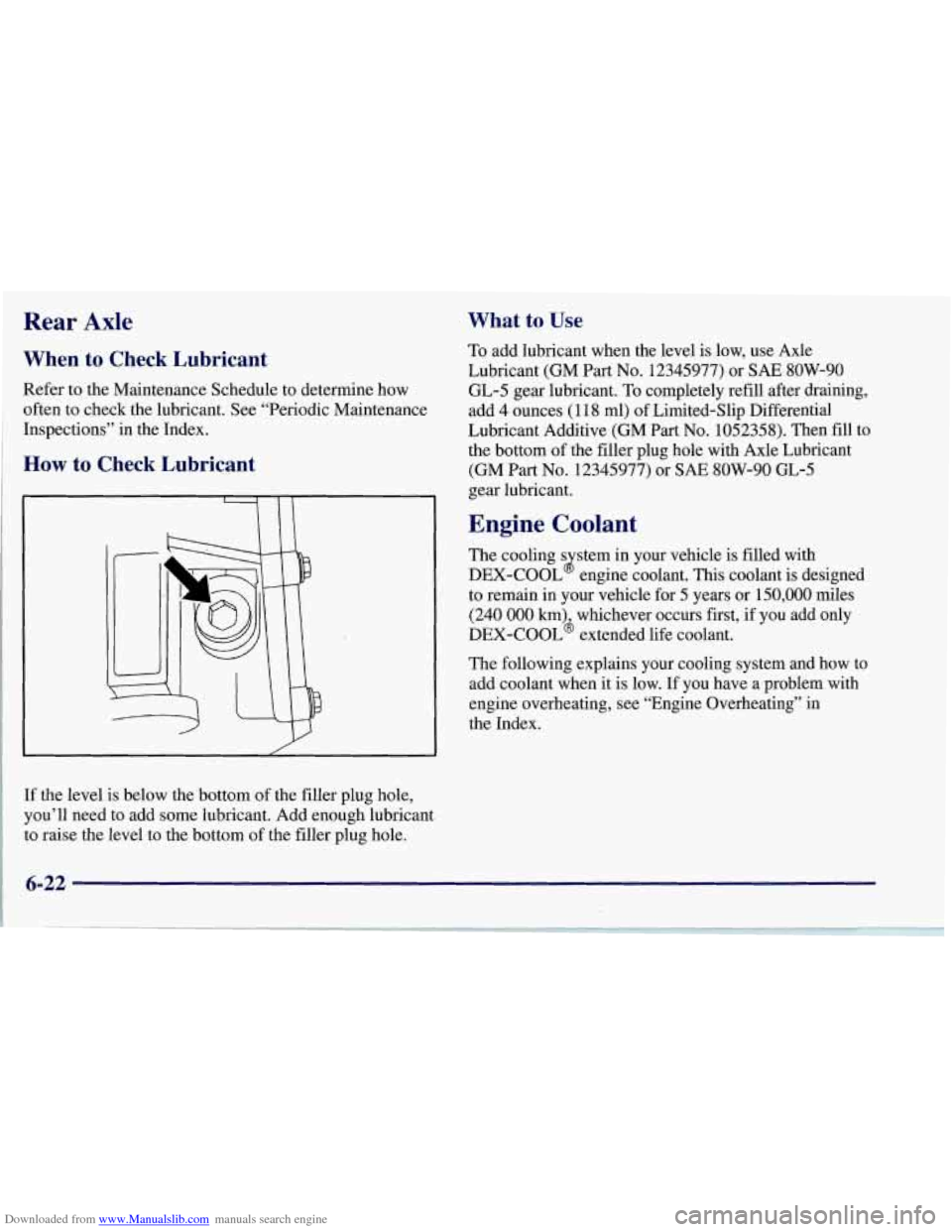
How to Check Lubricant
If the level is below the bottom of the filler plug hole,
you’ll need to add some lubricant. Add enough lubricant
to raise the level to the bottom of the filler plug hole.
What to Use
To add lubricant when the level is low, use Axle
Lubricant (GM
Part No. 12345977) or SAE 8OW-90
GL-5 gear lubricant. To completely refill after draining,
add
4 ounces (1 18 ml) of Limited-Slip Differential
Lubricant Additive (GM
Part No. 1052358). Then fill to
the bottom of the filler plug hole with Axle Lubricant
(GM
Part No. 12345977) or SAE 8OW-90 GL-5
gear lubricant.
Engine Coolant
The cooling s stem in your vehicle is filled with
DEX-COOL engine coolant. This coolant is designed
to remain in your vehicle for
5 years or 150,000 miles
(240
000 km) whichever occurs first, if you add only
DEX-COOL6 extended life coolant.
8
The following explains your cooling system and how to
add coolant when it is low.
If you have a problem with
engine overheating, see “Engine Overheating” in
the Index.
6-22
Page 261 of 356
Downloaded from www.Manualslib.com manuals search engine Surge Tank Pressure Cap
NOTICE:
The surge tank pressure cap is a 15 psi (105 kPa)
pressure-type cap and must be tightly installed to prevent coolant loss and possible engine damage
from overheating.
When you replace the surge tank pressure cap, a GM cap
is recommended.
Thermostat
Engine coolant temperature is controlled by a thermostat
in the engine coolant system. The thermostat stops the
flow
of coolant through the radiator until the coolant
reaches a pre-set temperature.
When you replace the thermostat, a
GM thermostat is
recommended.
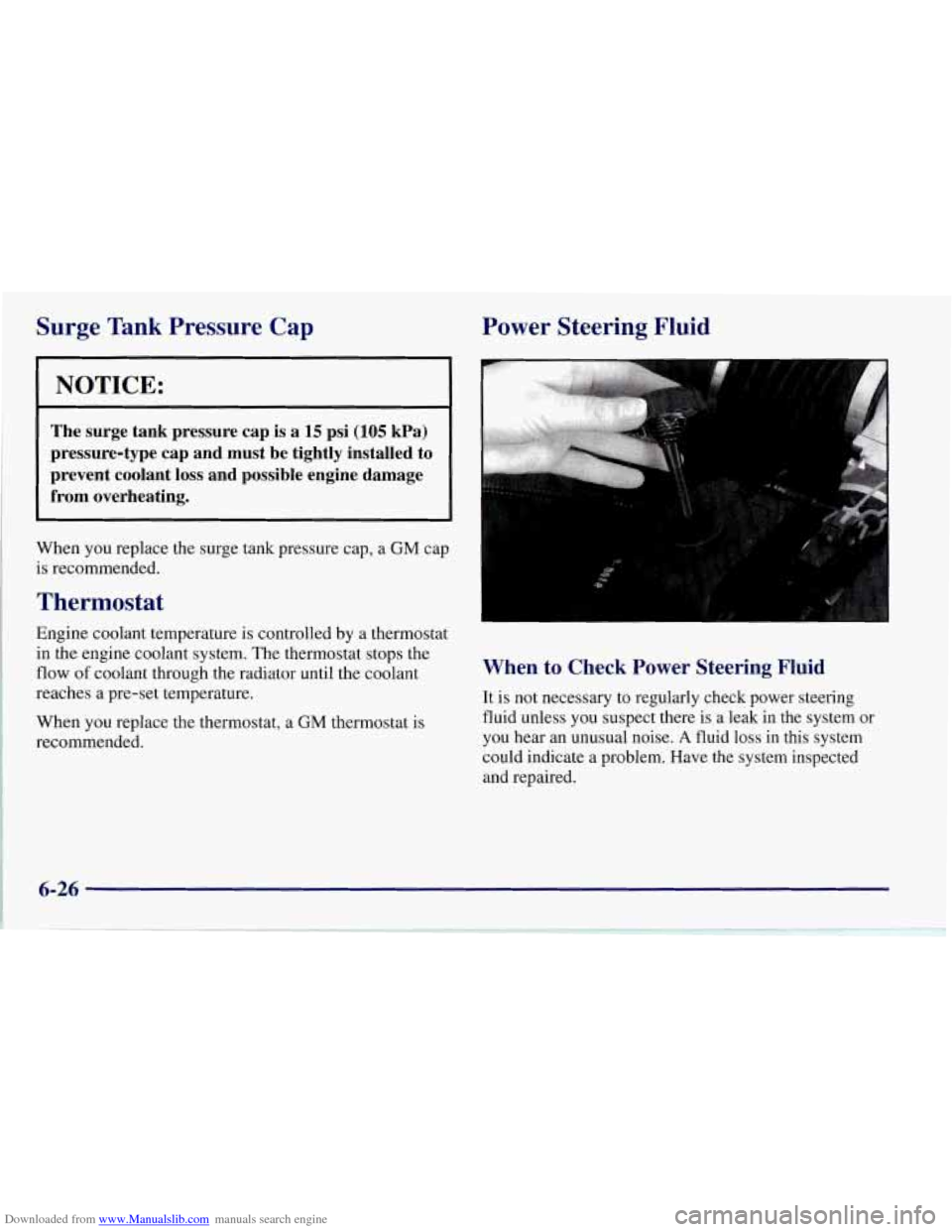
Power Steering Fluid
When to Check Power Steering Fluid
It is not necessary to regularly check power steering
fluid unless you suspect there
is a leak in the system or
you hear an unusual noise. A fluid loss in this system
could indicate a problem. Have the system inspected
and repaired.
6-26
Page 275 of 356
Downloaded from www.Manualslib.com manuals search engine Tires
Your new Corvette comes with high-quality tires made
by a leading tire manufacturer. If you ever have
questions about your tire warranty and where to obtain
service, see your Corvette Warranty booklet for details.
Poorly maintained and improperly used tires are
dangerous.
0 Overloading your tires can cause
overheating as a result of too much friction.
You could have an air-out and a serious
accident. See “Loading Your Vehicle”
in the Index.
CAUTION: (Continued)
0
0
0
See “Inflation
Underinflated tires
pose the same danger as
overloaded tires. The resulting accident could cause serious injury. Check all tires
frequently to maintain the recommended
pressure. Tire pressure should be checked
when your tires are cold.
Overinflated tires are more likely to be
cut, punctured or broken by a sudden
impact
-- such as when you hit a pothole.
Keep tires
at the recommended pressure.
Worn, old tires can cause accidents.
If your
tread is badly worn, or if your tires have
been damaged, replace them.
-- Tire Pressure” in this section
the correct inflation pressure for competitive or
high-speed driving.