light CHEVROLET CORVETTE 1997 5.G Repair Manual
[x] Cancel search | Manufacturer: CHEVROLET, Model Year: 1997, Model line: CORVETTE, Model: CHEVROLET CORVETTE 1997 5.GPages: 356, PDF Size: 18.43 MB
Page 224 of 356
Downloaded from www.Manualslib.com manuals search engine Engine Overheating
You will find an engine coolant temperature gage on the
instrument cluster and a COOLANT OVER TEMP
message on the Driver Information Center.
Overheated Engine Protection
Operating
Mode
Should a low coolant condition exist and the messages
COOLANT OVERTEMP and REDUCED ENGINE
POWER
are displayed, along with the CHECK
ENGINE light, an overheat protection mode which alternates firing groups of four cylinders helps prevent
engine damage. In this mode, you will notice a loss in
power and engine performance. This operating mode allows your vehicle to be driven to a safe place in an
emergency; you may drive up to
50 miles (80 km).
NOTICE:
After driving in the overheated engine protection
operating mode, to avoid engine damage, allow
the engine to cool before attempting any repair.
The engine
oil will be severely degraded. Repair
the cause of coolant
loss, change the oil and reset
the oil life monitor. See “Engine Oil, When to
Change” in the Index.
I I
5-13
Page 234 of 356
Downloaded from www.Manualslib.com manuals search engine NOTICE:
Spinning your wheels can destroy parts of your
vehicle
as well as the tires. If you spin the wheels
too fast while shifting your transmission back
and forth, you can destroy your transmission.
For information about using tire chains on your vehicle,
see “Tire Chains” in the Index.
Rocking Your Vehicle To Get It Out
First, turn your steering wheel left and right. That will
clear the area around your front wheels. You should
turn your TCS
off. (See “Traction Control System”
in the Index.) Then shift back and forth between
REVERSE (R) and a forward gear, spinning the wheels
as little as possible. For a manual transmission, shift
slowly between either FIRST
(1) or SECOND (2) and
REVERSE (R), allowing the wheels to stop before
shifting into gear. Release the accelerator pedal while
you shift, and press lightly
on the accelerator pedal
when the transmission is in gear.
If that doesn’t get you
out after a few tries, you may need to be towed out.
If you do need to be towed out, see “Towing Your
Vehicle”
in the Index.
5-23
Page 250 of 356
Downloaded from www.Manualslib.com manuals search engine Your Corvette engine is filled at the factory with a
Mobil
l@ synthetic oil, which meets all requirements for
your vehicle.
Substitute Oil: When adding oil to maintain engine oil
level, oil meeting GM Standard GM4718M may not be
available. You can add substitute oil designated SAE
5W-30 with the “Starburst” symbol at all temperatures.
If temperatures are above 0°F
(- 18 O C), you may
substitute SAE 1OW-30 with the “Starburst” symbol.
Substitute oil not meeting GM Standard GM4718M
should not be used for an oil change.
Engine Oil Additives
Don’t add anything to your oil. Your Chevrolet dealer is
ready to advise
if you think something should be added.
When to Change Engine Oil
Your Corvette has an Engine Oil Life Monitor. This
feature will let you know when to change your oil and
filter
-- usually between 3,000 miles (5 000 km) and
10,000 miles (1 6 000 km) since your last oil change.
Under severe conditions, the indicator may come on
before
3,000 miles (5 000 km). Never drive your vehicle
more than 10,000 miles
(1 6 000 km) or 12 months
(whichever occurs first) without an oil change. Use
engine oil meeting the GM Standard GM4718M. The
system won’t detect dust in the
oil. So, if you
drive in a dusty area, be sure to change your oil every
3,000 miles (5 000 km) or sooner if the CHANGE OIL
light comes on. Remember to reset the Engine Oil Life
Monitor when the oil has been changed. For more
information, see “Engine Oil Life Monitor” in the Index.
When Changing the Engine Oil
There is a special procedure for changing engine oil.
Contact your Chevrolet dealer for additional information
or the procedure can be found in a Corvette Service
Manual. To purchase a service manual, see “Service and
Owner Publications”
in the Index.
How to Reset the Engine Oil Life Monitor
Press RESET to acknowledge the CHANGE OIL SOON
warning. The oil page on the DIC will then show a
message such as OIL LIFE 0%. To reset the monitor,
press and hold RESET for two seconds.
You will then
receive a message such as OIL LIFE
99%.
Page 258 of 356
Downloaded from www.Manualslib.com manuals search engine A 50/50 mixture of water and DEX-COOL@
coolant will:
Give freezing protection down to -34°F (-37°C).
Give boiling protection up to 265 "F (129" C).
Protect against rust and corrosion.
Help keep the proper engine temperature,
Let the warning lights and gages work as
they should.
NOTICE:
When adding coolant, it is important that you use
only
DEX-COOL@ (silicate-free) coolant.
If coolant other than DEX-COOL@ is added to
the system, premature engine, heater core or
radiator corrosion
may result. In addition, the
engine coolant will require change sooner
-- at
30,000 miles (50 000 km) or 24 months,
whichever occurs first. Damage caused
by the use
of coolant other than DEX-COOL@ is not
covered by your new vehicle warranty.
What to Use
Use a mixture of one-half clean water (preferably
distilled) and one-half
DEX-COOL' coolant which
won't damage aluminum parts.
If you use this mixture,
you don't need to add anything else.
Adding only plain water to your cooling system
can be dangerous. Plain water, or some other
liquid like alcohol, can boil before the proper
coolant mix will. Your vehicle's coolant warning
system
is set for the proper coolant mix. With
plain water or the wrong mix, your engine could
get too hot but you wouldn't get the overheat
warning. Your engine could catch fire and
you or
others could be burned. Use
a 50/50 mix of clean
water and DEX-COOL@ coolant.
I
6-23
Page 266 of 356
Downloaded from www.Manualslib.com manuals search engine Brake Wear
Your Corvette has four-wheel disc brakes.
Disc brake pads have built-in wear indicators that
make a high-pitched warning sound when the brake
pads are worn and new pads are needed. The sound may
come and go or be heard all the time your vehicle is
moving (except when you
are pushing on the brake
pedal firmly).
The brake wear warning sound means that soon
your brakes won’t work well. That could lead
to
an accident. When you hear the brake wear
warning sound, have your vehicle serviced.
NOTICE:
Continuing to drive with worn-out brake pads
could result in costly brake repair.
Some driving conditions or climates may cause a brake
squeal when the brakes are first applied or lightly
applied. This does not mean something is wrong with
your brakes.
Brake linings should always be replaced as complete
axle sets.
See “Brake System Inspection” in Section
7 of this
manual under Part
C “Periodic Maintenance
Inspections.”
Brake Pedal Travel
See your dealer if the brake pedal does not return to
normal height, or if there is a rapid increase in pedal
travel. This could be a sign of brake trouble.
Brake Adjustment
As you make brake stops, your disc brakes
automatically adjust for wear.
6-31
Page 269 of 356
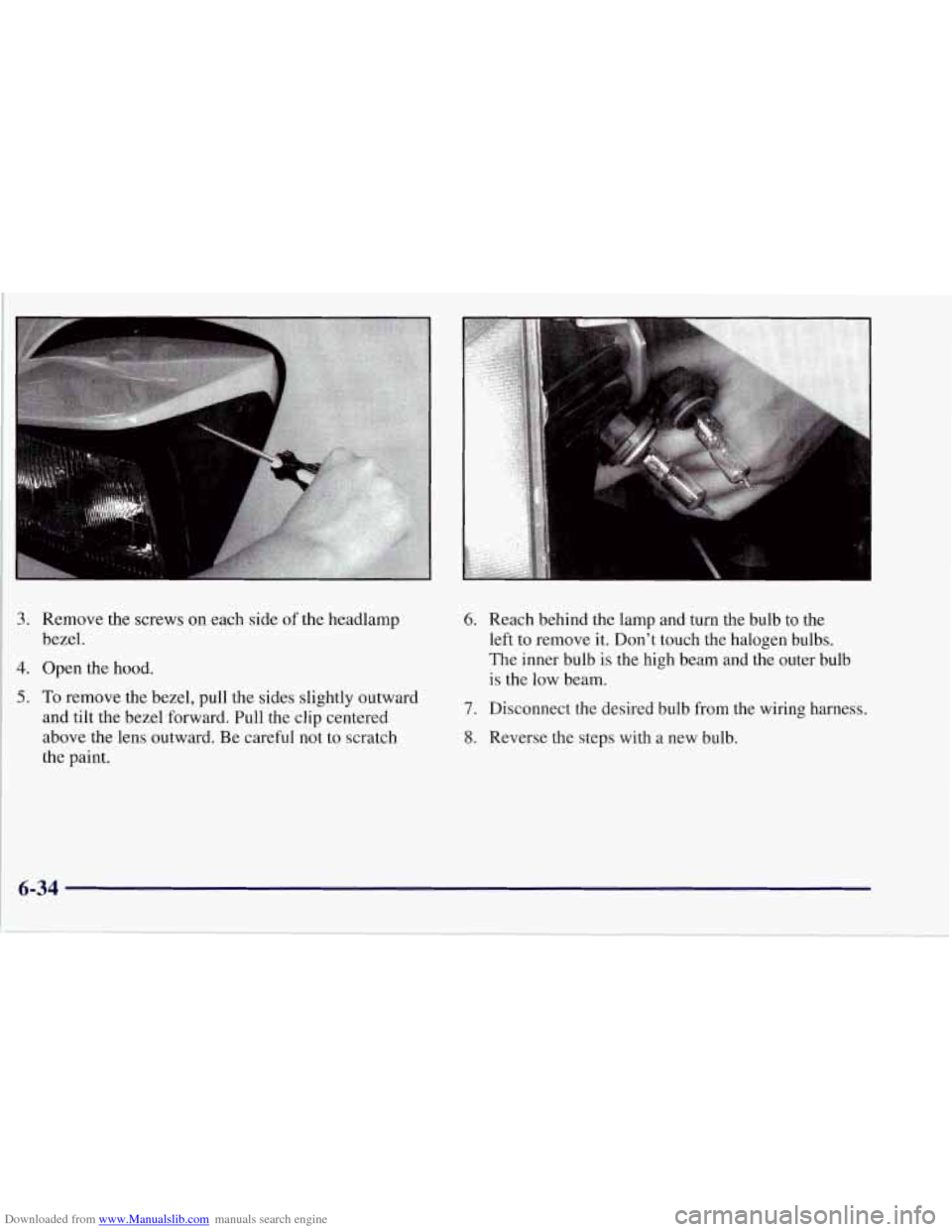
Downloaded from www.Manualslib.com manuals search engine 3.
4.
5.
Remove the screws on each side of the headlamp
bezel.
Open the hood.
To remove the bezel, pull the sides slightly outward
and
tilt the bezel forward. Pull the clip centered
above the lens outward. Be careful not to scratch
the paint.
6. Reach behind the lamp and turn the bulb to the
left
to remove it. Don’t touch the halogen bulbs.
The inner bulb is the high beam and the outer bulb
is the low beam.
7. Disconnect the desired bulb from the wiring harness.
8. Reverse the steps with a new bulb.
6-34
Page 281 of 356
Downloaded from www.Manualslib.com manuals search engine If you ever replace your tires with those not having a
TPC Spec number, make sure they are the same size,
load range, speed rating and construction type (bias,
bias-belted or radial) as your original tires.
I CAJTION:
Mixing tires could cause you to lose control while
driving.
If you mix tires of different sizes (other
than those originally installed on your Corvette)
or types (radial and bias-belted tires), the vehicle
may not handle properly, and you could have a
crash. Using tires of different sizes (other than
those originally installed on your Corvette) may
also cause damage to your vehicle. Be sure to use
the correct size and type tires on all four wheels.
Uniform Tire Quality Grading
The following information relates to the system
developed by the United States National Highway
Traffic Safety Administration, which grades tires by
treadwear, traction and temperature performance. (This
applies only to vehicles sold in the United States.) The
grades are molded on the sidewalls of most passenger
car tires. The Uniform Tire Quality Grading system does
not apply to deep tread, winter-type snow tires,
space-saver or temporary use spare tires, tires with
nominal rim diameters
of 10 to 12 inches (25 to 30 cm),
or to some limited-production tires.
While the tires available on General Motors passenger
cars and light trucks may vary with respect to these
grades, they must also conform to Federal safety
requirements and additional General Motors Tire
Performance Criteria
(TPC) standards.
If
you feel that winter tires are needed, see “Extended
Mobility Tires” in the Index.
Page 288 of 356
Downloaded from www.Manualslib.com manuals search engine Cleaning Coated Moldings
These moldings are around the hatch opening in your
Corvette’s rear area.
0 When lightly soiled, wipe with a sponge or soft
When heavily soiled, use warm soapy water.
lint-free cloth dampened with
water.
You can remove scratches from a coated molding by
wiping briskly with the solvent-type cleaner described
earlier. If a ring forms, repeat the procedure over a larger
area, wiping toward the center of the ring. If the ring
still remains, wipe the whole molding.
Cleaning Leather
Use a soft cloth with lukewarm water and a mild soap or
saddle soap and wipe dry with a soft cloth. Then, let the
leather dry naturally.
Do not use heat to dry.
0 For stubborn stains, use a leather cleaner. See your
Never use oils, varnishes, solvent-based or abrasive
dealer
for this product.
cleaners, furniture polish or shoe polish on leather.
immediately. If dirt
is allowed to work into the
finish, it can harm the leather.
Soiled or stained leather should be cleaned
Cleaning the Top of the Instrument Panel
Use only mild soap and water to clean the top surfaces
of the instrument panel. Sprays containing silicones or
waxes may cause annoying reflections in the windshield
and even make it difficult to see through the windshield
under certain conditions.
Cleaning Soft-Touch Paint Surfaces
Use only mild soap and water to clean the Soft-Touch
paint surfaces
in your Corvette.
Cleaning the Security Shade and
Convenience Net
Wash with warm water and mild detergent, rinse with
cold water and tumble dry on low.
Do not use chlorine
bleach.
6-53
Page 298 of 356
Downloaded from www.Manualslib.com manuals search engine Fuses and Circuit Breakers
The wiring circuits in your vehicle are protected from
short circuits by a combination of maxi-fuses,
mini-fuses and circuit breakers. This greatly reduces the
chance of fires caused by electrical problems.
Look at the silver-colored band inside the fuse. If the
band is broken or melted, replace the fuse. Be sure you
replace a bad fuse with a new one of the identical size
and rating.
If you ever have a problem on the road and don’t have a
spare fuse, you can borrow one that has the same
amperage. Just pick some feature of your vehicle that
you can get along without
-- like the radio or cigarette
lighter
-- and use its fuse, if it is the correct amperage.
Replace it as soon as you can.
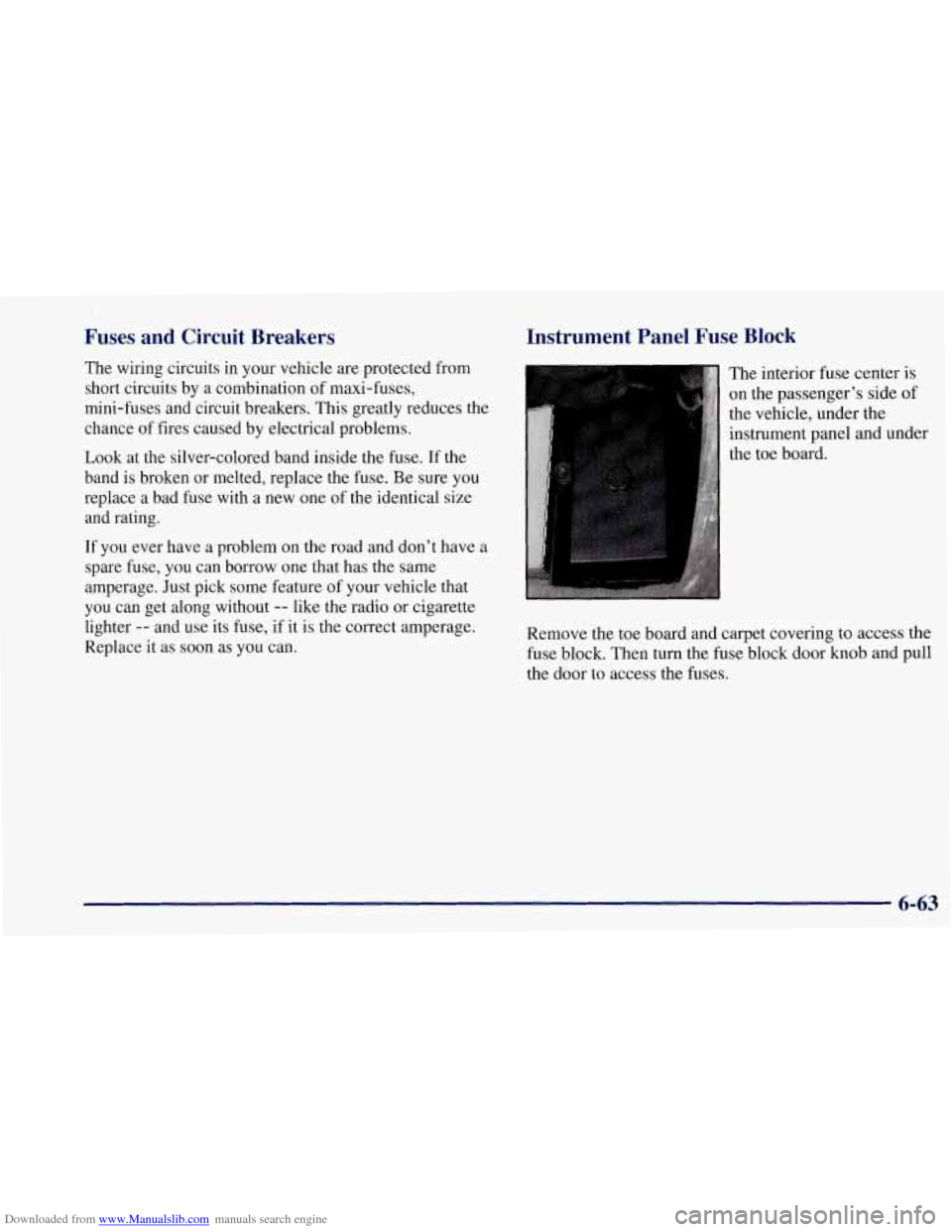
Instrument Panel Fuse Block
The interior fuse center is
on the passenger’s side of
the vehicle, under the
instrument panel and under
the toe board.
Remove the toe board and carpet covering
to access the
fuse block. Then turn the fuse block door
knob and pull
the door to access the fuses.
6-63
Page 299 of 356
Downloaded from www.Manualslib.com manuals search engine /
p4mrnm
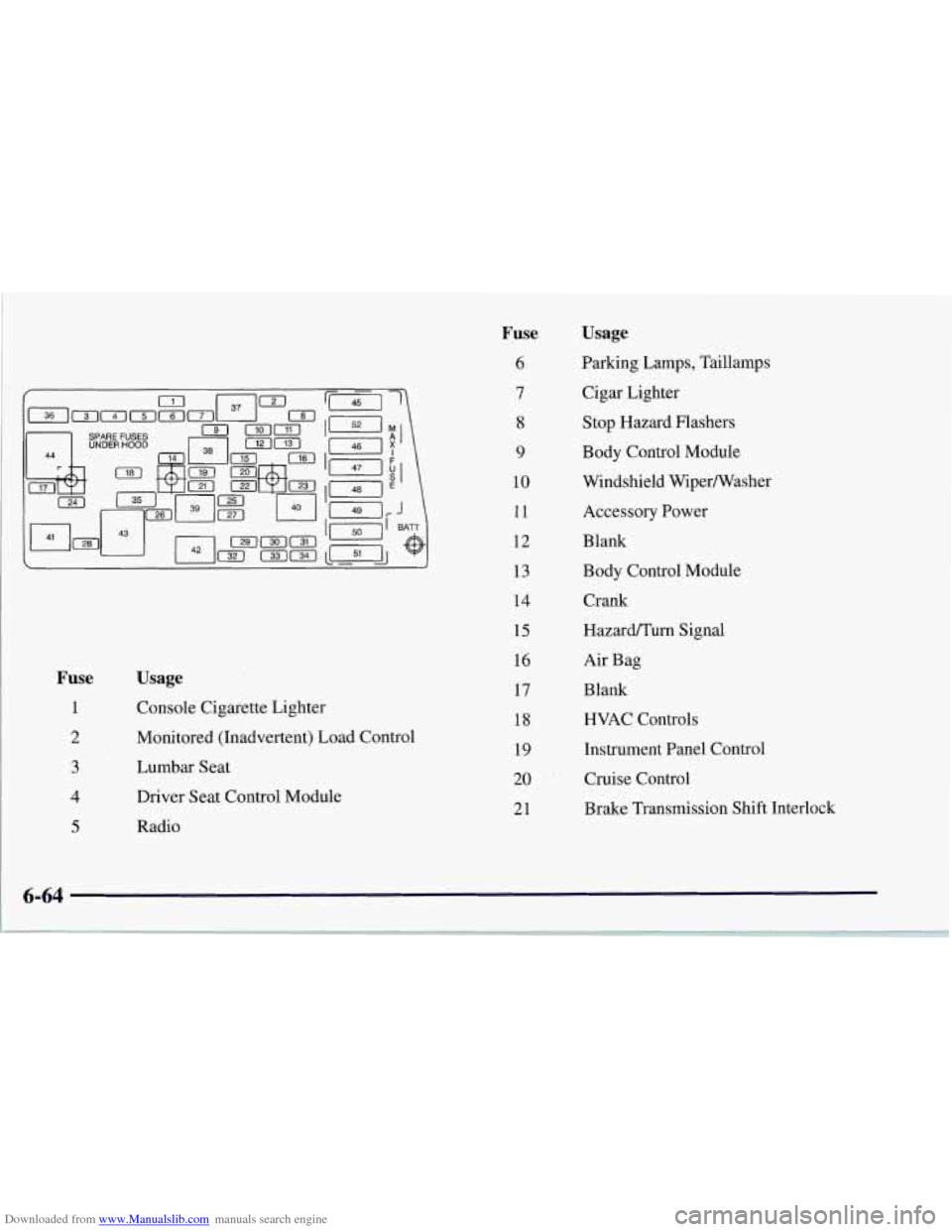
SPAREFUSES UNDER HOOD
Fuse Usage
1 Console Cigarette Lighter
2 Monitored (Inadvertent) Load Control
3 Lumbar Seat
4 Driver Seat Control Module
5 Radio
Fuse
6
7
8
9
10
11
12
13
14
15 16
17
18
19
20
21
Usage
Parking Lamps, Taillamps
Cigar Lighter
Stop Hazard Flashers
Body Control Module
Windshield Wipermasher
Accessory Power
Blank Body Control Module
Crank
Hazard/Turn Signal
Air Bag
Blank HVAC Controls
Instrument Panel Control
Cruise Control
Brake Transmission Shift Interlock
6-64
~ . . -