key CHEVROLET CORVETTE 1998 5.G User Guide
[x] Cancel search | Manufacturer: CHEVROLET, Model Year: 1998, Model line: CORVETTE, Model: CHEVROLET CORVETTE 1998 5.GPages: 378, PDF Size: 19.91 MB
Page 62 of 378
Downloaded from www.Manualslib.com manuals search engine The system has a feature that makes it difficult for you
to lock your keys in your vehicle.
If you leave your keys
in the ignition and attempt to lock the doors, the vehicle
will not lock and a chime will sound to remind you that
the keys are in the ignition.
If the door lock is pressed
again, within five seconds, the doors will lock and the
keys can be locked in the car. If you leave the keys
in
the ignition and move away with the key fob transmitter,
the doors still will not lock. You should notice that the
horn doesn’t sound and return to get your keys out of
the ignition.
The system will allow you to lock your keys in the
vehicle if you didn’t leave them in the ignition. You
should, however, be able to use the key fob transmitter
to get them out as long as the passive slide switch
is in
the
ON position. After 15 seconds of no motion, the key
fob transmitter shuts down to save the battery. Wait
about
30 seconds, then rock the vehicle. The key fob
transmitter should “wake up” and unlock the doors.
This system can’t guarantee that you will never be
locked out of your vehicle. If the battery is low or if the
key fob transmitter is in a place where the signal can’t
get to the antenna,
it won’t unlock the doors. Always
remember to take your keys with you.
Panic Alarm Button
When you press the special horn button on the key
fob transmitter, your vehicle’s horn will sound. This
panic alarm button will allow you to attract attention,
if needed.
If the horn alarm sounds, there are three ways to turn
it off:
Push the panic alarm button on the key fob
Wait 90 seconds, and the horn will turn off by
transmitter again.
itself
or
0 Turn the key to any position in the ignition switch,
except
OFT.
RF’A Settings
You can adjust the settings on the system through the
Driver Information Center (DIC). You can have just the
driver’s or both door locks passively unlock, change the
type of alarm used by the theft-deterrent, or have lamps
come on when you approach the vehicle. See “Driver
Information Center Controls and Displays” in the Index.
2-9
Page 63 of 378
Downloaded from www.Manualslib.com manuals search engine I’urning the Passive System Off
You can disable the passive feature by moving the
transmitter’s slider switch to
OFF. The vehicle will no
longer automatically disarm your theft-deterrent system or unlock the doors, however, you will be able to
actively control use of the door locks, the hatch/trunk lid
release and the panic alarm using the four transmitter
buttons. (These buttons also work when the passive feature is on.)
Make sure to fully slide the switch to either side when
turning the key fob transmitter on and
off. You should
feel a double click when sliding the switch back
and forth.
You can also check whether the passive system is on or
off by closing the door and moving away from the
vehicle with the keys and transmitter. If the doors lock,
the passive system is on.
If you are working around your vehicle and keeping
your keys with you, you might want to
turn the RFA
passive system off. If you don’t, the transmitter will
keep locking and unlocking your doors.
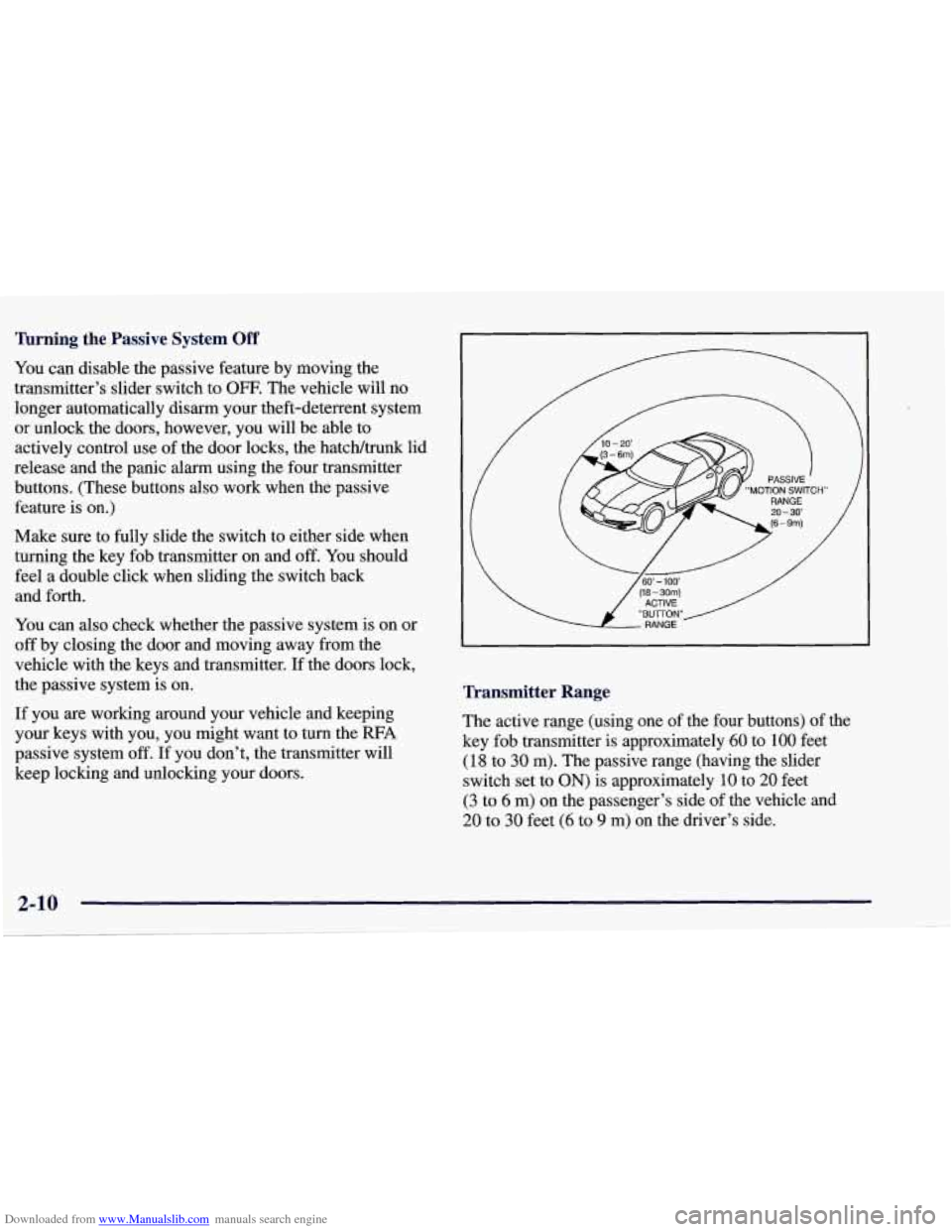
Transmitter Range
The active range (using one of the four buttons) of the
key fob transmitter
is approximately 60 to 100 feet
(18 to 30 m). The passive range (having the slider
switch set to
ON) is approximately 10 to 20 feet
(3 to 6 m) on the passenger’s side of the vehicle and
20 to 30 feet (6 to 9 m) on the driver’s side.
Page 64 of 378
Downloaded from www.Manualslib.com manuals search engine Resynchronizing Your Transmitter
Your RFA system uses a continually changing code for
increased security. Normally, the receiver in your
vehicle will keep track of this changing code.
,If your
vehicle does not respond to your transmitter, do the
following to determine what’s wrong:
1. Get closer to the vehicle and try pressing a button
again. Your battery may be low (If
so, see “Battery
Replacement” in the Index).
2. While standing close to your vehicle, press the
LOCK and UNLOCK buttons on your transmitter at
the same time and hold
for seven seconds. This will
attempt to resynchronize
the security code in your
RFA key fob transmitter.
3. When resynchronization is achieved, the horn
will chirp.
Loss of synchronization will occur after transmitter
battery replacement or disconnection of the
vehicle’s battery.
If attempts to resynchronize your transmitter to the
vehicle are not successful, you may need
to match the
transmitter to the vehicle.
Matching Transmitter(s) To Your Vehicle
Each key fob transmitter is coded to prevent another
transmitter from unlocking your vehicle.
If a transmitter
is lost or stolen,
a replacement can be purchased through
your dealer. Remember to bring any remaining
transmitters with you when you go to your dealer. When
the dealer matches the replacement transmitter to your
vehicle, any remaining transmitters must also be
matched. Once your dealer has coded the new
transmitter, the lost transmitter will not unlock your
vehicle. Each vehicle can have only three transmitters
matched to it.
To match transmitters to your vehicle:
1. Turn the ignition key to the ON position.
2. Clear any warning messages on the Driver
Information Center (DIC) by pressing the
RESET button.
3. Press the OPTIONS button on the DIC several times
until the blank page is displayed, then press and hold
the RESET button for two seconds.
2-11
Page 65 of 378
Downloaded from www.Manualslib.com manuals search engine 4. When the message FOB TRAINING is displayed,
push the RESET button once. The message
HOLD
LK + UNLK 1ST FOB will be displayed.
5. Press and hold the LOCK and UNLOCK buttons on
the transmitter simultaneously for
15 seconds.
6. When a transmitter is learned, the DIC will display
FOB LEARNED and then prompt you to learn the
next transmitter.
7. Repeat Steps 5 and 6 for each additional transmitter.
8. Remove the key from the ignition.
The programming mode will shut
off if
0 You don’t program any transmitters for two minutes.
0 You take the key out of the ignition.
0 You have programmed three transmitters.
Battery Replacement
Under normal use, the battery in your key fob
transmitter should last about
18 months.
You can tell the battery is weak if the transmitter won’t
work at the normal range
in any location. If you have to
get close to your vehicle before the transmitter works,
it’s probably time to change the battery.
NOTICE:
When replacing the battery, use care not to touch
any of the circuitry. Static from your body
transferred to these surfaces may damage
the transmitter.
2-12
Page 67 of 378
Downloaded from www.Manualslib.com manuals search engine Remote Hatch/Trunk Lid Release
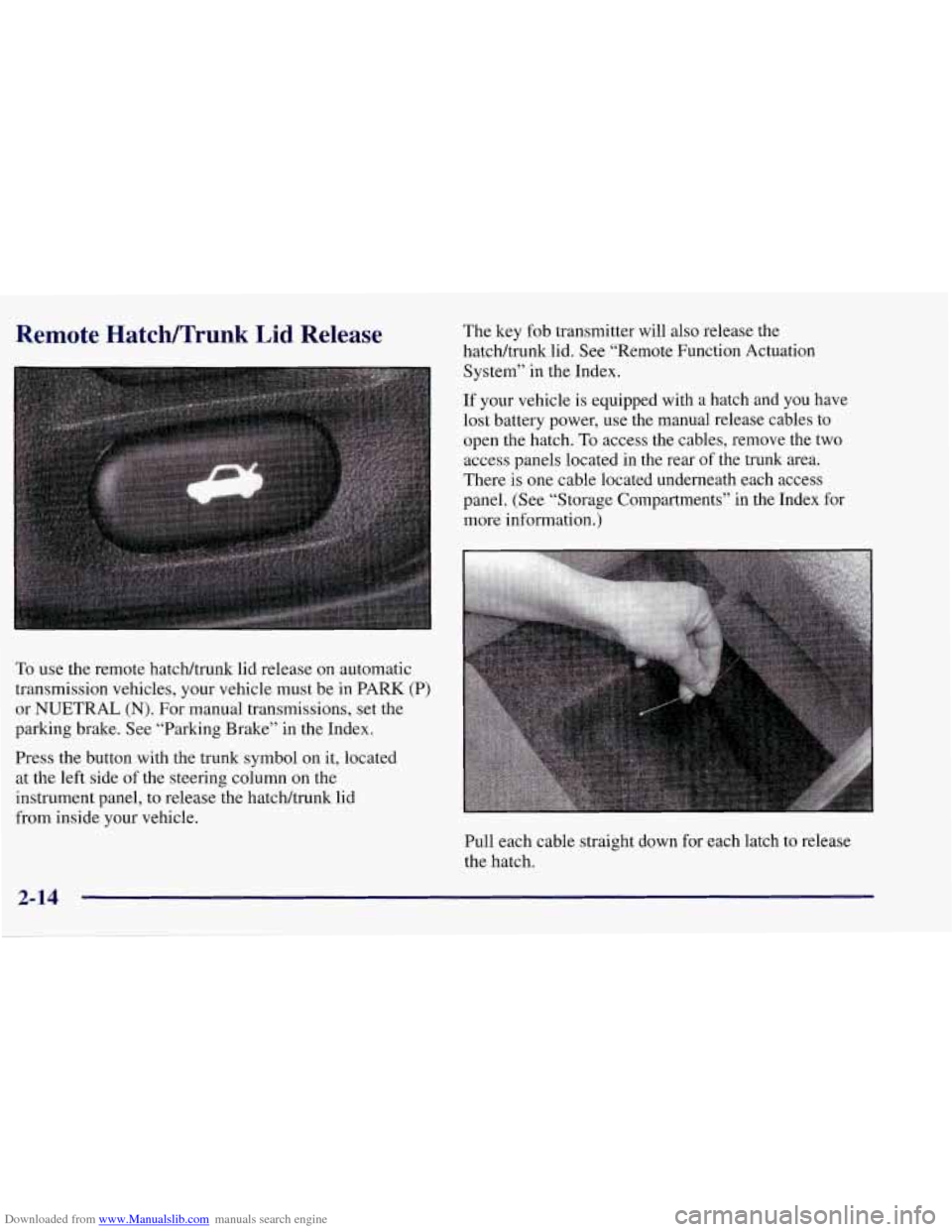
To use the remote hatcWtrunk lid release on automatic
transmission vehicles, your vehicle must be in PARK (P)
or NUETRAL
(N). For manual transmissions, set the
parking brake. See “Parking Brake” in the Index.
Press the button with the trunk symbol on it, located
at the left side of the steering column
on the
instrument panel, to release the hatchhunk lid
from inside your vehicle. The
key fob transmitter will also release the
hatcWtrunk lid. See “Remote Function Actuation
System” in the Index.
If your vehicle
is equipped with a hatch and you have
lost battery power, use the manual release cables to
open the hatch.
To access the cables, remove the two
access panels located in the rear of the trunk area.
There is one cable located underneath each access
panel. (See “Storage Compartments” in the Index for
more information.)
Pull each cable straight down for each latch to release
the hatch.
2-14
Page 69 of 378
Downloaded from www.Manualslib.com manuals search engine NOTICE:
If you put things in the hatcldtrunk area, be sure
they won’t break the glass when you close it.
Never slam the hatcldtrunk lid down. You could
break the glass or damage the defogger grid.
When you close the hatchhrunk lid, make sure
you pull down from the center, not the sides.
If
you pull the hatcldtrunk lid down from the side
too often, the weatherstrip can be damaged.
NOTICE:
Do not store heavy or sharp objects in the three
storage compartments located in the hatcldtrunk
area.
If you do, the objects could damage
the underbody.
Theft
Vehicle theft is big business, especially in some cities.
Although your vehicle has a number of theft-deterrent features, we
know that nothing we put on it can make it
impossible to steal. However,
there are ways you can help.
Key in the Ignition
If you leave your vehicle with the keys inside, it’s an
easy target for joy riders or professional thieves
-- so
don’t do it.
When you park your vehicle and open the driver’s door,
you’ll hear a tone reminding you to remove your key
from the ignition and take it with you. Always do this.
Your steering wheel will be locked, and
so will your
ignition.
If you have an automatic transmission, taking
your key out also locks your transmission. And
remember to lock the doors.
Page 70 of 378
Downloaded from www.Manualslib.com manuals search engine Parking at Night
Park in a lighted spot, close all windows and lock your
vehicle. Remember to keep your valuables out of sight.
Put them in a storage area, or take them with you.
Parking Lots
If you park in a lot where someone will be watching
your vehicle, it’s best to lock
it up and take your keys.
But what if you have to leave your key?
Do not leave
valuables in your vehicle, since there would be no place
to secure them.
”<
Universal Theft-Deterrent System
Your Corvette has a
theft-deterrent alarm
I SECURITY
system. With this system,
the SECURITY light will
flash as you open the door (if your ignition is
off).
This light reminds you to arrn the theft-deterrent system.
To arm the system, do the following: To
arm the system, do the following:
1. Press the LOCK button on the key fob transmitter, as
mentioned earlier, OR
2. Walk out of range with the passive switch on OR
3. Open the door. (The SECURITY light should flash.)
Lock the door with the power door lock switch. The
SECURITY light will stop flashing and stay on.
Close all the doors. The SECURITY light should
go off.
Now,
if a door or the hatcWtmnk lid is opened without
the key or the key fob transmitter system, the alarm will
go
off. Your horn will sound for two minutes, then it
will go off to save battery power. And, your vehicle
won’t start.
The theft-deterrent system won’t arm
if you lock the
doors with a key, the manual door
lock, or if you power
lock (from the inside) the vehicle after the doors
are closed.
If your passenger stays in the vehicle when you leave
with the keys, have the passenger lock the vehicle after
the doors are closed. This way the alarm won’t
arm, and
your passenger won’t set it
off.
2- 17
Page 71 of 378
Downloaded from www.Manualslib.com manuals search engine Always use your key or the key fob transmitter to
unlock a door. Unlocking a door any other way will set
off the alarm. If you do set off the alarm, there are four
ways to stop it:
Unlock any door with your key.
Put the key in the ignition.
Press the UNLOCK button on the key fob transmitter.
0 Walk into range with the passive switch on.
Testing the Alarm
1. Make sure the rear hatch/trunk lid is latched.
2. Lower a window on the door.
3. Manually arm the system with the power door
lock switch.
4. Close the doors and wait 15 seconds.
PASS-Key@
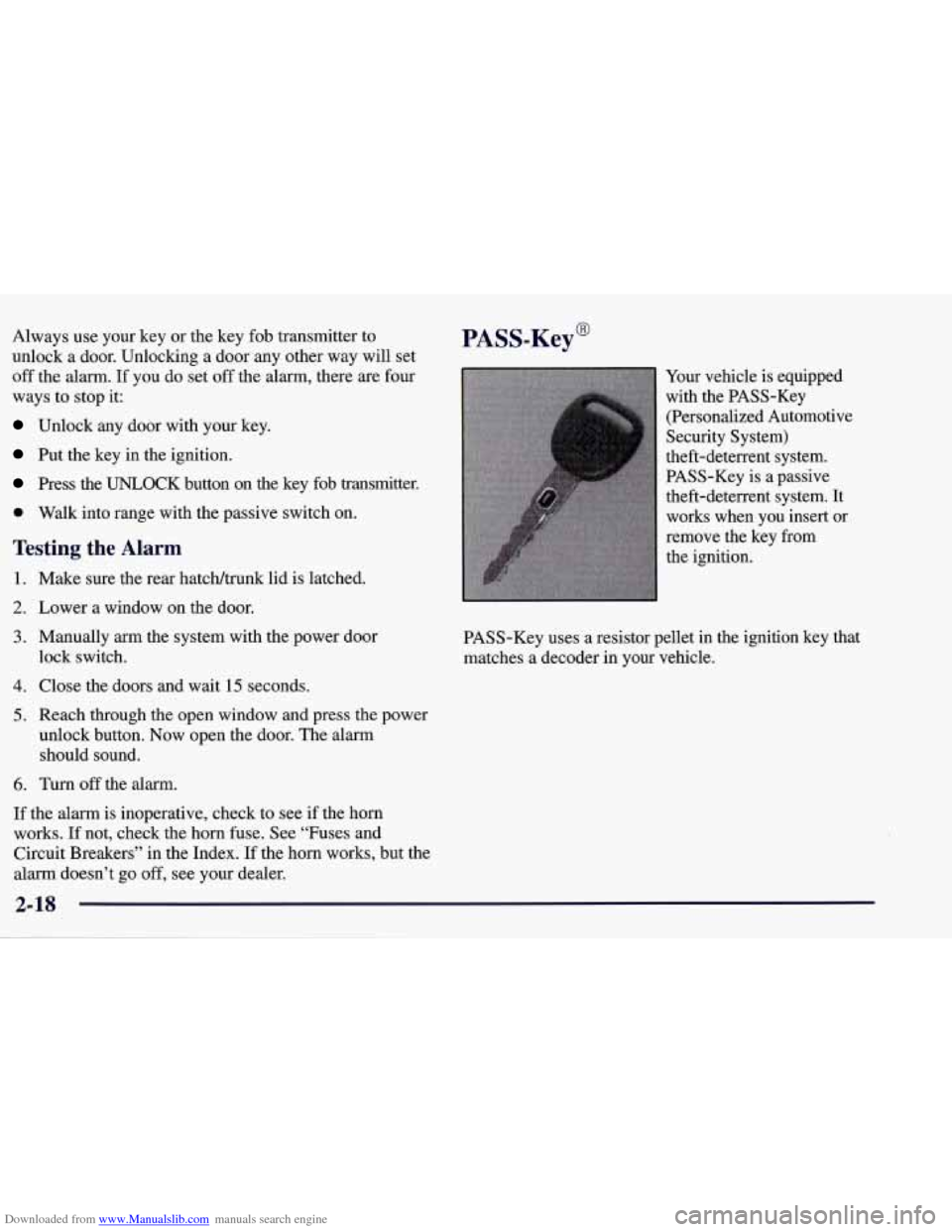
Your vehicle is equipped
with the PASS-Key
(Personalized Automotive
Security System)
theft-deterrent system.
PASS-Key is
a passive
theft-deterrent system. It
works when you insert
or
remove the key from
the ignition.
PASS-Key uses a resistor pellet in the ignition key that
matches
a decoder in your vehicle.
5. Reach through the open window and press the power
unlock button. Now open the door. The alarm
should sound.
6. Turn off the alarm.
If the alarm is inoperative, check to see if the horn
works. If not, check the horn fuse. See “Fuses and
Circuit Breakers” in the Index.
If the horn works, but the
alarm doesn’t go
off, see your dealer.
2-18
Page 72 of 378
Downloaded from www.Manualslib.com manuals search engine When the PASS-Key system senses that someone is
using the wrong key, it shuts down the vehicle’s starter
and fuel systems. For about three minutes, the starter
won’t work and fuel won’t go to the engine.
If someone
tries to start your vehicle again or uses another key
during this time, the shutdown period will start over
again. This discourages someone from randomly trying
different keys with different resistor pellets in an attempt
to make a match.
The key must be clean and dry before it’s inserted in the
ignition or the engine may not start. If the SECURITY
light comes on, the key may be dirty or wet.
If this happens and the starter won’t work, turn the
ignition
off. Clean and dry the key, wait three minutes
and try again. If the starter still won’t work, wait
three minutes and try the other ignition key. At this time,
you may
also want to check the fuses (see “Fuses and
Circuit Breakers” in the Index). If the starter won’t work
with the other key, your vehicle needs service. If your
vehicle does start, the first ignition key may be faulty.
See your dealer or a locksmith who can service the
PASS-Key. If
you accidentally use a key that has a damaged or
missing resistor pellet, you will see no SECURITY
light. You don’t have to wait three minutes before trying
the proper key.
If the resistor pellet is damaged or missing, the starter
won’t work. Use the other ignition key, and see your
dealer or a locksmith who can service the PASS-Key to
have a new key made.
If the SECURITY light comes on while driving, have
your vehicle serviced as soon as possible.
If you lose or damage a PASS-Key ignition key, see
your dealer or a locksmith who can service PASS-Key.
In an emergency, call the Chevrolet Roadside Assistance
Center at 1-800-CHEV-USA
(1-800-243-8872). In
Canada, call 1-800-268-6800.
2-19
Page 73 of 378
Downloaded from www.Manualslib.com manuals search engine New Vehicle “Break-In”
NOTICE:
Your vehicle doesn’t need an elaborate
“break-in.” But
it will perform better in the long
run
if you follow these guidelines:
0 Keep your speed at 55 mph (88 kmh) or
less for the
first 500 miles (805 km).
0 Don’t drive at any one speed -- fast or
slow
-- for the first 500 miles (805 km).
Don’t make full-throttle starts.
200 miles (322 km) or so. During this time
your new brake linings aren’t yet broken
in. Hard stops with new linings can mean
premature wear and earlier replacement.
Follow this breaking-in guideline every
time you get new brake linings.
0 Avoid making hard stops for the first
Ignition Switch
With the key in the ignition switch, you can turn the
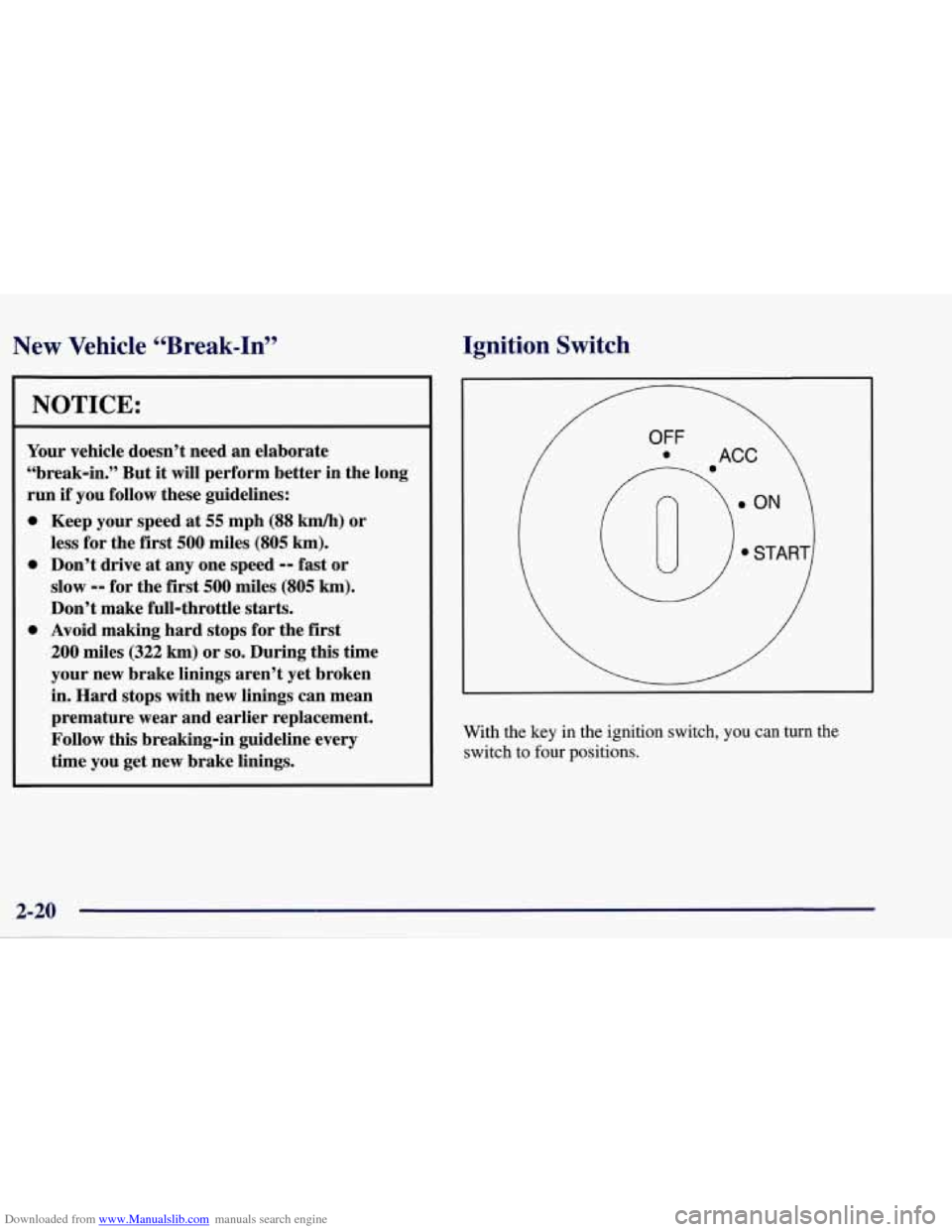
switch to
four positions.