engine CHEVROLET CORVETTE 2003 5.G Owners Manual
[x] Cancel search | Manufacturer: CHEVROLET, Model Year: 2003, Model line: CORVETTE, Model: CHEVROLET CORVETTE 2003 5.GPages: 368, PDF Size: 2.55 MB
Page 309 of 368

Finish Damage
Any stone chips, fractures or deep scratches in the
®nish should be repaired right away.
Minor chips and scratches can be repaired with touch-up
materials avaliable from your dealer or other service
outlets. Larger areas of ®nish damage can be corrected
in your dealer's body and paint shop.
Magnesium Wheel Finish
Notice:Improper paint repair or re®nishing can
cause corrosion damage to a magnesium wheel. See
your dealer if a magnesium wheel needs paint
repair or re®nishing.
Underbody Maintenance
Chemicals used for ice and snow removal and dust
control can collect on the underbody. If these are not
removed, accelerated corrosion (rust) can occur on
the underbody parts such as fuel lines, frame, ¯oor pan
and exhaust system even though they have corrosion
protection.
At least every spring, ¯ush these materials from the
underbody with plain water. Clean any areas where mud
and debris can collect. Dirt packed in close areas of
the frame should be loosened before being ¯ushed.
Your dealer or an underbody car washing system can
do this for you.
Titanium Exhaust System
(Z06 Only)
Time and high performance driving conditions can
cause a color change in titanium exhaust system parts.
This is normal for a titanium surface.
Fiberglass Springs
Notice:Don't use corrosive or acidic cleaning
agents, engine degreasers, aluminum cleaning
agents or other harsh solvents to clean ®berglass
springs; they'll damage the springs.
Chemical Paint Spotting
Some weather and atmospheric conditions can create a
chemical fallout. Airborne pollutants can fall upon and
attack painted surfaces on your vehicle. This damage
can take two forms: blotchy, ring-shaped discolorations,
and small, irregular dark spots etched into the paint
surface.
Although no defect in the paint job causes this, GM will
repair, at no charge to the owner, the surfaces of
new vehicles damaged by this fallout condition within
12 months or 12,000 miles (20 000 km) of purchase,
whichever occurs ®rst.
5-81
Page 311 of 368

Vehicle Identi®cation
Vehicle Identi®cation Number (VIN)
This is the legal identi®er for your vehicle. It appears on
a plate in the front corner of the instrument panel, on
the driver's side. You can see it if you look through the
windshield from outside your vehicle. The VIN also
appears on the Vehicle Certi®cation and Service Parts
labels and the certi®cates of title and registration.
Engine Identi®cation
The 8th character in your VIN is the engine code. This
code will help you identify your engine, speci®cations
and replacement parts.
Service Parts Identi®cation Label
You'll ®nd this label located inside the glovebox. It's
very helpful if you ever need to order parts. On this
label is:
·your VIN,
·the model designation,
·paint information and
·a list of all production options and special equipment
Be sure that this label is not removed from the
vehicle.
5-83
Page 317 of 368
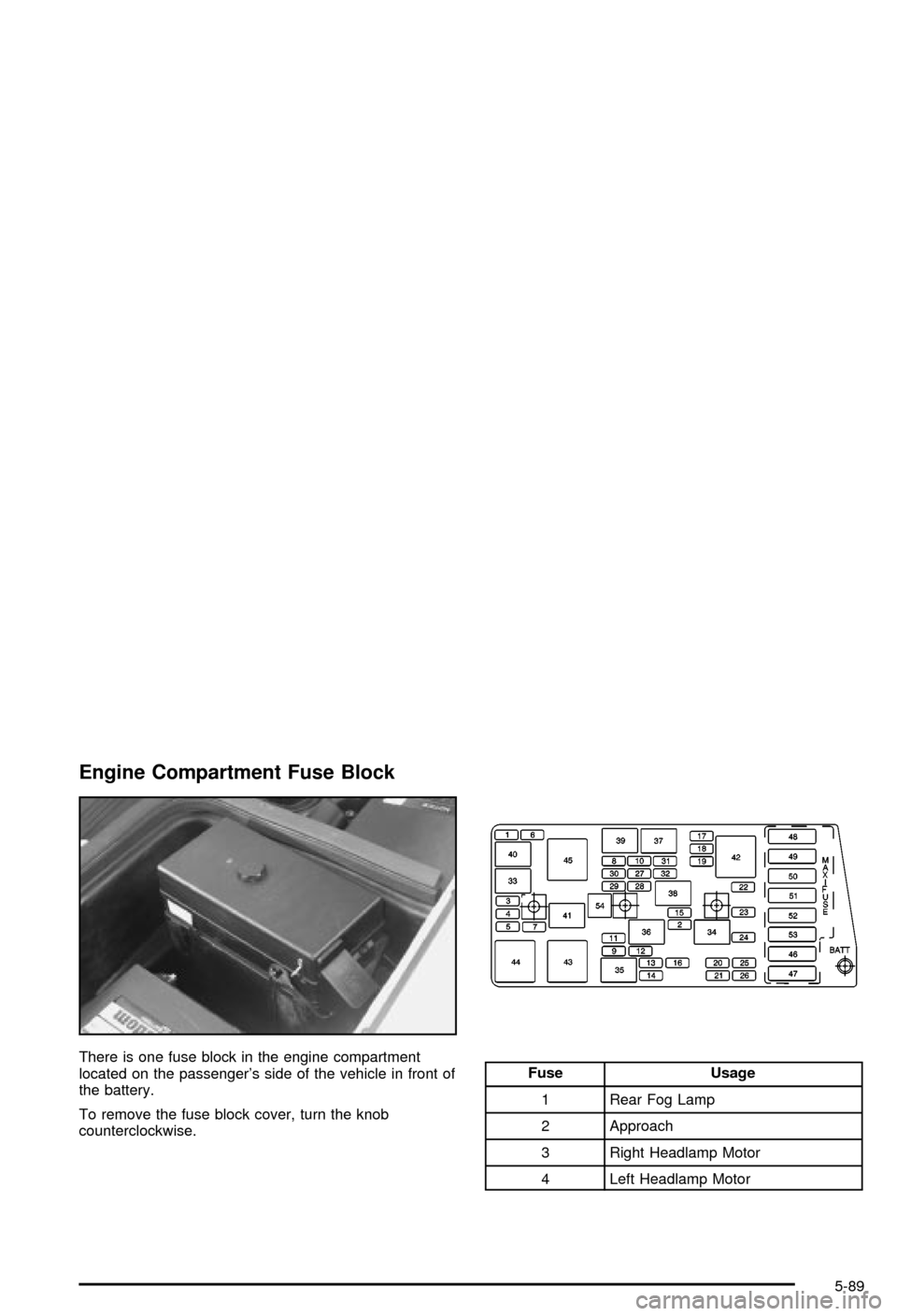
Engine Compartment Fuse Block
There is one fuse block in the engine compartment
located on the passenger's side of the vehicle in front of
the battery.
To remove the fuse block cover, turn the knob
counterclockwise.Fuse Usage
1 Rear Fog Lamp
2 Approach
3 Right Headlamp Motor
4 Left Headlamp Motor
5-89
Page 318 of 368
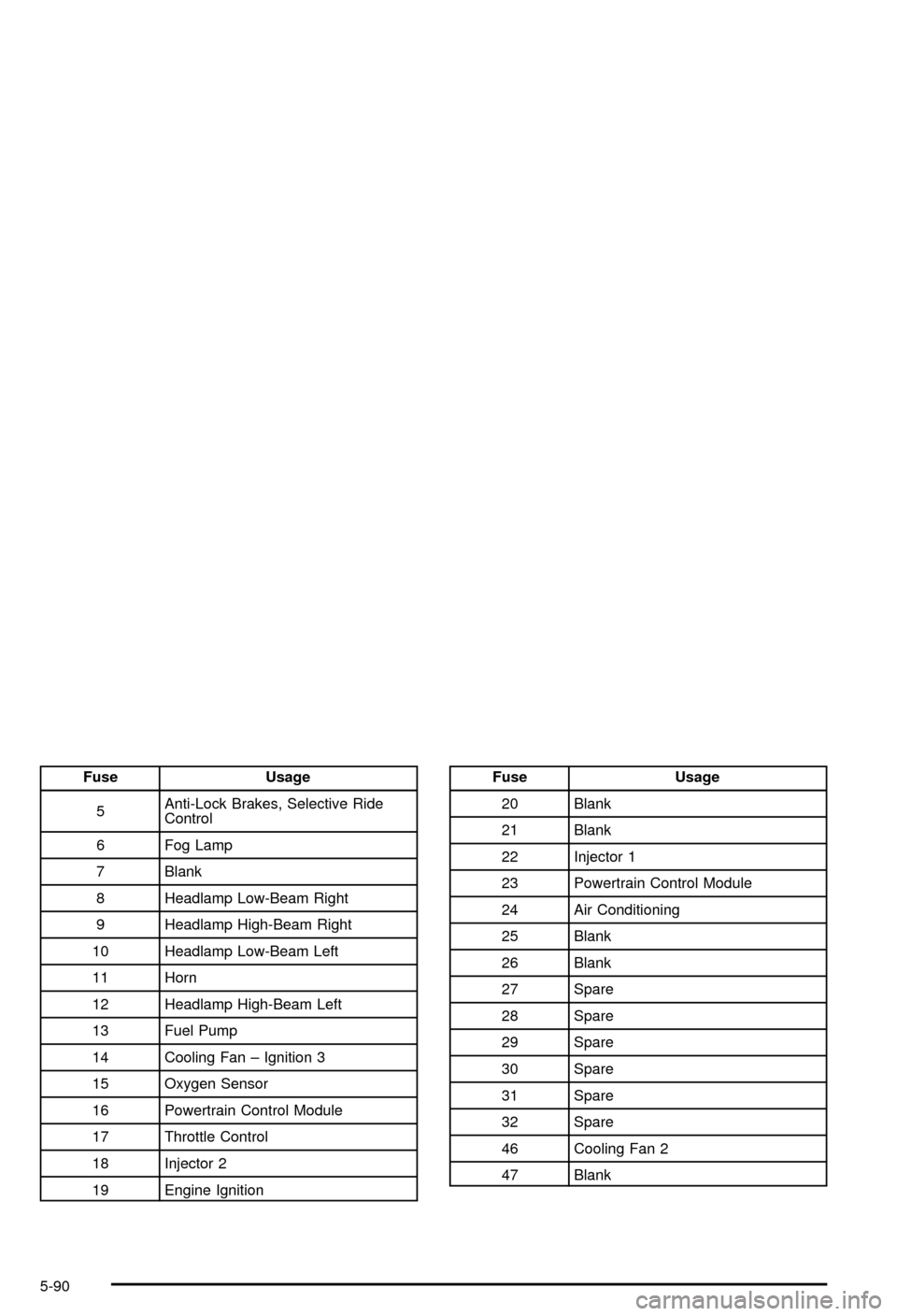
Fuse Usage
5Anti-Lock Brakes, Selective Ride
Control
6 Fog Lamp
7 Blank
8 Headlamp Low-Beam Right
9 Headlamp High-Beam Right
10 Headlamp Low-Beam Left
11 Horn
12 Headlamp High-Beam Left
13 Fuel Pump
14 Cooling Fan ± Ignition 3
15 Oxygen Sensor
16 Powertrain Control Module
17 Throttle Control
18 Injector 2
19 Engine IgnitionFuse Usage
20 Blank
21 Blank
22 Injector 1
23 Powertrain Control Module
24 Air Conditioning
25 Blank
26 Blank
27 Spare
28 Spare
29 Spare
30 Spare
31 Spare
32 Spare
46 Cooling Fan 2
47 Blank
5-90
Page 320 of 368
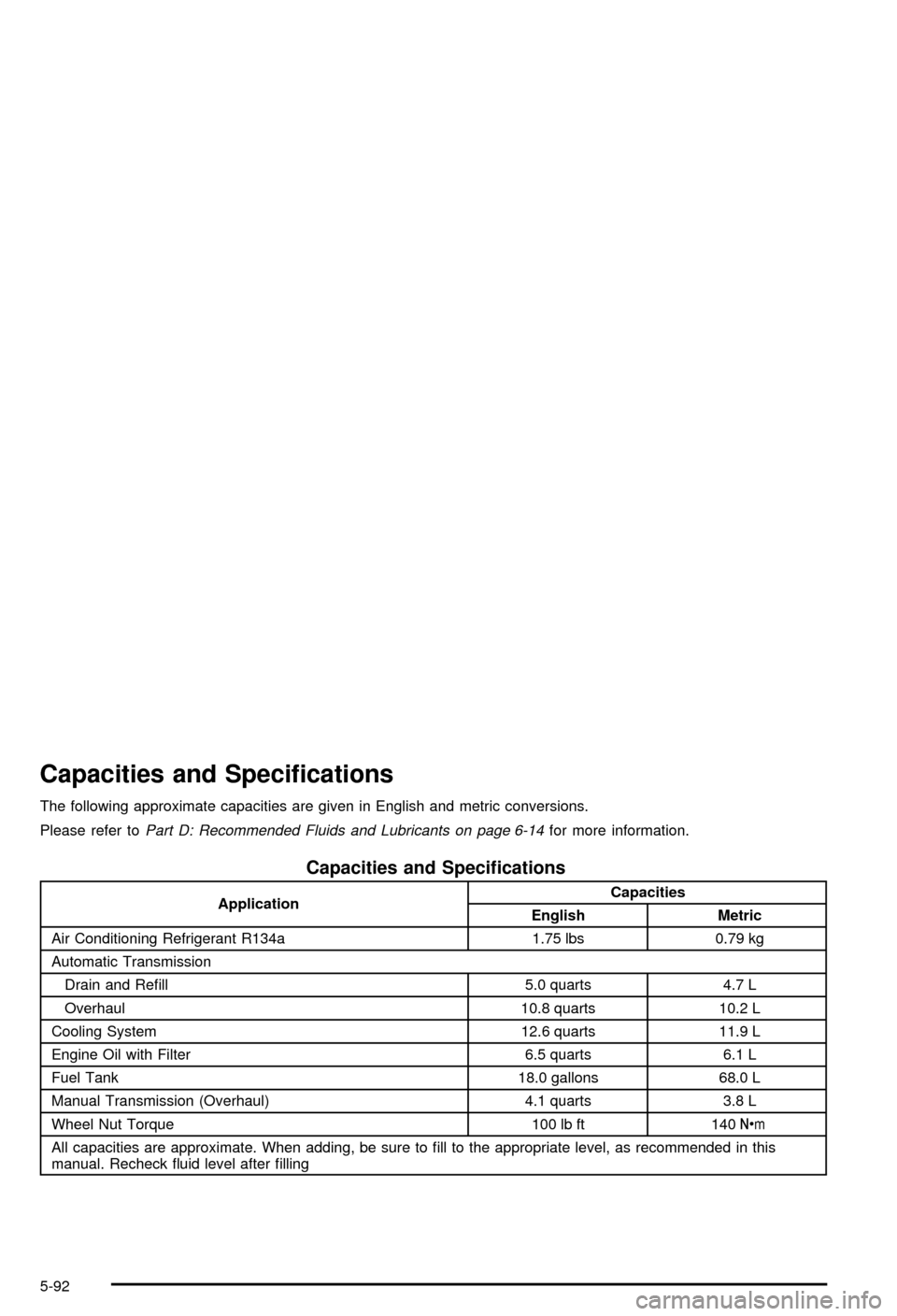
Capacities and Speci®cations
The following approximate capacities are given in English and metric conversions.
Please refer to
Part D: Recommended Fluids and Lubricants on page 6-14for more information.
Capacities and Speci®cations
ApplicationCapacities
English Metric
Air Conditioning Refrigerant R134a 1.75 lbs 0.79 kg
Automatic Transmission
Drain and Re®ll 5.0 quarts 4.7 L
Overhaul 10.8 quarts 10.2 L
Cooling System 12.6 quarts 11.9 L
Engine Oil with Filter 6.5 quarts 6.1 L
Fuel Tank 18.0 gallons 68.0 L
Manual Transmission (Overhaul) 4.1 quarts 3.8 L
Wheel Nut Torque 100 lb ft 140Y
All capacities are approximate. When adding, be sure to ®ll to the appropriate level, as recommended in this
manual. Recheck ¯uid level after ®lling
5-92
Page 321 of 368
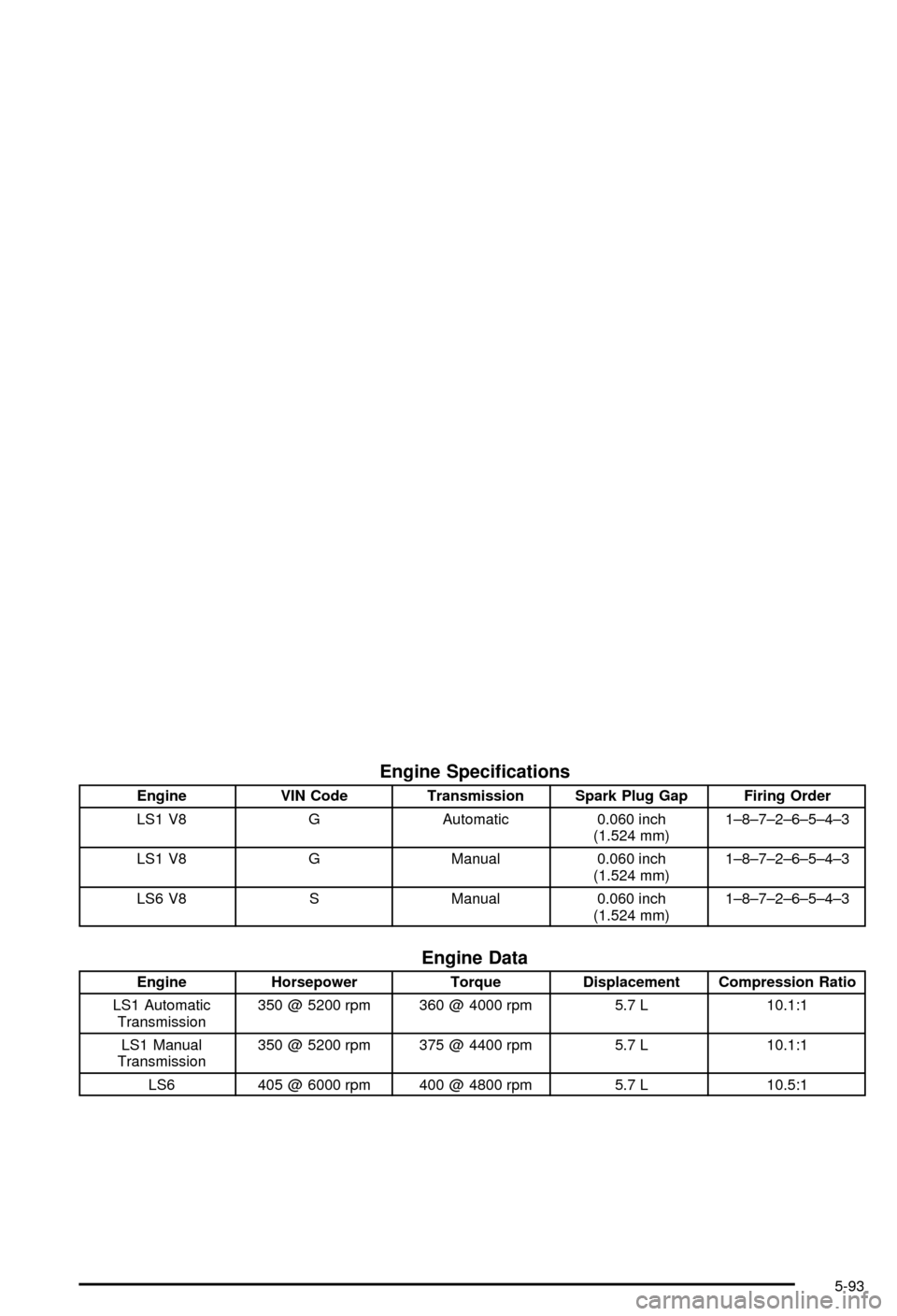
Engine Speci®cations
Engine VIN Code Transmission Spark Plug Gap Firing Order
LS1 V8 G Automatic 0.060 inch
(1.524 mm)1±8±7±2±6±5±4±3
LS1 V8 G Manual 0.060 inch
(1.524 mm)1±8±7±2±6±5±4±3
LS6 V8 S Manual 0.060 inch
(1.524 mm)1±8±7±2±6±5±4±3
Engine Data
Engine Horsepower Torque Displacement Compression Ratio
LS1 Automatic
Transmission350 @ 5200 rpm 360 @ 4000 rpm 5.7 L 10.1:1
LS1 Manual
Transmission350 @ 5200 rpm 375 @ 4400 rpm 5.7 L 10.1:1
LS6 405 @ 6000 rpm 400 @ 4800 rpm 5.7 L 10.5:1
5-93
Page 322 of 368
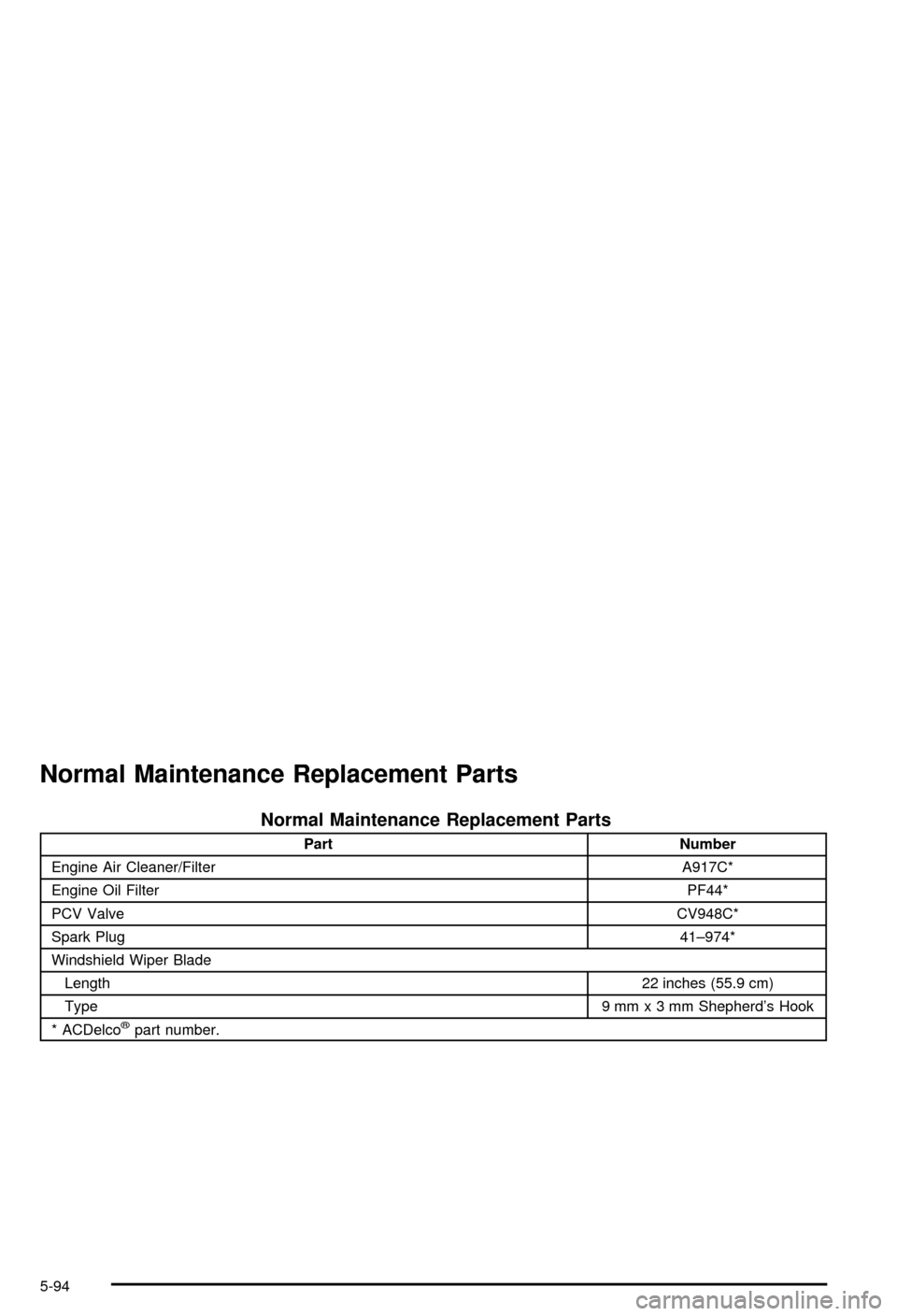
Normal Maintenance Replacement Parts
Normal Maintenance Replacement Parts
Part Number
Engine Air Cleaner/Filter A917C*
Engine Oil FilterPF44*
PCV ValveCV948C*
Spark Plug41±974*
Windshield Wiper Blade
Length22 inches (55.9 cm)
Type9 mm x 3 mm Shepherd's Hook
* ACDelco
žpart number.
5-94
Page 323 of 368

Engine Accessory Drive Belt Routing
5-95
Page 325 of 368

Maintenance Schedule......................................6-2
Introduction...................................................6-2
Your Vehicle and the Environment....................6-2
Maintenance Requirements..............................6-2
How This Section is Organized.........................6-3
Part A: Scheduled Maintenance Services...........6-4
Using Your Maintenance Schedule....................6-4
Scheduled Maintenance...................................6-4
Part B: Owner Checks and Services.................6-8
At Each Fuel Fill............................................6-8
At Least Once a Month...................................6-8
At Least Twice a Year....................................6-9At Least Once a Year.....................................6-9
Part C: Periodic MaintenanceInspections.........6-12
Steering and Suspension Inspection................6-12
Tire and Wheel Inspection.............................6-12
Exhaust System Inspection............................6-12
Fuel System Inspection..................................6-13
Engine Cooling System Inspection...................6-13
Rear Axle Service.........................................6-13
Brake System Inspection................................6-13
Part D: Recommended Fluids and
Lubricants................................................6-14
Part E: Maintenance Record...........................6-16
Section 6 Maintenance Schedule
6-1
Page 326 of 368

Maintenance Schedule
Introduction
Important: Keep engine oil at the proper level and
change as recommended.
Have you purchased the GM Protection Plan? The Plan
supplements your new vehicle warranties. See your
Warranty and Owner Assistance booklet or your dealer
for details.
Your Vehicle and the Environment
Proper vehicle maintenance not only helps to keep your
vehicle in good working condition, but also helps the
environment. Improper vehicle maintenance can
even affect the quality of the air we breathe. Improper
¯uid levels or the wrong tire in¯ation can increase
the level of emissions from your vehicle. To help protect
our environment, and to keep your vehicle in good
condition, be sure to maintain your vehicle properly.
Maintenance Requirements
Maintenance intervals, checks, inspections and
recommended ¯uids and lubricants as prescribed in this
manual are necessary to keep your vehicle in good
working condition. Any damage caused by failure
to follow scheduled maintenance may not be covered by
warranty.
6-2