wheel CHEVROLET CORVETTE 2004 5.G Owner's Guide
[x] Cancel search | Manufacturer: CHEVROLET, Model Year: 2004, Model line: CORVETTE, Model: CHEVROLET CORVETTE 2004 5.GPages: 384, PDF Size: 2.46 MB
Page 237 of 384
Towing
Towing Your Vehicle
Consult your dealer or a professional towing service if
you need to have your disabled vehicle towed. See
Roadside Assistance Program on page 7-6.
Recreational Vehicle Towing
Recreational vehicle towing means towing your vehicle
behind another vehicle — such as behind a motorhome.
The two most common types of recreational vehicle
towing are known as “dinghy towing” (towing your vehicle
with all four wheels on the ground) and “dolly towing”
(towing your vehicle with two wheels on the ground and
two wheels up on a device known as a “dolly”).
Your vehicle was not designed to be towed with any of
its wheels on the ground. If your vehicle must be
towed, see “Towing Your Vehicle” earlier in this section.
Loading Your Vehicle
It is very important to know how much weight your
vehicle can carry. This weight is called the vehicle
capacity weight and includes the weight of all occupants,
cargo and all nonfactory-installed options. Two labels
on your vehicle show how much weight it may properly
carry, the Tire and Loading Information label and the
Certification label.
{CAUTION:
Do not load your vehicle any heavier than the
GVWR, or either the maximum front or rear
GAWR. If you do, parts on your vehicle can
break, and it can change the way your vehicle
handles. These could cause you to lose
control and crash. Also, overloading can
shorten the life of your vehicle.
4-33
Page 243 of 384
Service............................................................5-3
Doing Your Own Service Work.........................5-4
Adding Equipment to the Outside of
Your Vehicle..............................................5-4
Fuel................................................................5-4
Gasoline Octane............................................5-5
Gasoline Specifications....................................5-5
California Fuel...............................................5-5
Additives.......................................................5-6
Fuels in Foreign Countries...............................5-6
Filling Your Tank............................................5-7
Filling a Portable Fuel Container.....................5-10
Checking Things Under the Hood....................5-10
Hood Release..............................................5-11
Engine Compartment Overview.......................5-12
Engine Oil...................................................5-13
Engine Air Cleaner/Filter................................5-18
Automatic Transmission Fluid.........................5-20
Manual Transmission Fluid.............................5-21
Hydraulic Clutch...........................................5-22
Engine Coolant.............................................5-23
Coolant Surge Tank Pressure Cap..................5-26
Engine Overheating.......................................5-26
Cooling System............................................5-29
Power Steering Fluid.....................................5-35
Windshield Washer Fluid................................5-36Brakes........................................................5-37
Battery........................................................5-40
Jump Starting...............................................5-41
Rear Axle.......................................................5-47
Bulb Replacement..........................................5-48
Halogen Bulbs..............................................5-48
Headlamps..................................................5-48
Taillamps and Turn Signal Lamps...................5-50
Back-Up Lamps............................................5-52
Windshield Wiper Blade Replacement..............5-52
Tires..............................................................5-55
Extended Mobility Tires (Except Z06)...............5-61
Inflation - Tire Pressure.................................5-62
Tire Pressure Monitor Operation
(Except Z06).............................................5-64
Tire Rotation................................................5-65
When It Is Time for New Tires.......................5-65
Buying New Tires.........................................5-66
Uniform Tire Quality Grading..........................5-67
Wheel Alignment and Tire Balance..................5-68
Wheel Replacement......................................5-68
Tire Chains..................................................5-71
Lifting Your Vehicle.......................................5-71
If a Tire Goes Flat........................................5-75
Tire Inflator Kit (Z06 Only).............................5-77
Section 5 Service and Appearance Care
5-1
Page 244 of 384
Appearance Care............................................5-82
Cleaning the Inside of Your Vehicle.................5-83
Care of Safety Belts......................................5-85
Weatherstrips...............................................5-85
Cleaning the Outside of Your Vehicle..............5-85
Finish Damage.............................................5-89
Carbon Fiber Hood (Z06 Commemorative
Edition Model Only)...................................5-89
Magnesium Wheel Finish...............................5-89
Underbody Maintenance................................5-89
Titanium Exhaust System (Z06 Only)...............5-89
Fiberglass Springs........................................5-90
Chemical Paint Spotting.................................5-90
Vehicle Care/Appearance Materials..................5-90Vehicle Identication......................................5-91
Vehicle Identification Number (VIN).................5-91
Service Parts Identification Label.....................5-92
Electrical System............................................5-92
Add-On Electrical Equipment..........................5-92
Headlamp Wiring..........................................5-92
Windshield Wiper Fuses................................5-92
Power Windows and Other Power Options.......5-92
Fuses and Circuit Breakers............................5-93
Capacities and Specications..........................5-99
Section 5 Service and Appearance Care
5-2
Page 281 of 384
Brake Wear
Your vehicle has four-wheel disc brakes.
Disc brake pads have built-in wear indicators that make
a high-pitched warning sound when the brake pads
are worn and new pads are needed. The sound
may come and go or be heard all the time your vehicle
is moving (except when you are pushing on the
brake pedal firmly).
{CAUTION:
The brake wear warning sound means that
soon your brakes will not work well. That
could lead to an accident. When you hear the
brake wear warning sound, have your vehicle
serviced.
Z06 models are equipped with high performance front
brake linings designed for improved brake performance
under severe use. They will normally exhibit some
low speed noise and you may notice an increase in the
amount of brake dust.Notice:Continuing to drive with worn-out brake
pads could result in costly brake repair.
Some driving conditions or climates may cause a brake
squeal when the brakes are first applied or lightly
applied. This does not mean something is wrong with
your brakes.
Brake linings should always be replaced as complete
axle sets.
Brake Pedal Travel
See your dealer if the brake pedal does not return to
normal height, or if there is a rapid increase in
pedal travel. This could be a sign of brake trouble.
Brake Adjustment
As you make brake stops, your disc brakes
automatically adjust for wear.
5-39
Page 300 of 384
(C) Aspect Ratio:A two-digit number that indicates the
tire height-to-width measurements. For example, if
the tire size aspect ratio is “70,” as shown in item “C” of
the illustration, it would mean that the tire’s sidewall
is 70% as high as it is wide.
(D) Construction Code:A letter code is used to
indicate the type of ply construction in the tire. The letter
“R” means radial ply construction; the letter “D” means
diagonal or bias ply construction; and the letter “B”
means belted-bias ply construction.
(E) Rim Diameter:Diameter of the wheel in inches.
(F) Service Description:These characters represent
the load range and the speed rating of a tire. The
load range represents the load carrying capacity a tire is
certified to carry. The load index can range from 1 to
279. The speed rating is the maximum speed a tire
is certified to carry a load. Speed ratings range
from “A” to “Z”.Tire Terminology and Denitions
Air Pressure:The amount of air inside the tire pressing
outward on each square inch of the tire. Air pressure
is expressed in pounds per square inch (psi) or
kilopascal (kPa).
Accessory Weight:This means the combined weight
of optional accessories. Some examples of optional
accessories are, automatic transmission, power steering,
power brakes, power windows, power seats, and air
conditioning.
Aspect Ratio:The relationship of a tire’s height to its
width.
Belt:A rubber coated layer of cords that is located
between the plies and the tread. Cords may be made
from steel or other reinforcing materials.
Bead:The tire bead contains steel wires wrapped by
steel cords that hold the tire onto the rim.
Bias Ply Tire:A pneumatic tire in which the plies are
laid at alternate angles less than 90 degrees to the
centerline of the tread.
Cold Ination Pressure:The amount of air pressure
in a tire, measured in pounds per square inch (psi)
before a tire has built up heat from driving.
SeeInation - Tire Pressure on page 5-62.
5-58
Page 303 of 384
Extended Mobility Tires
(Except Z06)
Your vehicle, when new, had Goodyear Extended
Mobility Tires (EMT). There’s no spare tire, no tire
changing equipment and no place to store a tire in the
vehicle. Extended Mobility Tires perform so well
without any air that a Tire Pressure Monitor (TPM) is
used to alert you if a tire has lost pressure.
If a tire goes flat, you won’t need to stop on the side of
the road to change the tire. You can just keep on
driving. The shorter the distance you drive and the
slower the speed, the greater the chance that the tire will
not have to be replaced. If you drive on a deflated
EMT for 50 miles (80 km) or less and at speeds
of 55 mph (90 km/h) or less, there is a good chance that
the tire can be repaired. The tire can operate effectively
with no air pressure for up to 200 miles (320 km) at
speeds up to 55 mph (90 km/h), but the tire would then
have to be replaced. When a tire is filled with air, it
provides a cushion between the road and the wheel.
Because you won’t have this cushion when driving on a
deflated tire, try to avoid potholes that could damage
your wheel and require replacement of it.
Some road hazards can damage a tire beyond repair.
This damage could occur even before you’ve driven
on the tire in a deflated condition. When a tire has been
damaged, or if you’ve driven any distance on adeflated EMT, check with an authorized Goodyear EMT
Service Center to determine whether the tire can be
repaired or should be replaced. To maintain your
vehicle’s extended mobility feature, all replacement tires
must be Extended Mobility Tires. As soon as possible,
contact the nearest authorized GM or Goodyear
EMT servicing facility for inspection and repair or
replacement. To locate the nearest GM or Goodyear
EMT servicing facility, call Roadside Assistance.
For phone numbers and Roadside Assistance details
seeRoadside Assistance Program on page 7-6.
You may also contact Goodyear, for the nearest
authorized EMT servicing facility, by calling
1-800-789-9878.
{CAUTION:
Extended mobility tires are constructed
differently than other tires and could explode
during improper service. You or others could
be injured or killed if you attempt to repair,
replace, dismount, or mount a extended
mobility tire. Let only an authorized EMT
Service Center repair, replace, dismount and
mount extended mobility tires.
5-61
Page 304 of 384
The valve stems on your extended mobility tires have
sensors that are part of the Tire Pressure Monitor
(TPM). SeeTire Pressure Monitor Operation
(Except Z06) on page 5-64. The TPM sensors contain
batteries which are designed to last for 10 years
under normal driving conditions. See your dealer if you
ever need to have a wheel replaced, or if the sensors
ever need replacement.
Notice:Using liquid sealants can damage the tire
valves and tire pressure monitor sensors in your
extended mobility tires. This damage would not be
covered by warranty. Don’t use liquid sealants
in your extended mobility tires.
If you feel that winter tires are needed for your driving
conditions, Goodyear Eagle M+S EMT tires are available
in your original equipment sizes from an authorized
Goodyear EMT retailer. These tires will improve snow
traction while maintaining your vehicle’s extended
mobility feature. When using winter tires on your vehicle,
be sure to use them on all four wheels. SeeBuying
New Tires on page 5-66.Ination - Tire Pressure
The tire and loading information label, shows the correct
inflation pressures for your tires when they’re cold.
“Cold” means your vehicle has been sitting for at least
three hours or driven no more than 1 mile (1.6 km). See
Loading Your Vehicle on page 4-33, for the location
of your vehicle’s tire and loading information label.
Notice:Don’t let anyone tell you that underination
or overination is all right. It’s not. If your tires
don’t have enough air (underination), you can get
the following:
Too much exing
Too much heat
Tire overloading
Bad wear
Bad handling
Bad fuel economy
If your tires have too much air (overination), you
can get the following:
Unusual wear
Bad handling
Rough ride
Needless damage from road hazards
5-62
Page 306 of 384
Tire Pressure Monitor Operation
(Except Z06)
The Tire Pressure Monitor (TPM) has a sensor on each
road wheel that transmits to a receiver on the
instrument panel.
The system operates on a radio frequency subject to
Federal Communications Commission (FCC) Rules and
with Industry and Science Canada.
This device complies with Part 15 of the FCC Rules.
Operation is subject to the following two conditions:
(1) this device may not cause harmful interference, and
(2) this device must accept any interference received,
including interference that may cause undesired
operation.
This device complies with RSS–210 of Industry and
Science Canada. Operation is subject to the following
two conditions: (1) this device may not cause
interference, and (2) this device must accept any
interference received, including interference that may
cause undesired operation of the device.Changes or modifications to this system by other than
an authorized service facility could void authorization to
use this equipment.
If a tire’s inflation pressure is between 5 psi (35 kPa)
and 25 psi (170 kPa), you will see a message on
the Driver Information Center. This message will show
which tire is underinflated and two chimes will sound. An
example would be LOW TIRE PRESSURE-LR. This
would mean that the inflation pressure in your left rear
tire is between 5 psi (35 kPa) and 25 psi (170 kPa).
If the inflation pressure in the tire drops below
5 psi (35 kPa), the message would read FLAT TIRE-LR
and four chimes will sound. SeeDriver Information
Center (DIC) on page 3-48.
The TPM will also alert you if a tire’s pressure is higher
than 42 psi (290 kPa). The message will show which
tire is overinflated and two chimes will sound. An
example would be HIGH PRESSURE-LR. This would
mean that the inflation pressure in your left rear tire
is higher than 42 psi (290 kPa). SeeDriver Information
Center (DIC) on page 3-48.
5-64
Page 307 of 384
If a tire pressure message appears on the Driver
Information Center, stop as soon as you can. Have the
tire pressures checked and set to those shown on
your Tire-Loading Information label. SeeInation - Tire
Pressure on page 5-62.
{CAUTION:
When the LOW TIRE PRESSURE or FLAT TIRE
message is displayed on the Driver Information
Center, your vehicle’s handling capabilities will
be reduced during severe maneuvers. If you
drive too fast, you could lose control of your
vehicle. You or others could be injured. Don’t
drive over 55 mph (90 km/h) when the LOW
TIRE PRESSURE or FLAT TIRE message is
displayed. Drive cautiously, and check your
tire pressures as soon as you can.
Tire Rotation
The tires on your vehicle are different sizes front to rear.
Due to this, your tires should not be rotated. Each tire
and wheel should be used only in the position it is in.
When It Is Time for New Tires
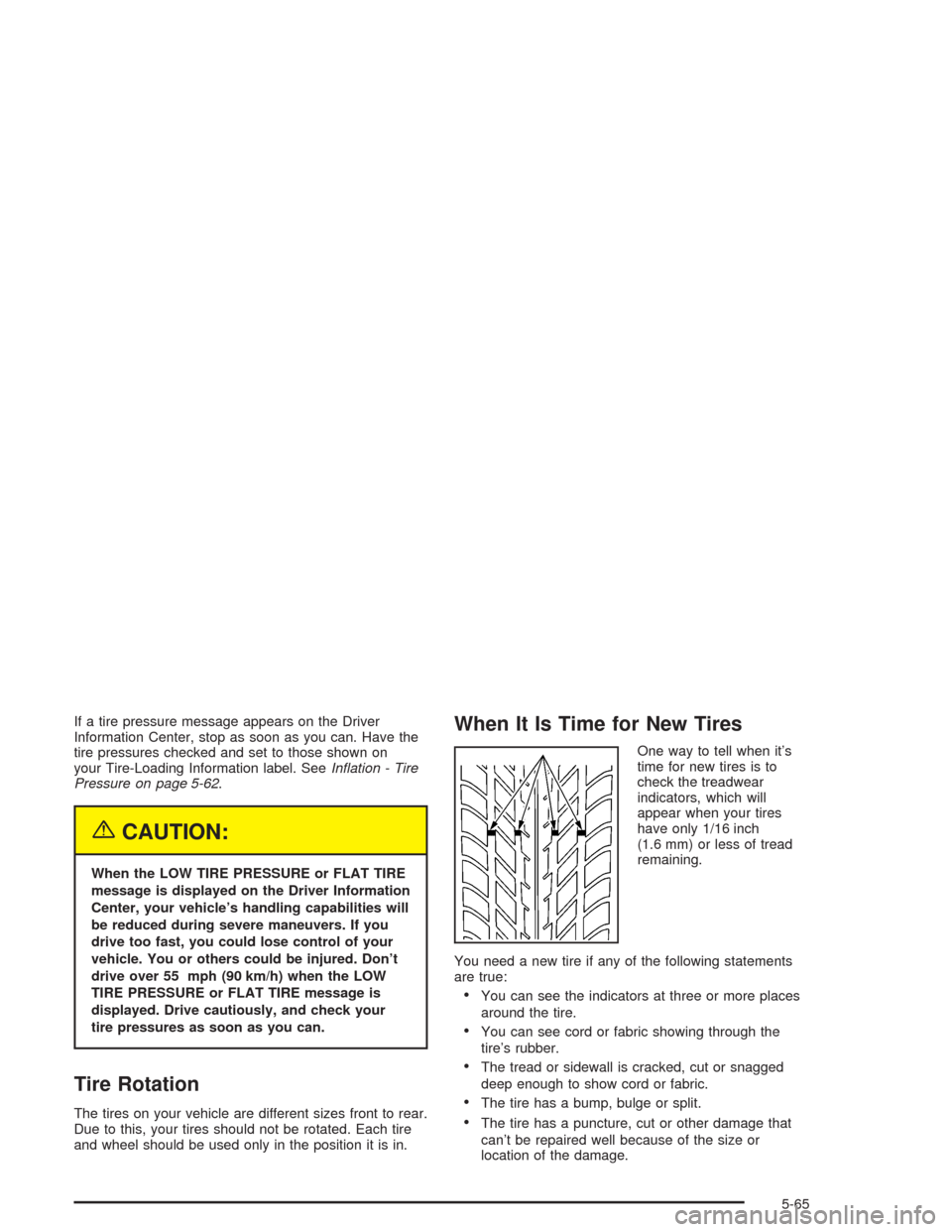
One way to tell when it’s
time for new tires is to
check the treadwear
indicators, which will
appear when your tires
have only 1/16 inch
(1.6 mm) or less of tread
remaining.
You need a new tire if any of the following statements
are true:
•You can see the indicators at three or more places
around the tire.
•You can see cord or fabric showing through the
tire’s rubber.
•The tread or sidewall is cracked, cut or snagged
deep enough to show cord or fabric.
•The tire has a bump, bulge or split.
•The tire has a puncture, cut or other damage that
can’t be repaired well because of the size or
location of the damage.
5-65
Page 308 of 384
Buying New Tires
To find out what kind and size of tires your vehicle
needs, look at the Tire and Loading Information label.
SeeLoading Your Vehicle on page 4-33, for an example
of the label and where it is located on your vehicle.
The tires installed on your vehicle when it was new had
a Tire Performance Criteria Specification (TPC Spec)
number on each tire’s sidewall. When you get new tires,
GM recommends that you get tires with that same
TPC Spec number. That way your vehicle will continue
to have tires that are designed to give proper
endurance, handling, load range, speed rating, traction,
ride, tire pressure monitoring system performance
and other things during normal service on your vehicle.
If your tires have an all-season tread design, the
TPC number will be followed by an “MS” (for mud
and snow).
If you ever replace your tires with those not having a
TPC Spec number, make sure they are the same size,
load range, speed rating and construction type (bias,
bias-belted or radial) as your original tires.{CAUTION:
Mixing tires could cause you to lose control
while driving. If you mix tires of different sizes
(other than those originally installed on your
vehicle) or types (radial and bias-belted tires),
the vehicle may not handle properly, and you
could have a crash. Using tires of different
sizes (other than those originally installed on
your vehicle) may also cause damage to your
vehicle. Be sure to use the correct size and
type tires on all four wheels.
If your vehicle is equipped with Extended Mobility Tires
and you feel that winter tires are needed, see
Extended Mobility Tires (Except Z06) on page 5-61.
{CAUTION:
If you use bias-ply tires on your vehicle, the
wheel rim anges could develop cracks after
many miles of driving. A tire and/or wheel
could fail suddenly, causing a crash. Use only
radial-ply tires with the wheels on your vehicle.
5-66