instrument panel CHEVROLET CORVETTE 2007 6.G Repair Manual
[x] Cancel search | Manufacturer: CHEVROLET, Model Year: 2007, Model line: CORVETTE, Model: CHEVROLET CORVETTE 2007 6.GPages: 488, PDF Size: 2.62 MB
Page 350 of 488
Coolant Surge Tank Pressure Cap
Notice:If the pressure cap is not tightly
installed, coolant loss and possible engine
damage may occur. Be sure the cap is
properly and tightly secured.
The coolant surge tank pressure cap must
be fully installed on the coolant surge tank.
SeeEngine Compartment Overview on
page 330for more information on location.
Engine Overheating
You will nd an engine coolant temperature
gage on the instrument panel cluster and a
COOLANT OVER TEMPERATURE message
on the Driver Information Center (DIC). See
Engine Coolant Temperature Gage on page 199
andDIC Warnings and Messages on page 214
for more information.
If Steam Is Coming From Your Engine
{CAUTION:
Steam from an overheated engine can
burn you badly, even if you just open
the hood. Stay away from the engine if
you see or hear steam coming from it.
Turn it off and get everyone away from
the vehicle until it cools down. Wait until
there is no sign of steam or coolant
before you open the hood.
If you keep driving when the vehicles
engine is overheated, the liquids in it can
catch re. You or others could be badly
burned. Stop your engine if it overheats,
and get out of the vehicle until the
engine is cool.
CAUTION: (Continued)
350
Page 389 of 488
Tire Pressure Monitor System
The Tire Pressure Monitor System (TPMS) uses
radio and sensor technology to check tire pressure
levels. TPMS sensors are mounted onto each
tire and wheel assembly. The TPMS sensors
monitor the air pressure in your vehicle’s tires
and transmit tire pressure readings to a receiver
located in the vehicle.
The TPMS is designed to alert the driver if a
low pressure condition exists. Using the Driver
Information Center (DIC), tire pressure levels can
be viewed by the driver. For additional information
and details about the DIC operation and displays
seeDIC Controls and Displays on page 208
andDIC Warnings and Messages on page 214.
When a low tire pressure condition is detected,
the TPMS will illuminate the low tire pressure
warning symbol located in the instrument panel
cluster. A DIC message to check the pressure in a
specic tire will also appear on the DIC display.The low tire pressure warning symbol on the
instrument panel cluster and the LOW TIRE
PRESSURE message on the DIC display will
appear at each ignition cycle until the tires
are inated to the correct ination pressure.
You may notice, during cooler weather conditions,
that the low tire pressure warning light and the
DIC warning message will appear when the vehicle
is rst started and then turn off as you start to
drive the vehicle. This could be an early indicator
that the tire pressures are getting low and
need to be inated to the proper pressure.
Each tire, including the spare (if provided), should
be checked monthly when cold and inated to
the ination pressure recommended by the
vehicle manufacturer on the vehicle placard or
tire ination pressure label. (If your vehicle
has tires of a different size than the size indicated
on the vehicle placard or tire ination pressure
label, you should determine the proper tire
ination pressure for those tires.)
389
Page 410 of 488
Leather
A soft cloth dampened with water may be used
to remove dust. If a more thorough cleaning
is necessary, a soft cloth dampened with a
mild soap solution can be used. Allow the
leather to dry naturally. Do not use heat to dry.
Never use steam to clean leather. Never use
spot lifters or spot removers on leather. Many
commercial leather cleaners and coatings that
are sold to preserve and protect leather may
permanently change the appearance and feel
of your leather and are not recommended. Do not
use silicone or wax-based products, or those
containing organic solvents to clean your vehicle’s
interior because they can alter the appearance
by increasing the gloss in a non-uniform manner.
Never use shoe polish on your leather.
Instrument Panel, Vinyl, and
Other Plastic Surfaces
A soft cloth dampened with water may be used
to remove dust. If a more thorough cleaning
is necessary, a clean soft cloth dampened
with a mild soap solution can be used to gently
remove dust and dirt. Never use spot lifters
or removers on plastic surfaces. Many commercial
cleaners and coatings that are sold to preserve
and protect soft plastic surfaces may permanently
change the appearance and feel of your interior
and are not recommended. Do not use silicone or
wax-based products, or those containing organic
solvents to clean your vehicle’s interior because
they can alter the appearance by increasing
the gloss in a non-uniform manner.
Some commercial products may increase gloss
on your instrument panel. The increase in
gloss may cause annoying reections in the
windshield and even make it difficult to see
through the windshield under certain conditions.
410
Page 418 of 488
Vehicle Identication
Vehicle Identication Number (VIN)
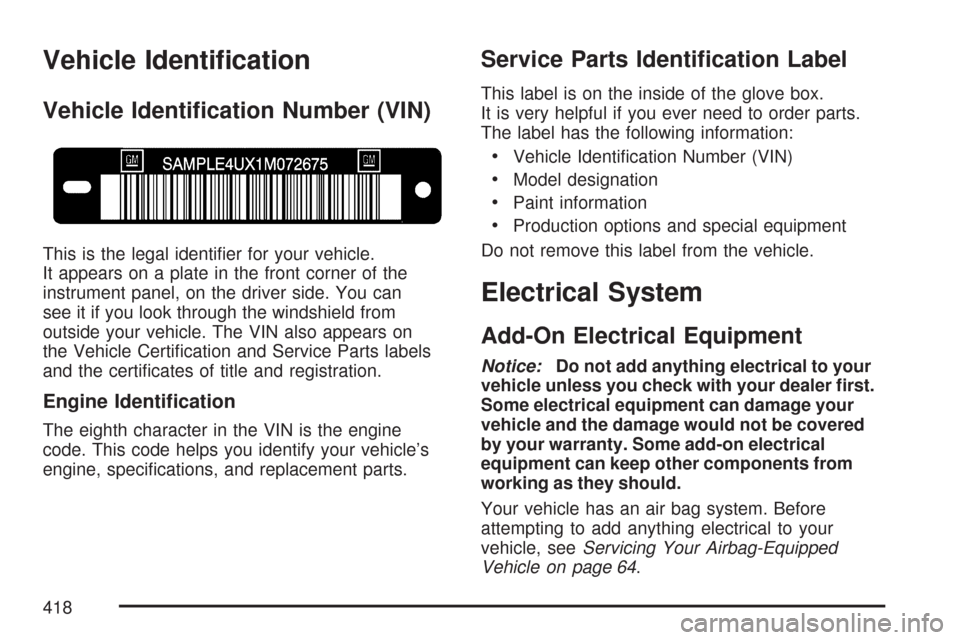
This is the legal identier for your vehicle.
It appears on a plate in the front corner of the
instrument panel, on the driver side. You can
see it if you look through the windshield from
outside your vehicle. The VIN also appears on
the Vehicle Certication and Service Parts labels
and the certicates of title and registration.
Engine Identication
The eighth character in the VIN is the engine
code. This code helps you identify your vehicle’s
engine, specications, and replacement parts.
Service Parts Identication Label
This label is on the inside of the glove box.
It is very helpful if you ever need to order parts.
The label has the following information:
Vehicle Identication Number (VIN)
Model designation
Paint information
Production options and special equipment
Do not remove this label from the vehicle.
Electrical System
Add-On Electrical Equipment
Notice:Do not add anything electrical to your
vehicle unless you check with your dealer rst.
Some electrical equipment can damage your
vehicle and the damage would not be covered
by your warranty. Some add-on electrical
equipment can keep other components from
working as they should.
Your vehicle has an air bag system. Before
attempting to add anything electrical to your
vehicle, seeServicing Your Airbag-Equipped
Vehicle on page 64.
418
Page 419 of 488
Headlamp Wiring
The headlamp wiring is protected by fuses in the
fuse block. An electrical overload will cause
the lamps to turn off. If this happens, have your
headlamp wiring checked right away.
Windshield Wiper Fuses
The windshield wiper motor is protected by a
fuse and an internal circuit breaker. If the motor
overheats due to heavy snow, etc., the wiper will
stop until the motor cools. If the overload is caused
by some electrical problem and not snow, etc.,
be sure to get it xed.
Power Windows and Other
Power Options
Circuit breakers protect the power seats, power
windows, and other power accessories. When the
current load is too heavy, the circuit breaker opens
and closes, protecting the circuit until the problem
is xed or goes away.
Fuses and Circuit Breakers
The wiring circuits in your vehicle are protected from
short circuits by a combination of J-Case fuses,
mini-fuses and circuit breakers. This greatly reduces
the chance of res caused by electrical problems.
Look at the silver-colored band inside the fuse.
If the band is broken or melted, replace the
fuse. Be sure you replace a bad fuse with a
new one of the identical size and rating.
If you ever have a problem on the road and do not
have a spare fuse, you can borrow one that has the
same amperage. Just pick some feature of your
vehicle that you can get along without — like
the radio or cigarette lighter — and use its fuse,
if it is the correct amperage. Replace it as soon
as you can.
Instrument Panel Fuse Block
The instrument panel fuse block is located on
the passenger’s side of the vehicle, under
the instrument panel and under the toe-board.
419
Page 452 of 488
Customer Assistance and
Information
Customer Satisfaction Procedure
Your satisfaction and goodwill are important
to your dealer and to Chevrolet. Normally, any
concerns with the sales transaction or the
operation of your vehicle will be resolved by your
dealer’s sales or service departments. Sometimes,
however, despite the best intentions of all
concerned, misunderstandings can occur. If your
concern has not been resolved to your
satisfaction, the following steps should be taken:
STEP ONE:Discuss your concern with a member
of dealership management. Normally, concerns
can be quickly resolved at that level. If the matter
has already been reviewed with the sales,
service, or parts manager, contact the owner of
the dealership or the general manager.STEP TWO:If after contacting a member of
dealership management, it appears your concern
cannot be resolved by the dealership without
further help, in the U.S., contact the Chevrolet
Customer Assistance Center by calling
1-800-222-1020. In Canada, contact General
Motors of Canada Customer Communication
Centre by calling 1-800-263-3777 (English) or
1-800-263-7854 (French).
We encourage you to call the toll-free number in
order to give your inquiry prompt attention. Please
have the following information available to give
the Customer Assistance Representative:
Vehicle Identication Number (VIN). This is
available from the vehicle registration or title, or
the plate at the top left of the instrument panel
and visible through the windshield.
Dealership name and location.
Vehicle delivery date and present mileage
(kilometers).
When contacting Chevrolet, please remember that
your concern will likely be resolved at a dealer’s
facility. That is why we suggest you follow
Step One rst if you have a concern.
452
Page 473 of 488
A
Accessories and Modications..................... 319
Active Handling System............................... 283
Active Handling System Light...................... 198
Adding Equipment to Your
Airbag-Equipped Vehicle............................ 65
Additives, Fuel............................................ 323
Add-On Electrical Equipment....................... 418
Air Cleaner/Filter, Engine............................. 342
Air Conditioning........................................... 179
Airbag
Passenger Status Indicator....................... 192
Readiness Light....................................... 191
Airbag System............................................... 50
What Will You See After an
Airbag Inates?...................................... 58
When Should an Airbag Inate?................. 55
Where Are the Airbags?............................. 53
Airbag Systems
Adding Equipment to Your
Airbag-Equipped Vehicle......................... 65
How Does an Airbag Restrain?.................. 57
Passenger Sensing System....................... 59
Servicing Your Airbag-Equipped Vehicle..... 64
What Makes an Airbag Inate?.................. 57Antenna, Diversity Antenna System............. 272
Antenna, XM™ Satellite Radio
Antenna System....................................... 272
Anti-Lock Brake System.............................. 279
Anti-Lock Brake, System Warning Light....... 197
Appearance Care
Aluminum or Chrome-Plated Wheels........ 414
Care of Safety Belts................................ 411
Cargo Cover and Convenience Net.......... 411
Chemical Paint Spotting........................... 416
Cleaning Exterior Lamps/Lenses.............. 412
Cleaning the Inside of Your Vehicle.......... 407
Coated Moldings...................................... 409
Convertible Top........................................ 414
Fabric/Carpet........................................... 409
Fiberglass Springs................................... 416
Finish Care.............................................. 412
Finish Damage......................................... 415
Instrument Panel, Vinyl, and Other
Plastic Surfaces.................................... 410
Leather.................................................... 410
Removable Roof Panel............................ 413
Tires........................................................ 415
Underbody Maintenance........................... 416
Vehicle Care/Appearance Materials.......... 417
Washing Your Vehicle.............................. 411
473
Page 475 of 488
C
Calibration..........................................108, 110
California Fuel............................................. 322
California Proposition 65 Warning................ 320
Canadian Owners........................................... 3
Capacities and Specications...................... 426
Carbon Monoxide............... 82,106, 304, 315
Care of
Safety Belts............................................. 411
Your CD Player........................................ 272
Your CDs ................................................. 271
Cargo Cover............................................... 132
CD, MP3 ..................................................... 261
Center Console Storage Area...................... 130
Chains, Tire................................................. 401
Check
Engine Light............................................ 200
Checking Things Under the Hood................ 328
Chemical Paint Spotting.............................. 416
Child Restraints
Child Restraint Systems............................. 37
Infants and Young Children........................ 34
Lower Anchors and Tethers
for Children..................................... 42, 46Child Restraints (cont.)
Older Children........................................... 31
Securing a Child Restraint in the
Passenger Seat Position......................... 46
Cigarette Lighter.......................................... 179
Cleaning
Aluminum or Chrome-Plated Wheels........ 414
Cargo Cover and Convenience Net.......... 411
Coated Moldings...................................... 409
Convertible Top........................................ 414
Exterior Lamps/Lenses............................. 412
Fabric/Carpet........................................... 409
Fiberglass Springs................................... 416
Finish Care.............................................. 412
Inside of Your Vehicle.............................. 407
Instrument Panel, Vinyl, and
Other Plastic Surfaces.......................... 410
Leather.................................................... 410
Removable Roof Panel............................ 413
Tires........................................................ 415
Underbody Maintenance........................... 416
Washing Your Vehicle.............................. 411
Weatherstrips........................................... 411
Windshield and Wiper Blades................... 413
475
Page 477 of 488
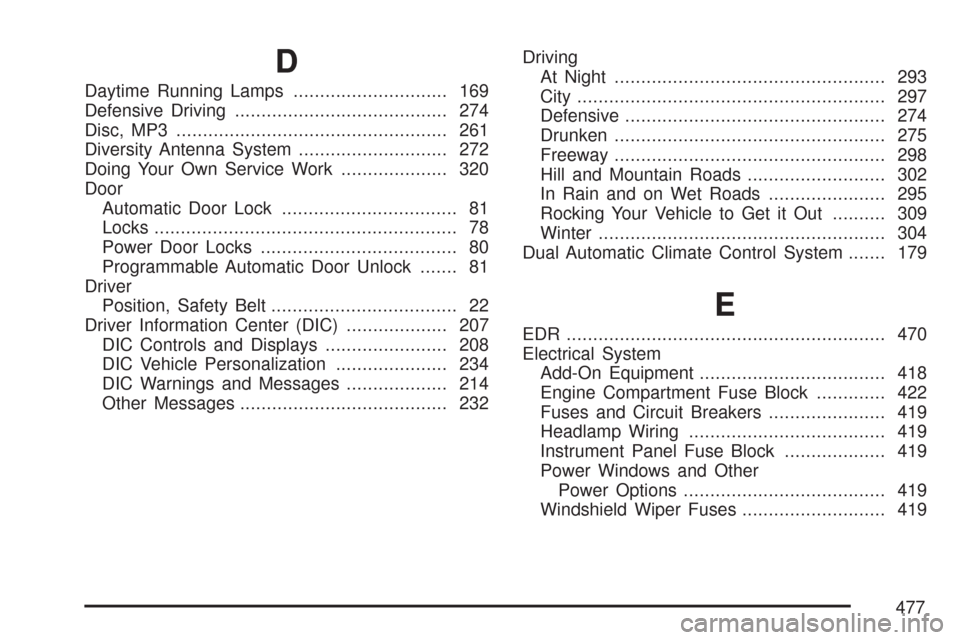
D
Daytime Running Lamps............................. 169
Defensive Driving........................................ 274
Disc, MP3................................................... 261
Diversity Antenna System............................ 272
Doing Your Own Service Work.................... 320
Door
Automatic Door Lock................................. 81
Locks......................................................... 78
Power Door Locks..................................... 80
Programmable Automatic Door Unlock....... 81
Driver
Position, Safety Belt................................... 22
Driver Information Center (DIC)................... 207
DIC Controls and Displays....................... 208
DIC Vehicle Personalization..................... 234
DIC Warnings and Messages................... 214
Other Messages....................................... 232Driving
At Night................................................... 293
City.......................................................... 297
Defensive................................................. 274
Drunken................................................... 275
Freeway................................................... 298
Hill and Mountain Roads.......................... 302
In Rain and on Wet Roads...................... 295
Rocking Your Vehicle to Get it Out.......... 309
Winter...................................................... 304
Dual Automatic Climate Control System....... 179
E
EDR ............................................................ 470
Electrical System
Add-On Equipment................................... 418
Engine Compartment Fuse Block............. 422
Fuses and Circuit Breakers...................... 419
Headlamp Wiring..................................... 419
Instrument Panel Fuse Block................... 419
Power Windows and Other
Power Options...................................... 419
Windshield Wiper Fuses........................... 419
477
Page 479 of 488
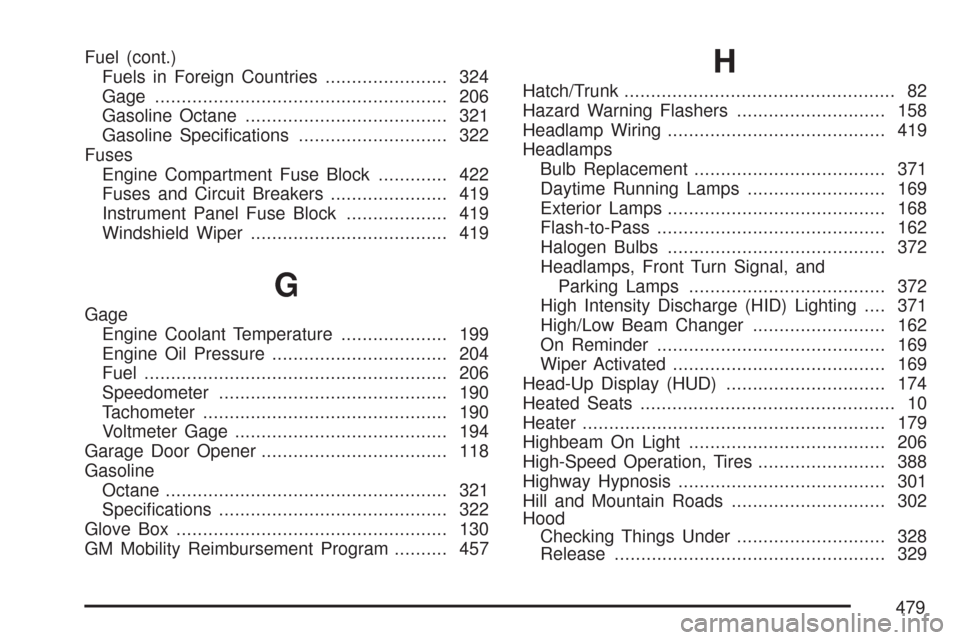
Fuel (cont.)
Fuels in Foreign Countries....................... 324
Gage....................................................... 206
Gasoline Octane...................................... 321
Gasoline Specications............................ 322
Fuses
Engine Compartment Fuse Block............. 422
Fuses and Circuit Breakers...................... 419
Instrument Panel Fuse Block................... 419
Windshield Wiper..................................... 419
G
Gage
Engine Coolant Temperature.................... 199
Engine Oil Pressure................................. 204
Fuel......................................................... 206
Speedometer........................................... 190
Tachometer.............................................. 190
Voltmeter Gage........................................ 194
Garage Door Opener................................... 118
Gasoline
Octane..................................................... 321
Specications........................................... 322
Glove Box................................................... 130
GM Mobility Reimbursement Program.......... 457
H
Hatch/Trunk................................................... 82
Hazard Warning Flashers............................ 158
Headlamp Wiring......................................... 419
Headlamps
Bulb Replacement.................................... 371
Daytime Running Lamps.......................... 169
Exterior Lamps......................................... 168
Flash-to-Pass........................................... 162
Halogen Bulbs......................................... 372
Headlamps, Front Turn Signal, and
Parking Lamps..................................... 372
High Intensity Discharge (HID) Lighting.... 371
High/Low Beam Changer......................... 162
On Reminder........................................... 169
Wiper Activated........................................ 169
Head-Up Display (HUD).............................. 174
Heated Seats................................................ 10
Heater......................................................... 179
Highbeam On Light..................................... 206
High-Speed Operation, Tires........................ 388
Highway Hypnosis....................................... 301
Hill and Mountain Roads............................. 302
Hood
Checking Things Under............................ 328
Release................................................... 329
479