radiator cap CHEVROLET CORVETTE 2007 6.G Owners Manual
[x] Cancel search | Manufacturer: CHEVROLET, Model Year: 2007, Model line: CORVETTE, Model: CHEVROLET CORVETTE 2007 6.GPages: 488, PDF Size: 2.62 MB
Page 349 of 488
Checking Coolant
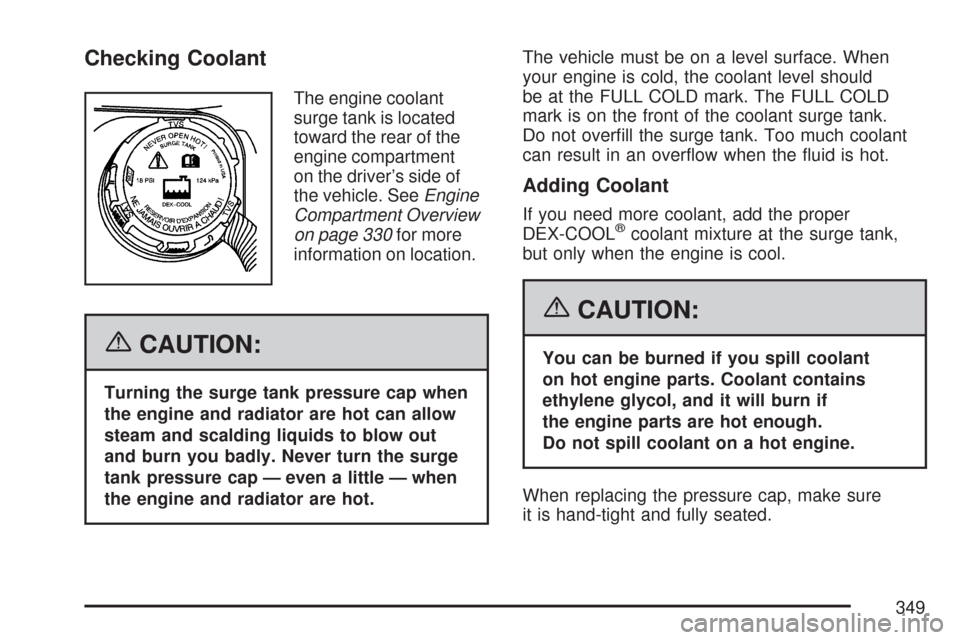
The engine coolant
surge tank is located
toward the rear of the
engine compartment
on the driver’s side of
the vehicle. SeeEngine
Compartment Overview
on page 330for more
information on location.
{CAUTION:
Turning the surge tank pressure cap when
the engine and radiator are hot can allow
steam and scalding liquids to blow out
and burn you badly. Never turn the surge
tank pressure cap — even a little — when
the engine and radiator are hot.The vehicle must be on a level surface. When
your engine is cold, the coolant level should
be at the FULL COLD mark. The FULL COLD
mark is on the front of the coolant surge tank.
Do not overll the surge tank. Too much coolant
can result in an overow when the uid is hot.
Adding Coolant
If you need more coolant, add the proper
DEX-COOL®coolant mixture at the surge tank,
but only when the engine is cool.
{CAUTION:
You can be burned if you spill coolant
on hot engine parts. Coolant contains
ethylene glycol, and it will burn if
the engine parts are hot enough.
Do not spill coolant on a hot engine.
When replacing the pressure cap, make sure
it is hand-tight and fully seated.
349
Page 354 of 488
The coolant level should be at the FULL COLD
mark on the front of the coolant surge tank. If it is
not, you may have a leak at the pressure cap or in
the radiator hoses, heater hoses, radiator, water
pump or somewhere else in the cooling system.
{CAUTION:
Heater and radiator hoses, and other
engine parts, can be very hot. Do not
touch them. If you do, you can be burned.
Do not run the engine if there is a leak.
If you run the engine, it could lose all
coolant. That could cause an engine re,
and you could be burned. Get any leak
xed before you drive the vehicle.
If there seems to be no leak, with the engine on,
check to see if the electric engine cooling fan is
running. If the engine is overheating, the fan should
be running. If it is not, your vehicle needs service.Notice:Engine damage from running your
engine without coolant is not covered by your
warranty. SeeOverheated Engine Protection
Operating Mode on page 352for information
on driving to a safe place in an emergency.
Notice:Using coolant other than DEX-COOL
®
may cause premature engine, heater core,
or radiator corrosion. In addition, the engine
coolant could require changing sooner,
at 30,000 miles (50 000 km) or 24 months,
whichever occurs rst. Any repairs would
not be covered by your warranty. Always
use DEX-COOL
®(silicate-free) coolant in
your vehicle.
How to Add Coolant to the Coolant
Surge Tank
If you have not found a problem yet, check
to see if coolant is visible in the surge tank.
If coolant is visible but the coolant level is not
at the FULL COLD mark on the front of the
coolant surge tank, add a 50/50 mixture of clean,
drinkable water and DEX-COOL
®coolant at
354
Page 355 of 488
the coolant surge tank, but be sure the cooling
system, including the coolant surge tank pressure
cap, is cool before you do it. SeeEngine
Coolant on page 347for more information.
If no coolant is visible in the surge tank, add
coolant as follows:
{CAUTION:
Steam and scalding liquids from a hot
cooling system can blow out and burn
you badly. They are under pressure, and if
you turn the coolant surge tank pressure
cap — even a little — they can come out
at high speed. Never turn the cap when
the cooling system, including the coolant
surge tank pressure cap, is hot. Wait
for the cooling system and coolant
surge tank pressure cap to cool if you
ever have to turn the pressure cap.
{CAUTION:
Adding only plain water to your cooling
system can be dangerous. Plain water, or
some other liquid such as alcohol, can
boil before the proper coolant mixture will.
Your vehicle’s coolant warning system is
set for the proper coolant mixture. With
plain water or the wrong mixture, your
engine could get too hot but you would
not get the overheat warning. Your engine
could catch re and you or others could
be burned. Use a 50/50 mixture of clean,
drinkable water and DEX-COOL
®coolant.
Notice:In cold weather, water can freeze and
crack the engine, radiator, heater core and
other parts. Use the recommended coolant
and the proper coolant mixture.
355
Page 356 of 488
{CAUTION:
You can be burned if you spill coolant
on hot engine parts. Coolant contains
ethylene glycol and it will burn if the
engine parts are hot enough. Do not
spill coolant on a hot engine.
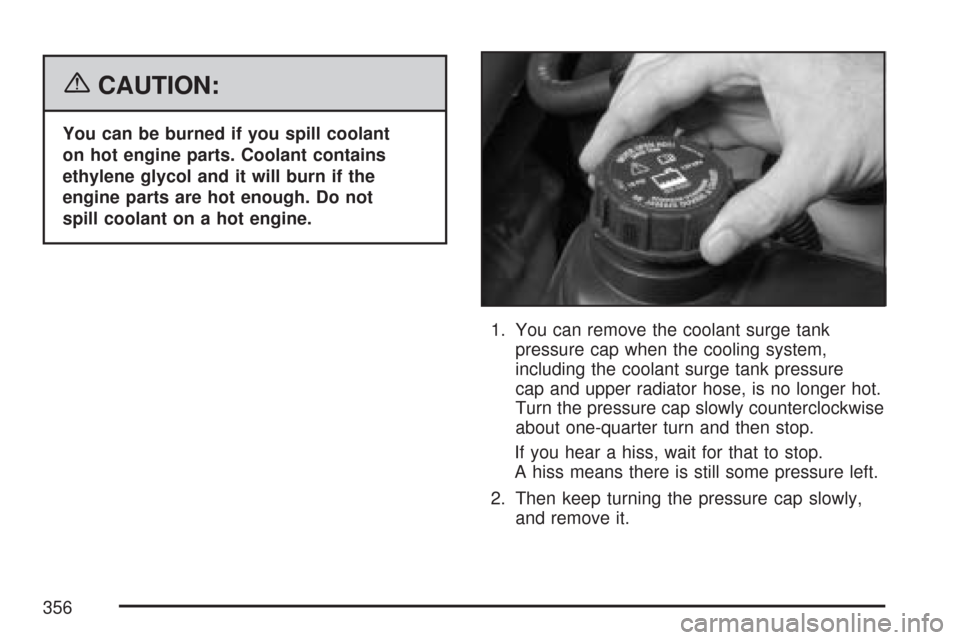
1. You can remove the coolant surge tank
pressure cap when the cooling system,
including the coolant surge tank pressure
cap and upper radiator hose, is no longer hot.
Turn the pressure cap slowly counterclockwise
about one-quarter turn and then stop.
If you hear a hiss, wait for that to stop.
A hiss means there is still some pressure left.
2. Then keep turning the pressure cap slowly,
and remove it.
356
Page 357 of 488
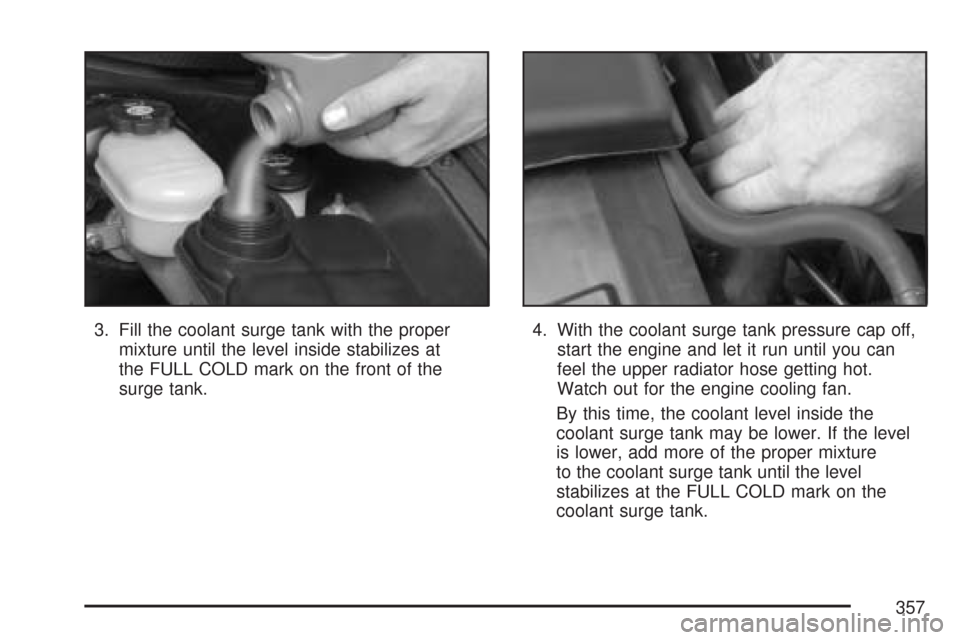
3. Fill the coolant surge tank with the proper
mixture until the level inside stabilizes at
the FULL COLD mark on the front of the
surge tank.4. With the coolant surge tank pressure cap off,
start the engine and let it run until you can
feel the upper radiator hose getting hot.
Watch out for the engine cooling fan.
By this time, the coolant level inside the
coolant surge tank may be lower. If the level
is lower, add more of the proper mixture
to the coolant surge tank until the level
stabilizes at the FULL COLD mark on the
coolant surge tank.
357
Page 437 of 488
Maintenance Footnotes
(a)Visually inspect brake lines and hoses for
proper hook-up, binding, leaks, cracks, chang,
etc. Inspect disc brake pads for wear and rotors for
surface condition. Inspect other brake parts,
including calipers, parking brake, etc.
(b)Visually inspect front and rear suspension and
steering system for damaged, loose, or missing
parts or signs of wear. Inspect power steering lines
and hoses for proper hook-up, binding, leaks,
cracks, chang, etc. If you have the Z06 or Z51
performance package, lubricate the outer ends of
both rear toe-links.
(c)Visually inspect hoses and have them replaced
if they are cracked, swollen, or deteriorated.
Inspect all pipes, ttings, and clamps; replace with
genuine parts as needed. To help ensure proper
operation, a pressure test of the cooling system
and pressure cap and cleaning the outside of the
radiator and air conditioning condenser is
recommended at least once a year.
(d)Inspect wiper blades for wear, cracking, or
contamination. Clean the windshield and
wiper blades, if contaminated. Replace wiper
blades that are worn or damaged. See WindshieldWiper Blade Replacement on page 375and
Windshield and Wiper Blades on page 413for
more information.
(e)Make sure the safety belt reminder light and all
your belts, buckles, latch plates, retractors, and
anchorages are working properly. Look for
any other loose or damaged safety belt system
parts. If you see anything that might keep a safety
belt system from doing its job, have it repaired.
Have any torn or frayed safety belts replaced. Also
look for any opened or broken airbag coverings,
and have them repaired or replaced. The
airbag system does not need regular maintenance.
(f)Lubricate all key lock cylinders and body
door hinges. Lubricate all hinges and latches,
including those for the hood, rear compartment,
console door, and any folding seat hardware. More
frequent lubrication may be required when
exposed to a corrosive environment. Applying
silicone grease on weatherstrips with a clean cloth
will make them last longer, seal better, and not
stick or squeak.
(g)A uid loss in any vehicle system could
indicate a problem. Have the system inspected
and repaired and the uid level checked. Add uid
if needed.
437
Page 438 of 488
(h)Change automatic transmission uid and lter
if the vehicle is mainly driven under one or
more of these conditions:
In heavy city traffic where the outside
temperature regularly reaches 90°F (32°C)
or higher.
In hilly or mountainous terrain.
Uses such as high performance operation.
(i)Drain, ush, and rell cooling system.
This service can be complex; you should have
your dealer/retailer perform this service. See
Engine Coolant on page 347 for what to use.
Inspect hoses. Clean radiator, condenser, pressure
cap, and ller neck. Pressure test the cooling
system and pressure cap.
(j)If you drive regularly under dusty conditions,
the lter may require replacement more often.
(k)If you drive regularly under dusty conditions,
inspect the lter at each engine oil change.
(l)Visually inspect belt for fraying, excessive
cracks, or obvious damage. Replace belt if
necessary.Owner Checks and Services
These owner checks and services should be
performed at the intervals specied to help ensure
the safety, dependability, and emission control
performance of your vehicle. Your GM
Goodwrench
®dealer can assist you with these
checks and services.
Be sure any necessary repairs are completed at
once. Whenever any uids or lubricants are added
to your vehicle, make sure they are the proper
ones, as shown inRecommended Fluids and
Lubricants on page 443.
438