ABS CHEVROLET CORVETTE 2009 6.G User Guide
[x] Cancel search | Manufacturer: CHEVROLET, Model Year: 2009, Model line: CORVETTE, Model: CHEVROLET CORVETTE 2009 6.GPages: 434, PDF Size: 2.53 MB
Page 258 of 434
Skidding
In a skid, a driver can lose control of the vehicle.
Defensive drivers avoid most skids by taking reasonable
care suited to existing conditions, and by not overdriving
those conditions. But skids are always possible.
The three types of skids correspond to the vehicle’s
three control systems. In the braking skid, the wheels are
not rolling. In the steering or cornering skid, too much
speed or steering in a curve causes tires to slip and lose
cornering force. And in the acceleration skid, too much
throttle causes the driving wheels to spin.
Remember: Any traction control system helps avoid only
the acceleration skid. If the traction control system is
off, then an acceleration skid is best handled by easing
your foot off the accelerator pedal.
If the vehicle starts to slide, ease your foot off the
accelerator pedal and quickly steer the way you want
the vehicle to go. If you start steering quickly enough,
the vehicle may straighten out. Always be ready for
a second skid if it occurs.Of course, traction is reduced when water, snow, ice,
gravel, or other material is on the road. For safety, slow
down and adjust your driving to these conditions. It is
important to slow down on slippery surfaces because
stopping distance will be longer and vehicle control more
limited.
While driving on a surface with reduced traction, try
your best to avoid sudden steering, acceleration, or
braking, including reducing vehicle speed by shifting to
a lower gear. Any sudden changes could cause the tires
to slide. You may not realize the surface is slippery until
the vehicle is skidding. Learn to recognize warning
clues — such as enough water, ice, or packed snow on
the road to make a mirrored surface — and slow down
when you have any doubt.
Remember: Any Antilock Brake System (ABS) helps
avoid only the braking skid.
4-14
Page 264 of 434
TheAntilock Brake System (ABS) on page 4-5improves
vehicle stability during hard stops on a slippery roads, but
apply the brakes sooner than when on dry pavement.
Allow greater following distance on any slippery road
and watch for slippery spots. Icy patches can occur on
otherwise clear roads in shaded areas. The surface
of a curve or an overpass can remain icy when the
surrounding roads are clear. Avoid sudden steering
maneuvers and braking while on ice.
Turn off cruise control, if equipped, on slippery surfaces.
Blizzard Conditions
Being stuck in snow can be in a serious situation. Stay
with the vehicle unless there is help nearby. If possible,
use theRoadside Assistance Program on page 7-7.
To get help and keep everyone in the vehicle safe:
Turn on theHazard Warning Flashers on page 3-6.
Tie a red cloth to an outside mirror.
{CAUTION:
Snow can trap engine exhaust under the vehicle.
This may cause exhaust gases to get inside.
Engine exhaust contains carbon monoxide (CO)
which cannot be seen or smelled. It can cause
unconsciousness and even death.
If the vehicle is stuck in the snow:
Clear away snow from around the base of
your vehicle, especially any that is blocking
the exhaust pipe.
Check again from time to time to be sure
snow does not collect there.
Open a window about two inches (5 cm) on
the side of the vehicle that is away from the
wind to bring in fresh air.
Fully open the air outlets on or under the
instrument panel.
Adjust the Climate Control system to a setting
that circulates the air inside the vehicle and
set the fan speed to the highest setting.
See Climate Control System in the Index.
CAUTION: (Continued)
4-20
Page 306 of 434
Checking Coolant
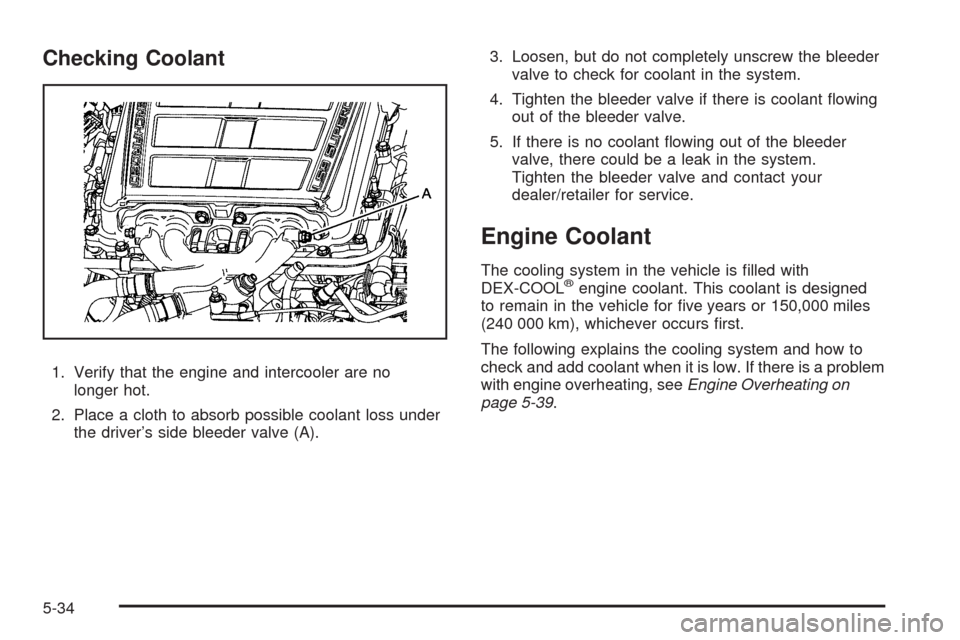
1. Verify that the engine and intercooler are no
longer hot.
2. Place a cloth to absorb possible coolant loss under
the driver’s side bleeder valve (A).3. Loosen, but do not completely unscrew the bleeder
valve to check for coolant in the system.
4. Tighten the bleeder valve if there is coolant owing
out of the bleeder valve.
5. If there is no coolant owing out of the bleeder
valve, there could be a leak in the system.
Tighten the bleeder valve and contact your
dealer/retailer for service.
Engine Coolant
The cooling system in the vehicle is lled with
DEX-COOL®engine coolant. This coolant is designed
to remain in the vehicle for ve years or 150,000 miles
(240 000 km), whichever occurs rst.
The following explains the cooling system and how to
check and add coolant when it is low. If there is a problem
with engine overheating, seeEngine Overheating on
page 5-39.
5-34
Page 330 of 434
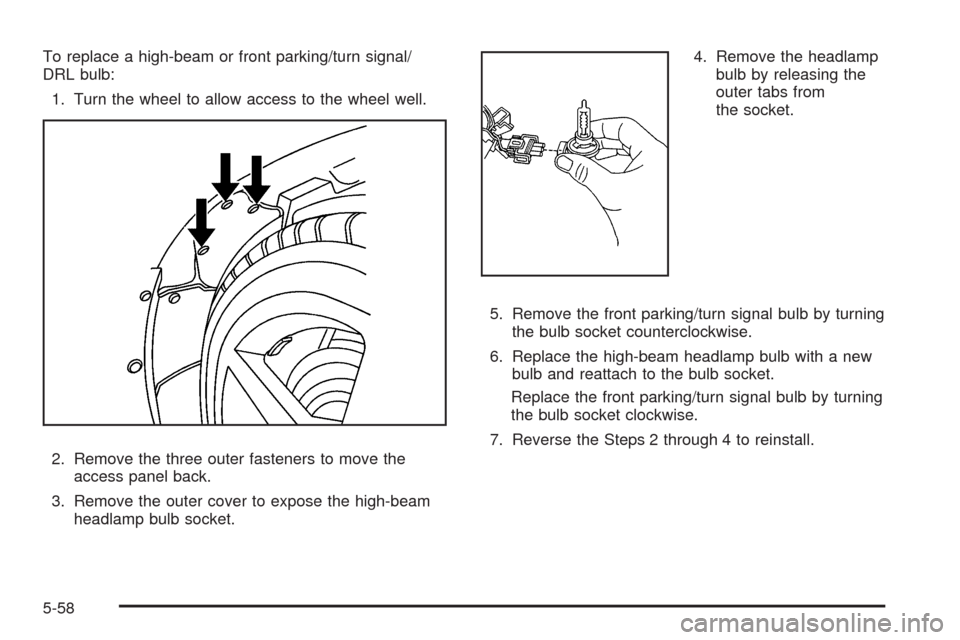
To replace a high-beam or front parking/turn signal/
DRL bulb:
1. Turn the wheel to allow access to the wheel well.
2. Remove the three outer fasteners to move the
access panel back.
3. Remove the outer cover to expose the high-beam
headlamp bulb socket.4. Remove the headlamp
bulb by releasing the
outer tabs from
the socket.
5. Remove the front parking/turn signal bulb by turning
the bulb socket counterclockwise.
6. Replace the high-beam headlamp bulb with a new
bulb and reattach to the bulb socket.
Replace the front parking/turn signal bulb by turning
the bulb socket clockwise.
7. Reverse the Steps 2 through 4 to reinstall.
5-58
Page 331 of 434
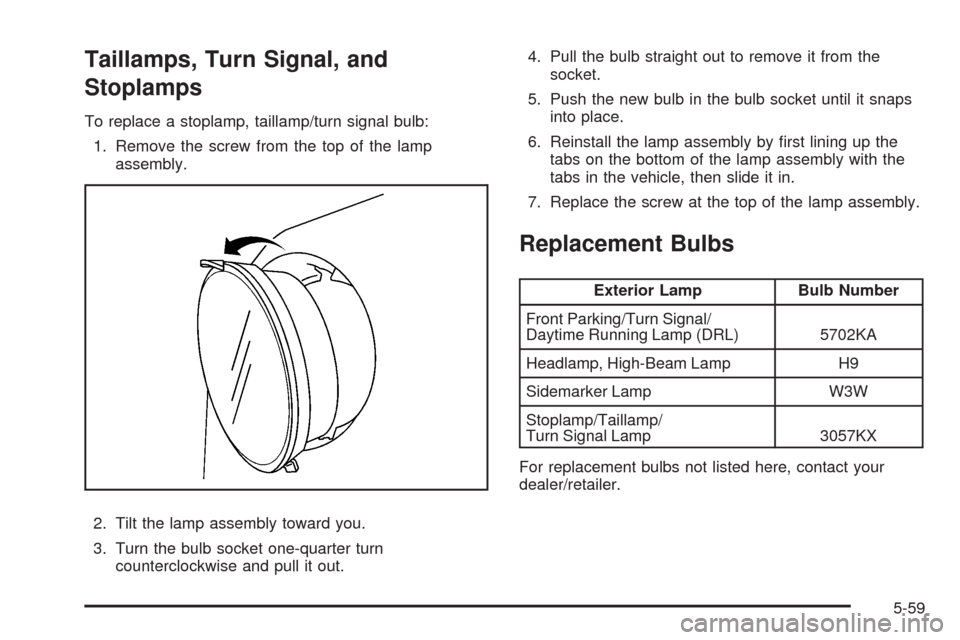
Taillamps, Turn Signal, and
Stoplamps
To replace a stoplamp, taillamp/turn signal bulb:
1. Remove the screw from the top of the lamp
assembly.
2. Tilt the lamp assembly toward you.
3. Turn the bulb socket one-quarter turn
counterclockwise and pull it out.4. Pull the bulb straight out to remove it from the
socket.
5. Push the new bulb in the bulb socket until it snaps
into place.
6. Reinstall the lamp assembly by rst lining up the
tabs on the bottom of the lamp assembly with the
tabs in the vehicle, then slide it in.
7. Replace the screw at the top of the lamp assembly.
Replacement Bulbs
Exterior Lamp Bulb Number
Front Parking/Turn Signal/
Daytime Running Lamp (DRL) 5702KA
Headlamp, High-Beam Lamp H9
Sidemarker Lamp W3W
Stoplamp/Taillamp/
Turn Signal Lamp 3057KX
For replacement bulbs not listed here, contact your
dealer/retailer.
5-59
Page 365 of 434
Fabric/Carpet
Use a vacuum cleaner with a soft brush attachment
frequently to remove dust and loose dirt. A canister
vacuum with a beater bar in the nozzle may only be
used on oor carpet and carpeted oor mats. For any
soil, always try to remove it rst with plain water or club
soda. Before cleaning, gently remove as much of the soil
as possible using one of the following techniques:
For liquids: gently blot the remaining soil with a paper
towel. Allow the soil to absorb into the paper towel
until no more can be removed.
For solid dry soils: remove as much as possible and
then vacuum.
To clean:
1. Saturate a lint-free, clean white cloth with water or
club soda.
2. Wring the cloth to remove excess moisture.
3. Start on the outside edge of the soil and gently rub
toward the center. Continue cleaning, using a clean
area of the cloth each time it becomes soiled.4. Continue to gently rub the soiled area until the
cleaning cloth remains clean.
5. If the soil is not completely removed, use a mild
soap solution and repeat the cleaning process
that was used with plain water.
If any of the soil remains, a commercial fabric cleaner
or spot lifter may be necessary. When a commercial
upholstery cleaner or spot lifter is to be used, test a small
hidden area for colorfastness rst. If the locally cleaned
area gives any impression that a ring formation may
result, clean the entire surface.
After the cleaning process has been completed, a paper
towel can be used to blot excess moisture from the
fabric or carpet.
Coated Moldings
These moldings are around the hatch opening in the
rear area.
When lightly soiled, wipe with a sponge or soft
lint-free cloth dampened with water.
When heavily soiled, use warm soapy water.
5-93
Page 379 of 434
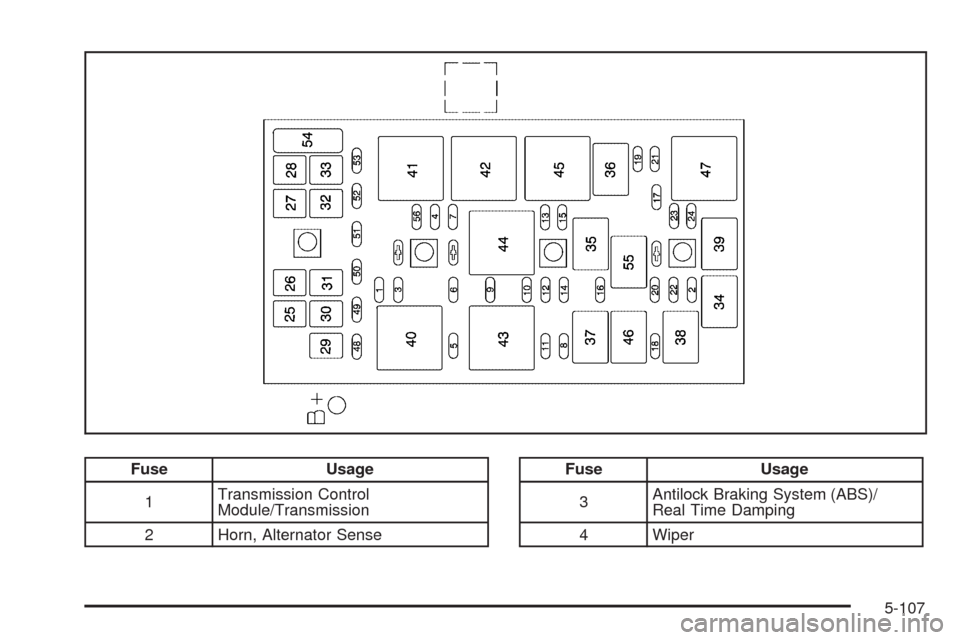
Fuse Usage
1Transmission Control
Module/Transmission
2 Horn, Alternator SenseFuse Usage
3Antilock Braking System (ABS)/
Real Time Damping
4 Wiper
5-107
Page 421 of 434
A
Accessories and Modications............................ 5-3
Accessory Power Outlets.................................3-23
Active Handling System..................................... 4-8
Active Handling System Light...........................3-40
Adding Equipment to Your Airbag-Equipped
Vehicle.......................................................1-58
Additives, Fuel................................................. 5-7
Add-On Electrical Equipment...........................5-102
Air Cleaner/Filter, Engine.................................5-28
Air Conditioning..............................................3-24
Air Dam, Front...............................................2-21
Airbag
Passenger Status Indicator...........................3-36
Readiness Light..........................................3-35
Airbag System................................................1-44
Adding Equipment to Your
Airbag-Equipped Vehicle............................1-58
How Does an Airbag Restrain?......................1-51
Passenger Sensing System...........................1-53
Servicing Your Airbag-Equipped Vehicle..........1-58
What Makes an Airbag Inate?......................1-51
What Will You See After an Airbag Inates?....1-52
When Should an Airbag Inate?....................1-49
Where Are the Airbags?...............................1-47
Antenna, Diversity Antenna System..................3-108Antenna, XM™ Satellite Radio Antenna
System.....................................................3-108
Antilock Brake System (ABS)............................. 4-5
Antilock Brake, System Warning Light................3-39
Appearance Care
Aluminum or Chrome-Plated Wheels..............5-99
Care of Safety Belts....................................5-95
Cargo Cover and Convenience Net................5-95
Chemical Paint Spotting..............................5-100
Cleaning Exterior Lamps/Lenses....................5-96
Coated Moldings.........................................5-93
Convertible Top...........................................5-98
Fabric/Carpet..............................................5-93
Fiberglass Springs
.....................................5-100
Finish Care.................................................5-96
Finish Damage..........................................5-100
Instrument Panel, Vinyl, and Other
Plastic Surfaces.......................................5-94
Interior Cleaning..........................................5-91
Leather......................................................5-94
Removable Roof Panel.................................5-98
Tires..........................................................5-99
Underbody Maintenance.............................5-100
Washing Your Vehicle...................................5-95
Weatherstrips..............................................5-95
Windshield and Wiper Blades........................5-97
Appointments, Scheduling Service.....................7-10
Ashtray.........................................................3-24
1
Page 427 of 434
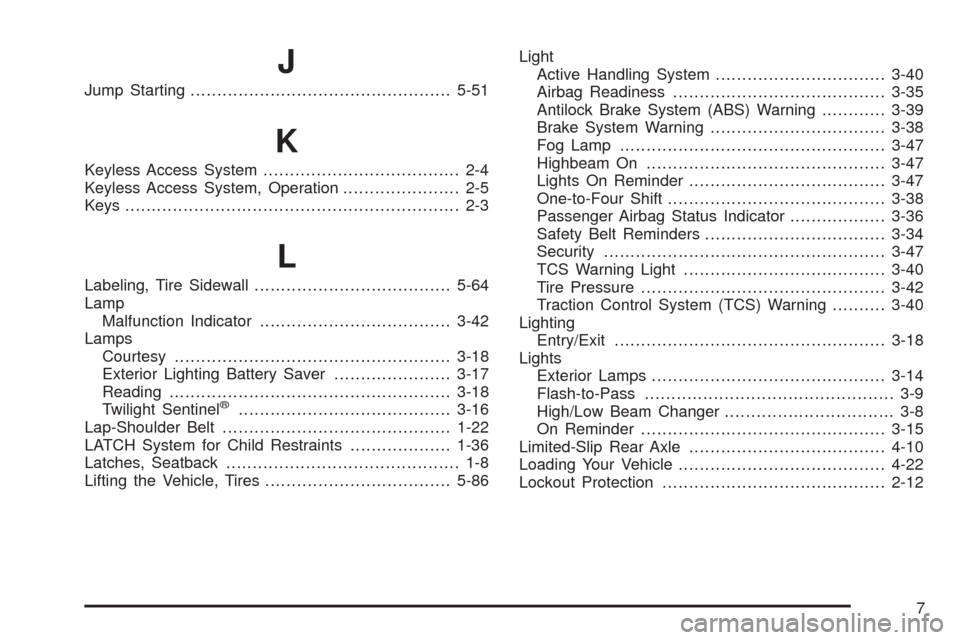
J
Jump Starting.................................................5-51
K
Keyless Access System..................................... 2-4
Keyless Access System, Operation...................... 2-5
Keys............................................................... 2-3
L
Labeling, Tire Sidewall.....................................5-64
Lamp
Malfunction Indicator....................................3-42
Lamps
Courtesy....................................................3-18
Exterior Lighting Battery Saver......................3-17
Reading.....................................................3-18
Twilight Sentinel
®........................................3-16
Lap-Shoulder Belt...........................................1-22
LATCH System for Child Restraints...................1-36
Latches, Seatback............................................ 1-8
Lifting the Vehicle, Tires...................................5-86Light
Active Handling System................................3-40
Airbag Readiness........................................3-35
Antilock Brake System (ABS) Warning............3-39
Brake System Warning.................................3-38
Fog Lamp ..................................................3-47
Highbeam On.............................................3-47
Lights On Reminder.....................................3-47
One-to-Four Shift.........................................3-38
Passenger Airbag Status Indicator..................3-36
Safety Belt Reminders..................................3-34
Security.....................................................3-47
TCS Warning Light......................................3-40
Tire Pressure..............................................3-42
Traction Control System (TCS) Warning..........3-40
Lighting
Entry/Exit...................................................3-18
Lights
Exterior Lamps............................................3-14
Flash-to-Pass............................................... 3-9
High/Low Beam Changer................................ 3-8
On Reminder..............................................3-15
Limited-Slip Rear Axle.....................................4-10
Loading Your Vehicle.......................................4-22
Lockout Protection..........................................2-12
7