cooling CHEVROLET CORVETTE 2009 6.G User Guide
[x] Cancel search | Manufacturer: CHEVROLET, Model Year: 2009, Model line: CORVETTE, Model: CHEVROLET CORVETTE 2009 6.GPages: 434, PDF Size: 2.53 MB
Page 309 of 434
{CAUTION:
Steam and scalding liquids from a hot cooling
system can blow out and burn you badly. They are
under pressure, and if you turn the coolant surge
tank pressure cap — even a little — they can
come out at high speed. Never turn the cap when
the cooling system, including the coolant surge
tank pressure cap, is hot. Wait for the cooling
system and coolant surge tank pressure cap to
cool if you ever have to turn the pressure cap.
If coolant is needed, add the proper DEX-COOL
®
coolant mixture directly to the surge tank, but be
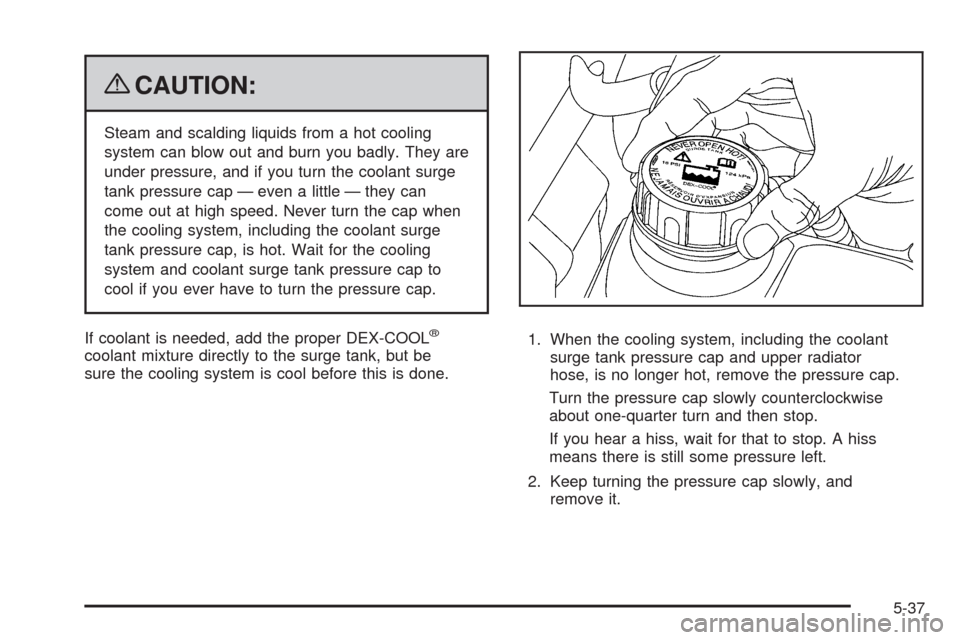
sure the cooling system is cool before this is done.1. When the cooling system, including the coolant
surge tank pressure cap and upper radiator
hose, is no longer hot, remove the pressure cap.
Turn the pressure cap slowly counterclockwise
about one-quarter turn and then stop.
If you hear a hiss, wait for that to stop. A hiss
means there is still some pressure left.
2. Keep turning the pressure cap slowly, and
remove it.
5-37
Page 310 of 434
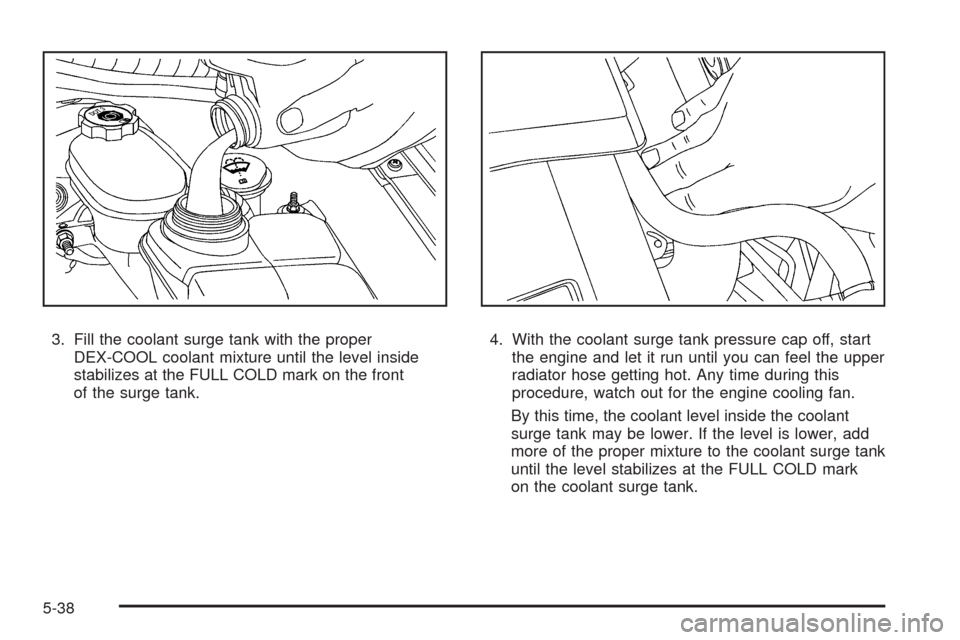
3. Fill the coolant surge tank with the proper
DEX-COOL coolant mixture until the level inside
stabilizes at the FULL COLD mark on the front
of the surge tank.4. With the coolant surge tank pressure cap off, start
the engine and let it run until you can feel the upper
radiator hose getting hot. Any time during this
procedure, watch out for the engine cooling fan.
By this time, the coolant level inside the coolant
surge tank may be lower. If the level is lower, add
more of the proper mixture to the coolant surge tank
until the level stabilizes at the FULL COLD mark
on the coolant surge tank.
5-38
Page 311 of 434
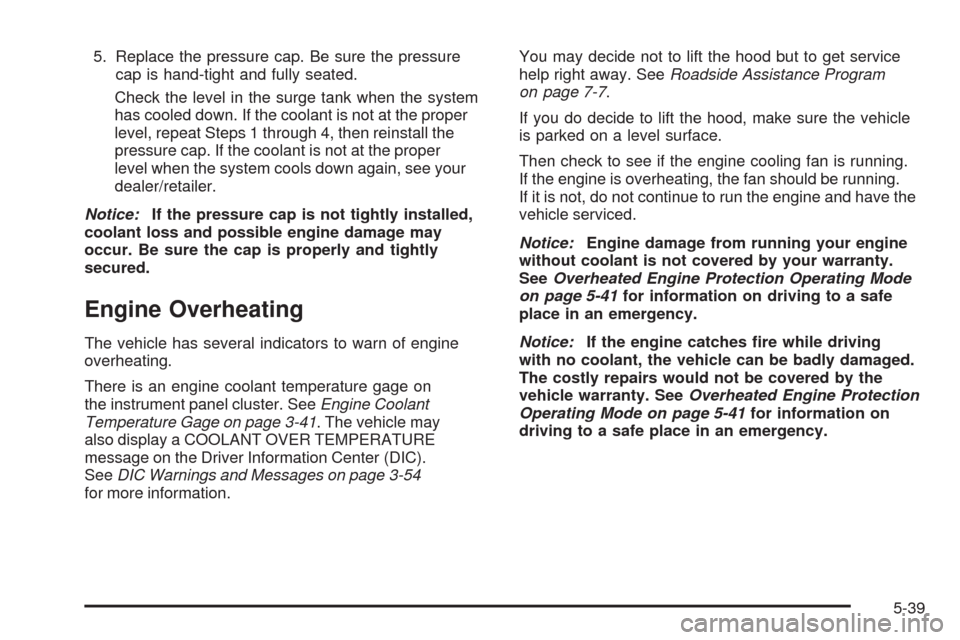
5. Replace the pressure cap. Be sure the pressure
cap is hand-tight and fully seated.
Check the level in the surge tank when the system
has cooled down. If the coolant is not at the proper
level, repeat Steps 1 through 4, then reinstall the
pressure cap. If the coolant is not at the proper
level when the system cools down again, see your
dealer/retailer.
Notice:If the pressure cap is not tightly installed,
coolant loss and possible engine damage may
occur. Be sure the cap is properly and tightly
secured.
Engine Overheating
The vehicle has several indicators to warn of engine
overheating.
There is an engine coolant temperature gage on
the instrument panel cluster. SeeEngine Coolant
Temperature Gage on page 3-41. The vehicle may
also display a COOLANT OVER TEMPERATURE
message on the Driver Information Center (DIC).
SeeDIC Warnings and Messages on page 3-54
for more information.You may decide not to lift the hood but to get service
help right away. SeeRoadside Assistance Program
on page 7-7.
If you do decide to lift the hood, make sure the vehicle
is parked on a level surface.
Then check to see if the engine cooling fan is running.
If the engine is overheating, the fan should be running.
If it is not, do not continue to run the engine and have the
vehicle serviced.
Notice:Engine damage from running your engine
without coolant is not covered by your warranty.
SeeOverheated Engine Protection Operating Mode
on page 5-41for information on driving to a safe
place in an emergency.
Notice:If the engine catches re while driving
with no coolant, the vehicle can be badly damaged.
The costly repairs would not be covered by the
vehicle warranty. SeeOverheated Engine Protection
Operating Mode on page 5-41for information on
driving to a safe place in an emergency.
5-39
Page 355 of 434
{CAUTION:
Putting a used wheel on the vehicle is dangerous.
You cannot know how it has been used or how
far it has been driven. It could fail suddenly and
cause a crash. If you have to replace a wheel,
use a new GM original equipment wheel.
Notice:The wrong wheel can also cause problems
with bearing life, brake cooling, speedometer or
odometer calibration, headlamp aim, bumper height,
vehicle ground clearance, and tire clearance to
the body and chassis.
{CAUTION:
Rust or dirt on a wheel, or on the parts to
which it is fastened, can make wheel nuts
become loose after a time. The wheel could
come off and cause a crash. When you
change a wheel, remove any rust or dirt from
places where the wheel attaches to the
vehicle. In an emergency, you can use a cloth
or a paper towel to do this; but be sure to use a
scraper or wire brush later, if you need to, to
get all the rust or dirt off.
5-83
Page 380 of 434
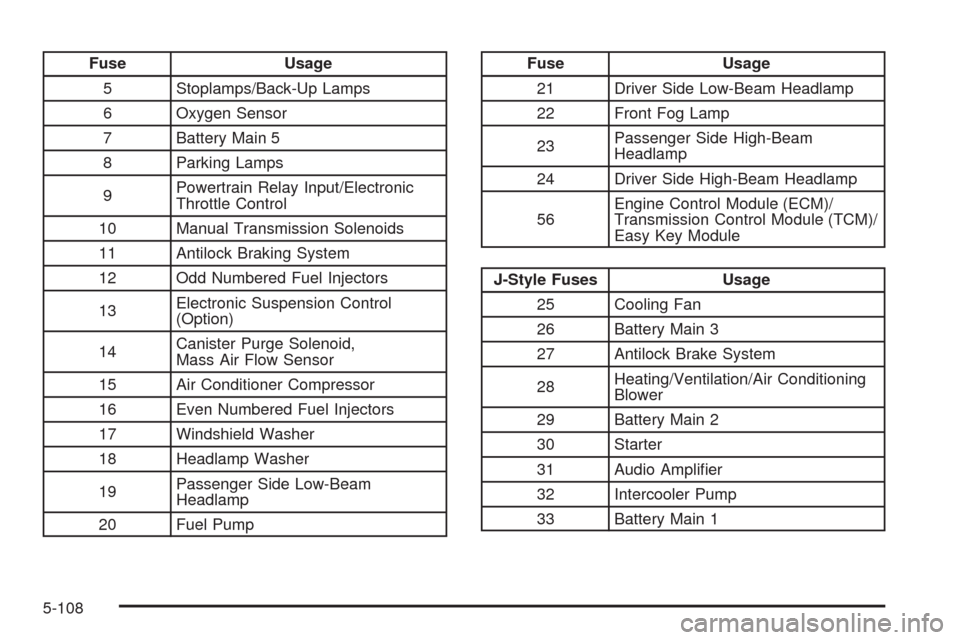
Fuse Usage
5 Stoplamps/Back-Up Lamps
6 Oxygen Sensor
7 Battery Main 5
8 Parking Lamps
9Powertrain Relay Input/Electronic
Throttle Control
10 Manual Transmission Solenoids
11 Antilock Braking System
12 Odd Numbered Fuel Injectors
13Electronic Suspension Control
(Option)
14Canister Purge Solenoid,
Mass Air Flow Sensor
15 Air Conditioner Compressor
16 Even Numbered Fuel Injectors
17 Windshield Washer
18 Headlamp Washer
19Passenger Side Low-Beam
Headlamp
20 Fuel PumpFuse Usage
21 Driver Side Low-Beam Headlamp
22 Front Fog Lamp
23Passenger Side High-Beam
Headlamp
24 Driver Side High-Beam Headlamp
56Engine Control Module (ECM)/
Transmission Control Module (TCM)/
Easy Key Module
J-Style Fuses Usage
25 Cooling Fan
26 Battery Main 3
27 Antilock Brake System
28Heating/Ventilation/Air Conditioning
Blower
29 Battery Main 2
30 Starter
31 Audio Amplier
32 Intercooler Pump
33 Battery Main 1
5-108
Page 382 of 434
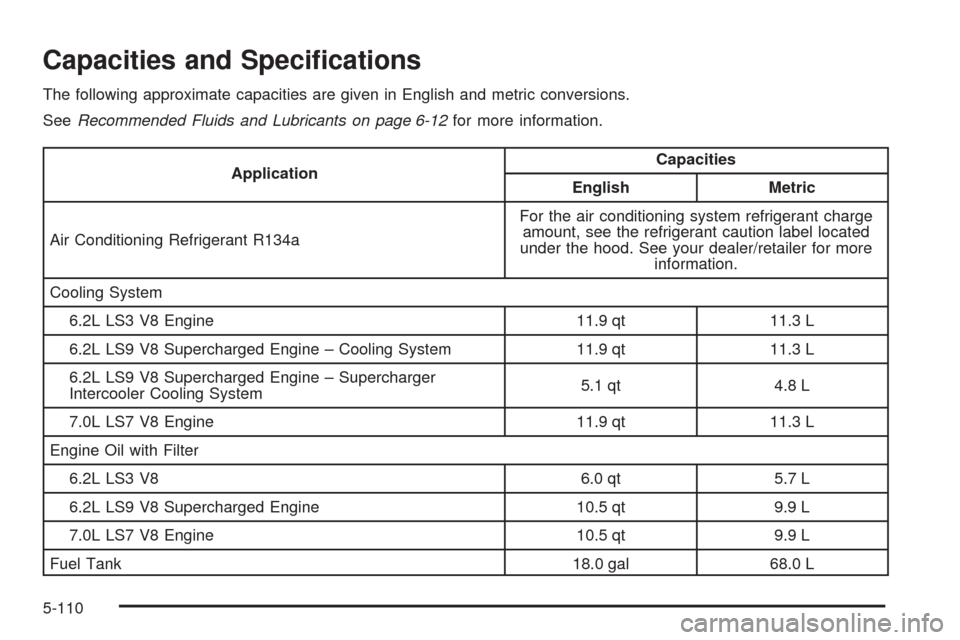
Capacities and Specications
The following approximate capacities are given in English and metric conversions.
SeeRecommended Fluids and Lubricants on page 6-12for more information.
ApplicationCapacities
English Metric
Air Conditioning Refrigerant R134aFor the air conditioning system refrigerant charge
amount, see the refrigerant caution label located
under the hood. See your dealer/retailer for more
information.
Cooling System
6.2L LS3 V8 Engine 11.9 qt 11.3 L
6.2L LS9 V8 Supercharged Engine – Cooling System 11.9 qt 11.3 L
6.2L LS9 V8 Supercharged Engine – Supercharger
Intercooler Cooling System5.1 qt 4.8 L
7.0L LS7 V8 Engine 11.9 qt 11.3 L
Engine Oil with Filter
6.2L LS3 V8 6.0 qt 5.7 L
6.2L LS9 V8 Supercharged Engine 10.5 qt 9.9 L
7.0L LS7 V8 Engine 10.5 qt 9.9 L
Fuel Tank 18.0 gal 68.0 L
5-110
Page 389 of 434
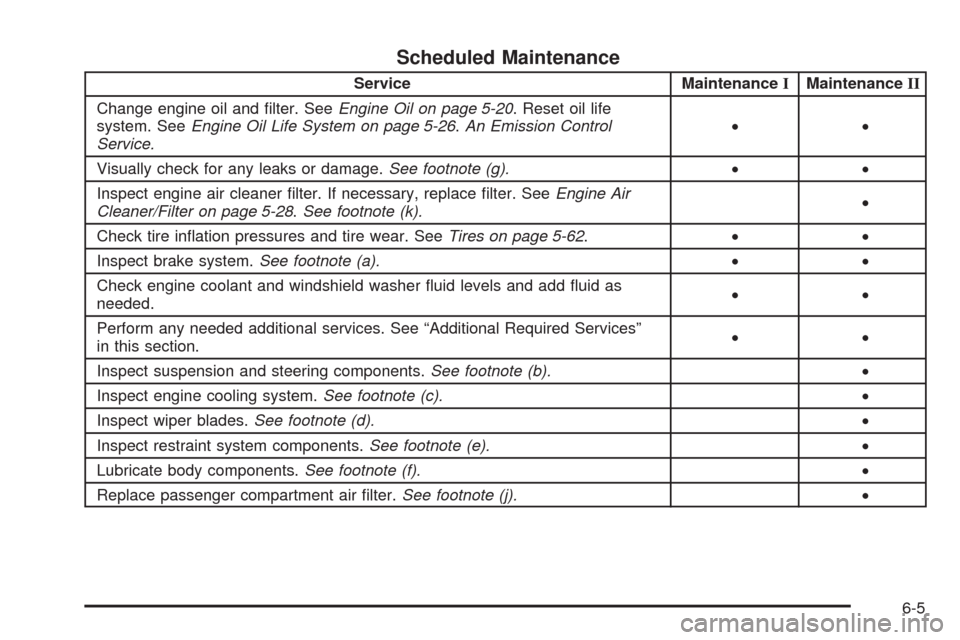
Scheduled Maintenance
Service MaintenanceIMaintenanceII
Change engine oil and lter. SeeEngine Oil on page 5-20. Reset oil life
system. SeeEngine Oil Life System on page 5-26.An Emission Control
Service.••
Visually check for any leaks or damage.See footnote (g).••
Inspect engine air cleaner lter. If necessary, replace lter. SeeEngine Air
Cleaner/Filter on page 5-28.See footnote (k).•
Check tire ination pressures and tire wear. SeeTires on page 5-62.••
Inspect brake system.See footnote (a).••
Check engine coolant and windshield washer uid levels and add uid as
needed.••
Perform any needed additional services. See “Additional Required Services”
in this section.••
Inspect suspension and steering components.See footnote (b).•
Inspect engine cooling system.See footnote (c).•
Inspect wiper blades.See footnote (d).•
Inspect restraint system components.See footnote (e).•
Lubricate body components.See footnote (f).•
Replace passenger compartment air lter.See footnote (j).•
6-5
Page 391 of 434
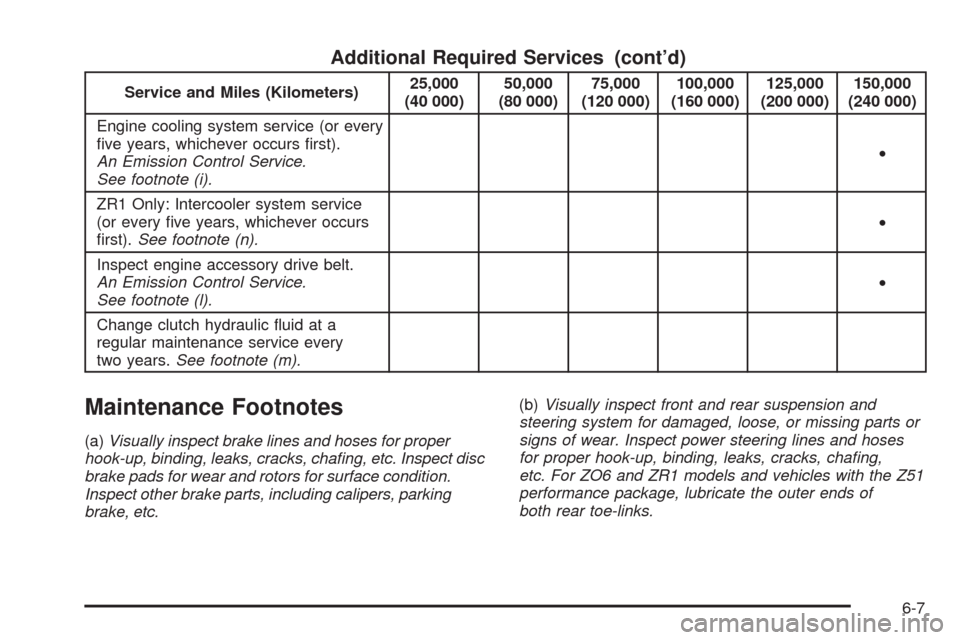
Additional Required Services (cont’d)
Service and Miles (Kilometers)25,000
(40 000)50,000
(80 000)75,000
(120 000)100,000
(160 000)125,000
(200 000)150,000
(240 000)
Engine cooling system service (or every
ve years, whichever occurs rst).
An Emission Control Service.
See footnote (i).•
ZR1 Only: Intercooler system service
(or every ve years, whichever occurs
rst).See footnote (n).•
Inspect engine accessory drive belt.
An Emission Control Service.
See footnote (l).•
Change clutch hydraulic uid at a
regular maintenance service every
two years.See footnote (m).
Maintenance Footnotes
(a)Visually inspect brake lines and hoses for proper
hook-up, binding, leaks, cracks, chafing, etc. Inspect disc
brake pads for wear and rotors for surface condition.
Inspect other brake parts, including calipers, parking
brake, etc.(b)Visually inspect front and rear suspension and
steering system for damaged, loose, or missing parts or
signs of wear. Inspect power steering lines and hoses
for proper hook-up, binding, leaks, cracks, chafing,
etc. For ZO6 and ZR1 models and vehicles with the Z51
performance package, lubricate the outer ends of
both rear toe-links.
6-7
Page 392 of 434
(c)Visually inspect hoses and have them replaced if they
are cracked, swollen, or deteriorated. Inspect all pipes,
fittings, and clamps; replace with genuine parts as
needed. To help ensure proper operation, a pressure test
of the cooling system and pressure cap and cleaning the
outside of the radiator and air conditioning condenser is
recommended at least once a year.
(d)Inspect wiper blades for wear, cracking, or
contamination. Clean the windshield and wiper blades, if
contaminated. Replace wiper blades that are worn or
damaged. See Windshield Wiper Blade Replacement on
page 5-60 and Windshield and Wiper Blades on
page 5-97 for more information.
(e)Make sure the safety belt reminder light and safety
belt assemblies are working properly. Look for any other
loose or damaged safety belt system parts. If you see
anything that might keep a safety belt system from doing
its job, have it repaired. Have any torn or frayed safety
belts replaced. Also see Checking the Restraint Systems
on page 1-60.(f)Lubricate all key lock cylinders and body door hinges.
Lubricate all hinges and latches, including those for the
hood, rear compartment, console door, and any folding
seat hardware. More frequent lubrication may be required
when exposed to a corrosive environment. Applying
silicone grease on weatherstrips with a clean cloth will
make them last longer, seal better, and not stick or
squeak.
(g)A fluid loss in any vehicle system could indicate a
problem. Have the system inspected and repaired
and the fluid level checked. Add fluid if needed.
(h)Change automatic transmission fluid and filter if the
vehicle is mainly driven under one or more of these
conditions:
In heavy city traffic where the outside temperature
regularly reaches 90°F (32°C) or higher.
In hilly or mountainous terrain.
Uses such as high performance operation.
6-8
Page 393 of 434
(i)Drain, flush, and refill cooling system. This service can
be complex; you should have your dealer/retailer perform
this service. See Engine Coolant on page 5-34 for what to
use. Inspect hoses. Clean radiator, condenser, pressure
cap, and filler neck. Pressure test the cooling system and
pressure cap.
(j)If driving regularly under dusty conditions, the filter
may require replacement more often.
(k)If driving regularly under dusty conditions, inspect
the filter at each engine oil change.
(l)Visually inspect belt for fraying, excessive cracks, or
obvious damage. Replace belt if necessary.
(m)Drain, flush, and refill clutch hydraulic system at a
regular service interval (IorII) every two years. This
service can be complex; you should have your dealer/
retailer perform this service. See Hydraulic Clutch on
page 5-31.
(n)Drain, flush, and refill intercooler system. This service
can be complex; you should have your dealer/retailer
perform this service. See Engine Coolant on page 5-34.Owner Checks and Services
These owner checks and services should be performed
at the intervals specied to help ensure vehicle safety,
dependability, and emission control performance. Your
dealer/retailer can assist with these checks and services.
Be sure any necessary repairs are completed at once.
Whenever any uids or lubricants are added to the
vehicle, make sure they are the proper ones, as shown
inRecommended Fluids and Lubricants on page 6-12.
At Each Fuel Fill
It is important to perform these underhood checks at
each fuel fill.
Engine Oil Level Check
Notice:It is important to check the engine oil
regularly and keep it at the proper level. Failure to
keep the engine oil at the proper level can cause
damage to the engine not covered by the vehicle
warranty.
Check the engine oil level and add the proper oil if
necessary. SeeEngine Oil on page 5-20.
6-9