light CHEVROLET CORVETTE 2009 6.G User Guide
[x] Cancel search | Manufacturer: CHEVROLET, Model Year: 2009, Model line: CORVETTE, Model: CHEVROLET CORVETTE 2009 6.GPages: 434, PDF Size: 2.53 MB
Page 72 of 434
Keyless Trunk Opening
Press the hatch/trunk release button located on the rear
of the hatch/trunk lid above the license plate to open the
trunk if the keyless access transmitter is within range.
SeeHatch on page 2-13for additional information.
There are other conditions that can affect the
performance of the transmitter. SeeKeyless Access
System on page 2-4Keyless Access System.
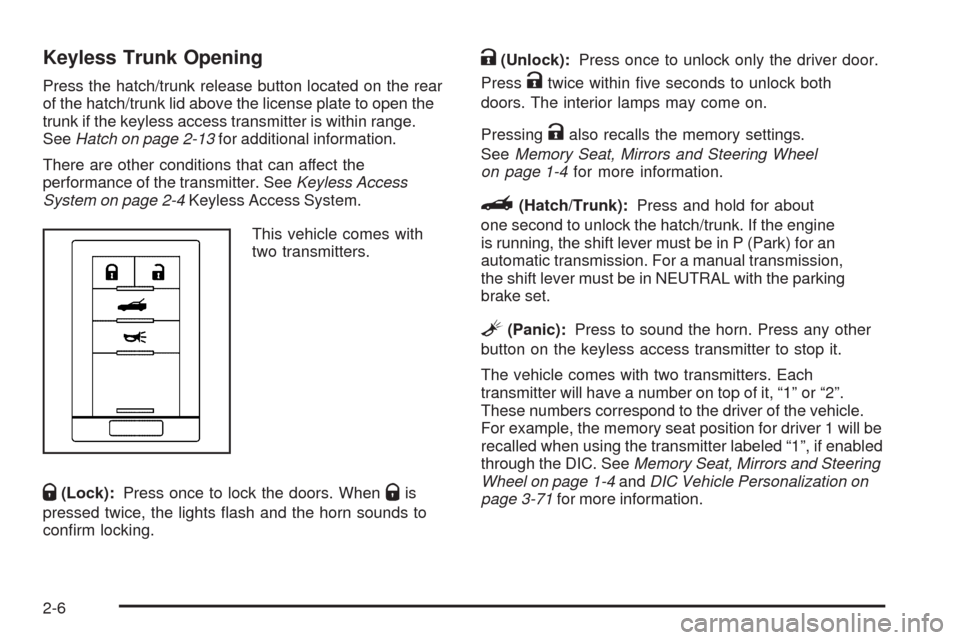
This vehicle comes with
two transmitters.
Q(Lock):Press once to lock the doors. WhenQis
pressed twice, the lights ash and the horn sounds to
conrm locking.
K(Unlock):Press once to unlock only the driver door.
Press
Ktwice within ve seconds to unlock both
doors. The interior lamps may come on.
Pressing
Kalso recalls the memory settings.
SeeMemory Seat, Mirrors and Steering Wheel
on page 1-4for more information.
}(Hatch/Trunk):Press and hold for about
one second to unlock the hatch/trunk. If the engine
is running, the shift lever must be in P (Park) for an
automatic transmission. For a manual transmission,
the shift lever must be in NEUTRAL with the parking
brake set.
L(Panic):Press to sound the horn. Press any other
button on the keyless access transmitter to stop it.
The vehicle comes with two transmitters. Each
transmitter will have a number on top of it, “1” or “2”.
These numbers correspond to the driver of the vehicle.
For example, the memory seat position for driver 1 will be
recalled when using the transmitter labeled “1”, if enabled
through the DIC. SeeMemory Seat, Mirrors and Steering
Wheel on page 1-4andDIC Vehicle Personalization on
page 3-71for more information.
2-6
Page 78 of 434
Power Door Locks
The power door lock switches are located on the doors.
There is an indicator light on the rear of the door
near the window.
K(Unlock):Press to unlock the doors.
When pressed, a beep sounds. If the door is closed, the
light blinks twice. If the door is open, the light ashes.
Q(Lock):Press to lock the doors.
When pressed, a beep sounds. If the door is closed
when pressed, the light comes on for a few seconds,
then turns off. If the door is open when pressed, the
light stays on.
Automatic Door Lock
The vehicle is programmed so that, when the doors are
closed, the ignition is on and the shift lever is moved
out of P (Park) for automatic transmissions, or when
vehicle speed becomes faster than 8 mph (13 km/h)
for manual transmissions, both doors will lock.
Use the power door unlock switch to unlock the door
when the vehicle is not in P (Park). When the door
is closed again, the doors will lock either when your
foot is removed from the brake or the vehicle speed
becomes faster than 8 mph (13 km/h).
Programmable Automatic Door
Unlock
The vehicle is programmed so that when the shift
lever is moved into P (Park) for automatic transmission
vehicles or when the ignition is turned off or is in Retained
Accessory Power (RAP) for manual transmission
vehicles, both doors will unlock.
With the vehicle stopped and the engine running,
door unlocking can be programmed through the Driver
Information Center (DIC). This allows the driver to choose
various unlock settings. For programming information,
seeDIC Vehicle Personalization on page 3-71.
Lockout Protection
Your vehicle can be programmed to sound the horn
three times and unlock the driver door when both doors
are closed and there is a keyless access transmitter
inside the vehicle. When the driver door is opened,
a reminder chime will sound continuously. The vehicle
will remain locked only when at least one transmitter
has been removed from the vehicle and both doors are
closed. SeeDIC Vehicle Personalization on page 3-71.
2-12
Page 81 of 434
Emergency Trunk Release Handle
(Coupe)Notice:Do not use the emergency trunk release
handle as a tie-down or anchor point when securing
items in the trunk as it could damage the handle.
The emergency trunk release handle is only
intended to aid a person trapped in a latched trunk,
enabling them to open the trunk from the inside.
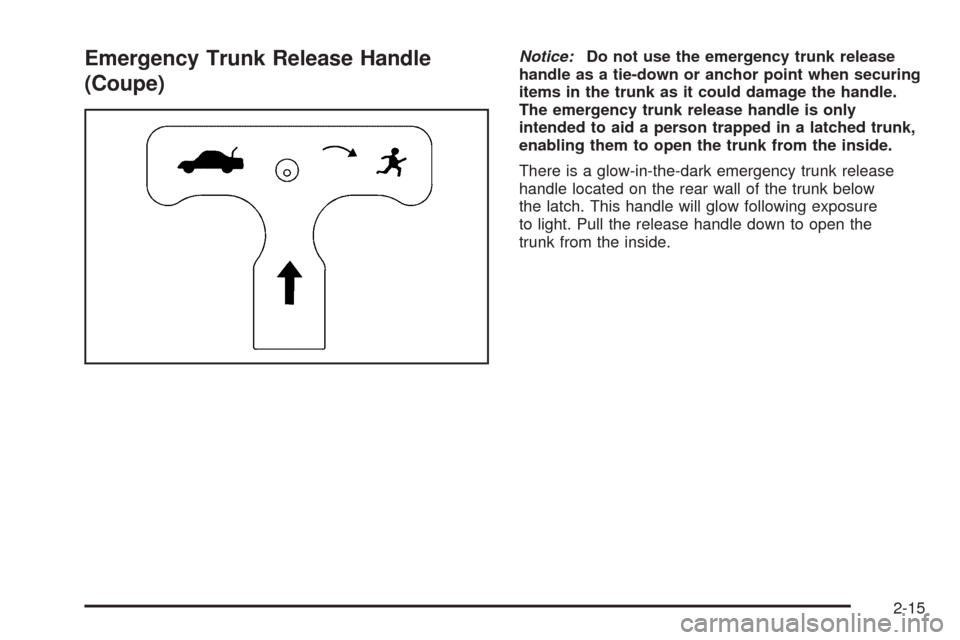
There is a glow-in-the-dark emergency trunk release
handle located on the rear wall of the trunk below
the latch. This handle will glow following exposure
to light. Pull the release handle down to open the
trunk from the inside.
2-15
Page 84 of 434
Sun Visors
Pull the visor toward you, or move it to the side to help
reduce glare.
To use the lighted mirror, lift the cover.
Theft-Deterrent Systems
Vehicle theft is big business, especially in some cities.
This vehicle has theft-deterrent features, however,
they do not make it impossible to steal.
Theft-Deterrent System
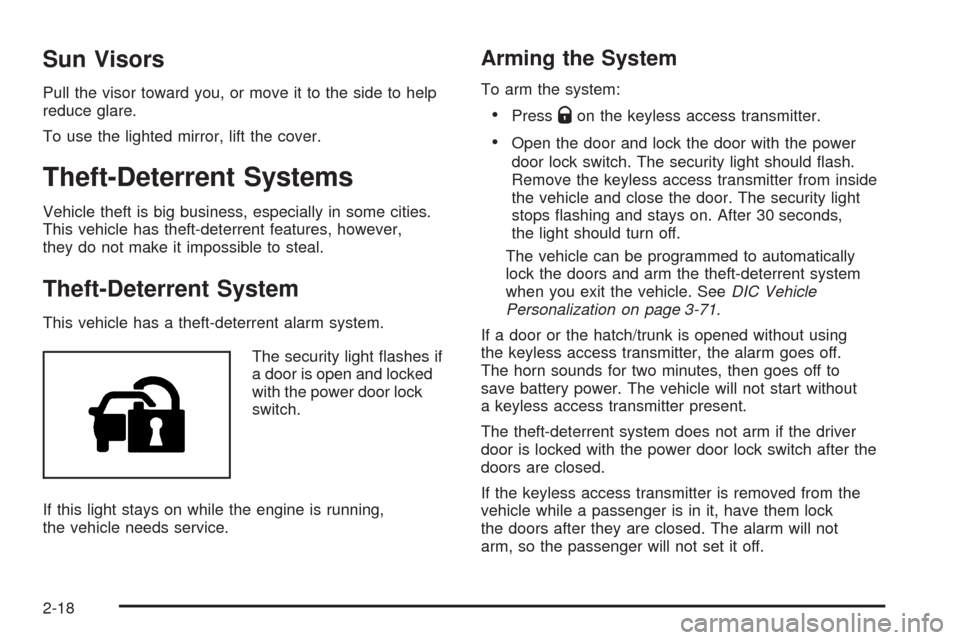
This vehicle has a theft-deterrent alarm system.
The security light ashes if
a door is open and locked
with the power door lock
switch.
If this light stays on while the engine is running,
the vehicle needs service.
Arming the System
To arm the system:
PressQon the keyless access transmitter.
Open the door and lock the door with the power
door lock switch. The security light should ash.
Remove the keyless access transmitter from inside
the vehicle and close the door. The security light
stops ashing and stays on. After 30 seconds,
the light should turn off.
The vehicle can be programmed to automatically
lock the doors and arm the theft-deterrent system
when you exit the vehicle. SeeDIC Vehicle
Personalization on page 3-71.
If a door or the hatch/trunk is opened without using
the keyless access transmitter, the alarm goes off.
The horn sounds for two minutes, then goes off to
save battery power. The vehicle will not start without
a keyless access transmitter present.
The theft-deterrent system does not arm if the driver
door is locked with the power door lock switch after the
doors are closed.
If the keyless access transmitter is removed from the
vehicle while a passenger is in it, have them lock
the doors after they are closed. The alarm will not
arm, so the passenger will not set it off.
2-18
Page 86 of 434
Immobilizer Operation
The vehicle has a passive theft-deterrent system.
The system is automatically armed when the ignition is
turned off.
The immobilization system is disarmed when the ignition
is turned to OFF/ACCESSORY or START and a valid
transmitter is found in the vehicle.
You do not have to manually arm or disarm the system.
The security light comes on if there is a problem with
arming or disarming the theft-deterrent system.
The system has one or more keyless access
transmitters that are matched to an immobilizer control
unit in the vehicle. Only a correctly matched keyless
access transmitter starts the vehicle. The vehicle
may not start if the keyless access transmitter is
damaged.
If the engine does not start and the security light comes
on, there may be a problem with the immobilizer system.
Press the START button again.If the vehicle does not start and the keyless access
transmitter appears to be undamaged, try another
keyless access transmitter. Or, place the transmitter in
the transmitter pocket. See “NO FOBS DETECTED”
underDIC Warnings and Messages on page 3-54for
additional information. Check the fuse. SeeFuses and
Circuit Breakers on page 5-103. If the engine still does
not start with the other transmitter, the vehicle needs
service. If the engine does start, the rst transmitter may
be faulty. See your dealer/retailer or have a new keyless
access transmitter programmed to the vehicle.
The immobilizer system can learn new or replacement
keyless access transmitters. Up to four keyless access
transmitters can be programmed for the vehicle.
To program additional transmitters, see “Matching
transmitter(s) to Your Vehicle” underKeyless Access
System Operation on page 2-5.
Do not leave the key or device that disarms or
deactivates the theft deterrent system in the vehicle.
2-20
Page 97 of 434
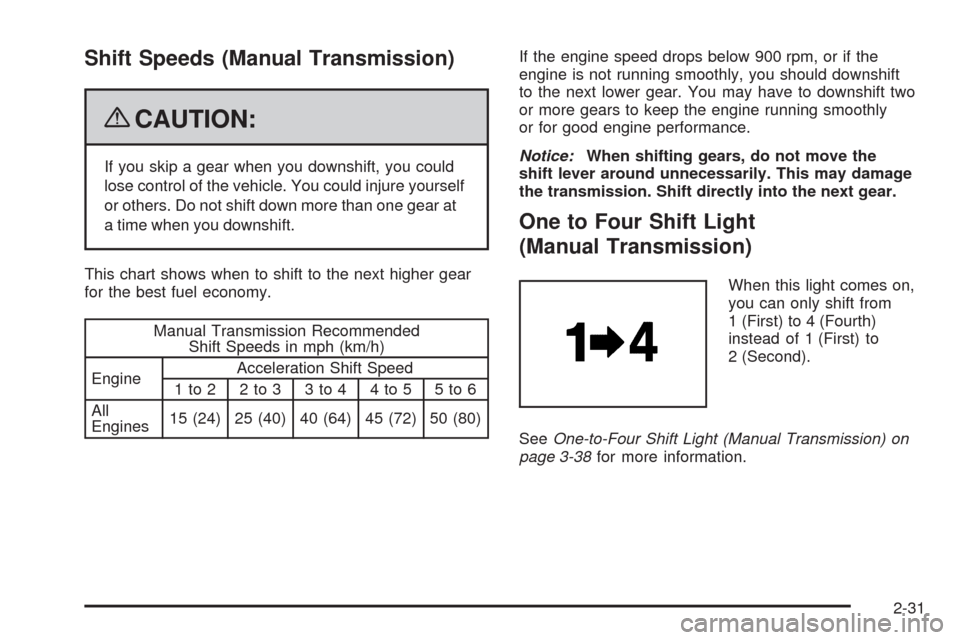
Shift Speeds (Manual Transmission)
{CAUTION:
If you skip a gear when you downshift, you could
lose control of the vehicle. You could injure yourself
or others. Do not shift down more than one gear at
a time when you downshift.
This chart shows when to shift to the next higher gear
for the best fuel economy.
Manual Transmission Recommended
Shift Speeds in mph (km/h)
EngineAcceleration Shift Speed
1to2 2to3 3to4 4to5 5to6
All
Engines15 (24) 25 (40) 40 (64) 45 (72) 50 (80)If the engine speed drops below 900 rpm, or if the
engine is not running smoothly, you should downshift
to the next lower gear. You may have to downshift two
or more gears to keep the engine running smoothly
or for good engine performance.
Notice:When shifting gears, do not move the
shift lever around unnecessarily. This may damage
the transmission. Shift directly into the next gear.
One to Four Shift Light
(Manual Transmission)
When this light comes on,
you can only shift from
1 (First) to 4 (Fourth)
instead of 1 (First) to
2 (Second).
SeeOne-to-Four Shift Light (Manual Transmission) on
page 3-38for more information.
2-31
Page 98 of 434
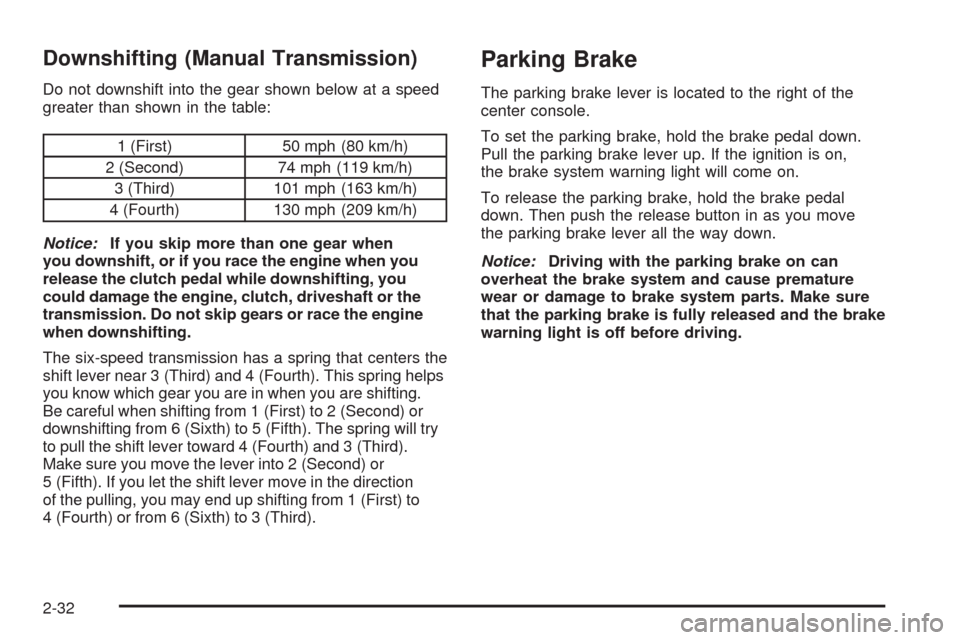
Downshifting (Manual Transmission)
Do not downshift into the gear shown below at a speed
greater than shown in the table:
1 (First) 50 mph (80 km/h)
2 (Second) 74 mph (119 km/h)
3 (Third) 101 mph (163 km/h)
4 (Fourth) 130 mph (209 km/h)
Notice:If you skip more than one gear when
you downshift, or if you race the engine when you
release the clutch pedal while downshifting, you
could damage the engine, clutch, driveshaft or the
transmission. Do not skip gears or race the engine
when downshifting.
The six-speed transmission has a spring that centers the
shift lever near 3 (Third) and 4 (Fourth). This spring helps
you know which gear you are in when you are shifting.
Be careful when shifting from 1 (First) to 2 (Second) or
downshifting from 6 (Sixth) to 5 (Fifth). The spring will try
to pull the shift lever toward 4 (Fourth) and 3 (Third).
Make sure you move the lever into 2 (Second) or
5 (Fifth). If you let the shift lever move in the direction
of the pulling, you may end up shifting from 1 (First) to
4 (Fourth) or from 6 (Sixth) to 3 (Third).
Parking Brake
The parking brake lever is located to the right of the
center console.
To set the parking brake, hold the brake pedal down.
Pull the parking brake lever up. If the ignition is on,
the brake system warning light will come on.
To release the parking brake, hold the brake pedal
down. Then push the release button in as you move
the parking brake lever all the way down.
Notice:Driving with the parking brake on can
overheat the brake system and cause premature
wear or damage to brake system parts. Make sure
that the parking brake is fully released and the brake
warning light is off before driving.
2-32
Page 103 of 434
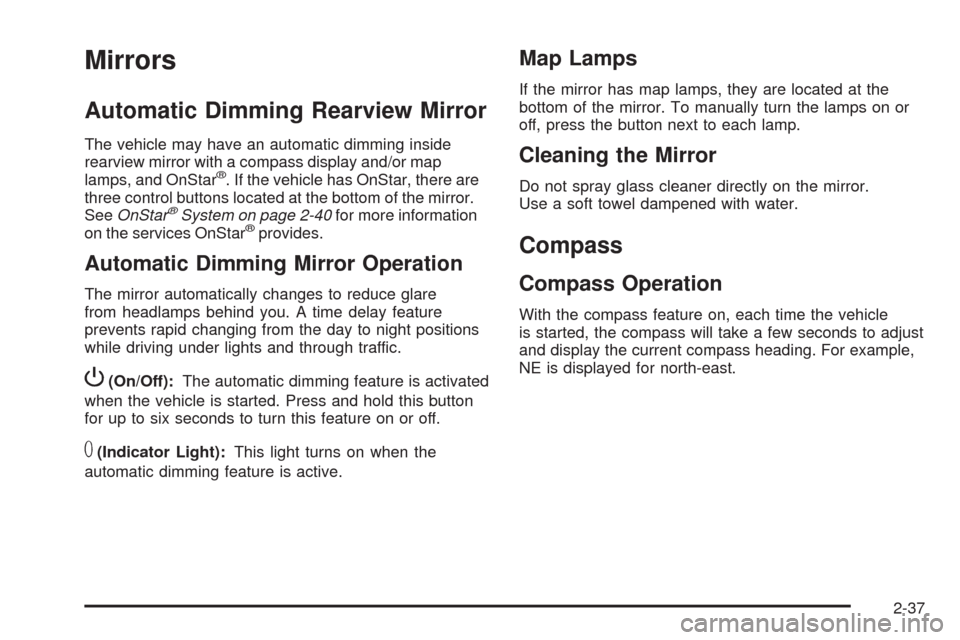
Mirrors
Automatic Dimming Rearview Mirror
The vehicle may have an automatic dimming inside
rearview mirror with a compass display and/or map
lamps, and OnStar
®. If the vehicle has OnStar, there are
three control buttons located at the bottom of the mirror.
SeeOnStar
®System on page 2-40for more information
on the services OnStar®provides.
Automatic Dimming Mirror Operation
The mirror automatically changes to reduce glare
from headlamps behind you. A time delay feature
prevents rapid changing from the day to night positions
while driving under lights and through traffic.
P(On/Off):The automatic dimming feature is activated
when the vehicle is started. Press and hold this button
for up to six seconds to turn this feature on or off.
T(Indicator Light):This light turns on when the
automatic dimming feature is active.
Map Lamps
If the mirror has map lamps, they are located at the
bottom of the mirror. To manually turn the lamps on or
off, press the button next to each lamp.
Cleaning the Mirror
Do not spray glass cleaner directly on the mirror.
Use a soft towel dampened with water.
Compass
Compass Operation
With the compass feature on, each time the vehicle
is started, the compass will take a few seconds to adjust
and display the current compass heading. For example,
NE is displayed for north-east.
2-37
Page 104 of 434
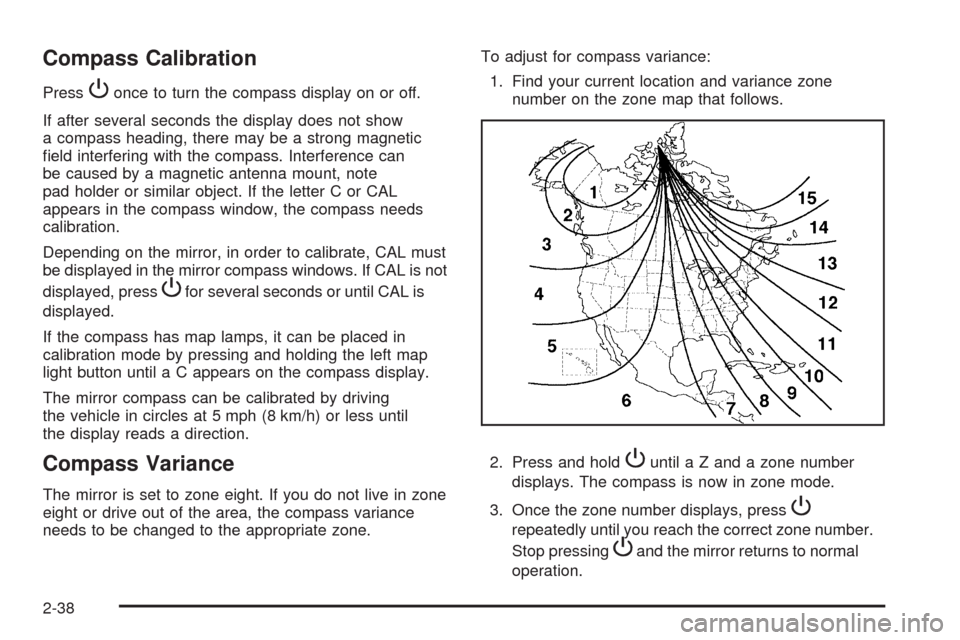
Compass Calibration
PressPonce to turn the compass display on or off.
If after several seconds the display does not show
a compass heading, there may be a strong magnetic
eld interfering with the compass. Interference can
be caused by a magnetic antenna mount, note
pad holder or similar object. If the letter C or CAL
appears in the compass window, the compass needs
calibration.
Depending on the mirror, in order to calibrate, CAL must
be displayed in the mirror compass windows. If CAL is not
displayed, press
Pfor several seconds or until CAL is
displayed.
If the compass has map lamps, it can be placed in
calibration mode by pressing and holding the left map
light button until a C appears on the compass display.
The mirror compass can be calibrated by driving
the vehicle in circles at 5 mph (8 km/h) or less until
the display reads a direction.
Compass Variance
The mirror is set to zone eight. If you do not live in zone
eight or drive out of the area, the compass variance
needs to be changed to the appropriate zone.To adjust for compass variance:
1. Find your current location and variance zone
number on the zone map that follows.
2. Press and hold
Puntil a Z and a zone number
displays. The compass is now in zone mode.
3. Once the zone number displays, press
P
repeatedly until you reach the correct zone number.
Stop pressing
Pand the mirror returns to normal
operation.
2-38
Page 109 of 434

How OnStar Service Works
The OnStar system can record and transmit vehicle
information. This information is automatically sent to an
OnStar Call Center when the OnStar button is pressed,
the emergency button is pressed, or if the airbags or
AACN system deploy. This information usually includes
the vehicle’s GPS location and, in the event of a crash,
additional information regarding the crash that the vehicle
was involved in (e.g. the direction from which the vehicle
was hit). When the Virtual Advisor feature of OnStar
Hands-Free Calling is used, the vehicle also sends
OnStar the vehicle’s GPS location so they can provide
services where it is located.
OnStar service cannot work unless the vehicle is in a
place where OnStar has an agreement with a wireless
service provider for service in that area. OnStar service
also cannot work unless the vehicle is in a place where
the wireless service provider OnStar has hired for that
area has coverage, network capacity and reception when
the service is needed, and technology that is compatible
with the OnStar service. Not all services are available
everywhere, particularly in remote or enclosed areas,
or at all times.Location information about the vehicle is only available if
the GPS satellite signals are unobstructed and available.
The vehicle must have a working electrical system,
including adequate battery power, for the OnStar
equipment to operate. There are other problems OnStar
cannot control that may prevent OnStar from providing
OnStar service at any particular time or place. Some
examples are damage to important parts of the vehicle
in a crash, hills, tall buildings, tunnels, weather or
wireless phone network congestion.
Your Responsibility
Increase the volume of the radio if the OnStar advisor
cannot be heard. If the light next to the OnStar buttons
is red, the system may not be functioning properly.
Press the OnStar button and request a vehicle
diagnostic. If the light appears clear (no light is
appearing), your OnStar subscription has expired and
all services have been deactivated. Press the OnStar
button to conrm that the OnStar equipment is active.
2-43