maintenance CHEVROLET CORVETTE 2012 6.G Owner's Manual
[x] Cancel search | Manufacturer: CHEVROLET, Model Year: 2012, Model line: CORVETTE, Model: CHEVROLET CORVETTE 2012 6.GPages: 434, PDF Size: 6.96 MB
Page 294 of 434
Black plate (20,1)Chevrolet Corvette Owner Manual - 2012
10-20 Vehicle Care
Changing Engine Oil and Filter
(Z06, ZR1, and Grand Sport)
These vehicles have a racetrack‐
ready dry sump engine lubrication
system. This high‐performance
system operates differently than a
standard engine lubrication system
and requires a special procedure
when changing the engine oil and
filter. Follow this procedure closely
when changing the engine oil
and filter.
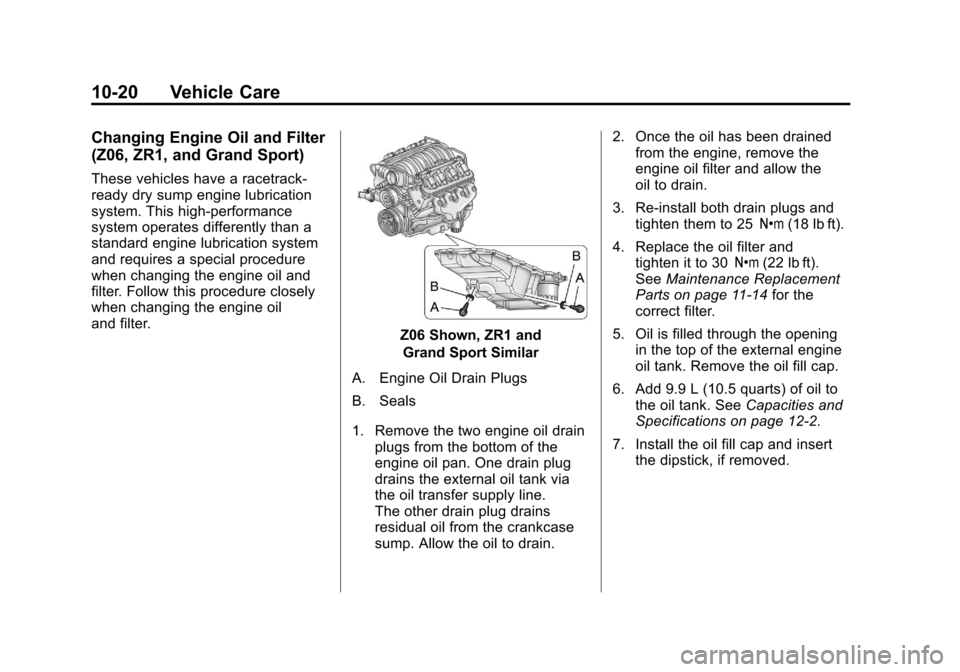
Z06 Shown, ZR1 andGrand Sport Similar
A. Engine Oil Drain Plugs
B. Seals
1. Remove the two engine oil drain plugs from the bottom of the
engine oil pan. One drain plug
drains the external oil tank via
the oil transfer supply line.
The other drain plug drains
residual oil from the crankcase
sump. Allow the oil to drain. 2. Once the oil has been drained
from the engine, remove the
engine oil filter and allow the
oil to drain.
3. Re‐install both drain plugs and tighten them to 25 Y(18 lb ft).
4. Replace the oil filter and tighten it to 30 Y(22 lb ft).
See Maintenance Replacement
Parts on page 11‑14 for the
correct filter.
5. Oil is filled through the opening in the top of the external engine
oil tank. Remove the oil fill cap.
6. Add 9.9 L (10.5 quarts) of oil to the oil tank. See Capacities and
Specifications on page 12‑2.
7. Install the oil fill cap and insert the dipstick, if removed.
Page 297 of 434
Black plate (23,1)Chevrolet Corvette Owner Manual - 2012
Vehicle Care 10-23
How to Reset the Engine Oil
Life System
Reset the system whenever the
engine oil is changed so that the
system can calculate the next
engine oil change. To reset the
system:
1. Press the TRIP button so theOIL LIFE percentage is
displayed.
2. Press RESET and hold for two seconds. OIL LIFE
REMAINING 100% will appear.
If the CHANGE ENGINE OIL
message comes back on when the
vehicle is started, the engine oil life
system has not reset. Repeat the
procedure.
Automatic Transmission
Fluid
How to Check Automatic
Transmission Fluid
It is not necessary to check
the transmission fluid level.
A transmission fluid leak is the
only reason for fluid loss. If a leak
occurs, take the vehicle to the
dealer service department and have
it repaired as soon as possible.
The vehicle is not equipped with a
transmission fluid level dipstick.
There is a special procedure for
checking and changing the
transmission fluid. Because this
procedure is difficult, this should
be done at the dealer service
department. Contact the dealer
for additional information or the procedure can be found in the
service manual. To purchase a
service manual, see
Service
Publications Ordering Information
on page 13‑17.
Notice: Use of the incorrect
automatic transmission fluid may
damage the vehicle, and the
damages may not be covered by
the vehicle warranty. Always use
the automatic transmission fluid
listed in Recommended Fluids
and Lubricants on page 11‑12.
Change the fluid and filter at the
intervals listed in Maintenance
Schedule on page 11‑3, and be
sure to use the fluid listed in
Recommended Fluids and
Lubricants on page 11‑12.
Page 298 of 434
Black plate (24,1)Chevrolet Corvette Owner Manual - 2012
10-24 Vehicle Care
Manual Transmission
Fluid
It is not necessary to check the
manual transmission fluid level.
A transmission fluid leak is the
only reason for fluid loss. If a leak
occurs, take the vehicle to the
dealer service department and have
it repaired as soon as possible.
SeeRecommended Fluids and
Lubricants on page 11‑12 for the
proper fluid to use.
Hydraulic Clutch
It is not necessary to regularly
check clutch fluid unless you
suspect there is a leak in the
system. Adding fluid will not correct
a leak. A fluid loss in this system
could indicate a problem. Have the
system inspected and repaired.
When to Check and What
to Use
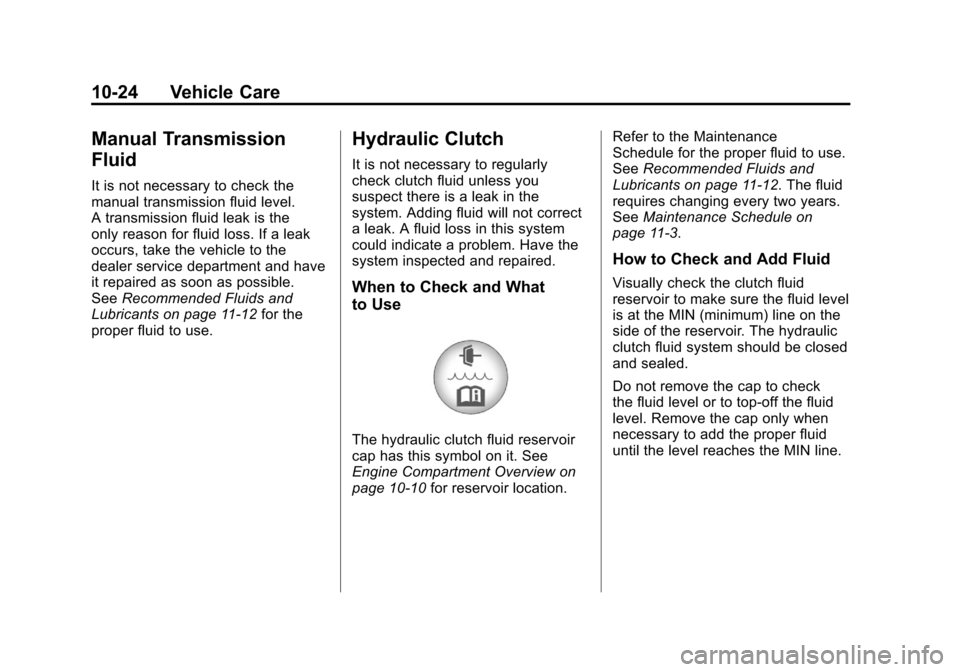
The hydraulic clutch fluid reservoir
cap has this symbol on it. See
Engine Compartment Overview on
page 10‑10 for reservoir location. Refer to the Maintenance
Schedule for the proper fluid to use.
See
Recommended Fluids and
Lubricants on page 11‑12. The fluid
requires changing every two years.
See Maintenance Schedule on
page 11‑3.
How to Check and Add Fluid
Visually check the clutch fluid
reservoir to make sure the fluid level
is at the MIN (minimum) line on the
side of the reservoir. The hydraulic
clutch fluid system should be closed
and sealed.
Do not remove the cap to check
the fluid level or to top‐off the fluid
level. Remove the cap only when
necessary to add the proper fluid
until the level reaches the MIN line.
Page 299 of 434
Black plate (25,1)Chevrolet Corvette Owner Manual - 2012
Vehicle Care 10-25
Engine Air Cleaner/Filter
SeeEngine Compartment Overview
on page 10‑10 for the location of the
engine air cleaner/filter.
Notice: If you spray water into
the engine air cleaner/filter intake
and water enters the engine air
cleaner/filter housing, you could
damage your vehicle's engine.
The repairs would not be covered
by your warranty. Do not spray
water into the engine air cleaner/
filter intake and/or housing.
If cleaning the vehicle with the hood
open, take care not to spray water
directly near the filter opening of
the air cleaner, as shown in the
illustration, as this could damage
the vehicle's engine. When to Inspect the Engine
Air Cleaner/Filter
Inspect the air cleaner/filter at
the scheduled maintenance
intervals and replace them at
the first oil change after each
80 000 km (50,000 mi) interval.
See
Maintenance Schedule on
page 11‑3 for more information.
If driving in dusty/dirty conditions,
inspect the filter at each engine oil
change.
How to Inspect the Engine
Air Cleaner/Filter
To inspect the air cleaner/filter,
remove the filter from the vehicle
and lightly shake the filter to release
loose dust and dirt. If the filter
remains covered with dirt, a new
filter is required. To inspect or replace the engine air
cleaner/filter:
1. Open the hood. See
Hood on
page 10‑9.
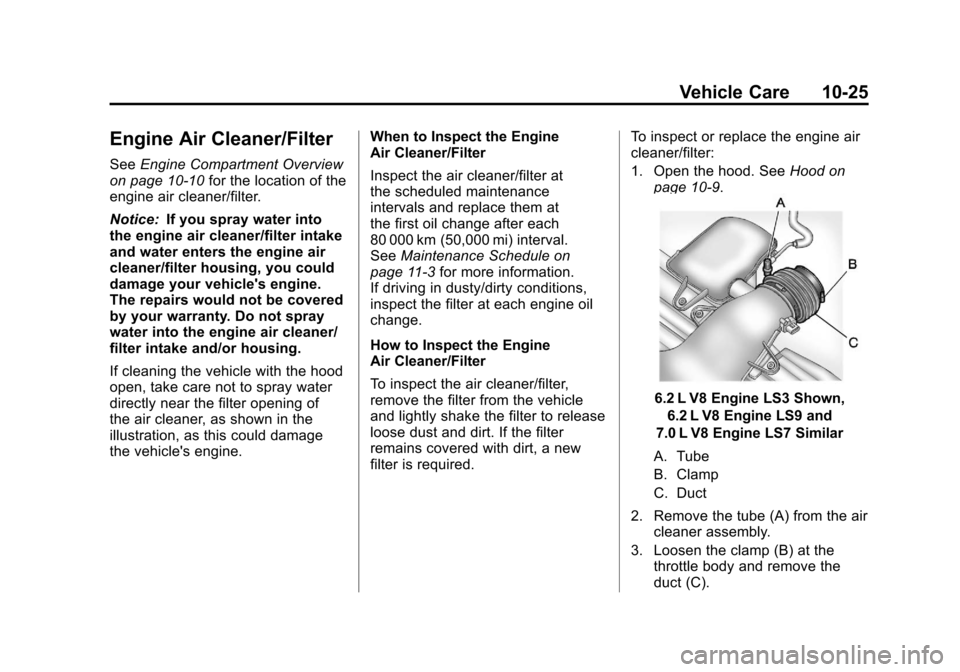
6.2 L V8 Engine LS3 Shown,
6.2 L V8 Engine LS9 and
7.0 L V8 Engine LS7 Similar
A. Tube
B. Clamp
C. Duct
2. Remove the tube (A) from the air cleaner assembly.
3. Loosen the clamp (B) at the throttle body and remove the
duct (C).
Page 301 of 434
Black plate (27,1)Chevrolet Corvette Owner Manual - 2012
Vehicle Care 10-27
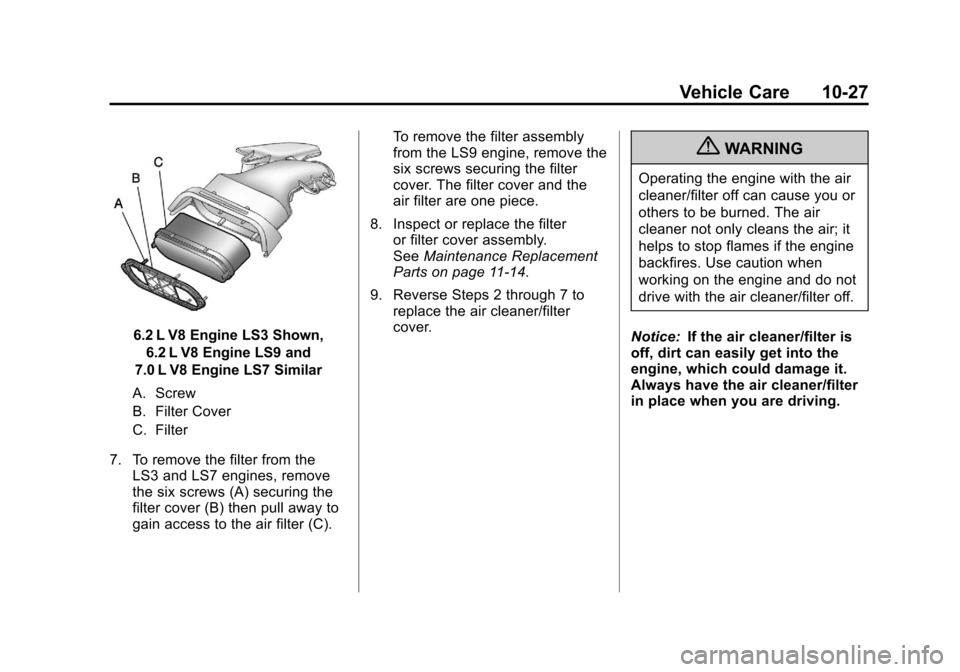
6.2 L V8 Engine LS3 Shown,6.2 L V8 Engine LS9 and
7.0 L V8 Engine LS7 Similar
A. Screw
B. Filter Cover
C. Filter
7. To remove the filter from the LS3 and LS7 engines, remove
the six screws (A) securing the
filter cover (B) then pull away to
gain access to the air filter (C). To remove the filter assembly
from the LS9 engine, remove the
six screws securing the filter
cover. The filter cover and the
air filter are one piece.
8. Inspect or replace the filter or filter cover assembly.
See Maintenance Replacement
Parts on page 11‑14.
9. Reverse Steps 2 through 7 to replace the air cleaner/filter
cover.
{WARNING
Operating the engine with the air
cleaner/filter off can cause you or
others to be burned. The air
cleaner not only cleans the air; it
helps to stop flames if the engine
backfires. Use caution when
working on the engine and do not
drive with the air cleaner/filter off.
Notice: If the air cleaner/filter is
off, dirt can easily get into the
engine, which could damage it.
Always have the air cleaner/filter
in place when you are driving.
Page 316 of 434
Black plate (42,1)Chevrolet Corvette Owner Manual - 2012
10-42 Vehicle Care
Brake Fluid
The brake master cylinder reservoir
is filled with DOT 3 brake fluid.
SeeEngine Compartment Overview
on page 10‑10 for the location of the
reservoir.
There are only two reasons why the
brake fluid level in the reservoir
might go down:
.The brake fluid level goes down
because of normal brake lining
wear. When new linings are
installed, the fluid level goes
back up.
.A fluid leak in the brake
hydraulic system can also cause
a low fluid level. Have the brake
hydraulic system fixed, since a
leak means that sooner or later
the brakes will not work well. Do not top off the brake fluid.
Adding fluid does not correct a leak.
If fluid is added when the linings
are worn, there will be too much
fluid when new brake linings are
installed. Add or remove brake fluid,
as necessary, only when work is
done on the brake hydraulic system.
{WARNING
If too much brake fluid is added,
it can spill on the engine and
burn, if the engine is hot enough.
You or others could be burned,
and the vehicle could be
damaged. Add brake fluid only
when work is done on the brake
hydraulic system. See
“Checking
Brake Fluid” in this section.
Refer to the Maintenance Schedule
to determine when to check the
brake fluid. See Maintenance
Schedule on page 11‑3.
Checking Brake Fluid
Check brake fluid by looking at the
brake fluid reservoir. See Engine
Compartment Overview on
page 10‑10.
The fluid level should be above the
MIN mark on the reservoir. If it is
not, have the brake hydraulic
system checked to see if there is
a leak.
After work is done on the brake
hydraulic system, make sure the
level is between the MIN and
MAX marks.
Page 321 of 434
Black plate (47,1)Chevrolet Corvette Owner Manual - 2012
Vehicle Care 10-47
Wiper Blade Replacement
Windshield wiper blades should
be inspected for wear or cracking.
SeeMaintenance Schedule on
page 11‑3 for more information.
Replacement blades come in
different types and are removed
in different ways. For proper
windshield wiper blade length
and type, see Maintenance
Replacement Parts on page 11‑14.
Notice: Allowing the wiper blade
arm to touch the windshield
when no wiper blade is installed
could damage the windshield.
Any damage that occurs would
not be covered by your warranty.
Do not allow the wiper blade arm
to touch the windshield. To replace the windshield wiper
blade:
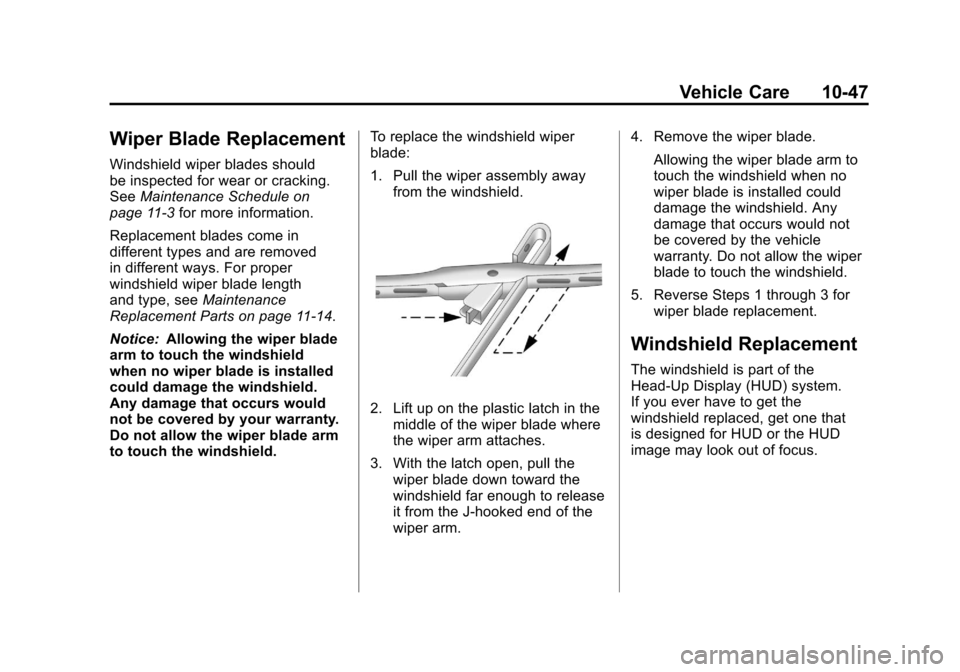
1. Pull the wiper assembly away
from the windshield.
2. Lift up on the plastic latch in themiddle of the wiper blade where
the wiper arm attaches.
3. With the latch open, pull the wiper blade down toward the
windshield far enough to release
it from the J-hooked end of the
wiper arm. 4. Remove the wiper blade.
Allowing the wiper blade arm to
touch the windshield when no
wiper blade is installed could
damage the windshield. Any
damage that occurs would not
be covered by the vehicle
warranty. Do not allow the wiper
blade to touch the windshield.
5. Reverse Steps 1 through 3 for wiper blade replacement.
Windshield Replacement
The windshield is part of the
Head-Up Display (HUD) system.
If you ever have to get the
windshield replaced, get one that
is designed for HUD or the HUD
image may look out of focus.
Page 343 of 434
Black plate (69,1)Chevrolet Corvette Owner Manual - 2012
Vehicle Care 10-69
As an added safety feature, your
vehicle has been equipped with a
tire pressure monitoring system
(TPMS) that illuminates a low tire
pressure telltale when one or
more of your tires is significantly
under‐inflated.
Accordingly, when the low tire
pressure telltale illuminates, you
should stop and check your tires as
soon as possible, and inflate them
to the proper pressure. Driving on
a significantly under‐inflated tire
causes the tire to overheat and can
lead to tire failure. Under‐inflation
also reduces fuel efficiency and
tire tread life, and may affect the
vehicle's handling and stopping
ability.
Please note that the TPMS is
not a substitute for proper tire
maintenance, and it is the driver's
responsibility to maintain correct tire
pressure, even if under‐inflation has
not reached the level to trigger
illumination of the TPMS low tire
pressure telltale.Your vehicle has also been
equipped with a TPMS malfunction
indicator to indicate when the
system is not operating properly.
The TPMS malfunction indicator is
combined with the low tire pressure
telltale. When the system detects a
malfunction, the telltale will flash for
approximately one minute and then
remain continuously illuminated.
This sequence will continue upon
subsequent vehicle start‐ups as
long as the malfunction exists.
When the malfunction indicator is
illuminated, the system may not be
able to detect or signal low tire
pressure as intended. TPMS
malfunctions may occur for a variety
of reasons, including the installation
of replacement or alternate tires or
wheels on the vehicle that prevent
the TPMS from functioning properly.
Always check the TPMS malfunction
telltale after replacing one or more
tires or wheels on your vehicle to
ensure that the replacement or
alternate tires and wheels allow
the TPMS to continue to function
properly.
See
Tire Pressure Monitor
Operation on page 10‑70 for
additional information.
Federal Communications
Commission (FCC) Rules
and with Industry Canada
Standards
See Radio Frequency Statement on
page 13‑21 for information
regarding Part 15 of the Federal
Communications Commission (FCC)
Rules and with Industry Canada
Standards RSS-GEN/210/220/310.
Page 344 of 434
Black plate (70,1)Chevrolet Corvette Owner Manual - 2012
10-70 Vehicle Care
Tire Pressure Monitor
Operation
This vehicle may have a Tire
Pressure Monitor System (TPMS).
The TPMS is designed to warn the
driver when a low tire pressure
condition exists. TPMS sensors are
mounted onto each tire and wheel
assembly on your vehicle. The
TPMS sensors monitor the air
pressure in the tires and transmits
the tire pressure readings to a
receiver located in the vehicle.
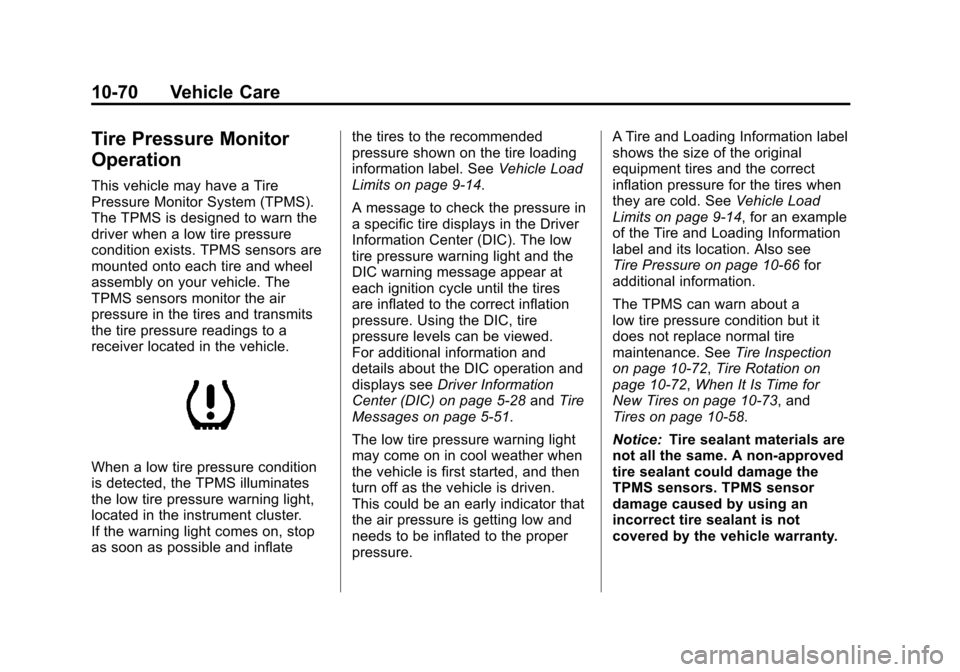
When a low tire pressure condition
is detected, the TPMS illuminates
the low tire pressure warning light,
located in the instrument cluster.
If the warning light comes on, stop
as soon as possible and inflatethe tires to the recommended
pressure shown on the tire loading
information label. See
Vehicle Load
Limits on page 9‑14.
A message to check the pressure in
a specific tire displays in the Driver
Information Center (DIC). The low
tire pressure warning light and the
DIC warning message appear at
each ignition cycle until the tires
are inflated to the correct inflation
pressure. Using the DIC, tire
pressure levels can be viewed.
For additional information and
details about the DIC operation and
displays see Driver Information
Center (DIC) on page 5‑28 andTire
Messages on page 5‑51.
The low tire pressure warning light
may come on in cool weather when
the vehicle is first started, and then
turn off as the vehicle is driven.
This could be an early indicator that
the air pressure is getting low and
needs to be inflated to the proper
pressure. A Tire and Loading Information label
shows the size of the original
equipment tires and the correct
inflation pressure for the tires when
they are cold. See
Vehicle Load
Limits on page 9‑14, for an example
of the Tire and Loading Information
label and its location. Also see
Tire Pressure on page 10‑66 for
additional information.
The TPMS can warn about a
low tire pressure condition but it
does not replace normal tire
maintenance. See Tire Inspection
on page 10‑72, Tire Rotation on
page 10‑72, When It Is Time for
New Tires on page 10‑73, and
Tires on page 10‑58.
Notice: Tire sealant materials are
not all the same. A non-approved
tire sealant could damage the
TPMS sensors. TPMS sensor
damage caused by using an
incorrect tire sealant is not
covered by the vehicle warranty.
Page 346 of 434
Black plate (72,1)Chevrolet Corvette Owner Manual - 2012
10-72 Vehicle Care
Tire Inspection
We recommend that the tires,
including the spare tire, if the
vehicle has one, be inspected
for signs of wear or damage at
least once a month.
Replace the tire if:
.The indicators at three or
more places around the tire
can be seen.
.There is cord or fabric
showing through the tire's
rubber.
.The tread or sidewall is
cracked, cut, or snagged
deep enough to show cord
or fabric.
.The tire has a bump, bulge,
or split.
.The tire has a puncture, cut,
or other damage that cannot
be repaired well because of
the size or location of the
damage.
Tire Rotation
If the vehicle has non-directional
tires, they should be rotated
every 12 000 km/7,500 mi.
SeeMaintenance Schedule on
page 11‑3.
Tires are rotated to achieve
uniform wear for all tires.
The first rotation is the most
important.
Any time unusual wear is
noticed, rotate the tires as soon
as possible and check the wheel
alignment. Also check for
damaged tires or wheels. See
When It Is Time for New Tires
on page 10‑73 andWheel
Replacement on page 10‑78.
Directional tires should not be
rotated. Each tire and wheel
should be used only in the
position it is in. Directional tires
will have an arrow on the tire indicating the proper direction of
rotation or will have
“left”or
“right” molded on the sidewall.
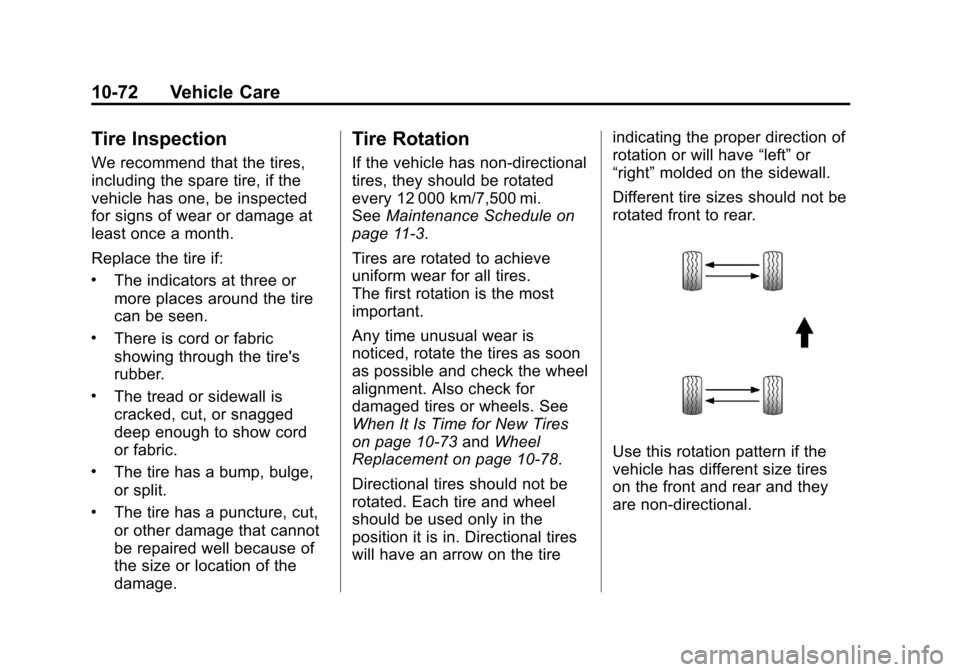
Different tire sizes should not be
rotated front to rear.
Use this rotation pattern if the
vehicle has different size tires
on the front and rear and they
are non-directional.